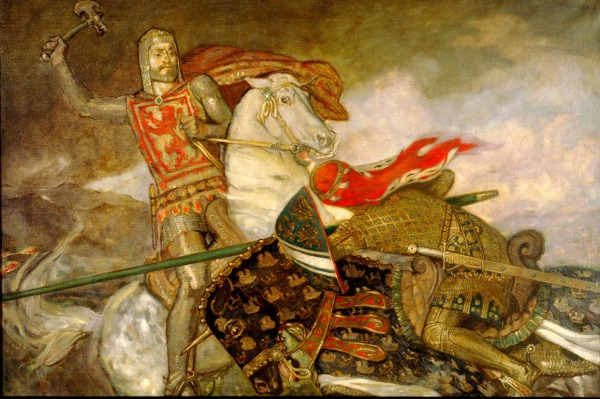
Scotland is getting over Bannockburn in the emotional sense, probably because we have had to put our money where our mouth is and govern ourselves to a considerable extent.
From disastrous beginnings after he took the throne of Scotland, having murdered a powerful rival, Robert I became a military leader of consummate genius. Throwing away the rulebook of medieval warfare, which favoured the mounted knight, he remodeled the Scottish army as a disciplined, audacious band of brothers capable of surprising castles, raiding and extracting blackmail as far south as Yorkshire and even defeating a mighty English army in pitched battle. Ruthless, charismatic, indomitable and lucky, the ‘Bruce’ is a towering example of an underdog capable of turning disadvantage into advantage and winning the day through talent and sheer determination.
Fiona Watson is a writer, historian and broadcaster living on the edge of the Scottish mountains rather too near the site of the battle of Bannockburn. Her most recent book was Macbeth. A True Story and she presents Scottish stories for Radio 4’s Making History. She was heavily involved in preparations for Bannockburn’s 700th anniversary and has written a graphic novel for the National Trust for Scotland about the battle. She is also writing a more traditional novel which has nothing whatsoever to do with Bannockburn set in the 1720s in the Highlands and the American colonies.
Pocket GIANTS: Robert The Bruce (published by The History Press, August 2014) To find out more click here. To find out more click here.
What makes Robert The Bruce different from any other land-hungry, sword-swinging, peasant-oppressing medieval ruler?
Well, you could say that he was your typical power-hungry, sword-swinging nobleman eager to make the most of a rather flimsy claim to the Scottish throne. The difference would be that he proved, somewhat unexpectedly given his rather mediocre record up until 1306, exceptionally good at being a king fighting for the freedom of his kingdom.
How did you go about setting the life in the times?
Well, I have been studying the Anglo-Scottish wars in general for far more years than I would like to admit, especially the period when Edward I was alive. It made sense to then go that bit further and look at the hero king, whom I knew pretty well while he was still Earl of Carrick. But, as with any great figure (especially one with such a dodgy start to his royal career), you have to be very careful not to just accept the hype that was written about him by his own propagandists and in the 700 years since. As with current politics, there is a lot more disagreement in reality than those trying to stage-manage things would like us to believe.
What is the best little known fact about Bruce?
ooooh, tricky, since we don’t have so very much personal stuff to go on. But I like the fact that, four years before he died, he gave his great friend, James Douglas, a charter with exceptional rights over his lands, accompanied by the gift, presented personally by the king, of an emerald. Sadly, the Douglases have managed to lose it (along with most of their lands). The Good Sir James had his own room in Bruce’s newly-built mansion at Cardross near Dumbarton and was with him pretty constantly before he died.
 Which actor would you cast to play Bruce?
Yes, well, it’s about time there was a film about him, isn’t it? A bit late for Sir Sean. I would have had Peter O’Toole, who was just wonderful as Henry II in The Lion in Winter. And it’s a pity that Michael Fassbinder has got to Macbeth first. It has to be someone capable of complexity. I suppose Daniel Craig might be looking for a new job soon…
Who were the women in Bruce’s life, what impact did they have?
We don’t really know anything much about his mother, but his sisters were feisty characters. One of them, Mary, bad-mouthed Edward I and so was treated very harshly when she was captured, ending up suspended in a cage from the walls of Roxburgh castle. Then there was his wife, Elizabeth de Burgh, daughter of the earl of Ulster, who supposedly told Bruce off taking the throne, telling him they were no more than ‘the king and queen of summer’. And the Countess of Buchan, who left her husband to take part in Bruce’s inauguration as a member of the Fife family, who usually played a key role in that ceremony. She ended up in a cage as well.
And finally Marjorie Bruce, the king’s daughter by his first marriage, though her main contribution was in having a son (who probably killed her in childbirth, sadly). That son was Robert Stewart, who became king in 1371 and whose line lasted right up until 1714. Unfortunately, it’s really hard to say very much about any of them, because the documents aren’t there.
When is the best time of year to visit Bannockburn battlefield? What are the unmissable features?
When it’s quiet is a good start. I slipped away during a bash to mark the anniversary in 2014 to go up to the statue and was pretty much on my own, trying to imagine what it would have been like exactly 700 years previously.
Unfortunately, it isn’t actually the battlefield but probably the site of Bruce’s camp between the two days of the battle. Everything else is under housing now. But if you stand at the rotunda, you can see the castle, which the English army were intent on relieving, the direction in which the English were coming and the direction that the Scots would have taken to engage them on the next, proper day of the battle. It is worth standing there too and reading the wonderful poem that Kathleen Jamie wrote to commemorate last year’s anniversary.
 Does Bannockburn have greater emotional than historical significance?
It certainly used to have a tremendous emotional pull but I didn’t think that was quite so obvious last year, perhaps because of the referendum. I actually think that Scotland is getting over Bannockburn in the emotional sense, probably because we have had to put our money where our mouth is and govern ourselves to a considerable extent. We are a lot more grown up now.
Not that Bannockburn isn’t important, but I think it may be its historical significance that grows in importance now.
Was Bannockburn’s 700th anniversary a focus for celebration or commemoration?
Actually, being a smart alec, I did tell a journalist off on the radio for saying we were celebrating the anniversary. Thousands and thousands of men died on that day and I think, after 700 years, it really should go without saying that we ought to be commemorating the occasion and not being jubilant about such carnage.
Was there a spider?
No. Isn’t that devastating? The spider story was actually first told about James Douglas, but was later transferred to Bruce since, let’s face it, there is no better way to sum up his trials and tribulations and how he overcame them in the first couple of years of his reign.
What should be playing on the stereo when we’re reading pocket GIANTS: Robert the Bruce?
How about ‘The Boys are back in Town’ by Thin Lizzy. I think that would get anyone in the mood. Followed by ‘We are the champions’ by Queen to mark Bannockburn, with a side order of ‘Another one bites the dust’ in memory of Edward II.
LIKE WHAT YOU JUST READ? FOLLOW US ON TWITTER! FIND US ON FACEBOOK! OR SIGN UP TO OUR MAILING LIST!


 Get Your Coats On
You must be logged in to post a comment.