“I hope Patrick is not revived. I much prefer him to be a cult that only a small number of us know about. In this sense he is the literary equivalent of “Withnail and I”. Pass the secret on – but not too loudly.”
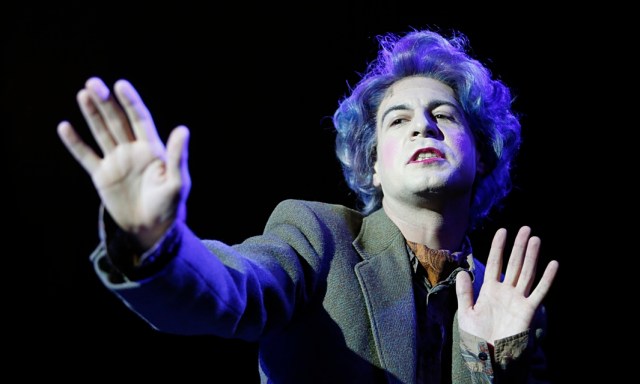
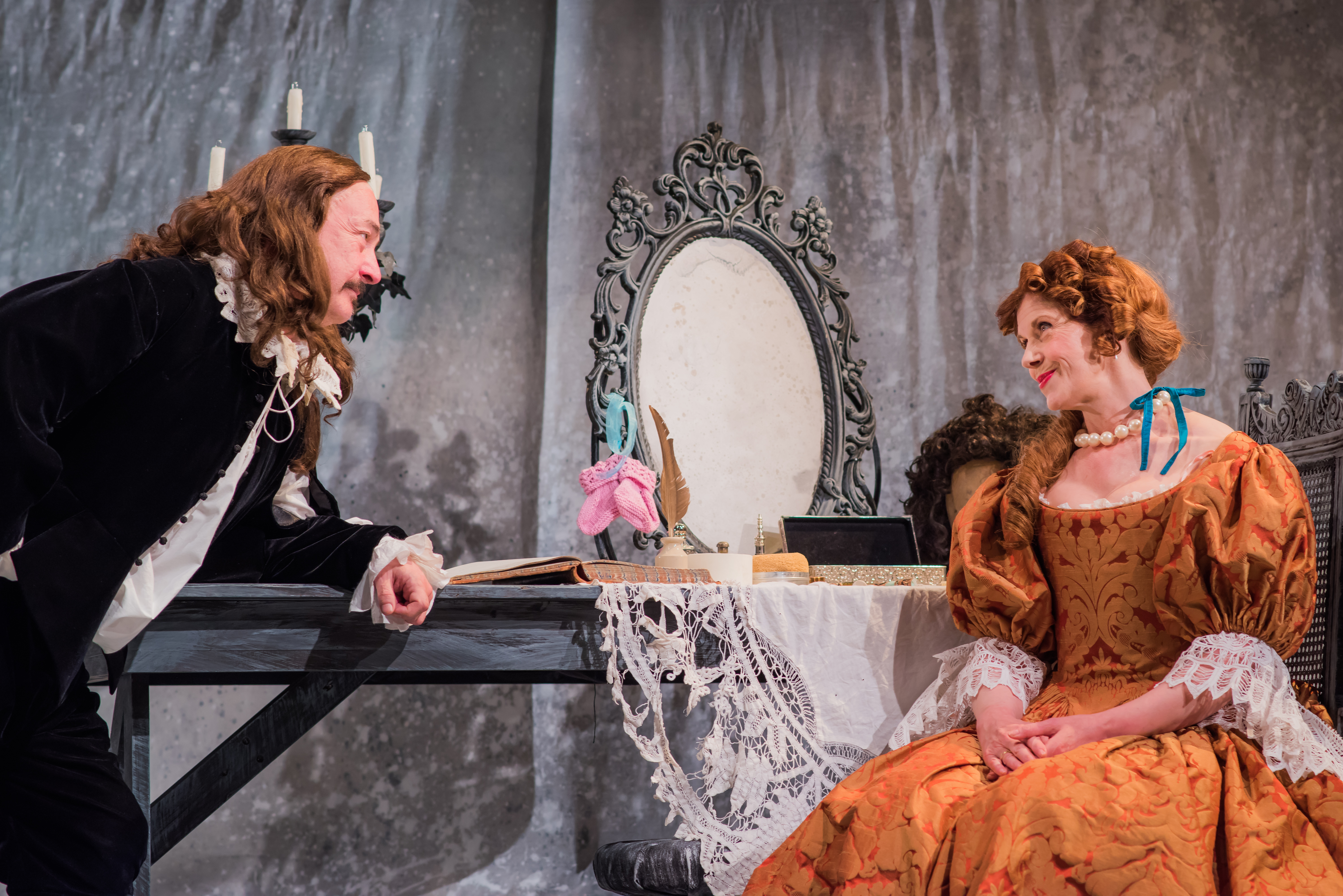
Soho Lives is a collection of two hit solo plays exploring the extraordinary lives and losses of two great Soho writers, Patrick Hamilton and Quentin Crisp. Greeted with huge acclaim since their debut productions, Mark Farrelly’s plays offer actors and audiences laughter, heartbreak, and an urgent, passionate reminder that the only thing that ever matters is being true to yourself.
Patrick Hamilton (1904 – 1962) was a shooting star playwright and novelist. His stage thriller Rope made him a hit on both sides of the Atlantic by the age of 25, and the play was later filmed by Hitchcock. Patrick repeated his success with the Victorian chiller Gaslight, while his highly regarded novels include Twenty Thousand Streets Under the Sky, Hangover Square and The Slaves of Solitude. His output – witty, cynical and beguilingly empathetic of all those “battered silly by life” – was cut brutally short by the loss of his battle with chronic alcoholism.
Quentin Crisp (1908 – 1999) was variously a rent boy, artist’s model and full time layabout. Shunned and beaten by London society for his flamboyant effeminacy, he concentrated simply on Being, and spawned a philosophy which enlightens to this day. After being portrayed by John Hurt in the classic TV film The Naked Civil Servant in 1975, he became an unlikely international treasure. Moving to New York in his seventies, he spent the rest of his life telling anyone who would listen ‘How to have a lifestyle’. Asked to give a young fan some life advice, he replied: “Remember – you don’t have to win”.
Mark Farrelly is an actor/writer. He was born in Sheffield and graduated with a double first in English from Jesus College, Cambridge. His West End credits include Who’s Afraid of Virginia Woolf? opposite Matthew Kelly at Trafalgar Studios. Mark is a veteran of numerous arts festivals and a regular favourite at the Edinburgh Fringe. He has performed his two hit solo plays, The Silence of Snow: The Life of Patrick Hamilton, and Quentin Crisp: Naked Hope over one hundred times. Mark’s latest project is as writer and co-star of Howerd’s End, celebrating the centenary of comedy legend Frankie Howerd.
Soho Lives: Two Solo Plays by Mark Farrelly (published by 49Knights, March 2016). To find out more click here.
Why Patrick Hamilton and Quentin Crisp?
Though I didn’t consciously know it at the time, they deeply mirrored aspects of my own life journey. Patrick’s personal life was a perpetual, drink-sodden mess (just read the highly autobiographical Hangover Square for a sense of this febrile fragility). I wasn’t in that league, but my personal life was certainly dysfunctional a few years ago. Around this time, me and my girlfriend of fifteen years split up, and I was truly on my own for the first time in life.
Horrifyingly, I found that adulthood could be postponed no longer (it seems that human adolescence now stretches to the age of 40). That’s where Quentin came in – the great guru of loneliness and laughing in the face of adversity. I was understandably drawn to Quentin’s story because it’s the tale of a man sitting in a flat on his own thinking life is over, which was very much me in 2012 /13, but then eventually things change and he ends up being the toast of New York.
I sensed that if I could draw solace from these two stories, then so might an audience… because we’re all suffering aren’t we? It’s a big part of what life is. The trick, as Quentin knew, is never to try to deal with it like Patrick – by running away.
Joining the two Lives is Soho. What was Soho like in their day and did Hamilton and Crisp ever meet there?
Soho (at least until recently) has always been what you want it to be. It’s a cipher for everyone’s inner ideal of a sanctuary from the harshness of life, but also a metaphor for the danger we like to flirt with in our younger days. So, for Patrick, it’s initially a boozy bolthole, a safe haven, idealised as a realm of “bottley glitter”. Later, as Patrick’s worldview darkened in the shadow of Hitler, Soho becomes a feeding ground for human sharks… conmen, narcissists, and also suicidal depressives.
Quentin likewise saw Soho initially as a refuge, hiding in what he called “layabout cafes”… until a “rough” or the police hassled him, angered by his brazen selfhood. Later he withdrew from it, and it existed only as a memory: “Soho used to be a more exciting place. You used to be able to get your throat cut on a really big scale”.
Did Patrick and Quentin ever meet? Unlikely. But I like to think they once unwittingly brushed past each other. Like so much of human interaction – almost connecting… but somehow never quite managing it.
Why have the novels of Patrick Hamilton dropped off the radar, and is he due a revival?
I suspect they dropped off the radar because there aren’t that many of them. He only wrote twelve books. The early ones are apprentice works, the later ones are blighted by the alcoholism that killed him at 58 (“I’ve been battered silly by life”), so for me that leaves only five flat-out great novels. They also have a narrowness of focus, compared to say E.M. Forster (another man who ‘only’ produced five great books). I hope Patrick is not revived. I much prefer him to be a cult that only a small number of us know about. In this sense he is the literary equivalent of Withnail and I. Pass the secret on – but not too loudly.
 Do John Hurt’s much celebrated portrayals of Quentin Crisp make it easier or harder for another actor to play him?
It didn’t really affect me. There have been thousands of Hamlets so I knew the world could cope with two Quentin Crisps. John Hurt (a great portrayer of victims, of whom it was rightly said “he suffers so well”) played to the hilt the bizarre upward inflections that Quentin sometimes spoke in. I deliberately toned this down for a solo play, as it would have become a bit annoying. So, at the wise encouragement of my superb director Linda Marlowe, I allowed some of my own voice to come into it. After all, the whole point of Quentin Crisp: Naked Hope is to encourage people to have the blind courage to be themselves at all times, however tough it is. Quentin said: “I simply refuse to bevel down my individuality to please other people”. Please dwell on what a great statement that is.
How do you go about researching your biographies, what sort of people do you meet, and what’s the single best insight you’ve gained?
The best research for writing a biographical piece is to have lots of psychotherapy. Find out who and what you are, what’s really going on beneath your behaviour patterns and your unexpressed wishes. Deeply explore why you are drawn to your subject, and what that says about you and the wider human “condition”. You’ll likely discover that your subject is what Jung called your shadow… some split-off, disowned part of yourself that you abandoned as a child in the face of criticism and aggression.
And now the soul burns to reconnect with all its parts. You’ve grown exhausted of listening to those dismal voices in your head, that embalmed Normal Bates gag reel of guff that keeps telling you that life is hopeless, you’re a failure and so on. It’s just a ghostly echo of everyone whose negativity you co-opted as a child, and you’ve spent years vainly trying to find the dimmer switch.
If (and it’s quite a big if) you are able to do this, then everything else will flow. Your reading, meeting surviving relatives, creating something of value… it will happen, though not necessarily in the manner you expected. The best insight (beautiful word) I had was when meeting Frances Ramsay, Quentin’s octogenarian niece. She said that whenever she was with Quentin, he would introduce her to his friends as “My niece Frances. She comes from real life”. And there it is. Quentin was an alien. Gloriously ironic that knowing yourself very deeply makes you an alien. And it does. Ninety percent of people I’ve met are phonies, imposters. I should know – I used to be one too.
 If you had the chance to take Patrick Hamilton and Quentin Crisp to dinner where would you go and who would you also invite along?
Even after all my experience (I’ve played both men on stage over 100 times) I don’t know whether they would “click”. It would certainly be an interesting speed-date. I think we should go to the Garrick Club. Patrick (rare for him) felt at home there, and Quentin would, even today, raise eyebrows with his appearance. I would like no other diners present, I would want them all to myself. However, if I could freely subvert the known laws of space and time then I would like to be joined by Tim Welling, my dear friend who committed suicide in 2012. He helped me in the early days of these projects, and was one of the few people I’ve met who, like Quentin, was entirely himself regardless of who he was with or where he was. I miss him deeply.
You’re next project is a play about Frankie Howerd. If you’ll let us peek over your shoulder at the portrait while it’s still in progress, what’s emerging on the canvas?
I’ve realised that Frankie is the archetype of the human condition – nervous, haunted, hunted, desperately trying to keep the plates spinning before the whole lot disastrously crashes down. Of course, as Frankie’s partner of 40 years, Dennis Heymer, knew, letting the plates crash down might be a very good thing, but Frankie could never take that Rubiconic risk. This meant that he created a brilliant, brave, timeless form of stand-up comedy, but had the classic unhappy inner life. His act was a band-aid solution to the problem of being Frankie Howerd.
Next year is Frankie’s centenary, and we’ve never had a big comedic anniversary like this that I’m aware of. I think it’s extremely healthy for people to have proper goodbyes in life. I realised this when I went to see Monty Python at the O2 in 2014: we, and they, were getting a chance to say goodbye formally, and that’s very healing, allows you to move on in life. Two big romantic relationships of mine ended without a proper goodbye (“closure”) which did me a lot of damage.
So the play (Howerd’s End) is partly about how to let go properly. Dennis lived on for seventeen years after Frankie died in 1992, was often found clinging to the grave weeping, never came to terms with the loss. So what he and the audience have to learn during the course of the play is how to let go of Frankie. After all, one day we’ll have to let go of ourselves.
Above all: I want the play to be bloody funny. We’re apt to make our clowns very dark for the sake of drama. Every stranger I’ve spoken to about Frankie grins and says “Oh I loved him”, and so although I certainly want to provoke a few tears, I also want the audience to ride big waves of happiness. I asked Barry Cryer about this. He wrote for Frankie, and said that he’d seen a TV biopic about Frankie that “was so bleak you’d never have guessed Frank was a funny man”. Well, exactly. The world in 2016 is a pretty dark and frightening place, bombs seemingly going off by the hour… and I think we could all do with a damn good laugh. I know I could.
How important has your time at Edinburgh been for the development of both scripts?
Invaluable. Edinburgh is a brutal forcing house for new projects, and if you can survive it, possibly even get good reviews and interest from producers, then you’ve done very well indeed. There are three thousand shows in Edinburgh every year. When I first appeared there in 2002 it was one thousand. Gives you some idea of what you’re up against. Edinburgh to me is like the painting of the raft of the Medusa… thousands of egos fighting over a small bit of attention. It’s actually quite unpleasant, and when I performed there in 2014 I stayed away from much of the craziness by retreating, Quentin-style, to my room and listening to meditation tapes to remember how beautiful and special it is to be alive, because you can easily forget that in Edinburgh in August.
What’s the one thing anyone contemplating bringing a solo show to Edinburgh needs to consider?
Money.
What should be playing on the stereo when we’re reading Soho Lives: Two Solo Plays?
For Patrick, a selection of his beloved Ella Fitzgerald (he adored These Foolish Things).
For Quentin, complete silence, which was the soundtrack to many years of his life in Chelsea (“If I want anything, it’s peace. Quiet. The opportunity to stay in my room and just stagger on”). Then after you’ve read it, listen to Open All Night, Marc Almond’s beautifully dark album from 1999. It’s truly atmospheric, evocative of a lost Soho that probably never existed, and I think Patrick and Quentin would especially appreciate track 3: Tragedy.
LIKE WHAT YOU JUST READ? FOLLOW US ON TWITTER! FIND US ON FACEBOOK! OR SIGN UP TO OUR MAILING LIST!




 Get Your Coats On
You must be logged in to post a comment.