+3 Review: Ameé Smith – Relax, it’s not about you (Underbelly Med Quad: Aug 3 – 29: 15.00 : 1hr)

https://i0.wp.com/www.underbellyedinburgh.co.uk/images/uploads/15201-Ame_Smith_Relax_Its_Not_About_You.jpg

“Optimistic, off-the-wall and unapologetically human”

Editorial Rating: 4 Stars Outstanding

I try my best not to judge shows before they’re done. But, finding the queue as lonely as a tarantula’s birdcage, I confess to some trepidation as I waited for Ameé Smith’s “Relax, it’s not about you”. Shows with sub-dozen audiences can be tense at the best of times, and given the very personal nature of Smith’s themes, comedy’s need for reactivity and my own creeping paranoia about audience interaction, it seemed a bespoke recipe for awkwardness.

But, for once, it appears the mantra of the 2* performer rings true: the reviewer was dead wrong.

Who exactly “Relax, it’s not about you” is about could make for an excellent piece of theatre analysis – could be Smith’s ex’s, could be Smith herself; and, perhaps overarchingly, it could be about every person watching. Complete with examinations of toxic relationship types, explorations of what makes something TMI and confessions of Smith’s own foibles, “Relax, it’s not about you” is a frenetic, laugh-filled odyssey through the minefield that is interhuman relations.

Whilst it all might sound a bit metaphysical, it’s certainly entertaining. It’s somewhere between hearing stories from a drunk aunt and hanging out with an unlucky-in-love best friend: sometimes rambling ,sometimes short and sharp, and always cringingly self-aware. And whilst the occasional semantic meander leads to a dead-end, Smith seems to be an expert at winding back her own train of thought. And rest assured, despite the heavy premise, it’s a set with its fair share of laughs. You’ll never look at ceramic owls the same way again, and that’s a promise.

For such a blurry and ill-defined subject, it’s impressive how consistent the show feels for its duration. Smith’s nervy, almost fractious energy is a wonderful constant, even when presented with an audience of two. Never before have I seen a performer approach a nearly-empty house with such vigor. In truth, my greatest disappointment with this performance is that I never got to see how Smith would play off a full house. She is (fittingly and obviously) the greatest asset this show has, having cracked the comedian’s riddle of creating an obvious gulf of wit between her and the audience, whilst simultaneously closing it with an almost tactical show of real honesty and vulnerability.

This is perhaps the only time I’ve ever regretted that the jokey offer of a pint after the show was not capitalised upon, so enthralled I was with the sheer openness with which Smith presents herself. Even her dodgy guitar skills, though they open the show on a slightly jerky note, have their significance later. This is feel-good theatre, despite being based on one of the worst parts of romance.

This is a show which deserves far, far more than what I saw it receive. Ameé Smith has crafted a difficult and beautiful thing: a comedy show which thrives on universal truths, yet doesn’t claim to have any answers. And despite a few momentary stumbles, “Relax, it’s not about you” is exactly the kind of show that typifies the Edinburgh Fringe: optimistic, off-the-wall and unapologetically human. Ameé Smith isn’t making a show about you – but that doesn’t mean everyone shouldn’t see it.

outstanding

StarStarStarStar

Reviewer: Jacob Close (Seen 25 August)

Visit the Other archive.
+3 Review: Price (still) Includes Biscuits. (the Space @Surgeons Hall. Until Aug. 27 18:15)

“Paul’s deadpan delivery casts a spell over her audience.”

Editorial Rating: Stars: 4 Outstanding

When Naomi Paul comes out to the soundtrack of Sweet Dreams Are Made of This and plants herself stock still in the centre of the brightly-lit stage, one immediately gets the impression that this show is going to be different. So it proves to be. 

Paul reassures the audience that the price does indeed include biscuits but they come later. It is then straight in with her observations on living in modern Britain. Paul uses her home city of Birmingham to illustrate the ridiculousness of current government policy and the effects of prolonged spending cuts. Slowly her body starts to move and her stance becomes more natural as Paul starts her first piece of audience interaction. On a small side table, she displays her latest certificate: Radicalisation General Awareness Training. Do you need to take the test? Are you aware of the signs? Perhaps you are a radical already and need to be reported?

Moving on from modern multicultural Britain, Paul then reflects upon her own Jewish and Eastern European roots. Through the media of spoken word, song and a coat, Paul tells how her America-bound ancestors to ended up in the Welsh valleys. The story moves from the ancestral selling of haberdashery to the fitting of industrially-constructed bras. The best laid plans of her mother, attempting to preserve the virtue of the teenage Paul, didn’t exactly go as expected.

Through further songs and stories of poverty and the workhouse, we return to the present with a treatise upon the dangers of Thinking. Especially dangerous is being careless with the incriminating evidence of Thinking. Rubbish bags and computers should be treated with caution, as should the practice of speaking with strangers. With that due warning, it’s time for the audience Biscuit Break.

From biscuits and budding (if potentially subversive) audience relationships, Paul continues with the subject of modern social contact. For some, the most meaningful conversations are with the call-centre operator or a visiting Jehovah Witness. This sweeps into the area of mixed marriages, diversity and religion. Where is the best place to be Jewish at Christmas?

Price (still) Includes Biscuits goes beyond the normal boundaries of observation comedy and satire. Over the course of the hour, Paul’s deadpan delivery casts a spell over her audience, leading to an outcome which is different from any other show on the Fringe. Maybe she hasn’t got the best singing voice  but the show is funny, it works and, what’s more, it gets one thinking.

Thinking. Dangerous business that nowadays.

outstanding

StarStarStarStar

Reviewer: Martin Veart (Seen 25 Aug)

Visit the Assembly Roxy Bedlam Church Hill Theatre Festival Theatre King’s Theatre Other Pleasance, Potterrow & Teviot Summerhall The Lyceum The Stand Traverse archive.

THIS REVIEW HAS NOT BEEN SUBEDITED

+3 Review: Spoon-Feeders (The Space@ Surgeons Hall. Until Aug 27th, 20:30)

“Watson will certainly be a playwright to look out for in the future.”

Editorial Rating: 4 Stars: 

Tension is build from the start even as the audience take their seats to the soundtrack Go! by Public Service Broadcasting. On the small stage is a brightly-lit office set: a desk and chair beneath a window, the view outside blocked with a heavy venetian blind. Large filing boxes are stacked to the right hand side. Go! fades and is replaced by the sound of public disorder: a large crowd shouts, chants and the sound of police sirens. Max enters: forehead glistening, his business shirt heavily marked with sweat. He twitches the blind to view the scene outside but rapidly turns away. This is clearly a man under a huge amount of stress, steeling himself for something momentous.

The mood is totally shattered by the loud strains Sinatra’s New York, New York, badly sung a cappella by staffers Tibby and Jons as they literally prance into the office. Their carefree existence is soon under threat however, when Max informs them that a graduate, Stephen, will be joining the team. Will the office dogsbody, Fizz, ever get her time to shine?

Max (performed by the play’s author Patrick Watson) owns the acting agency and employs the others. His company specialises in voice-over for broadcast news items. They don’t actually gather news: the blind remains resolutely shut on the disturbances outside. Instead it is their job to repackage and filter: deciding what makes it out for public consumption. This, along with the office politics, forms the themes of the play and results in the creation of a dark satire.

Light relief comes from Tibby (Aidan Clancy) and Jons (James Howlett), whose characters are totally outrageous. This leads to some incongruity because Max, Stephen (Joseph Campbell-Smith) and Fizz (Alex Burns) are played in earnest. If there is a weak point to this production it may be the characterisation. It is hard to imagine any of them having much of a hinterland, or existing beyond the performance space. Then again this may be intentional on the part of Watson, a sly nod to the morality tales of theatre ages past when audiences were presented with characters as symbols, used to represent deeper truths.

There is an awful lot to praise in this outing by Newcastle University Theatre Society. Production values are very high – way beyond those usual to the Fringe – with excellent use of sound, set and props. The actors all perform well within their remits so due credit to them and director Lucy Sherratt. This is Watson’s first play and he should be applauded for taking on big issues from the outset. If he continues to do so, Watson will certainly be a playwright to look out for in the future.

Star (blue)Star (blue)Star (blue)Star (blue)

Reviewer: Martin Veart (Seen 25 Aug)

Visit the Assembly Roxy Bedlam Church Hill Theatre Festival Theatre King’s Theatre Other Pleasance, Potterrow & Teviot Summerhall The Lyceum The Stand Traverse archive.

THIS REVIEW HAS NOT BEEN SUBEDITED

+3 Interview: Price (still) Includes Biscuits

2016pricesu_3t

“I also involve the audience in range of ways – but it’s always safe on the front row!”

WHO: Naomi Paul – Writer and performer

WHAT: “Satirical and hilarious deadpan humourist Naomi Paul returns to the Fringe with her quirky four-star one-woman show Price (still) Includes Biscuits. Naomi uses characteristic dry Jewish humour to comment on topical political issues, share personal stories and perform catchy handmade songs. The show takes audiences on a surreal journey from lingerie to libraries, Birmingham to the Balkans.”

WHERE: theSpace @ Surgeons Hall (Venue 53)

WHEN: 18:15 (50 min)

MORE: Click Here!


Is this your first time to Edinburgh?

No, it’s not the first time!

I came initially to the Free Fringe in 2011 with a double bill show and then again in 2012 with my first solo show, doing half the run in a lopsided comedy bus at The Free Sisters. Since then I have been at the Space @ Surgeon’s Hall performing solo shows entitled Making Light (2014) and Price Includes Biscuits (2015)…

Tell us about your show.

Price (still) Includes Biscuits is a revised and updated version of last year’s show – hence its title! I want to offer the audience unusual and satirical angles on the everyday (both personal and political). I use my Jewish background as a platform for material, as well as a deadpan style. I also involve the audience in range of ways – but it’s always safe on the front row!

I wrote and produced the show, and have been writing and performing my own work since 2010 and following completion of a Creative Writing MA.

For this show I’ve worked with Peta Lily on script development and directorial supervision, and with Joe Samuel on musical arrangement of the songs.

The show will be on in the forthcoming Birmingham Comedy Festival at the Old Joint Stock Theatre (Friday October 14, @8pm) After that I hope to take it to other festivals and small scale venues during 2016-7.

What should your audience see at the festivals after they’ve seen your show?

Simon and Garfunkel – Through the Years is a remarkable show by Bookends; they have forensically listened to the songs with great empathy and musicianship and when you shut your eyes you would imagine you were listening to the originals. At the Space at Symposium Hall

Lost in Blue by Debs Newbold at Summerhall. A remarkable piece of solo theatre telling a moving story via several characters, leaving the audience catching their breath – and their emotions – by the end.


LIKE WHAT YOU JUST READ? FOLLOW US ON TWITTER! FIND US ON FACEBOOK! OR SIGN UP TO OUR MAILING LIST!

INTERESTED IN BEING INTERVIEWED TOO? CLICK HERE!

+3 Review: The Glummer Twins (Paradise in The Vault: 22-28 Aug. 11.35am 1h.)

“The guys are genuinely funny”

Editorial Rating: 3 Stars: Nae Bad

On a small, well-lit stage, deep in subterranean Edinburgh, The Glummer Twins start their set with Just Turned Sixty and Taking it Badly: a really good bemoaning of being the owner of an ageing body.  Through the medium of beat poetry and music, the Glummer Twins (David Harmer and Ray Globe) take a look back to 60’s childhood, 70’s aftershave and 80’s yuppies.  They ask the important question of whatever happen to the mods?  Autobiography is included, such as after moving from south London, the warm welcome David received from his new Doncaster school chums.

The Twins look forward to the future with the poems  Old Bloke Blues and Fiery Jack: the latter a must-hear for any pharmacist or person taking a large range of medications.  Groans and laughs are generated in equally generous measure as we follow the puntastic adventures of poet-noir detective Percy Shelly – private dick.  The poems comes thick and fast, with fifteen being delivered over the hour.

The theme of the show is ageing and reminiscing because there comes a time in life, theirs in particular, that there is a lot to look back on but not so much to look forward too.  The Glummer Twins state they have been coming to the Fringe for thirty one years and obviously love what they do.  The audience are in the safe hands of veterans.  Both were members of the performance group Circus of Poets, which in the 1980s appeared on nation television and toured Europe.

The style of comedy is, fair to say, gentle.  That does not mean unfunny: far from it.  While Percy Shelly is undoubtedly the comedic highlight, the spirit and black humour of South Yorkshire is also evoked.  Whatever will happen to Derek the Trainspotter?  One also has to ask, in the wake of the recent Brexit vote, whether there is deeper meaning to the poems Mediterranean Homesick Blues and Speak Scandi?

Harmer and Globe are good, solid performers who deliver rhymes and laughter.  Globe handles the musical side with electric guitar, pedal beat boxes and shares vocals, while Harmer’s performance is spoken word and costume change.  The show is squarely aimed at older generations.  They know that their style and material are not going to rock the foundations of comedy but that does not matter.  The guys are genuinely funny.  Watching The Glummer Twins is a fine way to wind up a morning on the Fringe.

P.S. – if one wants to know the origins of the name, Google “The Glummer Twins” and see what comes up.

nae bad_blue

Star (blue)Star (blue)Star (blue)

Reviewer: Martin Veart  (Seen 26 August)

Visit the Assembly Roxy Bedlam Church Hill Theatre Festival Theatre King’s Theatre Other Pleasance, Potterrow & Teviot Summerhall The Lyceum The Stand Traverse archive.

THIS REVIEW HAS NOT BEEN SUBEDITED

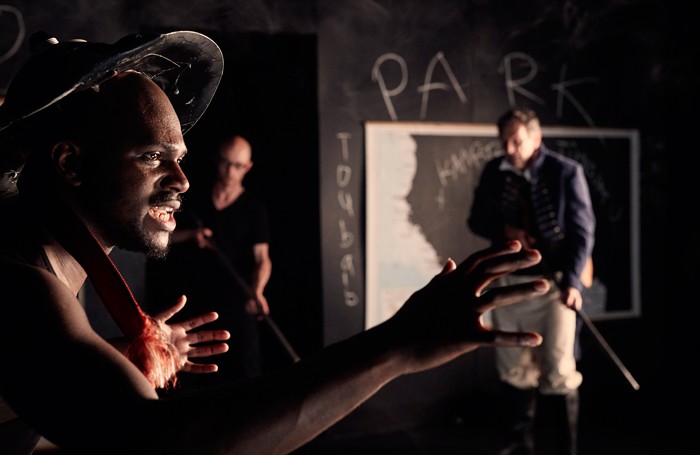
+3 Review: Mungo Park (Summerhall: 3 – 27 Aug. 8.45pm 1h 20m.)

Images: Dogstar Theatre.

Images: Dogstar Theatre.

“… an invitation to taste the popcorn, then it’s serried lights and blinding action”

Editorial Rating: 5 Stars: Nae Bad

There is a Mungo Park Road in Gravesend, Kent, and sheltered housing at Mungo Park Court in Selkirk which seems all a bit sedentary when it comes to the tremendous life of Mungo P himself. Born in 1771, near Selkirk right enough, he ventured out down the Niger River and was the first European to reach Timbuktu. Of course, he did not have a passport so that nice phrasing, used in this show, about his Majesty ‘requests and requires [that] the bearer pass freely without let or hindrance’ did not apply. Instead his heroic travels are the stuff of bedtime stories, ‘To Selkirk … and beyond!’ if you will, which is where Mungo Park Theatre (Copenhagen) and Dogstar Theatre (Inverness) come flying in.

Writer and director Martin Lyngbo wants Hollywood-on-stage for the ‘inner eye of everyone in the audience’. So we get an invitation to taste the popcorn, then it’s serried lights and blinding action. We move swiftly from the Highlands, to London, and – via the two journeys of 1796 and 1805 – to central West Africa, on foot and in a canoe.

Travel at the wrong time and it’s very hot and wet and deadly out there. The African interior was a huge gap surrounded by a coastline, for its ‘heart lies in darkness’ and between August and October forty-one out of the forty-five or so Brits on the second expedition died of fever. How Parks survived for as long as he did is an open question but – to judge by this play – it was a combination of physical toughness, determination (to see home and family again), good sense and good luck. Africa for him is ‘a fragile network’ of peoples and customs and you got nowhere without respecting that.

Mungo Park goes back to 2006. That first Danish production was rehearsed during the crisis that surrounded publication in a newspaper of the Muhammad cartoons. This English language version, by Jonathan Sydenham, still looks as if it is significantly influenced by that controversy. Clever caricature asks questions of how individuals are represented and received by ‘others’, culturally akin or not. African kings Desse and Ali play ‘up’ their obvious differences in sing-song pidgin speech; their messengers play their crafty roles as would flunkies of a European court but with outlandish accents. Sir Joseph Banks, notable patron of the natural sciences, is as interested in gold as he is in plants. Lieutenant John Martyn, in command of Parks’ escort, is more blood thirsty racist than an officer and a gentleman. Desperate and dangerous confusion results from misunderstanding and prejudice.

Kingsley Amadi (l)

Kingsley Amadi (l)

Matthew Zajac is impressive as the courageous and virtuous Mungo, whose story we follow at every turn, literally so as he fights his good fight on a turntable. Anders Budde Christensen is all exaggerated gesture and of wily tongue as emissary and as the not-so-enlightened James Rennell, map-maker, who would be master of all he surveys. Kingsley Amadi is black African potentate and crazy (white) army officer. It is so confidently performed that the zany is never risible, the indomitable never preposterous.

The rapid screenplay, to go with the filmic idea, produces strong exposition – particularly when its opening is chalked-up on the blackboard rather like title cards to a silent movie of colonial history in the making – and a dynamic narrative. No visual ‘shots’ are projected so there’s a spontaneous, on-the-spot quality to the whole piece. For the most part it is tightly focused upon Parks himself and when it isn’t there is some loss in terms of its depth of field. Performers running up and down the central aisle in a bright light did not look right.

Sturdy Mungo always has a satchel for his notebook and his Travels were published in 1799 but if you want a stirring measure of the man and of his life you won’t do better than this motion picture of a play.


nae bad_blue

Star (blue)Star (blue)Star (blue)Star (blue)Star (blue)

Reviewer: Alan Brown (Seen 24 August)

Go to Summerhall and the Dogstar Theatre Company

Visit Edinburgh49‘s  Summerhall archive.

+3 Review: Blueswater Presents: Queens of the Blues (SpaceTriplex: 5-27 August: 22.30: 50 minutes)

“A classy, confident and charming performance”

Editorial Rating: 4 Stars

Queens of the Blues is a new show presenting a musical history of powerful women who have influenced blues as we know it over the years, presented by Edinburgh band The Blueswater. The two main singers in this show (Nicole Cassandra Smit and Ruth Kroch) are perfect to represent such women: both give a classy, confident and charming performance with just the perfect amount of sass.

The show begins with an a capella song, which each member of the band joining in one after another. There is a large variety of songs including When the Levee Breaks by Memphis Minnie, Better Watch Your Step by Koko Taylor and Ella Fitzgerald’s Cow Cow Boogie.

One particular favourite of mine was the performance of the original version of Hound Dog by Willie Mae “Big Mama” Thornton. And I also had to admire Ruth when she announced she was going to give a solo rendition of the legendary Nina Simone’s Blues for Mama. But with her feisty attitude and powerful, soulful voice she really pulled it off!

The girls really keep the whole show moving, giving explanations about the history of each song and making jokes with the band. The old school blues band (including a two bassists, a guitarist, a drummer, harmonica player and a keyboard player) also all seemed relaxed and it was clear they all enjoyed playing together. At one point there was even a short stint by a trumpet player who surprised the crowd!

The only thing I wish is that we would have had a chance to dance, and given the vigorous foot tapping going on around me I am sure most of the audience would have agreed! The songs became more upbeat as the night went on and although the audience was at some point encouraged to dance the seating was so close together that there was not really enough space.

Star (blue)Star (blue)Star (blue)Star (blue)

Reviewer: Iona Young (Seen 23 August)

THIS REVIEW HAS NOT BEEN SUBEDITED

+3 Review: Criminology 303 (Venue 13: 6-27 August: 21.30: 35 mins)

“An intriguing drama”

Editorial Rating: 2 Stars

Criminology 303 is an interesting concept – flipping between alternate scenes 40 years apart. Initially we meet retired detective Norma Bates (Jilly Bond) in 2016 reflecting on an unsuccessful investigation from her past, before the action reverts to 1976 where she is in the thick of it. We learn early on how this (the only unsolved case of her career) clearly still haunts her, so an intriguing drama is set up as to whether she might finally solve it on our presence.

Bond does a great job in switching between the two ages of her character – the crabby older version is a distinct progression from her greener and more confident younger self. And although prone to some overacting (I think her initial terror at the power point presentation misbehaving is a bit extreme), she shows great skill and stamina to drive the action in both scenarios.

This production’s main downfall, however, is its length. At barely half an hour, it feels like it only just gets going before very abruptly ending. There is no satisfactory resolution, no real sense of progression in either story beyond some scene-setting, and consequently the whole thing feels a bit pointless.

I would have liked to see the 2016 scenario develop into a discursive and positive look back at the case with a view to at long last solving it, rather than being a very rushed ghost story that scares Bates away from her own lecture. The pace of Bates’ descent into terror in this part feels very disingenuous, subverting the strength her character should have had (after 40 years in the force), so to me a more subtle and drawn-out approach here would have been more powerful.

In the flashback scenes Julian Gartside is commandingly creepy as Mr McLeod, yet Tommo Fowler’s direction has him physically touch and overpower Bates as detective on more than one occasion, which again feels forced and comes across as a cheap way to demonstrate status quickly, when other techniques would have had greater impact. The scene-setting and background to the background of the case in this scene is very well developed and delivered by Gartside, if seemingly a little irrelevant from the main story, but again I can’t help but feel this all would have been so much more effective if we got to see more about how the action panned out in the end – it is a frustrating beginning to a chapter that ends mid-sentence.

Star (blue)Star (blue)

Reviewer: Steve Griffin (Seen 24 August)

THIS REVIEW HAS NOT BEEN SUBEDITED

+3 Review: Penetrating Europe, or Migrants Have Talent (Paradise in Augustines: until 28th Aug: 21:35: 1hr)

“Sandalovych doesn’t simply engage the audience, she immerses us in the tumultuous narrative.”

Editorial Rating: 3 Stars:  Nae Bad 

Our host (Dave Strudelbar) for this evening’s episode of Migrants Have Talent bounds down the stairs before introducing the evening’s two judges: immigration officer, Nigel Nobson (Uilleam Blacker) as well as glamorous former illegal immigrant, Nigella Smith (Lesya Liskevych).  Nigella explains that she was talent-spotted after five years of cleaning the toilets at Television Centre. She cleaned toilets under her original name, she minor celebs with a new one, changed by deed poll. Together Nigel and Nigella decide who stays and who is deported, with the audience voting in the event of a tie.

There are five contestants. Actor Iaroslav Tsigan’s character is from Ukraine. He traveled to Britain on false Polish papers. A likeable character, his honesty fails to impress the stern judges. Interwoven with the talent show format are the stories of two young people, who relate how it is to travel and cross borders. One is going east to Ukraine for an adventure; the other west, by land and sea, to join family already in Britain.

These paired stories, delivered solo with other cast members playing the role of various officials, are the most effective part of the production.  The contrasting experiences and expectations of the two young people are increasingly moving. Actor Ira Sandalovych compellingly portrays a descent into fear. Sandalovych doesn’t simply engage the audience, she immerses us in the tumultuous narrative.

Most of the large cast are employed in the Migrants Have Talent sections.  Writers Blacker and Olesha Khromeychuk deploy a tongue in cheek style of satire that seeks to lighten what are, in reality, stories of genuine human suffering. At no point are we allowed to forget that not a million miles away from the Fringe, real people are really living through such uncomic tragedies. Still, this is above all a theatre piece. How effective (as opposed to affecting) is it?

The message is crystal clear. Humanity is common: borders and suffering man made.

If there is a problem it’s is one of counterpoint. Does the satire sparkle bright enough against the darkness of the immigrants’ tales? The lighting is handed well and sound, with the ensemble song describing cranes flying away to die in foreign lands (a poem from 19th century Ukraine) is truly beautiful in such a small venue.  However, with such a large cast, the staging does slip into awkward moment but, overall, this is a more than likeable production whose heart is definitely in the right place.
nae bad_blue

Star (blue)Star (blue)Star (blue)

Reviewer: Martin Veart   (Seen 23 August)

Visit the Assembly Roxy Bedlam Church Hill Theatre Festival Theatre King’s Theatre Other Pleasance, Potterrow & Teviot Summerhall The Lyceum The Stand Traverse archive.

THIS REVIEW HAS NOT BEEN SUBEDITED

+3 Review: The Gin Chronicles: A Scottish Adventure (artSpace@StMarks: until 25th Aug: 18.30: 1hr)

“Just as stylish and enjoyable as the previous instalment”

Editorial Rating: 4 Stars

I was hoping that for this review I might be able to save myself a little work and effectively copy and paste most of my glowing review from the first chapter of The Gin Chronicles and that would be job done. Yet while much of what I loved about last year’s show is back – the overall premise and style of the piece, as well as many of the same faces on stage, for me, chapter two isn’t quite as fulfilling – Interrupt the Routine once again serve up a high quality gin but have perhaps skimped a little on the tonic.

Presented as a group of actors performing a radio play in 1947, it’s a very similar setup to the last outing – with four actors delivering a live broadcast of a radio play, and Luke Lamont more than capably producing all the sound effects live. With a note from the sponsor, a break midway through the action, and period set, props and costumes this piece really does have a lovely feel about it.

What Interrupt the Routine do very well is characterisation, in particular, slick and seamless transitions from one to the next. The cast of four play well over ten characters between them, and while some might only get a couple of lines, each one feels real and just as well-developed as the last. In saying that, it was a little disappointing that in this performance some of the regional accents (in particular Scottish and Spanish) seemed to slip on more than one occasion.

In terms of narrative, we see the useless but likeable amateur detective John Jobling (Robert Blackwood), once again supported by his rather more astute housemaid Doris Golightly (Helen Foster), trying to solve a gin-related crime. It’s all light-hearted stuff, but it’s only really towards the end that any sort of tension or detecting seem to come into play, and it’s a shame this isn’t brought in sooner, in favour of cutting some of the very nice but slightly unnecessary character vignettes in the first half of the production. The writing feels just a little lazy in places (references to “red lorry, yellow lorry” and an over-reliance on the name of “the Scottish play” being two examples) and the banter between the actors comes across as a little forced.

It’s still a very good show – just as stylish and enjoyable as the previous instalment – but for me lacks that extra garnish to make it really special.

Star (blue)Star (blue)Star (blue)Star (blue)

Reviewer: Steve Griffin (Seen 24 August)

THIS REVIEW HAS NOT BEEN SUBEDITED