
“Being worthy can come at a cost!”
WHAT: Born in Italy, the son of a freed slave, his early years were spent in obscurity. After earning his living as a teacher, Publius Helvius Pertinax would undergo one of history’s most successful professional reincarnations. With the support of influential patrons, he joined the Roman legions rising through the ranks along the cursus honorum, in a spectacular career which included senior commands from Syria to Brittania as well as key civil and military postings in between.
Pertinax was last confidant and friend of the Emperor Marcus Aurelius to survive the tumultuous and violent rule of the philosopher/statesman’s son, Commodus, who was killed in a palace coup on 31 December 192. Then serving as Urban Prefect of Rome, Pertinax found himself in the right place at the right time to unwillingly don the purple, yet his reign would last for just three months in before he too was assainated, this time by the rapacious and unruly Praetorian guards.
“Is Rome worth one good man’s life?” asks Connie Nielsen as she stands over the fresh corpses of Russell Crowe (as Maximus) and Joaquin Phoenix (as Commodus) at the end of Gladiator. “We believed it once. Make us believe it again.” Step up, step forward Derek Jacobi wearing Pertinax’s beard and less of Claudius’ drool.
Gibbon narrates the election of the Roman Emperor Pertinax with more precision than Ridley Scott, though with no less drama. “The measures of the conspirators were conducted with the deliberate coolness and celerity which the greatness of the occasion required. They resolved instantly to fill the vacant throne with an emperor whose character would justify and maintain the action that had been committed. They fixed on Pertinax, prefect of the city, an ancient senator of rank, whose conspicuous merit had broke through the obscurity of his birth, and raised him to the first honours of the state.”
Macchiavelli would write of Pertinax, “hatred is acquired as much by good works as by bad ones, therefore, as I said before, a prince wishing to keep his state is very often forced to do evil; for when that body is corrupt whom you think you have need of to maintain yourself—it may be either the people or the soldiers or the nobles—you have to submit to its humours and to gratify them, and then good works will do you harm.”
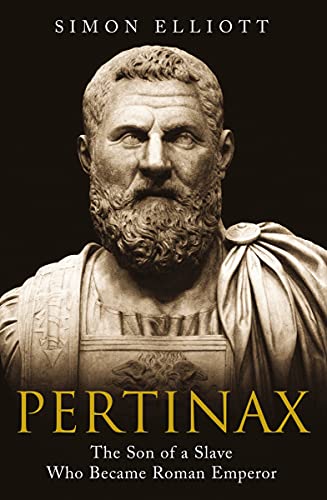
In Pertinax: The Son of a Slave Who Became Roman Emperor Simon Elliott brings together the threads of this remarkable life, setting a stage set at the high noon of Rome’s imperial power and prestige. The portrait that emerges is a flash of lightning which illuminates much of the moment and the man as it and he was, whilst also illustrating why Pertinax has been so much admired down the interveening centuries.
WHO: “Simon Elliott is an historian, archaeologist, author and broadcaster based in Kent. In 2017 he completed his PhD at the University of Kent in Archaeology, where he studied the military presence in Britain during the Roman occupation with a particular focus on the Classis Britannica regional fleet. Simon is now an Honorary Research Fellow at the University. He has a Masters Degree in War Studies from KCL and a Masters Degree in Archaeology from UCL, both completed part-time in the past decade and an original BSc in History and Politics.”
MORE? Here!
Why Pertinax?
I have great interest in the emperor Septimius Severus who ruled at the height of the empire’s power in my opinion. He also launched the last, but ultimately failed, campaigns to conquer the far north of Britain (now the region of modern Scotland) in AD 209 and AD 210, before dying in York in February AD 211. Severus was the ultimate victor in the Year of the Five Emperors in AD 193, with the first incumbent being Publius Helvius Pertinax. The more I studied this emperor the more fascinated I became, he the son of a manumitted slave who eventually rose through hard work, grit and diligence to become the emperor. He was also Severus’ mentor throughout much of his life.
What’s the one thing everyone should know about Pertinax?
That he was initially a Grammaticus teacher until his mid 30s when he suddenly decided to join the military out of knowhere, then rising through the ranks to become the most senior trouble shooter in the empire for the great Marcus Aurelius and mad and bad Commodus.
How did Pertinax feature in the minds of later generations down to our own time?
In the Roman world through to late antiquity, and even later, he was as famous as Julius Caesar or Augustus. The man who had risen from the bottom of Roman society all the way to the top. Further, in standing up to the Praetorian Guard when they demanded he pay them off, he upheld the highest of Roman ideals of worthy leadership. That this cost him his life only added to his contemporary fame. Since then, certainly from the 18th century, he has been used as an example of the worthy ruler, willing to stand up for his beliefs, even if at the cost to his own life.
Without his own legions to overpower hostile local power structures in Rome (including the Praetorians), could Pertinax have ever been anything more than a caretaker emperor?
I actually think Pertinax became emperor because of his standing as a civil leader, being the right man in the right place as city prefect at the point when Commodus was killed. Indeed, he could have called on his loyal legions to support him in power at any time but chose not to do so, making him vulnerable to the Praetorians. Being worthy can come at a cost!
A month on campaign / assignment with Pertinax; a long weekend with him at his country retreat; or a day in the Library of Alexandria – which appeals most?
Oh a month on campaign definitely, and north of the Danube against the Marcomanni in enemy territory. He excelled as a military leader!
If you could own one object described in the book what are you having and why?
An original copy of the Historia Augusta, one of the key primary texts for the period, in the hope I might find out who wrote it!!!
Clearly, Pertinax is overdue the attentions of a novelist. They’re all waiting outside your office to be interviewed for the job. Rosemary Sutcliffe, Gore Vidal, Robert Graves, Margaret George etc. Who are you picking and why?
Blimey they are all amazing. But for me Rosemary Sutcliffe given she was such an inspiration for my love of all things Roman!
If you could ask Pertinax one question what would it be, and what would you expect his answer to be?
Why oh why oh why oh why didn’t you call out your personal guard when you heard the Praetorians were on their way to the palace to confront you! And he would answer…because I thought they would listen to reason from such a seasoned veteran.
What’s the one primary source on Pertinax you know in your heart once existed, but which has been lost? What could it tell us?
Difficult to say given we probably have less than 5% of anything ever written about Pertinax from the classical world, and maybe even less!
What are you currently working on?
Proofreading Great Battles of Early Imperial Rome thru Pen & Sword out in November, and writing Vandal Heaven, my brand new take on post-Roman North Africa after my extensive travels there, this for Casemate Publishing.
LIKE WHAT YOU JUST READ? FOLLOW US ON TWITTER! OR SIGN UP TO OUR MAILING LIST!
 Get Your Coats On