
“It’s got a bit expensive too now I suppose, but then I just sneak in. I say, “I’m Roger McGough.””
WHO: Roger McGough, in conversation with our Features Editor, Dan Lentell
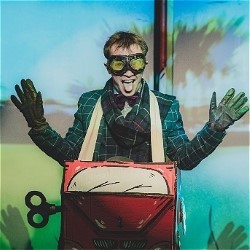
WHAT: “Renowned poet Roger McGough brings to life his witty and mischievous children’s book in a vibrant new musical adaptation. Follow the trail of Mr Toad’s coin in this ‘beginner’s guide to the mysteries of economics’ (The School Librarian), sure to delight audiences of all ages. ‘This has to be the family show of the year. The mighty McGough has a magic way with words and he’s created an utterly enchanting musical that’s a must-see. Five Stars!’ (Gyles Brandreth). ‘A full hour of pure magic’ (Mark Aspen). ‘Amazing show! We loved it’ (Binky Felstead).”
WHERE: Assembly Rooms – Ballroom (Venue 20)
WHEN: 11:55 (70 min)
MORE: Click Here!
DL: Are you going up to EdFringe this year?
RM: No, I’m not, unfortunately. I’m doing a new collected edition for Penguin, which is supposed to be delivered by the end of this month. It’s a big job, you know, I have millions, too many poems, I have thousands and thousands of poems. So I’m going to sift through them and it’s going to be done.
DL: You were first at the Fringe in the 1960s…
RM: Gosh, those days, you know it was very early days, ‘Beyond the Fringe‘ days. I went up with Scaffold. Everyone who was performing you’d meet in the Traverse Bar – that was the only bar that opened (after 10 o’clock) where you could get a drink in those days. What we did, and this goes to the poetry as well, we used to actually work out the show on the way up, on the train or in the car. By the end of our Edinburgh run – two weeks, sometimes three weeks – we’d have a decent show that we could then take on tour. Of course, it’s quite the opposite now, isn’t it? You go on tour, you work there, and you go to Edinburgh, hopefully with a sort of finished product. How we got away with it, I don’t know.
DL: What are the big things you’ve learned in recent and have you absorbed any of the lessons yet?
RM: It was not as bad for me as it was for others because although I still do gigs it didn’t matter too much, although I missed them, because what I like doing best is writing. I had a book come out called ‘Safety in Numbers‘. At the end of it, there’s this little four-liner, “Safety, in numbers, not anymore. The room starts to fill. I’m out of the door” It was a fallow period. A time to sow seeds and things came out of it. It was when I had the idea to adapt ‘Money-Go-Round‘ for the stage. So it was quite a good year really.
I was in ‘Toad of Toad Hall‘ at School, I played Mr Badger, so it was all in the back of my mind. When I did the book, with Walker books, and ‘Money Go Around‘ came out, I had one or two poems come out of it – a rabbit poem, a foxish poem and a toadish poem, and I thought, “I like lyrics again. Here we go again.” So I wrote it and took it over the road to the OSO, which is our local community theatre. I showed it to Johnny Danciger, who took it up and there we go.
DL: I’ve got an eight-year-old, a five-year-old, and a one and a bit…
RM: Oh, I wouldn’t let near it, mate! Okay. No, no. Oh, yes, of course, of course. Um, actually, I always say that. Children love it. They do, generally, love it. And they get involved in it, they believe it. That’s the thing. They understand it. They enjoy the wordplay. It’s all about the jokes and, of course, the actors bring so much to it. It’s a new cast and it’s full of acrobats doing things I could never dream of doing.
DL: Do you keep an eye on EdFringe? Are there things that you look for, even if you’re not coming up?
RM: No, I don’t. You see, because I’d want to be there. If you can’t afford it, don’t think about it, you know what I mean? It’s like when I was younger, and couldn’t afford to go with friends on holiday abroad. Don’t think about it. Don’t worry about it. There’s so many places I want to be, and retrace – places, and so on, so many memories. Do I look at the Fringe brochures? No, I’ll just wish, wish, wish I was there.
DL: So how did you pick #EdFringe shows in the ‘60s? How do you pick the shows you see now?
RM: Well, it was easy in the ‘60s because there were so few on then. Obviously, I had to see what was going on with other revues. There was Oxford and Cambridge but, in those days, Bristol did a lot of revues. There was a lot of surrealism, I remember Polish and Georgian companies. It was easy to walk down the street and just pick anything, walk in somewhere, and you’re exposed – in a delightful, surprising way – to so many things you wouldn’t have chosen.
You don’t quite know what you’re gonna get. That was always the exciting part of Edinburgh compared to the West End or Shakespeare. Of course, you know the great comedians are gonna be good. Frank Skinner this year’s going to be good. I hope our people are gonna be good, but my advice is to try and catch the ones that you don’t know about.
It’s got a bit expensive too now I suppose, but then I just sneak in. I say, “I’m Roger McGough.”
DL: Who or what was your best-ever EdFringe discovery?
RM: There was a chap called Paul Ableman. Have you heard of Paul Ableman?
DL: I have now.
RM: Paul Ableman used to have shows on at the Traverse around the same time that I was up there with Billy Connolly. Paul Averman was a sort of surrealist type of writing, which I liked, sort of early Pinter, surreal dialogue sort of stuff, like RD Laing, which I really enjoyed. And it was that sort of mix, as well as sort of Peter Cook people, who I got to know later on. Paul Ableman was someone who was an influence on me. Not known. Not recognized in a way. That was someone who you discover. You wouldn’t have gone to see him elsewhere. You have to go there, have to be there. So you can stumble across things. Especially when you’re young, when you’re looking out for it, you know. I’m so at that age now where I’m concentrating on what I do myself. I doubt if I’m going to be blown away by some poetry or some theatre.
DL: You’ve translated and published three plays by Molière…
RM: That’s happening. That’s another thing I’m doing. I’d forgotten about that. Sat 30 Sep – Sat 21 Oct at the Crucible in Sheffield – The Hypochondriac.
DL: What’s your elevator pitch for barbarians like me who’ve heard of him but never seen or read one of his plays?
RM: Well, I did French at university, French and Geography. Never really got to speak in French. Scraped through a degree. Never went to France. Didn’t think about it, until years, years have passed – as the French say, it’s not fully perfect. It was the year of Liverpool as European City of Culture, 2008. I was invited by, Gemma Bodinetz, who was the producer and manager of the Playhouse Theatre. She said, “Roger, how about doing a modern, theatre, a bit of culture, a specific culture?” She thought of French influence. I said, “Come on, I never went to Cambridge. I can’t do… I don’t know if I’d really be good enough.” And she said, “go on of course you can.”
So I did, and I enjoyed it. And what I found was, at first, being afraid of it. That’s the first fault line you’re going through – I can’t do it. I’m not good enough. But you start doing it and just start to enjoy it
There’s so many good versions of it that have been translated, word for word, syllable for syllable. But the syllables are too overly done to copy Moliere, and so it gets a bit like, um… it’s a bit boring sometimes.
So you’ve got to take a flyer yourself. I’d talk to Molière in my head. I got his permission to do things with the rhyming – not with the story, the story’s exactly him. The Hypochondriac, which he’d actually written, it’s not in verse, but in prose. I didn’t know that, and I just read the prose version and translated it into verse. I didn’t realize until I’d finished it. They said, “Hey, Roger, you know, this is in verse.”
“Well,” I said, “Molière didn’t do it, but he has now.”
LIKE WHAT YOU JUST READ? FOLLOW US ON TWITTER! OR SIGN UP TO OUR MAILING LIST!
INTERESTED IN BEING INTERVIEWED TOO? CLICK HERE!
 Get Your Coats On