‘Ciphers’ (Traverse: 12-14 Nov ’13)

ciphers-008 Grainne Keenan Ronny Jhutti

Image courtesy of http://www.traverse.co.uk

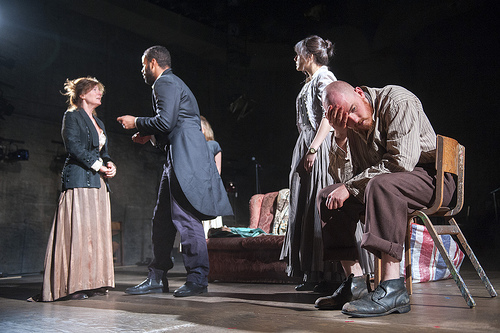
Ciphers’ emotional software is not stripped down but it is obviously engineered. The best scene, I thought, because it is securely plausible, is ‘in a pleasant suburban garden’ where Justine’s father is ‘pottering about sweeping leaves’”

A while back I watched a London Duck Tour run its amphibious vehicle off the Albert Embankment slap bang alongside the MI6 building. The tourists on the DUKW whooped and hollered but that happy eager sound was never going to carry into the showy headquarters of the British Secret Intelligence Service. Accept that Ciphers would take you down a similar edgy slipway and – despite appearances – you get much the same subdued effect.

Ciphers is by Dawn King, whose outstanding debut play Foxfinder won her an 2012 ‘Offie’ award for most promising new playwright. Ciphers has the same director, Blanche McIntyre, but it is very different – check out Michael Billington’s review of ‘Foxfinder’ to see how different – although just as ambitious and it will do King’s CV no harm at all. However, whilst to write a drama about a young woman whose life is taken over by her work for the secret service is superficially attractive – if you can, just think ‘Homeland’ for a moment – it gets a whole lot more demanding when the action and the psychology have to be live and convincing for two hours on a bleached stage. And this is one production that really does not need the distraction of an interval break, let alone ice-creams.

So Justine steps out in defence of the realm but without much protection, mental, physical or electronic. Ciphers’ emotional software is not stripped down but it is obviously engineered. The best scene, I thought, because it is securely plausible, is ‘in a pleasant suburban garden’ where Justine’s father is ‘pottering about sweeping leaves’. His other daughter, Kerry, is on an angry mission. She wants to know why ‘if [Justine] was an analyst why is she fucking dead!’ Neither father nor daughter knows what Justine did all day: ‘Sometimes I imagine her, doing … I don’t know. Spy things …’. Yet there unfortunately is the lameness of Ciphers. The euphemistic ‘intelligence community’ does not do ‘At Home’; its windows are one-way, and its best plots are kept secret.

How to make up the story then? Have large blank screens on stage to project English translations of Russian and a few chat-up lines in Japanese. Slide those screens to smart effect, move time around – a lot, and approach Justine’s story from multiple angles with demanding paired roles.

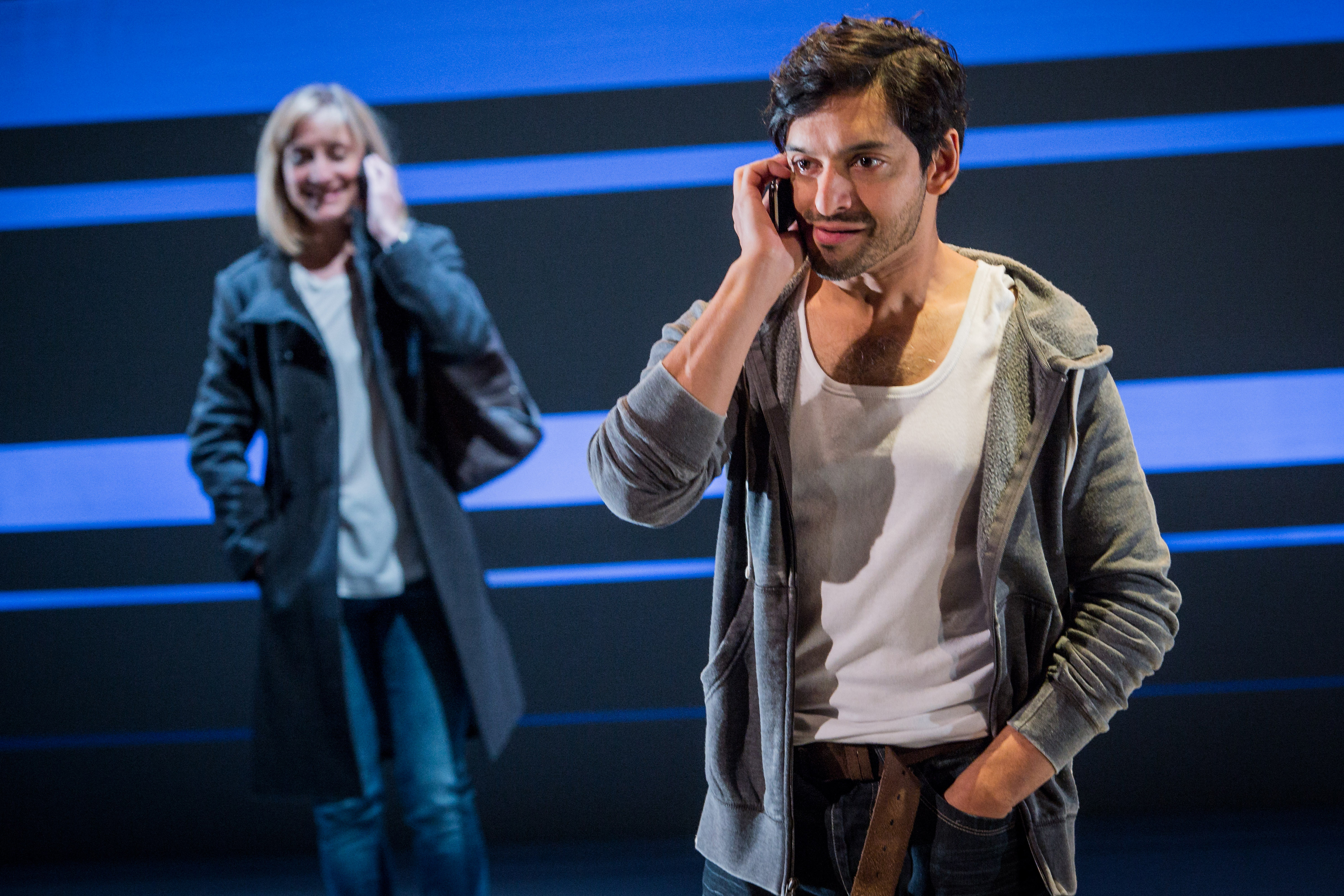
Gráinne Keenan plays Justine and Kerry, both sensitive and vulnerable; Bruce Alexander is their father, Peter with his garden broom, and is also the predatory, knowing, diplomat, Koplov. Between them Keenan and Alexander have the most reliable, natural, exchanges. It is harder for Ronny Jhutti as artist Kai and youth worker Kareem and for Shereen Martin as Anoushka, Kai’s wife, and as Sunita, an MI5 officer – could be MI6, who knows? These are the shallow roles where lines like ‘I’m shit’ or ‘We don’t have the resources’ are thin. Worse, if like me you’re trying not to decode Ciphers as subfusc Spooks, is the accidentally topical ‘Mohammad’s slipped surveillance. We don’t know where he is’.

Ciphers plays at the Bush Theatre, Hammersmith, from 14 January. That is barely two miles from the river where DUKW tours are suspended after one of the ‘Ducks’ caught fire downstream from the MI6 building. It will be interesting to follow how this spare, edgy, drama goes down. Personally, I don’t think that it rides that high in the water.

Reviewer: Alan Brown (Seen 12 November)

Visit Ciphers’ homepage here.

 

‘The Importance of Being Interested’ (The Stand: 10 Nov ’13)

” Thereafter Ince takes his time, circles his subject(s), and loves the fact that when you engage him you get a ‘Rent-a-Gob’ actor-comedian who does intersecting illustrated monologues way before brevity”

Editorial Rating: Nae Bad

‘And speaking of the science of Life, have you got the cucumber sandwiches cut for Lady Bracknell?’

Robin Ince’s stand-up promotion of scientific understanding has serious pedigree now. There was his 2008 Fringe show Things I Like About Carl Sagan And Others, the 2009 Night of a Billion Stars, last year’s Happiness Through Science tour, and now this one, The Importance of Being Interested, which does exactly what it says on the tin. Boldly search for ‘Pedigree Chum’ and top of the Google tree comes ‘Pedigree Brighter Futures’, which is where Ince would land us.

Initial lift comes from an explosive tribute to Brian Blessed which actually has enough energy to fuel the whole show. Thereafter Ince takes his time, circles his subject(s), and loves the fact that when you engage him you get a ‘Rent-a-Gob’ actor-comedian who does intersecting illustrated monologues way before brevity. Of course, it’s an act and is far better navigated and controlled than this self-deprecating drift suggests.
Space is tight at ‘The Stand’ and the analogy of a black hole is never far away. You do not escape Ince’s argument that what really counts is to notice things. What things? It doesn’t matter as long as you look and learn. Ince does not mention that particular weekly magazine for children published from 1962 until 1982, preferring for his stage the more adult and risible Unexplained, but Look and Learn is most certainly where his 44 year old heart is. There and with his five year old son, Archie, who can do no wrong and whose grasp of quantum theory is cute, for ‘Observe me [being bad] and I’ll collapse into a state of good behaviour’.
Perhaps there is too much of little Archie in extortionate Legoland and in the bath exploring himself and not enough of Charles Darwin and Richard Feynman, but Ince’s sincerity makes that forgivable. He bends double in near fury as he fulminates against the stupidity of rote learning in schools and is wicked about the telltale physiognomy of Secretaries Gove and Osborne. Crawley, presumably disfigured by Gatwick airport, gets it in the neck and ends up on the event horizon of non-existence, as do former Archbishop George Carey and the fatuous DJs on commercial radio that no self-respecting alien would listen to.
Co-host of BBC4’s The Infinite Monkey Cage, Ince can only admire the size of Darwin’s nose – that unbelievably almost denied him passage on HMS Beagle – and would defend to the last piglet squid, earth worm, or naked mole rat the right of a child to ask questions of their universe. That way we get to understand it a little more and can wear the ‘tribal scars’ of a BCG jag with pride. This comedian’s rational, humanist credentials are right up there with the Voyager programme. Ince doesn’t get heckled, he gets footnotes, addendums … (his joke).


nae bad_blue

Reviewer: Alan Brown (Seen 10 November)


‘Crime and Punishment’ (Lyceum: 22 Oct – 9 Nov ’13)

9820696075_7c9c0e2431

Image courtesy of http://www.lyceum.org.uk

“in this busy play-novel of downed vodka and photographic ‘shots’, I found that the drama has the consistency of one of Luzhin’s caramel wafers”

There is a lot of exposure in this production. There is no curtain for a start, no flats, no scene painting, nothing obviously comfortable on stage but utility furniture. Across the back, exposed, is a dressing room, liquor bottles and music kit, for the (a)ttiring house of the Shakespearian theatre equips this new adaptation of Dostoyevsky’s unsettling Crime and Punishment. The company gathers, warming up, as the audience sits down and a full-on Psalm 130, De Profundis, ‘Out of the depths … hear [our] prayer’, shifts seeming rehearsal to actual performance. What you are about to see could be barefaced and brazen.

In fact the way to enjoy this co-production with Glasgow’s Citizens and Liverpool’s Playhouse is to look at it as an amateur photographer and to accept that fiddling with your dramatic settings will affect what you see. Some scenes will be sharp, others appreciably less so; some clearly sequenced, others vaguely. The programme casts this as ‘fluidity of the staging, with its seamless transitions’.

Depth of field, then, is key. Rodion Raskolnikov, the ur-student transgressor, is more in focus than out of it, which is to actor Adam Best’s credit as the character is in the fever grip of irresolution to the point of passing out on his sofa or remaining mute and motionless while a policeman snuggles onto him and licks his shaven head. Raskolnikov’s idea of responding to the love-of-his-life, Sonya, is to bow down before her unhappiness. He is fixated on the genius of Napoleon but has the strategic nouse of a double axe-murderer. Best is lucid and good at the verbal and facial tics that impede Raskolnikov’s nihilistic raptures.

Adjust for comic relief and enter George Costigan first as Marmeladov, drunk, and then as Porfiry Petrovich, detective and examining magistrate. Now we’re learning about portrait photography: the two subjects are nicely observed, properly defined, and hold your attention. However, the entertaining, disconcerting, scenes might as well be framed: Meet a Drunk, Cross-examination, Youdunnit – as they illustrate what happens when police procedural meets comic accent and turn. Costigan’s Petrovich proves a wry nemesis.

Cate Hamer’s two principal roles as Pulkeria, Raskolnikov’s mother, and as Katerina, Marmeladov’s wife, are demanding and prominent but they cannot provide humour. Hamer has to do destitution, torn affections, and mental breakdown in vignettes of scenes where there are no decorative borders. The effect is monochrome.

There is a lot of creative energy and skill expended in this production. Supporting parts are bright and live in the moment, notably Obioma Ugoala as the unselfish Razumikhin. Writer, Chris Hannan, knows his Dostoyevsky and pares the novel down with evident respect and sensitivity. Thematically it is pretty intact, not least its all-Russian face-off between social cataclysm and (Christian) redemption, between the polemic of ‘new ideas, new economics’, and Sonya’s New Testament. Raskolnikov is criminally self-absorbed and the play’s script interrogates him. Stage microphones amplify his breathing; other characters ‘resting’ back-of-stage also judge him. Domininc Hill’s direction is clever – a door on wheels makes for fast entrances and exits, digitised blood slashes red  and the soundscape is close to a Threekopek Opera – but finally, inevitably maybe, in this busy play-novel of downed vodka and photographic ‘shots’, I found that the drama has the consistency of one of Luzhin’s caramel wafers.

Reviewer: Alan Brown (Seen 30 October)

‘Paul Bright’s Confessions of a Justified Sinner’ (Summerhall: 17-26 Oct ’13)

Paul Bright's Confessions prod 2 credit Tommy Ga-Ken Wan

Image by Tommy Ga-Ken Wan

“It is with wry humour, almost touched with disappointment, that the 1987-89 history of Confessions is presented.”

Editorial Rating: Nae Bad

This intriguing piece is ‘reconstructed’ by Untitled Projects. Any reassuring solidity provided by co-producers, National Theatre of Scotland, is shaky for this is a bit of a shape-shifter. It provides dramatic form, of that multi-media sort, to James Hogg’s astonishing Private Memoirs and Confessions of a Justified Sinner, published anonymously in 1824, and to the afflicted, near mad, efforts of actor/director Paul Bright in the late 1980s to put this resurgent, mind-bending, novel onto some kind of stage. It helps a lot if you accept the invitation to go to the four room exhibition – downstairs at the Summerhall – both before and after the show. It’s stark down there but there is much of real interest: archive film footage; Fringe fliers, past reviews, stuffed corbies – that substantiate what you will see/ have seen. And there’s a welcome wee dram to close with.

The host – actor George Anton – does it all, introducing Hogg’s book, introducing himself, meditating on acting, chronicling the history of Bright’s work, playing Bright in impassioned bursts, telling of their time together. He is well qualified to do so as Bright’s co-actor in three (of six ‘Episodes’ of the Confessions) and as his friend, which was clearly – in retrospect at least – one hell of a job.

A large screen assists all the while, showing captions, film – mostly grainy, jumpy and silent – various artefacts, and here-and-now interviews with others who knew and worked with Bright. If you know the book, then the split-screen, Gilmartin/Wringhim, Bright/Anton, doppelgänger scenes are especially successful; not least when you learn that Bright (brought up in Ettrick; but that is Ettrick, Kwa-Zulu Natal, & not Hogg’s Ettrick near Selkirk) had a twin brother who drowned when they were swimming together.

Bright protested Nature above Psychology and he would have his theatre ‘alive, dirty and dangerous’ and that does act against this production which is more intelligent composition, reflective anecdote and report than anything more forward or disturbing. It is with wry humour, almost touched with disappointment, that the 1987-89 history of Confessions is presented. The third Episode, ‘Trials’, was staged at the Queen’s Hall as original Scottish drama and as part of the Edinburgh International Festival . It was a ghastly trial for everyone, lasting nine hours and was a disaster: ‘an incomprehensible and pretentious assault on Scotland’s literary heritage’ was John Gross’s opinion in the Sunday Telegraph.

Unsurprisingly the last Episode 6, ‘The Road to the Suicide’s Grave,’ never happened. However,  here’s the real, valedictory, reconstruction that this production achieves. Paul Bright died in Brussels in 2010 at the age of forty-seven and up on the screen appears a fair sized box that George Anton got in the post from Belgium. It contained personal effects: notebooks, sketches, Bright’s copy of Hogg’s Confessions and a tape from a telephone answering machine. Listen to the message on that tape, watch the appreciably long final sequence and you understand that it is all underscored by affection for a lost friend who could not let go of an impossible project.

‘What can this work be?’ asks Hogg’s editor at the end of the sinner’s memoirs. ‘I cannot tell’ is his conclusion. Actor George Anton, writer Pamela Carter and director Stewart Laing create something more tangible of Paul Bright’s Confessions and in the end more definitive.

nae bad_blue

‘Oedipussy’ (Traverse: 9 – 12 Oct ’13)

6

“The poet did not write ‘Agamemnon, Parthenon, Taramasalata’ but in Oedipussy it is intoned as a choric reminder that Greek tragedy developed from the earlier satyr plays whose revels and antics are right up there with Spymonkey’s use of song and physical theatre.”

Editorial Rating: Nae Bad 

Dangle an adapted classic in front of a critic and you invite trouble. So it was fun to hear Spymonkey open Oedipussy with a swipe at a hostile review of their Moby Dick (Edinburgh, February 2010). The boot went onto the other, platformed, foot with wicked intent and not a little of the ensemble playing that would follow.

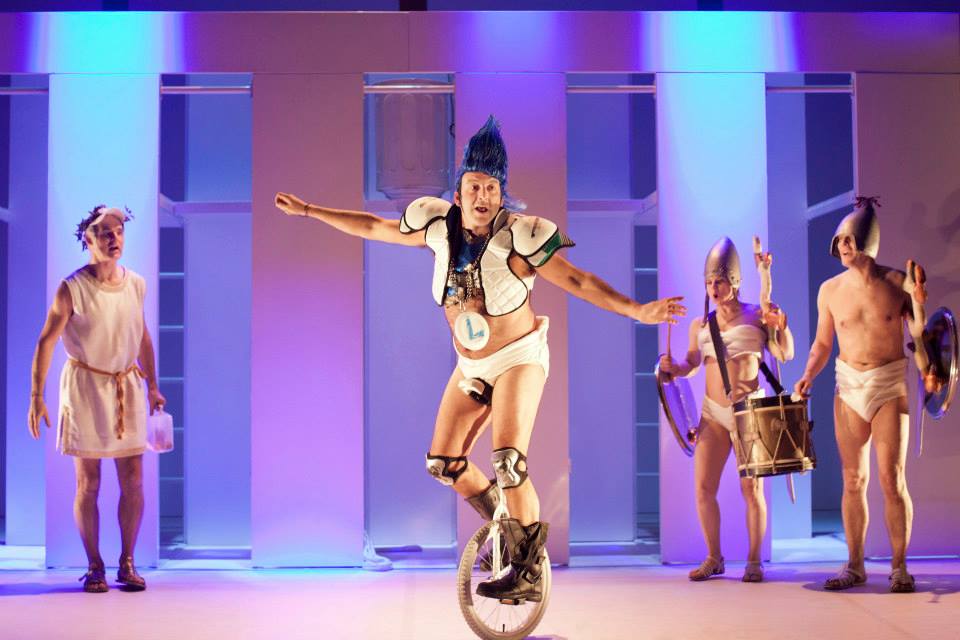
Oedipus has swollen feet, of course, which is not surprising as they are ‘pinned’ here using a cordless drill. Just one of the modern tools – add a unicycle, saxophone(s) and radio mic – that this production uses to ‘build up a dazzling mockery of delight’. The poet did not write ‘Agamemnon, Parthenon, Taramasalata’ but in Oedipussy it is intoned as a choric reminder that Greek tragedy developed from the earlier satyr plays whose revels and antics are right up there with Spymonkey’s use of song and physical theatre. ‘Woman-breasted Fate’ has her naked moment on stage as a wardrobe accident but otherwise the action is more ‘hot, hard, and in your face’ than anything stylised or reflective.

That said, ‘It’s not bloody panto’ either, as Jocasta (Petra Massey) would have the audience realise. The oracle may be hilariously represented by ballooned eyeballs – plus a red nose in a later manifestation – but the episodes are all here, from the infant Oedipus on Mount Kithairon to Jocasta’s suicide.

It is a post-modern piece though, if you allow 007 a mythic quality. Characters deconstruct as the four actors protest – along with Oedipus – that ‘this is the [real] me’: Petra Massey has problems with her feet and cannot have children; Aitor Basauri says he is not fat and tries out as a stand-up comic and Stephan Kreiss (Oedipus), at 51, needs pain relief from wild acting, and longs to go home to a more ordered Germany.

The Chorus (Park) does its job, singly, with a broken column on his head, and it seems is forever twirling in time as his robes wrap and unwrap around the white, ingeniously available set. Park is also Tiresias the blind prophet who has a remarkable turn as ‘a very bad David Bowie’ with outrageous pink cans on his head. Those costumes do stand out. They are colourful and outrageous, much more ‘Barbarella’(1968) than ‘Atlantis’ (2013).

Nevertheless, blood splatters and streams onto the stage and there are drum rolls to accompany the Eels’ ‘It’s a Motherf-’ – and, whilst the poetry is long gone, Oedipussy has its own tragic face. The production finally plays out to ‘Nobody does it better’, which is fair enough.

nae bad_blue

‘Educating Ronnie’ (Traverse: 2 – 5 Oct ’13)


MacRobert Arts Centre

“The money Joe sent would have provided the deposit on a house in a northern industrial town, or in more personal terms an engagement ring.”

Editorial Rating: Nae Bad

It is a touching story. It touched Joe Douglas for near on £19,300. By the end of the show, at the end of their story, Joe calculates exactly what it cost him over ten years to educate a young Ugandan, Ronnie.

It is a true morality tale that begins in 2002 with Joe, an 18 year old out of Stockport, enjoying a six week gap-year trip to Uganda, whose sights and sounds hit him ‘like a pop-up book’. It is not long after returning home that Ronnie ask Joe for help.

We never meet Ronnie but read and hear his emails and txts. They are pretty short, spell out how much money he needs to keep his education going and – later – how much to compensate the family of a fatal road traffic accident; how much to pay the hospital for his dying mother. The emails present on a video screen of a blackboard and then, diminished, pile up into an on-going reminder of Ronnie’s situation. There are beer mugs up there too, a nice calculation in student terms of how many pints can be bought for the £20 regularly sent to Ronnie by Western Union money transfer.

Joe introduces his story with the lights up. He is not a trained actor (the programme notes make clear his credentials as a director) and he would apologise for that. No need really; his one-man performance starts as he talks fondly to the seat reserved for his aunt Maria in the front row, for it is his auntie who looked after him in Uganda, and who interestingly did not take to Ronnie.

The money Joe sent would have provided the deposit on a house in a northern industrial town, or in more personal terms an engagement ring. He does actually take a ring out of his pocket and smiles, remarking that his parents paid for the wedding. And Ronnie? The BBC World Service went looking for him when this story was first staged at the Fringe in 2012. He has a FaceBook page apparently and does not want a copy of the script.

This work, a co-production by Macrobert and Utter, is smooth. Its careful technicals are well-rehearsed, the soundtrack is appropriate without sentimentality, Joe Douglas’s performance is characterful and honest. His story asks you to risk a leap of faith. I’m glad I did.

nae bad_blue

Reviewer: Alan Brown (Seen 2 October)

Visit Educating Ronnie homepage here.