+3 Review: Mungo Park (Summerhall: 3 – 27 Aug. 8.45pm 1h 20m.)

Images: Dogstar Theatre.

Images: Dogstar Theatre.

“… an invitation to taste the popcorn, then it’s serried lights and blinding action”

Editorial Rating: 5 Stars: Nae Bad

There is a Mungo Park Road in Gravesend, Kent, and sheltered housing at Mungo Park Court in Selkirk which seems all a bit sedentary when it comes to the tremendous life of Mungo P himself. Born in 1771, near Selkirk right enough, he ventured out down the Niger River and was the first European to reach Timbuktu. Of course, he did not have a passport so that nice phrasing, used in this show, about his Majesty ‘requests and requires [that] the bearer pass freely without let or hindrance’ did not apply. Instead his heroic travels are the stuff of bedtime stories, ‘To Selkirk … and beyond!’ if you will, which is where Mungo Park Theatre (Copenhagen) and Dogstar Theatre (Inverness) come flying in.

Writer and director Martin Lyngbo wants Hollywood-on-stage for the ‘inner eye of everyone in the audience’. So we get an invitation to taste the popcorn, then it’s serried lights and blinding action. We move swiftly from the Highlands, to London, and – via the two journeys of 1796 and 1805 – to central West Africa, on foot and in a canoe.

Travel at the wrong time and it’s very hot and wet and deadly out there. The African interior was a huge gap surrounded by a coastline, for its ‘heart lies in darkness’ and between August and October forty-one out of the forty-five or so Brits on the second expedition died of fever. How Parks survived for as long as he did is an open question but – to judge by this play – it was a combination of physical toughness, determination (to see home and family again), good sense and good luck. Africa for him is ‘a fragile network’ of peoples and customs and you got nowhere without respecting that.

Mungo Park goes back to 2006. That first Danish production was rehearsed during the crisis that surrounded publication in a newspaper of the Muhammad cartoons. This English language version, by Jonathan Sydenham, still looks as if it is significantly influenced by that controversy. Clever caricature asks questions of how individuals are represented and received by ‘others’, culturally akin or not. African kings Desse and Ali play ‘up’ their obvious differences in sing-song pidgin speech; their messengers play their crafty roles as would flunkies of a European court but with outlandish accents. Sir Joseph Banks, notable patron of the natural sciences, is as interested in gold as he is in plants. Lieutenant John Martyn, in command of Parks’ escort, is more blood thirsty racist than an officer and a gentleman. Desperate and dangerous confusion results from misunderstanding and prejudice.
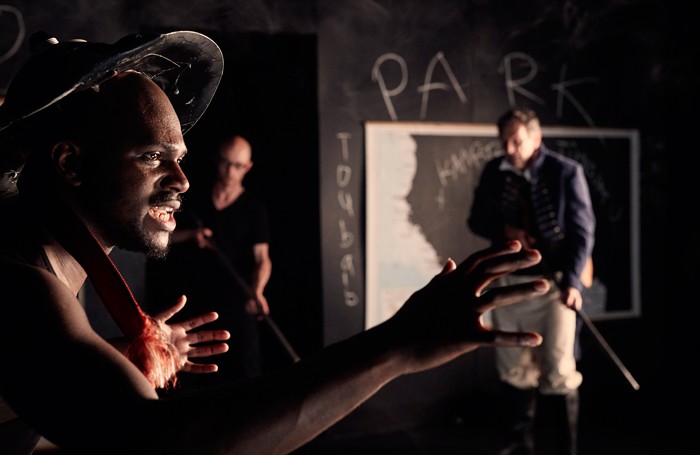
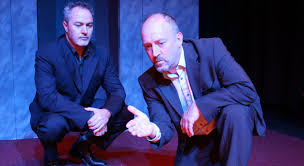
Kingsley Amadi (l)

Kingsley Amadi (l)

Matthew Zajac is impressive as the courageous and virtuous Mungo, whose story we follow at every turn, literally so as he fights his good fight on a turntable. Anders Budde Christensen is all exaggerated gesture and of wily tongue as emissary and as the not-so-enlightened James Rennell, map-maker, who would be master of all he surveys. Kingsley Amadi is black African potentate and crazy (white) army officer. It is so confidently performed that the zany is never risible, the indomitable never preposterous.

The rapid screenplay, to go with the filmic idea, produces strong exposition – particularly when its opening is chalked-up on the blackboard rather like title cards to a silent movie of colonial history in the making – and a dynamic narrative. No visual ‘shots’ are projected so there’s a spontaneous, on-the-spot quality to the whole piece. For the most part it is tightly focused upon Parks himself and when it isn’t there is some loss in terms of its depth of field. Performers running up and down the central aisle in a bright light did not look right.

Sturdy Mungo always has a satchel for his notebook and his Travels were published in 1799 but if you want a stirring measure of the man and of his life you won’t do better than this motion picture of a play.

 

nae bad_blue

Star (blue)Star (blue)Star (blue)Star (blue)Star (blue)

Reviewer: Alan Brown (Seen 24 August)

Go to Summerhall and the Dogstar Theatre Company

Visit Edinburgh49‘s  Summerhall archive.

+3 Review: Albatross (Paradise in Augustines. 5 -28 Aug. Times vary. 1h35m.)

Image: Andrew Brilliant/Brilliantpictures Inc.

Image: Andrew Brilliant/Brilliantpictures Inc.

” .. full-on theatrical broadsides”

Editorial Rating:  4 Stars: Nae Bad

Inbound from Watertown, Boston, MA, the Albatross has landed. Samuel Coleridge’s fantastic and ghastly Rime of the Ancient Mariner is rewritten and adapted for the stage by the Poets’ Theatre. It’s an expansive work that barrels along with bits of Pirates of the Caribbean about its rigging but where it matters, down on its spar strewn deck of a stage, it’s sound and faithful enough. It owns, as does Coleridge’s greybeard, ‘strange power of speech’ and compelling presence.

Despite water, water everywhere this is more wrap-around than immersive. You don’t sink into the Mariner’s story but Benjamin Evett, co-writer and solo performer, fastens it upon you and won’t let its folds drop until he’s done, which is how the poet would have it anyway. Evett’s acting is impressive, possessed by character, because there’s only penance left for an Irish American who knows he has ‘done a hellish thing’. He starts as a grouchy, foul-mouthed and dirty sailor and stays that way because he’s immortally cursed to tell his phenomenal tale. He holds his audience with his ‘glittering eye’ (and occasional insult) as he himself is held by his demons.

We’re told for fancy’s sake that the old sailor met Coleridge once, in Bristol, and mocked his lilting verse. You’ll hear the ballad quatrain in Albatross but in only in key snatches. The narrative shape of the ‘Rime’ is still there but is considerably amplified, particularly in Part 1 where the dastardly Black Dog, privateer at large, shanghaies the Mariner, chases down a treasure galleon and chews off noses. The visuals, sound and SFXs that accompany this action are full on theatrical broadsides with the Mariner hauling ropes, hoisting sails and … corralling penguins.

Nevertheless, Albatross would be serious about depicting a ‘soul in agony’, which is a must-have for any treatment of Coleridge’s poem. This is where Evett is most tested and where co-writer Matthew Spangler must have reached for words. I’m slightly surprised that they did not make more of the dice game between Death and Life-in-Death (a dead ringer for Lady Gaga?) and of its glaring image making. However, in our day and age the questions are as existential as they are Christian and it’s the philosophical open season when the Mariner snarls a reply as to ‘Why?’ Why, for Heaven’s sake, did he shoot the bird? Was it, God forbid, for fun? There is the prayerful close, which is good, but I was a little sorry to hear of a ‘zombie crew’ and not ‘this seraph band/Each one a lovely light’. No matter. If not for the Mariner, times are still a changing for the rest of us and this is a fullblown modern production in which caution is thrown to the to the wind.


nae bad_blue

Star (blue)Star (blue)Star (blue)Star (blue)

Reviewer: Alan Brown  (Seen 11 August)

Go to Albatross at Paradise Green & at Poets’ Theatre

Visit the Edinburgh49’s Other archive.

+3 Review: The Six-Sided Man (Assembly Roxy: 3 – 29 Aug. 1150. 1hr10m)

Gavin Robertson (l) & Nicholas Collett (r). Image: Assembly Roxy & Company Gavin Robertson

Gavin Robertson (l) & Nicholas Collett (r).
Image: Assembly Roxy & Company Gavin Robertson

“love its deadpan humour … the whole 4* performance of edge and ease”

Editorial Rating: 4 Stars:Nae Bad

You just know that you’re in expert hands when, to the exact beat of ABBA’s The Name of the Game, the dice are twice shaken and then thrown. Except they’re not, you just believe that you heard the rattle and saw the throw  …. and reckoned the fateful consequence. This is artful, practised, theatre.

The Dice Man appeared in 1971 and became a cult classic. The Six-Sided Man is its stage face, written and adapted by Gavin Robertson and first performed at the Edinburgh Festival in 1987. It’s back (by popular demand?) with Robertson himself playing The Patient and Nicholas Collett as The Psychiatrist. If they could, they’d be spokes on a roulette wheel; as it is they circle around each other, betting each other’s life on the throw of the dice, or die, which is an unfortunate pun.

The reason being, you see, is that the dice are liberating, freeing you of restraint and conformity by determining a single course of action that is irreversible. ‘Should I go out of the window four storeys up?’ becomes, on the throw of a 3, ‘I must go out of the window’. And where there is mortal risk there has to be sweet reward: roll a 6 and it’s the other guy who goes head first. The Winner Takes It All.

But that’s to jump the gun (with just the single bullet in the chamber, of course). The Patient comes to the Psychiatrist with his problems. The doctor is brisk. “Show me”, he says and the rest might be such weird stuff as dreams are made on but you’re not too sure. In fact – if that’s not too loaded an entity – there’s nothing quite so substantially awful as dog poo on your shoe on a first date.

The cure is that the predictable need not be endured or suffered  Yet the dialogue, alongside the high quality of the mime, voice and movement sequences, is unemotional and wary. No great shakes, you might say, but then you realise that there’s a face off here, with neither character prepared to raise the stakes until he’s as certain as he can be that he has the stronger hand. Knowing Me, Knowing You plays on.

The Dice Man was published under the name of Luke Rhinehart. In August 2012 ‘he’ announced his own death. Some believed it, some didn’t. It was a spoof but it allowed Luke to write his own valediction: ‘If you’re comfortable in the selves you’re rolling along with’, he wrote, ‘then roll on. Most people aren’t.’

You’ll roll with The Six-Sided Man and love its deadpan humour and admire the whole 4* performance of edge and ease but you’ll wonder where it’s going; at which point you’ll feel distinctly uncomfortable. Take A Chance on Me? You bet.

nae bad_blue

Star (blue)Star (blue)Star (blue)Star (blue)

Reviewer: Alan Brown  (Seen 8 August)

Go to The Six-Sided Man at Assembly Roxy.

Visit Edinburgh49’s  Assembly Roxy archive.

+3 Review: Nuclear Family (Assembly Roxy: 3 – 29 Aug. 1715. 1h)

Image. Sunday's Child & Fever Dream Theatre.

Image. Sunday’s Child & Fever Dream Theatre.

” .. a drama of a hopeless, unstable, situation”

Editorial Rating:  2 Stars

Torness nuclear power station is 30kms from Edinburgh, strikingly visible from the A1 and from the main line. The MailOnline did a photo feature on it in January last year. A close-up on one of the panels in the Control Room shows the operating switches to Boilers A to D. Understandably, there’s ‘Start Up’, ‘Drain and Warm-Up’, and – critically – ‘Dump’; which is what Ellen, who’s a technician at a nuclear site, has just done to Phil. He takes it very, very badly.

This then is your chance to get up-close and personal with nuclear safety. You play your part in an examination of how Phil, the jilted boyfriend, and a couple of his drunk mates got into the Central Control Room of a nuclear power station and caused a disaster. It’s your job to review the evidence of how it was allowed to happen and to play ‘What Would You Do / What Should They Have Done?’ The results are to be included in the final ‘Prescott’ report. (There is no connection BTW with the former Deputy Prime Minister or indeed, I trust, with any incident at a nuclear installation). As a core idea, it has a lot going for it; but what of its processes?

The audience of eight to ten – it might stretch to 14 or so – sits in a semi-circle. In front of us two actors act out the CCTV footage of the Security desk from that terrible evening. Ellen (Eva O’Connor) is on duty with her brother Joe (Adam Devereux), who is on a verbal warning for telling site managers what they don’t want to hear. This sequence is interrupted on five occasions for  audience participants to look at further evidence: personnel records, transcripts, and the like. A facilitator officiates and calls Time when a decision has to be reached: for example, sound the alarm now or wait? There is a show of hands to determine what happens next.

The acting was by far and away the best part, creating tension even when the plot approached meltdown. However, for me, the ‘interactive’ theatre was a nightmare. I had my senior doubts from the start when the bumbling distribution of iPods did not convince me that this was an official inquiry and then the request for a rapporteur helper was immediately taken up by a man to my right festooned with venue participant lanyards. He started whispering broken instructions on how to open the nano which I tried to follow but I had to give up on the looped audio files. My neighbour to the left seemed to be ‘on task’ and having an engaged conversation but all this activity seemed completely superfluous. It didn’t help, of course, that I was outside the discussions that were taking place. I just wanted to hear more from Joe and Ellen, whose acting was reaching critical levels, rather than wait for the next predictable outcome. Even then it was pretty obvious that whatever decision was reached, at whichever improbable juncture, it would make no difference. When the votes were taken there was no time to really examine the decisions reached. As an immersive simulation it wasn’t working; as a drama of a hopeless, unstable, situation, I liked its fallout.

Star (blue)Star (blue)

Reviewer: Alan Brown (Seen 7 August)

Visit the Assembly Roxy  archive.

+3 Review: Jane Eyre: An Autobiography (Assembly Roxy: 4 – 29 Aug. 1115. 1h30m)

Image. Dyad Productions.

Image. Dyad Productions.

“Rebecca Vaughn’s solo work is outstanding.”

Editorial Rating: 3 Stars Outstanding

” ‘… and when I draw up the curtain this time, reader, you must fancy you see …’  me, plain and plain-spoken Jane Eyre, on stage for ninety minutes as I tell you the story of my life.”

We have an autobiographical telling, dramatic and full of character, with nothing of substance left out and everything of significance retained. From the window seat in the breakfast room, aged 10, to the parlour of Ferndean Manor, some nine years later where the blind Mr Rochester – he of the ‘brow of rock’ – reclaims his darling Jane. Writer Elton Townend Jones calls his work ‘an impressionistic adaptation’ of Charlotte Bronte’s book. Well, fair enough, along with the charged immediacy of the scene(s) comes the solid narrative, fused and monumental.

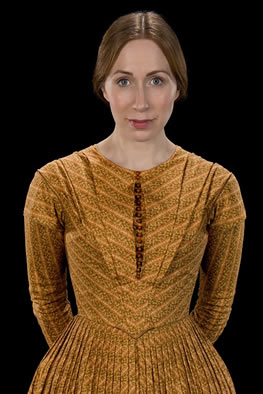
Performer Rebecca Vaughan is definitely impressive. She is Jane, of course, but she is also everyone else – except the source of crazed laughter from the attic. There is, inevitably, a cartoon Mr Brocklehurst, who might as well be the grim progenitor of today’s (English) free schools. Mr Rivers, impossible for the irreligious to figure, is left pallid and decent. Mr Rochester is gruff and always amused by Jane’s frank determinations. As Jane, Vaughan is upright and indomitable, which makes her excitement and frailty when it comes to the love story just a bit tricky. However, if romance is your thing, then Jane’s virtuous path to happiness is surely realised.

What makes the novel probably undoes its efficient telling. Jane ‘hadn’t intended to love [Rochester]’ but does and she certainly never expected riches but she gets them. That, to use Bronte’s unlikely word, is a ‘stunner’. The stage-succinct explanation of her 20K inheritance does advance a parallel narrative that gives Jane an easy living that is more assured than the trials and anxieties of any self-respecting literary heroine should be. I wondered, listening hard, whether her assessment of Position, Fortune, & Age in the marriage stakes – our century’s life-style choices – was beginning to count for more than love, which (I concede) is rather uncharitable.

Dyad Productions have worked the text of Jane Eyre to lucid and creditable effect and Rebecca Vaughn’s solo work is outstanding. I just found the whole piece satisfying and accomplished rather than remarkable or radical, which the novel is.

outstanding

StarStarStar

Reviewer: Alan Brown (Seen 7 August)

Go to Dyad Productions

Visit Edinburgh49’s Assembly Roxy archive.

+3 Review: Queen Lear (Assembly Roxy: 4 – 29 Aug. 16.10. 1h)

Image. Assembly & Ronnie Dorsey productions

Image. Assembly & Ronnie Dorsey productions

“Exquisite”

Editorial Rating:  4 Stars:  Outstanding

Shakespeare’s Lear is a pathetic apologist : ‘I am a very foolish, fond old man’, who (by his frail reckoning) would have fathered Cordelia in his late sixties. And he didn’t stop there. Why should he? He’s a King of ‘wild, roaring, lecherous men’ who live for ‘war, wine, and whoring’. So, in Ronnie Dorsey’s new and exquisite piece we come to his second queen, heavily pregnant and in great pain. No Lear is to be seen but his expectation of a son, for once legitimate, is almost unbearable.

Remember Lear’s ‘Let copulation thrive’? Well, he ends that hateful, mad, speech longing for anything ‘to sweeten my imagination’. Enter Queen Lear.

Three characters: the young queen; her devoted companion Ursula; and her priest, Lawrence. Back story: the queen was married at 16 and leaves her home in the Borders for good. She is cruelly abused by a husband who, after beating her, kicks her small dog to death. Rooks caw about the castle walls (we assume that the queen’s chamber is in a castle) and in these harsh, loveless, circumstances it is doubly touching to hear Ursula call her queen ‘Sweeting’.

Dorsey writes words that hold and sustain. Queen Lear grasps sympathy where it can be found and does not let go. The queen, who knows that she will not be remembered, talks of the coming birth with dread. She would have the child but fears she will not survive the labour. In her time a caesarean section is all about cutting and not delivery. Alice Allemano plays a woman living the agony of the fact that ‘this child is killing me’, so if ever a role has to be in extremis, then this is it. Jane Goddard plays Ursula with a loving solicitude that is never familiar but always kind. Mary McCusker, as Lawrence, has ‘his’ own confession to make in a performance of great sensitivity and control.

Mark Leipacher directs. It is a tight work, physically and emotionally close, as you’d expect of a confinement and what lightness and lift there is comes from the lyrical quality of Dorsey’s lines. Three benches and an embroidered bolster are the only props required. The queen is in an elegant gown that denotes her high rank but which confers neither influence nor power. She can only hope against hope that Lear’s Fool will somehow protect Cordelia.

When resolution comes to such a forlorn situation it’s hard to take. You might not accept it, but that’s the point. For Lear’s queen there is no healing touch for her ‘female wounds’.


outstanding

StarStarStarStar

Reviewer: Alan Brown (Seen 6 August)

Visit Edinburgh49’s Assembly Roxy  archive.

+3 Review: Molly Whuppie (Assembly Roxy: 4-28 Aug. 1030. 1hr 15)

Image. Assembly & LicketySpit Theatre

Image. Assembly & LicketySpit Theatre

“Smiling, tuneful, and big-hearted”

Editorial Rating: 4 Stars: Nae Bad

Molly Whuppie is a pickle of a lassie. She’s bright, bonny and brave and saves her mother and sister from dying of hunger on a northern shore. She’s a fairy tale character from the Western Highlands , whom English cousin Jack – of beanstalk fame – would love to meet, for their stories are pretty close; although Molly (aka. Maol a Chliobain) steals it, as her baddie is no the giant, but one King Boris (!), who loves his meringues too, too much.

Smiling, tuneful, and big-hearted, Molly Whuppie has toured all over Scotland and has already, since 2001, delighted upwards of 30,000 people. Licketyspit Theatre Company is Edinburgh based but has decided, as the International Festival posters have it, to ‘Welcome [the]World’ so this is the company’s Fringe premier and it’s a treat.

If you’re still fortunate to be in your early years – and therefore very unlikely to be reading this! – Licketyspit is for you. If you’re alongside a young child, then you’ll appreciate the modesty of the fact that all actors do is ‘show the story’ in exciting and imaginative ways. First then, there’s fearless Molly (Amy McGregor) who keeps her pretty red beret on even when balancing for her life on the Bridge of the One Hair, and we sing “I’m Molly and you can’t scare me / I’m Molly, Hee Hee Hee!” Second, there’s Virginia Radcliffe as Ninian the Giant in tremendous sandals and as horrid King Boris with a wonderful polka dot jester’s cap. No crown of majesty for him, just fanfare by kazoo.

Radcliffe is also Artistic Director of LicketySpit and it is easy in Molly Whuppie to see hers years of experience in building drama-led work for children and their families. There’s a good strong narrative where the good and the kind – above all – prevail, constantly reinforced by repetitive elements of colour, music and song. Invention is everywhere, from the reveal of successive kind grannies to land clearance by tree hurling.

Yes, it was probably devised as a December, Christmassy show when Molly, her mum, and her sister are perishing of cold and, yes, there’s the question of how come only giants have a Never Empty Purse; but no matter really, this is a warm and generous show with stick puppets to colour in and cut out afterwards.


nae bad_blue

Star (blue)Star (blue)Star (blue)Star (blue)

Reviewer: Alan Brown (Seen 6 August)

Go to Assembly Children’s Shows

Visit Edinburgh49’s Assembly Roxy archive.

Thon Man Moliere (Lyceum: 20 May – 11 June ’16)

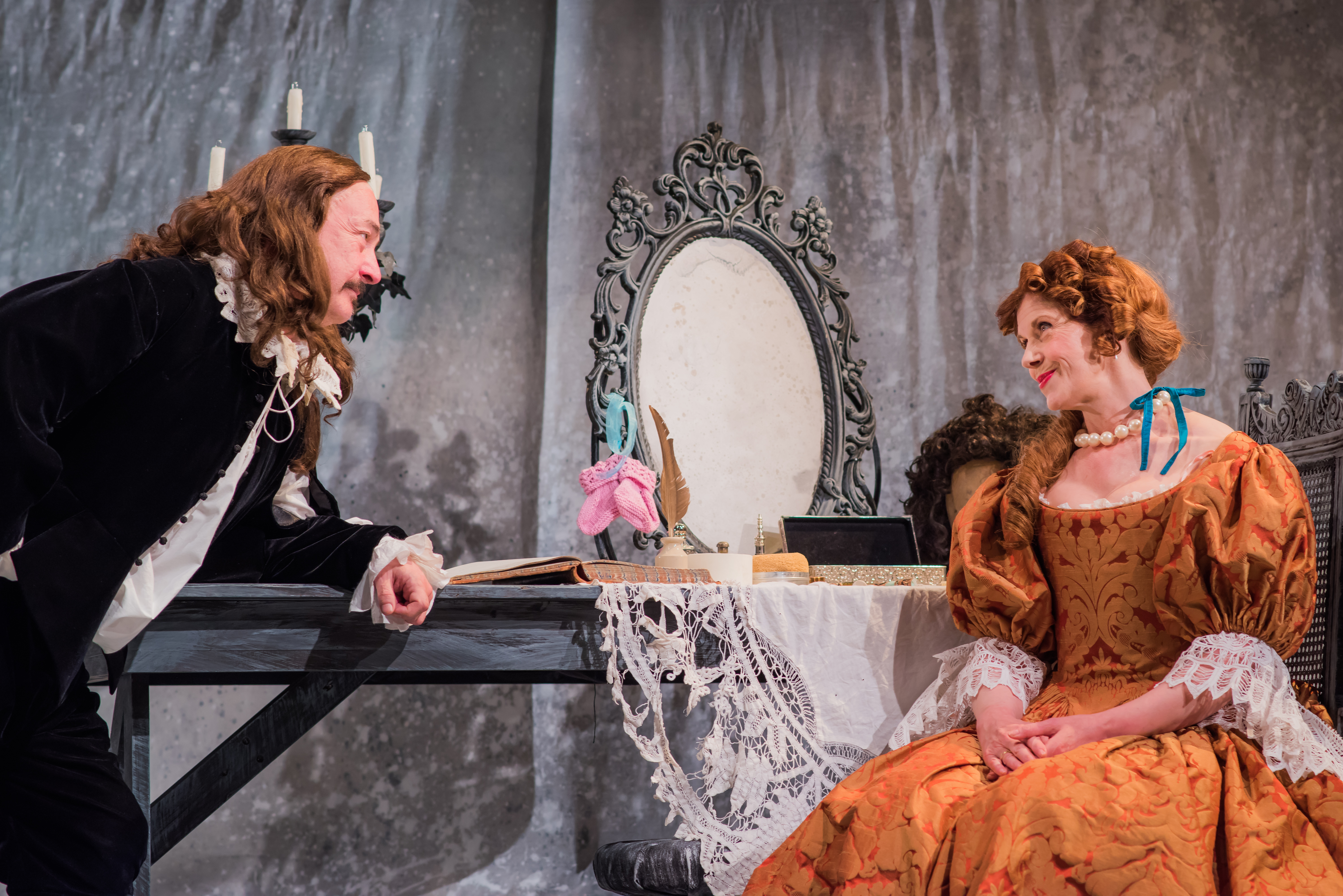
Jimmy Chisholm as Moliere & Siobhan Redmond as Madeleine. Photo: Mihaela Bdlovic.

Jimmy Chisholm as Moliere & Siobhan Redmond as Madeleine.
Photo: Mihaela Bdlovic.

“Siobhan Redmond as Madeleine and Jimmy Chisholm as Molière are perfectly, affectionately, matched.”

Editorial Rating: 4 Stars  Outstanding

In February 1662 Louis XIV sent flowers on the occasion of the marriage of Molière (40) to the seventeen year old Menou (Armande) Béjart. Perhaps the feted playwright was encouraged by the success in the previous year of his School for Husbands. And maybe those flowers were roses, for Menou draws firm, long stemmed roses in her sketch book. Wait up, they look like roses but maybe they’re …. Oh no! Surely not?

This is Liz Lochhead’s new play and she can have a garland too. Thon Man Molière is a comfortable winner. First off, it is a tribute piece to the man’s comedic genius; but second, it closely involves the women in his life, and third this play loves theatre and theatre-making.

Lochhead is an artist with the man’s biography. Born Jean-Baptiste Poquelin, her MacMolière is ‘Pokey’ indoors. Scaramouche is a pal but the fortunes of the ‘Illustrious Theatre’ company are dire to the point of collapse (and imprisonment for debt). There is rarely enough money and there are too few commissions until the king: “Vive le Roi!” – tires of the tragedies of Racine and Corneille. Tartuffe may well be a great play – and Pokey is inordinately proud of it – but it took nearly five years to get its revised version past the Archbishop of Paris. Molière’s first child is named after his royal godfather but Louis dies at eleven months.

There is a sub-title to shape the facts: ‘Whit got [Pokey] intae aw that bother …’ – and it’s sex; not so much sex with his teenage wife but the naughty fact that Menou is the daughter of his former lover, business partner and bestie, Madeleine, and that Madame Béjart will not – under any circumstances – have her daughter tread the boards. Siobhan Redmond as Madeleine and Jimmy Chisholm as Molière are perfectly, affectionately, matched. She has the reserve, bearing, velvet voice and wide skirts of a grande dame. He has the effrontery, the wit and the audacity of his celebrated character.

Ever around and about the principals is the troupe, historically verifiable and altogether mischievous. Gros-René (Steven McNicoll), in streaked green wig, gives a command performance in lugubrious drinking and losing his breeks. Therese (Nicola Roy) is his bed-hopping wife, who would be so much more than the maid in yet another farce. James Anthony Pearson is Michel Baron, the huge star-to-be, lithe and cocksure, but who is still unable to seduce the naïve Armande, very engagingly played by Sarah Miele. At a guess, only the more than capable, laconic and kind Toinette (Molly Innes) is entirely the writer’s invention.

Tony Cownie directs with an assurance born of his previous productions at the Lyceum of Lochhead’s ‘Molières’: Tartuffe (1986!), Miseryguts (Le Misanthrope) in 2001, and Educating Agnes (L’Ecole des Femmes) in 2011. Musical entr’actes by Claire McKenzie, a la Lully, are accompanied by sweet mime and when the drapes lift the action resumes, ‘at home’ or backstage where outsize greyscale putti come second to the wooden stool, wicker baskets and some splendid costumes that were too much even for the Comédie – Francaise, aka. ‘La Maison de Molière’.

Dinnae think Thon Man Molière is daft. The script is too sharp for that and its composed effect is almost tender, which, with all those satiric impulses flying around, is some achievement.

The theatre programme contains an excellent ‘Who Was Molière?’ by Liz Lochhead herself and there’s a helpful preview article by Neil Cooper in the Herald.


outstanding

StarStarStarStar

Reviewer: Alan Brown  (Seen 24 May)

Go to Thon Man Moliere at the Lyceum

Visit Edinburgh49‘s Lyceum  archive.

The Iliad (Lyceum: 20 April – 14 May ’16)

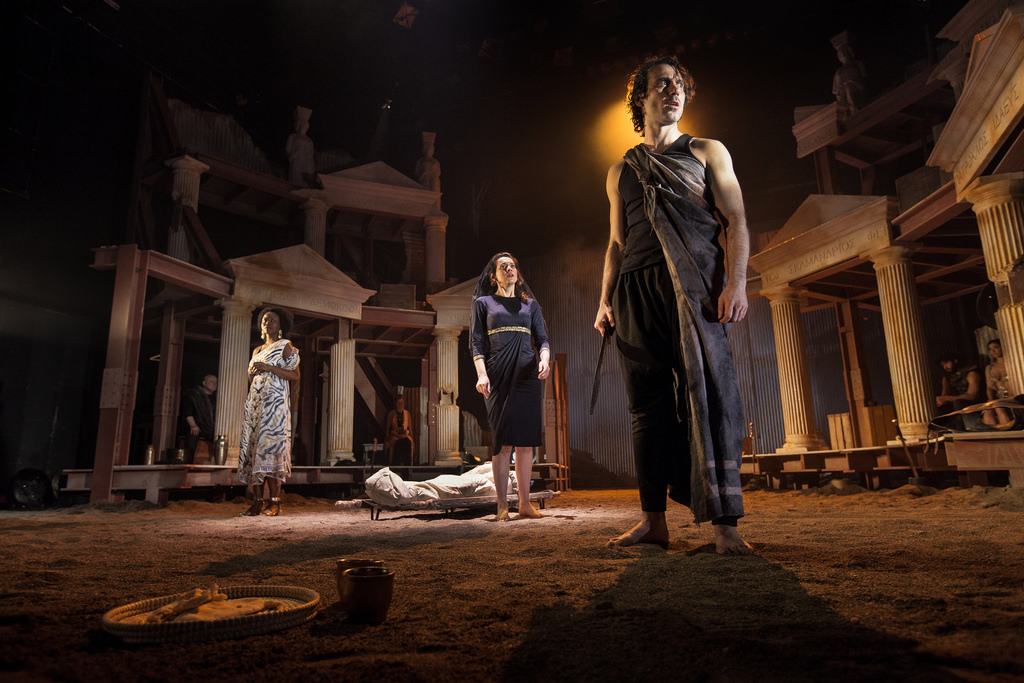
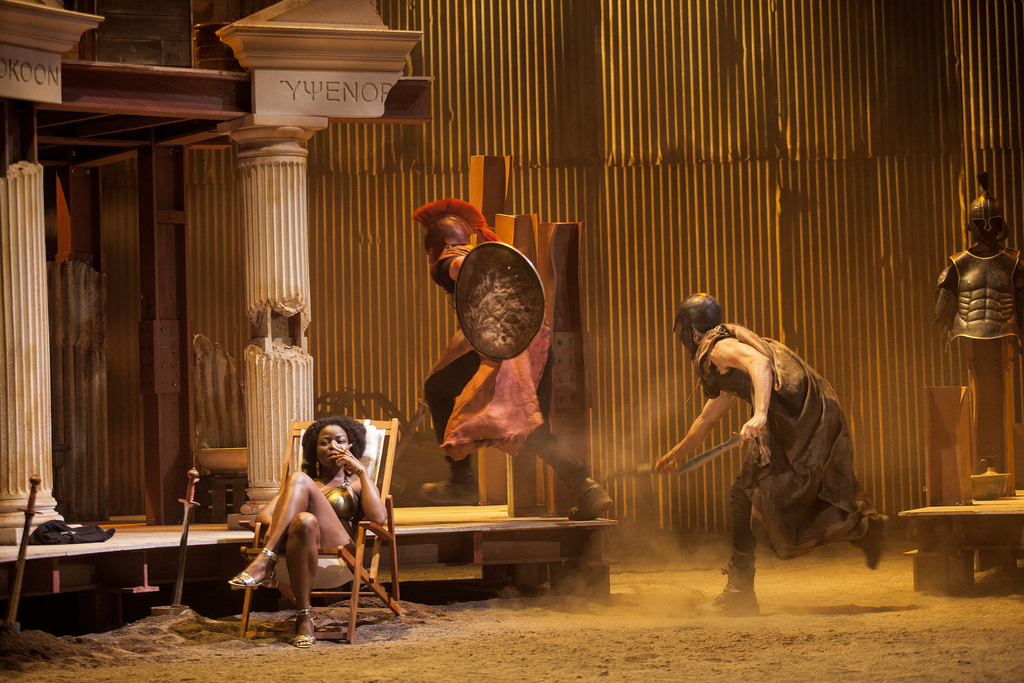
Ben Turner, downstage; Melody Grove, centre; & Emmanuella Cole, upstage.

Ben Turner, downstage; Melody Grove, centre; & Emmanuella Cole, upstage.

“This Iliad is forcefully staged and has the vehemence and colour of its core story.”

Editorial Rating:3 Stars Nae Bad

Mark Thomson’s last production as Artistic Director of the Lyceum for the past 13 years.

It is unsurprising that there’s plague about. There are no zips on the body bags on this beachhead and the Scamander River is full to overflowing with the dead. There’s Achilles’ refusal to dispose of Patroclus’s corpse until after he has killed Hector and then there’s the desecration of Hector’s body by lashing it to a chariot and dragging it through the dirt for twelve days, face down. No wonder – actually, yes, a lot of wonder is required – that Apollo took pity and ‘round him … wrapped the golden shield of storm so his skin would never rip’. Some say it was rose oil.

As epic tales go The Iliad is still the catchy, highly contagious one. It has tragic, raging action, love and sex, heroes and honour. There are no villains to speak of, just the ‘terrible beauty’ of Helen and the ‘smooth, full breasts’ of Aphrodite to sing of. Communicable? Certainly. Containable? Hardly.

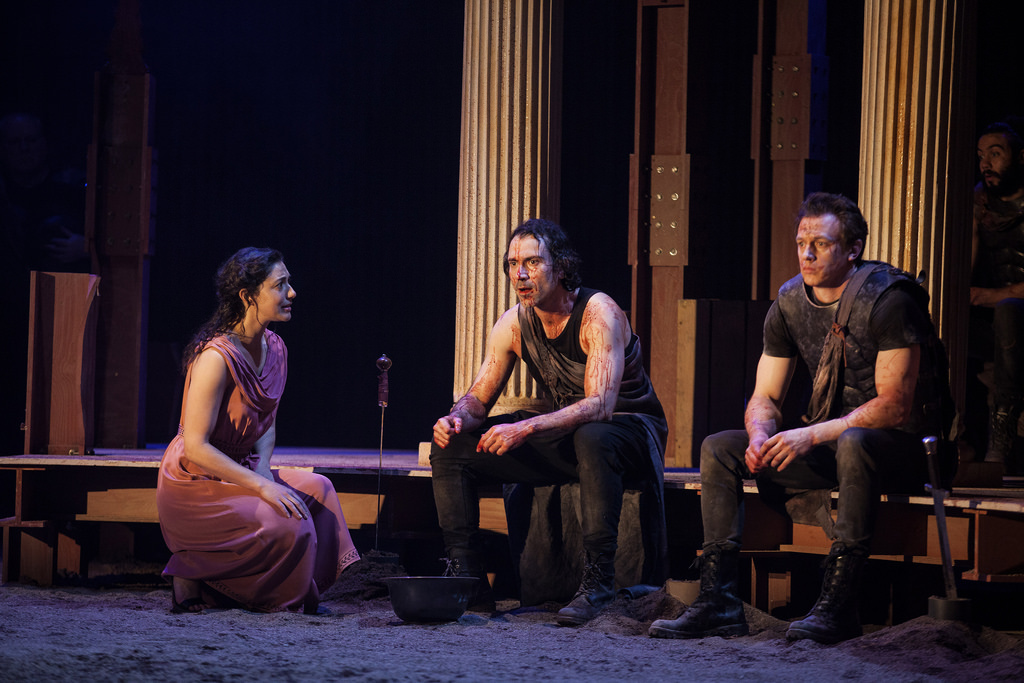
Emmanuella Cole, left; Ben Dilloway centre; & Rueben Johnson, right, as Diomede.

Emmanuella Cole, left; Ben Dilloway centre; & Rueben Johnson, right, as Diomede.

Fearless Mark Thomson takes writer Chris Hannan’s evocative script and directs an intrepid cast of twelve. Karen Tennent’s imposing set has broken columns and half pediments left and right with plenty of space and height for gods to take it easy in and for the Trojan women to look out anxiously over the ramparts. A massive wall of corrugated ‘bronze’ curves around them and the dust sometimes hangs in the air around a leather cuirass and plumed, hollow eyed helmet. The lighting design by Simon Wilkinson is as careful and as atmospheric as his work in Bondagers.

But there are 15,693 hexameter lines in Homer’s Iliad and probably as many ‘brazen spear points’ and slamming shields. What to do with them all? Thomson – to make an attractive prosaic point – starts his theatrical shebang with a baby’s cry and a cobbler hitting nails into a boot. (Think the traditional 3 knocks that alert a French audience to the start of a performance). More formally, several scenes begin and end as characters are dressed for their part, accompanied by near liturgical chant. No need though for Zeus (Richard Conlan) to dress up. His boxers and loose robe are as much Mustique as Olympus. Hephaestus (Daniel Poyser) has his iPad on the beach. ‘White-armed’ Hera (Emmanuella Cole) drifts in straight off Ebony magazine’s style pages and tells all. This is one all-mighty queen god who seems to owe her name to having had it up-to-here with her philandering husband (and brother BTW). We’re with you there, sister.

I worship Thetis,  because of passionate playing from Melody Grove, but otherwise these gods are the diverting side-show and narrative markers to the centre stage profiling of Achilles (Ben Turner). He stands, blood streaked, against all-comers, starting with ‘wine-mouth’ Agamemnon (Ron Donachie). There is pathos in the fine scene between the moping and vengeful Achilles and the shade of his beloved Patroclus (Mark Holgate) and the song at his companion’s funeral of his ‘head like a poppy drooping’ is an unlikely hit,  but it’s Thetis’s son vs. Hector (Benjamin Dilloway) that exercises fight director Raymond Short to his utmost. As well it might when he’s up against Brad Pitt and CGI – and a younger audience. Perhaps pounding Hector’s brains out is beyond even a screenplay.

Amiera Darwish, left, as Briseis; Ben Turner, centre; & Mark Holgate, right, as Patroclus.

Amiera Darwish, left, as Briseis; Ben Turner, centre; & Mark Holgate, right, as Patroclus.

This Iliad is forcefully staged and has the vehemence and colour of its core story. It is fiercely directed and there is a heart and soul to every performance, mortal or immortal, but it is so down to earth that it puts gods into deckchairs on a flyblown lido and so the topless towers of Ilium are levelled. I think it’s Hecuba (Jennifer Black) who says, ‘You clutch at emotions like clutching at straws’. That’s the problem when you go head-to-head with Homer.


nae bad_blue

Star (blue)Star (blue)Star (blue)

Reviewer: Alan Brown (Seen 26 April)

Go to The Iliad at the Lyceum.

Visit Edinburgh49‘s Lyceum archive.

Right Now (Traverse: 19 April – 7 May ’16)

Photos: Helen Murray

Photos: Helen Murray

“Funny and clever, disturbing and salacious”

Editorial Rating: 4 Stars

A Traverse Theatre Company, Theatre Royal Bath Ustinov Studio and Bush Theatre co-production.

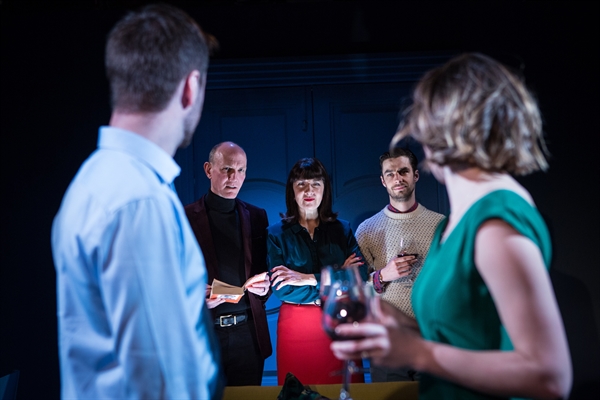
Ben is a junior doctor. He and Alice have been together for seven years and their work/life balance is screwed. As it happens, so far so familiar. Right now they’ve been in their new flat for six months, have just got the baby’s room to do, and things will get better. Only they don’t. Instead neighbours Juliette and Gilles and their son François come right on in from across the hall ….. Meet the Fockers from Quebec, everyone: with a ‘u’, inappropriate, out of order and way, way, out of bounds.

You watch your step in this pressing and uncomfortable comedy. You’re never too sure what’s underfoot or where it’s going. There’s a godawful squeaky toy behind the sofa and half a glass of red on the floor. ‘Beware’ should travel around the set like LED advertising at a sports ground. Beware Juliette with her penchant for flashing her knickers; beware Gilles’ prurient touch and tongue; beware François’s lacerating commentary. “They’re a bit odd” is Alice’s bang on estimate. “I like them” is Ben’s disastrous opinion. It’s funny and clever, disturbing and salacious, and very well performed.

Michael Boyd directs this production, which is a cracking compliment to French-Canadian writer Catherine-Anne Toupin. It looks clean, like a Farrow and Ball paint job by designer Madeleine Girling where the quality of the finish should never be in question. All the more effective, then, when a kind of moral distemper takes hold and it all gets corrupted, goes off-colour and becomes dubious. Guy Williams as Gilles is absolutely loathsome because his seduction of Alice is like a pet research project. He also, incidentally, proves that a black roll neck jumper and brown jacket are about as louche as it gets. Maureen Beattie, ever the mistress of the bewitching voice, is Juliette the mother temptress, against whom all resistance is futile. Just sticking a plaster on Dr. Ben’s hand makes him go weak at the knees. François – jittery and wacky by Dyfan Dwfor – may be appalled by his parents’ behaviour but is just as complicit.

Lindsey Campbell as Alice

Lindsey Campbell as Alice

If Toupin isolates a character, it’s Alice. The plot would push her under but she won’t go. Listen up in scene 5 for the psycho pairing of Ben (Sean Biggerstaff) and ‘Benny’ (that would be Biggerstaff too) but Alice stays there, screaming for help really. Lindsey Campbell has to do grieving and dirty dancing and horribly vulnerable all at once, which is why the sex is so desperate. It’s a class act and I think is what the show’s flier describes as traumatic, ‘teasing and thrilling’.

Right Now is as billed. It’s edgy, imminent, and contemporary, which makes it kind of Shakespearean: François as Feste maybe, Alice as the abused and distraught Ophelia; Juliette becomes Lady Macbeth, who has given suck, etc. Weird.

Star (blue)Star (blue)Star (blue)Star (blue)

Reviewer: Alan Brown (Seen 19 April)

See Right Now at the Traverse

Visit Edinburgh49‘s Traverse archive.