The Academy of Saint Martin In The Fields (Usher Hall: 10 January 2016)

Image: ASMF org.

Image: ASMF org.

“The quality of the playing was at a consistently high standard throughout.”

Editorial Rating:  4 Stars:  Nae Bad

A cold wet sleety January afternoon did not deter the hardy Edinburgh cognoscenti from gathering eagerly and loudly in the foyer of the Usher Hall on Sunday.  The Hall’s Twitter feed had advised  the 250 or so who had arranged to pick up their tickets from the box office to come early because of demand.  To begin with this certainly stopped the ticket queue from standing in the rain, and one got the impression the queue wouldn’t have minded anyway, but by 2.45pm the line was well out of the doors.

The draw was, of course, The Academy of Saint Martin In The Fields, perhaps the finest chamber orchestra in the world, now undergoing a new lease of life under the directorship of player/conductor Joshua Bell, subway busker and near megastar. Bell was certainly a brilliant catch for this magnificent band after Sir Neville Marriner’s retirement four years ago.

The other huge name on the bill was cellist Steven Isserlis, again, world class in stature.  The combined group are on a UK and European Tour, and it was Edinburgh’s turn to hear the magic.

The programme selection was both esoteric and matinee attractive.  The concert was relatively short, at a total of less than an hour and a half’s playing time, but nobody left feeling they had been short changed.  In art, as perhaps in matters of the heart, it is not so much the duration, but the intensity of the experience that provides the enduring memory.

The programme began with a snippet by Dvorak, “Silent Woods”, originally  “Waldesruhe”, a piece for piano for four hands, later transcribed for cello, and ultimately for cello and orchestra, which was the version we heard. Quiet, gentle, soothing, with flavours, understandably, of Smetana’s Ma Vlast, one wondered whether this lullaby-like jewel, played with such beguiling ease, would send the postprandial audience to sleep.

If it did (and the enthusiastic applause suggested otherwise) the blast of Beethoven’s Eighth Symphony would have them wide awake in no time.  This is not a great symphony, and apart from the lively Allegro vivace con brio, which the orchestra delivered in cracking form, the remaining three movements (a comment on the composition, not the playing), save for a spirited final Allegro vivace, plodded along a little.

After the interval we were treated to the second movement from Schumann’s posthumously published violin concerto,  along with a tiny but fascinating codetta written by Benjamin Britten.  Ten minutes of understated, beautiful playing, with Bell the absolute master of his art.

The concert ended with the “must have” item, the Brahms Double Concerto for Violin, Cello and Orchestra. What followed was secure, utterly capable ensemble playing with the two soloists interweaving with each other as warp and weft.  There was none of the stodginess you sometimes get in Brahm’s full on orchestration with the band moving nimbly through the familiar passages in support of the soloists.

Overall, not only did this concert have eminent soloists and an interesting programme, the quality of the playing was at a consistently high standard throughout.  At the time of their foundation 55 years ago, Sir Neville Marriner promised that the Academy would never go on stage unless thoroughly rehearsed.  True today as it was then, what we got was  not so much a concert as a performance, in the truest and fullest sense of the word.

nae bad_blue

Star (blue)Star (blue)Star (blue)Star (blue)

Reviewer: Charles Stokes (Seen 10 January)

Go to the Academy of St Martin’s in the Field.

Visit the Usher Hall and archive.


Scottish Chamber Orchestra: John Butt (Queen’s Hall: 10 Dec. ’15)

11 generations john butt real square listing

“But few will now be able to forget the jazz-like syncopations and whirling demisemiquavers”

Editorial Rating:  4 Stars

“Since 13 May 1871 Bach’s blood has ceased to flow in mortal veins!” concluded the Aberdonian scholar Charles Sandford Terry in 1930. Despite Johann Sebastian having 20 children, ten surviving to adulthood, it was for many years thought this centuries-old line of exceptional musicians had died out.

Genealogists have been delighted to discover, however, that the eldest son Wilhelm Friedemann Bach was not only a highly productive (if temperamental) musician, but through his fecund daughter a tiny band of U.S. based descendants have in recent years been discovered. At the Queen’s Hall on Thursday 10 December, it was for many the survival of W. F. Bach’s “Adagio and Fugue” F 65 (c.1740-5) which was the great discovery; the limpid flute-writing of adagio giving way to a vigorous and angular fugue of high order: subject, countersubject, stretto and inversion being hurled, attaco, by the enthusiastic players of the SCO.

Conductor John Butt firstly gave a stylish rendering of Johann Sebastian’s 4th Suite (Ouverture) in D, BWV 1069. The repetitive nature of gavottes, minuets and bourreés can sound tritely mechanical, but with subtle changes to phrasing and articulation, coupled with flexible tempi, the whole became animated and variegated, right up to the triumphal final Rejouissance.

Central to the programme was virtuoso bassoonist Peter Whelan, in the demanding C. P. E. Bach Concerto in A minor, Wq 170. Few will have heard this adaptation for bassoon before; but few will now be able to forget the jazz-like syncopations and whirling demisemiquavers. It is this superb instrumentalist who makes the galant writing a hit, and without him ovation and encore would be lesser or absent. Whereas the W. F. Bach work is a tribute to papa (reminiscent the more horribly difficult fugues of the Well Tempered Clavier (BWV 846-893), his brother at the court of Frederick the Great, namely Carl Phillip Emmanuel, is here in full rebellion against the structural emphasis of the father. The work swerves in mood and tempo: a son in a traffic-weaving go-faster Porsche, attempting to overtake the father in his stately processional Mercedes ……

The programme thus takes us from Baroque to Classical via the half-world represented by the Bach sons. To end: the well-familiar Symphony No 40 in G minor by Mozart; in the acoustic comfort-zone for many. Nevertheless, the minor key keeps the audience in thrall to the hints of tonal instability, and even menace, interplaying with the gracious theme of the first movement. At one point the strings’ suspirum seems more like expiration than sighing; and the natural horns are strangely dominant to one side of the hall. Their authentic resonance enlivens the sound universe for the work; more balance would be a further plus: try horns centre stage?

Meanwhile, let’s repeat this programmatic formula: the trusted repertoire enlivened by the Butt baton, and supplemented by the artful compositions of the younger Bachs. The audience went away filled with good things. May they return for more  …..


Star (blue)Star (blue)Star (blue)Star (blue)

Reviewer: Peter Smaill (Seen 10 December)
Peter is a guest contributor to Edinburgh49 and Chairman of Bach Network UK, a charity founded by John Butt and others to facilitate international dialogue and understanding of the works and context of Johann Sebastian Bach, amongst musicologists, performers and enthusiasts.

Go to the Scottish Chamber Orchestra

Visit the Queen’s Hall archive.

♫ Royal Scottish National Orchestra (Usher Hall: 20 Nov.’15)

“Their playing under Jun Markl’s baton was fluent and enjoyable throughout”


Editorial Rating:  5 Stars: Nae Bad

 Have you ever been to a concert hall, be it Royal Albert, Royal Festival, or, in this case, Usher, stared at the organ and pipes behind the choir stalls and wondered “Ooh, I wonder what that sounds like”?  Well, tonight we got the opportunity to do precisely that – twice!

The RSNO put on a night of late romantic music from both the 1850s and 1930s. Their playing under Jun Markl’s baton was fluent and enjoyable throughout,  and organist Thierry Escaich showed what a very fine artist he is on an equally splendid instrument.

Our appetiser was Liszt’s Les Preludes, the third of his thirteen symphonic poems and one of the earliest of its kind.  There has been the usual debate about what the work was a prelude for, including being influenced by Lamartine or his disciple Joseph Autran.  Ultimately Liszt himself appears to have settled the matter in a letter to cousin Eduard Liszt, asserting that Les Préludes represents the prelude to Liszt’s own path of composition. Maybe we shouldn’t attach too much importance to names.

The work itself is for a full orchestra and so warmed us up nicely for the major works to come. Liszt and Chopin are among the world’s greatest ever pianists, and it has always intrigued me how the former is much more skilled at orchestration than the latter.  This was a mature work well played that seemed to tell a story.  The flutes, that I felt held back slightly a couple of weeks ago in Tchaikovsky’s Romeo and Juliet Overture-Fantasy gave a beautifully clear account of themselves in the opening counter balance with the strings and then throughout. Rich, relaxing horns and warm string tones brought us to a happy conclusion.

We went forward in time some eighty years to hear Poulenc’s Concerto for Organ, Strings and Timpani. Commissioned by Princess Edmond de Polignac  and premiered a full five years later in 1939 by no less than Maurice Durufle on organ, it is a work of contrasts, from shades of gothic horror to interludes of quiet reflection. Organ, strings and timpani interplayed seamlessly in a myriad odyssey of seven movements.  A twenty minute treat, it is one of my favourite works for organ and orchestra and organist Thierry Escaich extracted every nuance from the solo part.

To conclude our evening there followed Liszt contemporary Camille Saint-Saens’s 3rd Symphony, more commonly known as the Organ Symphony, although the organ comes into its own only in the final movement. There is the danger of dismissing the remainder of the symphony as we wait for the great piped beast to come into its own, which is a pity, because the work as a whole is melodious, exciting and eminently listenable to.  From the opening violins, pizzicato cello and woodwind to the resounding brass there are wonderful examples of orchestration to which the RSNO did more than justice, producing a seamless flow of glorious music that after the magnificent coda gave way to sustained applause.

nae bad_blue

Star (blue)Star (blue)Star (blue)Star (blue)Star (blue)

Reviewer: Charles Stokes (Seen 20 November)

Go to RSNO

Visit the Usher Hall archive.

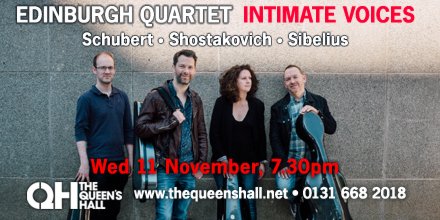
♫ Edinburgh Quartet (Queen’s Hall: 11 Nov. ’15)

“Precision mirrored with passion”

Embedded image permalink

Editorial Rating: 5 Stars:  Outstanding

One of the many appealing aspects of our home string quartet is the creativity of their programming.  Chamber Music is beautiful but a full concert can be a little samey.  Not so tonight.  Who else would start with the young Schubert, and then follow it immediately with Shostakovich, a leap of almost 150 years in composition, and make it work?

This was the second Edinburgh Quartet concert in their Intimate Voices series.  Following its successful launch at St Andrew’s and St George’s West almost a month ago, the Intimate Voices concept highlights the extraordinary intimacy created by the intense exposure and interdependence of the string quartet genre.

The publisher who mistook Schubert’s 10th String Quartet when discovering it posthumously could be forgiven for mistaking it to be a more mature work, but we now know Schubert wrote it when he was sixteen.  Properly fashioned nonetheless, the Edinburgh Quartet immediately developed its luscious, rich and warm tone that quickly drew us in.  Confidently and perfectly executed, this delightful piece with its nuances of Haydn and Mozart set us up for the treats to come.

The Shostakovich String Quartet No 7 proved an exciting thirteen minute contrast.  The F sharp minor key created an atmosphere of loss (Shostakovich’s first wife Nina died suddenly of undetected cancer of the colon. Their marriage had had its moments, but he was irreconcilable to the loss and the work is dedicated to her).  As so often with Shostakovich, the sparse strings have all the unstated menace of a horror movie, the fearful anticipation that worse is to come.  Throughout the three movements the tension gradually built into a cacophony of searing anguish only to fade away into the ether at the end.  Here the Edinburgh Quartet’s playing was undoubtedly world class. Precision mirrored with passion.

After the interval we dropped back fifty years and settled down to Sibelius’ String Quartet “Voces Intimae”.  Even though Sibelius himself was extremely wary of “names” for his compositions, (“You know how the wing of a butterfly crumbles at a touch? So it is with my compositions; the very mention of them is fatal”) the applied nomenclature is apt as it was self-penned.  The intimate nature of the work was immediately set by the opening violin and cello passage.  It is almost a feeling of reassurance that one gets from the Quartet’s complete homogeneity; they are at ease with each other and handled the frequent dynamic and tempo changes assuredly. They kept the spirit going all the way through the five movement work; their playing at times spellbinding, with aching tenderness in the Adagio di molto where Sibelius wrote the words Voces Intimae on the manuscript, and then frantic, with a wild moto perpetuo in the final Allegro, as they drove it to a breathtaking finish.

Not many promoters would put on a programme as varied as we had tonight.  It gave us a rich panoply of romantic music spanning 150 years.  The Quartet’s reputation continues to grow.

outstanding

StarStarStarStarStar

Reviewer: Charles Stokes (Seen 11 November)

Go to the Edinburgh Quartet.

Visit the Queen’s Hall archive.

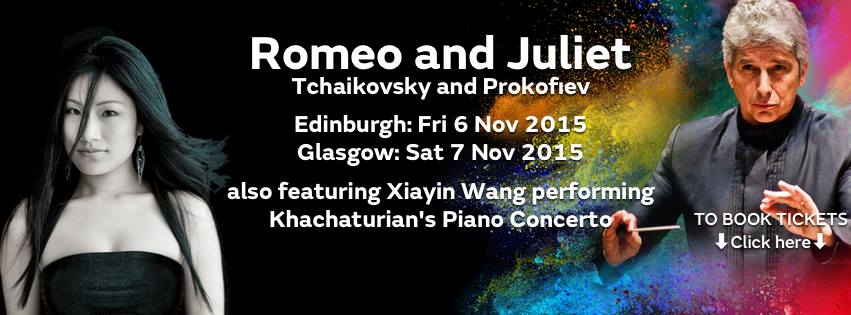
♫ Royal Scottish National Orchestra (Usher Hall: 6 Nov ’15)

“the playing was of the highest calibre…….”

Photo: RSNO.

Photo: RSNO.

 4 Stars:  Nae Bad

“If music be the food of love, play on…”  Yes, that’s from “Twelfth Night”, for love was the leitmotif of Friday evening’s RSNO concert at the Usher Hall, but the principal vehicle was that most famous love story of all, of Juliet and her Romeo.

While many others, from Gounod to Leonard Bernstein, have told this tale in musical form, there is no doubt that within the classical arena it is Tchaikovsky and Prokofiev who hold sway and these two were the chosen representatives for this part of the evening’s programme.

The concert opened with Tchaikovsky’s Romeo and Juliet Overture-Fantasy.  Tchaikovsky abandoned plans for an opera, never mind a ballet, and yet this 20 minute work is like a short, single movement symphony.  Not telling the story as such, it portrays its three main elements: the solemnity and compassion  of the Friar, the passion of the young lovers, and the festering hostility between the Montagues and Capulets.

RSNO Music Director Peter Oundjian chose to interpret this magnificent work conservatively and thereby avoided the emotion and thrills one might expect from, say, a Russian orchestra. As a consequence one found oneself wanting more, particularly from the all important flutes.  There were issues of balance among woodwind and brass, and a generally slow tempo.  Perhaps, inevitably, the band was settling in.

In between the Tchaikovsky and Prokofiev came the brilliantly chosen Khachaturian Piano Concerto.  The concerto, written some eighty years ago, was an ambitious attempt to blend Caucasian folk music influences within a bravura Liszt style masterwork. It arguably doesn’t quite bring it off, but is high on excitement, melody and romance, and is more akin to Prokofiev than the oft compared Tchaikovsky.  A clever piece of transitional programming.

It was with a sense of joy (and a bit of relief) that here, as for the rest of the evening, the RSNO gave of their very best.  The playing was taut, together, focussed.  Brass and woodwind complementing each other perfectly, a warm bass clarinet providing rich undertones for the clear and bright strings.

Soloist Xiayin Wang gave an exciting, bravura and thoroughly comprehensive interpretation in her high octane premiere performance of the work.  After the wake up call of the Allegro ma non troppo e maestoso we were soothed by the tender and melodic Andante con anima before the joyful resolution of the familiar third movement, appropriately designated as Allegro brilliante.  Orchestral accompaniment was punctuated by two extensive solo interludes, if not quite cadenzas, which the soloist disposed of magnificently. As a result I got more from work than ever before, and now consider it as far more than just Prokofiev-lite, and had the privilege of telling the soloist so as she charmingly and modestly mingled with us in the interval, sipping from a bottle of mineral water and shimmering in her gown.

Following the interval we were treated to a suite of 20 excerpts from Prokofiev’s ballet Romeo and Juliet that included some of its most romantic, accessible passages, until thirty minutes in, the bleak, searing awfulness of Tybalt’s Death hit us right between the eyes. Again, perhaps a little more restrained than a Russian orchestra might portray it, nonetheless, the RSNO’s playing was of the highest calibre: rich, flowing cadences, a silvery sheen on the strings, well balanced, richly toned woodwind and brass, and in the background the tuba and timpani sounding like a death knell.

Taken as a whole this was a cleverly programmed and highly effective concert that showed the RSNO’s playing, when into its stride, as being of the very finest.  Kicking off with the Tchaikovsky demands a leap of faith and perhaps a little less caution.  Nonetheless we had a glorious, generously programmed evening. There was a real lift to my walk home across the Meadows.

nae bad_blue

Star (blue)Star (blue)Star (blue)Star (blue)

Reviewer: Charles Stokes (Seen 6 November)

Go to RSNO here

Visit the Usher Hall archive.

♫ Scottish Chamber Orchestra (Queen’s Hall: 29 Oct ’15)

“A Melodious Maiden”

5. maiden real square listing

Editorial Rating: 4 Stars:

The Scottish Chamber Orchestra offered a diverse programme of Nordic delight at their recent gig at the Queen’s Hall.

First off was the world premiere of Verdigris by Finnish composer Lotta Wennakoski.  This was an arresting work; the astonishing opening pianissimo glissandi giving way to scary strings with woodwind interjections in a whole that was hard to reconcile with its claimed Sibelian, En Saga and Andante Festivo influences.  Unmelodic with little in the way of harmony, it reminded one of a twisted Nordic Noir one might see on BBC4.  Unfortunately, the coda was as unexpected as it was ineffective.

Denmark came next with one of the most full throated, committed renditions of Nielsen’s Violin Concerto I have had the pleasure of hearing.  Finnish violinist Pekka Kuusisti took complete command of the work and gave an electric performance including not one, but two virtuoso cadenzas.  Warm, well balanced sound between soloist and orchestra with french horns skilfully intervening between strings and soloist.  This was a thoroughly assured, well crafted performance in which the tension built irrevocably into a pulsating climax that brought prolonged and deserved applause from a grateful audience.  Kuusisti’s easy personal style built a popular rapport, and the two polkas he played by way of encore were a treat.

The second part of the programme was an ingenious piece of musical craftsmanship by conductor Tuomas Hannikainen.  Sibelius’s one published opera, The Maiden in the Tower, has a feeble plot and a poor libretto.  It also contains some of the most glorious, melodic passages the composer has ever written, all in the space of less than three quarters of an hour. Hannikainen cleverly reorchestrated the work as an orchestral suite.  So often this doesn’t really work, but in this case it really did.  We started with a bright, colourful overture in almost Hollywood style, a glorious romp, even Operetta, which morphed into something more akin to the great Finn’s gorgeous and melodic house style. If the brass had it in the Nielsen, the strings came into their own in this work, with a breathtaking idyll played by the flute, answered by urgent, plangent cellos. Hannikainen has created a work of real integrity that deserves committing to recording.

We had a wonderful joyride through the best of Finnish music, and the huge smiles and embraces amongst the band showed that they had too.  Bravo!

Star (blue)Star (blue)Star (blue)Star (blue)

Reviewer: Charles Stokes (Seen 29 October)

Go to the Scottish Chamber Orchestra

.

♫ The Edinburgh Quartet (St Andrew’s and St George’s West: 14 Oct.’15)

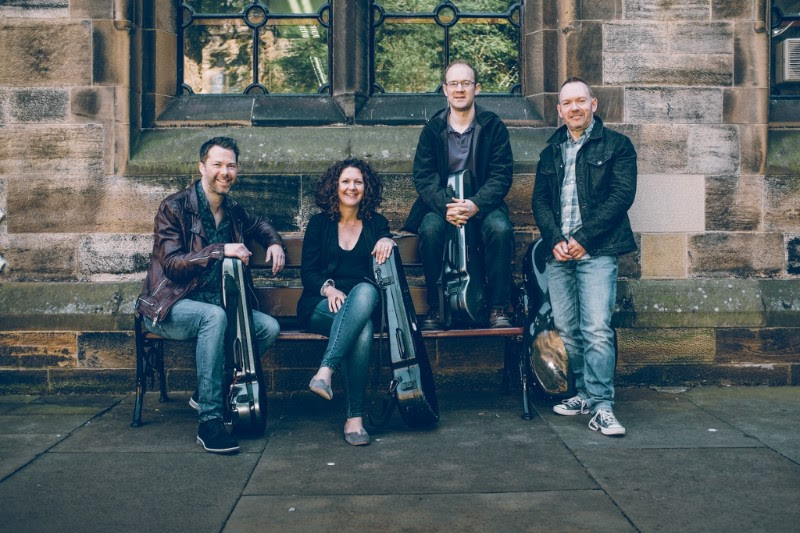
The Edinburgh Quartet. Photo: EQ.

“Intimacy and Excellence”

Editorial Rating:  5 Stars

The Edinburgh Quartet premiered its 2015/2016 Season with not so much a concert as a cleverly curated musical event.

The theme of The Edinburgh Quartet’s first trimester is “Intimate Voices”.  First Violin Tristan Gurney introduced the evening by explaining that they wanted a theme that reflected the medium’s capacity for intimate expression, and that there were many composers who chose to write for it because of this intimacy at the very core of the musical experience.  They exploited this brilliantly with their choice of opening work, Janacek’s String Quartet No. 2, Intimate Letters.

Janacek’s work is rewarding but challenging, and to plunge headlong into this incredibly varied, complex and intense oeuvre at a rush hour 5.30pm concert after a hard day at the office would have been a lot to ask of even the most ardent fan.  So they didn’t.  They led us in gently, and it made for an informed, involved and thoroughly inclusive musical evening of delight and difference.

The band kicked off with a beautifully together, easy on the ear interpretation of a waltz by Janacek’s contemporary Dvorak, and you immediately had the confidence that here was a quartet at ease with themselves, their music and their audience. We relaxed. Then Tristan got us into Janacek with his pleasing Romance for Violin ( accompanied on piano by the versatile second violin Gordon Bragg).  In a bright move that greatly helped us all in the appreciation of the music that was to follow, Edinburgh Makar/Poet Laureate Ron Butlin introduced us to Janacek’s 11 year long,  passionate, barely requited and entirely platonic romance with Kamila Stosslova, and read extracts from his love letters, whose poignancy enhanced the accessibility of the music and put it in context.

And what music it was! A beautifully woven tapestry of multifarious musical styles reflecting the panoply of emotions this extraordinary love affair engendered: bold unison openings, contrasting with passages so quiet that they were barely audible; rich melodic lines; frantic near dissonance; folk song; all greater than the sum of its parts in a way reminiscent of Beethoven’s late quartets. All in, a four movement work of less than half an hour’s duration for just four instruments!

And last, but of course not least, the playing.  Sure, the string quartet is intimate, but it is also a quite disproportionately expressive genre.  The Edinburgh Quartet is a well honed team, delivering demanding notation, phrasing and bowing, including pizzicato and sul ponticello, with not only great capability but real understanding, anticipating and following each other and never absorbed in their own playing at the expense of the group. Yet still with first class individual flair.  Fiona Winning’s viola richly developing and sustaining the theme of Kamila from early on, with Mark Bailey’s cello in confident support and finally getting his moment of glory in the last movement.  The violins, leading, supporting, ducking and diving throughout this rich, multi faceted and immensely enjoyable work.  An artistic and audible treat.

Star (blue)Star (blue)Star (blue)Star (blue)Star (blue)

Reviewer: Charles Stokes (Seen 14 October)

Go to Edinburgh Quartet here.

Visit the Other archive.