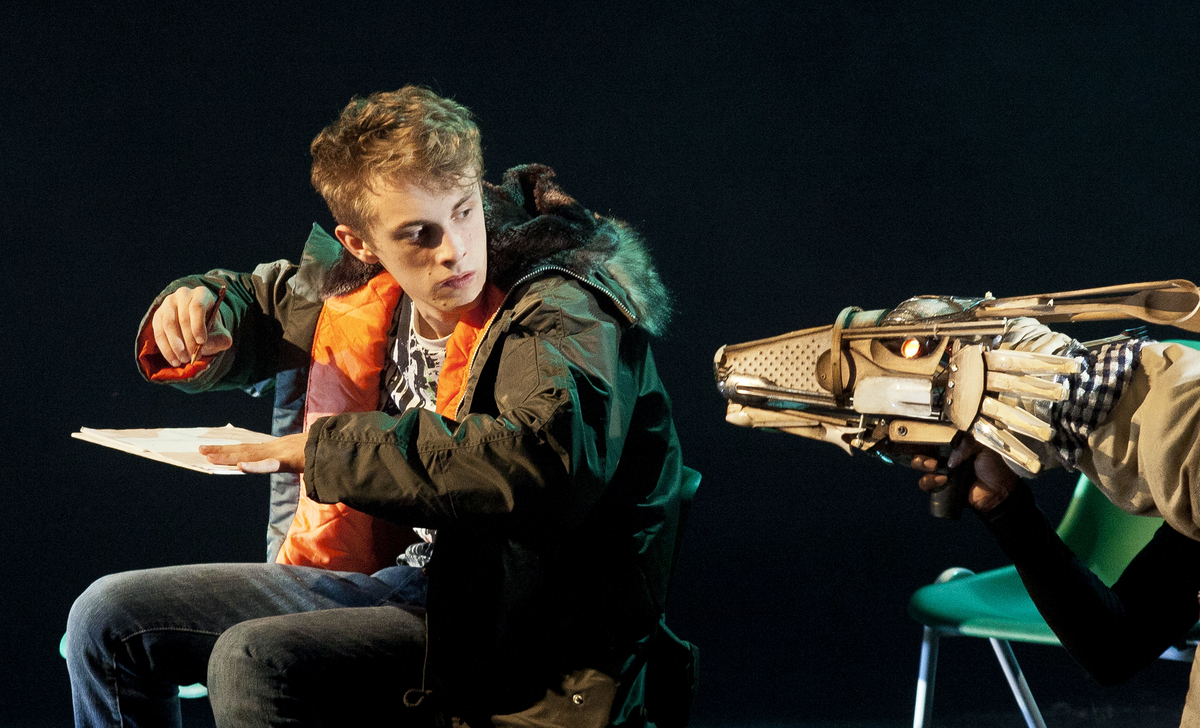
‘Dragon’ (Traverse: 30 Oct – 2 Nov ’13)

Dragon prod pic 4 Drew Farrell

Image by Drew Farrell

“And there are dragons!  Dragons everywhere.  Not the gold-hoarding recluses of British folklore, but the sensuous, bewitching creatures of the Orient”

Editorial Rating: Outstanding

A play for older children and big-hearted grown-ups, Dragon is filled with beauty from its very first scene.  A comforting kind of magic flows from its enchanting, nostalgic backdrop: searchlights pick out a city’s rooftops, while ghostly clouds hang in the moonlit sky.  But this isn’t a Disney fairytale. Within seconds of the opening, we’re thrust into a hospital ward – and there we witness a young teenager, Tommy, bidding his dying mother goodbye.

A host of motifs come together in this stylish, inventive performance.  Black-clad actors prowl the stage, wielding props which make up a dynamic and ever-changing set.  At its best, the choreography is breathtaking; look out for the scenes at Tommy’s school, where he sits still in the centre of the stage and classroom after classroom appears around him.  There’s plenty of humour, and there are elements of stage magic worked in too – props and even actors appear as if from nowhere, thanks to clever misdirection or ingenious tricks of the light.

And there are dragons!  Dragons everywhere.  Not the gold-hoarding recluses of British folklore, but the sensuous, bewitching creatures of the Orient, evoked here through a smattering of technical wizardry and a wealth of compelling puppetry.  As the story rolls on, you’ll come to recognise what Tommy’s dragon represents, and you’ll notice it growing and changing over the course of the play.  Sometimes it’s sinister, sometimes it’s as cute as a puppy, but towards the end it’s a monster… a terror to be fled, or faced down.

As befits a family-friendly show, Dragon’s plot is straightforward, and the emotions it plays on are big and simple ones.  Unaccompanied grown-ups might wish it were a little more nuanced, but if you’ve taken the kids you’ll find plenty of important themes to talk through later.  Tommy’s story encompasses loss, grief, anger and acceptance; along the way he discovers the importance of connecting with others, and learns that inner dragons always seem less scary when you bring yourself to face them head-on.

There’s very little spoken dialogue – which, incidentally, makes Dragon eminently accessible for people who are Deaf or hard of hearing – but the visual delight is accompanied by an atmospheric soundscape, lending tempo and portent to the action on stage.  Being picky, the lighting wasn’t executed quite as flawlessly as the rest of the production, and the slow-mo fight sequences felt hackneyed at times.  But the ending has a beguiling simplicity which complements that gorgeous opening, and there’s wonderment and poignancy in all that comes in between.  A must-see show for children aged 9 and up, and for adults who remember how to play.

outstanding

Reviewer: Richard Stamp (Seen 30 October)
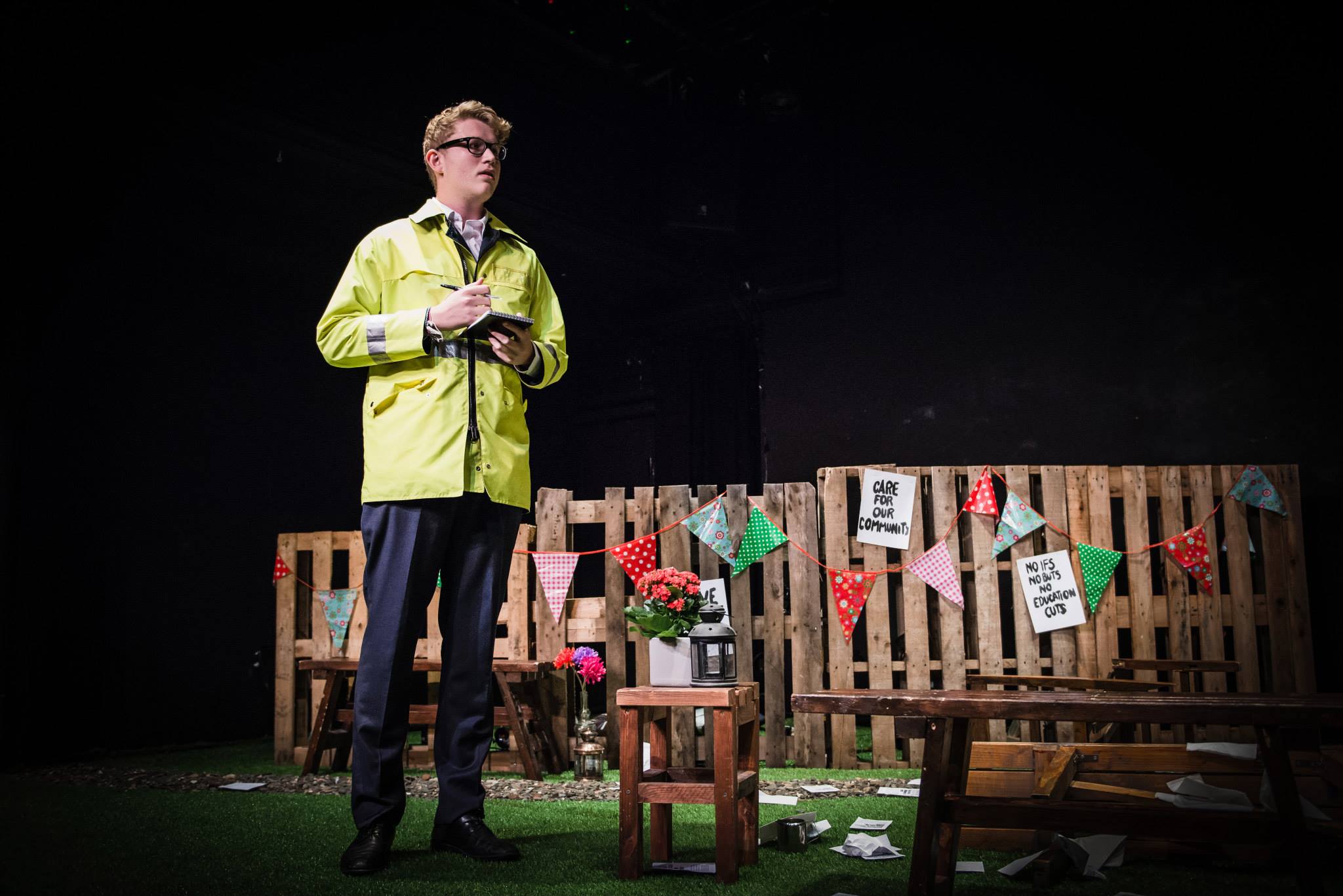
The Oak Tree (Bedlam: 16 – 17 Oct ’13)

965268_10153333436155858_1026221967_o

Image by Daniel Alexander Harris

The Oak Tree is the debut script from young author Ellie Deans, and it’s an impressive start to her writing career.”

Editorial Rating: Nae Bad

There’s a lot to catch your eye about this brand-new play – but the first thing you’ll notice is its expansive set.  Astro-turfing the whole Bedlam stage, it impeccably evokes the eponymous Oak Tree, a fading outdoor café in an equally fading part of London.  With its rustic fence and crunching gravel, the Oak Tree is both timeless and reassuringly familiar… but a man called Mark Duggan has just died in Tottenham, and in the course of a summer’s night, everything will change.

The Oak Tree is the debut script from young author Ellie Deans, and it’s an impressive start to her writing career.  The story’s revealed through well-paced dialogue, free from clumsy exposition; an occasional tendency to labour plot points is the only notable flaw.  Although it’s a political play, the tone is balanced and genuinely thought-provoking, and the characters are refreshingly nuanced too.

There’s both cleverness and chutzpah in the play’s construction, with a frothily entertaining first half yielding after the interval to a far darker tone.  Early highlights include a set-piece comic misunderstanding – which would stand scrutiny alongside many a TV sitcom – and a gloriously toe-curling business pitch, delivered in fearlessly hammy style by actor Robbie Nicol.  There are subtler motifs too: a touching bond between brother and sister, the burden of untold secrets, and the piquant realisation that the things we love can’t last forever.

But the script loses its way a little when it confronts its motivating theme, the riots of August 2011.  What caused the disorder?  Who should we blame? Is there room for understanding, or must we simply condemn?  The play touches on these important questions, but it doesn’t have time to explore many answers.  Deans is at her strongest when she’s pursuing a simpler agenda: illustrating how that summer’s shocking events tore families and communities apart in the parts of London left to deal with the aftermath on their own.

She’s aided in that task by a strong and confident cast.  Will Fairhead plays lascivious rich kid James with considerable relish, successfully drawing just a hint of likeability from his endlessly crass character.  Ella Rogers has the family matriarch nailed, bringing a gut-wrenching sense of tragedy to one emotional scene, while Casey Enochs puts in a finely-balanced performance as the other-worldly Annie – perhaps the most intriguing of Deans’ creations, and certainly the most saddening.

The Oak Tree undulates through a landscape of moods – from uplands of optimism to bleak valleys of despair – and at times, it’s deeply cynical.  But it’s defined throughout by a gentle, affectionate humour, and by characters complex enough to make you care.  Both playwright and cast deserve considerable credit for this engaging, inventive production.

nae bad_blue

‘The Fantasticks’ (Bedlam: 9 – 12 Oct ’13)

1391627_536699813084181_349070085_n

Image by Louise Spence

“Performed in New York almost continuously since 1960, The Fantasticks is a curiously-constructed musical.  The first act is cutesy – sometimes to a fault – telling the knowingly-ridiculous tale of a forbidden teenage romance, and of two fathers’ efforts to control their love-struck offspring.”

Editorial Rating: Unrated

“Try to remember the kind of September / When life was slow, and oh, so mellow,” exhorts The Fantasticks’ famed opening song. Well, they’ve missed September by a week or two, but in every other respect Edinburgh University Theatre Company have fulfilled that brief: this is a warm-hearted, uncomplicated production, which gently lulls you backwards into an agreeably nostalgic haze.  Sadly, however, the lyric also foretells this production’s main weakness.  It’s all just a little bit slow.

Performed in New York almost continuously since 1960, The Fantasticks is a curiously-constructed musical.  The first act is cutesy – sometimes to a fault – telling the knowingly-ridiculous tale of a forbidden teenage romance, and of two fathers’ efforts to control their love-struck offspring.  But after the interval, the scenes grow dream-like and altogether darker, in a dislocating transition which this particular production never quite pulled off.  It doesn’t help that the original boy-meets-girl plot is wrapped up by the end of Act One, leaving the second half to lumber away from an awkward standing start.

But we can’t blame EUTC for the plot’s idiosyncrasies, and they’ve certainly had fun responding to its old-style American charm. Jordan Robert-Laverty neatly captures the clean-cut naivety of a 1950’s college boy, while Claire Saunders excels as his swooning 16-year-old paramour, milking the comedy of her role without ever quite crossing the line into over-acting.  Saunders’ voice lends her songs an almost operatic tone, and contrasts nicely with the more natural style of Alexandre Poole – who brings an understated authority to his multi-faceted role as both villain and narrator.

Muscially, however, the performance suffered from frustrating inconsistency, with almost all the actors delivering showstopping performances for some songs while clearly struggling with others.  The surprising exceptions were Daniel Harris and Thomas Ware, playing the two teenagers’ warring fathers; their characters seem at first to be formulaic comedy chumps, but soon prove to be far more.  Harris and Ware both have fine, comforting voices, and their harmonising duets proved a thoroughly unexpected highlight – enhanced by some genuinely witty, if slightly methodical, dance.

Indeed, the whole production demonstrates a playful sense of physicality, with an impressive swordfight (and gloriously extended death scene) raising the stakes just before the interval.  But whenever the pace wasn’t being dictated by the music, the energy ebbed away.

So EUTC’s production isn’t quite fantastic – but it’s an enjoyable, stylish, and life-affirming version of a cosily charming musical. Credit must also go to pianist Dan Glover and harpist (yes, harpist) Sam MacAdam, whose position at the side of the stage brings them very much into the heart of the performance.  It’s a show I’ll be sure to remember.