The Iliad (Lyceum: 20 April – 14 May ’16)

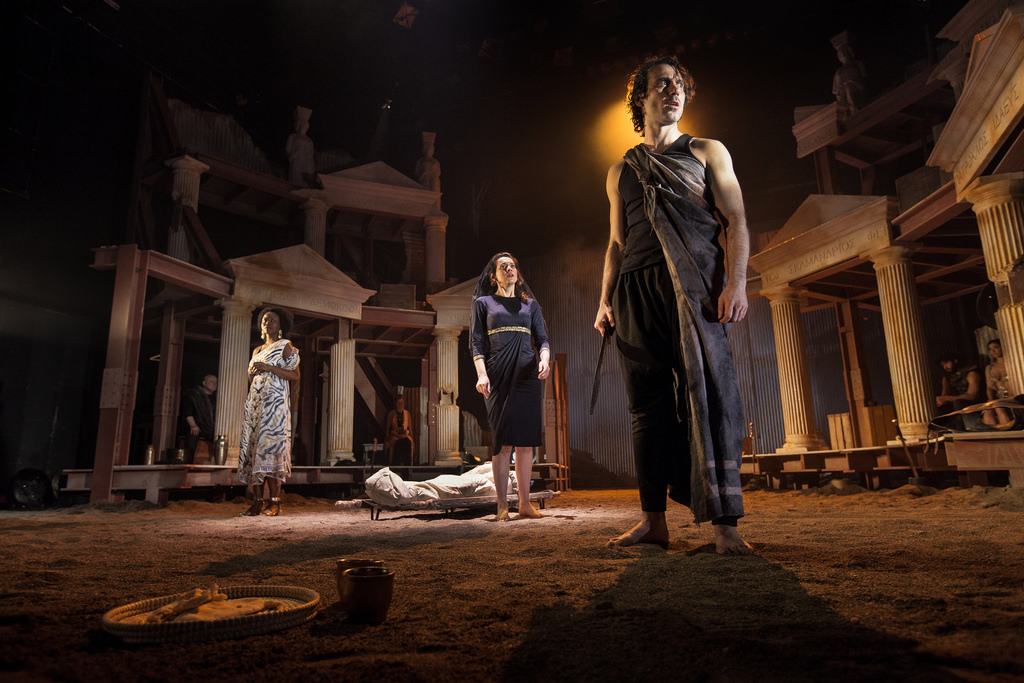
Ben Turner, downstage; Melody Grove, centre; & Emmanuella Cole, upstage.

Ben Turner, downstage; Melody Grove, centre; & Emmanuella Cole, upstage.

“This Iliad is forcefully staged and has the vehemence and colour of its core story.”

Editorial Rating:3 Stars Nae Bad

Mark Thomson’s last production as Artistic Director of the Lyceum for the past 13 years.

It is unsurprising that there’s plague about. There are no zips on the body bags on this beachhead and the Scamander River is full to overflowing with the dead. There’s Achilles’ refusal to dispose of Patroclus’s corpse until after he has killed Hector and then there’s the desecration of Hector’s body by lashing it to a chariot and dragging it through the dirt for twelve days, face down. No wonder – actually, yes, a lot of wonder is required – that Apollo took pity and ‘round him … wrapped the golden shield of storm so his skin would never rip’. Some say it was rose oil.

As epic tales go The Iliad is still the catchy, highly contagious one. It has tragic, raging action, love and sex, heroes and honour. There are no villains to speak of, just the ‘terrible beauty’ of Helen and the ‘smooth, full breasts’ of Aphrodite to sing of. Communicable? Certainly. Containable? Hardly.
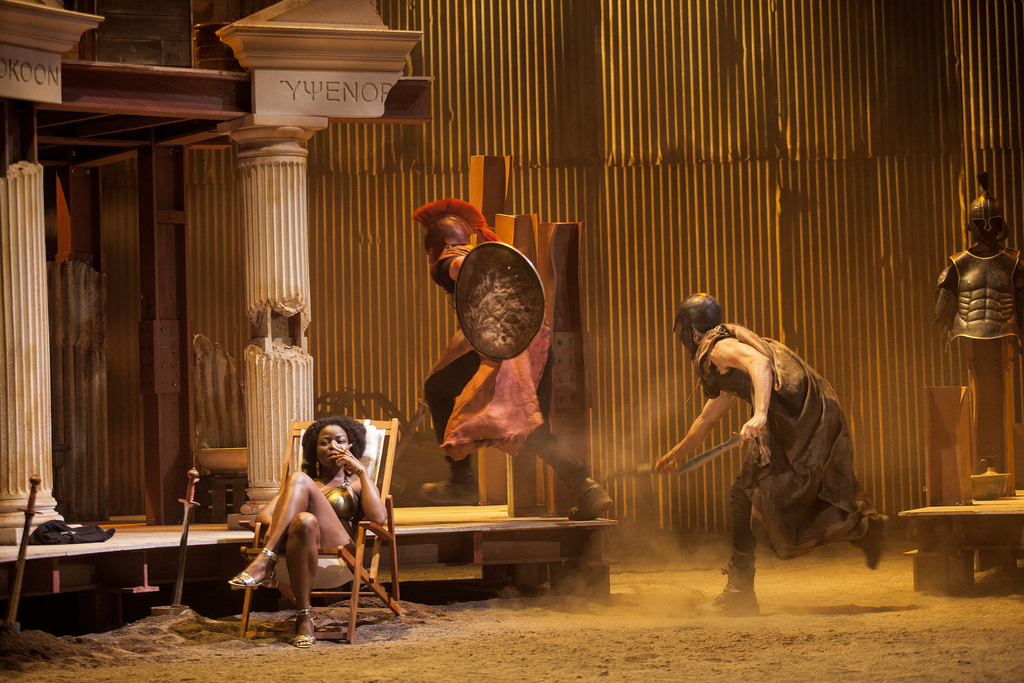
Emmanuella Cole, left; Ben Dilloway centre; & Rueben Johnson, right, as Diomede.

Emmanuella Cole, left; Ben Dilloway centre; & Rueben Johnson, right, as Diomede.

Fearless Mark Thomson takes writer Chris Hannan’s evocative script and directs an intrepid cast of twelve. Karen Tennent’s imposing set has broken columns and half pediments left and right with plenty of space and height for gods to take it easy in and for the Trojan women to look out anxiously over the ramparts. A massive wall of corrugated ‘bronze’ curves around them and the dust sometimes hangs in the air around a leather cuirass and plumed, hollow eyed helmet. The lighting design by Simon Wilkinson is as careful and as atmospheric as his work in Bondagers.

But there are 15,693 hexameter lines in Homer’s Iliad and probably as many ‘brazen spear points’ and slamming shields. What to do with them all? Thomson – to make an attractive prosaic point – starts his theatrical shebang with a baby’s cry and a cobbler hitting nails into a boot. (Think the traditional 3 knocks that alert a French audience to the start of a performance). More formally, several scenes begin and end as characters are dressed for their part, accompanied by near liturgical chant. No need though for Zeus (Richard Conlan) to dress up. His boxers and loose robe are as much Mustique as Olympus. Hephaestus (Daniel Poyser) has his iPad on the beach. ‘White-armed’ Hera (Emmanuella Cole) drifts in straight off Ebony magazine’s style pages and tells all. This is one all-mighty queen god who seems to owe her name to having had it up-to-here with her philandering husband (and brother BTW). We’re with you there, sister.

I worship Thetis,  because of passionate playing from Melody Grove, but otherwise these gods are the diverting side-show and narrative markers to the centre stage profiling of Achilles (Ben Turner). He stands, blood streaked, against all-comers, starting with ‘wine-mouth’ Agamemnon (Ron Donachie). There is pathos in the fine scene between the moping and vengeful Achilles and the shade of his beloved Patroclus (Mark Holgate) and the song at his companion’s funeral of his ‘head like a poppy drooping’ is an unlikely hit,  but it’s Thetis’s son vs. Hector (Benjamin Dilloway) that exercises fight director Raymond Short to his utmost. As well it might when he’s up against Brad Pitt and CGI – and a younger audience. Perhaps pounding Hector’s brains out is beyond even a screenplay.
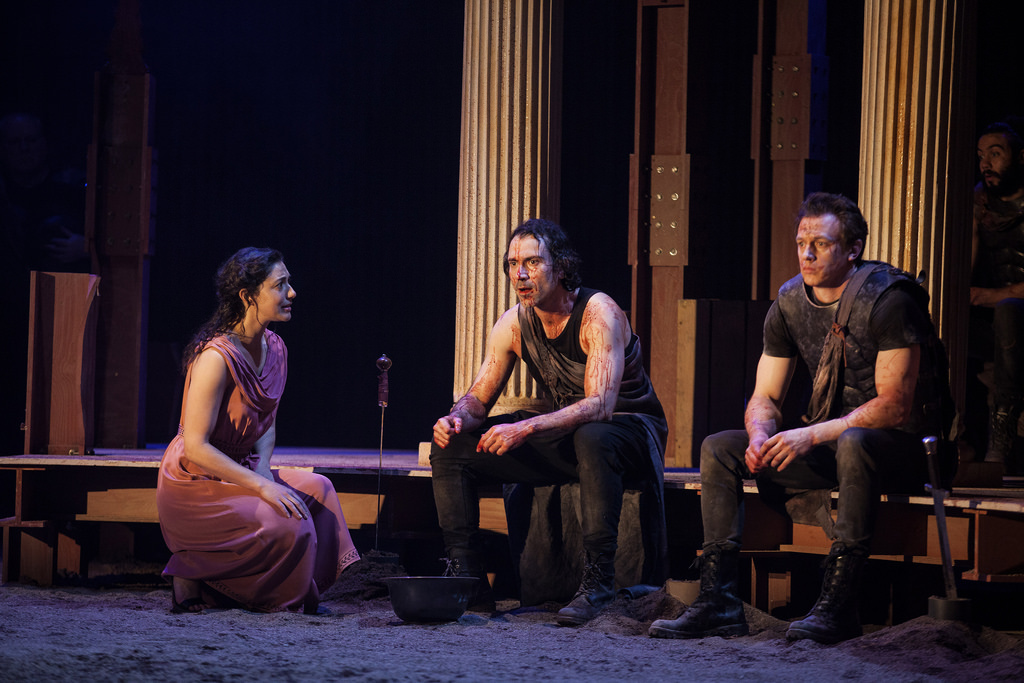
Amiera Darwish, left, as Briseis; Ben Turner, centre; & Mark Holgate, right, as Patroclus.

Amiera Darwish, left, as Briseis; Ben Turner, centre; & Mark Holgate, right, as Patroclus.

This Iliad is forcefully staged and has the vehemence and colour of its core story. It is fiercely directed and there is a heart and soul to every performance, mortal or immortal, but it is so down to earth that it puts gods into deckchairs on a flyblown lido and so the topless towers of Ilium are levelled. I think it’s Hecuba (Jennifer Black) who says, ‘You clutch at emotions like clutching at straws’. That’s the problem when you go head-to-head with Homer.

 

nae bad_blue

Star (blue)Star (blue)Star (blue)

Reviewer: Alan Brown (Seen 26 April)

Go to The Iliad at the Lyceum.

Visit Edinburgh49‘s Lyceum archive.

Scottish Chamber Orchestra: Ain Anger & Olari Elts

https://i0.wp.com/angusarts.org/wp-content/uploads/2015/05/SCO2.jpg


“No musician could fail to admire, and secretly envy, the sheer bravura and chutzpah of this performance…

 Editorial Rating: 3 Stars Nae Bad

Thursday’s Scottish Chamber Orchestra concert at the Queen’s Hall was a fascinating melange of the contemporary, romantic and classical. As a result we experienced a variety of different musical experiences in an exciting evening’s musical entertainment.

I suspect the main draw must have been the evergreen Beethoven’s Fifth Symphony, but more of this later. The gig kicked off with Brett Dean’s “Testament”, a work some years in evolution that, to quote the composer “in some way related to Beethoven’s life and music”. I personally found it hard to trace this link back to the great man, notwithstanding the composer’s consultation with the string section of the Berlin Philharmonic and studying of the Heiligenstadt Testament. There were strong influences of Honegger, Adams and even Lutoslawski, as well as some clear 19th century style melodic lines in what was a mosaic of musical styles. It made for an entertaining and lively start to the evening and the orchestra dispatched it with enthusiasm and considerable skill.

By way of a contrast followed Mussorgsky’s Songs and Dances of Death. Mussorgsky had planned to set eight songs by the poet Arseny Golenishchev-Kutuzov, with whom he shared rooms. In the event he set only four of them and died before he got around to orchestrate them, which his eminent fans Rimsky-Korsakov and Shostakovich were happy to do, as has contemporary Australian composer James Ledger. This latter was the version chosen for us. Perhaps an unconventional choice in view of his illustrious forebears, the orchestration undoubtedly worked in an atmospheric and almost mysterious way, including an extraordinary clarinet glissando in the third song Trepak (described as “death dances with a drunk in the forest at night). Leading contemporary Wagnerian and Estonian born Bass Ain Anger gave a deep, clear and resonant account of this very Russian work in the folk idiom. The power of the magnificent, but I repeat pleasingly clear bass voice was enthusiastically supported, especially by the brass, as it drew to its sombre, striking conclusion.

And so on to the popular, oft played, recorded and interpreted Beethoven’s Fifth Symphony in C minor. One almost wonders what the point of performing this work is; how can one possibly bring anything new? Everyone, from Von Karajan, the wonderful Carlos Kleiber, and even the Bee Gees in Saturday Night Fever, has had a crack at this gloriously barmy work, and the only person who hasn’t heard it properly in the civilised world is probably Beethoven himself.

To their credit the SCO did pull a rabbit out of a hat. They went off at a cracking pace like the crews in the Boat Race, taut, together, on the money with every new passage and actually managed to convey the excitement of hearing the piece for the first time. A confident opening by the cellos in the Andante con moto made the most of the crescendo in the initial cadence and there were good dynamics and clarity even in the small supporting parts, in particular woodwind and pizzicato strings, and the more so of this latter in the subsequent Allegro. The final, fourth movement Allegro brought the work, and the evening, to a resounding conclusion.

So what to make of this interpretation of the well-known work? Full marks for enthusiasm as caution was thrown to the winds, not afraid of turning up the volume, raw, earthy, almost ‘street’, spirited and raucous. I am sure my school director of music would think that conductor Olari Elts was being a bit naughty with the work, and there were a number of bum notes and other flaws, particularly in the often exposed brass. However, no musician could fail to admire, and secretly envy, the sheer bravura and chutzpah of this performance. Roll over Beethoven!

nae bad_blue

Star (blue)Star (blue)Star (blue)

Reviewer: Charles Stokes (Seen 7 April)

Go to the Scottish Chamber Orchestra

Visit Edinburgh49‘s Queen’s Hall archive.

The Silent Treatment (Traverse: 7 – 9 April ’16)

Photo: Lung Ha Theatre

Photo: Lung Ha Theatre

“A lot of barmy mischief making”

Editorial Rating: 3 Stars

Lung Ha Theatre Company is a leading theatre company for people with learning disabiities, in Scotland and internationally.

Shout it out: Lung Ha bucks trend! By the latest UK stats worker output per hour is down; well, not when you put 21 actors on stage and keep them acting all the while. All the more testing, when there’s little to no dialogue in Douglas Maxwell’s script of stage directions.

The Silent Treatment subjects its cast to keeping shtum – and alert. For the most part it is full on music and sound (by M J McCarthy) that cues the action. After Lung Ha’s Thingummy Bob with Cliff and The Shadows I had my old money on ‘Silence is Golden’ for some signature backing; but, no, that was 1967 and this play needs mobiles, scratchcards, emoticons and a chainsaw. Still, The Tremeloes’ lyrics have something relevant to say: here’s the second verse,

Talkin’ is cheap …
How could she tell? He deceived her so well.
Pity she’ll be the last one to know.

Billie (Nicola Tuxworth) thinks she has the secret to end all secrets. In fact, it’s her boyfriend (Stephan Tait) who’s got it and she won’t find it out until the end, when she will be speechless. In the meantime Billie goes with her little secret and sets out to try and wreck the sponsored silence that is being held to raise money for her mum, who’s in and out of hospital. Why would she do such a thing? That’s her secret and she’s not telling.

And, of course, no-one else is saying anything. The writing on the blackboard spells it out: SPONSORED SILENCE. No Phones (ignored), No Sleeping (impossible), No Eating (not when there’s a packet of Penguin biscuits around), No Knitting (didn’t see any), wheel noises and body noises don’t count (fair enough). It is the irrepressible Kenneth Ainslie as Toby who has real trouble with the rules but even he doesn’t speak.

Billie finds a helper in Stacey (Emma Clark) and the two of them, in and out of disguises and of the windows, do a lot of barmy mischief making under the stern nose of dominie Kitty (Kay Ann Jacobs); but it’s the four strong building crew (with foreman Mark Howie unmistakeably in charge) in high-vis vests and bowlers who do the heavy lifting, paying no attention whatsoever to Kitty’s gong.

The audience did not want to break the silence either. Hearty laughter seemed somehow disrespectful to Maria Oller’s close direction and the disciplined work of the performers on stage. With one great, if unholy, exception, the ingenious visual gags were met with appreciative chuckles rather than guffaws , and so when the end came – when it blossomed is actually more accurate – the applause was for hard study and successful work rather than for easy laughs.

Star (blue)Star (blue)Star (blue)

Reviewer: Alan Brown (Seen 7 April)

Go to The Silent Treatment and to Lung Ha Theatre Company

Visit Edinburgh49‘s Traverse archive.

Uncanny Valley (Summerhall: 29 – 31 March) – part of Edinburgh International Science Festival

Photo:.Borderline Theatre

Photo:.Borderline Theatre

“Educational and entertaining, well-worth taking the kids to”

Editorial Rating: 3 Stars: Nae Bad

As a child I was never particularly into science. At school the lessons were boring and didn’t challenge me to think creatively or engage with it in real life situations. Uncanny Valley, however, does both, placing today’s children at the heart of a situation we may well find ourselves in 30 years’ time.

Essentially it’s a show about humans and robots, and the difference between the two. With the world becoming ever more robotic, the subject matter is engaging for audiences of all ages and I certainly learned a thing or two about artificial intelligence and the Turing Test during the performance. While I imagine 9-year-old me might have struggled with some of the concepts and sitting still through some of the longer “lesson” parts, many of the younger audience members seemed to grasp it fairly well and engage in the interactive elements.

As a children’s piece, one can forgive a certain amount of ridiculousness and be able to suspend disbelief to still be able to enjoy the action. Credit goes to the actors for keeping the performance engaging, with boundless energy creating big, bold characters that are instantly relatable. Kirsty Stuart in particular shines as the cut-throat Mayor who’ll stop at nothing to eliminate robots in her town.

I would have liked closer attention paid to the narrative to keep it seamless all the way through: there were quite a few unexplained jumps in time and location in the story, and I never quite believed Ada’s relationship with her adopted parents. In saying that, some of the theatrical elements are very well done: the Turing Test at the end of the show is funny and gripping; the open moral discussion about whether to swerve a car off road and kill a group of chickens to save yourself is very thought-provoking, and I was even able to feel emotional connection with the robot characters of OKAY and SARA, which adds a really nice dimension.

The beginning is a little confusing – I feel that Rob Drummond as facilitator perhaps tries too hard to convey a lot of factual information early on and doesn’t seem as comfortable in parts of audience interaction as I would expect from an experienced TIE professional. These are only small moments throughout the piece though, as on the whole it’s quite slick and professional.

Overall, Uncanny Valley is educational and entertaining, and well-worth taking the kids to, as long as you’re ready for a bit of thinking! Theatrically it is a bit rough around the edges but still full of heart.

nae bad_blue

Star (blue)Star (blue)Star (blue)

Reviewer: Steve Griffin (Seen 31 March)

Visit the Summerhall archive.

International Waters (Traverse: 30 March – 3 April ’16)

International Waters 1

Photos: Tommy Ga-Ken Wan

“Almost edifying”

Editorial Rating:3 Stars Outstanding

You have to wonder. Fifty minutes into the heaving swell of International Waters when we’re all dramatically well and truly cast off, the fire alarm lights flash red and the theatre is evacuated. It has to be a Fire Exit production. And the prime minister announces that there will be no fire sale of the UK’s steel industry but it could still all go down the pan; which is pretty much where David Leddy’s new play takes us. It’s gut-churning with intent, from programme-as-origami downwards. This is theatre in the raw; its passage probably indigestible without great work by Becky Minto (Design), Nich Smith (Lighting) and Danny Krass (Sound).

For the U-bend see a cabin suite for the super-rich in the bowels of a super-tanker, complete with champagne buffet and karaoke machine. Cheaper accommodation is in assorted containers where you might be stacked next to a tiger or two. It is all rather make-do, rather urgent, for this is the last ship out of London where the banks have really, really, done their mucky worst. It’s safe to assume that the ATMs are empty and that the poor are on the streets and burning porsches. Still, if you have shedloads of ready money you can look good in white linen, enjoy the Moët, do a line of coke, and singalong to doomsday. Unfortunately it turns out that Sarah, Ben, Sophia, and Arian are in the Caliban suite for a less than delightful reason and that their ‘escape’ will end wretchedly. There’s no mage on the bridge to save them or to get them away from each other’s throats … or crotches.

International Waters 2

Down below, gripped by burning cabin fever and flushing itself out, is the fabled 1%: powerful and greedy, vulnerable and unhappy. Sarah (Claire Dargo), Ben (Robin Laing), Sophia (Selina Boyack), and Arian (Lesley Hart) go at it with astonishing abandon, pulling each other’s chains – just to stay with the scatological – and soiling themselves and their values in the process. It’s abject, messy, and ridiculous and yet the acutely angled and allusive content is almost edifying.

Leddy unships a bulk load of issues: rogue algorithms, flagrant wealth, economic migrants, drowned refugees; the paranoid survivalist versus the self-obsessed, #Blessed; Twitter storms, Old Testament retribution and the gospel strains of New Testament promise. This is one crowded ark of a stage, freighted with ideas, that spills more than it holds, deliberately upset by intemperate behaviour, bad language, and scary discordant sound. If the play is dead in the water at its conclusion, it’s not rudderless or overblown, but simply exhausted.

FYI. The show continued after the fire alarm, which says a lot about the quality of the performance and the unlikely integrity of the piece. It is preposterous and explicitly farcical, yet Leddy goes in behind the theatrical facade. He says (see programme note) that he’s also after the romantic sublime. Well, here’s Adele on a comparable course from Rolling in the Deep: “Go ‘head and sell me out and I’ll lay your shit bare.” Nice!


outstanding

StarStarStar

Reviewer: Alan Brown (Seen 30 March)

Go to International Waters at the Traverse and at Fire Exit .

Visit Edinburgh49‘s  Traverse archive.

SCO: IBRAGIMOVA & KRIVINE (Usher Hall 10 March ’16)

“I commend the SCO for their daring and committed performance tonight”

Editorial Rating: 3 stars


Thursday’s concert at the Usher Hall was designed to please, and did not fail. Mendelsohn’s Overture The Hebrides, Schumann’s Violin Concerto in D minor and Brahms’s Fourth Symphony span fifty years of the nineteenth century European Romantic genre and are all immensely satisfying upon the ear.

Yet when we talk of the Romantic genre we must not deceive ourselves with Batt-like portraits of composers gaining inspiration in the coffee house or at their desk by candlelight. These works are often borne out of insecurity and fear.

The Hebrides is really a tone poem in miniature, better known to us oldies as Fingal’s Cave, a short boat trip from Mull if you are interested. Mendelssohn struggled reconciling sonata form with tone painting, and wrote of the work as “the whole so-called development smells more of counterpoint than of blubber, gulls and salted cod”. In fact you would have to be an analytical cynic to agree with him, for it is a live, refreshing work and the SCO despatched it well.

Schumann’s Violin Concerto was also a cause of grief to its composer, who never heard it performed orchestrally. Swiftly composed in but thirteen days it was to languish for 125 years before its entry into the oeuvre after a series of family, political and technical issues. While fitting squarely into the romantic genre, and being a work of substance, it is nonetheless not without its problems. The first movement gives us soloist and orchestra working closely together more in the Baroque style, and this was exacerbated by imbalances between the two. Moreover, the positioning of instruments was curious, timpani within the main body, brass atop, basses to the left behind the first violins. Things came together better in the second slow movement when soloist Alina Ibragimova really came to the fore with confident bowing and tone. In the final movement it worked a treat and the band and soloist brought us romping home.

To me the ultimate version of the closing work, Brahms’s Fourth Symphony, has to be Carlos Kleiber’s extraordinary, almost eccentric 1981 recording for Deutsche Grammaphon with the Vienna Philharmonic, knocked off in a fraction less than 40 minutes. I have heard so many stodgy, proscenium arch type versions that I come to this oft performed work with some dread. I was delighted with the way the SCO tackled it. They took the opening movement very fast indeed – absolutely no trace of stodge here – and I would rather have a racy, resolute performance such as this with a few flaws (the trumpets a little too loud, some tricky moments in the horn section) than an immaculate, more pompous central European type interpretation. As we worked through the piece the playing became more assured, steady ensemble playing in the second movement after the hectic first, a slightly over keen entry to the third with the strings nailing it with their con attacas, a confident brass opening the final with the orchestra playing like the highly polished ensemble they can be.

All live music is a risk. I commend the SCO for their daring and committed performance tonight, and congratulate both them and Principal Guest Conductor Emmanuel Krivine drafted in at short notice to replace the indisposed Robin Ticciati. It was to his and the band’s credit that you never would have guessed.


Star (blue)Star (blue)Star (blue)

Reviewer: Charles Stokes (Seen 10 March)

Go to the Scottish Chamber Orchestra

Visit Edinburgh49‘s  Usher Hall archive

The Perfect Murder (King’s Theatre: 1 – 5 March ’16)

Jessie Wallace and Shane Ritchie. Image credit: Honeybunn photography

Jessie Wallace and Shane Ritchie.
Image credit: Honeybunn photography

“Dark humour and plenty of jumpy moments ensure sheer entertainment”

Editorial Rating: 3 Stars

An (almost) Perfect Murder is taking place at the King’s this week, which, on the whole, I think is worth witnessing. Despite the slightly shaky plot and occasional drop in pace and energy, this stage adaptation of Peter James’ original novella is filled with enough dark humour and jumpy moments throughout to ensure a thoroughly entertaining production.

The plot centres around the rocky married life of Joan and Victor Smiley, played by Jessie Wallace and Shane Richie of Eastenders fame, as they each plot to kill the other in order to run away with their respective new lovers and start a new life on a beach in Spain drinking mojitos all day. Idyllic? These characters seem to think so, and what ensues is a darkly funny and occasionally completely ridiculous two hours, as they attempt to carry out their cunning plan.

The majority of the audience are clearly there to see ‘Kat and Alfie’ in action, yet as the play progresses and we witness the duo in their first scene alone on stage together, the shadow of the soap opera couple diminishes and Wallace and Richie prove they are not one trick ponies, with convincing performances of new characters. The chemistry that works so well between the two on screen is immediately evident on stage, and despite the potentially dull moments of petty marital bickering throughout the first act, the two carry this off with such exuberance and fine-tuned comic timing that it is more than bearable to watch. Wallace in particular, through her portrayal of Joan, is successful in being totally neurotic and batty, yet kooky and loveable at the same time, and for me her solo moments on stage were one of the play’s highlights.

While not quite matching up to the prowess of Wallace and Richie, the rest of the cast are largely commendable in their efforts to bring heart to moments in the plot that don’t quite work. Stephen Fletcher as Joan’s ‘new man’ and subsequent partner in crime, Don, was delightful in a simple, buffoonish performance that worked well alongside Wallace’s Joan. Equally, Simone Armstrong as the psychic Croat prostitute provides necessary comedy and warmth. Benjamin Wilkin’s DC Grace falls slightly off the mark, and there is an immediate drop in the pace of the action in his scenes with Armstrong. While Grace doesn’t seem to do any policing and comes across as quite an unnecessary character altogether, there is definitely potential for a deeper exploration of character to create more interest that Wilkin does not fully exploit.

Michael Holt’s set works well alongside the action, using large homey rooms built on top of one another in a house-like structure to provide the different locations in the plot. High-pitched screams and ghostly flashing lights, reminiscent of an old-school horror movie, do add a certain haunted air that ensures many a jolt of shock among the audience. Director Ian Talbot has led this cast to create an audience-pleasing production whose strong performances allow us to forget about the nitty gritty details of the slightly silly plot and instead enjoy an evening of dark comedy and ultimately, sheer entertainment.

Star (blue)Star (blue)Star (blue)

Reviewer: Rachel Cram (Seen 2nd March)

Visit the King’s Theatre archive.

Julius Caesar (Augustine United Church 1 – 5 March ’16)

Antony (Tom Birch), Caesar (Adam Butler) and Calpurnia (Heather Daniel)

“The kind of unbridled creativity I often only see in student productions”

Editorial Rating: 3 Stars

Reimagining Shakespeare’s classic tale in the modern day world of professional football may seem like lunacy to some, but with themes like loyalty, pride in one’s city, questions over physical fitness and a bit of back-stabbing, the parallels between ancient Rome and football today aren’t as dissimilar as might be first assumed – it certainly piqued my interest. However, as can happen in football, I think there was perhaps too much theorising behind this production, which didn’t quite convert to success on the pitch.

Much like when reading a Hilary Mantel novel, I worry when I find myself constantly having to flick back to the character list to be reminded who everyone is and what side they’re on. And with this interpretation assigning each character a footballing role (for one or more teams) as well, it’s certainly not the easiest to follow for someone unfamiliar with the play.

Adam Butler as Caesar is every inch the star player in this outing, commanding attention and respect from all around him, and it is easy to build rapport with him as the fans’ favourite. He is confident, charismatic and handles Shakespeare’s text very well. Charlie Angelo is also enjoyable and convincing as Casca, bringing an air of comedy into what is otherwise quite an intense evening’s entertainment.

Various women are cast in male roles in this production, the most interesting of these being Alice Markey as Decius, who holds her own with strength and precision. However, in arguably the most important scene of the play, where Calpurnia convinces Caesar not to go out, only for Decius to then persuade him otherwise, I would have really liked to have seen the female Decius use a more sexual approach to her argument, heightening the tension in the scene which unfortunately seemed rather rushed.

Indeed, missed opportunities seemed the name of the game throughout, with many great ideas going unfulfilled or veering off-target. With almost all characters being football players, it is surprising how much standing around there is in group scenes, whereas seeing some football in action and the interactions that come naturally within that could add more depth and integrity to the performance. Given the interpretation of this piece I was also disappointed the fight scenes are not reimagined as football matches between the rival factions, and that stabbing is so faithfully used as the murder method of choice. With interesting references to performance-enhancing and other kinds of drugs throughout, maybe “dagger” could have had a whole new meaning?

However, what I particularly enjoyed about this production was the inventiveness of the projected films throughout, showing characters as models, celebrities and footballers on the pitch. These sections work very well to give background and depth to the characters, and to cover any edits from the original script. Additionally, when all characters are on stage reacting to Antony’s speech after Caesar’s death the atmosphere is very powerful and sustained, while the fight scenes show great energy and control. The use of hoodies instead of cloaks, paparazzi and mobile phones were all nice modern touches showing the kind of unbridled creativity I often only see in student productions.

Overall, I admire the headstrong strategy and imagination of the squad in this play, but for me the formation didn’t allow it to achieve a resounding victory.

Star (blue)Star (blue)Star (blue)

Reviewer: Steve Griffin (Seen 2 March)

Visit the Other archive.

THIS REVIEW HAS NOT BEEN SUBEDITED

LoopsEnd (Traverse, 2nd Feb ’16)

LoopsEnd

“A visual feast”

Editorial Rating: 3 Stars: Outstanding

I have seen many spectacular aerial displays over the years, from companies all over the world,  and with their latest work, LoopsEnd, Edinburgh and LA based Paper Doll Militia is definitely right up there with the best of them in terms of risk, precision and wow-factor. However, while technically the gymnastics were great, I was a bit disappointed by the overall cohesion of the work.

A performance in two parts, the first half, Ashes, was inspired by the tearing down of an industrial estate where the group used to rehearse. The main visual element of the piece was two long ropes hanging from the rigging, twisted and weighted down with bags of powder. Even watching the ropes untwist and retwist in the empty space was graceful and compelling, and when combined with George Tarbuck’s stunning lighting design and the trademark tricks and treats of a seasoned aerial company, this piece was, at times, nothing short of a visual feast.

Throughout the performance, white powder was used in various ways to represent the “ashes” – one performer literally had a pile on his shoulders in the opening sequence, while the closing image was of the two bags attached to the hanging ropes slowly emptying as the ropes swung in the space. These individual instances were very powerful visually, but it was difficult to see the link between these, and any sort of narrative or progression within the piece. Indeed, many of the “theatrical” devices seemed under-developed and incomplete: there were too many moments of clichéd wide-eyed wonder and writhing around in angst, and at one point one performer walked back and forward many times, overtly undecided about whether to touch the rope. Such basic and overused devices unfortunately offset the splendorous vision of the other sections.

In the second piece, Unhinged XY, projection was also used, which in some ways added another dimension to the visual smorgasbaord, but in others gave a seemingly unnecessary layer of complexity and confusion to the action – again, it often wasn’t clear how the costumes, music, acrobatics, projections and design all married up.

The aerial silk work in this piece, and the use of wind and fabric combined to make some stunning visuals and standout moments. When one performer walked up a hanging piece of silk, weighted at the bottom by another, while competing with gusts around her, I was awestruck by the strength and artistry on show.

It was a bit of a shame that both pieces relied quite so heavily on overpowering recorded sound and music. While at some points it was great in setting and supporting the overall tone of each section, its constant use meant the work was unable to establish a mood for itself, so I would have preferred a more selective and sensitive approach to the aural aspects of the performance.

Overall, there’s no denying the talent and visual creativity that have earned Paper Doll Militia their excellent reputation. However, LoopsEnd left me somewhat hanging in mid-air, rather than applauding with my feet flat on the ground.

outstanding

StarStarStar

Reviewer: Steve Griffin (Seen 2 February)

Go to Paper Doll Militia

Visit Edinburgh49‘s  Traverse archive.


‘To Breathe’ (Summerhall: 24 – 28 Nov ’15)

To Breathe 1


Photography: Andrew Perry. Back line, l to r: Erin Whalley, Tiffany Soirat, Anna Elisabeth Thomsen. Front line, l to r, Adela Briansó, Lewis McDonald, Maddie Flint.

“Inventive and intriguing”

Editorial Rating: 3 Stars: Nae Bad

It’s not often you see student theatre groups perform original work with such a strong dance element, especially pieces on complex themes with so much thought behind them. They generally take hours upon hours to devise and rehearse, so one must give Theatre Paradok kudos for even getting to the startline of this show, and for packing Summerhall’s Demonstration Room to the rafters with an eager audience on a Thursday night.

Given the premise of To Breathe as a physical exploration of body and breath, to me it was a somewhat strange choice to develop it with a cast of performers with limited dance experience and training. The lack of finesse and technique on display in the more choreographed elements unfortunately detracted from what could have been a very powerful and moving (no pun intended) performance, and this was the lasting impression I took with me – a great concept, but perhaps slightly overreached.

As a theatrical spectacle, it was certainly very accomplished: it contained a lot of light and shade, tension and calm, with a good sense of progression and drive, and the performers’ ability to create changing moods seamlessly was very impressive. Early on the piece was very playful, and the performers raised several laughs in their innocent self-discovery, before moving onto more emotive storytelling. Rachel Stollery’s design really complemented the action, as did the subtle use of music, and with a healthy mix of ensemble and solo sections, structurally this show ticks all the boxes.

What the troupe may not have shown in dance technique or grace, they more than made up for in emotional intensity, concentration and sheer gumption. There was a great energy and spirit to the performance, with the whole company throwing themselves into it wholeheartedly. Maddie Flint in particular was utterly watchable throughout, with a very engaging and expressive face.


To Breathe 2

Lewis MacDonald and Tiffany Soirat

While choreographically it was a fairly safe piece (albeit with a few too many cliched motifs for my liking), there were moments of dramatic risk that were inventive and intriguing. In one of the duets (performed by Lewis McDonald and Tiffany Soirat) the dancers fought and tussled to cover each other in paint, in a sequence that was both passionate and very well controlled. There were some great lifts on show, and this section oozed with sexual chemistry. Later on, the dancers experimented with different movements with their hands in a pile of mud, which again showed great creativity, yet it was difficult to see the connection between this and the rest of the performance.

Overall, the heart and soul of this performance were absolutely in the right place – but I would have liked to have seen more focus on the dance elements to make it more complete.

nae bad_blue

Star (blue)Star (blue)Star (blue)

Reviewer: Steve Griffin (Seen 26 November)

Go to Theatre Paradok

Visit the Summerhall archive.