‘The Last Straw’ (Bedlam: 21 – 25 October ’14)

The Last Straw 1

Photos: Ummatiddle

“…  impro cuts loose, and cries of ‘F –ing awesome’ applaud play and cast.”

Editorial Rating: 3 Stars: Outstanding

A tale of two exclamations from ole stage coach territory. There’s “Whoa!” (Slow down) or “Wow!” (Stop right there. That’s too much). Either way, forget it. The foot brake’s worn, the wheel brake’s a joke, and you’re gonna get hurt, lady, if you stay up top. Best ride is in here, in Bedlam, with us. It’s a long journey of near on two and a half hours but it’s fun.

Director and writer Eric Geistfeld is from somewhere in Minnesota. Home is unlikely to be Bemidji but what the heck, The Last Straw is tv’s Fargo in a gothic farce. It’s intrepid. No quavering, gathered strings here; no hole in the ice but a useful trapdoor. There is breakneck writing, lunatic action, a menagerie of oddball characters, a yellow sex doll, and a lot of laughs.

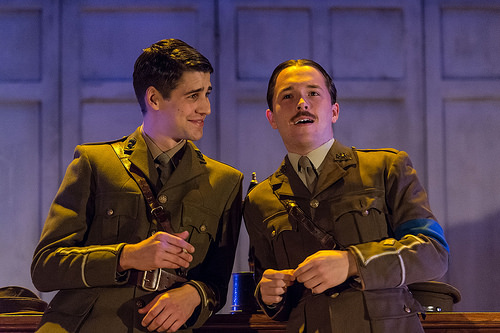
Upright, young Edward, true-buttoned Brit and in financial services, is just married to Judy, all-American sweetheart, ‘pajamaed’ and with her teddy. They are to live with Violet, Judy’s mother, in Terror Towers. It might as well be Marine Corps ville. Ronald Reagan is venerated and there is a dead butler, resident throughout the first half, who wears aviators and is fed cake, but it’s gum-chewing, pistol packing Violet (Isobel Moulder) who calls the shots, literally. There will be no kids until she’s ashes and she’d be much obliged if her son in law would smoke them after she’s gone. Not that she plans to let him live long. Edward (Macleod Stephen) is a good sort, articulates so well, but realises that his body bag is being prepared. Ma has to go so he puts out a contract on her life, as she has on his.

The Last Straw 2

There is live keyboard but you hang onto the soundtrack. The Magnificent Seven sets us off and then it’s a trip through The First Cut is the Deepest, Our House, The House of the Rising Sun and, of course, Sweet Dreams are Made of This. By this point Edward has taken a slice of sponged cocaine cake and is away, tally-ho, with his toilet plunger and the weird fairies from the basement. The fourth wall crumbled a while back, impro cuts loose,  and cries of ‘F –ing awesome’ applaud play and cast.

The Last Straw goes out to glad-hand its audience. Is it like the Lothian state fair on the Meadows? Kind of. Scenes are gaudy, wisecracking sideshows, neatly divided by a door on wheels. They put their trust in ‘Together we’ll go far’, which just happens to be the slogan of the Wells Fargo bank. Especially successful are ‘The Murderelli Brothers’, possibly from Brooklyn, whose take on Alan Rickman is actually to die for; ‘The Existential Hecklers’ from outta Sartre and ‘The Sad Killer’. What of the main act in amongst these diversions? Beyond the closing cheer of ‘Happy Families’, there needn’t be one. For the best of reasons The Last Straw is a fearless, crowded, tiring, play.

And so to our adventurous rating and ranking of 3* OUTSTANDING. Three stars (safe) because you won’t be disappointed by such a full-on, have-a go, production. Colour coded red – Outstanding – because The Last Straw is remarkable rather than unbearable. I thought so, anyway.

outstanding

StarStarStar

Reviewer: Alan Brown (Seen 22 October)

Visit Bedlam Homepage here

Visit our Assembly Roxy Bedlam Church Hill Theatre Festival Theatre King’s Theatre Other Pleasance, Potterrow & Teviot Summerhall The Lyceum The Stand Traverse archive.
THIS REVIEW HAS NOT BEEN SUBEDITED

‘Regeneration’ (King’s: 30 September – 4 October ’14)

Jack Monaghan (Prior) & Garmon Rhys (Owen). Photo: Manuel Harlan

Jack Monaghan (Prior) & Garmon Rhys (Owen).
Photo: Manuel Harlan

“‘Anthem for Dead Youth’”

Editorial Rating:  3 Stars

 By 1917, Post-Traumatic Stress Disorder’s designation in army speak is ‘Not Yet Diagnosed (Nervous),’ which then becomes ‘Shell Shock (wound)’ or ‘Shell Shock (sick)’. You could suffer both. Either way, it was identified as a ‘disability … caused by military service’. Watch this eager, opportune, play and you can add ‘unspeakable,’ ‘crippling’ or ‘shocking’ to the official terms.

Furthermore, pull open one of the gun metal drawers in the War Poets Collection at Craiglockhart and you’ll see an open medical register with ‘Neurasthenia’ entered alongside every one of the thirty plus names down the page. The ledger is matter-of-fact, inoffensive, prosaic for its time. However, writer Pat Barker turned that upside down in the terrific pages of ‘Regeneration,’ and Gillies MacKinnon took that book and made an excellent film of it. Now, Nicholas Wright’s adaptation tries it out on stage, with Simon Godwin directing and aiming high.

It is a fascinating, half-true story. Mutinous ‘Mad Jack’ Siegfried Sassoon (31) did meet Wilfred Owen (24) in Craiglockhart hospital during the summer of 1917. Sassoon did encourage Owen to write about the war. His pencilled revisions are all over a draft of ‘Anthem for Dead Youth’, along the lines of “No, make that… Doomed Youth’. Good man!” Sassoon’s doctor was William Rivers, anthropologist and pioneering psychiatrist. Owen recovers his health, Sassoon accepts counseling. Both officers choose to be ‘discharged to duty’. Both will return to the front line.

Stephen Boxer (Rivers). Photo: Manuel Harlan

Stephen Boxer (Rivers).
Photo: Manuel Harlan

Rivers also has another patient, Billy Prior, a boy from Bradford who knows all too well that he’s only made it to 2nd Lieutenant because the army is fast running out of the privately educated, well spoken type. The exchanges between Rivers – in a fine undemonstrative performance by Stephen Boxer – and the chippy but likeable Prior (Jack Monaghan) are the most forward and challenging in the play. Questions of class, upbringing and sex are insistently between them.

However, the relationship is less spiky between Owen and Sassoon. Garmon Rhys plays the younger man, gauche and pliable, who gains confidence and dignity by the close. Tim Delap is a debonair Sassoon, who has his own terrors in the night but whose brocade dressing gown stands them down. Between the two of them, the love that dare not speak it’s name gets treacherously close.

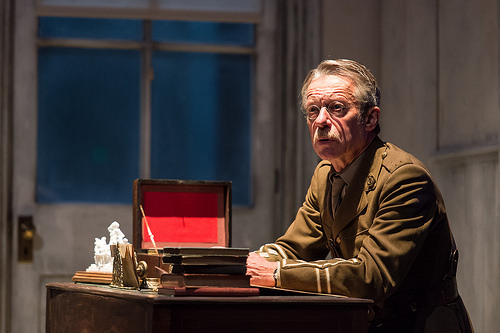
This production  is ambitious, brisk, and inventive, but its pace reinforces an episodic, fleeting quality. Reflective moments – Rivers dictating case notes, Mr Prior under hypnosis – are precious, but soon give way to the next happening. A burst of machine gun fire or a flash of howitzer blast are like fugitive subtitles, and the compressed script begins to sound sententious, light remarks diverting attention from tough themes. The stark set is washed out, bleached almost, and in need of some gloomy Edwardian mahogany. Additionally, the small marble of Laocoön on Rivers’ desk is a weighty feature that does its job, but otherwise, the fact that the Conservative Club on Princes Street, where Sassoon entertained, is now a Debenhams is indicative of a play piling literary stock and selling low. ‘The Parable of the Old Man and the Young’ it cannot be, although Capt. Rivers remains a merciful saint.


Star (blue)Star (blue)Star (blue)

Reviewer: Alan Brown (Seen 30 September)

Visit Regeneration‘s homepage here.

THIS REVIEW HAS BEEN SUBEDITED