‘Fountain of You’ (Venue 20, Aug 9, 13, 15, 18, 21, 24)

“Wróbel plays to the unambiguous ambiguity of the role in perfect contrast to Lucy McClure’s sweetness and light fairy Godmother archetype.”

Editorial Rating: 4 Stars (Nae Bad)

Bob Dylan once sang a song about how the tables can turn. How one minute you’re on top of the world and the next you’re on your own, with no direction home, a complete unknown, like a rolling stone. The Patriarchy is like that, always on the scrounge for a new Renfield, a new familiar to be standing by day and night to unquestioningly serve the needs of the bloodsucking sociopath lying in the coffin. So when a 30-something actress is suddenly aged-out of show business, she undergoes a wildly unconventional spa treatment to get her old life back. But it sets her on a whole new path to pursue true power and equality… at a cost.

As the 30-something actress, Martyna Wróbel is a flawless depiction of flawed humanity ready to get red in tooth and claw when the chips are down. The role demands sufficient sympathy to draw us in even as the horrible price to be paid gets reckoned. It’s Dorian Grey without the picture. It’s Sweeny Todd and Frankenstein but with less self-loathing. Wróbel plays to the unambiguous ambiguity of the role in perfect contrast to Lucy McClure’s sweetness and light fairy Godmother archetype, who dabbles in the dark arts by necessity, not choice.  

Selina Savijoki, Jadon Simone Trelour, Kaiyi Xu, and Bernice Jiaxin Zheng are billed as the ‘Esthettes’ and certainly, they deliver sensitivity and beautiful touches by the wheelbarrow full. These were four precision performances which instinctively demonstrated that they knew when to be seen and when to blend into the unfolding drama. Like a Persian rug possessed of a single tiny flaw to remind the viewer that total perfection is totally preserved to divinity, the single slip I spotted – a lighting mirror held the wrong way round during a dance number – served to amplify the meticulous striving for excellence we should expect from an RCS production.

There are plenty of good reasons to see this production, but the most compelling is David Joseph Healy who plays all the good guys as well as all the bad guys. Healy’s character work is funny, studied, striking, hugely impactful and… so my companion – a kittenish cougar – tells me both during and after… it’s sexy. Healy is clearly one to watch which raises the first of several question marks hanging by a horsehair over the banquet.

First, this is a show about how tough women have it, so why give the only male actor half the roles? It’s a glaring flaw in the script which should have sounded some alarm bells. This is a story about the impossible standards women face in the impossibly vain and shallow world of mass light entertainment as they age. And yet it is performed by horribly young and horribly attractive people who are horribly wonderful at everything they do.

Playing to a home crowd at Edinburgh is an incredible privilege, just ask a New Zealander. There’s nothing inherently wrong with privilege but, as Lord Acton did not say, absolute privilege corrupts absolutely. The single worst decision any EdFringe producer can make is to waste time. This was a one-hour story which was allowed to stretch on and on and on. The mantra, show me don’t tell me, works so long as someone is brave enough to make a cut or six where the ‘show me’ is killing the pace and packing. If this script were luggage it would be liable for an excess weight fee.

Still, as a showcase of what the RCS community can make happen, as a showcase of Olympian-level talent on stage and off this show is a triumph worthy of the great legacy and bright future of one of the nation’s most important centres for arts education. Get your Napoleon in rags coats on and go see this!


ALL our recent coverage? Click here!

‘Sherlock Holmes: The Last Act’ (Venue 20, Aug 8-25)

“Rooted in the best that has gone before Miles-Thomas delivers something I never looked for, never knew I wanted, but suspect I will no longer be able to do without – an intimate understanding of the famously finicky curmudgeon direct from the horse’s mouth.”

Editorial Rating: 4 Stars (Nae Bad)

I’ve just had a really good lunch. Breast of Guinea Fowl and a glass or two of something uncomplicatedly red. Peace and quiet in the tranquillity of Edinburgh’s clubland. A very short stroll to the Assembly Rooms and I’m ready to be told a chuffing good story, chuffing well, by a chuffing good actor. SPOILER ALERT: I get exactly that. An uncomplicated hour of familiar canonic classics.

Nigel Miles-Thomas’ classical portrait of Holmes is a lively, astutely judged and gratifyingly authentic homage that should easily pass muster with the purists. Rooted in the best that has gone before Miles-Thomas delivers something I never looked for, never knew I wanted, but suspect I will no longer be able to do without – an intimate understanding of the famously finicky curmudgeon direct from the horse’s mouth. Holmes without Watson to translate him into human is a tall order.

Edinburgh’s own Conan Doyle has been adapted more times than the Napoleon of Austerlitz has had hot biographies. Adaptations of the Sherlock Holmes universe are ten a penny but EdFringe punters have come to expect solid gold by those taking the road more travelled. There’s gold in this thar script by Holmesian hyper scholar, David Stuart Davies. Davies’ Holmes is humble, he recognises how much he needed Watson and is man enough to admit that he might have said so more clearly and more often. Holmes on the level is a much more amiable after-lunch companion than would have been the emotionally stunted, emotionally unavailable Sheldon Cooper Sherlock the arrogant SOB high on his own genius.

Cards on the table, the show’s director Gareth Armstrong produced what I consider to be the finest thing I have ever, and am ever likely to see at EdFringe – ‘The Rape of Lucrece’ performed by Gerard Logan in 2012. This was not so brilliant, nothing could be. I find myself wondering if there is rather too much material that’s been left in. A Fringe hour is like a suitcase, there is an artistry to packing it right and there’s something here that’s missing by its very presence. The high Victoriana set and properties did not sit comfortably with such determined minimalism. I’d have liked to have seen more movement, more business, more theatre framing Miles-Thomas’ exquisite portraiture. 

Like all brilliant careers, the Holmes universe lends itself to the retrospective scope. This is an adaptation which delivers the goods, although you’ll have to unpack them yourself. Let’s be clear, this is a potboiler but it’s as welcome as a Le Creuset coming out of the Aga and into good, companionable company. Get your Inverness capes on and go see this!


ALL our recent coverage? Click here!

‘Black and White Tea Room: Counsellor’ (Venue 20, Aug 8-11, 13-18, 20-25)

“It’s as though the Roaring Forties had popped by for high tea on a balmy summer’s day.”

Editorial Rating: 4 Stars (Nae Bad)

We enter to find a man sitting alone at a table. Control. This is a man in control. This is a man with a preference for control. The telephone rings. His visitor has arrived at the station. If the visitor follows the man’s instructions, then he will arrive shortly. The man puts a vinyl record on. There is no sound. The record spins round and round but no sound do we hear.

The visitor arrives. He is younger. He is dishevelled. He is not at ease. The visitor’s pulsing anxiety is in uncomfortable disharmony with the quiet tearoom where the man he has come to see provides counselling sessions in addition to light refreshments. There are rituals to be observed. Trust must be built. The man guides his visitor through the opening steps of their structured conversation. Trust will be essential if progress is to be made even as the mystery as to who these individuals are deepens, unravels, and ties itself in further knots. The man is not just any man, he is The Man – the kindly brute. The visitor is not just any random, he has a past to dredge and resentment to air.

As The Man, EdFringe favourite Nicholas Collett is as understated as a deadly cobra waiting to strike. Like a magician of auld he conjures the sturm directing the gale forces into a cyclonic hurricane of emotional turmoil in which both men will be torn apart. The Man is not without his own pain, not without his own losses. The Man is all too human which is why having an actor celebrated for his dramatic and emotional intelligence is such an important fit for this occasionally puzzling play. Collett is the lightning rod that keeps the ornate edifice from burning down.

As the visitor, Jonathan Kemp (of Drama Studio London faculty fame) delivers the drang, the stress that upsets The Man’s tranquillity with a sudden devastating revelation. It’s as though the Roaring Forties had popped by for high tea on a balmy summer’s day. Our perceptions are turned on their head. Has the visitor got a plan? Does he know what he is about? Kemp milks the mystery treading the line between uncertainty and hesitancy with nimbleness. Like something out of Hemmingway, we wonder if Kemp can land his catch. SPOILER ALERT: he does and he does so with an unforgettable, uncomforting authenticity.

This is a script which works in some places and which sags in others. This is a script where the overall wood and the individual trees are not always in perspective. There are gaps not all of which can be explained as a result of British actors tackling a sensitive chapter in Korean history. Still, for those of us who enjoy the bold subtleties of contemporary Korean storytelling, this is a fine vintage from a respected winery blending high drama, some dark comedy, and much to think about.

Come for the high-octane acting. Stay for the rip-roaring ride. Get your feather-down puffer coats on and go see this!


ALL our recent coverage? Click here!

‘Aude Lener – Love Reboot’ Venue 53 until 24th AUG (not 11th)

“Wanna feel loved? I’m no magician; I’m just French.”

Editorial Rating: 4  Stars (Nae Bad )

As a regular visitor to the Fringe for some years now, I’ve always had a soft spot for single-handed shows. So often the preferred vehicle for solo female performers, they can frequently take you by surprise, drawing from the almost infinite well of personal imagination and experience, unhindered by the theatrical presumptions inherent in a full-cast play. This slick, energetic, and well-staged production is written and performed in English (with occasional forays into Française) by the French film and TV actress Aude Lener.

Part stand-up comedy, part pop-philosophical treatise, part scatological cabaret, Lener delivers a wryly amusing exploration of a single woman’s life as she realises that the pursuit of love is slipping through her ageing fingers. As she wearily notes with a particularly gallic take on her situation: “Wanna feel loved? I’m no magician; I’m just French.” There is physical action a-plenty as Lener presents us with a rapid-fire series of vignettes enacting her somewhat crazy social and family life. These include a rather clever whiteboard presentation; much skilful use of a banana as a visual metaphor (oh, how the ladies in the front row giggled); the funniest rendition of Amazing Grace I’ve ever heard; and the recurring ghostly presence of her Aunt Madeline, who is dead but won’t lie down and keeps intruding into Aude’s life like an escapee from some grand guignol show at a seedy theatre in 1950s Pigalle.

Lener herself is something of a dramatic phenomenon. Her demure movie star face is elastic enough to quickly contort into a thousand visual caricatures to suit as many different voices, some her own internal monologue, others those of relatives, friends, and a succession of would-be lovers. With her pacy and emphatic delivery, she packs much observational humour, wit, and physicality into this 50-minute whirlwind of a show. Maybe it’s a cliché of national stereotyping for me to say that Lener’s French accent imbues her comedic insights with a philosophical authority that just wouldn’t be there if it came from a British actress? But it does.

So if, like me, you’re looking for something a little different to seek out in a small black-box studio theatre and won’t lose sleep if you never again see yet another angst-ridden portrayal of Emily Brontë or Mary Shelley, get yourself to TheSpace @ Surgeon’s Hall (Theatre 3) to laugh along with this quirky little gem.


ALL our recent coverage? Click here!

‘Mini Mozart – Babies Class’ (Bedfringe, 21 July 2024)

cover

“‘Does exactly what it says on the tin, delivering a dose of golden sunsound as pleasing as any since Orpheus rhymed Calliope with ‘my way’.”

Editorial Rating: 5 Stars (Outstanding)

Children don’t learn by osmosis, it’s the worst thing about them. Put a child in a room full of fine art, leave them to their own distracted devices and they will emerge no more educated or insightful than before they went in. How annoying is that? Turns out the path to understanding is not like those moving walkways at airports, you can’t just stand still and reasonably expect to arrive somewhere. BUT a good guide through the wilderness, a smart trainer, or an expert storyteller can make all the difference in terms of maximising the distance covered by the same effort. Interactivity and active listening are mission-critical to cognitive development.

‘Mini Mozart’ is a franchised method and educational mindset as much as it is any individual show. It was created by Clare-Louise Shaw in 2005. It is the ongoing culmination of 20+ years of experience combining musicianship, presenting & parenting. A product of Uppingham School and Berklee College of Music in the USA, the holder of a music degree from Newcastle University, Clare went on to join BBC Music. You might recognise her from her onscreen work in ‘BBC Young Musician’ of the Year and ‘The Proms’ or from her time as a singer at Disneyland Paris. It was during her first maternity leave, in 2005, that Clare was “hit by the clarity stick.” Knowing how much her infant son loved it when she played the violin, clarinet, or piano and remembering the same look of enchantment on the children’s faces at Disney, Clare got her NCT group and instruments together with a piano accompanist and ‘Mini Mozart’ was born.

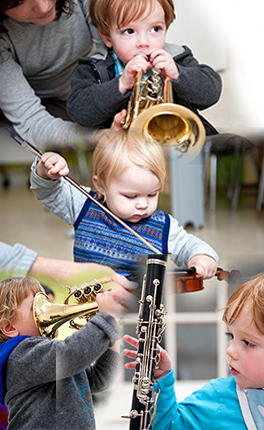
We enter to discover that our presenters today are Andrew on piano and Lottie on everything else. If that piper chap in Hamyln had a twin sister, Bedford’s own Lottie Bagnall might be her. She seamlessly gathers the children always shepherding, never leading. At no point do the children or their adults, seem bossed. With my school governor’s hat on, I see a smart, sensitive, sensory curriculum being mindfully delivered with a confidently light touch. This knowledge-rich content is not only substantial, it is massively entertaining for young and auld alike. Lottie’s not especially secret superpower is to make newcomers (including my girls) feel as welcome and included as the families she sees at her weekly sessions.

As immersive as a lavender bubble bath after an afternoon spent coal mining, as absorbing as a Sahara sea sponge, as gentle as the mistral is by comparison with the supersonic methane winds of Neptune – ‘Mini Mozart’ does exactly what it says on the tin, delivering a dose of golden sunsound as pleasing as any since Orpheus rhymed Calliope with ‘my way’.

In her Bedfringe notebook – the one with a cartoon of Richard Nixon carrying Louis Armstrong’s luggage through customs drawn on the inside cover – Daughter 1.0 (9yrs) wrote:

“I went to Bedford Festival Fringe this summer and went to Mini Mozart with my sisters [6yrs and 2yrs]. It was mostly aimed at babies or toddlers beetween 0 and 4 but even so I realy enjoyed it. It was all about the story of the three little pigs with violins, violas and clarenets and a piano! I realy enjoyed playing with rattles, giants scrunchies, parachutes and singing lots of song My littlest sister said she realy enjoyed it and so did I!”

Come for the touchy-feely encounters with strings and clarinet buttons. Stay despite the scary Peter and the Wolf puppet – Clare says he’s fine, but they all say that about their wolf puppets don’t they!? – leave having heard the finest versions of ‘Wheels on the Bus’, ‘I’m a Little Teapot’, and ‘Sleeping Bunnies’ you’re ever likely to hear. Get your evening tailcoats on and go see this!


Reviewer: Dan Lentell

ALL our Town & Gown coverage? Click here!

‘1984’ (Venue 139, until AUG 28th)

“This is a show that has, despite the odds, pulled a rabbit out of a hat and snatched victory from the jaws of defeat.”

Editorial Rating: 4 Stars (Outstanding)

In Fringe lore, Proletariat Productions’ production of ‘1984’ will be remembered as the little engine that could. Beset by off-stage problems, not the least of which was the sudden short-notice loss of their original O’Brien, this is a show that has, despite the odds, pulled a rabbit out of a hat and snatched victory from the jaws of defeat.

George Orwell’s masterpiece will always draw a crowd but it isn’t often that we get to see his work presented with such chilling clarity. This is a multimedia heavy, perhaps a little too multimedia heavy, rendering of ordinary people trapped in the brutality and squalor of a society gone wrong.

As Winston Smith, Orion Powell delivers the goods in a powerful performance which brings all the classic elements of the rebellious everyman together with fresh insights and pathos. In a story centred on artificiality and the breakdown of empathy, Powell reaches towards the light Smith detects in others. With both Julia and O’Brien there is a deeper humanity on show often missing in less well-observed adaptations.

Although not on stage, she is only ever seen in the video clips, Estelle Mey establishes herself as one to watch. She is neither too sexual, nor too unsensual. If Disney did Orwell, Mey would be the princess. The setting for her relationship with Smith is staged so as to highlight the escapism, the fantasy, and the impossibility of their love. It’s one of several devices which make this production so compelling.

In the other supporting roles Michael Keegan and Camber Sands buttress the drama with carefully considered yet dynamic character sketches which do much to shoulder the weight of this heavy script. This is entertainment after all. Having joined the production just two days before opening night, Daniel Llewelyn-Williams as O’Brien cannot be praised highly enough for his superb performance, the keystone on which all else rests. I’ve never understood people who enjoy potholing. I will never understand how Llewelyn-Williams can be having so much fun under so much pressure, but he is and it’s because he suspects what we all know – he is a great character actor of the auld skool in whose hands a script becomes a kite soaring skyward.

This is not a production without faults, but there are no unforced errors. This is a Herculean effort that has rolled the boulder up the hill where it stands in majesty. This is a troupe of players with something special on offer. Their chemistry is fresh, compelling, and hugely satisfying. If vampires fed off theatre companies this is the slender neck that would attract the most fangs. The pleasure of auld EdFringe is seeing something break out of the seed and start to grow. Where this group goes next I want to follow.

Come for a classic done proper. Stay for a fine ensemble. Get your blue boiler suits on comrades and go see this!


ALL our recent coverage? Click here!

‘CREEKSHOW’ (Venue 82, until AUG 27th)

“If the Deptford Necker had a lighter, brighter, sweeter little sibling, Witzel would be them.”

Editorial Rating: 4 Stars (Outstanding)

Don’t it always seem to go, that you don’t know what you’ve got til it’s gone? Jenny Witzel’s show is a love letter to Deptford Creek, a social history chronicling all that makes this part of east London unique. There’s a housing crisis in the UK, had you noticed? In our broken not-quite-beyond-not-just-yet-repair society, it is those with the least who struggle and suffer the most. If the Pandemic taught us anything, it’s that we are not all in the same boat even when we are all in the same storm. Some of us are on yachts. Some of us are barely clinging to the wreckage of shattered hopes and dreams. In Deptford, according to the statistics, many, many of us are early-generation Brits putting down roots and building our place in the landscape.

So understanding the disruptive nature of disruption matters. There’s a moment in the story when Witzel describes donning a pair of waders to explore Deptford Creek at low tide. Amid the layers and layers of history, is the more recent detritus of sprawling city life. Rusting mattresses. Shopping trollies. Assorted metal crap that I would have thought needs hoiking out and taking down the recycling centre. Wrong. Nature doesn’t know what an apple orchard is. To the dryads and nymphs, mature woodland is mature woodland. Similarly, for the fauna and flora of a tidal creek those abandoned metal whotnots and doobries are an essential refuge from predators and the elements – what us ape-descended life forms like to call ‘home’. Clean-up efforts need to be sensitive and not so dramatic as to actually do more harm than good.

Deptford has rarely been fortunate when it comes to sensitive re-developments. Aboard her houseboat, itself an exemplar of upcycling as public and domestic art, Witzel can see the impact the latest bout of gentrification is likely to have. There is nothing new under heaven as Deptford’s post-war slum clearances and social housing projects are rebooted in the current generation as luxury apartment complexes and high-end shops.

CREEKSHOW‘ is a polemic beautifully written and performed. For me, it’s the material history examined wot won it. Mudlarking awakens in all right-feeling people, young and auld, a sense of wonder and excitement as the past emerges into the light of day. The objects Witzel shares are evocative of the proximity and distance of the past. The multimedia elements are graceful as a tea ceremony.

On stage, Witzel draws us in with a magical, folkloreic combination of approachable mystery. If the Deptford Necker had a lighter, brighter, sweeter little sibling, Witzel would be them. There are occasional pacing issues all but inevitable in a show that started life as a 25mins seedling – at APT Gallery in April 2022 – and which grew into a 50mins sapling – as part of Deptford X Festival in September 2022. I would also have liked to see some interior photographs of Witzel floating home to describe later to Daughter 1.0 (8yrs) who dreams of one day living aboard a houseboat. Still, if not quite yet all the way to Tilbury, this is a show with the heart and stomach of a king, and a king of England too.

Come for the lyrical and the magical. Stay for the unclouded insight into as how fings ain’t wot they used to be. Get your waterproofs on and go see this!


ALL our recent coverage? Click here!

‘Steve Richards Presents: Rock’n’Roll Politics’ (Venue 43, until AUG 26th)

“This show has put down roots in EdFringe over the past decade, establishing itself as a regular Fringe favourite.”

Editorial Rating: 4 Stars (Outstanding)

Rather a lot has changed in our political landscape since I last reviewed ‘Steve Richards Presents: Rock’n’Roll Politics’ in 2013. For one thing, the Post-Post-War Consensus – the steady relay race that delivered (relative) policy continuity from Major to Blair to Brown, to Cameron – broke down under the weight of a binary in/out referendum on the UK’s membership of the EU. So the only big question in politics today is who will the architects of the Post-Post-Post-War Consensus be? Post-pandemic, post-net zero, who will be running Britain?

“Not you mate” as the voter said to the organist. Labour needs Scotland and London to win at Wastemonster. With the Independence question still unanswered, the former remains as much of a challenge as it did before the spectacular implosion of the seemingly solid Sturgeon administration. With Mayor Sadiq Kahn’s ULEZ expansion proving so terrifically unpopular, the former is less certain than it should be at this point in the election cycle. Post-Corbyn, the red team’s mounting internal divisions and catastrophic vulnerabilities will be a key determining factor in whether Labour can oust from office a blue team holding 157 more seats than them. It’s worth remembering that in 1997 New Labour gained ‘just’ 146 in the most dramatic landslide of recent memory.

So there’s a contradiction running through the heart of this year’s edition of ‘Rock’n’Roll Politics’. This is a show, or rather it’s a conversation, between Richards and his audience, about what is happening and what might happen rather than what he or they would want to happen. Richards has views, he has opinions, but his focus is on objectivity rather than the kind of subjective political debate that so quickly descends into a shouting match. And yet, objectively, Labour seems further from Number 10 than is allowed for in the unchallenged assumption that Keir Starmer is anywhere close to victory. By the end of the hour, I am no more enlightened as to how Labour intends to triumph than when I went in. Perhaps that’s the point.

Subjectively, I like Steve Richards and I am clearly not alone. It’s a full house. Objectively, this show has put down roots in EdFringe over the past decade, establishing itself as a regular Fringe favourite for many. And yet, as a vigorous sapling, it still has many of the same issues it had as an ambitious seedling. The pacing is still hopeless. Richards, who made his living padding out the Sunday politics shows back in the day, needs to say what he will do much less than he just needs to do it. Richards needs to upgrade his format without dislodging himself from that comforting midpoint he inhabits between Peter Henesey and James Carville. The content is all there but he should not be content with how it’s presented.

Without some big clear questions being asked, commentary breaks from insight and heads off down a rabbit warren. I’m ready to see this show branching out of the Wastemonster bubble and looking further afield for inspiration. The shadows dance across the back wall of Plato’s cave amid endless speculation and commentary. Meanwhile, reality gets on outside. Richards has an ultra-solid foundation. It’s time for him to build on it.

In the meantime, come for the quiet charm and unabashed wonkery. Stay for the rapport. Get your anoraks on and go see this!


ALL our recent coverage? Click here!

‘After Shakespeare’ (Venue 38, until AUG 26th)

“For a title character who spends so much of the play talking about himself, it is no small achievement that Wolfe has found so much new to say about the Danish Prince.”

Editorial Rating:4 Stars (Outstanding)

Shakespeare is rightly considered one of the greatest historical portrait artists of all time if not always the most accurate. In a memorable and powerful quartet of monologues, Lexi Wolfe adds background to four of the most familiar of the Bard’s heroes and villains.

We enter to find a medieval barfly, someone who is used to taverns and the telling of tall tales. Henry V is descanting on his own deformity, an arrow wound received at the Battle of Shrewsbury in 1403. The subject of Henry V’s facial surgery (and his ugliness) is the subject of numerous scholarly articles, but few of these treatments come close to Wolfe’s searing portrait of a very human monster. This is not the shining exemplar of patriotic valour rendered by a quill of the Swan of Avon. This is a less forgiving autopsy of power.

Through Portia, Wolfe is able to flex a different set of dramatic muscles. She delivers a kinder, though not more gentle, insight into a young woman trapped by circumstances in a gilded cage. This would have been a good moment to really change the pace and delivery style into something lighter and perhaps more humorous, a scalpel rather than a broadsword. Portia played a great trick on her nearest and dearest, as well as society at large I would have liked to have seen more twinkle and less brooding.

As Hamlet, Wolfe is more successful in unravelling the character’s motivations and internal processes. Each of the quartet is a scholarly essay on themes relating both to the drama on stage as well as to the play in historical context. Here this is most pronounced. Wolfe’s formidable scholarship is spotlit to best advantage. For a title character who spends so much of the play talking about himself, it is no small achievement that Wolfe has found so much new to say about the Danish Prince, or perhaps she simply says it more concisely.

It is as Lady Macbeth that Wolfe really brings her dramatic stage presence to bear. It’s like having meditatively watched a tank rolling up the garden path only to be surprised when it opens fire, demolishing the potting shed with a sudden, unleashed violence. It helps that physically, this is the character Wolfe seems most at home in. This finale could have been the alpha as well as the omega of the performance not simply for the power of the delivery, but for the length and breadth of the underpinning contextual analysis.

In their infinite wisdom and capacity to pick winners, EdFringe punters have not been slow to identify ‘After Shakespeare’ as one of this year’s standout shows, one not to be missed. Here is unapologetic Shakespeare nerdism. Here is an unforgettable performance. Here is an essay, or rather here are four essays, that deliver on the promise of adding colours to the chameleons. It is an exceptional piece of theatre which may age like a butt of malmsey wine and become a reliable favourite for those of us with a passion for new and clever ways to explore the Shakespearian universe.

Come for the story-retelling. Stay for the scholarship. Get your doublets on and go see this!


ALL our recent coverage? Click here!

‘Appraisal’ (Venue 45, until AUG 28th)

“There is so much sympathy, a wealth of similar lived experiences, that Bull’s unpulled punches often land not so much with a collective cry of pain as a collective groan of mutual support.”

Editorial Rating: 4 Stars (Outstanding)

You are cordially invited to a bear baiting. The bear, Jo the line manager, is to be found practising golf shots in his office when his opponent, Nicky, enters for her annual workplace appraisal. What follows is an hour’s worth of savage entertainment as the two battle with wits and words. Jo is not just a bear, he is a dinosaur. There’s no phone or laptop on his desk. Just a bottle of Scotch in the top drawer. He’s into power for power’s sake. He lacks vision. He lacks empathy. He lacks everything but a red in tooth and claw survival instinct. He’s every over-promoted snotrag festering in every uncollapsed hierarchy, devoid of any real values or value.

Nicky, by contrast, is good at what she does and she’s been doing it for eleven years. She simply wants to be left alone to get on with her job. She doesn’t want any more responsibility. She does wish that Jo’s sole passion, office politics and rivalries, would stop upsetting her work/life balance. Jo has an agenda for today’s appraisal and, together, Nicky and the audience must try to figure out what he’s up to.

Angela Bull, as Nicky, plays to the crowd. There is so much sympathy, a wealth of similar lived experiences, that Bull’s unpulled punches often land not so much with a collective cry of pain as a collective groan of mutual support. Bull is the everyperson who has had to deal with Jo’s universal brand of narcissistic manipulation. As the play builds to it’s snappy crescendo, Bull piles on the pressure, nimbly sidestepping the bombardment from on high to give as good as she gets.

Fringe treasure Tim Marriot, as Jo, studiously avoids playing the pantomime villain. As the writer also, Marriot knows what makes Jo tick and how to reveal each flaw and defect to best advantage. This is not Marriot’s homage to Gordon Britas, this is an infinitely deeper, more tragic individual all too human, vulnerable, and painfully self-aware. There are moments when one might wish that Marriot’s preference for understatement was either sharper or bolder to make his meaning clearer. A thinking and cerebral player, sometimes we could wish for more Vinney Jones from Marriot and less Colin Veitch.

The office worker as a species is under threat of extinction. The halcyon landscape to which Nicky harks back, of jobs for life and quiet efficiency, was shaken in the decades prior to lockdown working. Soon they will be gone, replaced by portfolio careers and the gig economy. One can imagine future generations mining this rich, but exotic seam in the human experiance, struggling to comprehend how so much human potential was wasted in pursuit of so little. Long, drawn-out workdays adding ever more to the deadweight of meetings and processes. How did people stand it?

I recently had a meeting in a plum orchard, which is about as corporate as I get. It was harvest time so we picked while we talked, sustained by the occasional overripe fruit. It was bliss. Can you imagine that people would rather hold their meetings in ugly offices, surrounded by pointless paper, spouting pompous gibberish? A better, more spiritually sustaining existence is possible than the dower, dowdy world of commutes and offices, EdFringe is proof of that. Jo is a dinosaur so perhaps Nicky is the wee, sleekit, cowrin, tim’rous beastie, the early mammal who will survive the COVID meteor’s impact and freely evolve into something better than a roaring, slavering, bully with a walnut-sized brain. Here’s hoping.

Come for two Fringe favourites doing big things in a small world. Stay for the tragi-comic reminder of how bloody awful office life is. Get your sensible work coats on and go see this!


ALL our recent coverage? Click here!