♫ Royal Scottish National Orchestra (Usher Hall: 20 Nov.’15)

“Their playing under Jun Markl’s baton was fluent and enjoyable throughout”


Editorial Rating:  5 Stars: Nae Bad

 Have you ever been to a concert hall, be it Royal Albert, Royal Festival, or, in this case, Usher, stared at the organ and pipes behind the choir stalls and wondered “Ooh, I wonder what that sounds like”?  Well, tonight we got the opportunity to do precisely that – twice!

The RSNO put on a night of late romantic music from both the 1850s and 1930s. Their playing under Jun Markl’s baton was fluent and enjoyable throughout,  and organist Thierry Escaich showed what a very fine artist he is on an equally splendid instrument.

Our appetiser was Liszt’s Les Preludes, the third of his thirteen symphonic poems and one of the earliest of its kind.  There has been the usual debate about what the work was a prelude for, including being influenced by Lamartine or his disciple Joseph Autran.  Ultimately Liszt himself appears to have settled the matter in a letter to cousin Eduard Liszt, asserting that Les Préludes represents the prelude to Liszt’s own path of composition. Maybe we shouldn’t attach too much importance to names.

The work itself is for a full orchestra and so warmed us up nicely for the major works to come. Liszt and Chopin are among the world’s greatest ever pianists, and it has always intrigued me how the former is much more skilled at orchestration than the latter.  This was a mature work well played that seemed to tell a story.  The flutes, that I felt held back slightly a couple of weeks ago in Tchaikovsky’s Romeo and Juliet Overture-Fantasy gave a beautifully clear account of themselves in the opening counter balance with the strings and then throughout. Rich, relaxing horns and warm string tones brought us to a happy conclusion.

We went forward in time some eighty years to hear Poulenc’s Concerto for Organ, Strings and Timpani. Commissioned by Princess Edmond de Polignac  and premiered a full five years later in 1939 by no less than Maurice Durufle on organ, it is a work of contrasts, from shades of gothic horror to interludes of quiet reflection. Organ, strings and timpani interplayed seamlessly in a myriad odyssey of seven movements.  A twenty minute treat, it is one of my favourite works for organ and orchestra and organist Thierry Escaich extracted every nuance from the solo part.

To conclude our evening there followed Liszt contemporary Camille Saint-Saens’s 3rd Symphony, more commonly known as the Organ Symphony, although the organ comes into its own only in the final movement. There is the danger of dismissing the remainder of the symphony as we wait for the great piped beast to come into its own, which is a pity, because the work as a whole is melodious, exciting and eminently listenable to.  From the opening violins, pizzicato cello and woodwind to the resounding brass there are wonderful examples of orchestration to which the RSNO did more than justice, producing a seamless flow of glorious music that after the magnificent coda gave way to sustained applause.

nae bad_blue

Star (blue)Star (blue)Star (blue)Star (blue)Star (blue)

Reviewer: Charles Stokes (Seen 20 November)

Go to RSNO

Visit the Usher Hall archive.
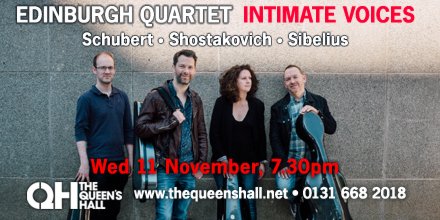
♫ Edinburgh Quartet (Queen’s Hall: 11 Nov. ’15)

“Precision mirrored with passion”

Embedded image permalink

Editorial Rating: 5 Stars:  Outstanding

One of the many appealing aspects of our home string quartet is the creativity of their programming.  Chamber Music is beautiful but a full concert can be a little samey.  Not so tonight.  Who else would start with the young Schubert, and then follow it immediately with Shostakovich, a leap of almost 150 years in composition, and make it work?

This was the second Edinburgh Quartet concert in their Intimate Voices series.  Following its successful launch at St Andrew’s and St George’s West almost a month ago, the Intimate Voices concept highlights the extraordinary intimacy created by the intense exposure and interdependence of the string quartet genre.

The publisher who mistook Schubert’s 10th String Quartet when discovering it posthumously could be forgiven for mistaking it to be a more mature work, but we now know Schubert wrote it when he was sixteen.  Properly fashioned nonetheless, the Edinburgh Quartet immediately developed its luscious, rich and warm tone that quickly drew us in.  Confidently and perfectly executed, this delightful piece with its nuances of Haydn and Mozart set us up for the treats to come.

The Shostakovich String Quartet No 7 proved an exciting thirteen minute contrast.  The F sharp minor key created an atmosphere of loss (Shostakovich’s first wife Nina died suddenly of undetected cancer of the colon. Their marriage had had its moments, but he was irreconcilable to the loss and the work is dedicated to her).  As so often with Shostakovich, the sparse strings have all the unstated menace of a horror movie, the fearful anticipation that worse is to come.  Throughout the three movements the tension gradually built into a cacophony of searing anguish only to fade away into the ether at the end.  Here the Edinburgh Quartet’s playing was undoubtedly world class. Precision mirrored with passion.

After the interval we dropped back fifty years and settled down to Sibelius’ String Quartet “Voces Intimae”.  Even though Sibelius himself was extremely wary of “names” for his compositions, (“You know how the wing of a butterfly crumbles at a touch? So it is with my compositions; the very mention of them is fatal”) the applied nomenclature is apt as it was self-penned.  The intimate nature of the work was immediately set by the opening violin and cello passage.  It is almost a feeling of reassurance that one gets from the Quartet’s complete homogeneity; they are at ease with each other and handled the frequent dynamic and tempo changes assuredly. They kept the spirit going all the way through the five movement work; their playing at times spellbinding, with aching tenderness in the Adagio di molto where Sibelius wrote the words Voces Intimae on the manuscript, and then frantic, with a wild moto perpetuo in the final Allegro, as they drove it to a breathtaking finish.

Not many promoters would put on a programme as varied as we had tonight.  It gave us a rich panoply of romantic music spanning 150 years.  The Quartet’s reputation continues to grow.

outstanding

StarStarStarStarStar

Reviewer: Charles Stokes (Seen 11 November)

Go to the Edinburgh Quartet.

Visit the Queen’s Hall archive.

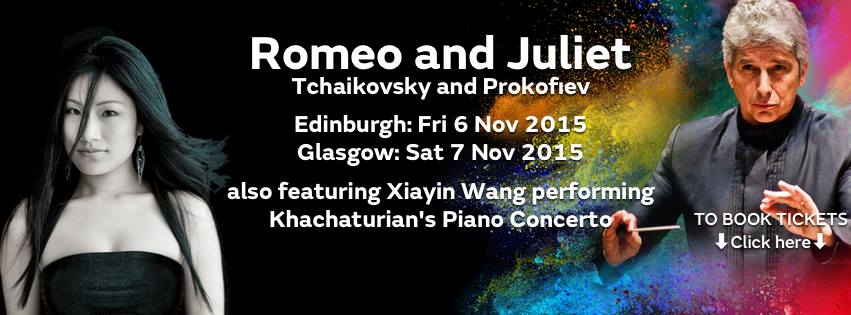
♫ Royal Scottish National Orchestra (Usher Hall: 6 Nov ’15)

“the playing was of the highest calibre…….”

Photo: RSNO.

Photo: RSNO.

 4 Stars:  Nae Bad

“If music be the food of love, play on…”  Yes, that’s from “Twelfth Night”, for love was the leitmotif of Friday evening’s RSNO concert at the Usher Hall, but the principal vehicle was that most famous love story of all, of Juliet and her Romeo.

While many others, from Gounod to Leonard Bernstein, have told this tale in musical form, there is no doubt that within the classical arena it is Tchaikovsky and Prokofiev who hold sway and these two were the chosen representatives for this part of the evening’s programme.

The concert opened with Tchaikovsky’s Romeo and Juliet Overture-Fantasy.  Tchaikovsky abandoned plans for an opera, never mind a ballet, and yet this 20 minute work is like a short, single movement symphony.  Not telling the story as such, it portrays its three main elements: the solemnity and compassion  of the Friar, the passion of the young lovers, and the festering hostility between the Montagues and Capulets.

RSNO Music Director Peter Oundjian chose to interpret this magnificent work conservatively and thereby avoided the emotion and thrills one might expect from, say, a Russian orchestra. As a consequence one found oneself wanting more, particularly from the all important flutes.  There were issues of balance among woodwind and brass, and a generally slow tempo.  Perhaps, inevitably, the band was settling in.

In between the Tchaikovsky and Prokofiev came the brilliantly chosen Khachaturian Piano Concerto.  The concerto, written some eighty years ago, was an ambitious attempt to blend Caucasian folk music influences within a bravura Liszt style masterwork. It arguably doesn’t quite bring it off, but is high on excitement, melody and romance, and is more akin to Prokofiev than the oft compared Tchaikovsky.  A clever piece of transitional programming.

It was with a sense of joy (and a bit of relief) that here, as for the rest of the evening, the RSNO gave of their very best.  The playing was taut, together, focussed.  Brass and woodwind complementing each other perfectly, a warm bass clarinet providing rich undertones for the clear and bright strings.

Soloist Xiayin Wang gave an exciting, bravura and thoroughly comprehensive interpretation in her high octane premiere performance of the work.  After the wake up call of the Allegro ma non troppo e maestoso we were soothed by the tender and melodic Andante con anima before the joyful resolution of the familiar third movement, appropriately designated as Allegro brilliante.  Orchestral accompaniment was punctuated by two extensive solo interludes, if not quite cadenzas, which the soloist disposed of magnificently. As a result I got more from work than ever before, and now consider it as far more than just Prokofiev-lite, and had the privilege of telling the soloist so as she charmingly and modestly mingled with us in the interval, sipping from a bottle of mineral water and shimmering in her gown.

Following the interval we were treated to a suite of 20 excerpts from Prokofiev’s ballet Romeo and Juliet that included some of its most romantic, accessible passages, until thirty minutes in, the bleak, searing awfulness of Tybalt’s Death hit us right between the eyes. Again, perhaps a little more restrained than a Russian orchestra might portray it, nonetheless, the RSNO’s playing was of the highest calibre: rich, flowing cadences, a silvery sheen on the strings, well balanced, richly toned woodwind and brass, and in the background the tuba and timpani sounding like a death knell.

Taken as a whole this was a cleverly programmed and highly effective concert that showed the RSNO’s playing, when into its stride, as being of the very finest.  Kicking off with the Tchaikovsky demands a leap of faith and perhaps a little less caution.  Nonetheless we had a glorious, generously programmed evening. There was a real lift to my walk home across the Meadows.

nae bad_blue

Star (blue)Star (blue)Star (blue)Star (blue)

Reviewer: Charles Stokes (Seen 6 November)

Go to RSNO here

Visit the Usher Hall archive.

♫ Scottish Chamber Orchestra (Queen’s Hall: 29 Oct ’15)

“A Melodious Maiden”

5. maiden real square listing

Editorial Rating: 4 Stars:

The Scottish Chamber Orchestra offered a diverse programme of Nordic delight at their recent gig at the Queen’s Hall.

First off was the world premiere of Verdigris by Finnish composer Lotta Wennakoski.  This was an arresting work; the astonishing opening pianissimo glissandi giving way to scary strings with woodwind interjections in a whole that was hard to reconcile with its claimed Sibelian, En Saga and Andante Festivo influences.  Unmelodic with little in the way of harmony, it reminded one of a twisted Nordic Noir one might see on BBC4.  Unfortunately, the coda was as unexpected as it was ineffective.

Denmark came next with one of the most full throated, committed renditions of Nielsen’s Violin Concerto I have had the pleasure of hearing.  Finnish violinist Pekka Kuusisti took complete command of the work and gave an electric performance including not one, but two virtuoso cadenzas.  Warm, well balanced sound between soloist and orchestra with french horns skilfully intervening between strings and soloist.  This was a thoroughly assured, well crafted performance in which the tension built irrevocably into a pulsating climax that brought prolonged and deserved applause from a grateful audience.  Kuusisti’s easy personal style built a popular rapport, and the two polkas he played by way of encore were a treat.

The second part of the programme was an ingenious piece of musical craftsmanship by conductor Tuomas Hannikainen.  Sibelius’s one published opera, The Maiden in the Tower, has a feeble plot and a poor libretto.  It also contains some of the most glorious, melodic passages the composer has ever written, all in the space of less than three quarters of an hour. Hannikainen cleverly reorchestrated the work as an orchestral suite.  So often this doesn’t really work, but in this case it really did.  We started with a bright, colourful overture in almost Hollywood style, a glorious romp, even Operetta, which morphed into something more akin to the great Finn’s gorgeous and melodic house style. If the brass had it in the Nielsen, the strings came into their own in this work, with a breathtaking idyll played by the flute, answered by urgent, plangent cellos. Hannikainen has created a work of real integrity that deserves committing to recording.

We had a wonderful joyride through the best of Finnish music, and the huge smiles and embraces amongst the band showed that they had too.  Bravo!

Star (blue)Star (blue)Star (blue)Star (blue)

Reviewer: Charles Stokes (Seen 29 October)

Go to the Scottish Chamber Orchestra

.

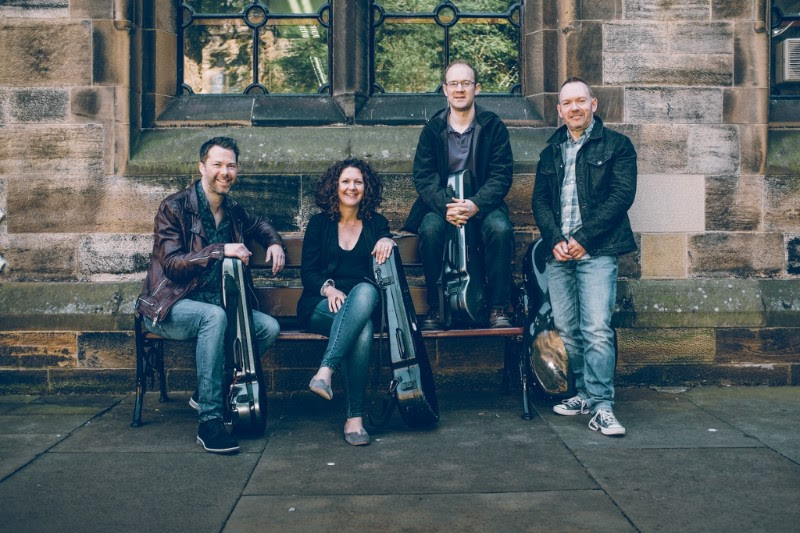
♫ The Edinburgh Quartet (St Andrew’s and St George’s West: 14 Oct.’15)

The Edinburgh Quartet. Photo: EQ.

“Intimacy and Excellence”

Editorial Rating:  5 Stars

The Edinburgh Quartet premiered its 2015/2016 Season with not so much a concert as a cleverly curated musical event.

The theme of The Edinburgh Quartet’s first trimester is “Intimate Voices”.  First Violin Tristan Gurney introduced the evening by explaining that they wanted a theme that reflected the medium’s capacity for intimate expression, and that there were many composers who chose to write for it because of this intimacy at the very core of the musical experience.  They exploited this brilliantly with their choice of opening work, Janacek’s String Quartet No. 2, Intimate Letters.

Janacek’s work is rewarding but challenging, and to plunge headlong into this incredibly varied, complex and intense oeuvre at a rush hour 5.30pm concert after a hard day at the office would have been a lot to ask of even the most ardent fan.  So they didn’t.  They led us in gently, and it made for an informed, involved and thoroughly inclusive musical evening of delight and difference.

The band kicked off with a beautifully together, easy on the ear interpretation of a waltz by Janacek’s contemporary Dvorak, and you immediately had the confidence that here was a quartet at ease with themselves, their music and their audience. We relaxed. Then Tristan got us into Janacek with his pleasing Romance for Violin ( accompanied on piano by the versatile second violin Gordon Bragg).  In a bright move that greatly helped us all in the appreciation of the music that was to follow, Edinburgh Makar/Poet Laureate Ron Butlin introduced us to Janacek’s 11 year long,  passionate, barely requited and entirely platonic romance with Kamila Stosslova, and read extracts from his love letters, whose poignancy enhanced the accessibility of the music and put it in context.

And what music it was! A beautifully woven tapestry of multifarious musical styles reflecting the panoply of emotions this extraordinary love affair engendered: bold unison openings, contrasting with passages so quiet that they were barely audible; rich melodic lines; frantic near dissonance; folk song; all greater than the sum of its parts in a way reminiscent of Beethoven’s late quartets. All in, a four movement work of less than half an hour’s duration for just four instruments!

And last, but of course not least, the playing.  Sure, the string quartet is intimate, but it is also a quite disproportionately expressive genre.  The Edinburgh Quartet is a well honed team, delivering demanding notation, phrasing and bowing, including pizzicato and sul ponticello, with not only great capability but real understanding, anticipating and following each other and never absorbed in their own playing at the expense of the group. Yet still with first class individual flair.  Fiona Winning’s viola richly developing and sustaining the theme of Kamila from early on, with Mark Bailey’s cello in confident support and finally getting his moment of glory in the last movement.  The violins, leading, supporting, ducking and diving throughout this rich, multi faceted and immensely enjoyable work.  An artistic and audible treat.

Star (blue)Star (blue)Star (blue)Star (blue)Star (blue)

Reviewer: Charles Stokes (Seen 14 October)

Go to Edinburgh Quartet here.

Visit the Other archive.

Calypso Nights: Juan, Two? (Assembly Roxy: 5 – 30 Aug : 21:30 : 1hr)

https://i0.wp.com/tourism.atdw.com.au/Multimedia/Original__9674861_WATC_CN_Press1.jpg

As entertaining as he is inventive”

Editorial Rating: 4 Stars Nae Bad

It’s very hard to tell the flavours in a good condiment apart. It’s that phenomenon when two different kinds of thing come together to form something completely new, and often indescribable. Somewhat ironically to the themes of Barnie Duncan’s riotous show, “Calypso Nights: Juan, Two?” very much contributes to that phenomenon. It’s dance, music, laughter and ridiculousness all rolled up into something which resembles a surprisingly entertaining, cuba-libre flavoured fever dream.

Presented by high-powered DJ Juan Vesuvius (Duncan), Calypso Nights is a spicy blend of music, comedy and Caribbean-tinged factoids, tied together by his considerable powers as a mix DJ and seemingly never-ending cultural knowledge.

And the Caribbean couldn’t ask for a better ambassador, fictional or otherwise: with a pair of turntables and expertly used dry ice, Duncan dominated the small stage with such confidence that he managed to pull off the bizarro-world Elvis look.  And it was that very bravado that served to underscore the blurring between audience member and participant; it requires a special type of performer to turn an at first reticent audience into a flag-waving dance party – but DJ Juan Vesuvius has the knack.

The message of the benefit of mixtures was wholeheartedly present throughout the act: his DJ’ing skills had a surprising substance and quality quite unheralded by his pidgin english-spouting exterior. Mixing between seemingly dissonant bands and musical styles, Duncan creates something new and interesting nearly every time – although, his high energy weirdness threatens to send the unstable show into meltdown towards the end, where the comedy content is eaten up somewhat by a fusion cascade of sheer strangeness.

If you’re looking for a night of nigh-indescribable fun, Juan Vesuvius is your man. As entertaining as he is inventive, it’s hard to top this dose of musical chutney.

nae bad_blue

Star (blue)Star (blue)Star (blue)Star (blue)

Reviewer: Jacob Close (Seen 26 August)

Visit the Assembly Roxy archive.

THIS REVIEW HAS NOT BEEN SUBEDITED

Ali Affleck’s Speakeasy Sessions, New Orleans Jazz and Blues, Moody Moonshine (The Outhouse, 10-12 Aug : 7pm : 1hr)

“A masterclass in real grassroots jazz”

Editorial Rating: 4 Stars: Outstanding

What I love about the Fringe is how often the most wonderful things can occur in the most bizarre places. In the upstairs room of a pub down a side street in the New Town I was treated to a real jazz feast by Ali Affleck and The Copper Cats Quintet.

The setup was nothing grand: six musicians squeezed onto a tiny stage and 50 or so seats for the sellout crowd. To open, the Copper Cats played a lively instrumental piece, giving us a glimpse into the talents of the individual band members, and then Ms Affleck took to the stage.

The setlist pleasingly contained precious few well-known numbers, so this was a masterclass in real grassroots jazz in every sense of the word. While it took a couple of songs for the group to really get going, something “clicked” in Affleck’s voice during the sultry A Good Man is Hard to Find, and the mood went up a notch. Her voice was deep and smooth and I wanted to just wrap myself up in it. It was a real privilege to witness a singer that channels Billie Holiday with so much charm and poise.

Later on, Affleck’s high notes sparkled in Electric Chair Blues, and this was the moment that I really felt like I had been transported to a basement jazz bar somewhere in old-school, downtown New Orleans. And that’s where I stayed for the rest of this gig.

The cheeky Diga Diga Doo showed off Affleck’s playful side, and He Likes it Slow was velvety, soulful and divinely decadent. Penultimate number Egyptian Ella – the band’s favourite – was a roaring romp of a tune that had all of us tapping our feet in time, and My Man was graceful, seductive and left us all wanting more.

While Affleck’s vocals were mesmerising, this was far from a solo show. Dick Lee on the clarinet was stunning in his riffs and runs, as was Colin Steele on the trumpet. Indeed, the band showed great togetherness and comradery (with a hint of friendly competition in trying to outdo each other in some of the improvised sections), so there was always something interesting happening visually as well as the stunning soundscape.

A real treat for all jazz lovers, catch them while (and where!) you can.

outstanding

StarStarStarStar

Reviewer: Steve Griffin  (Seen 11 August)

THIS REVIEW HAS NOT BEEN SUBEDITED

The Oxford Gargoyles (C : 5-15 August : 13.00 : 50 mins)

“A flawless vocal performance”

Editorial Rating: 4 Stars: Outstanding

It seems somewhat incredulous that I last saw the Oxford Gargoyles at the Fringe nine years ago. And I guess what’s most pleasing is the evolution in style since then – from what was previously a supremely talented but somewhat serious choir, to a much more risky and fun-loving bunch, with the same level of musical talent.

After a slightly bizarre introduction, the show opened with gospel number from Disney’s Hercules: That’s the Gospel Truth, which although impressive, perhaps had a slightly too complex arrangement that to the average punter would probably have sounded quite chaotic. Indeed, this was a theme that, being harsh, was true throughout their 50-minute set: amazing vocal talent that was sometimes lost behind some very complex arrangements.

What I imagine the group would hail as their “money song” was the most bizarre mash-up that I have ever heard including (among others): Stanford’s Evening Canticles in C, G and B flat; Stevie Wonder’s Signed, Sealed Delivered; Bach’s Magnificat; and even some 90s rock thrown in for good measure. Again, vocally very impressive, and I’m sure music geeks will go nuts for it, but for the layman it is quite difficult to enjoy properly with so much going on.

In saying that, this is a vocal group that absolutely knows is niche in the a capella market, and their songs were in the most part performed in their very individual style. A beautiful, soulful rendition of Let It Be, and a much simpler mash-up of jazz classics including Beyond the Sea were very distinctive to the Gargoyle’s sound. The haunting and simple Blame it on my Youth was perhaps my favourite of the evening though, going to show that they’ve still got all their old tricks, as well as having learnt some new.

The show closed with a song that I never thought I would hear from an acapella, especially a jazz acapella: Shania Twain’s Man, I feel Like a Woman. This number perhaps most evidently summed up the gutsiness this group now has, incorporating humour, original arrangement and a flawless vocal performance. It was delivered with real panache and was a great way to close the show.

For me it’s great to see so much freshness and originality alive and well in university a capella groups, and I hope the Oxford Gargoyles keep up their good work.

outstanding

StarStarStarStar

Reviewer: Steve Griffin (Seen 9 August)

THIS REVIEW HAS NOT BEEN SUBEDITED

The Sons of Pitches (Gilded Balloon, 7-13 Aug : 22.30 : 1hr)

“Their energy and stage presence was infectious”

Editorial Rating: 4 Stars: Outstanding

This is a Fringe show that has brought its own warm-up act. It may be a little arrogant, but once the real deal gets going it’s easy to see why – the sounds made by these lads with just their mouths was simply astonishing.

I’ve seen a lot of a capella groups, especially at the Fringe, and what I liked about these guys is that at just five members, compared to the usual twelve or so one might normally expect, they easily made it sound like there were several more of them on stage creating multiple levels. The layering and blend of voices in different parts is so on point that you can’t really tell who is singing what, while their energy and stage presence was infectious.

From one of the top vocal groups on the circuit, their basic “party pieces” were flawless, but this show attempted to combine a capella with comedy. Support act Love Heart came back on stage half way through to introduce a section where the group would improvise songs around a genre and subject. The improvisation itself delivered incredible attempts at traditional Irish, country and calypso music (all from audience suggestions), and I was desperate to have seen these developed further.

For me there was too much chat and not enough singing in this show, and although the interludes were enjoyable, that’s not what the majority of the audience were there to see.

While I won’t linger on some of the unfortunate vocal cracking from the singers at the higher end, the standout Son from this performance was undoubtedly Midé Adenaike. His beatboxing skills were jaw-droppingly fantastic, and particularly in the night’s closing number he stole the show.

For the most part this was an upbeat vocal party, but for me the real proof of an a capella group’s mettle is in their stripped back numbers. The Sons’ penultimate song was the self-penned Foundations, a ballad about stability within a relationship. Unfortunately without Adenaike on beats the group seemed a little lost, and although delivering a good performance, it wasn’t to the standard of their earlier tunes.

While this is a very impressive troupe with a lot to offer the world of a capella, in this performance they didn’t quite blow me away as much as perhaps they should have done, but it was still an incredibly enjoyable hour.

outstanding

StarStarStarStar

Reviewer: Steve Griffin  (Seen 7 August)

Visit the Potterrow & Teviot  archive.

THIS REVIEW HAS NOT BEEN SUBEDITED

Bonsoir Monsieur Nightfall (Assembly Roxy, 5 Aug – 30 Aug : 22:45 : 1hr)

“A voice so deep and gloriously textured you could happily drown in it.”

Editorial Rating: 4 Stars  Outstanding

In French (I’m told) there’s a term “à l’ouest” which, if not taken literally, means a dreamer, or someone “from another planet”. It seems only fitting then that Helenē Clark not only made the long journey west from France to Britain, but is also utterly out of this world.

Taking inspiration from her time out on the streets, Clark’s set was an audial rollercoaster, ranging from almost stingingly raw despair to jubilation and joy. Deeply varied to say the least, but it did so without ever feeling disjointed – owing in large part to Clark’s evocative and smoky singing. She has a voice so deep and gloriously textured you could happily drown in it. Up against a gauntlet of styles ranging from junk guitar to tango, Clark’s range and tone were utterly without fault.

But the mightiest mountains do not stand alone. And whilst the main event was undeniably Clark, full credit must be given to her backing instrumentalists, who all were utterly on point with their performances and energy. Andy Shuttleworth and Dick Playfair especially impressed, the former showing off a beautiful and often mesmerising skill in fingerpicking, and the latter scoring points for utterly blowing me away with the strength and energy of his punchy jazz trumpeteering.

Of course, no show is without shortcomings. Clark’s vocal tone sometimes betrayed her enunciation, meaning that her lyrical work sometimes felt wasted as certain verses were lost to a rumbling growl. And, whilst her stories between songs added substance, they sometimes bordered on good natured but stunted rambling.
But any and all faults were immediately forgiven by the closing number, referred to cheekily by Clarke as their “Calypso Carnival”. It typified what made Bonsoir Monsieur Nightfall so engrossing: never before have I seen a group of musicians so obviously having a blast with their craft, and doing so with such sustain and finesse. Sorrowful, sultry and absurdly fun all in one, ‘Bonsoir Monsieur Nightfall’ never missed a beat.

If you can sit through this show without at least once cracking a smile, I’d recommend getting your pulse checked. This is not one to be missed.

outstanding

StarStarStarStar

Reviewer: Jacob Close

Visit the Assembly Roxy archive.

THIS REVIEW HAS NOT BEEN SUBEDITED