Our Fathers (Traverse: 24 – 28 October ’17)

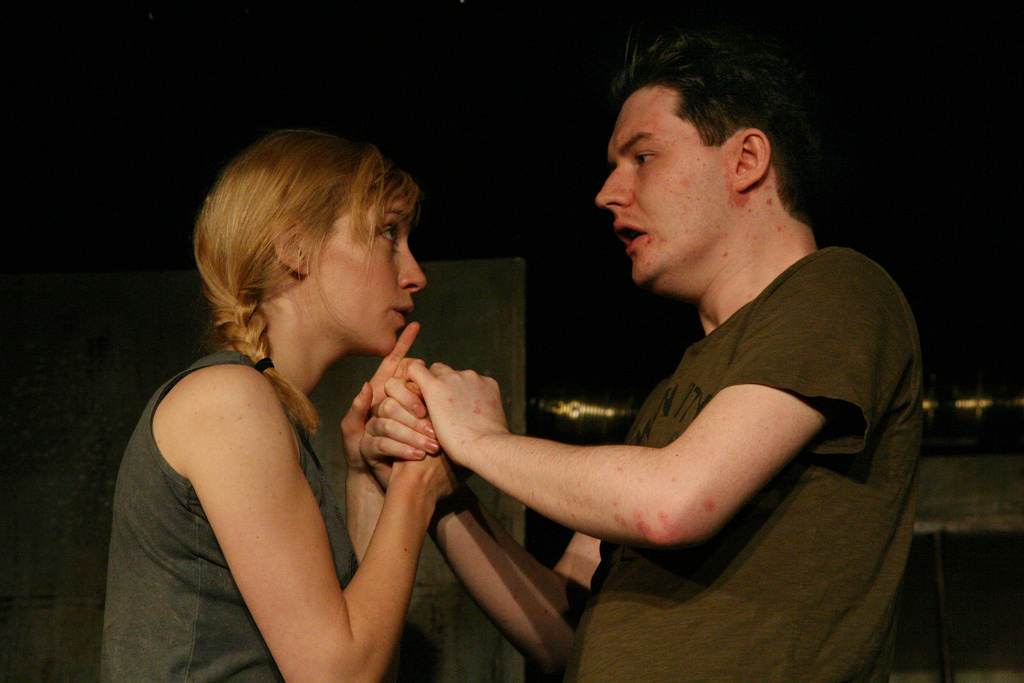
Rob Drummond (l) & Nicholas Bone (r)
Photo by Mihaela Bodlovic

“‘All Things Bright and Beautiful’ this is not, as a caustic version makes clear.”

Editorial Rating:

4 Stars: Nae Bad

Yet this is a kind piece, just possibly milder and more forgiving than its writers first intended. Rob Drummond and Nicholas Bone got together – which is a mighty draw in the first place – and offer Our Fathers as a sincere appraisal of their own lives as the doubting sons of clergymen. Their text – for this is a messaging service too – is Edmund Gosse’s celebrated memoir Father and Son (1907) with its epigraph, ‘Belief, like love, cannot be compelled’.

 Written and performed by Rob Drummond and Nicholas Bone, I should add, which is testament to the play’s personal and affecting quality. Whilst they take the parts of Philip Gosse (Drummond) and Edmund (Bone), they are also themselves, appearing friendly and unassuming, and only getting cross with one another rather than with the world. If anyone disappoints, and it is as sorrowful as it is a raging disappointment, it is the God of their fathers, who has definitely messed up. ‘All Things Bright and Beautiful’ this is not, as a caustic version makes clear.

Gosse the father was a biologist as well as an evangelical churchman, putting him squarely in the round hole of being a Christian scientist. He could write Evenings at the Microscope (1859) and still find plenty of time to rubbish the idea of evolution. One of his vivid illustrations of a jellyfish is revealed in the church hall cupboard, upstage right. Karen Tennent’s jewel of a set, so precisely lit by Simon Wilkinson, is particularly successful at focusing attention. The Victorian underslip is puzzling (a beloved dead mother?) but the fossils next to the plain wooden cross speak volumes. And there’s the fishbowl in which to dunk the book – [Told you that they get cross]. There’s an available reference to Prospero, promising to drown his learning [Like hell he will!] but then you could see it as some inventive gloss on baptism, which Drummond is especially keen to dish and seeks audience support to do so.

In Chapter 1 of Father and Son Edmund Gosse writes, ‘Several things tended at this time to alienate my conscience from the line which my father had so rigidly traced for it’. That ‘line’ is in the severe  clerical dress, the chalked up 5th commandment, and in the earnest hymn singing, but there’s also the sheer size of Philip (Drummond) alongside the much slighter Edmund, who draws up his little chair to his father’s big table. So it’s amusing that it’s Nicholas Bone who stands firm against Rob Drummond’s pleading to ‘play’ the son and it’s sad when young Edmund’s prayers fail and his looked-for faith is nowhere to be seen.

But all told Our Fathers is an easeful piece. Drummond makes light of the ribbing he got at school for ‘being the son a preacher man’. Hopefully it was good-natured, for let’s presume that he was, indeed is, ‘the sweet talking son of a preacher man’. Both men – tricky to call them actors at this affectionate point – hold up photographs of their fathers, whose recorded voices we hear.

On reflection, which is very much the point, I’m with the storyteller of Genesis 1:31: ‘God saw everything that he had made [including sons], and, behold, it was very good.’ This original, deceptively modest work, is also very good at what it asks and does.

nae bad_blue

Star (blue)Star (blue)Star (blue)Star (blue)

Reviewer: Alan Brown  (Seen 25 October)

Go to Our Fathers at the Traverse and touring with Magnetic North

Visit Edinburgh49 at the Traverse archive.
RSNO: Norrington (Usher Hall 21 Oct’ 2017)


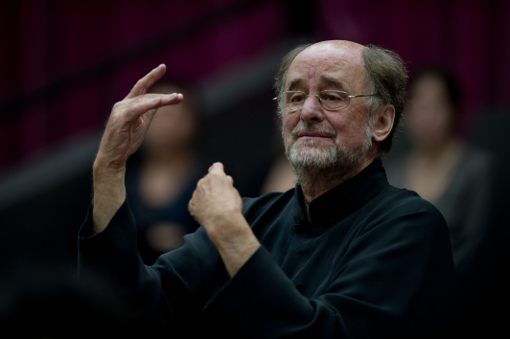
Sir Roger Norrington
Photo: Alberto Venzago

“Sometimes good things come in small packages”

Editorial Rating: 4 Stars


There was much more to Friday’s excellent RSNO/Roger Norrington gig than met the eye. Of course it was a thrill to be in the hands of the maestro of historically informed musical performance, last seen here at the Edinburgh Festival for his assured and thrilling Monteverdi performances, as well as for the reassurance of an evening’s accessible, if not easy listening, classical music. Yet we got so much more, namely an insight into the deceptively futuristic ahead-of-its-time works of Robert Schumann and Felix Mendelssohn-Bartholdy.

The first question one was forced to ask oneself was, “When is a symphony not a symphony?” The initial work, Schumann’s Overture, Scherzo and Finale was originally titled Symphonette and played out in three movements in around 19 minutes. Both Prokofiev and Shostakovich wrote symphonies of lesser duration, the former at the beginning and the latter towards the end of their symphonic canon, so why the name change? In admittedly three movements rather than four, it was greater than the sum of its parts and was a satisfying, rounded piece developing all the way through towards a Finale: Allegro molto vivace that was recognisably mature Schumann as compared to its more Mozartian beginnings.

After the deftest of scene changes (only three first violin desks to move out of the way in this cut down band) to bring on the concert grand Steinway, Roman Rabinovich delighted us in a relaxed, assured and thrilling interpretation of Mendelssohn’s Piano Concerto No 1 in G minor.   In an underrated work clearly ahead of its time – that reminded me of Brahms and Tchaikovsky a generation later  – we were treated to excellent solo and ensemble playing of a dramatic operatic opening followed by a strong melodic line and taut together playing under Norrington’s understated, enabling direction.

The evening concluded with Schumann’s Symphony No 1 in B flat minor (Spring). I cannot find any reference to Tchaikovsky being influenced by Schumann in his ground breaking fourth symphony but the opening two bars of the Spring symphony were near identical. The orchestra were sufficiently beefed up for this work to make one forget it was contemporaneous with the opening number. We went from two French horns to five, nought to three trombones and were full on for more than half an hour. The playing and direction were disciplined and effective with well-managed crescendos and an elaborate brass coda in the first movement. The band continued to provide a rich tone in the second, but in the elaborate and extended finale, following on a beautiful flute intervention, the brass gave into themselves showing tone a little coarsened by virtue of their evident enthusiasm. Never mind, this was joyous music making.

As I left the auditorium I noticed that I was leaving at the remarkably early hour of ten past nine. We had, in fact, just one and a quarter hours of music making when on a good night one can expect nearer two hours. Yet it was a well-put together programme and hard to see how it could have been justifiably fleshed out. Some times good things come in small packages.


Star (blue)Star (blue)Star (blue)Star (blue)

Reviewer: Charles Stokes (Seen 20 October)

Go to  the RSNO, Scotland’s National Orchestra

Visit Edinburgh49 at the  Usher Hall .

Hedda Gabler (Festival Theatre: 17-21 October ’17)

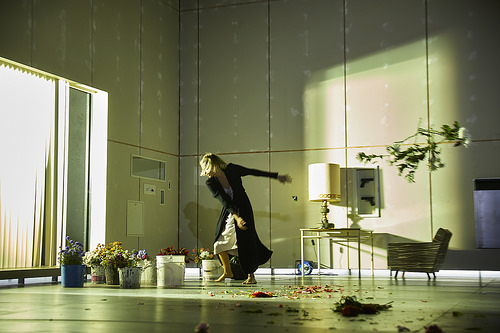
Photo. National Theatre, London

“Glistens with sparkling elements”

Editorial Rating: 3 Stars

I wonder if there is a word, other than bewilderment, for the reaction to a writer who receives praise despite mediocre work. This is what Patrick Marber’s writing stokes inside me. His re-writing of Henrik Ibsen’s Hedda Gabler is by far the most lamentable element of this National Theatre production, which sometimes glistens with sparkling elements, but includes far too many misjudgments at the head-in-hands level .

To name a few: Leonard Cohen’s lovely yet done-to-death “Hallelujah” plays over a somber transition. Pale blue lights shine intermittently on the assembled actors, for no apparent reason. Physicality is dishearteningly overplayed at times, making the performers appear more like wet marionettes than characters telling a story. And yet, Marber’s script outdoes them all.

The play concerns itself with a day and a night in the apartment of academic wet blanket Tesman and the eponymous Hedda, his new, unfulfilled wife. Friends and former lovers of theirs come and go to moan and wail about their various woes, from dead-end marriages to unrequited love to jealousy over academic rivals’ successes. There are intriguing elements to these episodic entrances and exits, most compellingly when Tesman’s semi-rival Lovborg lays out his plan for his next work. This is what most frustrates about this show: there are so many glimmers of intriguing theatre, many stemming from Ivo Van Hove’s smart (yet here unexceptional) direction, but they are all but snuffed out by Marber’s tone-deaf phrasing and (I hazard) self-importance.

Hedda, a groundbreaking and fresh character in 1891, is nowadays much less extraordinary. She is the daughter of a prestigious general, and a young woman with many suitors, yet lacks any real goals or interests in life. This “poverty of spirit” as the play decides to call it, leads her to seek out increasingly sadistic means of exerting some kind of power over something, whether it be tearing up flowers or firing her father’s pistols at unsuspecting guests, and eventually much worse. This kind of bourgeois-fetishizing story creates just the sort of middle-of-the-road tension and intrigue that should be right up Marber’s alley. Is Tesman going to get his professorship? Is Hedda fulfilled? What is that maid doing there? Yet Marber seems to think he doesn’t need to convince an audience to care about these central questions of the script. So he fails to.

Much like in his magnum opus, Closer, Marber’s word choices can prove unfortunate and even unpleasant. The storyline is treated with such carelessness that it is unclear whether it is satirizing its own pomposity or reveling in it. It looks like Ibsen’s text has suffered a form of quantitative easing and the original is struggling to get back into shape. Certain big monologues (that strain the runtime for no apparent reason) are answered by brief ironic retort: when one character loses the precious, handwritten single draft of his upcoming masterpiece, he waxes poetic for no less than five minutes about his loss — to which another character quietly quips: “It’s just a book.” Somehow, this self-awareness gets squashed and replaced with showiness and shiny things.

There are many shiny things. The set is the unfurnished apartment owned by Hedda and Tesman and is immaculately underdressed. Hedda’s costume is a shiny nightgown. The lights gleaming out of an impressive side window are shiny, as is the display Hedda creates as she plays with the blinds out of increasingly aggressive boredom. The two handguns on show in their upstage glass case  are shiny, and even shinier when they are — spoiler alert — fired at certain characters. But shiny objects do not tell good stories by themselves. We seem to have a production that thinks having a smooth set and glossy production values can make up for a certain percentage of the narrative. They cannot. Some more work on character dynamics and relationships and a little less time stapling roses to walls would have helped quite a lot.

That being said, there is still much to be appreciated in the production. For their stamina alone, the actors deserve some credit. Wading through these lines with such patience must have been hard. Lead actress Lizzy Watts gives Hedda some delightfully cruel ticks, from turning her back on anyone she finds unworthy, to consciously tormenting her guests with their worst vices. Her dynamic with Richard Pyros, playing Lovborg, was the most electric to watch, especially as she toys with his teetotalism in the most vicious way. Adam Best as corrupt judge Brack is the most bombastic onstage presence by far, and his was a refreshing performance. Annabel Bates is good at looking sad, that’s for sure. Abhin Galeya waves his hands around far too much, but otherwise is a solid Tesman — though the character seemed meant to be much more pathetic than the relatively proud man Galeya has created. Christine Kavanagh is a charming red herring at the beginning, as her Aunt Juliana character deftly introduces the audience to the show, then disappears — which is a shame, as Kavanagh’s energy was possibly the best-measured. Madlena Nedeva is a solemn and well-crafted presence as Berte, the maid, yet her character is so untapped that she quite literally becomes more a piece of furniture than a participant.

Overall, an underwhelming and overwritten production of an important play. It is surprising and disappointing that others have eaten it up nonetheless.

Star (blue)Star (blue)Star (blue)

Reviewer: Nathaniel Brimmer-Beller  (Seen 17 October)

Go to Hedda Gabler at the Festival Theatre

Go to Edinburgh49‘s Festival Theatre archive.


Cockpit (Lyceum: 6 – 28 October ’17)

Photo. Mihaela Bodlovic

“Director Wils Wilson goes all out to create predicament and danger”

Editorial Rating: 4 Stars: Nae Bad

Albert Camus’ La Peste was published in June 1947. The first Edinburgh International Festival was in August 1947. Bruno Walter conducted the Vienna Philharmonic in the closing concert and reckoned that “Here human relations have been renewed”. Bridget Boland’s Cockpit opened at the Playhouse, London, in February 1948 and mashed pestilence and optimism together. Now it’s back, thanks to David Greig, and fit for purpose: a raw and vehement history play, but without princes and kings.

London’s Cockpit theatre was on Drury Lane. It was probably another ‘Wooden O’, built around an actual cock pit. Boland’s play goes one better than Shakespeare’s Henry V, her ‘swelling [and vicious] scene’ holding not only ‘the vasty fields of France’ but the whole of Europe. Cockpit is actually set in a theatre. You get the immersive idea pretty quickly when you notice that the Lyceum has been commandeered by the ‘Allied Government’. It’s late 1945, it’s punishingly cold, and there’s still the reverberation of pulverising bombardment. We’re in the British Zone of Occupied Germany and a theatre is being used as an assembly centre for displaced persons (DPs), hundreds of them. They’re even huddled on the stage. Cast-off clothes are over the backs of the seats. There are ladders from boxes, screened by sacking, to the Stalls and – we’re told – German corpses in the boiler room. Transport is being arranged to take you home (whether you want to go back or not …).  You in the Dress Circle are going West. Those of you in the Stalls are going East. Jiri, on stage and silent, is from Lidice and has no home left. Willkommen im Umwelttheater!, as ingeniously constructed by designer Ana Inés Jabares-Pita.

It is a babel of Slavic voices and trouble. But surely a British officer can sort this lot out, provided he has a desk and reason on his side. Young Captain Ridley has been detached from his regiment because he has School Certificate German. He does have his service revolver. His sergeant, Sergeant Barnes, has no German, just loud Geordie and a Sten gun. Between them they put on a brave ‘show’ – in the choice Army sense of the word – but there’s a limit to how long they can just ‘Carry on’.

Conflict starts with ‘Who’s pinched my sauce pan?’ and very quickly turns serious, not least because the Poles hate the Jews ( – ouch!) and the Russians will kill the Poles and the Chetniks will kill anybody, especially socialist partisans. A French collaborator – but forced labour would qualify that – is certain that Marie, a Resistance fighter, will falsely denounce him. Add infectious disease and Capt. Ridley is in a desperate jam. There is some rallying round but a different kind of ‘show’ is needed to relieve the tension; after all, we’re in a playhouse. When it comes, two thirds through, we get an operatic cloth and a bravura performance from Sandra Kassman.

(L-R) Nebli Basani, Peter Hannah, Dylan Read (Bauer), Sandra Kassman (stairs), Kaisa Hammarlund (stairs) and Adam Tompa. Photo. Mihaela Bodlovic

This is Boland’s brilliant conceit. When the German stage manager, Bauer, says “You will need the theatre – afterwards”, you believe him. And when faced with the possibility that his theatre – probably one of the few buildings left standing in his flattened city – might be burnt down to halt contagion, the man is stricken with sadness. Bauer (Dylan Read), as comic denizen of his place, living in the flies, and true Propsmeister, is almost the only source of laughter in an otherwise sombre drama. Read also plays Duval, whose occasional spoken French, is so good that you appreciate the difficulties of staging a script that demands heavily accented English from several characters. Whatever ‘European’ means, this cast is it.

Director Wils Wilson goes all out to create predicament and danger. A chant is either angry or sorrowful and certainly incomprehensible (unless you’re Romanian). Rush and hurry can subordinate the personal stories. There is a stretch of choreographed movement for the whole company that would express the plight of the displaced anywhere, at any time. The excellent music by Aly Macrae is often discordant and broken, except for the quiet piano at the beginning of the second half. Capt. Ridley (sturdy by Peter Hannah) might be resolute, almost heroic, but it’s not enough. There is a passing mention of a major somewhere else but the chain of command appears well and truly absent, which will irritate Army types.

Cockpit is bold work, both then and now. It is theatrical but – more importantly – it’s humane. A Russian DP proclaims “20 million Russians died. It must not happen again”. That’s from the Stalls, going East. Primo Levi, after Auschwitz and going West, got it exactly right: ‘It happened, therefore it can happen again’.

nae bad_blue

Star (blue)Star (blue)Star (blue)Star (blue)

Reviewer: Alan Brown (Seen 10 October)

Go to Cockpit at the Lyceum

Visit Edinburgh49 at the The Lyceum  archive.

Jury Play (Traverse: 3-7 October ’17)

“The fourth wall isn’t so much broken as shattered”

Editorial Rating: 4 Stars: Outstanding

Sometimes the power and excitement of a show begin long before you take your seat, and remain with you for several days after. For Jury Play, a detailed email briefing is circulated in advance of the performance/court appearance, creating intrigue into what the evening will entail: it’s worth saying at this point that this is in no way like your standard trip to the theatre. The excitement only builds as you go through “security”, enter the (optional) ballot to become a jury member, and start to leaf through your court information pack while taking in Emily James’s impressive and sizeable courtroom set.

Yet what, on the surface, appears to be conceived as an interactive courtroom drama, where the prosecution and defence present facts about a given crime and a resolution is reached by the audience/jury, what Jury Play peels away at is what effect the trial process has on individual members of the jury, specifically for trials that last for weeks.

At various points during the trial, voiceovers expressing jury members’ thoughts are overlaid with the action, which include worries about getting children to school, paying bills, what specific legal terms mean, and even staying awake. Snippets of video conversation between writers Dr Jenny Scott and Ben Harrison about the performance also add a pleasingly Brecthian feel and help break up some of the monotony of the trial itself. So far, so so. Everything changes in Act ii, however, when the formal trial is over and the power lies in the jury’s hands. I won’t give away all the spoilers, but I shall simply reveal that organised chaos ensues, and the meat of the piece really comes out as an intelligent, human, and common sense discussion into the way we conduct trials.

When it comes to the performance it is John Betts as Judge who commands the show, and with his hilarious doddery asides and sensitive chairing of the discussion in the second half of the piece, you feel like you’re in his space, and he decides at any given point how comfortable anyone is to feel. Helen Mackay is also excellent as the conscious “everyman” figure Janis, who just wants to do her duty, and the cast as a whole make the performance very accessible: the fourth wall isn’t so much broken as shattered, with a piece of it distributed to each and every person in the room.

For me, though perhaps a reflection on the subject matter it discusses, Scott and Harrison’s script is too laboured and lengthy at points – missing some crucial details to aid comprehension in the first half, and dragging out its point in the second. The ending, while interesting and fitting stylistically with the piece, also feels like a bit of a cop-out and rather abrupt – as if the ideas just ran out at that point and there was nowhere else to go.

Overall this is a fascinating insight into the legal system, what it’s like to be a jury member, and how seemingly unfit for purpose the whole setup is – especially for people like me who have very little knowledge of its intricacies. Jury Play is absolutely worth taking part in, if there’s any room left in the public gallery.


outstanding

StarStarStarStar

Reviewer: Steve Griffin (Seen 5 October)

Visit the Traverse archive.

THIS REVIEW HAS NOT BEEN SUBEDITED

Pleading (Traverse: 3 – 7 October ’17)

Kim Allan and Daniel Cameron
Photo: Oran Mor

““Everything is negotiable””

Editorial Rating: 3 Stars

Pleading is the first up of five plays in this season’s ‘A Play, A Pie and A Pint’. This is a spiky three-hander by Rob Drummond, surely a playwright on a roll; and there is something of a wrestling bout to its twists and holds. Heard as a radio drama on BBC4 in January, Pleading comes to the stage – but call it a mat – with a narrative thwack.

Michael (19) and Freya, his girl next door /one-time sweetheart, have been banged up in a foreign jail for three weeks now. They are brought together to talk to their assigned lawyer, Amelia Singh. Where exactly they are  is not given but they do face the death penalty for attempting to smuggle Class 1 drugs. That fate – and their flight itinerary: Singapore > Perth > Brisbane > prison – would suggest Malaysia or Thailand. No worries (really?), for Freya’s dad is a QC and in that part of the world “We’re not foreign, we’re British.” Er …? Cue Boris Johnson and the Road to Mandalay?

If ever a defence lawyer was gobsmacked and keeps talking, then it’s the calm and collected Amelia (Nicole Cooper). How to convince her jumpy clients to plead guilty and serve a prison sentence? Maybe then Daddy can come and flap his silk. “Everything is negotiable”, declares Amelia, but it helps if you keep your story straight and consistent. So, over 50 minutes, Freya and Michael ‘negotiate’ the possibilities of how heroin ended up in her backpack. It is conceivable that the truth is told at the end but who can tell? It’s always salutary to be reminded of our talent for lying.

It is an unsparing and sweaty tussle that is ably performed. Freya (Kim Allan) is more in control but her account is the more wayward. Michael (Daniel Cameron) is more fragile, even desperate. At the close they are hanging onto each other for support and the law is somewhere else entirely.

Director David Ian Neville has a good play for voices to work with. Movement is conspicuous and time parcelled out by Amelia’s visits to the remarkably quiet prison. There is credible tension and there is sympathy and anxiety but as a drama I felt it wanted more fear and a lawyer on the ropes.

Star (blue)Star (blue)Star (blue)

Reviewer: Alan Brown (Seen 3 October)

Go to Pleading at the Traverse

Visit Edinburgh49 at the Traverse archive.
What Shadows (Lyceum: 7 – 23 September ’17)

Ian McDiarmid as Enoch Powell
Photos: Mihaela Bodlovic

“A remarkable performance, as unsettling as it is astonishing”

Editorial Rating:  4 Stars: Outstanding

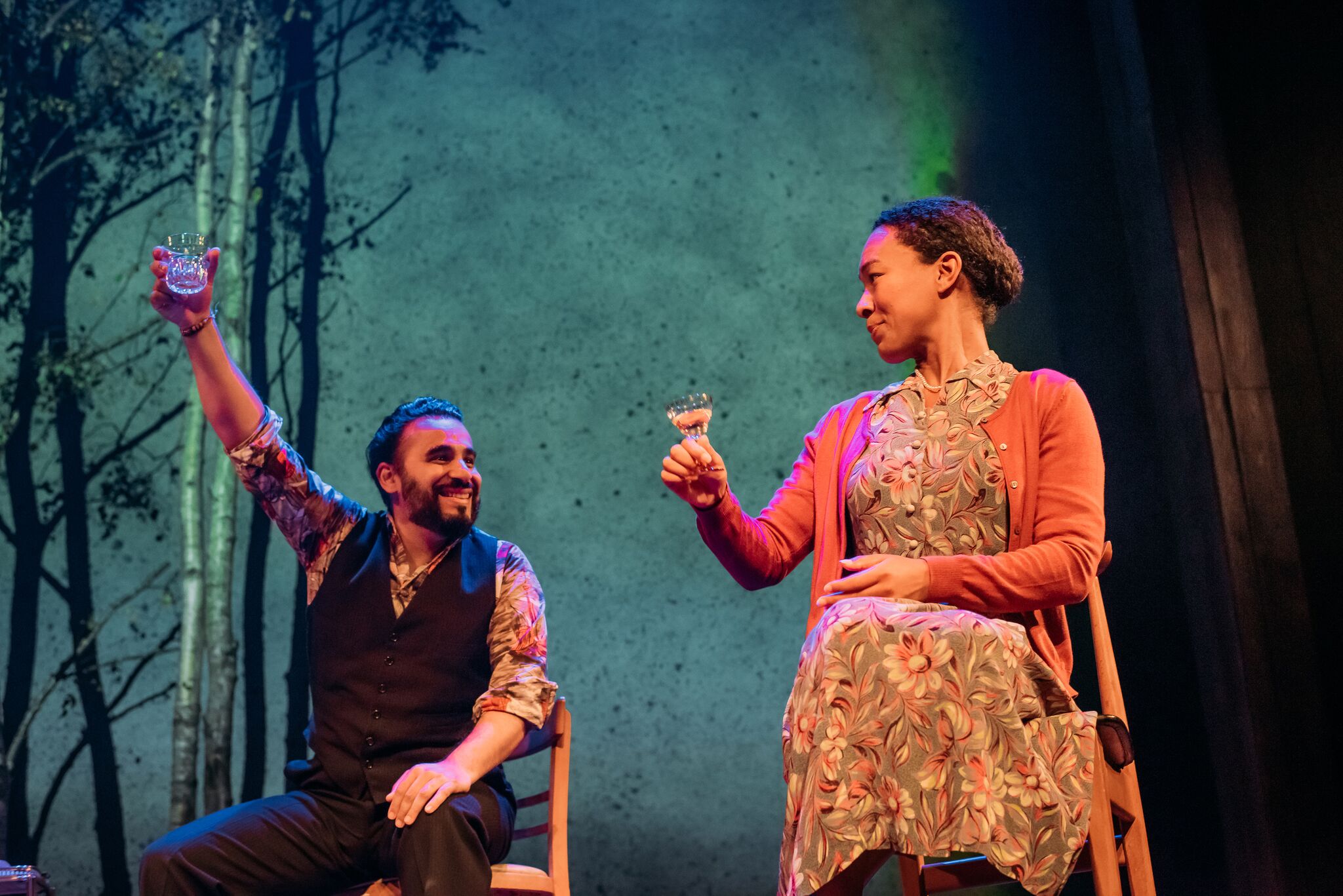
Shadows cast? Shadows fleeting? Shadows lengthening? Take your pick as you find your way back and forth through the many scenes of Chris Hannan’s timely play upon the redoubtable life of Enoch Powell (1912 -1988), for whom – archly – it is ‘in fog [that] you feel England all around you’. As it is what you see is a beautiful copse of silver birches.

This is the standout Birmingham Rep’ production from 2016 directed by Roxanna Silbert. Ian McDiarmid (Powell), Paula Wilcox and Waleed Akthar reprise their roles. McDiarmid, especially and importantly, gives a commanding performance as the radical, absolutist Conservative whose proudest, indisputable claim was that he always spoke for his constituents of Wolverhampton South West, and as their MP from 1950 to 1974 that meant speaking his formidable mind about immigration. For the classical scholar, poet, and theologian whose idea of total Englishness was ‘sunken lanes in Shropshire’, immigration is as unpoetic – but as necessary – as it gets. Lamentable too. For Powell’s close friend, local newspaper editor and Quaker Clem Jones (Nicholas le Prevost), ‘England’ is more subtle – ‘Gary Sobers bowling his slow Chinaman’: surely one, nowadays, for the British Citizenship Test.

What Shadows moves between 1992 and 1967/68. Powell’s notorious ‘Rivers of Blood’ speech, that closes the first half of the play, was given at a Conservative Association meeting in Birmingham on April 20 1968. Twenty-five years on two feuding Oxford history lecturers, one black, one white, Rose Cruickshank (Amelia Donkor) and Sofia Nicol (Joanne Pearce), see a research paper, maybe a book, contextualising that speech, interviewing Powell, and hitting upon Insights-to-Racism-and-How-to-Stop-It. Parody did not seem far away, particularly in their self-righteous, point scoring tones; and they’re certainly no match against Powell, even at the end of his life and shaken by Parkinson’s.

Ameet Chana as Sultan and Amelia Donkor as Joyce Cruickshank

Hannan’s invention is both amusing and accurate. 1967 is a Powell picnic, with his wife Pamela (Joanne Pearce) at her supportive best; it is also a hostess trolley at an awkward New Year’s Eve party, where Grace Hughes (Paula Wilcox) is a white landlady of two Punjabis, the gauche Saeed (Waleed Akthar) and the jovial and appealing Sultan (Ameet Chana), whose war service in Burma included learning ‘I Love a Lassie’ from the 1st Battalion Seaforth Highlanders. 1968 is the Powells leaving an RSC production of ‘King Lear’ at Stratford and being buttonholed by Sultan. “England must be cured of Empire” pronounces Enoch. There’s even a passing reference to the late and great Alan Howard.

In this show, though, it’s Ian McDiarmid whom you must applaud. It is a remarkable performance, as unsettling as it is astonishing. Go to Youtube for Michael Cotterell’s 1995 film portrait of Powell, ‘Odd Man Out’, and realise how close the actor is to his subject. Obviously the words, their clarity, and the curiously accented speech can be the same but there is the tight smile, the nodding assent that is as sympathetic as it is probably dismissive. Powell nearly usurped the Tory party on principle and McDiarmid shows how he did it, without quite turning the man into the near demon / archangel of the Left and Right respectively. Enoch in carpet slippers and dressing gown is still the insurgent and not some benign ambassador for the National Trust.

The ending looks to the future, to whatever England makes of itself. It probably has to be a tad romantic and suffused with colour to offset the gloom of the present day.

outstanding

StarStarStarStar

Reviewer: Alan Brown (Seen 12 September)

Go to What Shadows at the Lyceum & to the Birmingham Repertory Theatre

Visit Edinburgh49 at The Lyceum archive.

Columns (theSpace on the Mile: 14-26th Aug: 10.55: 60 mins)

“A really joyous production”

Editorial Rating: 3 Stars: Nae Bad

If there were an award for theatre company I most want to be friends with, The Wax House (formed by Laura Day and Alexander Hartley) would win it hands-down. Their smiles, personalities and passion for what they do is infectious, and that’s what’s most resounding about this performance of new work Columns. It feels more like you’ve popped round to a mate’s house for fun story time than a converted hotel function room on the Royal Mile, and the atmosphere of the piece really does transport you to a happy place.

The story follows two main characters: Sophie (Day), a personal trainer with an estranged mother and rather volatile relationship with her father; and Joe (Hartley), a pot-plant enthusiast whose parents upped and disappeared without a word almost two years ago. At its heart is a theme of reconciliation and helping others come to terms with loss.

The mainstay of the story is Sophie’s quest to help Joe deal with his parents’ unexplained disappearance, and the questionable moral choices (such as impersonating his mother in a voicemail message) she makes along the way in so doing. It’s a simple and effective approach to create tension and drive the piece along, as we do follow her thought process and qualms at each step, though it’s a shame how easily it all turns out in the end: some of the journey and struggle is cut short, cheating the audience of a full feeling of satisfaction.

Indeed, what is rather frustrating about Columns overall is the number of loose ends and glossings over of facts that are rather central to the story: proof of a certain phone call, and Sophie’s motivation to undertake her first piece of exploration being key examples. Yet what is there is performed with such warmth and vivre that these flaws are almost forgotten by the end.

The company make clever use of carboard boxes as their set and props throughout, each painted with different patterns and images on each side, and which are then variously arranged to create different scenes. This action adds to the playful, happy nature of the piece, as do the audio interludes accompanying each scene change, seemingly capturing unplanned snippets of Day and Hartley in discussion about the show.

The performance I saw was a relaxed one, adapted specifically to suit those who find the traditional theatre environment too formal to sit still and quiet in for an hour. Day and Hartley certainly make the space welcoming and friendly one to be in, encouraging us all to be ourselves and respond however we felt comfortable to. I’d never been to a relaxed performance before, but would absolutely recommend it for those who might face barriers to access theatre normally.

Overall this is a really joyous production, but needs more work on the script and details of the story to take it to the next level.

nae bad_blue

Star (blue)Star (blue)Star (blue)

Reviewer: Steve Griffin (Seen 24 August)

THIS REVIEW HAS NOT BEEN SUBEDITED

#JeSuis (Zoo Southside: 16-26th Aug: 20.30: 45 mins)

“Hugely powerful…all this show needs is an audience”

Editorial Rating: 5 Stars: Outstanding

#JeSuis isn’t just a stunning piece of contemporary dance from Aakash Odedra Company. It’s a galling political movement in response to the global media disparity in coverage of the growing number of displaced people worldwide. And what hits hardest in this performance is the sheer determination and resilience of a group desperate to have their voice heard.

On a basic level #JeSuis presents the hopeless waiting, the loneliness, danger, shaming and stigma of being a refugee, through a series cleverly woven scenes and images that are at once beautiful and brutal. The piece starts slow, as we see the performers wait for something, anything to happen, and when a grizzly authority figure enters and the phone rings, desperation boils over and violence erupts. The use of structural and architectural lighting in this section reflects the harsh rules and boundaries displaced people often find themselves within, adding an extra layer of discomfort as dancers are enclosed within small spaces of light, thrown away from the light, or have a spotlight shone directly in their faces.

The movements are frantic and jagged – as if each limb is under remote control of a six-year-old child on speed – and the quality signifies the alarming lack of control the individuals have over their situation. The imagery created is stark: we see dancers desperately attempt to move freely, to being physically wrapped in layers of cling film while they continue to fight, to the more aggressive restraining of an individual who reaches for the ever-present microphone to one side of the stage. But perhaps most powerful in the early part of the performance is an apparent sexual assault conducted by the authority figure, leaving his victim broken while the others can only look on.

Yet it’s not all darkness and depression – a sense of comradery builds between the group to over-throw their oppressor towards the second half, with rousing unison sequences and a role-reversal as they hold back the authority figure from achieving his own goals. The token use of sung and spoken word are a perfect complement to all the other ways the dancers attempt to express themselves throughout the piece, and it’s evident that something has to give. Yet even as the next chapter emerges at the show’s climax, it’s with a distinctly bitter-sweet sentiment, as the rigid unison once again feels like overbearing control of a different kind.

This performance of #JeSuis is a work in progress, with further development scheduled for the second half of the year, though from here it’s hard to see how much better it can get. From a theatrical perspective seeing some of the individual characters and journeys developed would help build a greater empathetic connection with their stories, otherwise all this show needs is an audience. Even as a work in progress this is a hugely powerful piece of contemporary dance, perhaps made all the more poignant given the fact it is unfinished, like many of the struggles faced by those it represents.

outstanding

StarStarStarStarStar

Reviewer: Steve Griffin (Seen 22 August)

THIS REVIEW HAS NOT BEEN SUBEDITED

+3 Review: Oskar’s Amazing Adventure (Gilded Balloon Teviot: Until 27 Aug: 11.50: 40min)

“The highest praise I can think of is to jump up and down in my seat squealing ‘Again! Again!'”

Editorial Rating: 5 Stars: Outstanding

It’s the middle of a hard winter in Switzerland. The little house on the top of the mountain is snowbound. Oppressed with cabin fever, fun loving puppy Oskar runs off in search of new friends to play with.

The show is based on the picture book by celebrated children’s author Colin Granger. Colin is of course a part owner of Komedia Brighton, and (once upon a time) was the author of the Heinemann English Grammar (which is yet to be dramatised for the stage). All the original characters are present, including Oskar, his friend the Marmot, the hungry Fox, Grandma, the chickens, the other puppies. The only exception is Mrs Goat who lost her seat on the tour bus to Colin.

We enter to find an alpine backdrop hung from rustic timbers. In front is a canvas pyramid with three of the four sides painted with a particular scene from the narrative that is about to unfold. With the occasional turn of this pyramid by performer Natasha Granger, Oskar’s story is revealed. Not since the Pharaoh Khufu walked out of Dunbar and Sons onto Morningside Road, having just purchased the ultra deluxe funerary care package, has a pyramid been put to such effective use.

This production is a grace and flavour mansion giving Colin Granger’s charming narrative a home away from home. The grace is delivered by his daughter Natasha whose fluid movement melts in and out of the liquid lighting and soundscape. The flavour is unmistakably alpine – crisp, simple, elegant. The interplay of stagecraft and performance is balanced and nuanced. The puppetry (including some shadow play on one side of the pyramid) empowers rather than overpowers. The effect is hugely satisfying, whether this is your first ever show or simply your latest.

It’s a safe bet that the Children’s section of the Fringe guide is the growth area to watch and shows like Oskar’s are in the vanguard. A glance at the reviews on EdFringe.com reveals where that vanguard will encounter the sharpest slings and arrows. Audiences love this show (as they should). The “professionals” are noticeably less excited. Why would they be? It’s fairly obvious that they weren’t accompanied by a reliable preschooler.

You might have noticed that it’s really quite expensive to come to Edinburgh in August and this is true for pundits as well as for producers and punters. Bringing a kid along too (without the support of local grandparents in residence) is a big ask, but it must be better answered. As the children’s section of the Fringe guide grows, reviewers and their publishers need to be much better at reflecting the artistry and talent that shows intended for younger audiences are already delivering.

This was my own preschooler’s first ever live show and I am so massively grateful to Theatre Fideri Fidera for making it such a positive and memorable experience for us both. Oskar’s Adventure may not strike a jaded 20-something as particularly amazing, but for preschoolers first noticing the big wide world (and for those of us privileged to attend them on their journey) the perspective offered is just right. The highest praise I can think of is to jump up and down in my seat squealing “Again! Again!”

outstanding

StarStarStarStarStar

Reviewer: Dan Lentell (Seen 23 August)

THIS REVIEW HAS NOT BEEN SUBEDITED