‘Birdsong’ (King’s: 21 – 25 April ’15)

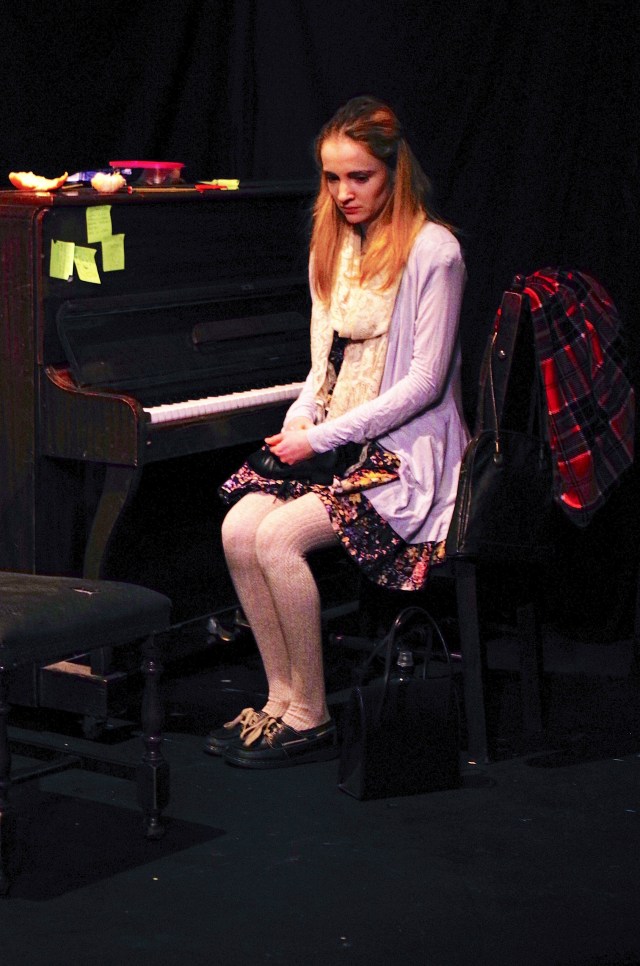
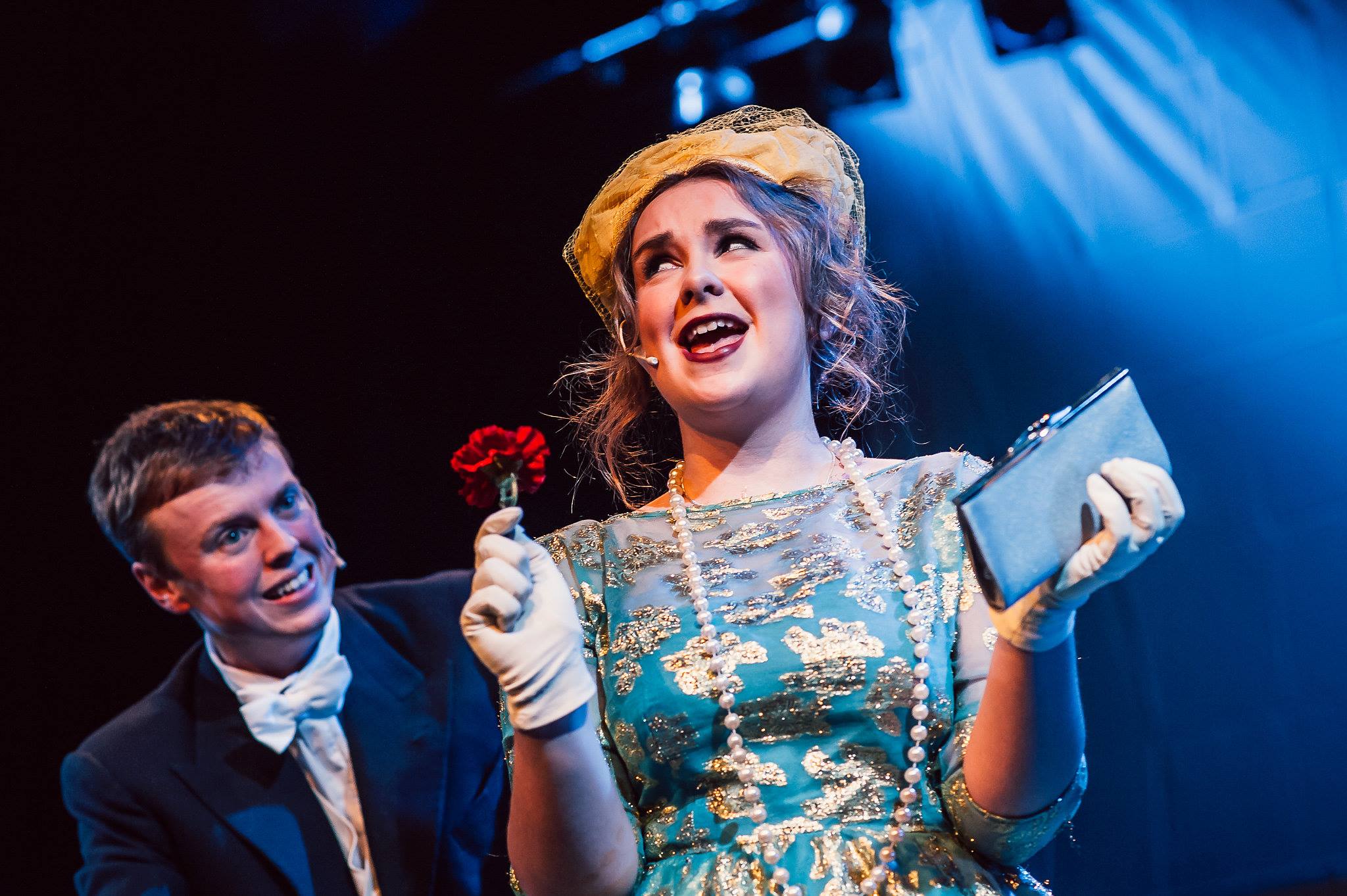
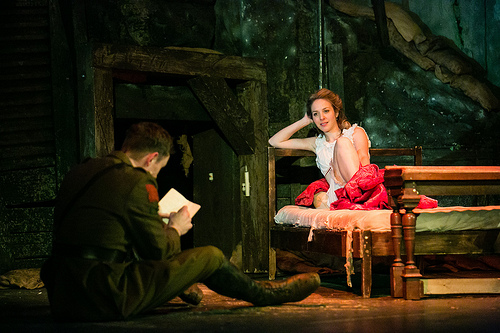
Edmund Wiseman as Stephen Wraysford and Emily Bowker as Isabelle Azaire. Photos: Jack Ladenburg

Edmund Wiseman as Stephen Wraysford and Emily Bowker as Isabelle Azaire.
Photos: Jack Ladenburg

“More resonant than sword waving in front of machine guns”

Editorial Rating:  4 Stars Nae Bad

If you can bear a literary introduction read Sassoon’s The Redeemer and Owen’s Strange Meeting before the show. If not, just take this from Issac Rosenberg’s Returning, we hear the Larks:

‘Death could drop from the dark
As easily as song –
But song only dropped’

Which is what you do get in this moving if fitful adaptation of Sebastian Faulks’ Birdsong. There is lovely singing and there are skylarks – but there is also a rat on a bayonet, blood dripping down 60 feet, and furious bombardment.

This is poignant and dramatic storytelling by the Original Theatre Company. Yes, Faulks’ book is blasted open in Rachel Wagstaff’s new version for the stage and at times the effect is not pretty, parts do fall away and some of the shoring up looks shaky but I reckon that’s inevitable. The back set is a high rampart of shattered wood and piled debris. Two large timbers make a cross that rises above the parapet in a stark reminder that Christ had one hell of a job to do on the Western Front. Men pray in this play, which is not at all what I remember from the book, and it is horribly easy to understand why. That green hill is not so far away and might well be undermined by tons of explosive that will send you to kingdom come.

What I do recall from Faulks’ pages are sex and war story content of frightful detail and claustrophobic novelty. Well, the sex is still around but the novelty has gone because even if you do not know the book there’s the two-part tv. series with Eddie Redmayne and the Australian film Beneath Hill 60. Tunnelling onto and about the stage aint the same but the sappers do a brave job of crawling by (electric) candlelight. They ‘Play Fritz’ and imagine the lives of the enemy, who may only be a few feet away, below, above, or ahead. There’s suspense to be had before an attack tunnel breaks through or a detonation shakes the walls and then there’s rushing confusion. Nevertheless, the best action stays with the characters.
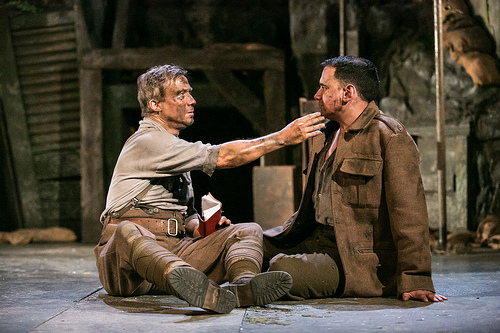
Peter Duncan as Jack Firebrace and Liam McCormick as Arthur Shaw

Peter Duncan as Jack Firebrace and Liam McCormick as Arthur Shaw

With a name like Jack Firebrace we’re close to plain allegory. Peter Duncan plays him admirably as sturdy, loving, dauntless . The short scenes when this former London Tube tunneller and his best mate, Arthur Shaw (Liam McCormick), share letters and thoughts of home are possibly the most affecting in the play. What is more intense but – it seems – far less mature is the love affair between Stephen Wraysford, 20, (Edmund Wiseman) and Isabelle Azaire, 27 (Emily Bowker). The individual performances are easily good enough to make this believable in the moment but it is a stretch to see it played out over eight years, from 1910 to 1918. The flashbacks flare and are gone and you can almost see the narrative being shovelled in before the light vanishes. A final, near wordless, scene when the cast of Stephen’s lacerated memories people the stage is a welcome coup d’oeil upon the whole ghastly shebang.

Arguably a resurrection is being played out: of Stephen’s passionate love and of his war – that’s understood; but it is also an appeal to stand by what is now out of living memory. Hence the really telling effect in this production of folk song, hymn and psalm, beautifully sung by James Findlay ; a cut above and much more resonant than sword waving in front of machine guns, more so even than a Tommy / Hun hug of reconciliation. For what Wagstaff has crafted from Faulk’s book and what director Alastair Whatley turns out on stage is a theatrical ‘Stand to’ – to guard against what Stephen kept close in his coded notebook and is now given voice:
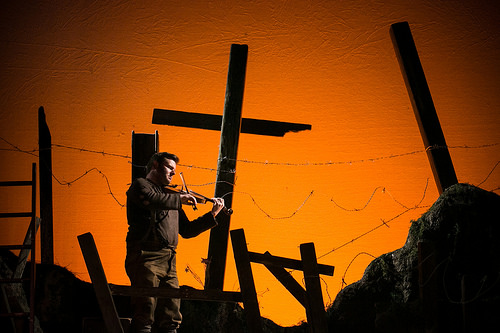
James Findlay as Cartwright, Singer and Musician

James Findlay as Cartwright, Singer and Musician

‘No child or future generation will ever know what this was like. They will never understand … We will seal what we have seen in the silence of our hearts and no words will reach us’.

You might simply want to accept Stephen’s commanding officer’s invitation to join him for tea on the Royal Mile when ‘this’ is all over. Or you can talk about ‘Birdsong’, which would be better.

nae bad_blue

Star (blue)Star (blue)Star (blue)Star (blue)

Reviewer: Alan Brown  (Seen 22 April)

Go to the King’s and Festival theatres here.

Visit the King’s Theatre archive.

‘The Steamie’ (Brunton Theatre, 27 – 28 March’15)

Photo: Sam McNab

Photo: Sam McNab

“Out-and-out hilarious .. a cleansing experience “

Editorial Rating: 4 Stars: Outstanding

Many plays aspire to be immersive, but few could claim that word as literally as Scottish favourite The Steamie. Set in a Glasgow wash-house one 1950’s Hogmanay, this much-loved play is a rhapsody of basins and bubbles – following the gossipy banter of four local women as they look forward to the party to come. And in this out-and-out hilarious version of The Steamie, Lothians-based Quirky Pond faithfully recreate the unique ambiance of the communal laundry – starting with David Rowley’s set that is so realistic, I swear I even smelt the soap-suds in the air.

If the truth be told, Tony Roper’s 1987 script teeters on the borderline between the charmingly nostalgic and the wilfully old-fashioned. Very little actually happens – and while we get to know and love its cast of four indomitable women (plus one hapless man), the directions in which their characters develop are thoroughly predictable ones. So The Steamie will never make for a night of thought-provoking theatre, but it’s a carefree celebration of a simpler and friendlier age, a world which (if it ever existed) vanished down the plug-hole many years ago.

Director Andy Corelli has understood this straightforward appeal, and delivered a production that’s filled with witty detail yet feels uncomplicated too. There are plenty of crowd-pleasing set-pieces, while a constant bustle of physical activity sets the scene for a joyful gallop through Roper’s dense script. All of the cast display impeccable timing – faultlessly selling the humour Roper extracts from the unlikeliest of topics – and Sam McNab’s effective lighting creates some highly believable vignettes, bringing scenes from the characters’ imaginations right into the eponymous wash-house.

Among a uniformly strong cast, Alice T Rind deserves special note for her portrayal of Mrs Culfeathers – the steamie’s ageing matron, whose single-minded monologues underpin much of the script’s most memorable humour. But all of the characters are rounded and developed, avoiding the stereotypes which might bedevil a lesser treatment of Roper’s script. And there’s no doubting that the audience – some of whom knew the play so well they were reciting favourite lines a few seconds ahead of the cast – loved every minute of it. One of Rind’s best punchlines even triggered that ultimate accolade, a show-stopping round of spontaneous applause.

As a Steamie first-timer, though, I spotted a handful of minor issues. The opening scenes seemed a little rushed, especially as my Edinburgh-tuned ears struggled to adjust to full-throated Glaswegian. It was difficult to visualise the world outside the wash-house – they could surely have made more of their 1950’s soundtrack to help set the scene – and, churlish though it might be to comment on this, I sometimes sensed that the actors were enjoying themselves just a tiny bit more than I was. The fourth-wall-busting opening, which saw the whole audience joining in to get the party started, set an expectation of camaraderie which the rest of the play never quite managed to match.

These, though, are details. This is a laugh-aloud treatment of a laugh-aloud script, and a play which somehow contrived to make me nostalgic for a time I can’t even recall. And more than that, it’s reminded me of the importance of blether and friendship. This play about laundry is a cleansing experience for even the most jaded of souls.

outstanding

StarStarStarStar

Reviewer: Richard Stamp (Seen 27 March)

Visit Quirky Pond and the Brunton, Musselburgh, here.

‘Hatters!’ (Assembly Roxy: 31 March – 3 April’15)

“Awash with lots of individually interesting ensemble moments and devices.”

Editorial Rating: 3 Stars: Nae Bad

Hatters is an intriguing piece of ensemble theatre. It follows the story of Robert, a hapless member of the Bright Young Things in 1930s London, and his attempts to navigate a minefield of sinister characters and mistaken identities in order to marry his fiancé.

Loosely inspired the Evelyn Waugh novel Vile Bodies, the company devised the production around the novel’s key dramatic moments and characters. Keeping very much in theme with the “modernist” style adopted by Waugh in his book, a more experimental approach is used by the company in its presentation of society in the run up to World War 2.

It’s a very physical production, which at times hinders the narrative of the piece as the actors often parade around from scene to scene embodying furniture, cars and general London street scenes. This makes it quite difficult for the audience to know what’s going on. In fact, the show opens with all nine actors stood in a circle facing inwards, and one by one they appear to suffer some sort of epileptic fit before ending in a pile on the floor. By the end of the performance we still had no idea what relevance this had to everything else, and moments like this unfortunately detracted from what was actually a very interesting exploration of modernist theatrical storytelling.

In saying that, in many of the physical sections the action was accompanied by human soundscaping, which worked particularly well in creating atmosphere, and was executed with just the right level of depth and detail. In some cases though, a subtler approach could have been more effective and less jarring to the main action, which was on the whole, very well executed.

As a devised work, facilitated by the passionate Sibylla Archdale Kalid, Hatters is awash with lots of individually interesting ensemble moments and devices. One good example of this was the tea party scene, where actors swapped character with each other many times, but managed to maintain continuity and clarity of action and dialogue. Indeed, the cast’s overall approach to and execution of characterisation, aided by different hats to help identify them, was a real strength of the show.

However, the fragmented style and seeming need to cram in everything that had been devised for fear of wasting it did end up being a bit overkill. With so many different devices and styles used, the piece lacked some consistency. It would have been more effective to see more themes running throughout the performance, rather than something new adopted for every new scene.

The production was certainly not without its laughing moments. Comic timing was very good throughout, as was delivery of some of the witty one-liners worked into the script. My particular favourite was uttered by Robert’s fiancé, just after he’d had to sell her to pay off his debts: “These feelings don’t just go away when you’re sold!” Something about the pure innocence in the delivery had the whole audience in stitches.

Overall, this was a courageous and admirable effort, with a lot of potential to be expanded and developed over time. It’s just not quite there yet.

nae bad_blue

Star (blue)Star (blue)Star (blue)

Reviewer: Steve Griffin  (Seen 3 April)

Visit the Assembly Roxy Bedlam Church Hill Theatre Festival Theatre King’s Theatre Other Pleasance, Potterrow & Teviot Summerhall The Lyceum The Stand Traverse archive.

THIS REVIEW HAS NOT BEEN SUBEDITED

‘Stepping Out’ (Bedlam: 25 – 26 March ’15)

Olivia Evershed as Andy

Olivia Evershed as Andy

“Tap isn’t easy to master, so respect must go to the whole cast for giving it a very good shot, as well delivering a solid comedic acting display.”

Editorial Rating: 3 Stars: Nae Bad

Stepping Out is a comedy about a group of mismatched characters in the 80s who are all in the same recreational tap dance class. And yes, they do actually dance. If that doesn’t sound funny already, Lorna Treen’s performance as ancient, grouchy pianist Mrs Fraser in the opening scene, delivering witty one-liners in brilliant dead pan style, sets the show off to a very good start.

As the play progresses, we get to learn more about each character and their relationships with each other, some of which aren’t as rosy as they might initially seem. Although a bit of a slow burner in terms of narrative in the first half, when the class is offered the chance to put on a real show to a paying audience the tension is raised a notch and it picks up some of the pace it had been lacking.

The script posed some difficulties with staging, largely due to its ensemble nature (most of the cast were on stage a majority of the time) and the structure of the dialogue into small snippets rather than full scenes. This had the effect of it all feeling a bit fragmented and having a stilted sense of flow, but director Zoe Most and the cast did well to keep action on stage alive from every angle despite this.

Interspersed with the comedy were some very touching moments, particularly between Andy and Geoffrey. However these got a little bit lost among the more active, ensemble scenes, and could have been more impactful with a bit more contrast in pace and dynamics.

The dancing itself was very enjoyable and was well choreographed to show progression in the class’s ability from the beginning to the end of the play. Tap isn’t easy to master, so respect must go to the whole cast for giving it a very good shot, as well delivering a solid comedic acting display.

The stand out performer (for me) was Isabella Rogers as the outspoken, middle class Vera. Her facial expressions, comic timing and perfect delivery of the line “I used to be fat, you know” had the whole audience giggling with glee. She drew attention whenever she was on stage and delivered a captivating and comical performance. Olivia Evershed, playing the browbeaten Andy, showed great depth in a complex character and was also compelling to watch.

For the opening night of a student production, one can forgive it being a little rough around the edges. The heart and soul of the piece were definitely intact and it delivered laughs a plenty. Overall, a very enjoyable evening, well worth stepping out to.

nae bad_blue

Star (blue)Star (blue)Star (blue)

Reviewer: Steve Griffin  (Seen 25 March)

Visit the Assembly Roxy Bedlam Church Hill Theatre Festival Theatre King’s Theatre Other Pleasance, Potterrow & Teviot Summerhall The Lyceum The Stand Traverse archive.

THIS REVIEW HAS NOT BEEN SUBEDITED

‘The Strange Case of Jekyll and Hyde’ (Traverse: 19 – 21 March ’15)

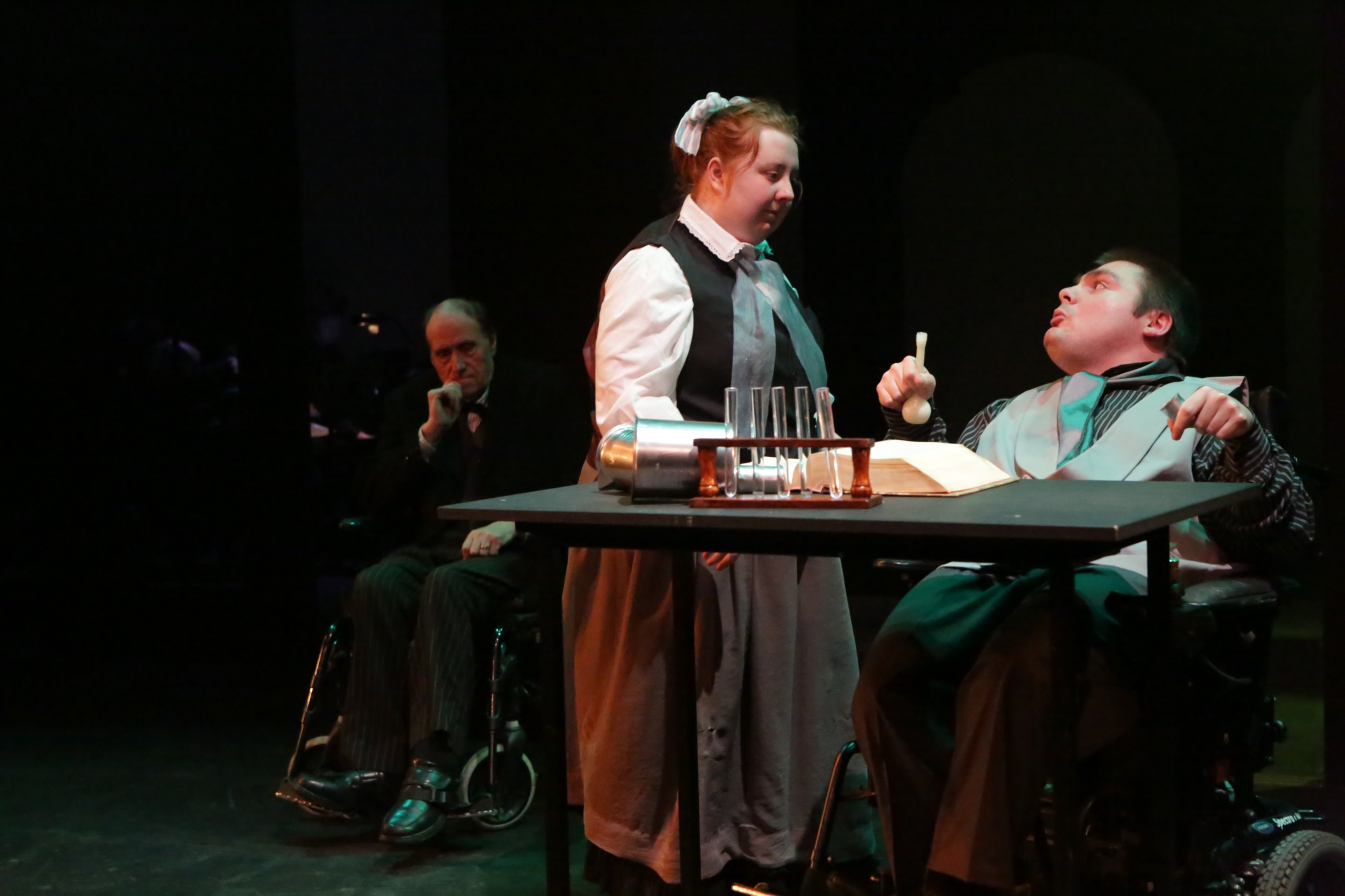
(l - r) John Edgar as Poole, Emma McCaffrey as Miriam Jekyll and Stephen Tait as Dr Jekyll Photos: Douglas Jones

(l – r) John Edgar as Poole, Emma McCaffrey as Miriam Jekyll and Stephen Tait as Dr Jekyll
Photos: Douglas Jones

“A fleet and surprising adaptation of a famous story”

Editorial Rating: 4 Stars

It is strange indeed when Miriam Jekyll puts Hyde onto her shoulders and carries her off stage. You might think that light work is being made of RLS’s ‘classic’ shocker of morbid psychology. You’d be wrong though. Stevenson’s story is here, it’s just been gifted with some nimble ideas and relocated to Edinburgh. Hair restoration and topiary outrages in the New Town are up there together with the double consciousness.

Writer Morna Pearson gives Dr Jekyll a family: Jane, his wife, who finds anaesthesia from marriage in drink; William, his son, a friendly soul who is never going to get to Uni’; and Miriam, his daughter, who should be in the Chemistry labs but who has become Hugo’s darling Intended. It is Miriam who helps herself to her father’s green potion and who finds Hyde (a dead ringer for The Woman in Black) at the bottom of the glass. And it is together, through the toun, that the two young women enact ‘the thorough and primitive duality of man’. It is not the case, in this version, that when Hyde appears Jekyll disappears. No, theirs is a prime alliance.

The pathological strain is replaced by social horrors: Jekyll has money problems and his creditor, Dr Black, sexually assaults Miriam. Hyde fights back. Police enquiries get nowhere as the good folk cannot see that the evil doers are just like them – sometimes. To frame the action Director Caitlin Skinner has the twenty cast members divide into pairs and to eyeball each other accusingly and then “Shush!” us into a conspiracy of silence.

The thematic assists from composer Greg Sinclair and the musicians of Drake Music work extremely well. The opening soundscape of bells and chimes and hooves quickly gives way to single notes and jagged chords. Miriam suffers the effects of the concoction as pins and needles stick in our ears. Solo voices intone in uncanny ways and wind about the silhouetted archways, stairs and closes of the city.

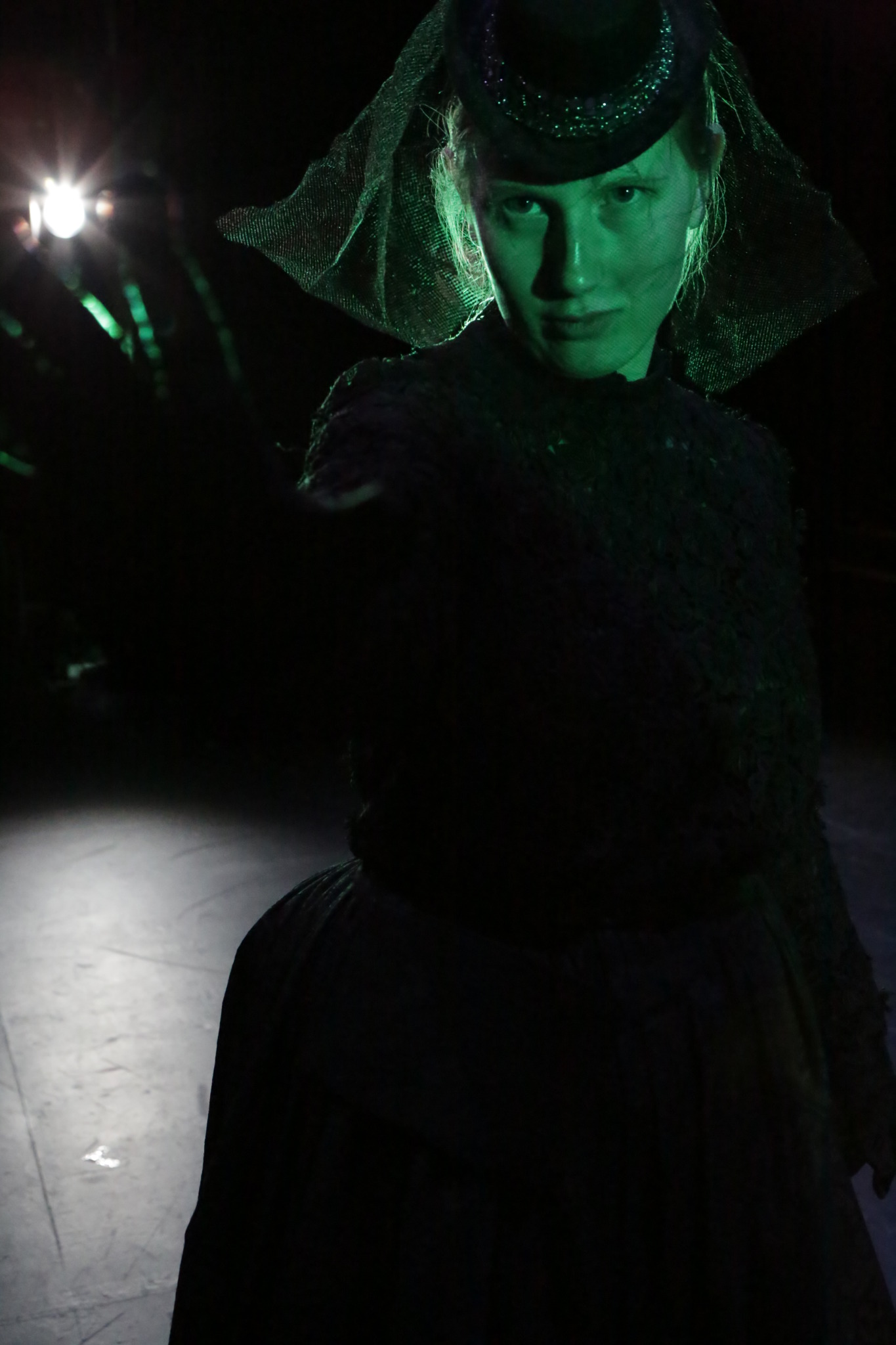
Nicola Tuxworth as Hyde

Nicola Tuxworth as Hyde

The open stage and precise blocking allows the performers to distinguish themselves. Stephen Tait as Dr Jekyll is the focused professional with secrets to concentrate on. He loves his daughter but is the late Victorian father with some lunatic ideas about the brain. Emma McCaffrey’s Miriam responds with due affection but has her own abiding demon to wrestle with, both in the parlour and on the roof. Hyde (Nicola Tuxworth) does not speak but is a veiled and forbidding presence whose outstretched hand you would not want to hold. For me, though, it is the lugubrious Poole (John Edgar), butler to Jekyll’s household, whose words you hang onto. After all, it is Poole who reveals that he has heard Miriam talking to her ‘friend’.

So, a fleet and surprising adaptation of a famous story that really belongs to Edinburgh and which Lung Ha Theatre make their own.

Star (blue)Star (blue)Star (blue)Star (blue)

Reviewer: Alan Brown (Seen 21 March)

Go to Lung Ha Theatre Company and Drake Music Scotland here.

Visit the Traverse archive.

‘The Gondoliers’ (Pleasance: 17 – 21 March ’15)

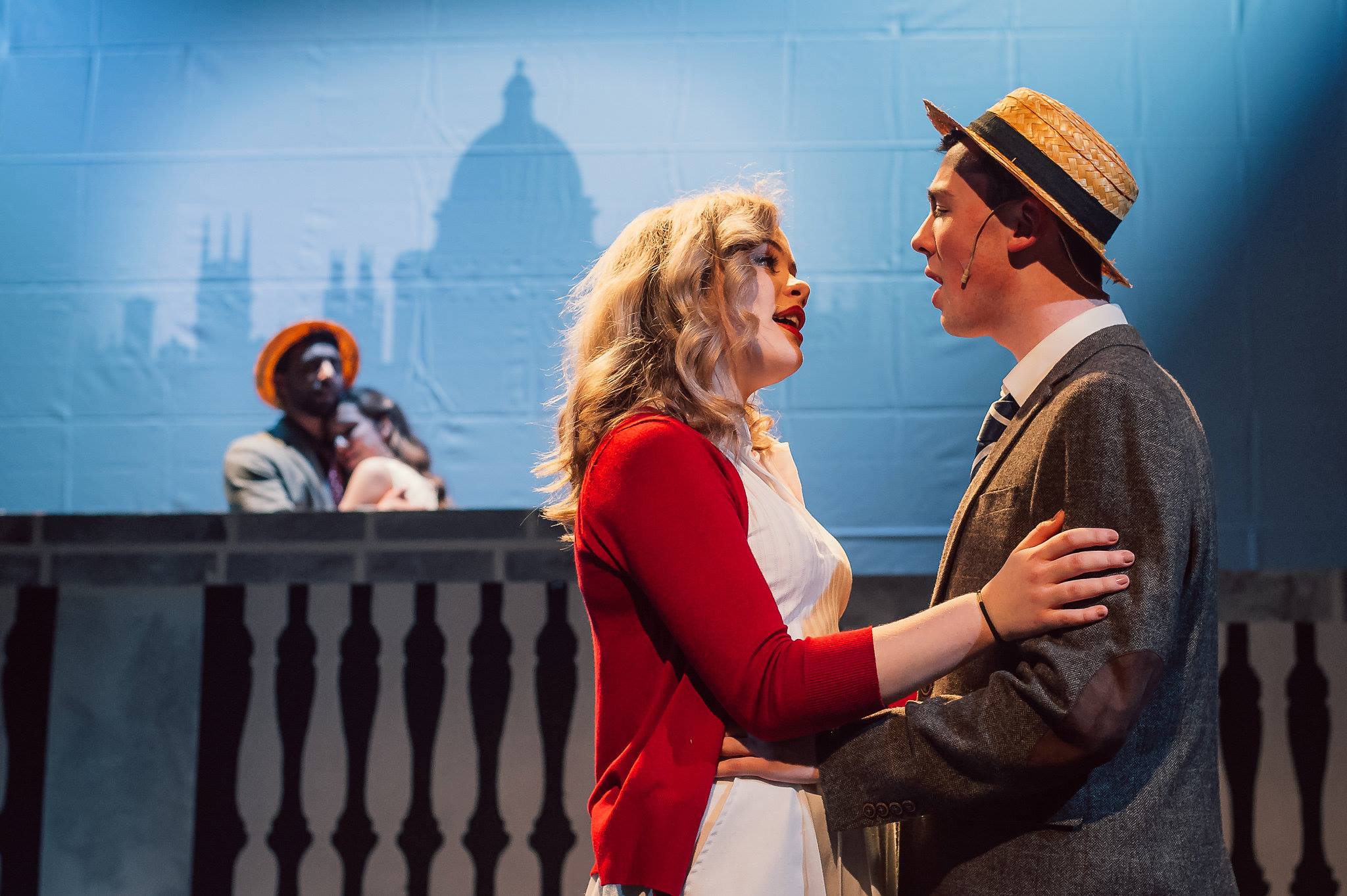
fr. Eleanor Crowe as Gianetta with Harry McGregor as Marco; with Lydia Carrington as Tessa and Sean Marinelli as Giuseppe, behind.

fr. Eleanor Crowe as Gianetta with Harry McGregor as Marco; with Lydia Carrington as Tessa and Sean Marinelli as Giuseppe, behind.

 “The lovers glide through their united vocal performances”

Editorial Rating: 4 Stars:  Nae Bad

Director Thomas Ware and Assistant Director Lucy Evans set out with a vision to create a modernised version of Gilbert and Sullivan’s comic opera The Gondoliers and by the King of Barataria do they succeed! The costumes ooze Fifties glamour and glam their way through prestigious St Mark’s, ‘Oxbridge’; for St Mark is the patron saint of the original setting, Venice. Geddit? We have a show worth seeing.

His debut on the maestro’s podium saw Musical Director Steven Segaud coaxing a sound from the cast that can only be described as stunning. Conducting a 30-piece band and a cast of 33 takes great skill and his hard work paid off. The eleven-strong male chorus is perfectly matched by their female counterparts. The combined choral sound is magical and the principals more than hold their own when on their own.

Gilbert and Sullivan are notorious for weaving multiple devilishly intricate, wordy melodies that can trip up even the well-seasoned EUSOG trouper, but this cast were as quick lipped as they were quick witted. The overall sound and lasting impact more than made up for any bum notes from the band pit or stage.

Set Designer Isobel Williams and her team deserve mention for the unembellished stage design. It was most effective – using silhouettes is a clever way of determining location without having to build separate sets for the two cities and the bridge-turned-platform was also a great asset to the stage dressing; adding both height and opportunity for fun entertainment, should the need arise. What’s more, the gondoliers could then pass through ‘behind’; noticeable but unobtrusive – the audience catching no more than a glimpse of a hat, a head and an oar: a most effective direction.

Dominic James Lewis and Lucy Gibbons as the Duke and Duchess of Plaza Toro. Photos: EUSOG

Dominic James Lewis and Lucy Gibbons as the Duke and Duchess of Plaza Toro.
Photos: EUSOG

The added references of pop culture to the script did add to the hilarity of many a situation – most notably the larger-than-life Duke of Plaza Toro and his wife, the Duchess; portrayed by Dominic Lewis and Lucy Gibbons. The evident cracks in their marriage and need for lavish pomp and ceremony resulted in expectant chuckles from the audience as soon as they appeared on stage – such a reaction cannot be misconstrued. The pair’s comic timing and natural awareness and reaction to the other’s antics made for a great laugh.

Harry MacGregor and Sean Marinelli took to the roles of gondoliers Marco and Giuseppe, respectively, with an ease and camaraderie that was a joy to watch on stage. While the brothers’ vocals may not always have reflected their unity, their acting certainly did, especially when acting through technical glitches and finding love. The pair’s love interests, Eleanor Crowe and Lydia Carrington, made easy the chance to revel in G&S splendour – as Gianetta and Tessa; these sopranos worked their instruments well to produce a beautiful sound, and as a quartet, the lovers glide through their united vocal performances.

The most convincing love entanglement springs between Casilda, daughter of the Duchess – and newly made Queen of Barataria – and Luiz, a serving man. This tricky, class conflicted, love was fantastically conveyed by Ethan Baird and Ellie Millar; the pair’s pathetic battle against their feelings was poignantly funny – this poignancy only made more bitter sweet by the mellow melding of the pair’s vocals. Millar rose effortlessly through the high notes and was complemented perfectly by Baird’s rich tenor. And as with all Gilbert and Sullivan fairy tale-esque romances, the queen gets her king, strife is resolved within Barataria and Baird shows he suits both bowler hat and king’s garb.

All in all, farce and fancy that epitomizes what it means to be a Savoy Opera where life’s a pudding full of plums. Tra, la, la, ha, ha, ha, et cetera.

nae bad_blue

Star (blue)Star (blue)Star (blue)Star (blue)

Reviewer: Amy King  (Seen 16 March)

Visit Edinburgh University Savoy Opera Group here.

Visit the  Pleasance archive.

‘Chess’ (Church Hill Theatre: 10 – 14 March’15)

The Chess game between Anatoly Sergievsky (Kenneth Pinkerton) and Freddie Trumper (Ali Floyd). Photo: Alan Potter, StagePics.co.uk

The Chess game between Anatoly Sergievsky (Kenneth Pinkerton) and Freddie Trumper (Ali Floyd).
Photo: Alan Potter, StagePics.co.uk

“Gorgeous creativity”

Editorial Rating: 4 Stars Outstanding


Fifteen years ago, in what can only be classed as a folly of youth, I went all the way to Frankfurt to see a production of Chess. I tell that anecdote to highlight two key points: firstly, that performances of this musical aren’t that easy to find, and secondly that I’m a dyed-in-the-wool Chess nut. You can trust me, then, when I say it’s worth the bus trip to Morningside – because Edinburgh Music Theatre’s interpretation of the story is among the best I’ve seen.

Since its West End opening in 1986, Chess has had an appropriately chequered past. Written by Tim Rice and – of all people – Benny and Björn out of ABBA, it’s a 1970’s tale of Cold War intrigue set against the backdrop of a world-championship chess match. Being a musical, however, it’s also a schmaltzy love story; the juxtaposition doesn’t quite work, and the book’s been through a string of revisions in an attempt to find a winning endgame. Yet for all the plot’s faults, the soft-rock score ranks among my favourites, and there’s a sly humour to be found underpinning some of Rice’s more preposterous rhymes.

Without a doubt, the greatest strength of Edinburgh Music Theatre’s version is its engaging and hard-working ensemble. When they fill the stage, their voices truly fill the room, and I loved the little story vignettes that were often built into their tableaux. It’s a huge group of people, yet they’re made to seem even more numerous by a slew of rapid costume changes: far from the black-and-white styling you might be expecting, we’re treated to an unashamed riot of lumberjack shirts, sparkly pom-poms, leather hot-pants and flamboyant jeans.

There’s a gorgeous creativity to Mike Davies’ direction too – not just in the broad sweep, but in the minor detail, bringing out insights that are unexpected and new. A trivial example will show you what I mean: there’s a particular moment in a particular song when every director has the cast stamp their feet. It’s what the music seems to demand, and it captures the menace inherent in the East – vs – West storyline. But in this production, when the time comes, they look towards each other with cloying false smiles – turning the number on its head, to uncover a glorious comedy of manners.

Unfortunately though, the sheer size of the chorus occasionally overpowers the production. The iconic Anthem, for instance, is all about solitary defiance – and the impressive Kenneth Pinkerton was perfectly capable of holding the stage for it, without having twenty-odd singers troop into the foreground. More significantly, the chorus and the principals sometimes seemed to be in competition, with the leading actors’ lyrics often drowned out by a swelling accompaniment.

Among the other principals, it took me a while to warm to Ali Floyd as the American grandmaster Freddie Trumper; he lacked some of the boorish aggression his lyrics seem to imply. Still, he comprehensively won me over with his character-defining solo ‘Pity The Child’, which he performed with both vicious anger and electrifying restraint. Josephine Heinemeier also delivered some show-stopping moments as his partner Florence, while Lauren Gracie made an all-too-brief appearance as the Soviet grandmaster’s wife Svetlana. Gracie has a stunning voice, and it’s just a shame that the script (which, to be honest, isn’t all that big on women) makes us wait so long to hear it.

In the end though, the crowning achievement of Edinburgh Music Theatre’s production isn’t the solos or even the set-pieces, but the way it tells the story. The pace occasionally slips, but at their best they segue seamlessly from song to scene to song – building a sense of coherence and immediacy that even professional musical productions often lack. The climactic number ‘The Deal (No Deal)’ is genuinely exciting, presided over by a mischievous pair of god-like figures who delight in the havoc they’ve wrought. So if you’re tempted by this one, be sure not to miss it – that would be a folly at any age..


outstanding

StarStarStarStar

Reviewer:  Richard Stamp (Seen 12 March)

Go to Edinburgh Music Theatre here

Visit the Church Hill Theatre archive.

‘The Merchant of Venice’ (Assembly Roxy: 10 – 14 March’15)

Isobel Moulder as Portia and Will Fairhead as Bassanio.

Isobel Moulder as Portia and Will Fairhead as Bassanio.

“From the Rialto to Little Venice, W9,  is neat”

Editorial Rating:  3 Stars

Were Antonio at work today, this stacked play would be even trickier than it already is. He’d be talking about moving cargo rather than sailing ships. His wealth would be in metal boxes to Singapore or Mumbai rather than argosies from Venice. Nevertheless, reassuringly, his sound advice to Bassanio would be the same: “Go, presently inquire where money is”. That would send the enterprising lover to Shylock, who would have friends and funds in Frankfurt and away we go.
However, in this production when Shylock asks “What news from Germany?” (that’s Genoa back then), the context shifts mightily. For now we’re back to September 1939 and the news ain’t good. In fact if you’re Jewish it has been desperate. Director Rae Glasman finds a choice text in Prime Minister Chamberlain’s declaration of war:

   “Now may God bless you all. May He defend the right. It is the evil things that we shall be fighting against – brute force, bad faith, injustice, oppression and persecution – and against them I am certain that the right will prevail.”

That’s not Shakespeare but it works. For a start, which God: Christian or Jewish? Who is the more righteous: backscratching Bassanio, Jew-baiting Gratiano, or is it Antonio, who spits at Shylock in the street? Is it merciful or just to condemn Shylock to near ruin and to force him to convert? Portia, if always an unlikely victim, will find happiness in marriage. There is a happy and flimsy ending, which is why – I suppose – Glasman has that radio broadcast at the end of the play, to make her audience ask what exactly has prevailed here? Actually, I would have welcomed that mooring at the start. There’s the trouble with The Merchant of Venice; it goes all over the place: scenically, tonally, action-wise. Underwhelming and overwhelming.

From the Rialto to the City of London and to Little Venice, W9, is still neat. Portia’s Belmont is relocated to a country house, somewhere in the Chilterns, I guess. That is not a displacement too far but it looked hard to accommodate on the Roxy’s stage. I found the opening and drawing of the full length curtains in-between scenes more distracting than helpful and it’s a No-thank you to the squealing Downton maids at open-the-box time. The Glen Miller sound was melodious though and the cocktail cabinet and fetching evening wear did their elegant, idle, thing well enough.

As do Bassanio’s set of chaps. Portia (Isobel Moulder) sees them – and quite possibly all men – as “bragging Jacks” to be practised upon, which this marble-mouthed lot certainly deserve. She is also properly merciless in the court, where otherwise the languor of the club rooms seemed to have carried over. To supply Bassanio (Will Fairhead) with an Eton education and braces was presumably to allow him to stand nonchalantly, hands in pockets, between the caskets and to give him the manners, surely the compassion, to pick up Shylock’s yarmulke from the floor and to give it back.

Joe Shaw as Shylock with Kirsty Findlay as Jessica. Photos: Aliza Razel

Joe Shaw as Shylock with Kathryn Salmond as Tubal.
Photos: Aliza Razel

I could believe in Shylock (Joe Shaw) as a broken father. “My daughter is my flesh”, he says, and then Jessica abandons him – or is stolen from him. His hair should have been greyer but it is no surprise when – to take like for like – he would cut into a spent Antonio (Pedro Leandro) above his heart. There is real pain in that vengeful effort.

Kirsty Findlay as Jessica and Chaz Watson as Lucy Gobbo.

Kirsty Findlay as Jessica and Chaz Watson as Lucy Gobbo.

There are laughs in the features and antics of preposterous suitors, Arragon and Morocco, and in the crazy work of Lucy Gobbo (Chaz Watson) who sounds like the ‘wauling bagpipe’ of Shylock’s protest and who looks way too bad for Emil and the Detectives.

Rory McIvor as Lorenzo spoke the (blank) verse best and did Moonlight Serenade introduce his scene with Jessica near the close? I can’t recall. I do remember approving Bassanio’s choice of the lead casket, for ‘Thy plainness moves me more than eloquence’, which is where I stand on this production. It looks pretty and sounds attractive but its necessary centre of gravity is away, awry.


Star (blue)Star (blue)Star (blue)

Reviewer: Alan Brown  (Seen 10 March)

Visit the Assembly Roxy archive.

‘The Effect’ (Summerhall: 11 – 14 March’15)

Cameron Crighton as Tristan and Scarlett Mack as Connie All photos: Firebrand.

Cameron Crighton as Tristan and Scarlett Mack as Connie
All photos: Firebrand.

“A well-thought-out and faultlessly-delivered show”

Editorial Rating: 4 Stars: Nae Bad

Set across the four-week span of a clinical drugs trial, The Effect (2012) is a play which tackles perhaps the highest concept of all: our ability to assess and analyse the workings of our own mind. Penned by Lucy Prebble , best known for writing the briefly-sensational ENRON, it’s revived here by Borders-based company Firebrand Theatre. Ironically though, Firebrand’s clinically-excellent performance throws into focus a few pronounced oddities in the script.

The “effect” of the title is the placebo effect – the powerful medical phenomenon which says that if we think we’re taking a drug, we’ll experience at least some of its benefits. Prebble explores that concept through two parallel storylines: a young couple who may or may not be falling in love, and a doctor who may or may not be depressed. Intellectually, I can see how this all hangs together, but it still felt like I was watching two plays uncomfortably squashed into one. “What is love?” and “Do antidepressants work?” are just very different questions, and I’m not sure it’s possible to tackle them both while doing full justice to either.

Much more successful, for me, were the human tales. On the one hand, there’s a sweet boy-meets-girl story – with the requisite courtship, predictable crisis, and the hope of a reconciliation by the end. It’s a time-worn formula, but it’s well-executed, and the tale has a twist that’s genuinely startling yet fully justified by the plot. Actors Scarlett Mack and Cameron Crighton do a fine job delivering characters we can love, with Crighton’s physical restlessness also adding plenty of interest to a series of otherwise quite static scenes.

Pauline Knowles as Lorna

Pauline Knowles as Lorna

Jonathan Coote as Toby

Jonathan Coote as Toby

Alongside them we have Pauline Knowles’ acerbic but secretly-warm-hearted doctor, who provides a lot of deadpan humour but clearly has a vulnerable side too. Knowles impressed me with her ability to inject subtle emotion, as did Jonathan Coote, playing the pharmaceutical-company manager with a secret in his past. It’s hinted early on that these two characters have met before, and the details of their relationship are revealed in carefully-measured doses – an ongoing mystery which underpins the first act of the play.

Fine acting and direction are complemented by an effective design. The whole production is stark and monochrome, filled with medical whites and impersonal greys, a choice which serves to highlight rather than diminish the colourful humanity on display. Every now and then the cast break off into stylised sequences set to a techno-inspired soundtrack, punctuating the wordy script while skipping lightly over the duller parts of the plot. At times it all grows a little protracted – and I certainly wouldn’t have minded if they’d cut the last ten seconds of the sex scene – but all in all, Firebrand Theatre do well to thread a coherent path through a complex storyline.

In the end, the effect of The Effect was a mildly frustrating one: the script tries too hard to draw connections, and ends up feeling both crowded and languid at the same time. But that’s no reflection at all on the production company, who once again (see our reviews of Outlying Islands and of Blackbird) have laid on a well-thought-out and faultlessly-delivered show. All in all, this one’s well worth catching on its remaining dates at Summerhall – for the questions it poses may be disjointed, but they’re still intriguing ones.


nae bad_blue

Star (blue)Star (blue)Star (blue)Star (blue)

Reviewer: Richard Stamp (Seen 11 March)

Go to Firebrand & Summerhall here

Visit the Summerhall archive.

‘Long Live The Little Knife’ (Citizens, Glasgow: 24 – 28 Feb.’15)

Neil McCormack as Jim Wendy Seager as Liz Photo: Tommy Ga-Ken Wan

Neil McCormack as Jim Wendy Saeger as Liz. Photo: Tommy Ga-Ken Wan


“Exquisite performances”

Editorial Rating: 2 Stars Outstanding

nb. Long Live The Litte Knife is now on tour and plays at the Traverse  this Saturday, March 7, at 7.30pm.

This is a show about having balls, which might explain our curious ‘2* Outstanding’ rating, but it doesn’t. That’s down to great acting.

Ballsy, I maintain. Both literally – the “little knife” of the title is the one used to emasculate castratos – and figuratively, too. So here’s a ballsy statement of my own: despite playwright David Leddy’s reputation, despite compelling and committed acting, and despite the plaudits heaped on the show during its run at the Edinburgh Fringe … it isn’t actually very good.

There’s just far, far too much packed in. The play’s themes include love, loss, art, infertility, deception, class, and modern slavery – all tackled at breakneck pace, with alternating comic and tragic tones. At the very end, Leddy brings out the darkest topic of all – one that’s proved more topical than he can possibly have feared when he penned the script back in 2013. But by that point, and perhaps to my shame, I was so overloaded that I couldn’t bring myself to care.

Don’t get me wrong: it’s fine for a script to seem anarchic, as long as there’s something constant threaded through it, something you can recognise and grab onto. The problem with Little Knife is that there’s no central premise – unless you count a foggy concept that things aren’t ever what they seem. The principal characters are confidence tricksters, and the script is pulling a kind of trick of its own: persuading us that, because we’re feeling slightly confused, there must be something deep going on.

But I’m sorry, there isn’t. And that’s a big shame – because there are the outlines of some thought-provoking themes visible through the murk. At one point, it seems that Leddy’s about to deconstruct the whole concept of verbatim theatre, an exercise which could be both entertaining and genuinely profound. But it goes nowhere: there’s some off-the-wall dialogue between an actor and a techie, then the theme is quietly dropped, never to be discussed again.

The avant-garde clichés are abundant – that on-stage techie, actors who announce that they’re actors, stage directions read aloud – and there’s an over-worked set-up for a final flourish, which on the night I attended was thoroughly ruined by a glowing fire-exit sign. As I write this, they’re tweeting that they bought all their equipment from a builder’s yard. So?

Neil McCormack as Jim Wendy Seager as Liz Photo: Tommy Ga-Ken Wan

Neil McCormack as Jim Wendy Saeger as Liz.                                   Photo: Tommy Ga-Ken Wan

What redeems the show, however, are exquisite performances from Wendy Saeger and Neil McCormack, who acquit themselves with considerable distinction in extremely challenging roles. Out of character, they’re friendly and welcoming; once the story begins, they keep the energy high as events become more and more absurd. And on the few occasions they’re allowed a little time, they show intense sensitivity, dropping the mood in an instant as the pain in their past is revealed.

Saeger is particularly powerful when her character recalls a dying son; McCormack, meanwhile, endures a wince-inducing crux scene, which very few actors could make so horribly real. It’s worth watching the background, too, as their reactions to events are often as compelling as the cavorting in centre-stage. So it’s five stars for them – but alas, even stellar performances can’t counteract a thoroughly frustrating and self-indulgent script.

outstanding

StarStar

Reviewer: Richard Stamp (Seen 25 February)

Go to Fire Exit here (!).

Visit the Traverse archive.