‘The Real Inspector Hound’ (Bedlam: 28-29 January ’15)

Real Inspector Hound

“…utterly absurd and completely entertaining”

Editorial Rating: 3 Stars: Nae Bad

A buzz of excitement rippled through the café during the wait for the doors to open. Inside the auditorium the audience is greeted with the strains of period music and a spotlight trained on a man in an armchair with a notebook to hand, who would later be introduced to us as Moon, played by Ben Horner.

As can be expected of any of Tom Stoppard’s work, The Read Inspector Hound is a wordy script with many a tricky speech to deliver, which at times proved a challenge  – but not one the actors were defeated by – and a journey for its audience that can be difficult to follow. Director Cameron Scott was brave to tackle this play but his addition of updated jokes including Real McCoys – the crisps – and a myriad of highly comical moments from his cast proved that he was more than capable of handling such a project.

This murder mystery play-within-a-play delved with ease into the absurdity of the human condition and the blurring of lines between what is real and what we desire to be real , drawing the audience in and gripping them from the very beginning with the fast pace and rapidly building hysteria.

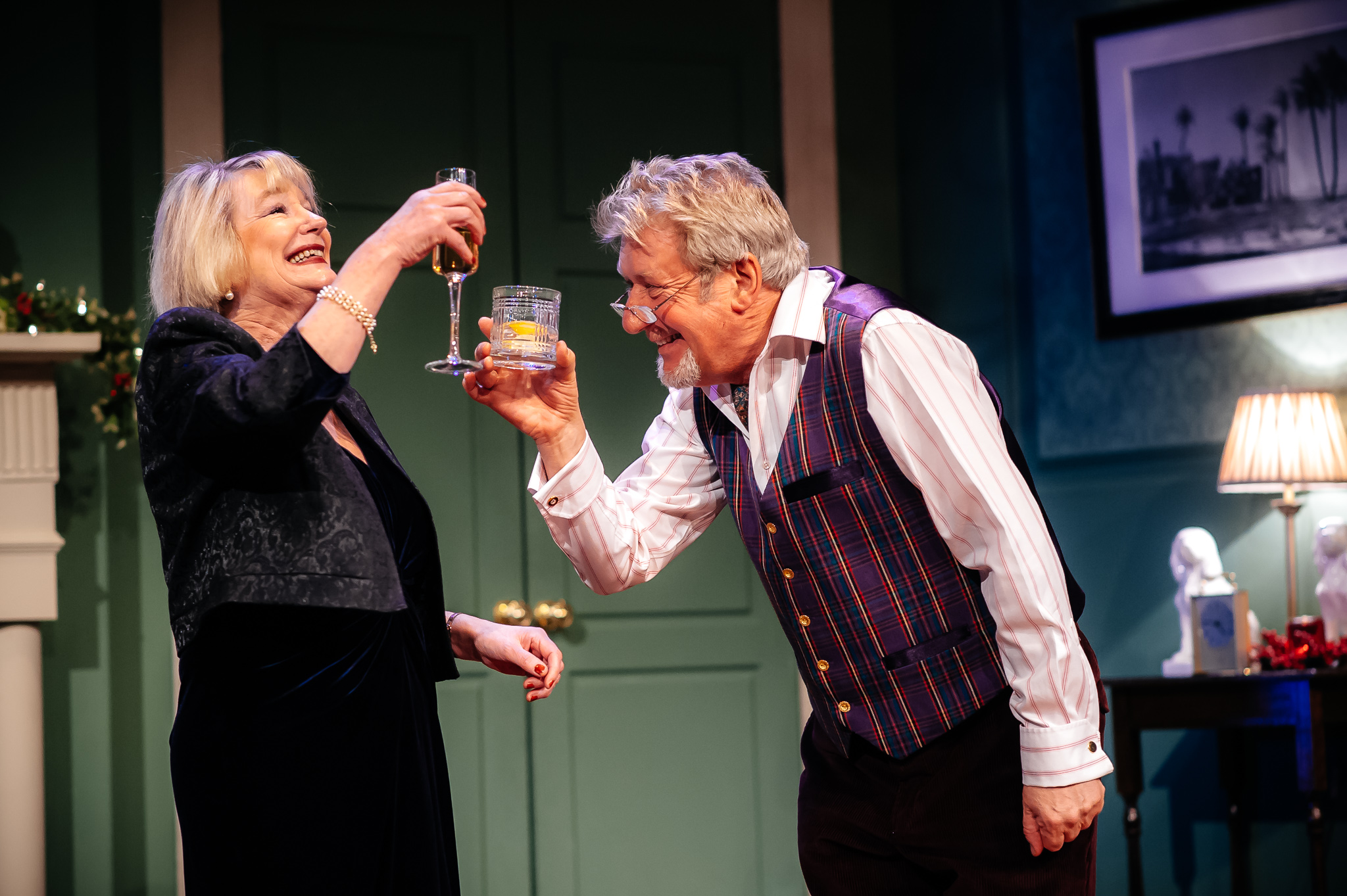
The production team’s terrific set design included patio doors, a very large Persian rug and two tables, one holding the drinks, the other waiting for the drinkers. The elevated pair of armchairs, occupied by Moon and his most respectable reviewing counterpart Birdboot, brought to life by Finlay MacAfee, worked well to maintain the separation of reality and imagination – at first.

As a duo, MacAfee and Horner were most convincing; Moon’s nervous disposition and Birdboot’s self-righteous air coloured the play throughout and their back-and-forth monologues were highly entertaining.

Leyla Doany gave a great performance – her busybody Mrs Drudge’s facial expressions, dusty white hair and reactions to the goings on around her kept the stage alive with comic ridicule.

The suave Simon Gascoyne – a smooth delivery from Leopold Glover – and his scorned lovers had the audience in hysterics; both Lady Cynthia Muldoon and Felicity Cunningham proved they could hold their own against the stud. Liss Hansen and Heather Daniel’s respective characters certainly appeared to take some satisfaction in the slaps they delivered so soundly.

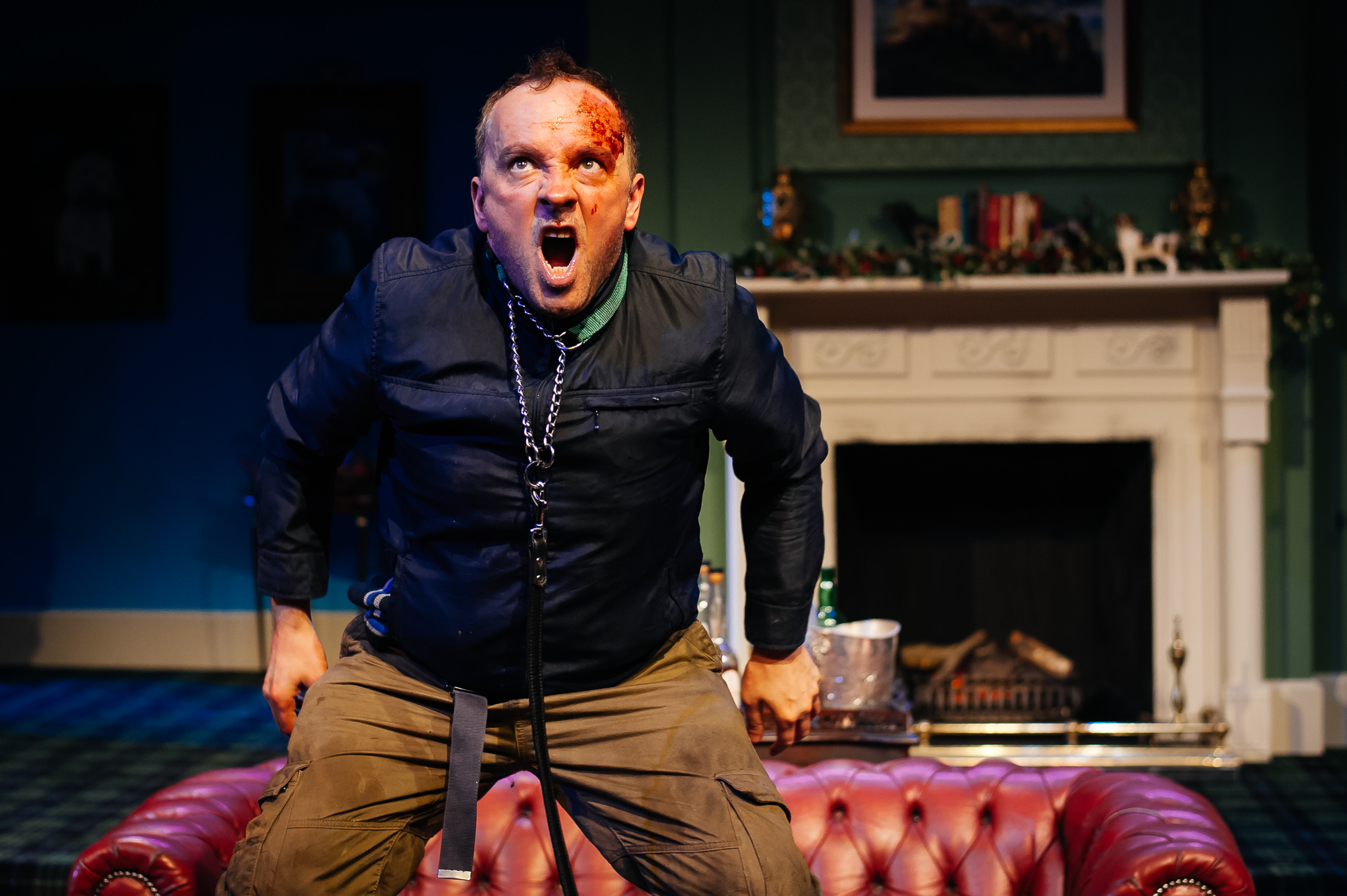
Capturing madness and mayhem in his enigmatic performance, Joseph Macaulay’s manic portrayal of Inspector Hound was impressive in its crazed delivery. The long-winded speeches and wrongful assumptions were delivered with a high energy and conviction of character. His deer-stalker, binoculars and wellington boots were comic props used to their fullest potential, much like their owner.

To add to the further absurdity, the casting of Megan Burt as Albert, who was masquerading as the crippled brother Magnus, brought comic timing and a most-amusing manoeuvring of Magnus’s wheelchair. Her adorned beard was a favourite in the costume department. The big reveal at the close of the play – that Albert is also the real ………….. – stays true to the whodunit nature of this bizarre adventure.

A special mention must also be given to Liam Rees who arguably had the most difficult part to play of all – the corpse. How he was able to lie still and play dead surrounded by the onslaught of commotion, without so much as a twitch and a chuckle, is beyond me.

Technically, this production was slick. Jack Simpson’s work on lighting and sound effects did enhance the action with the constant ringing of the telephone (with the cut cable!) and dramatic spotlights at every opportune moment.

As the story unravelled and reviewers Moon and Birdboot are sucked into the madness of the play, the action and pace built and built to a dizzying climax, ending in death and further confusion. Stoppard always keeps you guessing.

The production team – Cameron Scott, producer Tabitha James, stage manager Jonathan Barnett and tech manager Jack Simpson, evidently put a lot of energy into creating this show and their hard work most certainly paid off. All in all, as a reviewer reviewing a play of reviewers reviewing a play, I must admit this show was utterly absurd and completely entertaining.

nae bad_blue

Star (blue)Star (blue)Star (blue)

Reviewer: Amy King  (Seen 28 January)

Visit the Bedlam archive.
THIS REVIEW HAS NOT BEEN SUBEDITED

‘Faith Healer’ (Lyceum: 14 January to 7 February ’15)

Photo: Eoin Carey

Sean O’Callaghan as Frank. Photo: Eoin Carey

“He walks across a cobbled yard and smack into classical tragedy.”

Editorial Rating: 4 Stars: Outstanding

I don’t suppose Glasgow’s Celtic Connections features a whippet on the bagpipes. Well, Brian Friel’s forlorn yet devout play has one. It also has an Academy Award Best Original Song, from 1936, in The Way you Look Tonight and the Troon to Larne ferry. From Ceann Loch Biorbhaih (aka Kinlochbervie) in Sutherland to Welsh Methodist halls to Donegal to digs in rundown Paddington, Faith Healer – first performed in 1980 – has evocative mileage.

It is all in the voice and the story telling and in the sad and unaccountable distance between them. Three characters explain themselves to their audience. Simples. Each in turn stands alone on stage and talks of how it was when they were together, how it is now, and how it might have been – or might have seemed. Memory is fallible. What you once thought you had learnt by heart or by experience, bitter or sweet, can be a struggle to recall. Their time is provisional. Contingent. (Go to Philip Larkin in Ambulances where ‘what cohered ..across the years .. the unique random blend .. At last begin to loosen’.) You cannot miss the tatty banner, centre, ‘Fantastic Francis Hardy, Faith Healer. One Night Only’.

We have a correlated but discrepant narrative. That’s four monologues in four scenes. Francis, or Frank, appears first and last; first, anxious to justify his billing, dismissive of rhetoric but still fervent of speech and gesture. An act, in effect, that he protests is balanced between ‘the absurd and the momentous’. And last, in an extraordinary extended coda, he is steadier, a little prouder, and with a crumpled press clipping of ‘10 Healed in Glamorgan’ he walks across a cobbled yard and smack into classical tragedy. Grace, mother of his child, loves him selflessly but suffers incomprehension and loss. She has the second scene, casting Frank as immoderately talented but possessed by his own impossible calling. Then, after the interval, there’s Teddy from down the Old Kent Road or Stepney or Bow. Breezy, enduring, big-hearted Teddy: skint impresario, dog lover, pigeon manager, fixer, van driver and bedsit philosopher. Teddy’s responsible for the ‘Fan-tas-tic’ on the banner and his exasperated, “For Gawd’s sake!” is about as Christian as this play gets. Friel, after all, dumped the priesthood.

Nevertheless, I think director John Dove is going for Frank’s miraculous redemption here. Earnest self-doubt proves definitive, more so than the poetic drifts over Loch Clash. The set may be cheerless and angular with a job lot of bistro chairs arranged left stage but then Frank is lucky if more than half a dozen of the lame or the disfigured roll up to receive his ‘gift’.  The keen monologue form is necessarily upfront and in your face, as it were, but even so the acting is unusually expressive and open. Gesture is weighted. The lightest it gets is Teddy (Patrick Driver) wafting another pale ale onto the table. Frank (Sean O’Callaghan) seeks rest and certainty with dire conviction. Grace (Niamh McCann), fighting despair, is bright eyed with hope. Driver’s performance does stand out, “Dear ‘earts”, almost too much maybe, but Teddy’s bow tie and patter can do soul searching as well as the single crucifix high on the side wall and when he chokes up it is all the more compelling.

Anticipating the ignorant and hapless English soldiers of Friel’s next play, Translations, Teddy is not understood in the Irish-speaking community of Baile Beag / Ballybeg. Regardless, this is an eloquent production. Admirable in fact.

(By n’ by, listen up for Translations on BBC Radio 4 Extra on Sunday 25 January at 1330.)


outstanding

StarStarStarStar

Reviewer: Alan Brown  (Seen 17 January)

Visit Faith Healer at the Lyceum here

Visit the Assembly Roxy Bedlam Church Hill Theatre Festival Theatre King’s Theatre Other Pleasance, Potterrow & Teviot Summerhall The Lyceum The Stand Traverse archive.

THIS REVIEW HAS NOT BEEN SUBEDITED

♫ Kat Healy (Voodoo Rooms: 17 December ’14)

“I only seem to write songs about boys and the weather”

Editorial Rating: 3 Stars: Nae Bad

Kat Healy is an Edinburgh singer­-songwriter, based in Leith, with an acoustic, folk-influenced style. She kicked off her set with Weatherman (“I only seem to write songs about boys and the weather”), accompanying herself on guitar in a finger­picking style. There are quotations on Kat’s website comparing her to Joni Mitchell… yes… well… maybe. Certainly Kat’s voice is beautiful, expressive with a huge amount of control, able to sustain the final note in each phrase with excellent tone and apparent ease – all the more remarkable given that she is currently suffering with a heavy cold.

The patter between numbers is entertaining, chatty. Graham joins the stage on guitar for Frozen Smile, his playing style is understated, staccato notes with lots of muting, an excellent accompanist. The keys emphasise the scrunchy dissonance of the 9th and 11th chords. Kat did not play guitar for this and that allowed for fuller vocals and expression. Unfortunately the next song was spoiled by an annoying PA hum from the electric guitar that Graham had swapped to. Paul Gilbody, who had done his own very entertaining guitar and vocal slot in support earlier, joined on double bass and, for me, this didn’t add too much to the performance; mainly pizzicato root notes with octave leaps, notes that were already being played on keys.

Paul’s bass part for the next song, No Heros, did add a lot to the music, with a well­ crafted line with a nice hook which leaped effectively to a high register, overlapping with the guitar part. This was a great song, where Kat performed with a real emotional depth – though the bass notes on the keys in the chorus were a little ham­fisted.

Heart strings were tugged with a song about Kat’s late mother. However, this beautiful song was marred as the buzzing electric guitar returned and, with no other instruments playing to mask it, the fault was quite stark. Kim Edgar and Emily Kelly, who had both done support earlier, joined in for the final piece, I’ll Fly Away, from the American songbook. This was a fun, upbeat, three­ part close­harmony version. There were a few balance issues with Kim being quite a bit quieter than the other two, but they clearly enjoyed singing this song.  And that, along with a great little guitar solo from Graham, was a fitting end to the night.

As a gig it was good value at £9, especially with the three support acts. I found Kat’s professionalism of performing whilst feeling under the weather to be great, BUT starting the gig over half an hour late was not! I came to hear Kat’s amazing voice and I got that, but I do feel that she is at her best when she is not playing guitar herself. As a set then one or two more up­beat numbers would not have gone amiss, but that emotion, always on the edge of melancholy does have its place and maybe, quite possibly, the world needs a female equivalent of Ben Howard or Benjamin Francis ­Leftwich.

nae bad_blue

Star (blue)Star (blue)Star (blue)

Reviewer: David Jones (Seen 17 December)

Visit Kat Healy here

Visit our Assembly Roxy Bedlam Church Hill Theatre Festival Theatre King’s Theatre Other Pleasance, Potterrow & Teviot Summerhall The Lyceum The Stand Traverse archive.

THIS REVIEW HAS NOT BEEN SUBEDITED

‘The Devil Masters’ (Traverse: 10 – 24 December’14)

Photo: Mihaela Bodlovic

Photo: Mihaela Bodlovic

“Chains, mordant humour and lashings of sharp comment”

Editorial Rating: 3 Stars Nae Bad

Admire the set. Designed by Anthony Lamble and lit by Colin Grenfell. Very tasteful, very Royal Circus; to begin with, at least, and then it looks unhinged.

It is Christmas Eve and Cameron and Lara Leishman are ‘At Home’ for drinkies, the remains of a chinese carry-out and lots of presents, just the two of them and their Skye terrier, Maximilian, and that’s how they like it. That these two advocates are self-satisfied is to put it mildly, but then their swish garden flat is in the New Town and no doubt they have worked so very hard to afford it. You might have called round earlier, expressing mild surprise that Cameron isn’t a QC yet and thought it all a touch chichi, maybe, but it is still absolutely fabulous … “and do have a lovely time this evening, just the two of you”.

Except that they don’t, not at all.

‘Season’s Greetings’ are a joke when it comes to what happens to the Leishman’s. For a start, Max’ gets dognapped and second there’s that pun in their name. Iain Finlay Macleod gives us pedigree ‘Christmas Carol’, the writer’s mega cut. No redemption is offered but this story has chains, mordant humour and lashings of sharp comment .

The first gift is unwrapped and admired and Cameron and Lara receive an unexpected and unwelcome visitor. John watches ‘The Wire’, so he says he’s from ‘the projects’. For Lara he’s a schemie, feral, the low life of the Sheriff’s Courts. He needs house training. Cameron, well bred, is a little more accommodating. He realises that for John to have had to leave Fettes junior school after only a couple of years was not one of life’s lucky breaks (!). John (Keith Fleming) has nerve, wit and honesty but gets it in the neck. He’s walking wounded in a nasty class war that Lara (Barbara Rafferty) prosecutes with all her vicious might. Cameron (Johnny Bett) would intercede but plays junior counsel to his partner’s vengeful brief. Director Orla O’Loughlin brings on action that is outrageous, radge and lurid.

Photo: Mihaela Bodlovic

Photo: Mihaela Bodlovic

It is close to home. Some will wince in recognition at lookalike ANTA interiors. There’s Albinoni on the invisible Sonos wireless system. Cameron knocks plebian Glasgow. Edinburgh lawyers acquire frightfully mannered English accents. There’s the EH3 postcode, Georgian cornicing, John’s pals from Pilton with their howling dogs, fireworks at New Year, and a legal profession prejudicially bent on fee income. But there’s more to it. David Hume’s statue is arraigned, or more accurately his toe is. What would the great philosopher make of the Leishman’s behaviour? For sure, they only actually do anything – as opposed to decorating their tree with photographs of past pooches – when they’re frightened or threatened. At best this is difficult to live with; at worst, it’s deranged.

I’ll stay with Christmas rather than moral philosophy. Go to ‘The Devil Masters’ with this text in mind: ‘He came unto his own, and his own received him not. (John 1:11) ’. Dispute ownership.


nae bad_blue

Star (blue)Star (blue)Star (blue)

Reviewer: Alan Brown  (Seen 10 December)

Visit ‘The Devil Masters’ at the Traverse here.

Visit our Assembly Roxy Bedlam Church Hill Theatre Festival Theatre King’s Theatre Other Pleasance, Potterrow & Teviot Summerhall The Lyceum The Stand Traverse archive.

THIS REVIEW HAS NOT BEEN SUBEDITED

‘Aladdin’ (King’s: 29 Nov’ 14 – 18 Jan.’15)

Aladdin 1

I’m a Believer

Editorial Rating: 4 Stars: Nae Bad

Actually, literally, which is tricky during a panto, I prefer ‘Al – la – din’. That has distance and colourful resonance. Losing that second ‘d’ does away with the Highland laddie and puts our local hero Southside, somewhere between and above the Mosque Kitchen and the Nile Valley Café . Only momentarily though, for the gong gongs and we’re away to Peking of old. ‘Somewhere in Egypt’ is scene 12 of 16.

The King’s 2014  ‘Al – la – din’ is no call to prayer, although it does co-opt I’m a Believer as its signature belter. No, this is a serious magical treat, remarkably served after only ten days of full rehearsal. The reach and back-up power of producers Qdos Entertainment beggars the imagination, which is also what young Aladdin is about. He is poor but bold, his Mum runs the steamie off the street of 1,000 chopsticks, and he’s going to marry the most beautiful and loaded girl in the land, sorry, Empire. Yes he is and you should not doubt it. For a start Greg Barrowman as Aladdin has One Direction quality and the spangled charms of the Slave of the Ring to help him, in an appealing and graceful performance by Lisa Lynch. Kohl eyed Princess Jasmine (Miriam Elwell-Sutton), all brocade and style, just clocks him the once and she immediately wants “to talk to that boy – alone”. Lucky lad.

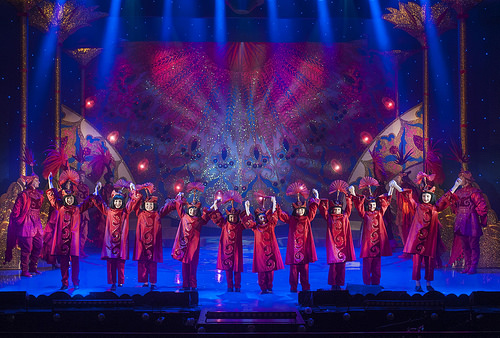
So dump the suspense and bring on the dancers, young and old, and give in to the moment, to the scene painting, to the costumes and to the out and out marvellous: the Vanishing Princess, Escape from the Table of Death, and an absolutely wicked, jaw dropping, example of Defying Gravity. Then enter, upstage and tall, the Mighty Nasty Cobra and the Giant Genie (a very droll, almost child-friendly Malcom Tucker). Take hold, my son, of the The Lamp of Amazing Power. Capital!Aladdin 2

Actually, again, there are three presiding comic genies of panto at the King’s. Three denizens of this Christmas cave of wonders: Allan Stewart as Widow Twankey, Andy Gray as Wishee Washee, and Grant Stott as Abanazar the bad, bad, Wizard. Rub that lamp for all it’s worth and you could not wish for more fun than these three familiars provide. “Oh, the acting!”, despairs Washee, as in “Our acting’s pants”, but what’s not to enjoy in amongst the topical gags (listen out for the 45/55 result), shuttling tongue-twisters, celebrity laundry, and hilarious routines? Their final skit of ‘If I Were Not Upon the Stage’, when they are joined by James Paterson (prev. the Emperor of China), is pure wallaping music hall.

This ‘Aladdin’ is an extravaganza, up there with flying carpets, and is tip-top admirable. My one queasy, senior, misgiving – because I’m not good off the ground – is that if there is a command message, it’s not ‘Open Sesame’ but ‘Get rich, and the girl’s yours’.

nae bad_blue

Star (blue)Star (blue)Star (blue)Star (blue)

Reviewer: Alan Brown (Seen 4 December)

Visit ‘Aladdin’ at the King’s here

Visit our Assembly Roxy Bedlam Church Hill Theatre Festival Theatre King’s Theatre Other Pleasance, Potterrow & Teviot Summerhall The Lyceum The Stand Traverse archive.

THIS REVIEW HAS NOT BEEN SUBEDITED

‘Home for Christmas’ (The Studio: 3 December 2014)

  carol-ann-duffy

little machine

“some shakin’ metaphysics to die for”

Editorial Rating:  3 Stars

As Homecoming Scotland 2014 approaches its close we enter The Home Straits, a programme of poetry and music on the theme of … home. This show, first of three, finished with the sweet tones and bitter air of Byron’s We’ll Go No More A-Roving that deserved louder applause (& participation) than our few and faint hearts allowed.

Home for Christmas is Poet Laureate Carol Ann Duffy’s idea. She is up front for the first half, reading her poems, alongside musician and Edinburgh friend John Sampson, but after the interval she sits out and Little Machine, is on stage. The band sing their settings of six of Duffy’s Christmas poems and then eight further poems, from the 16th Century ballad Western Wind to Liz Lochhead’s fervid My Way. Mood and style vary from piece to piece, from loose and cool J.J Cale to a Rocksteady lilt for Advent and there’s some shakin’ metaphysics to die for in Thomas Carew’s Mediocritie. The music making is very good – I like distinct guitar work – and the high regard for the poetry is evident in the diction.

However, it is sombre and plaintive to start with. “It’ll be over soon; home by Christmas” was the fond, forsaken hope. John Sampson’s trumpet opens with the Last Post, and then there’s Duffy’s own poem Last Post, where ‘If poetry could truly tell it backwards, then it would …. And all those thousands dead … Are queuing up for home … Freshly alive.’ Christmas Truce follows, when ‘beneath the yawn of history’ a miraculous peace broke out. The subsequent pairing of Wilfred Owen’s The Send-off with her response, An Unseen, is dreadfully poignant.

Just as sharp is the keen, deadpan, humour of three monologues from the celebrated The World’s Wife: Mrs Midas, Mrs Tiresias, and (Duffy’s favourite) Faust; and then four later poems of percipient, careful intent: Mrs Schofield’s GCSE, The Counties, The Human Bee, and Liverpool. They are all in the public domain – and not just on The Guardian’s pages – so go find them, realise their quality and why Duffy wrote them.

Little Machine had been on Radio Scotland’s ‘Culture Studio’ with Janice Forsyth that same afternoon. The trio anticipated an evening of banter and wit. Well, not really. I enjoyed their music, admired John Sampson’s playing the two halves of the recorder at the same time (do not try this at home, he cautioned) and heard really good poems, tellingly read by the poet herself, but it proved a subdued occasion, with little ‘give’ from our side of the stage. That’s what happens when the Last Post sounds. It all goes still and not in a stille nacht, glad tidings, kind of way.

Star (blue)Star (blue)Star (blue)

Reviewer: Alan Brown (Seen 3 December)

Visit ‘Little Machine’ here

Visit our Assembly Roxy Bedlam Church Hill Theatre Festival Theatre King’s Theatre Other Pleasance, Potterrow & Teviot Summerhall The Lyceum The Stand Traverse archive.

THIS REVIEW HAS NOT BEEN SUBEDITED

‘The BFG’ (Royal Lyceum Theatre: 28 November ’14 – 3 January ’15)

Photo: Tommy Ga-Ken Wan

Photo: Tommy Ga-Ken Wan

“This is where dreams is beginning…”

Editorial Rating: 4 Stars: Outstanding

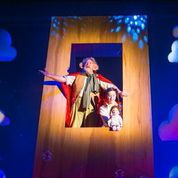
This is the Lyceum’s Christmassy adaptation of Roald Dahl’s ginormous classic. Its message is of humility and caution, all intertwined, and it’s very enjoyable. I loved Dahl’s children stories and still do. It was therefore a delight to hear David Wood’s success in retaining the whimsical language for this play within a play and to see director Andrew Panton realise it all on stage.

What better to represent the many rooms of childhood imaginings than a doll’s house? That’s designer Becky Minto’s large doll’s house across the breadth of the Lyceum’s stage and there’s a 00-Super gauge train track going around it, just as would be expected of any child’s play room. However, arguably the most enchanting aspect of the set is the BFG’s cave and specifically the hanging shelves that are lowered into view, adorned with jars of multi-coloured dreams. Simple but so effective. And there are the bright and innovative costumes to match. In and out of onesies, dresses and tops; on and off with hats and shoes; all changed at a quick pace – a pace wholly in keeping with the never-ending imaginations of children. One of the most impressive costumes in the wardrobe is the Queen’s – a majestic Claire Knight – whose wellie boots are topped with fur and whose royal emblem is emblazoned on a red gilet.

An integral part of this production is its combination of live music and pre-recorded sound effects. The cast’s rounded musical performances only serve to further enchant a spell-bound audience. The hard work of Claire McKenzie – musical director and composer– is evident in polished but yet playful performances. Her marriage of jaunty Scottish rhythms, fiddles and drums with children’s nursery rhymes and kazoos is expertly balanced.

BFG 2

Any decent toy box has its puppets and they are brought out to play big time in this production. The medium provides much comic input as well as creating numerous characters in the hands of a small cast. The puppetry is an original and attractive feature and gives literal form to the make-believe on stage. Robyn Milne’s infectious giggle and expressive performance brings the Sophie doll vibrantly to life whilst Lewis Howden’s mysterious and magnificent BFG is not so much scaled down – except for those ears! – as uplifted. Clumsy on his feet and tripping over his gobblefunk speech this BFG warms the hearts of the audience.
Children and adults alike respond happily to the energy and enjoyment of the performances and repeated ‘whizzpopping’ had the children – and many adults – giggling with glee. This is, after all, a treasured story that seems to have lived a lot longer than its thirty-two years might suggest. There is wonderful fancy evoked here, escapism and delightful nostalgia.

“Human beans is not thinking giants exist.” Well, after this great big and magic production this human bean thinks otherwise.

outstanding

StarStarStarStar

Reviewer: Amy King (Seen 3 December)

Visit ‘BFG’ at the Lyceum here

Visit our Assembly Roxy Bedlam Church Hill Theatre Festival Theatre King’s Theatre Other Pleasance, Potterrow & Teviot Summerhall The Lyceum The Stand Traverse archive.

THIS REVIEW HAS BEEN SUBEDITED

‘Chess: The Musical’ (Pleasance Theatre: 18 – 22 November ’14)

Photo: Oliver Buchanan

Photo: Oliver Buchanan

“Without Clark’s poise on which to pivot, the story might have given up and defected to the bar.”

Editorial Rating: 4 Stars: Outstanding

Priests, poets and psychiatrists all agree that the border between pure genius and melancholy madness is chequered with 64 black and white squares (with a white one always on the right). Next time you encounter that tramp in Potterrow Port, the one who’s convinced he’s Marcel Duchamp, ask him whether mad people gravitate to chess, or if chess makes them so. Chances are he’ll mutter darkly about the Lasker-Reichhelm position, but he might respond that the dedicated player lives “a monk-like existence and know[s] more rejection than any artist.”

The real Duchamp, the one who’d never been seen dead with a trolley from Aldi, directed those words to American prodigy Bobby Fischer, upon whose bizarre biography, Benny Andersson and Björn Ulvaeus (loosely) based a musical.

Inspired by the 1972 match between Fischer and Boris Spassky, the ABBA alumni spun a yarn interweaving two grandmasters’ competition in the arena, over a lady, and among the ideological roadblocks of Cold War politics. Truthfully, Gilbert and Sullivan Chess is not. The undeniable success of this production says more about EUSOG’s commitment to sampling work pas a la D’Oyly Carte than it does about Andersson & Ulvaeus’ capacity for profound historical commentary post-1815.

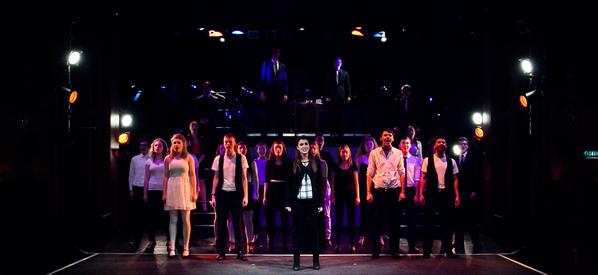
We enter to find the orchestra have escaped from their pit, and are lording it above the action. Production Manager Tom Turner has crammed more steeldeck into the set than went into South Park’s Ladder to Heaven. Visually the effect is elegant, the band’s movements in stylish harmony with Sam Burkett’s clever choreography. However x4 keys, drums, bass guitar, x3 violins, x2 cellos, flute, x2 clarinet, x3 trumpets, trombone, bassoon, oboe, french horn as well as percussion will tend to make a fair bit of noise and some dampening field needed to be generated for the sake of the singers down below.

Douglas Clark shone as Anatoly, making the script & song his own so as to cover the extensive narrative arc laid out for him. Without Clark’s poise on which to pivot, the story might have given up and defected to the bar. Tadgh Cullen (as Freddie) nailed Fischer’s astonishing angst. It was easy to see why Lydia Carrington (as Florence, the lady interest) would love him, and even easier to see why she left. I thought having Cullen sing his big number an octave higher than his vocal range was a brilliant piece of 4th wall smashing artistry, subtly underlining Freddie’s inner turmoil. My companion, smarter than your average bear, though it was a Boo-Boo. Cullen’s commitment held out. Our cheering was long, loud and genuine.

Giselle Yonace (as the tournament arbiter), Caroline Hickling (as Anatoly’s Russian wife), Peter Green (as the US manager), and Steven Segaud (as the mendacious USSR fixer) found the space to establish bold performances, spotlighting and supporting the main cast’s quirks and qualities. When Segaud tapped the vein of comic villainy in his character, I wasn’t the only one LMAO.

Ethan Baird’s direction emphasised the characters and the story they had to tell. But rather like flat pack furniture after the third house move, Chess is starting to show both its age and essential flimsiness. The producers are a bit young (and far too stylish) to embrace an ‘80s nostalgic short hand, but would one double-breasted suit have killed them? Would a visual of tactical nuclear warheads rolling through Red Square been so amiss? Several pieces were missing from this puzzling-out of a not so retro script.

If a musical about chess, written by the blokes from ABBA, set in the Evil Empire’s dreary dying days isn’t enough to float your Typhoon-Class, then here’s the only reason you’ll ever need to get out and kill, maim or mutilate whatever man or beast stands between you and the front row seats: Lydia Carrington.

She’s amazing. Her gorgeous voice battles down the band like Eva Green casually knocking down Greeks in the latest 300 movie. Carrington’s give and take with the male leads is as beguiling as Keira Knightley, as sexy as Elisha Cuthbert, and as anticipateringly exciting as when Elizabeth Warren made a cameo opposite John Goodman in Alpha House.

If you don’t see Carrington now, you’ll only have to pretend you did later. Unlike my VHS of Learn Chess with Nigel Short (ft. Carol Vorderman) this is one to watch.

outstanding

StarStarStarStar

Reviewer: Dan Lentell (Seen 19 November)

Visit EUSOG here

Visit our Pleasance, Potterrow & Teviot archive.

THIS REVIEW HAS NOT BEEN SUBEDITED

editor@edinburgh49.com

‘Bondagers’ (Lyceum: 22 October – 15 November ’14)

Bondagers 1

Photos: Drew Farrell

“a fertile, sure-yield production “

Editorial Rating: 4 Stars

First performed by the Traverse Theatre Company at the Tramway, Glasgow, and then the Traverse, Edinburgh, in May 1991. Listed by the National Library of Scotland as one of the 12 key Scottish plays of the past forty years.

There is the straight open road and there is the wide open field. We are likely, through pig-ignorance, to love the first and disregard the second. However, Sue Glover’s Bondagers will change your mind, and if it doesn’t, you’re past saving. For this bonneted, bonny, holy play almost makes the invisible visible. Almost, for there are small molehills of socio-economics and human geography to flatten first.

In his peerless survey of theatrical landscapes, Peter Brook ends chapter 2 of The Empty Space with this question: ‘Where should we look for [holy theatre]? In the clouds or on the ground?’ You can smell the answer in Lu Kemp’s fertile, sure-yield production. An earthy top dressing covers the Lyceum stage, and when it’s hoed, watered or shovelled, you could be in the fields alongside the A697, just past Greenlaw. In Bondagers, which is part keepsake, part platform, this Berwickshire acreage matters hugely.

For most of us, farmland is now remote, somehow indistinguishable territory. Once upon a time, really not so long ago, over the Lammermuir hills a married ploughman (a hind) was bound to provide a woman (a bondager) to also work on the farm. She might be his wife, but not when there were infant children to raise. By the 1890’s, a good master would have paid his bondager ten pence a day. Women’s work for women’s pay was still holding firm.

Bondagers2

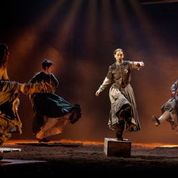
You’d have to split the Lyceum to set Bondagers in the round, but the creative team gets close to the vision thing, whose horizon(s) stretch way beyond the box beds in the cottage row, not that you see them anyway. There are no doors, no flats, and no fly-on-the-wall positions, as the scenery is a wide semi-circle of tan planking, thin and loosely joined, with the mist floating beneath it. The sights and sounds of this piece are filmic but solidity is vested in the spirits of six women. When fifteen year old Tottie calls out to her father in Saskatchewan the Canadian prairie seems as close as the Cheviots. Sara, the sturdy elder, leaves no room for doubt or longing, and Ellen, once bound over but now the tenant farmer’s young wife, is still bold and outspoken. Meanwhile, plainly and keenly, there are the folk songs: by turns affecting, burdened or bawdy, they keep time and period in step. Those warm, singing hearts lie under bulky wraps that are a triumph of research and costuming by the Wardrobe department. Additionally, the movement director, Ian Spink, deserves applause in his own right. From hiring to flitting the year round weather seems autumnal and chill. When the light does come, right at the end, the advancing glaring beams are of a different nature altogether.

In this rare atmosphere and with their own language a’ aboot them, the six bondagers share their lives. Sara (a fabulous Wendy Seagar) is the embodiment of moral dignity; good wife Maggie (Pauline Lockhart) scuttles undiminished from bairn to crib to table; Liza (Jayd Johnson) and Jenny (Charlene Boyd) chop neeps by day and gaze for lovers in their broken mirror by night. Innocent, wilder, emblematic Tottie (Cath Whitefield) strays outside the fold and suffers grievous harm. Mistress Ellen (Nora Waddell) brings knowledge of farm economy and crop rotation alongside her desire for a baby.

This is substantial and enthralling theatre by director Kemp and designer Jamie Vartan and yet its make-believe is vulnerable. I’d call Bondagers rhapsodic but there’s dissonance. A working girl can still be seduced into marriage by the promise of a clock, a dresser and a bed. Worse, there are bogeymen around: a sheriff who orders an arrest and a marquess who raises the rent. That brief combination is enough to silence the women well before the badass harvester turns off into the fields.

Still, the road’s clear to Coldstream and you can see for miles. Enjoy the view and love Bondagers.

Star (blue)Star (blue)Star (blue)Star (blue)

Reviewer: Alan Brown  (Seen 28 October)

Visit the Lyceum Homepage here

Visit our Assembly Roxy Bedlam Church Hill Theatre Festival Theatre King’s Theatre Other Pleasance, Potterrow & Teviot Summerhall The Lyceum The Stand Traverse archive.

THIS REVIEW HAS BEEN SUBEDITED

Crash (Traverse: 28 Oct – 1 Nov ’14)

Photo. Leslie Black

Photo. Leslie Black

“More slo-mo skid and shunt than full-on collision, more  crunch than splat”

Editorial Rating:  4 Stars: Nae Bad

In the Autumn line-up of A Play, A Pie and a A Pint.

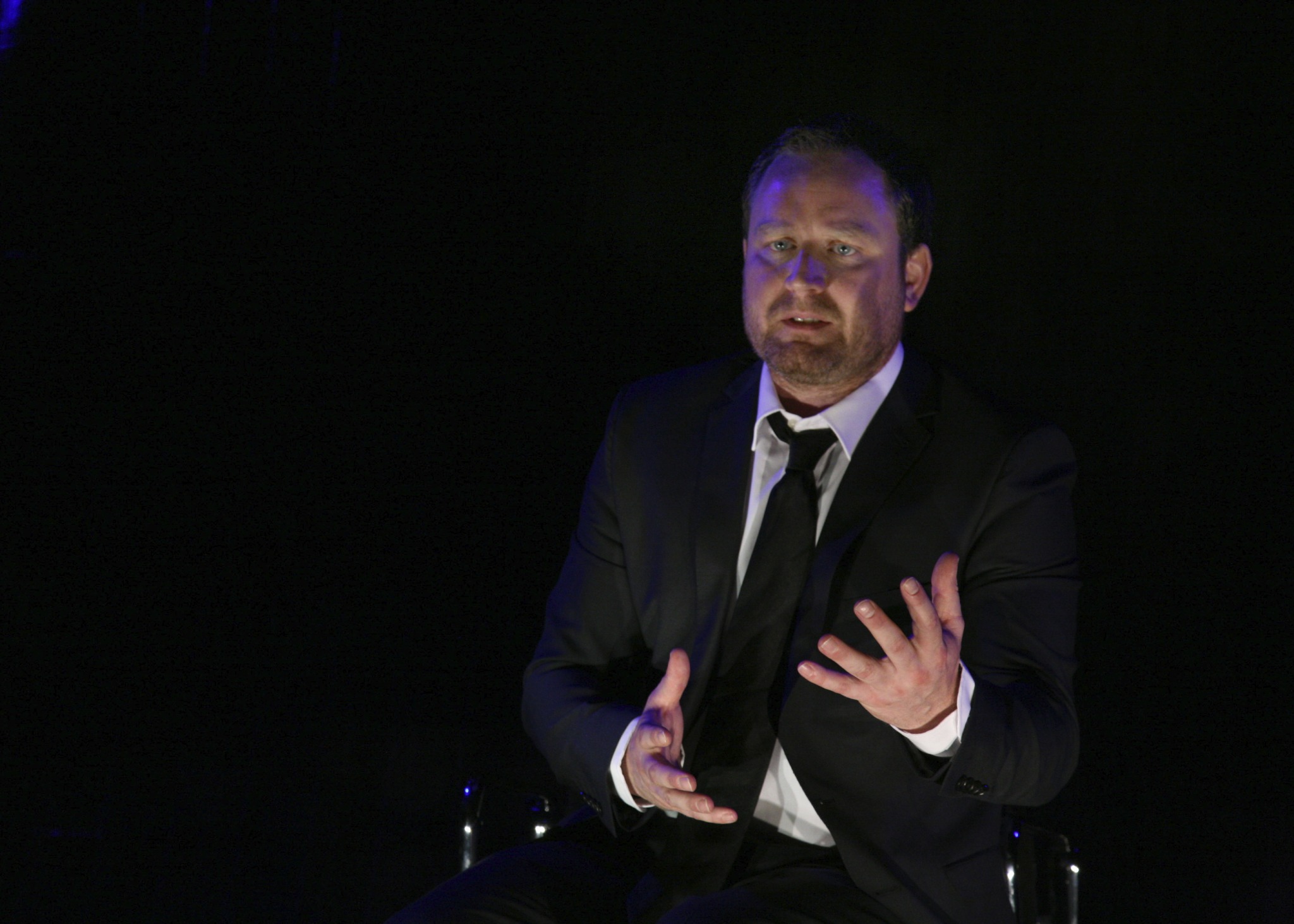
A whacked City trader speaks. He’s Scottish but it’s a quids in, pound sterling monologue, unassuming and on the level; a penny plain real deal, in fact, provided you accept that asset management is an emotional as well as a financial business. Finally, even naturally, the ‘game’ wastes you. There’s a wreck at the end of the tunnel.

Writer Andy Duffy’s single character has no name. He is a man alone in a sober suit and tie on a shiny office chair in a smooth glossy space. He could be in Aberdeen or across the way in Standard Life House, but still I incline to the Square Mile. His story begins on the night of 23 August 2007. (For the record Lehman Brothers declared bankruptcy on 15 November 2008.) He is precise like that; where he can he will enumerate, when he can’t he’ll simply point out that you don’t make money by being careful. And, instinctively, he has made and is still making lots of it.

Man (Jamie Michie) reads a piece in the ‘Financial Times’. His new girlfriend, Kate, prefers novels, which he considers to be self-indulgent pap. Man had a wife once but Alison died, which he’s sorry about, but shit happens when you lose control at the wheel, or when your investments go south. That’s ‘unprecedented volatility’ for you, which is where I’d bring in Russell Brand, who had lunch with the FT just last week. Brand finds the pink pages ‘hard to understand’ and opposes his ardent belief in spiritual ideologies to the FT’s economic one(s). So too even our trader, bruised and shaken by his wife’s death, attends meditation classes where in mid-mantra he finds consolation in … Kate’s long blond hair and tight figure. Nothing too revolutionary there to upset the capital markets .

Crash is more slo-mo skid and shunt than full-on collision, more crunch than splat, and so more revealing. There is the head-rest proposition that ‘money equals power and freedom’ but how is that supportable? Every now and again something is going to pile in from behind and the result will be bloody. You can hear it happening. There is a thrum of white noise – not Traverse 2’s air con – and the lighting gets colder. I was reminded of a Tube train coming into Bank. Man rises from his chair and/or collapses on a park bench and you wonder, not for the first time since the last financial horror show, if getting minted is worth it.

A driven, strong play that is expertly directed by Emma Callander and impressively performed by Jamie Michie.

nae bad_blue

Star (blue)Star (blue)Star (blue)Star (blue)

Reviewer: Alan Brown (Seen 28 October)

Visit Traverse Homepage here

Visit our Assembly Roxy Bedlam Church Hill Theatre Festival Theatre King’s Theatre Other Pleasance, Potterrow & Teviot Summerhall The Lyceum The Stand Traverse archive.

THIS REVIEW HAS NOT BEEN SUBEDITED