‘Normal / Madness’ (Assembly Roxy: 12 – 13 May ’15)

Photos: Kidder theatre

Photos: Kidder theatre

“A show that is performed with great sympathy that you will take heart from”

Editorial Rating:  4 Stars: Nae Bad

You say ‘Normal’, slash, ‘Madness’; I say ‘Normal’, oblique, ‘Madness’. WTF; you’re right, ‘slash’ is sharper, more definite. But it cuts both ways. Yes, there’s separation but they’re related, surely?

And that’s the point. Look at the flyer for Kidder theatre’s Normal / Madness. Mother and daughter, backs to the camera, are walking down a railway track holding hands; each balances on one rail, each supports the other. They walk beneath a star filled sky – in golden light – and it’s a lovely, endearing picture; but were it for real we’d have an irresponsible, lunatic, piece of parenting.

Here’s the crass response: “Pull yourself together woman!” Oh, is that all you have to do? What if you can’t because you’re ill? What if your whole life can become precarious in an instant? That’d be mental, then.

Kirsty McKenzie, 30, tells it how it is and how it was. Her mother, Mary, has schizoaffective disorder and has had it for a long time. She suffers psychotic symptoms, similar to schizophrenia, and the mood symptoms of the manic depressive. We see Mary overwhelmed and scared. We see Kirsty caring, trying to help and to understand.

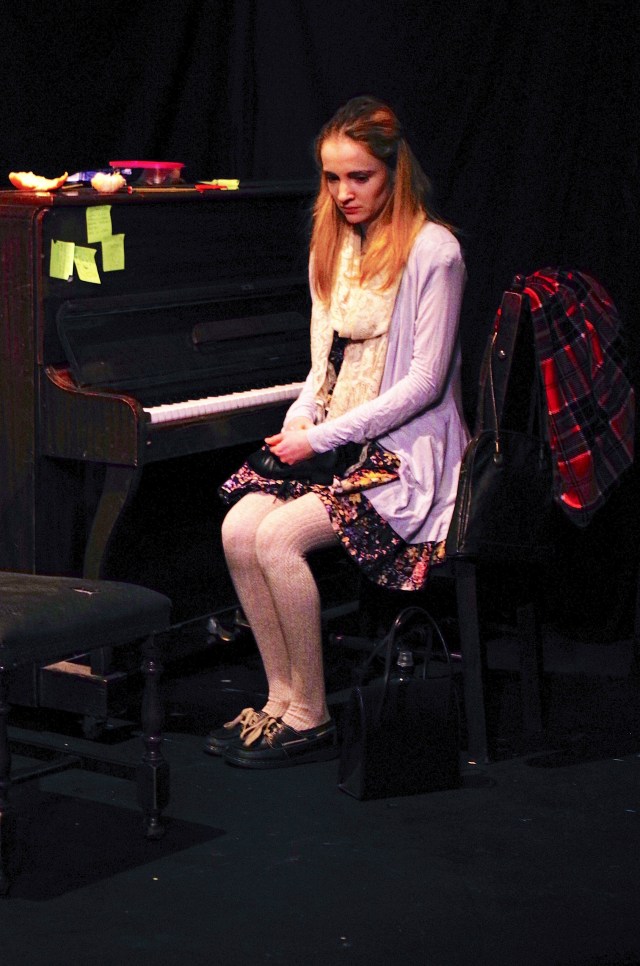
Writer/Actor Fiona Geddes is alone on stage. She’s Kirsty with a broad smile, a ready sense of humour and a wonderful positive manner. She’s also Mary, low, terribly anxious and scrabbling in the sand for the six pounds in coppers that she buried and now cannot find. The tide is coming in along the Moray Firth and the children’s treasure hunt has had it. As a metaphor for how mental illness wipes you out, time and again, that’s hard to beat.
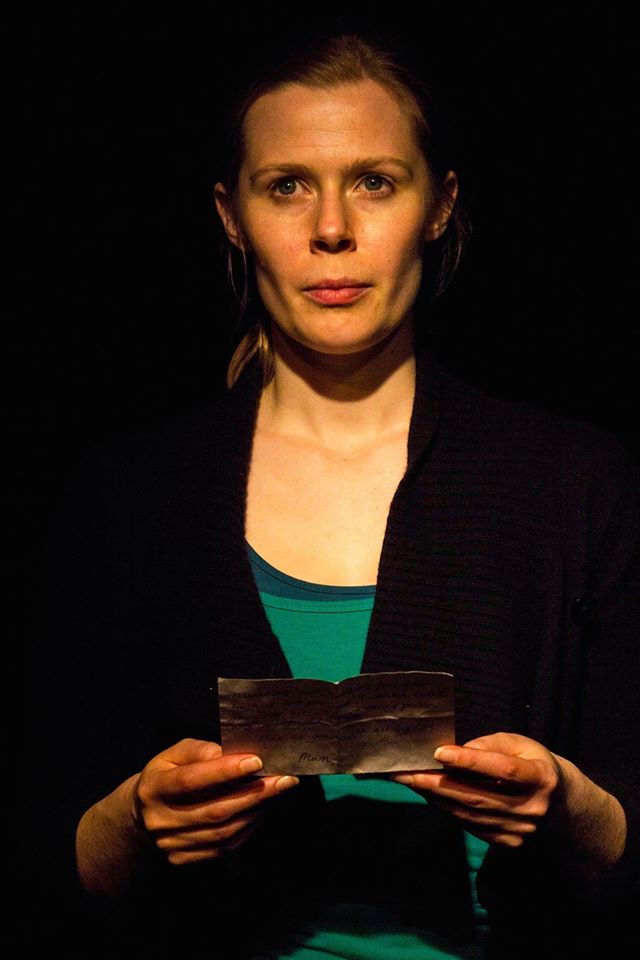
Fiona Geddes as Kirsty

Fiona Geddes as Kirsty

We get to learn a fair bit about schizoaffective disorder. Medical information is relayed in tones halfway patronising and/or foreign. I couldn’t help wishing for some projected slides with bullet points to do a professional job. More time with Mary, Kirsty, and bipolar boyfriend Patrick, would have been better, especially as mother and Patrick don’t get on. The familiar, homely, strains of ‘Coronation Street’ are almost therapeutic and are certainly ironic.

You’ll like Kirsty because of her honesty and because she is a loving person. Yes, the issue is her Mum’s condition but the story is Kirsty’s. Consider the choices she (& Patrick) have to make regarding children of their own. Genetic counselling gives you fair enough odds but ….

Geddes and director Jessica Beck brought Normal / Madness to the Fringe last year. Now, during Mental Health Awareness Week, it is back in Edinburgh and on tour. It’s on next at The Tron in Glasgow . The charity ‘Rethink Mental Illness’ supports this production, which – forgive me – is a no-brainer. It is a show that is performed with great sympathy that you will take heart from. ‘Help and Hope’ is the message.

nae bad_blue

Star (blue)Star (blue)Star (blue)Star (blue)

Reviewer: Alan Brown (Seen 12 May)

Go to ‘Normal / Madness’ at Kidder here

Visit the Assembly Roxy archive.
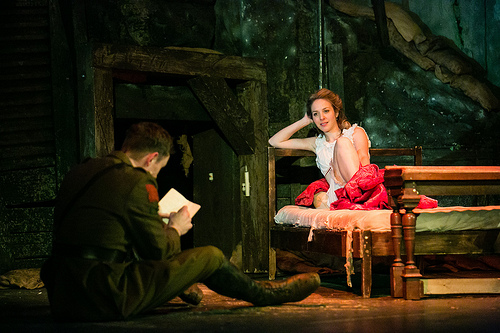
‘Birdsong’ (King’s: 21 – 25 April ’15)

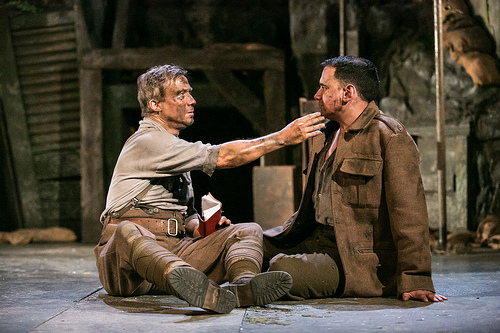
Edmund Wiseman as Stephen Wraysford and Emily Bowker as Isabelle Azaire. Photos: Jack Ladenburg

Edmund Wiseman as Stephen Wraysford and Emily Bowker as Isabelle Azaire.
Photos: Jack Ladenburg

“More resonant than sword waving in front of machine guns”

Editorial Rating:  4 Stars Nae Bad

If you can bear a literary introduction read Sassoon’s The Redeemer and Owen’s Strange Meeting before the show. If not, just take this from Issac Rosenberg’s Returning, we hear the Larks:

‘Death could drop from the dark
As easily as song –
But song only dropped’

Which is what you do get in this moving if fitful adaptation of Sebastian Faulks’ Birdsong. There is lovely singing and there are skylarks – but there is also a rat on a bayonet, blood dripping down 60 feet, and furious bombardment.

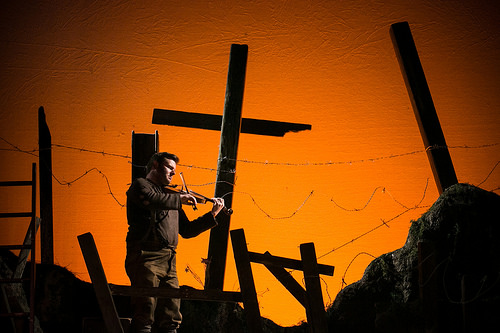
This is poignant and dramatic storytelling by the Original Theatre Company. Yes, Faulks’ book is blasted open in Rachel Wagstaff’s new version for the stage and at times the effect is not pretty, parts do fall away and some of the shoring up looks shaky but I reckon that’s inevitable. The back set is a high rampart of shattered wood and piled debris. Two large timbers make a cross that rises above the parapet in a stark reminder that Christ had one hell of a job to do on the Western Front. Men pray in this play, which is not at all what I remember from the book, and it is horribly easy to understand why. That green hill is not so far away and might well be undermined by tons of explosive that will send you to kingdom come.

What I do recall from Faulks’ pages are sex and war story content of frightful detail and claustrophobic novelty. Well, the sex is still around but the novelty has gone because even if you do not know the book there’s the two-part tv. series with Eddie Redmayne and the Australian film Beneath Hill 60. Tunnelling onto and about the stage aint the same but the sappers do a brave job of crawling by (electric) candlelight. They ‘Play Fritz’ and imagine the lives of the enemy, who may only be a few feet away, below, above, or ahead. There’s suspense to be had before an attack tunnel breaks through or a detonation shakes the walls and then there’s rushing confusion. Nevertheless, the best action stays with the characters.

Peter Duncan as Jack Firebrace and Liam McCormick as Arthur Shaw

Peter Duncan as Jack Firebrace and Liam McCormick as Arthur Shaw

With a name like Jack Firebrace we’re close to plain allegory. Peter Duncan plays him admirably as sturdy, loving, dauntless . The short scenes when this former London Tube tunneller and his best mate, Arthur Shaw (Liam McCormick), share letters and thoughts of home are possibly the most affecting in the play. What is more intense but – it seems – far less mature is the love affair between Stephen Wraysford, 20, (Edmund Wiseman) and Isabelle Azaire, 27 (Emily Bowker). The individual performances are easily good enough to make this believable in the moment but it is a stretch to see it played out over eight years, from 1910 to 1918. The flashbacks flare and are gone and you can almost see the narrative being shovelled in before the light vanishes. A final, near wordless, scene when the cast of Stephen’s lacerated memories people the stage is a welcome coup d’oeil upon the whole ghastly shebang.

Arguably a resurrection is being played out: of Stephen’s passionate love and of his war – that’s understood; but it is also an appeal to stand by what is now out of living memory. Hence the really telling effect in this production of folk song, hymn and psalm, beautifully sung by James Findlay ; a cut above and much more resonant than sword waving in front of machine guns, more so even than a Tommy / Hun hug of reconciliation. For what Wagstaff has crafted from Faulk’s book and what director Alastair Whatley turns out on stage is a theatrical ‘Stand to’ – to guard against what Stephen kept close in his coded notebook and is now given voice:

James Findlay as Cartwright, Singer and Musician

James Findlay as Cartwright, Singer and Musician

‘No child or future generation will ever know what this was like. They will never understand … We will seal what we have seen in the silence of our hearts and no words will reach us’.

You might simply want to accept Stephen’s commanding officer’s invitation to join him for tea on the Royal Mile when ‘this’ is all over. Or you can talk about ‘Birdsong’, which would be better.

nae bad_blue

Star (blue)Star (blue)Star (blue)Star (blue)

Reviewer: Alan Brown  (Seen 22 April)

Go to the King’s and Festival theatres here.

Visit the King’s Theatre archive.

‘Hatters!’ (Assembly Roxy: 31 March – 3 April’15)

“Awash with lots of individually interesting ensemble moments and devices.”

Editorial Rating: 3 Stars: Nae Bad

Hatters is an intriguing piece of ensemble theatre. It follows the story of Robert, a hapless member of the Bright Young Things in 1930s London, and his attempts to navigate a minefield of sinister characters and mistaken identities in order to marry his fiancé.

Loosely inspired the Evelyn Waugh novel Vile Bodies, the company devised the production around the novel’s key dramatic moments and characters. Keeping very much in theme with the “modernist” style adopted by Waugh in his book, a more experimental approach is used by the company in its presentation of society in the run up to World War 2.

It’s a very physical production, which at times hinders the narrative of the piece as the actors often parade around from scene to scene embodying furniture, cars and general London street scenes. This makes it quite difficult for the audience to know what’s going on. In fact, the show opens with all nine actors stood in a circle facing inwards, and one by one they appear to suffer some sort of epileptic fit before ending in a pile on the floor. By the end of the performance we still had no idea what relevance this had to everything else, and moments like this unfortunately detracted from what was actually a very interesting exploration of modernist theatrical storytelling.

In saying that, in many of the physical sections the action was accompanied by human soundscaping, which worked particularly well in creating atmosphere, and was executed with just the right level of depth and detail. In some cases though, a subtler approach could have been more effective and less jarring to the main action, which was on the whole, very well executed.

As a devised work, facilitated by the passionate Sibylla Archdale Kalid, Hatters is awash with lots of individually interesting ensemble moments and devices. One good example of this was the tea party scene, where actors swapped character with each other many times, but managed to maintain continuity and clarity of action and dialogue. Indeed, the cast’s overall approach to and execution of characterisation, aided by different hats to help identify them, was a real strength of the show.

However, the fragmented style and seeming need to cram in everything that had been devised for fear of wasting it did end up being a bit overkill. With so many different devices and styles used, the piece lacked some consistency. It would have been more effective to see more themes running throughout the performance, rather than something new adopted for every new scene.

The production was certainly not without its laughing moments. Comic timing was very good throughout, as was delivery of some of the witty one-liners worked into the script. My particular favourite was uttered by Robert’s fiancé, just after he’d had to sell her to pay off his debts: “These feelings don’t just go away when you’re sold!” Something about the pure innocence in the delivery had the whole audience in stitches.

Overall, this was a courageous and admirable effort, with a lot of potential to be expanded and developed over time. It’s just not quite there yet.

nae bad_blue

Star (blue)Star (blue)Star (blue)

Reviewer: Steve Griffin  (Seen 3 April)

Visit the Assembly Roxy Bedlam Church Hill Theatre Festival Theatre King’s Theatre Other Pleasance, Potterrow & Teviot Summerhall The Lyceum The Stand Traverse archive.

THIS REVIEW HAS NOT BEEN SUBEDITED

‘Stepping Out’ (Bedlam: 25 – 26 March ’15)

Olivia Evershed as Andy

Olivia Evershed as Andy

“Tap isn’t easy to master, so respect must go to the whole cast for giving it a very good shot, as well delivering a solid comedic acting display.”

Editorial Rating: 3 Stars: Nae Bad

Stepping Out is a comedy about a group of mismatched characters in the 80s who are all in the same recreational tap dance class. And yes, they do actually dance. If that doesn’t sound funny already, Lorna Treen’s performance as ancient, grouchy pianist Mrs Fraser in the opening scene, delivering witty one-liners in brilliant dead pan style, sets the show off to a very good start.

As the play progresses, we get to learn more about each character and their relationships with each other, some of which aren’t as rosy as they might initially seem. Although a bit of a slow burner in terms of narrative in the first half, when the class is offered the chance to put on a real show to a paying audience the tension is raised a notch and it picks up some of the pace it had been lacking.

The script posed some difficulties with staging, largely due to its ensemble nature (most of the cast were on stage a majority of the time) and the structure of the dialogue into small snippets rather than full scenes. This had the effect of it all feeling a bit fragmented and having a stilted sense of flow, but director Zoe Most and the cast did well to keep action on stage alive from every angle despite this.

Interspersed with the comedy were some very touching moments, particularly between Andy and Geoffrey. However these got a little bit lost among the more active, ensemble scenes, and could have been more impactful with a bit more contrast in pace and dynamics.

The dancing itself was very enjoyable and was well choreographed to show progression in the class’s ability from the beginning to the end of the play. Tap isn’t easy to master, so respect must go to the whole cast for giving it a very good shot, as well delivering a solid comedic acting display.

The stand out performer (for me) was Isabella Rogers as the outspoken, middle class Vera. Her facial expressions, comic timing and perfect delivery of the line “I used to be fat, you know” had the whole audience giggling with glee. She drew attention whenever she was on stage and delivered a captivating and comical performance. Olivia Evershed, playing the browbeaten Andy, showed great depth in a complex character and was also compelling to watch.

For the opening night of a student production, one can forgive it being a little rough around the edges. The heart and soul of the piece were definitely intact and it delivered laughs a plenty. Overall, a very enjoyable evening, well worth stepping out to.

nae bad_blue

Star (blue)Star (blue)Star (blue)

Reviewer: Steve Griffin  (Seen 25 March)

Visit the Assembly Roxy Bedlam Church Hill Theatre Festival Theatre King’s Theatre Other Pleasance, Potterrow & Teviot Summerhall The Lyceum The Stand Traverse archive.

THIS REVIEW HAS NOT BEEN SUBEDITED

‘The Gondoliers’ (Pleasance: 17 – 21 March ’15)

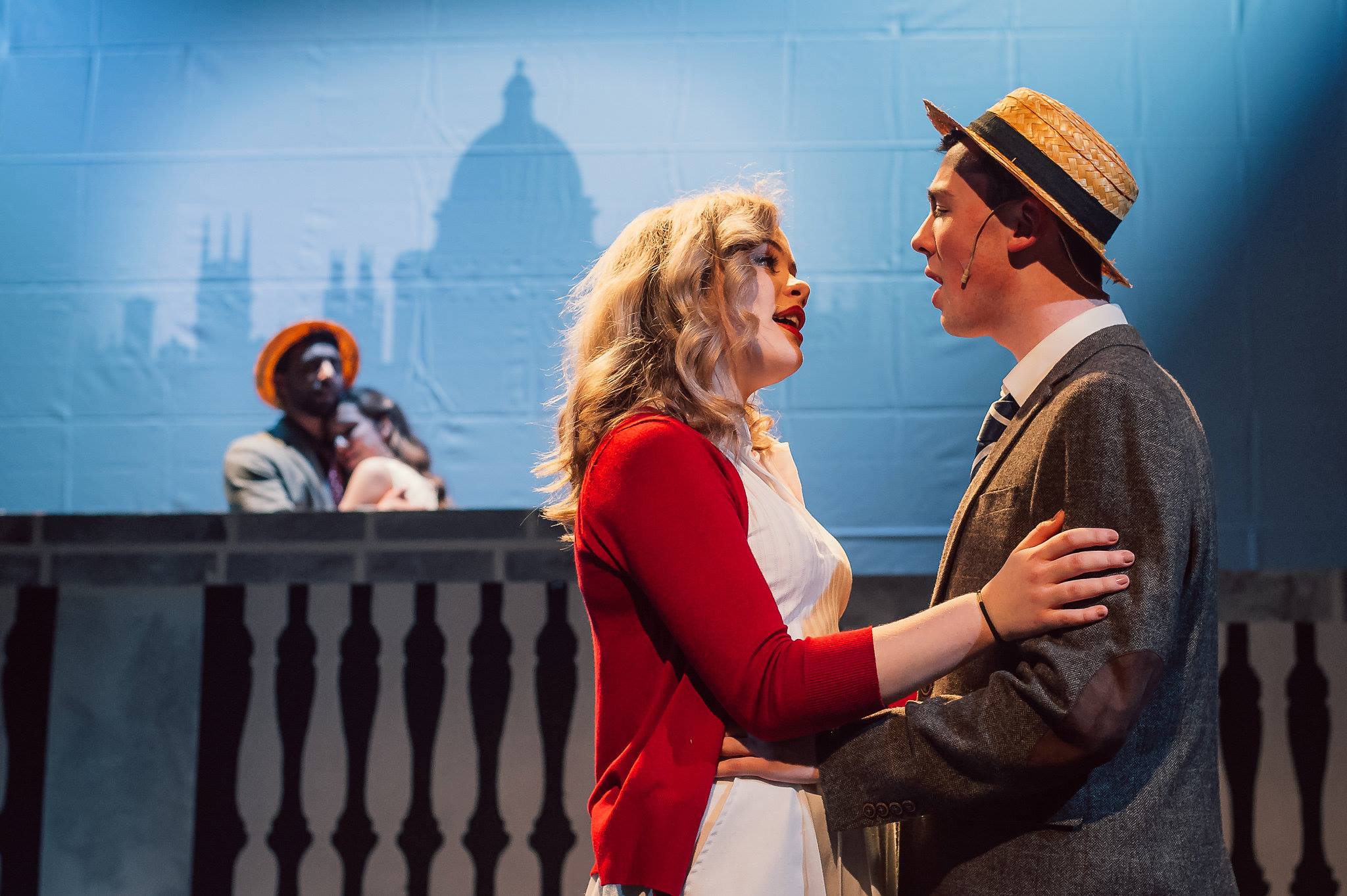
fr. Eleanor Crowe as Gianetta with Harry McGregor as Marco; with Lydia Carrington as Tessa and Sean Marinelli as Giuseppe, behind.

fr. Eleanor Crowe as Gianetta with Harry McGregor as Marco; with Lydia Carrington as Tessa and Sean Marinelli as Giuseppe, behind.

 “The lovers glide through their united vocal performances”

Editorial Rating: 4 Stars:  Nae Bad

Director Thomas Ware and Assistant Director Lucy Evans set out with a vision to create a modernised version of Gilbert and Sullivan’s comic opera The Gondoliers and by the King of Barataria do they succeed! The costumes ooze Fifties glamour and glam their way through prestigious St Mark’s, ‘Oxbridge’; for St Mark is the patron saint of the original setting, Venice. Geddit? We have a show worth seeing.

His debut on the maestro’s podium saw Musical Director Steven Segaud coaxing a sound from the cast that can only be described as stunning. Conducting a 30-piece band and a cast of 33 takes great skill and his hard work paid off. The eleven-strong male chorus is perfectly matched by their female counterparts. The combined choral sound is magical and the principals more than hold their own when on their own.

Gilbert and Sullivan are notorious for weaving multiple devilishly intricate, wordy melodies that can trip up even the well-seasoned EUSOG trouper, but this cast were as quick lipped as they were quick witted. The overall sound and lasting impact more than made up for any bum notes from the band pit or stage.

Set Designer Isobel Williams and her team deserve mention for the unembellished stage design. It was most effective – using silhouettes is a clever way of determining location without having to build separate sets for the two cities and the bridge-turned-platform was also a great asset to the stage dressing; adding both height and opportunity for fun entertainment, should the need arise. What’s more, the gondoliers could then pass through ‘behind’; noticeable but unobtrusive – the audience catching no more than a glimpse of a hat, a head and an oar: a most effective direction.

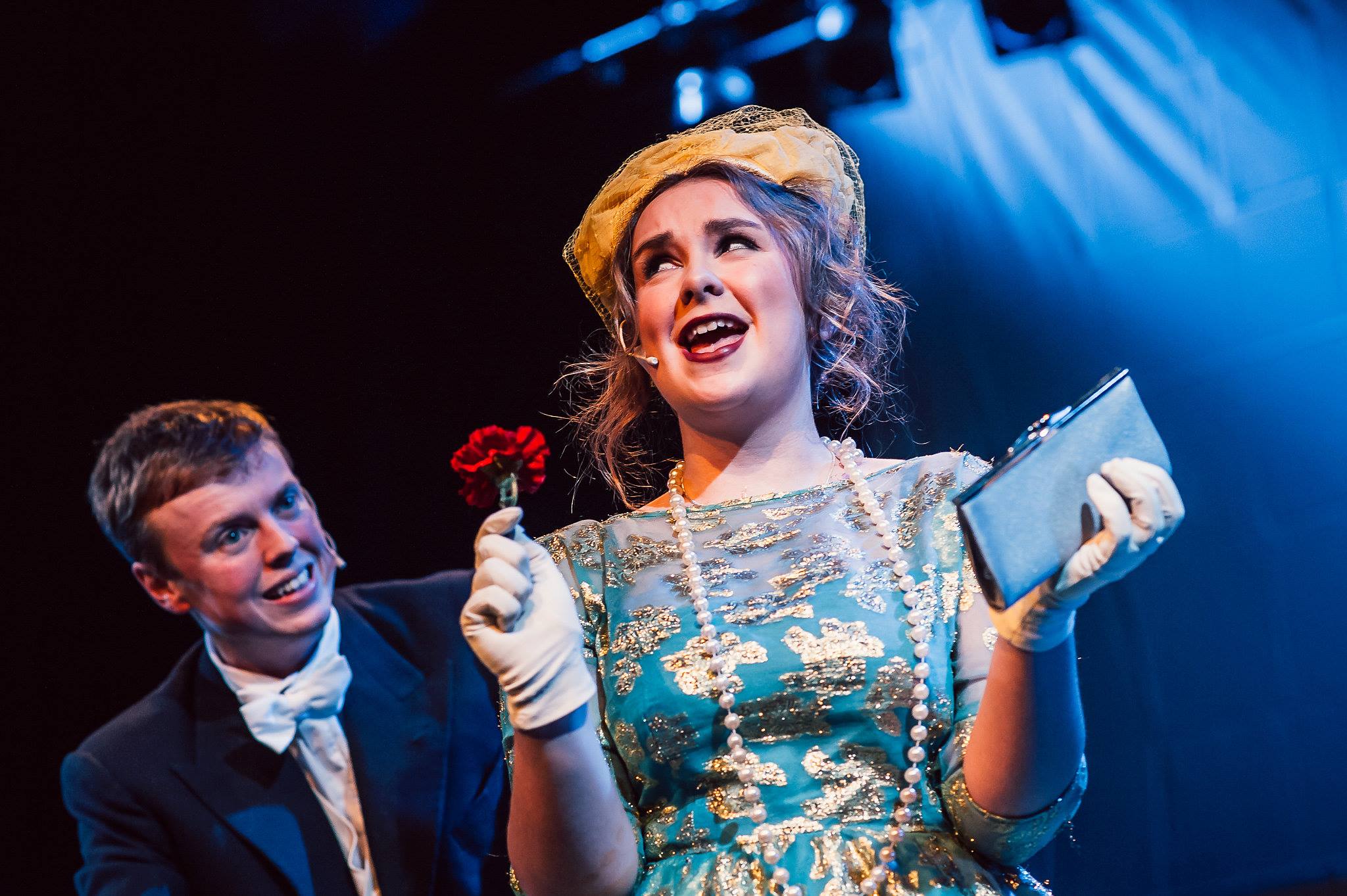
Dominic James Lewis and Lucy Gibbons as the Duke and Duchess of Plaza Toro. Photos: EUSOG

Dominic James Lewis and Lucy Gibbons as the Duke and Duchess of Plaza Toro.
Photos: EUSOG

The added references of pop culture to the script did add to the hilarity of many a situation – most notably the larger-than-life Duke of Plaza Toro and his wife, the Duchess; portrayed by Dominic Lewis and Lucy Gibbons. The evident cracks in their marriage and need for lavish pomp and ceremony resulted in expectant chuckles from the audience as soon as they appeared on stage – such a reaction cannot be misconstrued. The pair’s comic timing and natural awareness and reaction to the other’s antics made for a great laugh.

Harry MacGregor and Sean Marinelli took to the roles of gondoliers Marco and Giuseppe, respectively, with an ease and camaraderie that was a joy to watch on stage. While the brothers’ vocals may not always have reflected their unity, their acting certainly did, especially when acting through technical glitches and finding love. The pair’s love interests, Eleanor Crowe and Lydia Carrington, made easy the chance to revel in G&S splendour – as Gianetta and Tessa; these sopranos worked their instruments well to produce a beautiful sound, and as a quartet, the lovers glide through their united vocal performances.

The most convincing love entanglement springs between Casilda, daughter of the Duchess – and newly made Queen of Barataria – and Luiz, a serving man. This tricky, class conflicted, love was fantastically conveyed by Ethan Baird and Ellie Millar; the pair’s pathetic battle against their feelings was poignantly funny – this poignancy only made more bitter sweet by the mellow melding of the pair’s vocals. Millar rose effortlessly through the high notes and was complemented perfectly by Baird’s rich tenor. And as with all Gilbert and Sullivan fairy tale-esque romances, the queen gets her king, strife is resolved within Barataria and Baird shows he suits both bowler hat and king’s garb.

All in all, farce and fancy that epitomizes what it means to be a Savoy Opera where life’s a pudding full of plums. Tra, la, la, ha, ha, ha, et cetera.

nae bad_blue

Star (blue)Star (blue)Star (blue)Star (blue)

Reviewer: Amy King  (Seen 16 March)

Visit Edinburgh University Savoy Opera Group here.

Visit the  Pleasance archive.

‘The Effect’ (Summerhall: 11 – 14 March’15)

Cameron Crighton as Tristan and Scarlett Mack as Connie All photos: Firebrand.

Cameron Crighton as Tristan and Scarlett Mack as Connie
All photos: Firebrand.

“A well-thought-out and faultlessly-delivered show”

Editorial Rating: 4 Stars: Nae Bad

Set across the four-week span of a clinical drugs trial, The Effect (2012) is a play which tackles perhaps the highest concept of all: our ability to assess and analyse the workings of our own mind. Penned by Lucy Prebble , best known for writing the briefly-sensational ENRON, it’s revived here by Borders-based company Firebrand Theatre. Ironically though, Firebrand’s clinically-excellent performance throws into focus a few pronounced oddities in the script.

The “effect” of the title is the placebo effect – the powerful medical phenomenon which says that if we think we’re taking a drug, we’ll experience at least some of its benefits. Prebble explores that concept through two parallel storylines: a young couple who may or may not be falling in love, and a doctor who may or may not be depressed. Intellectually, I can see how this all hangs together, but it still felt like I was watching two plays uncomfortably squashed into one. “What is love?” and “Do antidepressants work?” are just very different questions, and I’m not sure it’s possible to tackle them both while doing full justice to either.

Much more successful, for me, were the human tales. On the one hand, there’s a sweet boy-meets-girl story – with the requisite courtship, predictable crisis, and the hope of a reconciliation by the end. It’s a time-worn formula, but it’s well-executed, and the tale has a twist that’s genuinely startling yet fully justified by the plot. Actors Scarlett Mack and Cameron Crighton do a fine job delivering characters we can love, with Crighton’s physical restlessness also adding plenty of interest to a series of otherwise quite static scenes.

Pauline Knowles as Lorna

Pauline Knowles as Lorna

Jonathan Coote as Toby

Jonathan Coote as Toby

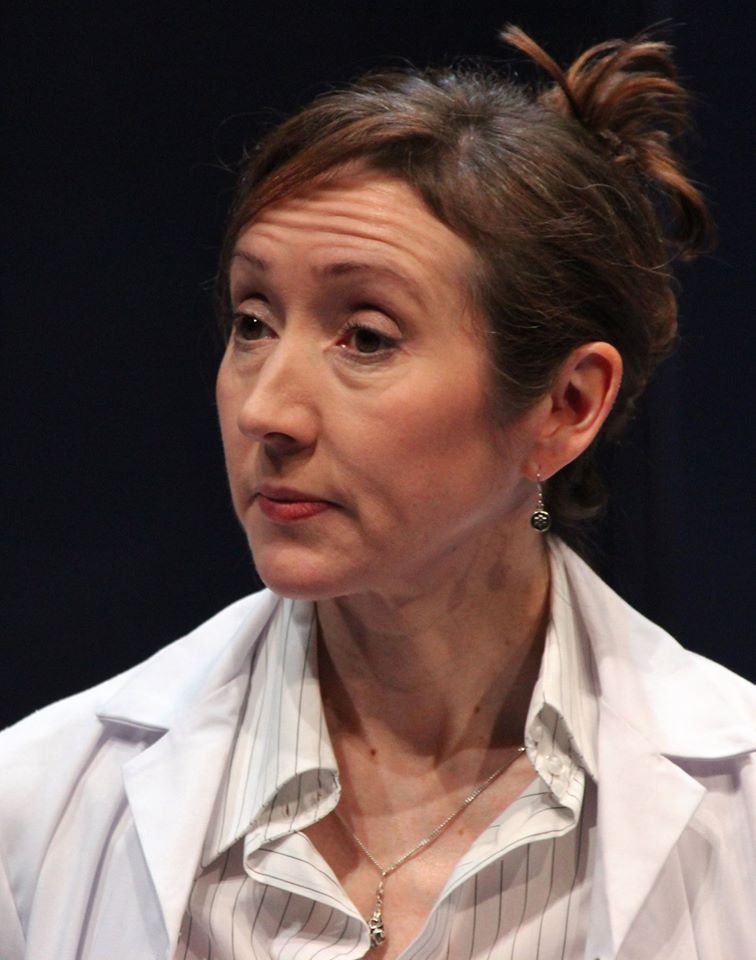
Alongside them we have Pauline Knowles’ acerbic but secretly-warm-hearted doctor, who provides a lot of deadpan humour but clearly has a vulnerable side too. Knowles impressed me with her ability to inject subtle emotion, as did Jonathan Coote, playing the pharmaceutical-company manager with a secret in his past. It’s hinted early on that these two characters have met before, and the details of their relationship are revealed in carefully-measured doses – an ongoing mystery which underpins the first act of the play.

Fine acting and direction are complemented by an effective design. The whole production is stark and monochrome, filled with medical whites and impersonal greys, a choice which serves to highlight rather than diminish the colourful humanity on display. Every now and then the cast break off into stylised sequences set to a techno-inspired soundtrack, punctuating the wordy script while skipping lightly over the duller parts of the plot. At times it all grows a little protracted – and I certainly wouldn’t have minded if they’d cut the last ten seconds of the sex scene – but all in all, Firebrand Theatre do well to thread a coherent path through a complex storyline.

In the end, the effect of The Effect was a mildly frustrating one: the script tries too hard to draw connections, and ends up feeling both crowded and languid at the same time. But that’s no reflection at all on the production company, who once again (see our reviews of Outlying Islands and of Blackbird) have laid on a well-thought-out and faultlessly-delivered show. All in all, this one’s well worth catching on its remaining dates at Summerhall – for the questions it poses may be disjointed, but they’re still intriguing ones.


nae bad_blue

Star (blue)Star (blue)Star (blue)Star (blue)

Reviewer: Richard Stamp (Seen 11 March)

Go to Firebrand & Summerhall here

Visit the Summerhall archive.

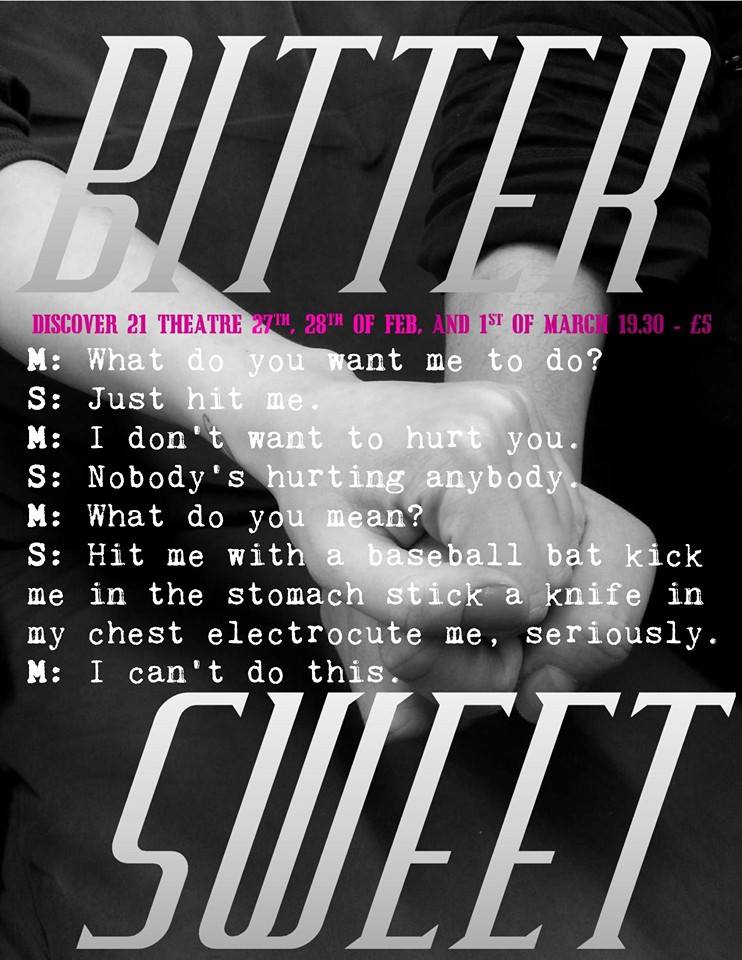
‘Bitter Sweet’ (Discover 21 Theatre: 27 Feb -1 March ’15)

Bitter Sweet 2

“Distorted Love”

Editorial Rating: 3 Stars: Nae Bad

Shocking.

That’s the first word that springs to mind when looking back on the journey followed in Bitter Sweet. Writer and Director Kolbrun Bjort Sigfusdottir created a show that saw reality and fantasy twisted and contorted into a near horror story.

The venue, Discover 21 Theatre, was a perfectly intimate venue that provided closeness to the action that was necessary for this performance to deliver its full impact.

The set was simple, yet detailed. The hints of Steig Larsson’s influence on the script were mirrored in the set – his books featured on the shelves of the bookcase and were reflected in S’s character traits. A small fold-out sofa that sat stage-right was used in a variety of ways that kept the action from becoming too similar and repetitive.

Technically, this play was slick. The music was well-fitted to the rising tensions and served to heighten emotions – both loving and dark. The tone of the scene changed with the lighting cues which was a clever technique to keep the course of the play as disjointed as the relationship.

Both Kate Foley-Scott and Ben Blow tackled this difficult script with a tenacity that is commendable.

Depression and its effects on love feature heavily in this show. Foley-Scott was completely convincing in her portrayal of a manic depressive. Her pleads to be hurt were difficult to watch but impossible to look away from. Her character, known only as S, was desperate to feel anything, while inflicting nothing but pain on her partner. Despite her small stature, Foley-Scott offered a huge performance that was warmly received by the audience.

Ben Blow approached this play masterfully. His constant switching between the softly spoken, sensitive boyfriend and the angry, resentful, jilted lover was fascinating to watch. Blow owned the stage in both roles and that made for confident performance, even the most controversial scenes between the couple were grimly tenable.

The sensitive subject matter of sexual violence left the audience reeling; perhaps it really was too vivid and coarse. A less abrasive way to introduce the idea could have been to perform the scene in a black-out so only the voices could be heard. In all honesty, one scene was too graphic and uncomfortable to the point where it was unwatchable.

It would be wrong to say that this show was enjoyable – what with its dark content – but it certainly grips you. It was a shame that the audience were so few in number, but their appreciation for the performance was genuine and well-deserved.


nae bad_blue

Star (blue)Star (blue)Star (blue)

Reviewer: Amy King  (Seen 27 February)

Visit Discover 21 theatre here .

THIS REVIEW HAS NOT BEEN SUBEDITED

‘Sister Act’ (King’s: 18 – 21 February ’15)

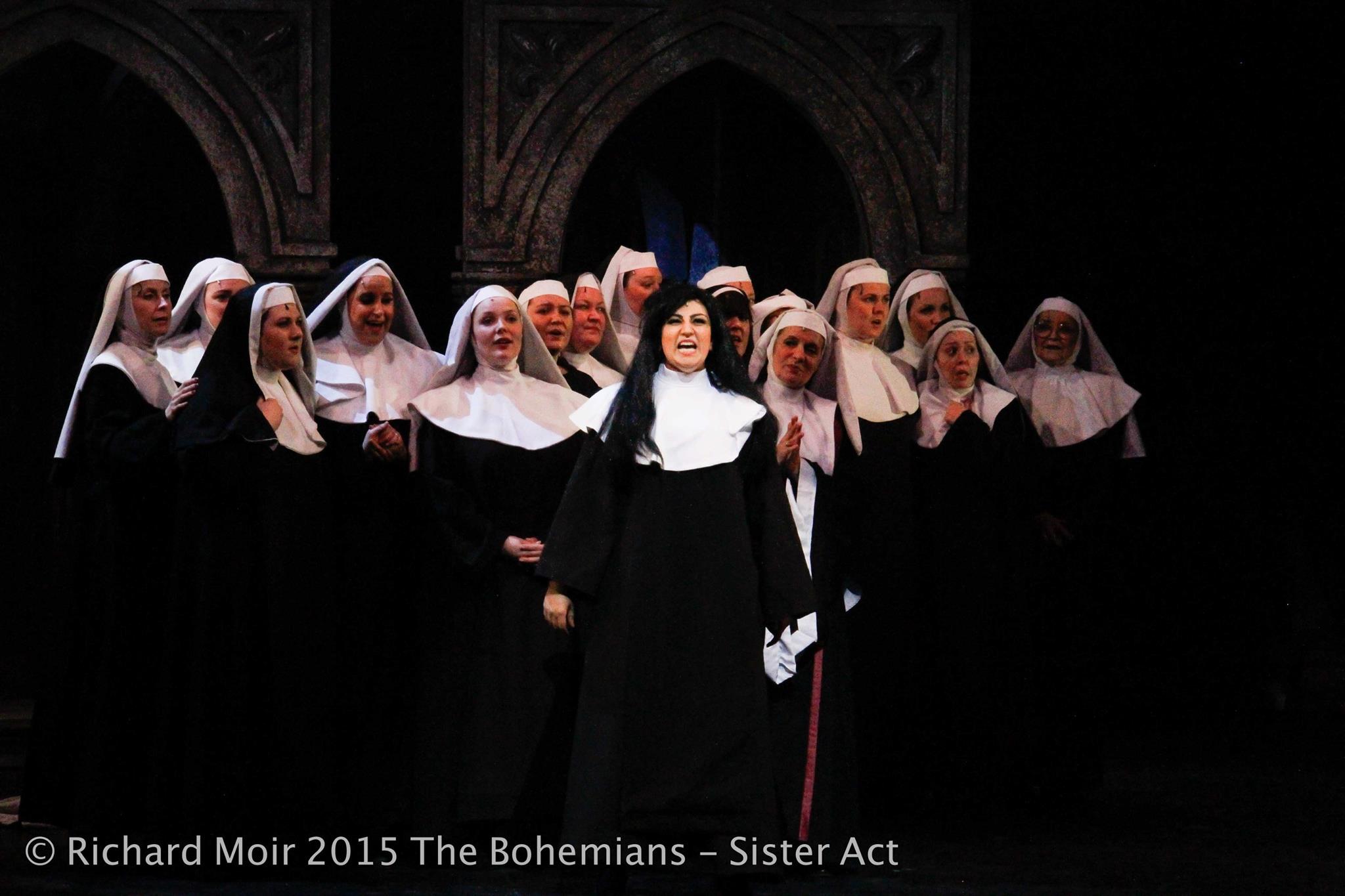
 SisterAct2

“Divine”

Editorial Rating:  4 Stars: Nae Bad 

‘The Bohemians’, established in 1909, are one of Edinburgh’s major amateur musical companies.

Sister Act was one of the first DVDs I was ever given as a child. There was always a magic to the film that I adored and Whoopi Goldberg never failed to have me dancing and singing along with the other nuns. Cheri and Bill Steinkellner adapted the Whoopi Goldberg classic for stage; something I am so glad they did. Bohemians’ director Colin Cairncross took on the challenge, bringing to the stage a production full of vivacity and talent. For an amateur production, this show really did impress.

Ian Monteith-Mathie took on the role of Musical Director for this production and worked with Alan Menken’s music score to create a beautiful sound from the performers – the harmonies in the full cast numbers were incredible. His orchestra carried the cast through the show in funky rhythms and soulful melodies.

Niloo-Far Khan took a walk in Whoopi’s shiny heeled boots as Deloris Van Cartier and commanded stage with ease. Vocally, her performance was faultless and she gave great gusto to her character. Her on-stage rapport with Mother Superior – portrayed by Dorothy Johnstone – was as entertaining as it was electric. The pair shone in the spotlight as they battled to prove the other wrong before finally reconciling their differences. Johnstone carried a wisdom about her that was evident in both action and song and her protective instincts towards the nuns shone through. It was truly delightful to witness the transformation of the choir of nuns – the resulting musicality from the hard work of Deloris (and Monteith-Mathie) raised hairs on the neck. It was, for lack of a better word, divine.

Officer Eddie Souther lamented that he “Could Be That Guy” and if he was referring to a talented singer and a joy to watch on stage, then Gareth Brown certainly was “that guy”. His soft, awkward character was greatly set against the imposing Curtis Jackson. Padraig Hamrogue’s portrayal of Curtis was reminiscent of the black and white gangster movies – his menacing demeanour coupled with a bluesy bass range created an imposing mobster who demanded respect through fear. His three henchmen, Joey, TJ and Pablo juxtaposed his dark humour by lighting the stage with their comical desperation to please their boss. Thomas MacFarlane, Lewis McKenzie and Andrew Knox really threw themselves into their characters and greatly entertained the audience with their antics – their song, “Lady in the Long Black Dress”, was hysterical, offering the comic trio a real chance to hustle the limelight.

The show was bathed in colour. The costumes – a superb effort from Jean Wood and Liz Kenyon – were fantastic; Lighting Designer Jonnie Clough filled the stage with a complex programme of spotlights, colourwashes and dazzling effects. The set design from UK Productions Ltd, although perhaps too large and busy for the stage space, was certainly impressive in its detail. This production was full of glitz and glamour; even the nuns were able to lose the basic black habit for something a little (or a lot) more colourful. The cast raised their voices and they raised the roof. This was an uplifting performance and a fantastic show.

nae bad_blue

Star (blue)Star (blue)Star (blue)Star (blue)

Reviewer: Amy King  (Seen 18 February)

Visit ‘The Bohemians‘ here

Visit the  King’s Theatre archive.

THIS REVIEW HAS NOT BEEN SUBEDITED

‘Rent’ (Churchill Theatre: 10 – 14 February ’15)

“Meenan is on interstellar form. His lightning fast, fluid movements suggest he’d be the one to back in a 2-on-1 prize fight against Jackie Chan and Dame Edna.”

Editorial Rating: 5 Stars: Nae Bad

“Dove sono le Puccini?” The gondolier looked up excitedly, “le puttane?!” “Err… no mate. Le Puccini? Opera a palazzo.” The Venetian working-man seemed disappointed. “Non è così buono,” he muttered sadly as we glided off towards an intimate encounter with La bohème.

Italian Giacomo Puccini adapted the narrative from Frenchman Henri Murger’s vignettes about Paris’ bohemian denizens. A century after La bohème’s 1896 premiere in Turin, American Jonathan Larson’s rock musical reimagining opened on New York’s Broadway. From there Rent emerged for one of the longest, most commercially successful, runs in musical history. Murger’s Scènes de la vie de bohème have thus been around the block so many times, the Gondolier’s puttane might have seemed positively virginal by comparison.

It’s Christmas Eve in the East Village. It’s a time before hipsters. A filmmaker and a rock musician – two noble artists, both alike in poverty – are told by their ex-roommate, now their current landlord, that they must pay the back rent owed. Solemnly they refuse. Joe Christie (as filmmaker Mark) and Nitai Levi (as rock musician Roger) establish strong leads, demonstrating possession of the several narrative arcs, the prism through which Larson’s sketchy urban landscape emerges. Jonathan Ip as landlord Benny demonstrates a determined gravity that centres the action.

Rent’s cast of bohemian characters provide fertile ground for a company well-suited to clever character studies. As Tom Collins – the maverik, homosexual college professor – Benjamin Aluwihare stands out as one of those student performers you hope will graduate into the major league. It’s all the more impressive because he is sharing the stage, romance and tragedy with Scott Meenan (as Angel, Collins’ cross-dressing significant other).

Meenan is on interstellar form. His lightning fast, fluid movements suggest he’d be the one to back in a 2-on-1 prize fight against Jackie Chan and Dame Edna. Meenan is camp, courageous, charming and – above all – courteous – daring to share the limelight so as to shine more brightly.

Not since Lily Cade met India Summers has a sapphic combo been as hot as the pairing of Caroline Elms (as lesbian lawyer Joanne) and Roz Ford (as bisexual performance artist Maureen). Both have superb presence, a mastery of pace and comic timing. Together they’re an alchemy reminiscent of Candice Bergen in Murphy Brown, Carla Gugino in Spin City, or Moira Kelly in The West Wing.

If Rent was truly bohemian (rather than theatrical hand sanitizer) we might have seen Rachael Anderson tumbled into their heady mix in a ménage-à-hell-yeah. Anderson’s jaw dropping portrayal of erotic dancer Mimi slips the surly bonds of physicality, lifting this production into a godlike orbit, circling the clumsy trendiness of Lawson’s checklist re-rendering of La Belle Époque original.

Eilidh Bruce Bass’ costumes establish the production’s look and feel as high 90s – existing somewhere between when Fraiser stopped looking like Cheers, but before Friends stopped looking like Seinfeld. Her clever attention to detail provides a palette of subtle retrospection on the period, touching up where Rent’s oh-so earnest themes have faded. The costumes achieve the remarkable feat of blending with the set without being lost in it.

And it really is a brilliant set. The band are incorporated without being outsourced to a balcony or platform. The back lighting comes through grimy green industrial window panes, each one an individual tale of neglect underscoring the dramatic meaning rising from below. The ensemble draw the various levels together passing props up and down with never a fumble. The stage right lighting rig is part of the set. That tubular grey lattice – which in most productions needs to be blanked out by the mind’s eye – it’s hanging there, at an angle, bold as brass. Who’d have thunk it? Well Andrew McDivitt did and it’s why his set designs are worth the ticket price alone (and then some).

As musical theatre Rent is what it is from when it was. The songs aren’t especially catchy, the narrative arcs are a muddled rainbow, the characters are embalmed in worthy sentiment. Jonathan Larson’s tragic death on the opening night of his work in progress denied audiences the chance to see the tweaks and changes he might have made.

Still, it’s hard not to get excited when Footlight’s production time comes around. High professional standards abound, not least from the ensemble who supercharge everything with which they come into contact. First-timer Campbell Keith is first among equals for his infectious enthusiasm, commitment and drive.

For me, as an essentially sedentary being, watching this cast might be what a flightless penguin feels looking up at a flock of starlings – isn’t it marvellous! How do they co-ordinate like that? And what kind of fish do they catch in the sky?

nae bad_blue

Star (blue)Star (blue)Star (blue)Star (blue)Star (blue)

Reviewer: Dan Lentell (Seen 10 February)

Visit Rent & the Edinburgh University Footlights here.

Visit the Assembly Roxy Bedlam Church Hill Theatre Festival Theatre King’s Theatre Other Pleasance, Potterrow & Teviot Summerhall The Lyceum The Stand Traverse archive.

THIS REVIEW HAS NOT BEEN SUBEDITED

‘Journey’s End’ (Bedlam: 3 – 7 February ’15)

“That was a damn plucky sparrow. Did you hear it chirping away, all through the final artillery bombardment?”

Editorial Rating: 3 Stars: Nae Bad

Recent findings, reported in The Journal of Rhetorical Geology, suggest that the best seams of theatrical pathos (the awakening of emotion) are to be found in the scarred and sacred landscape of the Great War. There pathos in its purest form can be located, under layer upon layer of cultural sediment laid down by successive generations struggling to comprehend the bloodshed.

Extracting pathos is relatively simple. Pop down to Armstrongs, buy a few green jackets, then sit around on stage acting out various combinations of maudlin, keen, world-weary and surprisingly chipper. Refining said pathos, into something worthy of the sacrifice of the young men who actually lived and suffered through the realities of trench warfare is, however a much taller order.

We enter to find one of the best sets ever seen at Bedlam. The officers’ dugout is constructed of little more than canvas and suggestion. Somehow it’s both claustrophobic and snugly, a shelter against Gerry’s wizzbangs, a petri dish for festering resentments. Here a mixed cast will achieve mixed results unraveling the social nuance and dark humour of R. C. Sherriff’s classic script.

Based on the writer’s own experience as a Captain on the Western Front, Journey’s End has been revised time and again. It first opened in 1928, starring Laurence Olivier as Stanhope, the company commander stretched passed the limits of mental and physical endurance. It’s the story of men living among the wreckage of their youth, uncertain of their future, certain that nothing can be as it was before.

EUTC’s Ben Schofield steps confidently into the breech focusing his fire on Stanhope’s relationship with the recently posted 2nd Lieutenant Raleigh, a greenhorn from his pre-war past. Tom Trower captures Raleigh’s hero worship of Stanhope without neglecting his own dramatic narrative. A fine bromance disintegrates before our eyes. It’s the one theme signed, sealed, and delivered enough to satisfy even the most finickity marker of an English Lit paper.

Ross Baillie as Osbourne, Stanhope’s second in command, brings Jovian gravity to the picture. His coupling of calm self-possession to undertones of physical menace are reminiscent of those Scottish Green Party political broadcasts featuring The Hound from Game of Thrones. Alex Andrassy provides equally strong character work, catching the comic value of Private Mason, the Baldrickian mess cook, with a bittersweet distillation of timing and physicality.

Jari Fowkes, as Lt. Trotter, bowls the social googly. Trotter isn’t one of the chaps, he’s come up through the ranks. Despite baiting the hook with almost every non-RP middle-class accent variation from the Thames estuary to West Yorkshire, none of the other actors bite and a trick is missed. Ciara Chapman, as the unaccountably poshest Sergeant-Major in British military history, underscores a glaring oversight – yes, the play is set in France, but it’s about a changing Britain.

There are moments when this production is utterly captivating, the acting sharp, the discipline, focus and effort obvious. Equally there are times – such as when a sparrow continues to sing through the final bombardment (rather than poignantly waiting for peace to break out like how John Lloyd had it) – that you find yourself wishing for something informed by more than Blackadder Goes Forth. You start to wish that this had been a production referencing more broadly the artistic expression, across every medium, which the Western Front continues to inspire.

Then the ending reveal happens, the set transforms, and it’s magnificent.

nae bad_blue

Star (blue)Star (blue)Star (blue)

Reviewer: Dan Lentell (Seen 5 February)

Visit the Assembly Roxy Bedlam Church Hill Theatre Festival Theatre King’s Theatre Other Pleasance, Potterrow & Teviot Summerhall The Lyceum The Stand Traverse archive.

THIS REVIEW HAS NOT BEEN SUBEDITED