‘Don Giovanni’ (Festival Theatre: 14, 17, 19, 21, 23 Nov ’13)

5. Scottish Opera's Don Giovanni, 2013. Directed by Sir Thomas Allen, Designed by Simon Higlett. Credit James Glossop.

Image courtesy of James Glossop

“Loporello’s rather oaf like simplicity contrasts brilliantly with Jacques Imbrailo’s suave, cool and arrogant Don Giovanni, sweeping about in a rather splendid coat like a cross between Zorro and Prince Charming”

Editorial Rating: Nae Bad

If Don Giovanni lived today, The Priory would have him in a heartbeat. I think it’s safe to say his lascivious antics would more than qualify him as a sex addict. Unfortunately for Don Giovanni  (and rather fortunately for the women of Western Europe it seems) instead of a £600 a night treatment programme, he finds himself dragged into the fiery depths of hell  -free of charge, I presume – to be toasted for all eternity by beings that rather resemble the desert people of Star Wars. Still, it makes a good opera.

In this version, presented by Scottish Opera, the drama has migrated east from its original setting of Spain to a shadowy 18th Century Venice. Perhaps they are hinting at the similarities between Don Giovanni and the legendary seducer Giacomo Casanova –acquaintance of Mozart and his librettist Lorenzo De Ponte.  Apart from this slight geographic adjustment, this production is a fairly traditional one – there’s no La Scala floor to ceiling mirrors to accuse the audience here! In a world abuzz with finding new adaptations, angles and settings, though, Scottish Opera prove that traditional does not have to mean dull.

One of the more challenging aspects of this rather tricky work is its drammo giocoso genre. Playing the comedic moments for optimum laughs whilst building the dramatic undercurrent to a climactic and rather sensational finale is an art, and something this production does well. It is a production of rich characters in which no emotion is half felt and the cast largely embody these.  The Laporello/Don Giovanni relationship eschews the more rigid servant/master dynamic in favour of a more shiny superhero and less successful sidekick feel. Laporello, played gloriously by Peter Kalman, draws hearty laughs from the audience with his reluctant service, sarcastic comments and fantastic acting. His rather oaf like simplicity contrasts brilliantly with Jacques Imbrailo’s suave, cool and arrogant Don Giovanni, sweeping about in a rather splendid coat like a cross between Zorro and Prince Charming. It’s safe to say his dark good looks and robust, velvety baritone proved an irresistible elixir for women both on and off stage.

Sneaking up behind him, though, is Barnaby Rea’s Masetto who oozes masculinity from every pore. It is a delight to watch him being frustrated and manipulated by the bewitching Anna Devin as Zerlina. In a cast of magnificent voices, Devin’s stands out as something particularly special. Apart from her delightful, impish acting, her soprano is as resonant as a bell, sailing effortlessly over the orchestra to caress and entice the audience. On a slightly disappointing note, Ed Lyon’s Don Ottavio stuck out as a little lost. Despite pleasing vocals, he lacked the developed character of the rest – and his Captain Hook costume was a little bizarre.

The passion flowing from the stage was matched by that rising from the pit. The orchestra seemed to delight in Mozart’s complex score, particularly the final, ombra soaked scene filled with drama, tension and trombone blasts. It was generally led well by the baton of Speranza Scapucci, although a slightly livelier tempo would have been no bad thing.

Mark Jonathan and Simon Higlett, too, should be congratulated on their lighting and set design. The dark palette and clever lighting (or rather, shadow) design kept the production cloaked in a veil of mystery and reinforced the dark nature of the plot, in a subtle rather than overpowering way.

Don Giovanni is one of the most performed operas in the world for a reason. It has excellent music, an engaging plot and some wonderful personalities. Scottish Opera have produced a very accessible production with some top notch character development, rich voices and effective staging. Whether you are a seasoned opera goer or a complete beginner, you could do worse than catch this interpretation of the Mozart classic.
nae bad_blue

Reviewer: Madeleine Ash (Seen 19 November)
‘The Importance of Being Interested’ (The Stand: 10 Nov ’13)

” Thereafter Ince takes his time, circles his subject(s), and loves the fact that when you engage him you get a ‘Rent-a-Gob’ actor-comedian who does intersecting illustrated monologues way before brevity”

Editorial Rating: Nae Bad

‘And speaking of the science of Life, have you got the cucumber sandwiches cut for Lady Bracknell?’

Robin Ince’s stand-up promotion of scientific understanding has serious pedigree now. There was his 2008 Fringe show Things I Like About Carl Sagan And Others, the 2009 Night of a Billion Stars, last year’s Happiness Through Science tour, and now this one, The Importance of Being Interested, which does exactly what it says on the tin. Boldly search for ‘Pedigree Chum’ and top of the Google tree comes ‘Pedigree Brighter Futures’, which is where Ince would land us.

Initial lift comes from an explosive tribute to Brian Blessed which actually has enough energy to fuel the whole show. Thereafter Ince takes his time, circles his subject(s), and loves the fact that when you engage him you get a ‘Rent-a-Gob’ actor-comedian who does intersecting illustrated monologues way before brevity. Of course, it’s an act and is far better navigated and controlled than this self-deprecating drift suggests.
Space is tight at ‘The Stand’ and the analogy of a black hole is never far away. You do not escape Ince’s argument that what really counts is to notice things. What things? It doesn’t matter as long as you look and learn. Ince does not mention that particular weekly magazine for children published from 1962 until 1982, preferring for his stage the more adult and risible Unexplained, but Look and Learn is most certainly where his 44 year old heart is. There and with his five year old son, Archie, who can do no wrong and whose grasp of quantum theory is cute, for ‘Observe me [being bad] and I’ll collapse into a state of good behaviour’.
Perhaps there is too much of little Archie in extortionate Legoland and in the bath exploring himself and not enough of Charles Darwin and Richard Feynman, but Ince’s sincerity makes that forgivable. He bends double in near fury as he fulminates against the stupidity of rote learning in schools and is wicked about the telltale physiognomy of Secretaries Gove and Osborne. Crawley, presumably disfigured by Gatwick airport, gets it in the neck and ends up on the event horizon of non-existence, as do former Archbishop George Carey and the fatuous DJs on commercial radio that no self-respecting alien would listen to.
Co-host of BBC4’s The Infinite Monkey Cage, Ince can only admire the size of Darwin’s nose – that unbelievably almost denied him passage on HMS Beagle – and would defend to the last piglet squid, earth worm, or naked mole rat the right of a child to ask questions of their universe. That way we get to understand it a little more and can wear the ‘tribal scars’ of a BCG jag with pride. This comedian’s rational, humanist credentials are right up there with the Voyager programme. Ince doesn’t get heckled, he gets footnotes, addendums … (his joke).


nae bad_blue

Reviewer: Alan Brown (Seen 10 November)


‘The Birds’ (Summerhall: 14-16 Nov ’13)

“Josephy McAulay is Bowie-esque as Tereus, King of the Birds. Flamboyant yet balanced. He owns the stage but is prepared to share.”

Editorial Rating: Nae Bad

Rosy fingered dawn breaks through the floor to ceiling windows of the Edinburgh49 conference room. Scylla and Charybdis have nothing on our esteemed editor when she’s on the warpath. If you’re lucky she’ll just turn you to stone gorgon-style. If not you’ll find yourself clutching a short straw waiting in line to see something so bad the shade of Achilles would thank his lucky stars he gets to flit about all day in the underworld.

But I’m in luck! Not only have I not been turned to stone (rock hard abs aside) but I’m in the queue to see Edinburgh University Classics Society (EUCS) performing Aristophanes, and I love Aristophanes. I love Aristophanes so much I have an autographed poster of Douglas M. MacDowell on my wall.

What is it reasonable to expect from students producing work likely to fall among their set texts? Obviously a solid, even reverential approach from young minds absorbed in the comic genius of ancient knob gags and innuendo – in your endo. But if you’re anticipating ropey acting, adequate costumes and limited choreography – you’d be wrong. Far from delivering an earnest but ham-dram performance, this production of Emily Ingram and Lauren Moreau’s adaptation of The Birds is well on the road to the Dionysia.

We enter to find Summerhall’s demonstration room bathed in dry ice. A piano keyboard sits upstage right and drawings of birds are pinned aside the chalkboard (also featuring a bird). This helps to illustrate that The Birds is about Birds. Or rather it is about two Athenian wideboys convincing the King of the Birds to blockade Olympus by stopping smoke rising to heaven from sacrifices offered to the gods by men.

Euan Dickson is Pisthetaerus, the brains behind the operation. Max Cumming as Euelpides is his birdbrained confederate. Aristophanes deploys their self-imposed (or maybe self-preserving) exile as a means to take satirical target at the foibles of his fellow Athenians. Where other adaptations might have entirely respun these comic threads into contemporary cloth, here the antique flavours are preserved. As opposed to the coach-tour approach of say, Fringe landmark Shakespeare for Breakfast, this production is free of naff pop-culture references (actually, there is one but it is essential to the plot). The audience, composed largely of classicists, is expected to make the ascent unaided.

Plenty of spectacle lines the script’s path so that even my companion, despite being a semi-barbarous science type, is never lost. Josephy McAulay is Bowie-esque as Tereus, King of the Birds. Flamboyant yet balanced. He owns the stage but is prepared to share. And there is plenty of talent to go round. Some great character work is on offer from Jacob Close (calm, pacy – the ideal foil to Dickson), Byron Jaffe (a middle order master of horizontal bat shots) and Matthias Vollhardt as the wandering poet lost in himself reminded me so much of Thom Dibdin I nearly fell off my bench in surprise.

A quick look down the cast & crew list suggests The Birds might be a rather plummy affair. Fortunately Rachel Bussom (as Tereus’ consort, Procne) and Jodie Mitchell (as his deadpan, pun-dropping doorkeeper) provide laconic counterpoise to the home counties Attic. While the chaps are larking about, they prick egos on stage and off – scorching without burning. Bussom is the best thing we’re likely to see before Jennifer Saunders returns in the second series of Blandings.

Birds in general, and the birds in The Birds in particular, are a showy order of creature. All feathers and dance steps, they’re never happier than when being admired. Tereus’ court centres on his spectacular daily cabaret. It’s a fantastically tall order for a production staged in a rather dreary auld lecture theatre. The dance routines were devised to look impressive without over-taxing the mixed company. Colourful (if malting) feather boas combine with garish, lacy things from the parts of Primark unseen by men to raunchercise proceedings – as does Gaia Arcagni (whose charming physical range runs the full gamut from crow to flamingo). Tamsyn Lonsdale-Smith all but steals the show with her brilliantly conceived entrance as Iris, floating in on the herculean arms of her devoted attendants.

The Birds is not without its shortcomings. The cast are under-directed when not centre stage. Dickson and Cumming do not blend into the background and their slapstick needs much polishing, as do Cumming’s shoes. The production is too prop light. The business necessary to successfully be off stage while on it is absent. Several of the birds decide to take up smoking for want of anything better to do – if they had wings instead of fingers the result could not be any clumsier. The pianist is utterly lost amid the hilarity with little to do. Either he needs a mask, or a bell with which to mark the passing of each bird-related pun. The venue acoustics are awkward and some are managing better than others.

This is a production deserving a much longer run. Over the course of a Fringe it would be polished and perfected so that it might exceed the success of the original 414 BC outing of The Birds and claim first prize. Even so, much effort has gone in and more that is clever, witty and insightful has come out. This is a great production which you’ll remember fondly even when pinned down by angry Spartans in a walled orchard listening to goatsong.

nae bad_blue

Reviewer: Dan Lentell (Seen 15 November)

Visit The Birds homepage here.

‘Twonkey’s Blue Cadabra’ (Mary King’s Close: 6 Nov ’13)

Twonkey pic three 2013

“Vickers weaves bizarre, bamboozling, absurdly nonsensical stories, which he tells with a mix of puppetry and song “

Editorial Rating: Nae Bad

Who is Twonkey?  What is a cadabra?  Why is Twonkey’s cadabra blue?  All your questions will be answered – sort of – in the course of this weirdly compelling performance, which combines freewheeling inventiveness with some genuinely touching storytelling.  Fresh from a much-starred run at the Edinburgh Fringe, this one-off appearance in the depths of Mary King’s Close also included some new material destined for next year’s follow-up show.

Any attempt to describe Paul Vickers’ one-man act is doomed to inadequacy, but here’s a quick list of just a few of the things he covers.  An oven talks; a tailor flies; a creepy cat just keeps coming back, and our host explains the best way to sneak up on an unsuspecting microphone.  Vickers weaves bizarre, bamboozling, absurdly nonsensical stories, which he tells with a mix of puppetry and song.  His parallel worlds have an internal consistency, and enough points of reference to hang onto – but if you’re expecting a close connection with reality, you’ll be set to rights within the first few minutes of his pleasantly perplexing routine.

It simply wouldn’t work if you took it too seriously.  But Vickers, who drifts in and out of character as Mr Twonkey, develops a rapid rapport with his audience; the crowd grew noticeably more relaxed with his complex material as the show wore on.  There’s a fair amount of comic bungling – it takes real panache to lose your props quite so endearingly, quite so often – and selected punters have their minds probed by psychic underwear, an ice-breaker which actually works remarkably well.

But for all the random wackiness, there’s a real poignancy to some of the storytelling.  Vickers’ biography of Stan Laurel might be untroubled by actual facts, but his imagined anecdote touches on big questions of fame, friendship, and the things a celebrity must leave behind.  And the most moving story of all was the very last one he told, which used a run-in with a drunken postman as the jumping-off point for a tale of lost love.  Suddenly, and very quietly, the whimsical took a devastatingly serious turn.

It might have been a touch more satisfying if the stories linked together – absurdist non-sequiturs can only take you so far – but Vickers’ greatest achievement is to leave you feeling that, in a way you can’t quite express, it all made perfect sense in the end.  A show like this is bound to split opinion, and if you want to be led by the hand through an intricately-constructed narrative you really won’t like it at all.  But if you relish the occasional outbreak of nonsense, you’ll find Twonkey’s Blue Cadabra a gloriously colourful show.


nae bad_blue

Reviewer: Richard Stamp (Seen 6 November)

Visit Twonkey’s Blue Cadabra homepage here.


‘Paul Bright’s Confessions of a Justified Sinner’ (Summerhall: 17-26 Oct ’13)

Paul Bright's Confessions prod 2 credit Tommy Ga-Ken Wan

Image by Tommy Ga-Ken Wan

“It is with wry humour, almost touched with disappointment, that the 1987-89 history of Confessions is presented.”

Editorial Rating: Nae Bad

This intriguing piece is ‘reconstructed’ by Untitled Projects. Any reassuring solidity provided by co-producers, National Theatre of Scotland, is shaky for this is a bit of a shape-shifter. It provides dramatic form, of that multi-media sort, to James Hogg’s astonishing Private Memoirs and Confessions of a Justified Sinner, published anonymously in 1824, and to the afflicted, near mad, efforts of actor/director Paul Bright in the late 1980s to put this resurgent, mind-bending, novel onto some kind of stage. It helps a lot if you accept the invitation to go to the four room exhibition – downstairs at the Summerhall – both before and after the show. It’s stark down there but there is much of real interest: archive film footage; Fringe fliers, past reviews, stuffed corbies – that substantiate what you will see/ have seen. And there’s a welcome wee dram to close with.

The host – actor George Anton – does it all, introducing Hogg’s book, introducing himself, meditating on acting, chronicling the history of Bright’s work, playing Bright in impassioned bursts, telling of their time together. He is well qualified to do so as Bright’s co-actor in three (of six ‘Episodes’ of the Confessions) and as his friend, which was clearly – in retrospect at least – one hell of a job.

A large screen assists all the while, showing captions, film – mostly grainy, jumpy and silent – various artefacts, and here-and-now interviews with others who knew and worked with Bright. If you know the book, then the split-screen, Gilmartin/Wringhim, Bright/Anton, doppelgänger scenes are especially successful; not least when you learn that Bright (brought up in Ettrick; but that is Ettrick, Kwa-Zulu Natal, & not Hogg’s Ettrick near Selkirk) had a twin brother who drowned when they were swimming together.

Bright protested Nature above Psychology and he would have his theatre ‘alive, dirty and dangerous’ and that does act against this production which is more intelligent composition, reflective anecdote and report than anything more forward or disturbing. It is with wry humour, almost touched with disappointment, that the 1987-89 history of Confessions is presented. The third Episode, ‘Trials’, was staged at the Queen’s Hall as original Scottish drama and as part of the Edinburgh International Festival . It was a ghastly trial for everyone, lasting nine hours and was a disaster: ‘an incomprehensible and pretentious assault on Scotland’s literary heritage’ was John Gross’s opinion in the Sunday Telegraph.

Unsurprisingly the last Episode 6, ‘The Road to the Suicide’s Grave,’ never happened. However,  here’s the real, valedictory, reconstruction that this production achieves. Paul Bright died in Brussels in 2010 at the age of forty-seven and up on the screen appears a fair sized box that George Anton got in the post from Belgium. It contained personal effects: notebooks, sketches, Bright’s copy of Hogg’s Confessions and a tape from a telephone answering machine. Listen to the message on that tape, watch the appreciably long final sequence and you understand that it is all underscored by affection for a lost friend who could not let go of an impossible project.

‘What can this work be?’ asks Hogg’s editor at the end of the sinner’s memoirs. ‘I cannot tell’ is his conclusion. Actor George Anton, writer Pamela Carter and director Stewart Laing create something more tangible of Paul Bright’s Confessions and in the end more definitive.

nae bad_blue

The Oak Tree (Bedlam: 16 – 17 Oct ’13)

965268_10153333436155858_1026221967_o

Image by Daniel Alexander Harris

The Oak Tree is the debut script from young author Ellie Deans, and it’s an impressive start to her writing career.”

Editorial Rating: Nae Bad

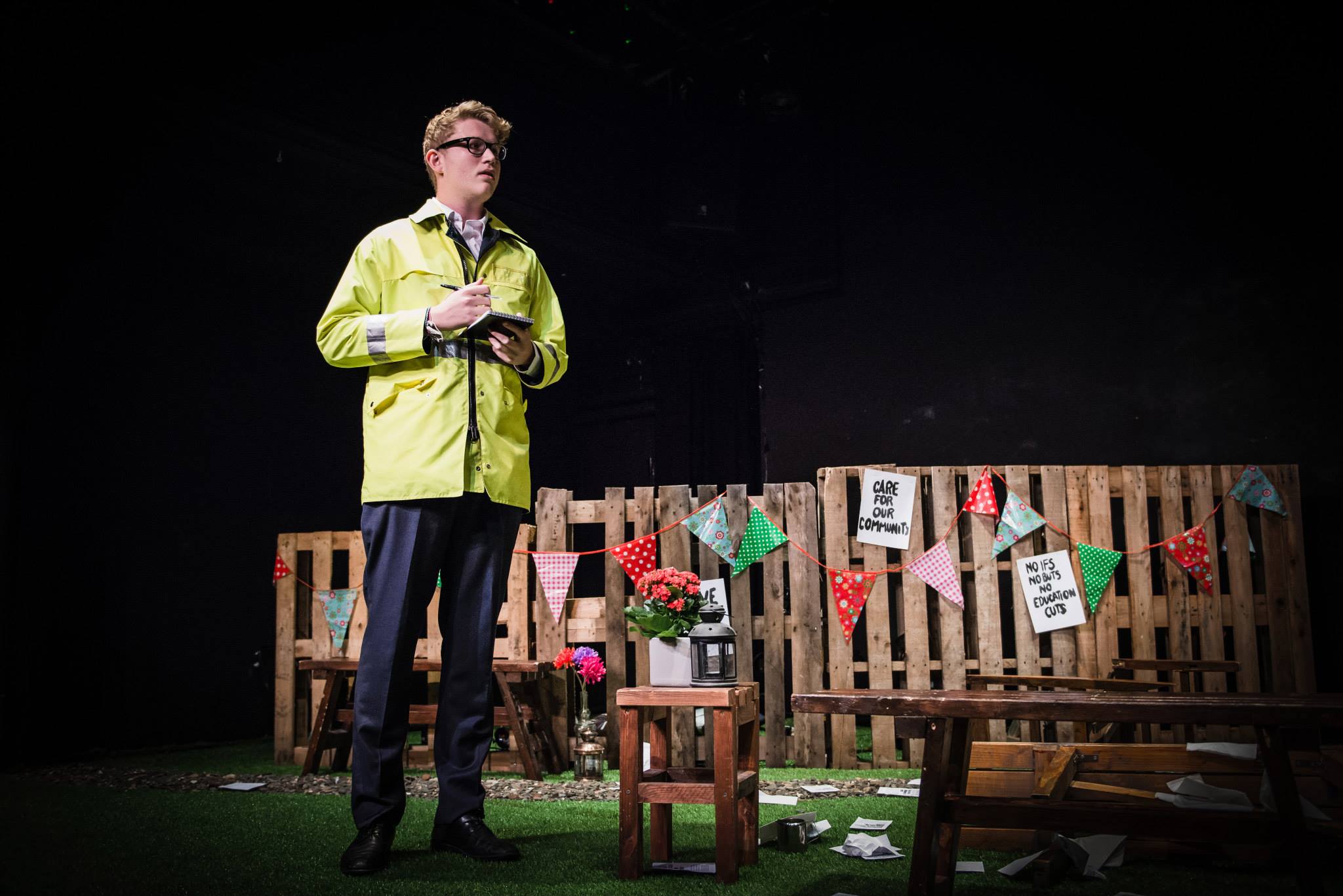
There’s a lot to catch your eye about this brand-new play – but the first thing you’ll notice is its expansive set.  Astro-turfing the whole Bedlam stage, it impeccably evokes the eponymous Oak Tree, a fading outdoor café in an equally fading part of London.  With its rustic fence and crunching gravel, the Oak Tree is both timeless and reassuringly familiar… but a man called Mark Duggan has just died in Tottenham, and in the course of a summer’s night, everything will change.

The Oak Tree is the debut script from young author Ellie Deans, and it’s an impressive start to her writing career.  The story’s revealed through well-paced dialogue, free from clumsy exposition; an occasional tendency to labour plot points is the only notable flaw.  Although it’s a political play, the tone is balanced and genuinely thought-provoking, and the characters are refreshingly nuanced too.

There’s both cleverness and chutzpah in the play’s construction, with a frothily entertaining first half yielding after the interval to a far darker tone.  Early highlights include a set-piece comic misunderstanding – which would stand scrutiny alongside many a TV sitcom – and a gloriously toe-curling business pitch, delivered in fearlessly hammy style by actor Robbie Nicol.  There are subtler motifs too: a touching bond between brother and sister, the burden of untold secrets, and the piquant realisation that the things we love can’t last forever.

But the script loses its way a little when it confronts its motivating theme, the riots of August 2011.  What caused the disorder?  Who should we blame? Is there room for understanding, or must we simply condemn?  The play touches on these important questions, but it doesn’t have time to explore many answers.  Deans is at her strongest when she’s pursuing a simpler agenda: illustrating how that summer’s shocking events tore families and communities apart in the parts of London left to deal with the aftermath on their own.

She’s aided in that task by a strong and confident cast.  Will Fairhead plays lascivious rich kid James with considerable relish, successfully drawing just a hint of likeability from his endlessly crass character.  Ella Rogers has the family matriarch nailed, bringing a gut-wrenching sense of tragedy to one emotional scene, while Casey Enochs puts in a finely-balanced performance as the other-worldly Annie – perhaps the most intriguing of Deans’ creations, and certainly the most saddening.

The Oak Tree undulates through a landscape of moods – from uplands of optimism to bleak valleys of despair – and at times, it’s deeply cynical.  But it’s defined throughout by a gentle, affectionate humour, and by characters complex enough to make you care.  Both playwright and cast deserve considerable credit for this engaging, inventive production.

nae bad_blue

‘Oedipussy’ (Traverse: 9 – 12 Oct ’13)

6

“The poet did not write ‘Agamemnon, Parthenon, Taramasalata’ but in Oedipussy it is intoned as a choric reminder that Greek tragedy developed from the earlier satyr plays whose revels and antics are right up there with Spymonkey’s use of song and physical theatre.”

Editorial Rating: Nae Bad 

Dangle an adapted classic in front of a critic and you invite trouble. So it was fun to hear Spymonkey open Oedipussy with a swipe at a hostile review of their Moby Dick (Edinburgh, February 2010). The boot went onto the other, platformed, foot with wicked intent and not a little of the ensemble playing that would follow.

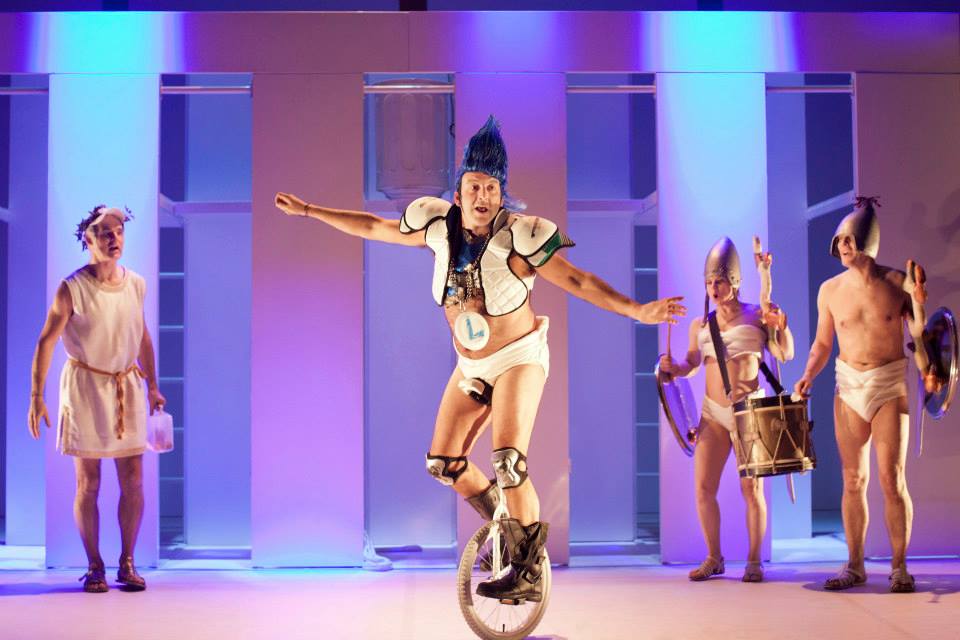
Oedipus has swollen feet, of course, which is not surprising as they are ‘pinned’ here using a cordless drill. Just one of the modern tools – add a unicycle, saxophone(s) and radio mic – that this production uses to ‘build up a dazzling mockery of delight’. The poet did not write ‘Agamemnon, Parthenon, Taramasalata’ but in Oedipussy it is intoned as a choric reminder that Greek tragedy developed from the earlier satyr plays whose revels and antics are right up there with Spymonkey’s use of song and physical theatre. ‘Woman-breasted Fate’ has her naked moment on stage as a wardrobe accident but otherwise the action is more ‘hot, hard, and in your face’ than anything stylised or reflective.

That said, ‘It’s not bloody panto’ either, as Jocasta (Petra Massey) would have the audience realise. The oracle may be hilariously represented by ballooned eyeballs – plus a red nose in a later manifestation – but the episodes are all here, from the infant Oedipus on Mount Kithairon to Jocasta’s suicide.

It is a post-modern piece though, if you allow 007 a mythic quality. Characters deconstruct as the four actors protest – along with Oedipus – that ‘this is the [real] me’: Petra Massey has problems with her feet and cannot have children; Aitor Basauri says he is not fat and tries out as a stand-up comic and Stephan Kreiss (Oedipus), at 51, needs pain relief from wild acting, and longs to go home to a more ordered Germany.

The Chorus (Park) does its job, singly, with a broken column on his head, and it seems is forever twirling in time as his robes wrap and unwrap around the white, ingeniously available set. Park is also Tiresias the blind prophet who has a remarkable turn as ‘a very bad David Bowie’ with outrageous pink cans on his head. Those costumes do stand out. They are colourful and outrageous, much more ‘Barbarella’(1968) than ‘Atlantis’ (2013).

Nevertheless, blood splatters and streams onto the stage and there are drum rolls to accompany the Eels’ ‘It’s a Motherf-’ – and, whilst the poetry is long gone, Oedipussy has its own tragic face. The production finally plays out to ‘Nobody does it better’, which is fair enough.

nae bad_blue

‘Educating Ronnie’ (Traverse: 2 – 5 Oct ’13)


MacRobert Arts Centre

“The money Joe sent would have provided the deposit on a house in a northern industrial town, or in more personal terms an engagement ring.”

Editorial Rating: Nae Bad

It is a touching story. It touched Joe Douglas for near on £19,300. By the end of the show, at the end of their story, Joe calculates exactly what it cost him over ten years to educate a young Ugandan, Ronnie.

It is a true morality tale that begins in 2002 with Joe, an 18 year old out of Stockport, enjoying a six week gap-year trip to Uganda, whose sights and sounds hit him ‘like a pop-up book’. It is not long after returning home that Ronnie ask Joe for help.

We never meet Ronnie but read and hear his emails and txts. They are pretty short, spell out how much money he needs to keep his education going and – later – how much to compensate the family of a fatal road traffic accident; how much to pay the hospital for his dying mother. The emails present on a video screen of a blackboard and then, diminished, pile up into an on-going reminder of Ronnie’s situation. There are beer mugs up there too, a nice calculation in student terms of how many pints can be bought for the £20 regularly sent to Ronnie by Western Union money transfer.

Joe introduces his story with the lights up. He is not a trained actor (the programme notes make clear his credentials as a director) and he would apologise for that. No need really; his one-man performance starts as he talks fondly to the seat reserved for his aunt Maria in the front row, for it is his auntie who looked after him in Uganda, and who interestingly did not take to Ronnie.

The money Joe sent would have provided the deposit on a house in a northern industrial town, or in more personal terms an engagement ring. He does actually take a ring out of his pocket and smiles, remarking that his parents paid for the wedding. And Ronnie? The BBC World Service went looking for him when this story was first staged at the Fringe in 2012. He has a FaceBook page apparently and does not want a copy of the script.

This work, a co-production by Macrobert and Utter, is smooth. Its careful technicals are well-rehearsed, the soundtrack is appropriate without sentimentality, Joe Douglas’s performance is characterful and honest. His story asks you to risk a leap of faith. I’m glad I did.

nae bad_blue

Reviewer: Alan Brown (Seen 2 October)

Visit Educating Ronnie homepage here.

‘Only Wolves and Lions’ (Summerhall; 12, 14-15 Sept ’13)

“From this melting pot, hopefully, will be drawn a social bond that will spark conversation when we finally sit back down to eat.”

Editorial Rating: Nae Bad

Only Lions and Wolves is a collaboration between British artist Leo Kay and his Basque collaborator Unai Lopez de Armentia. Their aim is to bring together a group of total strangers to select, cook and consume a menu of dishes made from an array of raw ingredients brought by us.

The dining table is set for an extended family banquet. Gas camping hobs have been set up  along the hall’s sides. At one end is a table of carbs (rice, flour etc) and condiments such as tinned tomatoes, olive oil et al. At the other end are the cooking pots, utensils and cutlery which we will use to prepare our dishes. A washing line runs behind this table hung with ladles and potato mashers and above it hangs a chandelier of colanders. We sit and, under Kay’s direction, introduce ourselves. The ice is melted with a free form dance warm up as well as bonobo impressions – bonobos and chimps are social creatures too runs the logic.

We team up and are asked to suggest possible dishes within our culinary range and the options available. Then we cook against a clock set for 45 minutes. From this melting pot, hopefully, will be drawn a social bond that will spark conversation when we finally sit back down to eat.

The frame may be hippy-dippy collectivist, but the content of Lions and Wolves feels a lot like the team building exercises, networking events and other assorted workshops strewn throughout corporate life. I am reminded why I’d never want to live in a commune. When Kay and de Armentia start talking Trotsky I regret there isn’t an ice pick on the washing line. It’s a shame that the meal is not billed as vegetarian – for an event aimed at deconstructing social barriers the line between herbivores and carnivores is jarring.

Discussing politics at the dinner table and in mixed company does not come easily. The work is much stronger, pacier too, when outlining broader philosophical lessons from thinkers such as Epicurus and how these might be applied topically to alleviate the symptoms of downturn and recession.

Only Lions and Wolves is a conceptual work in progress. Edinburgh has a well established dining club scene into which this format (if not the current means of execution) could easily fit. An ambitious yet inventive concept, it could hold better selected material, but what tailoring there is, is neat, stylish and bold. When they loosen up, the performers are a lovely bromantic couple in whose company it is a pleasure to spend an evening.

nae bad_blue

Reviewer: Dan Lentell (Seen 12 September)

Visit Only Wolves and Lions homepage here.