RSNO: Sondergard, Jansen: Usher Hall 21 Oct 16

Image result for RSNO

“What struck me …. was the precision, accuracy and vitality of the playing, with rock steady tempi combined with real verve”

Editorial Rating: 5 Stars: Outstanding

Following on the RSNO’s opening gig a fortnight ago featuring the fabulous Nicola Benedetti and the Tchaikovsky Violin Concerto, Friday’s concert fielded another outstanding violinist in the persona of Janine Jansen playing the Sibelius. What is so special about live music is that you don’t know what you are going to get, in terms of interpretation and playing skill, until you hear it. You know it is (usually) going to be good, but how, and in what way? The RSNO, guest conductor Thomas Sondergard and Jansen, are all very fine artists approaching the top of their game, but who perhaps one would not yet categorise as world class. However, I defy anyone to name an artist or orchestra who could have performed better than they did on the night. I have never heard a rendition of the Sibelius Violin Concerto played with more clarity, dazzling technique and sheer artistic conviction, with orchestra and soloist joined at the hip through the sensitive yet controlled baton of Sondegard.

Intriguingly, the orchestra started the evening off with two short pieces by Mahler, Blumine, and What the Wild Flowers Tell Me, arranged by Benjamin Britten from the Third Symphony.

Blumine is a serious, complete piece. A quiet string introduction led to a short horn passage before the bleak solo trumpet established the theme, followed by lush strings that proved we were definitely in Mahler land. Plaintive oboe and mournful horn passages followed before the strings brought the work to an ethereal close.

What the Wild Flowers Tell Me made for a pleasant intermezzo. We were now musically well set up for the main event with our confidence in the orchestra and conductor fully endorsed.

Jean Sibelius was a violinist himself and knew the capabilities of his instrument, which he exploited to the full in his concerto. A violinist in the RSNO to whom I was chatting in the interval, described the first movement as “hard”, the second as “OK” and the third as “really very hard”. All I did was gasp at Janine Jansen’s ability to get concert hall audibility from pianissimo passages, and volume from high register playing and harmonics with little more than an inch or two of metal string to draw it from. The first movement conveyed an eerie dramatic tone that permeates much of Sibelius’s music, and suggested frozen wastes and Nordic mythology. The pianissimo opening with the interplay between the soloist and strings was brilliant and perfectly balanced, and as the movement progressed the theme was passed seamlessly from violin to woodwind and brass and then to a magnificent cadenza. To my satisfaction, the breath taken audience (I suspect a little more cognoscenti than on the opening night) refrained from applause.

In the second movement a rich woodwind opening gradually built up to a grand, panoramic finale. Come the third, the danse macabre, the soaring soloist and supportive orchestra brought the work to a deeply satisfying, enriching conclusion.

Our evening ended with Beethoven’s Seventh Symphony. What struck me about the performance of the work, which often comes across as a bit stodgy and clumsy, was the precision, accuracy and vitality of the playing, with rock steady tempi combined with real verve. A joyous, carefree end to an exceptional evening’s music.

outstanding

StarStarStarStarStar

Reviewer: Charles Stokes (Seen 21 October)

Visit Edinburgh49‘s Usher Hall archive.
The Cheviot, the Stag and the Black, Black Oil (Lyceum: 14 – 24 Sept’16)

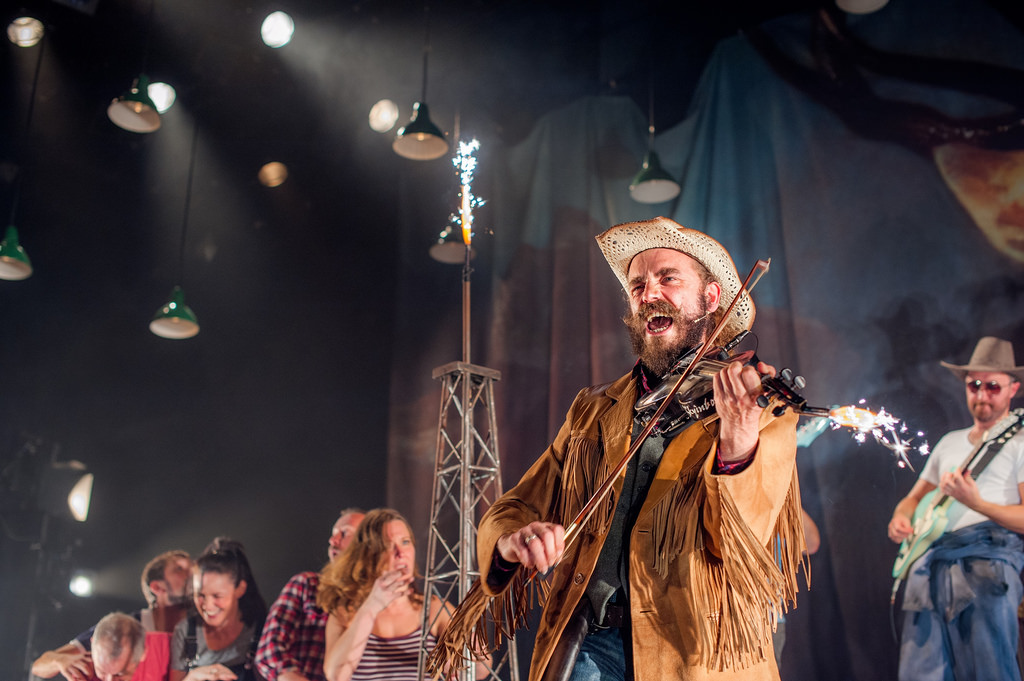
Alasdair Macrae, Musical Director, as Texas Jim . Photo:Tommy Ka-Gen Wan

Alasdair Macrae, Musical Director, as Texas Jim .
Photo:Tommy Ka-Gen Wan

“43 years of agitprop stardom”

Editorial Rating: 4 Stars: Outstanding

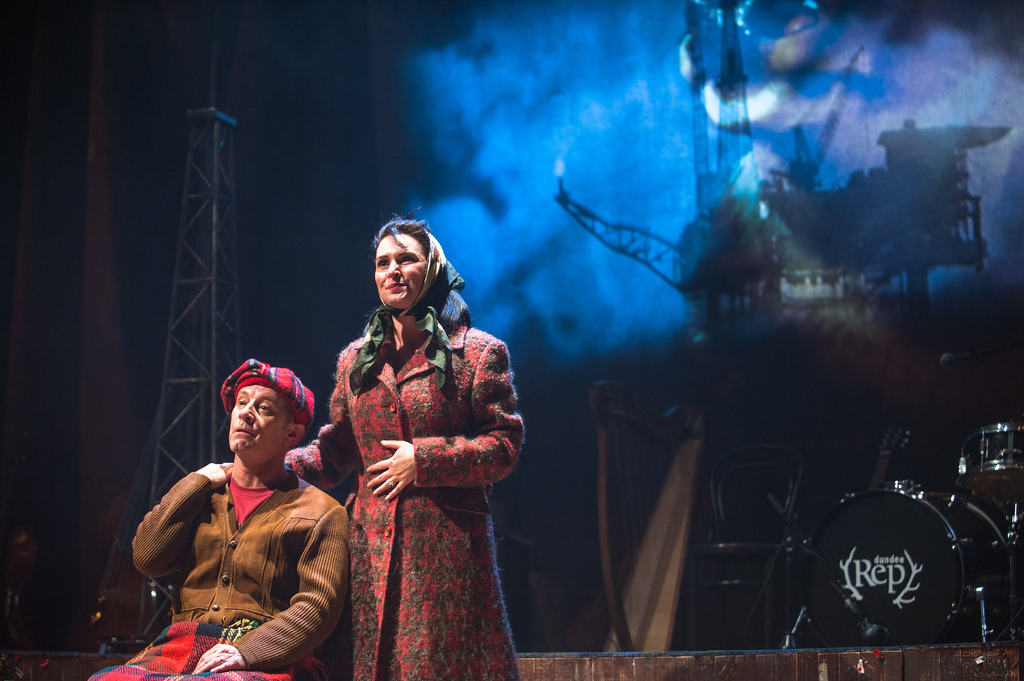
Popular entertainment is a broad church. It is entertaining (& mildly provocative) when the Union flag is raised above Craigmillar Castle, as it has been these past few days, and – to pursue a theme – there’s the BBC’s Scotland and the Battle for Britain to watch and absorb. And now, from 1973 but fresh from Dundee and fit as a fiddle, comes Tom McGrath’s fabled The Cheviot, the Stag, and the Black, Black Oil. From the off you’ll be singing These Are My Mountains and asking yersel, ‘And whose mountains are those, exactly?’

For this is about the land and of its people (& famously of the 7:84 theatre company that brought it across the land to the people). You don’t see the vans but you could just about pack up these actor musicians, their many costumes and their instruments, into two Ford Transits, with room to spare for model crofts, wee sheep, an oil derrick and some fancy digital kit. It’s all highly portable and hugely worth the telling – and the singing and the dancing. The staging, in the Lyceum space, does not lend itself to community theatre but this is still a barnstorming effort.

This is not Land Economy by ceilidh and clàrsach but it’s not far off, which is actually the point, because here’s the old story-on-stage, ingeniously played but plainly told, of the people of Sutherland and Ross-shire being expropriated and displaced by the forces of profit and loss. The sturdy Highlander cannot stand against the combined agency of absent landowner, factor, police and lots of sheep. In fact Porky Highlander (Stephen Bangs) doesn’t stand at all but takes prudent cover behind his women and shoogles off to Canada in a string vest. It’s much the same when it comes to the east coast and Aberdeen with oil, Texaco and Mobil, and company men; and now – to update our scene, as this production cleverly does – there’s the Trump International Golf Links and layoffs on the rigs. And what are the burghers of Edinburgh going to do about that? Hmm, sadly, probably not that much, but we can tap our feet to Texas Jim (Alasdair Macrae), laugh at Jo Freer’s turn as hideous property developer Andy McChuckemup, and wonder what on earth the ghillie (Calum MacDonald) is talking about, because his gaelic is way beyond our ken.

Barry Hunter & Jo Freer.

Barry Hunter & Jo Freer. Photo:Tommy Ka-Gen Wan

Director Joe Douglas plays the script for what it’s worth, which is still not devalued by 43 years of agitprop stardom. The humour is all there, from panto to banter, as is the braying English accent (Emily Winter, all tweed and Golly!) and ‘Land of Hope and Glory’ on kazoo. There is also the nastiness and the pity of it: evictions in the face of defiance and protest; loss and frailty; the dignity of labour forced down and out by ‘owners’ who monetise the works, from creel to North Sea platform. Irene Macdougall’s top hatted Loch is as villainous and intractable as her Announcer’s role is friendly and open.

It is a young Bill Paterson who, in the 1974 TV adaptation of The Cheviot, the Stag, and the Black, Black Oil, introduces the story of ‘What’s been happening here in the Highlands, a story that has a beginning, a middle, but as yet no end’. Well, conceivably, the Scottish Parliament and land reform might wrap it up, or the price of crude could do it, or – Whisht! – a second vote on independence, but for the time being Dundee Rep is bringing it on just fine.

(That Union Jack at Craigmillar Castle? Sony Pictures is filming Outlander there … )


outstanding

StarStarStarStar

Reviewer: Alan Brown (Seen 14 September)

Go to Dundee Rep and  the Lyceum

Visit Edinburgh49‘s The Lyceum  archive.

+3 Review: Ameé Smith – Relax, it’s not about you (Underbelly Med Quad: Aug 3 – 29: 15.00 : 1hr)

https://i0.wp.com/www.underbellyedinburgh.co.uk/images/uploads/15201-Ame_Smith_Relax_Its_Not_About_You.jpg

“Optimistic, off-the-wall and unapologetically human”

Editorial Rating: 4 Stars Outstanding

I try my best not to judge shows before they’re done. But, finding the queue as lonely as a tarantula’s birdcage, I confess to some trepidation as I waited for Ameé Smith’s “Relax, it’s not about you”. Shows with sub-dozen audiences can be tense at the best of times, and given the very personal nature of Smith’s themes, comedy’s need for reactivity and my own creeping paranoia about audience interaction, it seemed a bespoke recipe for awkwardness.

But, for once, it appears the mantra of the 2* performer rings true: the reviewer was dead wrong.

Who exactly “Relax, it’s not about you” is about could make for an excellent piece of theatre analysis – could be Smith’s ex’s, could be Smith herself; and, perhaps overarchingly, it could be about every person watching. Complete with examinations of toxic relationship types, explorations of what makes something TMI and confessions of Smith’s own foibles, “Relax, it’s not about you” is a frenetic, laugh-filled odyssey through the minefield that is interhuman relations.

Whilst it all might sound a bit metaphysical, it’s certainly entertaining. It’s somewhere between hearing stories from a drunk aunt and hanging out with an unlucky-in-love best friend: sometimes rambling ,sometimes short and sharp, and always cringingly self-aware. And whilst the occasional semantic meander leads to a dead-end, Smith seems to be an expert at winding back her own train of thought. And rest assured, despite the heavy premise, it’s a set with its fair share of laughs. You’ll never look at ceramic owls the same way again, and that’s a promise.

For such a blurry and ill-defined subject, it’s impressive how consistent the show feels for its duration. Smith’s nervy, almost fractious energy is a wonderful constant, even when presented with an audience of two. Never before have I seen a performer approach a nearly-empty house with such vigor. In truth, my greatest disappointment with this performance is that I never got to see how Smith would play off a full house. She is (fittingly and obviously) the greatest asset this show has, having cracked the comedian’s riddle of creating an obvious gulf of wit between her and the audience, whilst simultaneously closing it with an almost tactical show of real honesty and vulnerability.

This is perhaps the only time I’ve ever regretted that the jokey offer of a pint after the show was not capitalised upon, so enthralled I was with the sheer openness with which Smith presents herself. Even her dodgy guitar skills, though they open the show on a slightly jerky note, have their significance later. This is feel-good theatre, despite being based on one of the worst parts of romance.

This is a show which deserves far, far more than what I saw it receive. Ameé Smith has crafted a difficult and beautiful thing: a comedy show which thrives on universal truths, yet doesn’t claim to have any answers. And despite a few momentary stumbles, “Relax, it’s not about you” is exactly the kind of show that typifies the Edinburgh Fringe: optimistic, off-the-wall and unapologetically human. Ameé Smith isn’t making a show about you – but that doesn’t mean everyone shouldn’t see it.

outstanding

StarStarStarStar

Reviewer: Jacob Close (Seen 25 August)

Visit the Other archive.

+3 Review: Price (still) Includes Biscuits. (the Space @Surgeons Hall. Until Aug. 27 18:15)

“Paul’s deadpan delivery casts a spell over her audience.”

Editorial Rating: Stars: 4 Outstanding

When Naomi Paul comes out to the soundtrack of Sweet Dreams Are Made of This and plants herself stock still in the centre of the brightly-lit stage, one immediately gets the impression that this show is going to be different. So it proves to be. 

Paul reassures the audience that the price does indeed include biscuits but they come later. It is then straight in with her observations on living in modern Britain. Paul uses her home city of Birmingham to illustrate the ridiculousness of current government policy and the effects of prolonged spending cuts. Slowly her body starts to move and her stance becomes more natural as Paul starts her first piece of audience interaction. On a small side table, she displays her latest certificate: Radicalisation General Awareness Training. Do you need to take the test? Are you aware of the signs? Perhaps you are a radical already and need to be reported?

Moving on from modern multicultural Britain, Paul then reflects upon her own Jewish and Eastern European roots. Through the media of spoken word, song and a coat, Paul tells how her America-bound ancestors to ended up in the Welsh valleys. The story moves from the ancestral selling of haberdashery to the fitting of industrially-constructed bras. The best laid plans of her mother, attempting to preserve the virtue of the teenage Paul, didn’t exactly go as expected.

Through further songs and stories of poverty and the workhouse, we return to the present with a treatise upon the dangers of Thinking. Especially dangerous is being careless with the incriminating evidence of Thinking. Rubbish bags and computers should be treated with caution, as should the practice of speaking with strangers. With that due warning, it’s time for the audience Biscuit Break.

From biscuits and budding (if potentially subversive) audience relationships, Paul continues with the subject of modern social contact. For some, the most meaningful conversations are with the call-centre operator or a visiting Jehovah Witness. This sweeps into the area of mixed marriages, diversity and religion. Where is the best place to be Jewish at Christmas?

Price (still) Includes Biscuits goes beyond the normal boundaries of observation comedy and satire. Over the course of the hour, Paul’s deadpan delivery casts a spell over her audience, leading to an outcome which is different from any other show on the Fringe. Maybe she hasn’t got the best singing voice  but the show is funny, it works and, what’s more, it gets one thinking.

Thinking. Dangerous business that nowadays.

outstanding

StarStarStarStar

Reviewer: Martin Veart (Seen 25 Aug)

Visit the Assembly Roxy Bedlam Church Hill Theatre Festival Theatre King’s Theatre Other Pleasance, Potterrow & Teviot Summerhall The Lyceum The Stand Traverse archive.

THIS REVIEW HAS NOT BEEN SUBEDITED

+3 Review: The Master & Margarita (Zoo at St.Cuthbert’s: until 29th Aug (not 19-20, 25th) Aug: 22.00: 1hr 30mins)

“A Hell of a show”

Editorial Rating: 4 Stars: Outstanding

It was with a certain amount of trepidation when I met The Sleepless Theatre Company on the Royal Mile and discussed with the crew their production of The Master and Margarita. How on earth are they going to do it?, I thought.

Action opens with the procurator of Judea, Pontius Pilate, in court session over an apparently worthless vagrant, Yeshua Ha Nostri. The procurator is ill and it would be so simple to dismiss this tramp with two words: “Hang him.” Nineteen hundred years later, it is a hot May night in Moscow and the committee members of the exclusive Communist Party writers’ guild, are sweltering in a small meeting room, waiting for the Chair, Mikhail Berlioz, to arrive. He is late. None of them can know that dark powers have already entered the city.

For Russians, The Master and Margarita by Mikhail Bulgakov is the Soviet Union’s most famous novel. It is a wide-ranging satirical fantasy and the changes in location (across Moscow and Jerusalem), space and time are a daunting challenge for any adaptation. In this interpretation Sleepless Theatre does well at capturing those changes, using the magnificent setting of the St.Cuthbert’s Church to great effect. Like the cast, the audience too are expected to be mobile, following the action around the hall and even being participants if the scene demands. I found the flight of Margarita (Iona Purvis) over the rooftops of Moscow particularly effective: Purvis is obviously dance-trained and her graceful physical acting really added to the dreamlike quality. Against my expectations, the company’s low-tech approach often overcomes the staging challenges inherent in the novel and they should be highly commended for this.

The central relationship between Margarita and The Master (Jonny Wiles) is wonderful: both actors touchingly portraying the sacrifices each make for the other in the cause of their mutual love and Woland (James Blake-Butler) is suitably all-powerful and sinister. Gwenno Jones captures the tortured soul of Frieda perfectly; though as Yeshua, to me, Jones fails to show the calm and almost playful wit possessed by the character, even in the face of death. Coupled with Pilate (Georgia Figgis) lacking a real menacing streak, the opening scene rings slightly less true than the others, which are on the whole excellently delivered.

Narration is a large part of this production, with actors taking this in turn, and in the first scene I did have some concerns about the delivery (and, indeed the existence of) some crucial lines. During the interrogation Pilate lays too much emphasis on a certain word than is appropriate and leads the witness. The script sees the narrator point this out, rather than it being obvious from the acting, and it is a shame that writer Alexander Hartley keeps to narration here, rather than letting the acting speak for itself. Apart from this minor blip, the rest of the narration remains faithful to the book, and dedication to original text should otherwise be praised.

The Master & Margarita is a massive challenge for any company to take on, and for the most part Sleepless Theatre Company do a really good job: the central themes of the book come shining through. If you know the book, see Master & Margarita for the joy of seeing it live. If you have never read the book, go see. You are in for one hell of a show.

outstanding

StarStarStarStar

Reviewer: Martin Veart (Seen 16th August)

THIS REVIEW HAS NOT BEEN SUBEDITED

+3 Review: The Accidentals – Tone Down For What (theSpace@ Symposium Hall: Aug 17-20, 22-27 : 18.20 : 50 mins)

” A nonstop vocal joyride”

Editorial Rating: 4 Stars Outstanding

Returning to a group you have vastly enjoyed at the Fringe previously is like releasing a paper airplane into a storm: there’s not much you can do but hope – and as I sat in the audience for the next instalment in The Accidentals’ success story, I could definitely hear the wind whispering at the stage door. For me, this Fringe has certainly raised the quality bar in terms of performances I’ve seen, and my worst nightmare was that my favourite a capella choir just wouldn’t be able to stand up to the wonder. My only advice to other prospective audience members would be this: fear not. The Accidentals aren’t just coasting on the wind, they’re soaring.

Running the variety gauntlet once again from traditional Scottish tunes to lip-battering beatbox performances, The Accidentals are a joy to watch from the moment they enter the stage. The sheer variety of voices they represent is staggering: expect the tooth-rattlingly low and the glass-breakingly high, all wrapped up in a nonstop vocal joyride.

Tone Down For What is not just a show of the same quality that audiences have come to expect from these returning Fringe champions: this year’s edition comes with bells and whistles, including the first successful audience participation exercise in a musical show which didn’t sound like a slowly deflating, middle class balloon. As someone who prefers to sit silently in the back like a rock with great taste in theatre, I’m deeply skeptical of audience participation at the best of times: but I’ll be damned if this wasn’t the only time I’ve been happy to be part of one of those wild experiments in awkward enthusiasm.

The evolution of The Accidentals this year seem to run deeper than superficiality: things have taken a wickedly feminist turn, and tonally, it couldn’t have been done better. It’s hard to address the inequality of perceived competency between male and female singing groups, especially without dragging what would otherwise be a lighthearted show into preachy seriousness, but The Accidentals pull it off flawlessly – it’s cheeky, it’s defiant and unapologetically mocking.

Of course, the preceding points would be moot without the vocals to back them up, and this show doesn’t disappoint. A personal shout-out goes to Ruth Kroch, whose rapping sans mic was both impressive and powerful, despite the looming possibility of being drowned out by the note-perfect vocals of her peers; and also to Steph Boyle – hearing the sheer brute force of the voice coming out of such a small woman is like watching a pea-shooter fire ICBMs. But I cannot stress enough that each and every performer in this group is one to watch. Tone Down for What is an ensemble piece in its purest and most brilliant form, even down to the tongue in cheek comedy. If you’re looking to get blown away by the power of the female voice, this would be the place to do it.

A few quite noticeable tech fumbles notwithstanding, I couldn’t see a misstep on stage. For an opening night, that’s really impressive. The only real criticism I could find with the show is that it reminded me how bitter I am about the fact their version of “Who Did That To You” isn’t available on Spotify.


outstanding

StarStarStarStar

Reviewer: Jacob Close (Seen 15 August)

Visit the  Other  archive.

THIS REVIEW HAS NOT BEEN SUBEDITED

+3 Review: Moscow Boys (Zoo Southside: 5-29 Aug: 20.35: 1hr 10mins)

“Funny, impressive and unlike anything I’ve ever seen before”

Editorial Rating: 4 Stars: Outstanding

My early front-runner for most bonkers show of the year is this one: an all-male tap-dancing string quartet from Russia with a penchant for wearing funky hats. Oh, and that’s before they change into rollerblades and charge around the stage while still playing their instruments. You have to see it to believe it.

I’m no classical music aficionado (though I did have a rather painful year learning to play the violin at the age of 7), but to me the musicianship was spot on. I paid very close attention to check whether the boys were actually playing the instruments (just to be sure), and can confirm that yes, it’s all live, and all note-perfect.

This is far from being your average string quartet concert: right from the off it is set up as a comedy piece too, as the boys begin to play around as soon as their maestro has left the stage. It starts small – standing up, sitting, down and swapping seats – but before you know it they’ve burst into a full-blown tap routine (while still playing), without any effect on the quality of the sound. And that’s just the beginning of the madness.

Musically we get everything from Tchaikovsky to Timberlake, and on the whole it just flows seamlessly together as if originally written that way. There’s not a sheet of music or music stand in sight, so extra kudos to the quartet for merging so many pieces of music together and learning it all so well they can perform it while dancing – this really is impressive stuff.

This is very close to being a five star show, it is just a little disappointing that the troupe seem to pull out all of their best tricks in the first half of the performance, so the second half is spent wondering what will happen next, given that most of their cards are already on the table. Later on they also rely on recorded sound to support their playing, when the wow-factor in the first half comes from just the four performers and their instruments.

It’s funny, impressive and unlike anything I’ve ever seen before. I would definitely recommend it for those looking for something a little different this Fringe.

outstanding

StarStarStarStar

Reviewer: Steve Griffin (Seen 14 August)

THIS REVIEW HAS NOT BEEN SUBEDITED

+3 Review: Mark Watson – I’m Not Here (Pleasance, Aug 16-21, 23-28 : 21.00 : 1hr)

https://i0.wp.com/www.edfestmag.com/wp-content/uploads/2016/08/MARKWATSON_GJPR_IMAGE-400x250.jpg

“The definition of five-star comedy”

Editorial Rating: 5 Stars: Outstanding

What is there left to say about Mark Watson? Returning to the Edinburgh Fringe once again, this comedy veteran is ready to prove he’s still got plenty of comedy muscle to flex, even if his ego hasn’t quite caught up with his skill yet.

Lit by the neon glow of his own initials, “I’m Not Here” is a journey through identity, celebrity and self-deprecation, all presented in Watson’s fantastic Bristolian twang. The best part of this performance (well, perhaps apart from the jokes) is the sheer amount of tangents Watson manages to swing down during the course of a single anecdote. He’s the comedy equivalent of a rambling great-uncle, but in the best way possible. Two stories stretched out across an hour, but it was never dragged: various twists of wit far too delicious to spoil what may have been a run-of-the-mill comedy show into an utter experience for all in the room.

And at the centre of it lies Watson himself: a man for whom fame has not come easily nor, often, recognisably. Anecdotes about famous comedian friends abound, but Watson never comes across as bitter. The type of comedy he champions is a razor-walk, but there’s never so much as a faltering step: the energy and emotional charge of his jokes work with almost Olympic precision and speed. Despite his considerable success and talent, Watson has managed to remain the ever-scrappy underdog, bruised by outside forces but never quite blown away – a refreshing contrast to the many Carrs and McIntyres in the comedy industry. The self-deprecating English comedian is a trope by now, but Watson proves he is still the undisputed master of comedic self hatred.

And, of course, this is all wrapped up in fantastic gags. The sheer density of jokes is mind-boggling, especially when none of them feel rushed or wanting for space. Watson is clearly in his element on stage, and his special brand of nervously energetic comedy is just as strong as ever. It’s always a good sign when the man sat beside you must wipe tears of joy from a face which, until Watson came on stage, was akin to a bulldog licking bleach off a thistle.

“I’m Not Here” is one of the biggest comedy events at the Fringe, and it’s well earned. Mark Watson shows once again why he’s arguably the defining personality for his flavour of comedy, without missing a damned step. This is the definition of five-star comedy.


outstanding

StarStarStarStarStar

Reviewer: Jacob Close (Seen 13 Aug)

Visit the  Pleasance, Potterrow & Teviot archive.

THIS REVIEW HAS NOT BEEN SUBEDITED

+3 Review: Rory O’Keeffe – Monoglot (Pleasance, Aug 16-29 : 16.45 : 1 hr)

https://laughoutlondon.files.wordpress.com/2016/08/rory-okeeffe.jpg?w=750

 “Monoglot? Perhaps. Monotonous? Certainly not.”

Editorial Rating: 4 Stars Outstanding

Most comedy shows I attend sober don’t begin with a five minute monologue by the empty mic. But then again, Rory O’Keeffe is anything but conventional. Through a tightly packed hour, he mimes, gurns and grins his way through a wonderfully punny routine based on the vagaries of language.

O’Keeffe himself looks like he should be a comedian. His boyish charms and the energy of his movements reinforce his sheer youth, but the confidence and the jokes are of a far higher calibre than one might expect for such a young man. Each ridiculously cartoonish movement was comedically precise and utterly free of inhibition, which cannot be said for many of his compatriots. If nothing else, this show would get a star alone for the sheer fearlessness with which O’Keeffe seeks to make a happy fool of himself. Despite his considerable vocabulary, it appears “inhibition” is one he hasn’t learnt yet.

But, luckily for all of us, his jokes definitely keep up with his own frenetic pace. Make no mistake: this is a downright clever show. As someone who loathes seeing a punchline coming, I might as well have been blindfolded in the dark. From the broad launching point of “language”, O’Keeffe manages to wring out a surprising variety of jokes – and, when I attended, flexed some serious improv muscle when it came to hecklers. Some of the best gags of the show were created on the spot, and it’s a real hallmark of quality on O’Keeffe’s considerable wit.

However, sometimes even the most runaway wit must be reined. A very distinct section which rounded off the show, whilst extremely impressive, wended a little too long, as often did a few of the foreign language jokes. That is not to say that O’Keeffe doesn’t manage to make unknown tongues funny, and far from it – but despite his skill (at least, for a self-professed monoglot) it’s always trumped by his own inventive observations about our shared mother tongue.

As far as hidden gems go, Rory O’Keeffe is a comedy diamond. Tucked away behind labyrinthine Pleasance as he is, he’s worth more than price of admission and job of seeking him out. Monoglot? Perhaps. Monotonous? Certainly not.


outstanding

StarStarStarStar

Reviewer: Jacob Close (Seen 14 Aug)

Visit the Pleasance, Potterrow & Teviot archive.

THIS REVIEW HAS NOT BEEN SUBEDITED

+3 Review: Gobsmacked! (Underbelly George Square,

“These guys should be selling out arenas…the best show I’ve ever seen in Edinburgh.”

Editorial Rating: 5 Stars:  Outstanding

With their own set and taking the stage in individual black and white outfits to reflect their own personalities, Gobsmacked! look every inch the “cool” a capella group, and their opening number – an energetic rendition of Queen’s Don’t Stop Me Now – shows just how much they mean business.

The group’s arrangements – all by former Sons of Pitches star Jack Blume – are quite poppy by nature, allowing each member of the group to have their moment as lead vocalist, with plenty of supporting lines and balance, despite there being just seven members. Throughout the show there are blends and mash-ups aplenty, especially the closing medley, which somehow managed to link over 20 pop songs into one cohesive number, and every arrangement is just as rousing and unique as the last. This is a show that just has quality at every level.

Many a capella choirs these days claim to have slick choreography to accompany their singing, but few I’ve seen have come close to this group’s overall visual presentation with movement, drama and tableau so effortlessly working alongside their singing. In particular, the mash-up between Gnarls Barkley’s Crazy with Adele’s Rolling in the Deep depicts a relationship break-down, jealousy and attempts to move on in a perfect combination between flawless singing and creative staging.

It’s almost impossible for me to pick any standout moments, as the show is all so polished in wow-factor, but award-winning beatboxer Ball-Zee’s solo section midway through the performance left me genuinely gobsmacked for about ten minutes, and in a sea of up tempo numbers I can’t not mention the beautifully stripped back rendition of I Will Wait. If, midway through the show, I was worried that Gobsmacked! might be leaning a bit too much towards the pop-dance genre, this song went a long way to demonstrating the variety and depth of music that this group can more than capably deliver.

I suppose I should attempt to highlight areas of the performance that didn’t work as well, but the only very slight blemishes I noticed were that a couple of the performers seemed a little less flamboyant and stage-aware than their choir-mates (though we can’t all be divas), and it was a shame that some live vocal looping was used in a couple of the songs (though only the really keen observer would notice this). Otherwise, for me this show is as close to perfection as you can get.

After this performance Gobsmacked! are now my absolute favourite a capella group in town – these guys should be selling out arenas. I honestly think this is the best show I’ve ever seen in Edinburgh.

outstanding

StarStarStarStarStar

Reviewer: Steve Griffin (Seen 14 August)

THIS REVIEW HAS NOT BEEN SUBEDITED