‘Goblin’s Story’ (The Vault: 19-24 Nov ’13)

shoot3

“In a play which offers so much juicy character work it is an astonishing feat of theatrical good manners that no one attempts to hog the green tinted limelight.”

Editorial Rating: Outstanding

The programme handed to us as we entered The Vault on Merchant Street is printed on lavender paper. “It’s like the Lavender List.” I’m impressed. I didn’t think the Current Mrs Dan had listened to a word I’d said after I’d finished Sandbrook’s multi-volume history of the 70’s. And yet she could recall all the murky, paranoia of Downing Street as Harold Wilson left it. She had even remembered that the dodgy dossier of resignation honours awarded to Wilson’s cronies had (allegedly) been printed on lavender-coloured stationery. “Of course I remember about the Lavender List” she went on, “You were in [Michael Frayn’s] Democracy with Ted Short’s son.” So I was. Wilson’s mind in the final hours of his political life must have been very like The Vault was as we entered. Spooky. Subterranean. Cavernous. A swaying symphony of forest greens to the fore, a fearsome projected illumination of goblinity at the back. A fantasy landscape where even the trees have agendas of their own. Wilson would have been right at home.

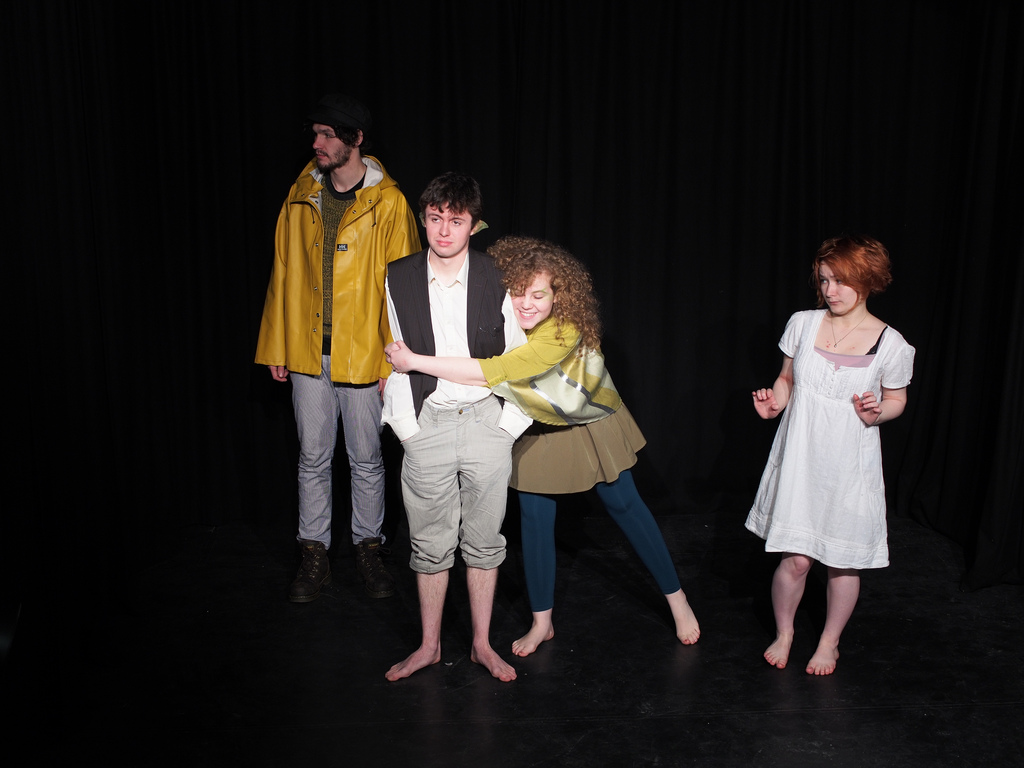
Goblin’s Story is a tapestry of threads drawn from nineteenth century poetry. It is centred on Christina Rossetti’s Goblin Market. The central characters are ‘the baddies’ of familiar, and not so familiar, period pieces. A goblin, named Goblin, possessed of a gentler soul than other goblins, is sat on a tree stump. He’s disengagedly reading a newspaper while his attention is sought by the insistent Jabberwocky. Shrek-like, Goblin just wants to be left alone. When the Ancient Mariner appears spouting his mad rhymes Goblin’s peace is well and truly shattered. All that is left is for Cutty Sark, a witch from Tam o’Shanter, to put in an appearance.

Laura Witz’s direction has turned comic timing into an extreme sport. A fraction of difference either way and oblivion beckons. She builds the tension slowly but steadily, drawing out the first nervous giggles into sustained tittering and then total sympathy. Goblin Story is her script and she knows just what to do with it. Witz is fortunate to have at her disposal a formidable ensemble. In addition to the four main characters there is a goblin posse of five and a pose of as many trees. But the stage never appears crowded. The blocking is interstellar.

The living forest is represented by girls in black holding branches of bay, which charge the atmosphere with perfume and rustle. They are supernumerary superheros. Poised and perfectly mannered, their gestures enhance the play’s depth and subtlety like a bay leaf in a stew.

The goblins, expertly led by Rory Kelly (the Robbie Coltrane of our time), are sinister and sophisticated in their movements. They are living out Rossetti’s narrative poem with savage delight. The noble Jabberwocky (Grace Knight) attempts to organise her companions so as to disrupt the goblins’ dastardly designs.

Knight is bubbly and engaging. An essential contrast to the moody, broody Goblin (James Beagon). Beagon is the pace setter for the piece with a deal of heavy dramatic lifting to do. Although he hardly seems to breaks a sweat, his concentration is total. In a play which offers so much juicy character work it is an astonishing feat of theatrical good manners that no one attempts to hog the green tinted limelight. The cast’s capacity to be off stage while on it, to blend into the background when needed, is best demonstrated by Thomas Edward whose tall frame towers over the rest of the company. Edward could so easily have hammed up his comic non-sequiturs, taken from Coleridge’s The Rime of the Ancient Mariner, playing soft balls to an increasingly generous audience. Instead he is an adornment to the play and it in turn is an adornment to him. Izzy Hourihane, as Cutty Sark, completes the ensemble. It’s a wonder that such a big voice can be housed in so small a figure. Hourihane does smart and sassy rather like a Michelin starred restaurant does fish and chips, a superb interpretation of familiar themes. This company should be held together by royal decree – I genuinely believe that they can achieve anything together, especially when presented with a script as dashingly bold as is Goblin’s Story.

This production achieves so much in so small an amount of time and in such an imposingly characterful venue. The idiosyncratic costumes bring each individual into a collective harmony. The lighting and the makeup add highlights and flare in all the right places. The trees, who might so easily have become the director’s peculiar fetish, add a living lustre offset by the ghastly goblins. Upon such foundations the cast assemble a brilliant entertainment. A literary and literate script given a lively and lucid shine by a company of accomplished artists.

You might think bringing so many branches of bay leaves on stage was a tad presumptuous but this production cannot be garlanded with sufficient laurels.

outstanding

Reviewer: Dan Lentell (Seen 19 November)

Visit Goblin’s Story homepage here.

‘The Edinburgh Book Lovers’ Tour’ (Writers’ Museum)

20131117-101621.jpg

“For the visitor this must surely be the best tour available. For the resident, The Edinburgh Book Lovers’ Tour is a masterclass in presenting our city to visitors.”

Editorial Rating: Outstanding

“Don’t expect a crowd.” As I pick my way towards the Writer’s Museum I can’t help wondering if Allan Foster hasn’t rather overdone things in the modesty department. En route to the rendezvous I pass assorted aldermen, literary luminaries and even the odd Duke (it’s a truism of getting older that policemen and Dukes all start looking younger). But it turns out that the gathered host aren’t in Lady Stair’s Close to join The Edinburgh Book Lovers’ Tour.

My host explains that a memorial is being unveiled to Gavin Douglas (1474-1522) (no?..me neither) the priest, poet and statesman who translated the Aeneid into Middle Scots. Presumably paint dried faster at the turn of the 16th century, thus offering less spectacle, so this is how they spent their time. Douglas is the 37th writer to be commemorated with an inscribed flagstone – handy for that direct form of criticism alluded to in Byron’s lament for Castlereagh. I will not find anything good to say about the flagstone commemorations until the organisers cease to shun McGonagall.

I have an awful lot good to say about Foster’s approach to guiding, starting with the way he rides out the noisy intrusion into his routine by the horde of newly fledged Douglas groupies. The weather is on our side but even so Foster’s laconic embrace acts like an umbrella on our small party, shielding we few from the outside elements. It’s an odd thing taking a walking tour through one’s own regular haunts – unsettling almost. That is until you remember how much fun you will have over the coming months lecturing anyone fortunate enough to be in company with you on the Southside’s glorious (and not so glorious) literary heritage. Foster is not short of an opinion or three but he is better than most (present author included) at separating his commentary from reportage.

Our route takes us from the Writer’s Museum, across the Royal Mile to Parliament Square, down Barrie’s Close, along the Cowgate to the Old Infirmary, up Drummond Street through the Potterrow Port and via George Square, before concluding beside Greyfriars.

Along the way we are treated to a grand narrative, illustrated with dozens of facts trivial and otherwise. My two companions are a journalist and English professor from daaahn sauff and Newfoundland respectively. I enjoy chatting to them as we pass from point to point. This is not such familiar geography for them but then they have sailed to Treasure Island, peered under morgue sheets with Rebus, played Quidditch with Potter and gazed upon the gently rolling eyes induced by Scott’s best romantic vistas.

This rain-soaked ground we Edinbuggers bustle about on is holy. It slowly dawns on me how much we are taking for granted. It’s not just the sack of Robert Louis Stevenson’s beloved Rutherford’s Bar by pirates of the Caribbean. Nor how little bronze or marble denotes the untended springs of creativity sacred to Clio, Calliope, Melpomene and their sisters. It’s the sinking feeling that we are not much better than the historically illiterate residents of Worcester who met messrs Adams and Jefferson with such bemused incomprehension and contempt.

Scott was derided in his own life for writing popular trash unworthy of a gentleman of letters. Despite huge sales and an even larger intellectual impact (especially, much to the regret of Mark Twain, in the American South) the true identity of “The Author of Waverley” was kept an open secret in case it sullied Scott’s true reputation as a provincial lawyer. Foster does not avoid questions of taste when discussing Edinburgh’s literary present but does identify them as secondary and somewhat unbecoming. Foster is not crippled by paroxysms of grief, as is one former literary editor of the North Britischer newspaper of my acquaintance, when he thinks on the work McCall Smith, Rowling and Ranking COULD be writing – what matters is that they ARE writing (and, incidentally, are being read by millions).

For the visitor this must surely be the best tour available. For the resident, The Edinburgh Book Lovers’ Tour is a masterclass in presenting our city to visitors. Unlike the former literary editor and his discredited vintage of print pundits there is nothing in Foster cringing or apologetic. The plaque to Rowling just above eye level across from Old College is treated with as much deference as are those to Stevenson or McGonagall across the way. Knowledgeable and in the know, he must navigate the tour by all the names he drops, Foster is informed and informative. Lyrically laconic but also hugely welcoming. A civic ambassador extraordinaire.

When my own father awakes from his notion that Auld Reekie, Brigadoon-like, disappears into the September mist at the end of each successive Fringe I shall be paying to take him on this tour.

outstanding

Reviewer: Dan Lentell (Seen 15 November)

Visit The Edinburgh Book Lovers’ Tour homepage here.

‘Dragon’ (Traverse: 30 Oct – 2 Nov ’13)

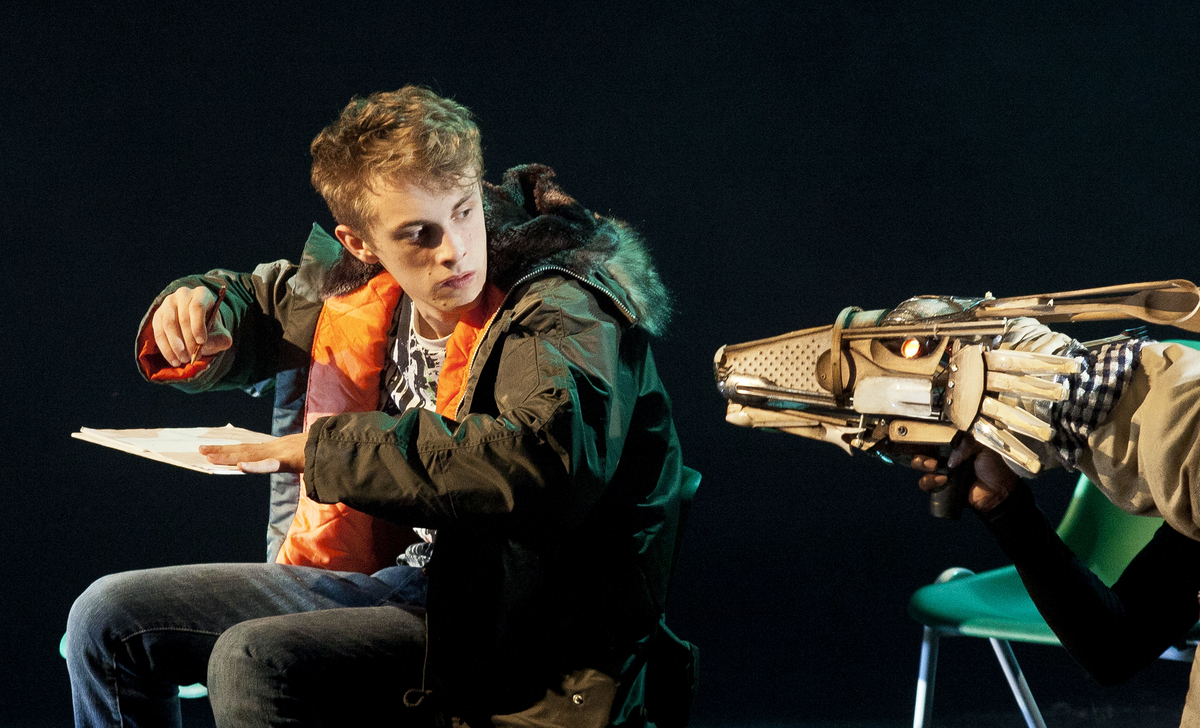
Dragon prod pic 4 Drew Farrell

Image by Drew Farrell

“And there are dragons!  Dragons everywhere.  Not the gold-hoarding recluses of British folklore, but the sensuous, bewitching creatures of the Orient”

Editorial Rating: Outstanding

A play for older children and big-hearted grown-ups, Dragon is filled with beauty from its very first scene.  A comforting kind of magic flows from its enchanting, nostalgic backdrop: searchlights pick out a city’s rooftops, while ghostly clouds hang in the moonlit sky.  But this isn’t a Disney fairytale. Within seconds of the opening, we’re thrust into a hospital ward – and there we witness a young teenager, Tommy, bidding his dying mother goodbye.

A host of motifs come together in this stylish, inventive performance.  Black-clad actors prowl the stage, wielding props which make up a dynamic and ever-changing set.  At its best, the choreography is breathtaking; look out for the scenes at Tommy’s school, where he sits still in the centre of the stage and classroom after classroom appears around him.  There’s plenty of humour, and there are elements of stage magic worked in too – props and even actors appear as if from nowhere, thanks to clever misdirection or ingenious tricks of the light.

And there are dragons!  Dragons everywhere.  Not the gold-hoarding recluses of British folklore, but the sensuous, bewitching creatures of the Orient, evoked here through a smattering of technical wizardry and a wealth of compelling puppetry.  As the story rolls on, you’ll come to recognise what Tommy’s dragon represents, and you’ll notice it growing and changing over the course of the play.  Sometimes it’s sinister, sometimes it’s as cute as a puppy, but towards the end it’s a monster… a terror to be fled, or faced down.

As befits a family-friendly show, Dragon’s plot is straightforward, and the emotions it plays on are big and simple ones.  Unaccompanied grown-ups might wish it were a little more nuanced, but if you’ve taken the kids you’ll find plenty of important themes to talk through later.  Tommy’s story encompasses loss, grief, anger and acceptance; along the way he discovers the importance of connecting with others, and learns that inner dragons always seem less scary when you bring yourself to face them head-on.

There’s very little spoken dialogue – which, incidentally, makes Dragon eminently accessible for people who are Deaf or hard of hearing – but the visual delight is accompanied by an atmospheric soundscape, lending tempo and portent to the action on stage.  Being picky, the lighting wasn’t executed quite as flawlessly as the rest of the production, and the slow-mo fight sequences felt hackneyed at times.  But the ending has a beguiling simplicity which complements that gorgeous opening, and there’s wonderment and poignancy in all that comes in between.  A must-see show for children aged 9 and up, and for adults who remember how to play.

outstanding

Reviewer: Richard Stamp (Seen 30 October)