♫ ‘A French Feast’, RSNO (Usher Hall, 6 Feb.’15)

A French Feast

“Müller-Schott’s cello lines sing”

Editorial Rating: 4 Stars Outstanding

A ‘French Feast’ of music with the Royal Scottish National Orchestra

Tall, dark-haired, handsome, talented, humble, charming – yet I still cannot begrudge him anything. Daniel Müller-Schott was the immensely capable German solo cellist taking part in tonight’s performance of a ‘French Feast’ of music with the Royal Scottish National Orchestra. In a talk in the bar of the Usher Hall with RSNO violinist Ursula Heidecker Allen prior to the concert, Müller-Schott described his musical ability as being “his mother’s fault”, she being an accomplished harpsichord player who always had the house full of music and musicians when he was growing up. He had many anecdotes, including the time his friend Philipp Lahm, former captain of the German football team, came to his house. Lahm had a go on Müller-Schott’s cello but professed that he might find it easier if he could play it with his feet!

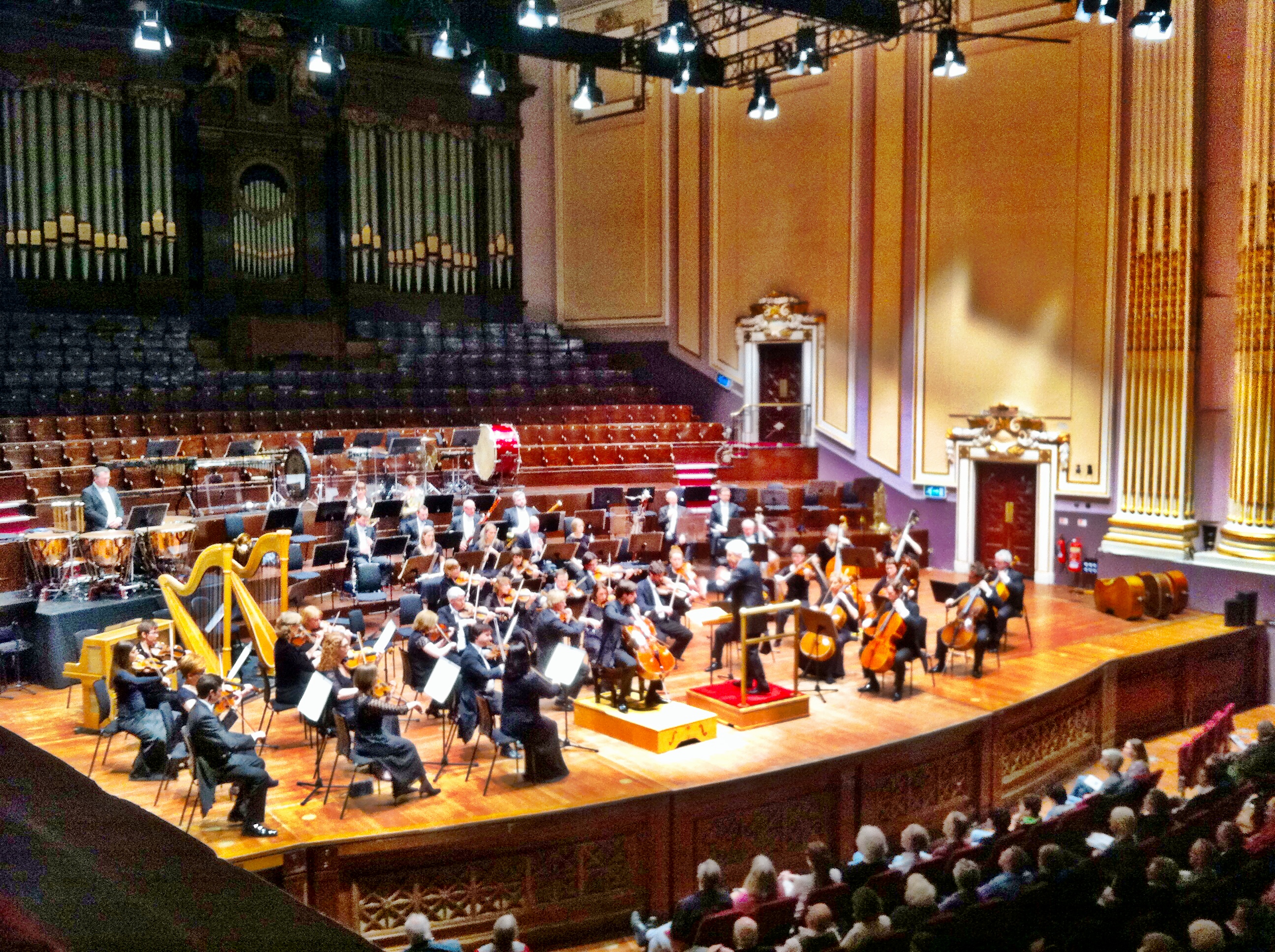
This concert, of largely Romantic music, kicked off without the cellist. César Franck’s Les Éolides is a symphonic poem based on a poem of the same name and was composed during the latter part of his life when, as professor of organ music at the Paris Conservatoire, he was at his happiest and his work was more refined. The beginning of this piece has a lot of exposed entries by different orchestral groups and unfortunately one of the brass entries slightly misfired, but it was largely unnoticed by the audience. The silver-haired Gilbert Varga, conducting, has a very elegant baton style and strikes a debonair pose on the podium. He conducted without a score and, despite being a guest conductor, connected really well with the orchestra, conveying subtleties within the subdued dynamics which really evoked the ebb and flow of the wind subject of the original poem.

Müller-Schott  joined the orchestra for Camille Saint-Saëns’ Cello Concerto No.1 in A-minor. I liked the programme. French-born Saint-Saëns wrote the piece for Belgian cellist Tolbecque; Franck, whose music came before, became a citizen of France but was originally Belgian. Ok, maybe I’m just being a bit of a sad europhile, but it tickled me. What anybody could appreciate, however, was the quality of the performance. This is a gem of a piece of music anyway; regarded by Rachmaninoff, no less, as the best cello concerto ever written. But Müller-Schott’s cello lines sing, achieving a remarkably consistent tone from the lowest open strings through to the highest register, from dazzlingly quick triplets to whole phrases in harmonics. He achieves the hardest thing: to make the virtuosic look effortless. Müller-Schott’s own modesty showed through in the music as he let the music speak and it spoke magnificently.

The melancholic Elégie to follow was all emotion and so beautiful. Every time I hear Fauré’s music I always think “I must listen to more Fauré”. I suppose it’s akin to watching the Olympics and vowing to get fit, you know it’s good for you. The audience loved Müller-Schott’s performances and did not want to let him go. For his encore he played a movement from one of Benjamin Britten’s cello concertos. I feared at first that it would be a little too discordant for the ‘French Feast’ audience but they lapped it up. I think he could have played anything!

Some conductors are a bit too up themselves to even attempt to engage meaningfully with an audience, but Varga is not one of them and he made a deliberate, helpful, effort to introduce and explain each piece. After the intermission he quoted Einstein, “Imagination is stronger than knowledge”, and explained that “we musicians give you food for your imaginations, especially in Ravel’s Five Tales from Childhood”. Ma mère l’Oye (Mother Goose) is the collective title for them. It was a pleasant surprise to see a conductor who has the courage to get the strings to play so quietly for conductors are often “More string, please!” and it really allowed the woodwind soloists to be fully ‘cantabile’. Orchestral lead Maya Iwabuchi enjoyed some lovely, very expressive, solo lines in the 4th and 5th sections.

The finale was Ravel’s La Valse, a hugely fun, engaging piece of music which I think is difficult to get right but which the RSNO pulled-off with energy and precision. Varga’s conducting became purposefully jerky and robotic towards the end, hamming-up the idea of the music representing a petulant child breaking up his ‘waltz’ toy to make something more mechanical, supposedly better, but actually more ferocious and alarming.

Great entertainment and musical good times! We can be proud to have a national orchestra such as this and with upcoming programmes to suit a variety of tastes I would certainly recommend supporting them at a concert near you soon.

.outstanding

StarStarStarStar

Reviewer: David Jones (Seen 6 February)
Visit RSNO here.  Visit Usher Hall here.

THIS REVIEW HAS NOT BEEN SUBEDITED

‘Faith Healer’ (Lyceum: 14 January to 7 February ’15)

Photo: Eoin Carey

Sean O’Callaghan as Frank. Photo: Eoin Carey

“He walks across a cobbled yard and smack into classical tragedy.”

Editorial Rating: 4 Stars: Outstanding

I don’t suppose Glasgow’s Celtic Connections features a whippet on the bagpipes. Well, Brian Friel’s forlorn yet devout play has one. It also has an Academy Award Best Original Song, from 1936, in The Way you Look Tonight and the Troon to Larne ferry. From Ceann Loch Biorbhaih (aka Kinlochbervie) in Sutherland to Welsh Methodist halls to Donegal to digs in rundown Paddington, Faith Healer – first performed in 1980 – has evocative mileage.

It is all in the voice and the story telling and in the sad and unaccountable distance between them. Three characters explain themselves to their audience. Simples. Each in turn stands alone on stage and talks of how it was when they were together, how it is now, and how it might have been – or might have seemed. Memory is fallible. What you once thought you had learnt by heart or by experience, bitter or sweet, can be a struggle to recall. Their time is provisional. Contingent. (Go to Philip Larkin in Ambulances where ‘what cohered ..across the years .. the unique random blend .. At last begin to loosen’.) You cannot miss the tatty banner, centre, ‘Fantastic Francis Hardy, Faith Healer. One Night Only’.

We have a correlated but discrepant narrative. That’s four monologues in four scenes. Francis, or Frank, appears first and last; first, anxious to justify his billing, dismissive of rhetoric but still fervent of speech and gesture. An act, in effect, that he protests is balanced between ‘the absurd and the momentous’. And last, in an extraordinary extended coda, he is steadier, a little prouder, and with a crumpled press clipping of ‘10 Healed in Glamorgan’ he walks across a cobbled yard and smack into classical tragedy. Grace, mother of his child, loves him selflessly but suffers incomprehension and loss. She has the second scene, casting Frank as immoderately talented but possessed by his own impossible calling. Then, after the interval, there’s Teddy from down the Old Kent Road or Stepney or Bow. Breezy, enduring, big-hearted Teddy: skint impresario, dog lover, pigeon manager, fixer, van driver and bedsit philosopher. Teddy’s responsible for the ‘Fan-tas-tic’ on the banner and his exasperated, “For Gawd’s sake!” is about as Christian as this play gets. Friel, after all, dumped the priesthood.

Nevertheless, I think director John Dove is going for Frank’s miraculous redemption here. Earnest self-doubt proves definitive, more so than the poetic drifts over Loch Clash. The set may be cheerless and angular with a job lot of bistro chairs arranged left stage but then Frank is lucky if more than half a dozen of the lame or the disfigured roll up to receive his ‘gift’.  The keen monologue form is necessarily upfront and in your face, as it were, but even so the acting is unusually expressive and open. Gesture is weighted. The lightest it gets is Teddy (Patrick Driver) wafting another pale ale onto the table. Frank (Sean O’Callaghan) seeks rest and certainty with dire conviction. Grace (Niamh McCann), fighting despair, is bright eyed with hope. Driver’s performance does stand out, “Dear ‘earts”, almost too much maybe, but Teddy’s bow tie and patter can do soul searching as well as the single crucifix high on the side wall and when he chokes up it is all the more compelling.

Anticipating the ignorant and hapless English soldiers of Friel’s next play, Translations, Teddy is not understood in the Irish-speaking community of Baile Beag / Ballybeg. Regardless, this is an eloquent production. Admirable in fact.

(By n’ by, listen up for Translations on BBC Radio 4 Extra on Sunday 25 January at 1330.)


outstanding

StarStarStarStar

Reviewer: Alan Brown  (Seen 17 January)

Visit Faith Healer at the Lyceum here

Visit the Assembly Roxy Bedlam Church Hill Theatre Festival Theatre King’s Theatre Other Pleasance, Potterrow & Teviot Summerhall The Lyceum The Stand Traverse archive.

THIS REVIEW HAS NOT BEEN SUBEDITED

‘The BFG’ (Royal Lyceum Theatre: 28 November ’14 – 3 January ’15)

Photo: Tommy Ga-Ken Wan

Photo: Tommy Ga-Ken Wan

“This is where dreams is beginning…”

Editorial Rating: 4 Stars: Outstanding

This is the Lyceum’s Christmassy adaptation of Roald Dahl’s ginormous classic. Its message is of humility and caution, all intertwined, and it’s very enjoyable. I loved Dahl’s children stories and still do. It was therefore a delight to hear David Wood’s success in retaining the whimsical language for this play within a play and to see director Andrew Panton realise it all on stage.

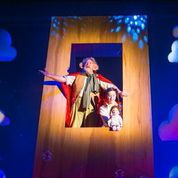
What better to represent the many rooms of childhood imaginings than a doll’s house? That’s designer Becky Minto’s large doll’s house across the breadth of the Lyceum’s stage and there’s a 00-Super gauge train track going around it, just as would be expected of any child’s play room. However, arguably the most enchanting aspect of the set is the BFG’s cave and specifically the hanging shelves that are lowered into view, adorned with jars of multi-coloured dreams. Simple but so effective. And there are the bright and innovative costumes to match. In and out of onesies, dresses and tops; on and off with hats and shoes; all changed at a quick pace – a pace wholly in keeping with the never-ending imaginations of children. One of the most impressive costumes in the wardrobe is the Queen’s – a majestic Claire Knight – whose wellie boots are topped with fur and whose royal emblem is emblazoned on a red gilet.

An integral part of this production is its combination of live music and pre-recorded sound effects. The cast’s rounded musical performances only serve to further enchant a spell-bound audience. The hard work of Claire McKenzie – musical director and composer– is evident in polished but yet playful performances. Her marriage of jaunty Scottish rhythms, fiddles and drums with children’s nursery rhymes and kazoos is expertly balanced.

BFG 2

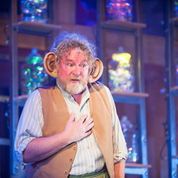
Any decent toy box has its puppets and they are brought out to play big time in this production. The medium provides much comic input as well as creating numerous characters in the hands of a small cast. The puppetry is an original and attractive feature and gives literal form to the make-believe on stage. Robyn Milne’s infectious giggle and expressive performance brings the Sophie doll vibrantly to life whilst Lewis Howden’s mysterious and magnificent BFG is not so much scaled down – except for those ears! – as uplifted. Clumsy on his feet and tripping over his gobblefunk speech this BFG warms the hearts of the audience.
Children and adults alike respond happily to the energy and enjoyment of the performances and repeated ‘whizzpopping’ had the children – and many adults – giggling with glee. This is, after all, a treasured story that seems to have lived a lot longer than its thirty-two years might suggest. There is wonderful fancy evoked here, escapism and delightful nostalgia.

“Human beans is not thinking giants exist.” Well, after this great big and magic production this human bean thinks otherwise.

outstanding

StarStarStarStar

Reviewer: Amy King (Seen 3 December)

Visit ‘BFG’ at the Lyceum here

Visit our Assembly Roxy Bedlam Church Hill Theatre Festival Theatre King’s Theatre Other Pleasance, Potterrow & Teviot Summerhall The Lyceum The Stand Traverse archive.

THIS REVIEW HAS BEEN SUBEDITED

‘Chess: The Musical’ (Pleasance Theatre: 18 – 22 November ’14)

Photo: Oliver Buchanan

Photo: Oliver Buchanan

“Without Clark’s poise on which to pivot, the story might have given up and defected to the bar.”

Editorial Rating: 4 Stars: Outstanding

Priests, poets and psychiatrists all agree that the border between pure genius and melancholy madness is chequered with 64 black and white squares (with a white one always on the right). Next time you encounter that tramp in Potterrow Port, the one who’s convinced he’s Marcel Duchamp, ask him whether mad people gravitate to chess, or if chess makes them so. Chances are he’ll mutter darkly about the Lasker-Reichhelm position, but he might respond that the dedicated player lives “a monk-like existence and know[s] more rejection than any artist.”

The real Duchamp, the one who’d never been seen dead with a trolley from Aldi, directed those words to American prodigy Bobby Fischer, upon whose bizarre biography, Benny Andersson and Björn Ulvaeus (loosely) based a musical.

Inspired by the 1972 match between Fischer and Boris Spassky, the ABBA alumni spun a yarn interweaving two grandmasters’ competition in the arena, over a lady, and among the ideological roadblocks of Cold War politics. Truthfully, Gilbert and Sullivan Chess is not. The undeniable success of this production says more about EUSOG’s commitment to sampling work pas a la D’Oyly Carte than it does about Andersson & Ulvaeus’ capacity for profound historical commentary post-1815.

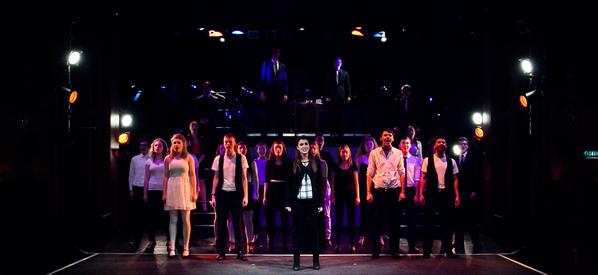
We enter to find the orchestra have escaped from their pit, and are lording it above the action. Production Manager Tom Turner has crammed more steeldeck into the set than went into South Park’s Ladder to Heaven. Visually the effect is elegant, the band’s movements in stylish harmony with Sam Burkett’s clever choreography. However x4 keys, drums, bass guitar, x3 violins, x2 cellos, flute, x2 clarinet, x3 trumpets, trombone, bassoon, oboe, french horn as well as percussion will tend to make a fair bit of noise and some dampening field needed to be generated for the sake of the singers down below.

Douglas Clark shone as Anatoly, making the script & song his own so as to cover the extensive narrative arc laid out for him. Without Clark’s poise on which to pivot, the story might have given up and defected to the bar. Tadgh Cullen (as Freddie) nailed Fischer’s astonishing angst. It was easy to see why Lydia Carrington (as Florence, the lady interest) would love him, and even easier to see why she left. I thought having Cullen sing his big number an octave higher than his vocal range was a brilliant piece of 4th wall smashing artistry, subtly underlining Freddie’s inner turmoil. My companion, smarter than your average bear, though it was a Boo-Boo. Cullen’s commitment held out. Our cheering was long, loud and genuine.

Giselle Yonace (as the tournament arbiter), Caroline Hickling (as Anatoly’s Russian wife), Peter Green (as the US manager), and Steven Segaud (as the mendacious USSR fixer) found the space to establish bold performances, spotlighting and supporting the main cast’s quirks and qualities. When Segaud tapped the vein of comic villainy in his character, I wasn’t the only one LMAO.

Ethan Baird’s direction emphasised the characters and the story they had to tell. But rather like flat pack furniture after the third house move, Chess is starting to show both its age and essential flimsiness. The producers are a bit young (and far too stylish) to embrace an ‘80s nostalgic short hand, but would one double-breasted suit have killed them? Would a visual of tactical nuclear warheads rolling through Red Square been so amiss? Several pieces were missing from this puzzling-out of a not so retro script.

If a musical about chess, written by the blokes from ABBA, set in the Evil Empire’s dreary dying days isn’t enough to float your Typhoon-Class, then here’s the only reason you’ll ever need to get out and kill, maim or mutilate whatever man or beast stands between you and the front row seats: Lydia Carrington.

She’s amazing. Her gorgeous voice battles down the band like Eva Green casually knocking down Greeks in the latest 300 movie. Carrington’s give and take with the male leads is as beguiling as Keira Knightley, as sexy as Elisha Cuthbert, and as anticipateringly exciting as when Elizabeth Warren made a cameo opposite John Goodman in Alpha House.

If you don’t see Carrington now, you’ll only have to pretend you did later. Unlike my VHS of Learn Chess with Nigel Short (ft. Carol Vorderman) this is one to watch.

outstanding

StarStarStarStar

Reviewer: Dan Lentell (Seen 19 November)

Visit EUSOG here

Visit our Pleasance, Potterrow & Teviot archive.

THIS REVIEW HAS NOT BEEN SUBEDITED

editor@edinburgh49.com

‘The Last Straw’ (Bedlam: 21 – 25 October ’14)

The Last Straw 1

Photos: Ummatiddle

“…  impro cuts loose, and cries of ‘F –ing awesome’ applaud play and cast.”

Editorial Rating: 3 Stars: Outstanding

A tale of two exclamations from ole stage coach territory. There’s “Whoa!” (Slow down) or “Wow!” (Stop right there. That’s too much). Either way, forget it. The foot brake’s worn, the wheel brake’s a joke, and you’re gonna get hurt, lady, if you stay up top. Best ride is in here, in Bedlam, with us. It’s a long journey of near on two and a half hours but it’s fun.

Director and writer Eric Geistfeld is from somewhere in Minnesota. Home is unlikely to be Bemidji but what the heck, The Last Straw is tv’s Fargo in a gothic farce. It’s intrepid. No quavering, gathered strings here; no hole in the ice but a useful trapdoor. There is breakneck writing, lunatic action, a menagerie of oddball characters, a yellow sex doll, and a lot of laughs.

Upright, young Edward, true-buttoned Brit and in financial services, is just married to Judy, all-American sweetheart, ‘pajamaed’ and with her teddy. They are to live with Violet, Judy’s mother, in Terror Towers. It might as well be Marine Corps ville. Ronald Reagan is venerated and there is a dead butler, resident throughout the first half, who wears aviators and is fed cake, but it’s gum-chewing, pistol packing Violet (Isobel Moulder) who calls the shots, literally. There will be no kids until she’s ashes and she’d be much obliged if her son in law would smoke them after she’s gone. Not that she plans to let him live long. Edward (Macleod Stephen) is a good sort, articulates so well, but realises that his body bag is being prepared. Ma has to go so he puts out a contract on her life, as she has on his.

The Last Straw 2

There is live keyboard but you hang onto the soundtrack. The Magnificent Seven sets us off and then it’s a trip through The First Cut is the Deepest, Our House, The House of the Rising Sun and, of course, Sweet Dreams are Made of This. By this point Edward has taken a slice of sponged cocaine cake and is away, tally-ho, with his toilet plunger and the weird fairies from the basement. The fourth wall crumbled a while back, impro cuts loose,  and cries of ‘F –ing awesome’ applaud play and cast.

The Last Straw goes out to glad-hand its audience. Is it like the Lothian state fair on the Meadows? Kind of. Scenes are gaudy, wisecracking sideshows, neatly divided by a door on wheels. They put their trust in ‘Together we’ll go far’, which just happens to be the slogan of the Wells Fargo bank. Especially successful are ‘The Murderelli Brothers’, possibly from Brooklyn, whose take on Alan Rickman is actually to die for; ‘The Existential Hecklers’ from outta Sartre and ‘The Sad Killer’. What of the main act in amongst these diversions? Beyond the closing cheer of ‘Happy Families’, there needn’t be one. For the best of reasons The Last Straw is a fearless, crowded, tiring, play.

And so to our adventurous rating and ranking of 3* OUTSTANDING. Three stars (safe) because you won’t be disappointed by such a full-on, have-a go, production. Colour coded red – Outstanding – because The Last Straw is remarkable rather than unbearable. I thought so, anyway.

outstanding

StarStarStar

Reviewer: Alan Brown (Seen 22 October)

Visit Bedlam Homepage here

Visit our Assembly Roxy Bedlam Church Hill Theatre Festival Theatre King’s Theatre Other Pleasance, Potterrow & Teviot Summerhall The Lyceum The Stand Traverse archive.

THIS REVIEW HAS NOT BEEN SUBEDITED

‘Outlying Islands’ (Traverse: 1 – 4 October ’14)

Martin Richardson. Photo: Graham Riddell

Martin Richardson.
Photo: Graham Riddell

“Wide, invigorating views in a small space”

Editorial Rating: 4 Stars: Outstanding

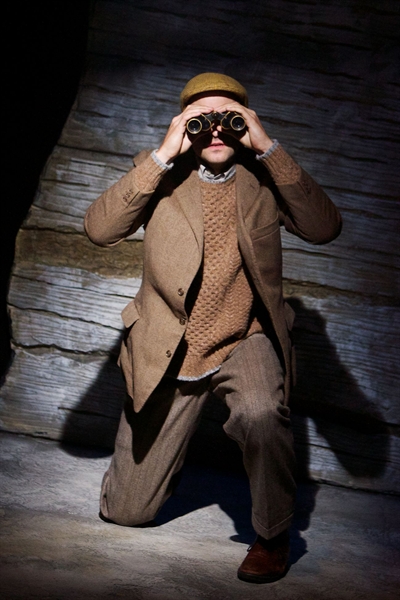
“‘Scuse my French,” says birdwatcher John – repeatedly. This thoroughly decent young man, BA. Cantab., has had enough – again! The year is 1939 and John is on the remotest of the Western Isles with stinking socks and his gimlet-eyed pal, Robert, who is bound to get the sweet girl first. You might hear the romantic airs of Local Hero within Outlying Islands, for the Celtic soundscape is lovely, but instead I see a fab, screwed up Tintin-esque adventure amongst the fork tailed petrels.

I reckon playwright David Greig likes Hergé’s impeccable line, after all, he did adapt Tintin in Tibet  for a Christmas show at the Barbican in 2005. Outlying Islands has the same startling and redemptive quality of that blameless story. However, the play’s audience also sees scary biological warfare and delightful sex.

It is the sharp clarity of the piece that impresses most. The first lines open with “I have noticed,” and it as if the audience are the ones with the binoculars, watching intently and enjoying what they discover. A bright and acute script paired with alert, insightful direction by Richard Baron is as effective as fixer in old style photographic processing, which you’ll be reminded of. We get focus and definition all throughout, with flashbulbs and nae pixels.

James Rottger and Helen Mackay. Photo: Graham Riddell

James Rottger and Helen Mackay.
Photo: Graham Riddell

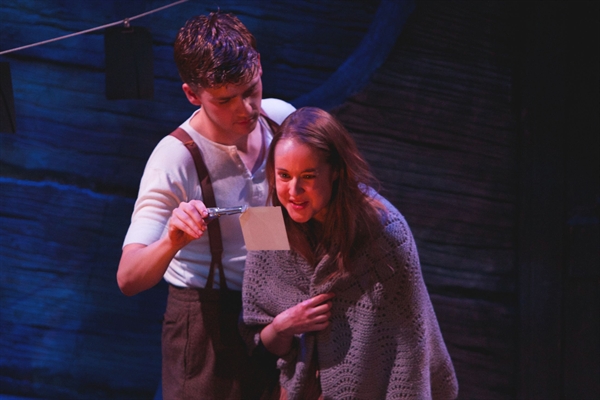
We are way out west, literally in a rock burrow, and cinematically in Laurel and Hardy territory. Their 1937 film is Ellen’s favourite but for her ‘Free’ church uncle, Kirk (!), the cinema is a place of darkness where only the Fallen gather. London, by way of the same Calvinist conviction, is a ‘gannetry of random defecation’. What’s a young woman to do – apart from prepare puffin stew? Ellen’s happiness at finding an answer in unforeseen liberty is wonderful, and Helen MacKay is jubilant in the role. Nice John or Johnny, played straight and true by James Rotger, is not a happy chappie when confronted by deep feelings – arguably like Tintin – therefore his discomfort, naked on the kitchen table, is understandable. Martin Richardson is utterly convincing as Robert. Probably amoral, certainly sensitive, fiercely rational, and undoubtedly bad for Kirk’s health, he has the dash of the pagan about him. Crawford Logan has the unsympathetic (adult) roles, playing Kirk, who is mean in spirit, calculating, a relic to be parodied, and, very briefly, the Captain of the ship that returns to take them off the island and back to …. Ullapool?

During the referendum campaign David Greig spoke of Scotland and a Scottish population that had been wearing UK goggles for long enough: ‘goggles which say you never ask questions’. ‘Outlying Islands’ has come back, post Yes/No, and offers wide, invigorating views in a small space. You might pick holes at some cartoonish excess or at the fly-away innocence of the plot or even at some speech bubble dialogue, but I saw an excellent production from  Firebrand Theatre; the same company that brought ‘Blackbird’ (not Leach’s petrel) to Summerhall in February. That was outstanding too.

outstanding

StarStarStarStar

Reviewer: Alan Brown (Seen 1 October)

Visit Outlying Islands homepage here.

THIS REVIEW HAS BEEN SUBEDITED

The Edinburgh49 Prize: for distinctive and memorable theatre (2014). Winners!

outstanding

“CONGRATULATIONS!”

Editorial Rating: Outstanding

The winners of the first ever Edinburgh49 Prize: for distinctive & memorable theatre (sponsored by Alechemy Brewing) were announced on 10 July at our ‘End of Normality’ party held at Assembly Roxy.

The event marked the city’s transition into full-on Festivals mode and was a chance to celebrate all that’s weird and wonderful about the other 49 weeks in the arts calendar.

Not only did our sponsor, Alechemy Brewing of Livingstone, ensure that everyone was well watered throughout the night, they also provided the star prize for our winning pub quiz team, a powerful combination of Royal Lyceum’s marketing team and NTS producers, who received a chance to sample 11 bottles from across Alechemy’s range.

Despite on-going tours and pre-Fringe commitments, we were delighted to welcome so many friends old and new to join us for the official announcement of the 6 winning productions, chosen from the more than 75 shows reviewed by us since last September.

In date order, the winning shows are:

With special mention of The #1 Loch Ness Monster Experience performed by Bruce Morton and Karen Fraser Docherty at Edinburgh College, 24 June, 2014 as part of the National Theatre of Scotland’s The Great, Yes, No, 5 Minute Theatre Show.

Charlotte Productions celebrate the sucess of Goblin's Story in style.

Charlotte Productions celebrate the sucess of Goblin’s Story in style.

Many congratulations again to all the winners and many, many thanks again to all the companies, participants and venues who have made 2013-14 such a wonderful year with which to begin Edinburgh49. Our job for 2013-14 was to establish the title and prove it could endure from one Fringe to another. We’ve done that. Next year we’d like to expand our coverage into new genres – can you help us?

There are some incredibly talented individuals operating across the genres in this city. If you think you can help amplify word-of-mouth with passionate, peer-review style reviews which help producers and punters alike – please get in touch!

No more reviews for now, as we circle around the Fringe and live up to our name, but we will be back in September.

See you on the far side!

Alan, Richard & Dan

‘Pressure’ (Lyceum: 1 – 24 May ‘ 14)

Pressure handbill

‘The clock counts down, isobars group, weather fronts advance’

Editorial Rating: Outstanding

A new play by David Haig. Directed by John Dove.

Pressure blows up a storm of anticipation. Remember the first handbill: warships steaming full ahead out of the binoculars and heading straight for you? If you have seen The Longest Day, the film about D-Day and the Normandy landings on June 6 1944 (but it helps if you’re over 50 and a boy), then remember that scene when a German officer adjusts his Zeiss lenses and sees the invasion force emerge through the dawn mist. Shock and awe big time! Impossible to create much the same on stage? Not if you can read a barometer and like the joke of employing a meteorologist to forecast shooting conditions for Gone with the Wind.

That was filming in 1939 in sunny LA County, whereas Pressure builds over four actual days in 1945 in Southwick House, near Portsmouth. US General Dwight D. Eisenhower is in command but depends upon a plumber’s son from Dalkeith to tell him what the weather is going to do. High winds mean high seas, overturned landing craft and limited air cover. Should he or should he not postpone? And, General, this is British weather we’re talking about.

Enter James Stagg PhD, RAF pro tem, ace meteorologist on tenterhooks. Cue very big charts, 5 to 6 low pressure systems, 2 high ones, flurries of weather reports, black Bakelite telephones, pots of caffeine and introduce the fact that beyond 24 to 36 hours the science of forecasting is all informed guesswork. Where, over there and by the way, are Rommel’s tank divisions? You grasp the fog of war.

The uncomplicated story takes hold very quickly. Stagg’s gloomy, inclement forecast is opposed by his American opposite number, trained in Beverley Hills and on the Italian beachheads. Lt. Kay Summersby and Eisenhower are an established item; conceivably a chaste one. The clock counts down, isobars group, weather fronts advance and Stagg suffers personal agonies of his own.

Writer David Haig is James Stagg and is a near elemental force. He stands awkwardly to attention in front of his commanders but provides reports of such detail that you … are blown away, as it were. This is a man, you sense, who cannot be sure that he is right but will move heaven and earth to move the odds in his favour.

In his life Eisenhower was a lucky general. Malcolm Sinclair plays him on a long fuse and a tight smile, unbowed by his massive responsibility and with a winning streak straight out of the end zone. It is a calm, light time (rare in Pressure) when Stagg tries to explain rugby football to the general who clearly will never understand why the ball is passed backwards.

Laura Rogers as Kay Summersby is a delight. The compassionate role moves her imperturbably to and fro between the five star general, whom she has known for two years, and the private, undemonstrative, scientist and allows both characters to open up. In this reading Summersby is probably David Haig at his most imaginative.

Director John Dove has those fine, clear- sighted Lyceum productions of Arthur Miller plays to his credit. In relation to this current production The Man Who Had All the Luck might as well be Eisenhower’s experience. In Pressure Dove succeeds not simply with pace and control but he also has stage actors in uniform to contend with, which weighs more significantly than civilian costume, and is never to be taken for granted. We are behind the lines, of course, but you never doubt that there is a war going on. There is just the one violent reminder when a plane goes ‘down’ and that seems a little unnecessary given the intensity of the on-stage action. Pressure is a taut, winning drama and you will appreciate the energy and skills of the creative team behind it, from blackout lighting to the drone of bomber formations.

It is, finally, David Haig’s play and is, I think, a major achievement. An exciting, dramatized, chronicle.

outstanding

Reviewer: Alan Brown (Seen 8 May)

Visit Pressure homepage here.

‘Factor 9’ (Traverse: 24 – 26 April’14)

Matthew Zajac as Bruce (Norval)

Matthew Zajac as Bruce (Norval)

‘Blood bags swing in the central section … Death certificates litter the stage floor throughout.’

Editorial Rating: Outstanding

There is an eye-catching stainless steel angel outside the Scottish National Blood Transfusion Service centre in Ellen’s Glen Road, Liberton, barely four miles south of the Traverse. There is also, facing Reception, a rust streaked 40 cubic yard capacity waste skip. Factor 9 shows us what happened when, in 1984, contaminated blood product did not end up in the bin.

Injury, pain, hurt and a raging sense of injustice is how writer Hamish MacDonald sees it. His script could have taken on some late gothic horror, as in Stevenson’s Olalla, but that is torpid and exotic compared to the energy and ghastly proximity of Factor 9.

Dramatic, genuine, testimony is given by two haemophilia sufferers, Rab (Stewart Porter) and Bruce (Matthew Zajac). Together, but occasionally taking different parts along the way, they tell the story of their lives. In medical reports and studies they are classified as ‘Unfortunate individuals’ who were exposed to that single batch of HIV contaminated factor VIII concentrate from Scottish donors. Rab would have been a ghillie but now only drives into the hills to scream insults at the view. Bruce tried to be a nurse but is thrown off his course – and onto the streets – as an unacceptable infectious risk. He has a recurring hopeless dream of taking a hammer to water and trying to smash his way out of all-enveloping misery. Bruce has, in his words, become shockproof: “Fucking unfortunate?” No, try “Fucking incredible”.

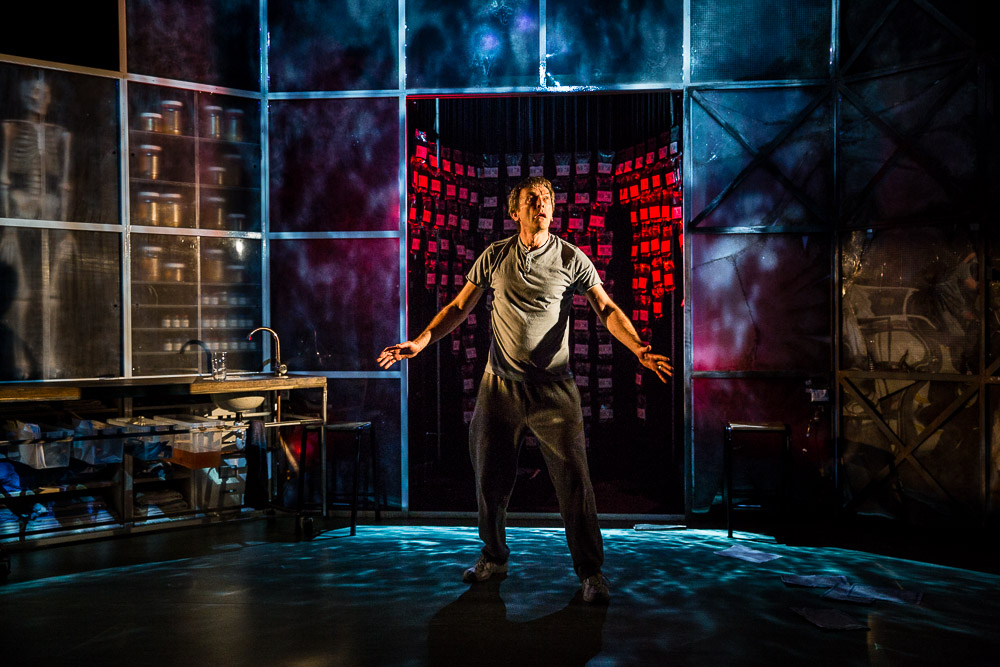
“How could this happen?” is the furious and tendentious question that fronts Factor 9. Director Ben Harrison and Designer Emily Jones get the answers out in impressive and surprising order. Visual, contextual information is screened on the grid squares of a threefold set. Important dates and locations clearly register, not least the security fencing around the Arkansas state prison(s) where donor prisoners are paid for their blood, some of it infected with viral hepatitis and HIV. White symbols turn red when, of those 32 patients in that 1984 cohort, another one is ‘away’. A lab bench wheels into use as a bed. Utility chairs are in the Waiting area where Rab and Bruce and their families spend a horrible amount of time. Blood bags swing in the central section and the names of drug companies – notoriously IG Farben and latterly Hoechst, Armour, Baxter and Bayer – are indexed above. Death certificates litter the stage floor throughout.

L. Stewart Porter as Rab (Mackie)

L. Stewart Porter as Rab (Mackie)

Actors Porter and Zajac are utterly convincing. You see Rab and Bruce briefly, innocently, having fun in the Children’s Hospital when their parents have gone home for the night but otherwise, as stigmatised plague-carriers and guinea-pigs, it is their outright, unequivocal anger that registers. Rab knows magic tricks and the vehemence of his ironic “Abracadabra” when significant medical records just disappear is punishing. Zajac also plays the haematology consultant and actually wins sympathy for a professional who, grappling with the uncertain and the unknown, finally does not know what to say. The scene when an anatomical skeleton is substituted for the doctor and ‘examined’ by his patients is ingenious and macabre.

Factor 9 is properly more than a tongue-lashing for pharma. Neither is it a pitiless exposee of medical practice in the face of an emerging pandemic within the haemophila community. It is much better than viral polemic because of terrific performance and inventive direction. In the House of Commons the Contaminated Blood (Support for Infected and Bereaved Persons) Bill waits for its 2nd Reading. This Dogstar Theatre production should introduce it.

outstanding

Reviewer: Alan Brown (Seen 24 April)

Visit Factor 9‘s homepage here and preview the show’s Fringe ’14 run here.

‘Blackbird’ (Summerhall: 26 February – 1 March ’14)

“An outstanding performance from both cast and crew… the kind of production which makes it impossible to imagine the play in anyone else’s hands”

Editorial Rating: Outstanding

First performed in 2005, Blackbird is a terrifying play.  It’s terrifying because of its subject matter: a sexual relationship between a 12-year-old girl and a middle-aged man.  It’s terrifying because it highlights the lifelong consequences, both for the victim and her abuser.  But more than that, it’s terrifying because it dares to ask some forbidden questions – evoking just the slightest touch of sympathy for the devil, and challenging us to wonder how a once-decent man can possibly have fallen so far.  It’s morally troublesome, sexually explicit, and profoundly disturbing at times.

A decade after her defilement – and now a young woman – Una returns unexpectedly, determined to confront her abuser Ray.  Ray, in the meantime, has admitted his sins and served his time in prison, and seems to have re-built a modestly respectable life.  But that, of course, isn’t quite the full story; at the heart of the play is a series of well-paced revelations, which lead the audience through the gamut of possible responses to such a shocking tale.  And they’re all delivered through a single, credible dialogue, a masterclass in exposition done well.

But all that counts for nothing if the actors aren’t up to the task – and in Greg Wagland and Romana Abercromby, Blackbird finds the cast such a challenging script demands.  Both actors bring a reckless intensity to their roles, an urgent mutual desire to tell their shared tale.  As Una, Abercromby is sassy and bold, coolly aware of the power she now wields – a veneer which makes it all the more shocking when the true impact of the abuse is finally revealed.  Wagland, meanwhile, presents a desperate, imploring Ray, yet shows a hint of imperiousness too; it’s a many-layered performance, that delivers a lot more subtlety than first meets the eye.

While the principal actors each have their moments in the spotlight, the pivotal scene belongs to Abercromby.  As Una recalls how her life unravelled, she’s helped by Jon Beales’ haunting sound design – which carries just enough echoes of a seaside town at midnight to transport us into her painfully-remembered world.  It’s details like that which make this production so impressive, and Abercromby’s words are perfectly synchronized with the soundscape.  The whole play, in fact, is flawlessly well-performed.

Firebrand Theatre bill their production as a “site-specific staging”, which is rather stretching the point, but director Richard Baron does make excellent use of the unconventional space at Summerhall.  He turns the old-style lecture theatre into a claustrophobic and uncompromising arena – a courtroom where the audience sits in uneasy judgement on both accuser and accused.  And Baron and the actors have crafted a restlessly physical performance, using constant movement to stoke the pressure without ever feeling unnatural or forced.

If there’s a criticism to make of Harrower’s script, it’s that his symbolism is often heavy-handed: the sordid nature of the story is reflected by a squalid, rubbish-strewn stage.  And the narrative stops more than it ends, as though even the playwright didn’t know quite how to respond to his worrying final revelation.  But this is an outstanding performance from both cast and crew – the kind of production which makes it impossible to imagine the play in anyone else’s hands.  Firebrand’s reputation preceded them to Edinburgh, and it’s clear that reputation is very much deserved.

outstanding

Reviewer: Richard Stamp (Seen 27 February)

Visit Firebrand Theatre homepage here.