‘Banknote’ (Lauriston Hall: 26 – 30 March’14)

BanknoteCM Photography

“The offbeat ideas just roll gloriously on”

Editorial Rating: Unrated

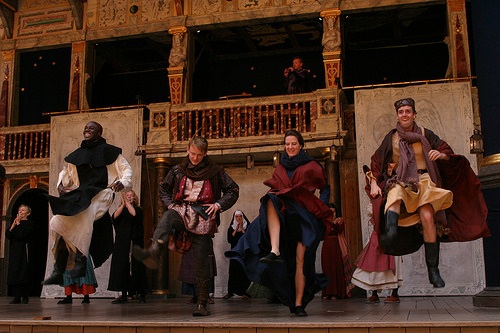
According to their website, Theatre Paradok aim to be “experimental without being exclusive” – and if Banknote is anything to go by, they’ve got that brief comprehensively nailed. In the space of 90 minutes, their eminently experimental play anthropomorphises the Bank of Scotland £1 note, imagining it as – what else? – a Victorian-era burlesque star. The eponymous banknote’s key virtues (like being trustworthy, or difficult to copy) are exhibited in a series of broadly-comic vignettes; and those vignettes lampoon distinctly non-Victorian cultural phenomena, ranging from The Proclaimers to ‘Blind Date’. This is every bit as perplexing as it sounds.

But Paradok get away with such a bizarre concept, because their pecuniary antics are laugh-out-loud funny almost the whole way through. Star of the show is Euan Dickson, who plays compere to most of the set-pieces and brings just the right level of pantomime exaggeration to his role. The gaggle of “burlesque dancers” aren’t quite as burlesque as they want to be, but they successfully develop rounded individual characters and perform with genuine skill. And there’s a welcome change of pace from a compelling performance poet, despite the fact that his appearance ended in what may or may not have been scripted confusion.

There are sharper moments – at one point a dippy, put-upon dancer casually reveals a far more intelligent side – but in the main, the offbeat ideas just roll gloriously on. As is mandatory in experimental theatre, the cast drop out of character to conduct an artistic quarrel. There’s a well-timed intervention from a bare-chested man in boxing gloves (who’s spent three-quarters of the play standing at the back of the room doing absolutely nothing at all). And it all ends with the most cheerfully tuneless song-and-dance number you’ll ever have heard – which still contrived, through sheer chutzpah and charisma, to get the whole audience happily chanting along.

What’s missing, though, is an overall sense of coherence. While there is a narrative thread running through the set-pieces, it isn’t strong enough to stitch them together, leaving the work as a whole with an episodic and juddering feel. For a minute or two after the interval, there’s a glimpse of the anchoring theme this play so badly needed; the obsessive chemist Alexander Crum Brown takes centre stage, describing his quest to develop the “impossible” perfect banknote. But that promising insight is passed over in a moment, lost among a flurry of over-complex allegory and wilfully-anachronistic humour.

In short, Theatre Paradok’s experiment has bubbled somewhat out of control. Never mind though; it was hugely enjoyable to watch, and I’m sure it was just as much fun to perform in. Student theatre’s allowed to be freewheeling – they have the rest of their lives to rein their imagination in.

Reviewer:Richard Stamp (Seen 28 March)

Visit Banknote homepage here.
‘The Picture of Dorian Gray’ (Bedlam: 26 – 29 March ’14)

Dorian Gray

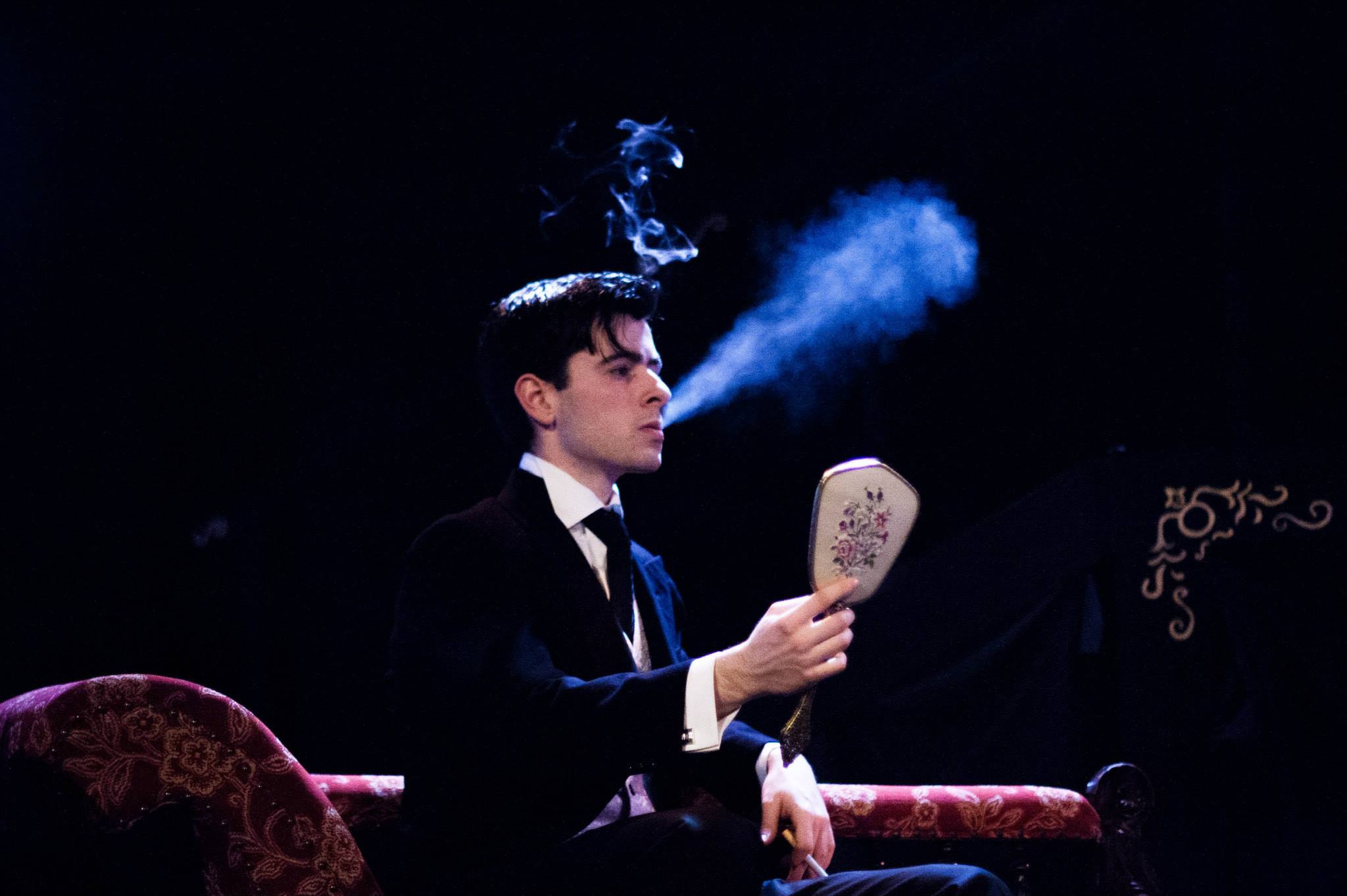
Wil Fairhead as Dorian Gray. Photo. Paul Alistair Collins

“The contrast between Gray and his aging associates was very well handled and provided the actors with opportunities to show off their powers of reaction, in which they all excelled.”

Editorial Rating: Unrated

I’ve been told to stop sending hectoring emails to the producers of Epic Rap Battles of History. Apparently they aren’t going to be pitting Dorian Gray against Doctor Faustus in the present series, and that’s an end of it. It’s too epic for EpicLLOYD and Nice Peter isn’t so nice when cease and desist letters start flying around. If the line, “you’re a puny little dandy, as weak as lager shandy” doesn’t clinch the deal, it seems nothing will.

Oscar Wilde’s The Picture of Dorian Gray is the story of a handsome fellow who sells his soul for the outward appearance of eternal youth. Under the mephistophelian tutelage of his friend Lord Henry, Gray shuns the simple life betraying the trust of those he befriends. After breaking the heart of his first love, Sybil, a beautiful young actress, Gray realises that while he never ages, his sins are being scored upon a portrait painted in his prime.

Published in 1890, Wilde’s only novel courted controversy like a magnet attracts filings. It is arguably his most important work, the one in which his gorgeous worldview is most cunningly elaborated. Adapting The Picture for the stage might be considered an impious undertaking – certainly the path to hell is paved with unsold copies of Oliver Parker’s 2009 film version.

Neil Bartlett’s adaptation is more faithful to Wilde’s original, but the perfect proportioning of gothic subtlety is lost. For all its larger failings, what annoys me most about the script is that Sybil, performing in Romeo and Juliet, is called to the stage for beginners’ positions even though she won’t appear until scene 3. Wilde did details like Ozwald Boateng does, if you’re going to muck around with him do it right.

Jonathan Ip, as Lord Henry, has the fuzziest end of the lollipop. Huge chunks of semidigested monologue blocked his route through the first couple of scenes – a grueling marathon run with hurdles. Under the sheer weight of words, Ip’s delivery of Wildean wit is muted, and about as jolly as Reading Gaol on a rainy day.

Together with Wil Fairhead in the title role, Ip took to hiding behind his props. The obsessive smoking of e-cigarettes, as well as the constant imbibing from tumblers of neat spirits, suggested that the lads were finding it all a bit much. It’s a wonder director Kirstyn Petras hasn’t got them attending an AA meeting or two.

Fairhead was a strong lead, though noticeably better playing the bastard than the boy. The contrast between Gray and his aging associates was very well handled and provided the actors with opportunities to show off their powers of reaction, in which they all excelled. Both Ip and Dean Joffe (as Basil Hallward) found themselves in their characters’ older selves.

The overall set design was smart, and would have suited a tighter script. It is impossible for a production to stay pacy when it has so many scene changes, necessitating the movement of masses of trinket bedecked and bulky furniture – dropping a hand mirror on stage must bring seriously bad luck.

A platform at the back, with attractive gold detailing, provided Gray with an attic in which to conceal his shame, and the bulky furniture with a place come and go from. To the sides were galleries for the supporting cast who were excellent throughout. Some very strong performances were on show demonstrating that those crowding the wings were not just clothes hangers for Sophie Guise’s superbly tailored costumes. It’s nice to see someone who knows the difference between morning and evening wear, even if Ip’s waistcoat stuck out from the latter. Also, giving the ladies slippers might have reduced the noise of the perpetual scene changes.

With so much participation from the team behind In The Heights, Edinburgh University Footlights’ outstanding recent outing, this production pulled one rabbit from the battered top hat. Jimi Mitchell’s dance routine was spectacular. It was what the cast had been waiting for. Perhaps it was a little too interwar but it showed what the players were capable of when freed from the confines of the script.

This was a production posing more questions than it provided answers. Why did the script refer to the portrait’s golden curls when Fairhead is dark haired? Why was the portrait shown at all when there was no picture, just a black canvas? Wouldn’t reactions to the unseen have been more effective? When you’ve got Benjamin Aluwihare and Jordan Roberts-Lavery in a cast, why wouldn’t you put them front and centre? How many butlers and valets were there? Was it strictly necessary to employ the entire membership of the Junior Ganymede Club?

I would have preferred to see this capable cast and crew tackling an actual Oscar Wilde play, rather than an inadequate adaptation of the great man’s only novel. Not only would there have been more scope for the actresses but the men could have enjoyed playing rallies of banter against one another. Instead they were stuck struggling with a script as stiff as the day old corpse of a portrait artist being carried down from an attic.

Reviewer: Dan Lentell (Seen 28 March)

Visit The Picture of Dorian Gray‘s homepage here.

‘Union’ (Lyceum: 20 March – 12 April’14)

Josh Whitelaw as Allan Ramsay in Tim Barrow's Union. Photo by Tim Morozzo

Josh Whitelaw as Allan Ramsay.   Photo by Tim Morozzo

“A valiant shagging of historical event and character”

Editorial Rating: Unrated

England and Scotland have been at it for a good while.

Once upon a time there was some rough wooing. Then, once upon a time – again – there was the Union of the Crowns, which sounds more consensual, and then, once upon a … etc., there was the Act of Union, which obviously came straight out of the The Joy of Sex and now – just reported today – we have a time of conscious uncoupling.

Fancy a flutter on the outcome? Tim Barrow wagers you will. His new play, Union, is a valiant shagging of historical event and character that is really, really, not into contraception. Probity is not on top either. See, on the common stage in gilded London, the seventeen pregnancies of Queen Anne. That’s Anne the last of the slimy Stuarts, as we’re in the realm of Horrible Histories; and meanwhile in the vennels of Edinburgh there is the whoring of Grace and Favour.

Scotland is up for sale: 20 old K should do it, not least because in 1707 one English pound was equal to twelve Scottish. ‘What cares our land for coin?’ is the noble poet’s cry. Actually, pal (only John Dalrymple, Earl of Stair, is no friend to Allan Ramsay, makar) there are those who care a lot. And so on 16 January 1707 the treaty of Union is passed by Scotland’s Parliament by forty- one votes, 110 to 69.

The headcount in the script is 10. Ten actors do it all: only Josh Whitelaw (Allan Ramsay), Sally Reid (Grace) and Irene Allan (Queen Anne) do not have other parts. That works well and the scenes play out within eye-catching projected sets that turn and turnabout: Edinburgh is Celtic chords, rain, tankards, cards, and clustered wigs; the Queen’s showy rooms in Kensington Palace are just the place to take exotic teas and to play catch-the-crown.

I thought the safety curtain was the huge Union flag, which has a certain metaphorical fit to it. No fire risk, we’re ‘Better Together’ and all that; but this is one production, I put it out again, that does not want to stay protected. Think of the Darien scheme and go for broke.

And, despite much concerted entertainment, Union does break in two. Allan’s love for Grace and for Scotland is too soft to hold when all about them is political and [sorry] priapic disorder. Liam Brennan is a riot as The Duke of Queensberry and as a mincing teasalesman at court. At times Queen Anne’s part turns Irene Allan into Queenie from Blackadder. Andrew Vincent as Marlborough has a comic swagger that batters belief. By contrast Tony Cownie’s performance as Stair and Walpole is too good, too convincing, not to place him in Congreve’s The Way of the World. The line-up of Scottish nobles, pro-union ‘Yes’ on the left, outraged ‘No’ on the right, has to happen but it looks awkward and is – literally – staged. When Allan sets his verses free on the water you stay as unconvinced as Grace is of the power of scribbling.

To return. Now, are you sitting comfortably? Once upon a time the Duke of Marlborough drew his pistols at table and blew his daughter’s hamster apart. In a way that is how I feel about Union. Its remains are in your lap rather than in your head. More gross than shocking. As ballsy as Scotland’s Future? Has to be.

Reviewer: Alan Brown (Seen 25 March)

Visit Union homepage here.

‘Eternal Love’ (Kings: 18 – 22 March ’14)

image

“Derrick Zieba’s sound design and William Lyons’ composition were delightful, filling the air like a rhapsody of gorgeous butterflies.”

Editorial Rating: Unrated

Their forbidden love broke all the rules. Their passion tore their lives apart, ripping through the loose fabric of twelfth century mores. The devotion of Abelard and Heloise continues to inspire the deepest affection in those who have born witness to their story.

Eternal Love (formerly titled In Extremis) is set in medieval Paris in the age of the great Peter Abelard. The French capital is the epicenter of a proto-renaissance. New modes of thinking are challenging the old order. Ecclesiastical certainties are coming under the scrutiny of innovative thinkers like Abelard.

Having quarreled with his old fashioned teacher, William of Champeaux, Abelard establishes a philosophical academy of his own. It’s a runaway success, elevating the trendy young scholar into the most fashionable circles. Every inquiring mind wants to be shaped by him, and few are more engaged than the beautiful Heloise.

When her uncle hires Abelard to provide private tuition, Heloise is brought into the intellectual and sexual orbit of a man with many powerful enemies.

Howard Brenton’s script is a vehicle not only for one of Europe’s most cherished love stories, but also for deeper musings about the interplay of intellectual and physical love. It is a sly and wily creature, coiling around familiar events, unafraid to flex its comic muscles.

However, John Dove’s direction recalls the sad tale of the actor, made famous by a long-running TV improv show, who found himself unable to work without exaggeration. Perhaps this production would have worked in the frenetic intimacy of London’s Globe Theatre in which it was born, but something was badly lost in translation.

The actors were spread across the broader canvas of the Kings like cold butter straight from the fridge. The blocking was as blocky as Duplo and so were several of the performances. A last minute substitution in the cast may not have helped, but at no point was the love, the very birth of romance, in evidence. The violence of Abelard’s fate worse than death was muted, monotonal even.

The set was barely a set. A wishy-washy shadow, a pale imitation of the Globe. Entrances? Check. Musician’s gallery? Check. Some trees? Check. Anything else? Not really. This was a prop-lite production well turned out in medieval clobber but with the feeling of a functional business suite rather than brilliant tailoring.

Euterpe was the only saving grace. Derrick Zieba’s sound design and William Lyons’ composition were delightful, filling the air like a rhapsody of gorgeous butterflies. Together with Rebecca Austen-Brown and Arngeir Hauksson, Lyons found the quick heart of Brenton’s script. Measured, witty, soulful and soul-filled, I just wish the rest of the production could have looked up from the stage and played as well as the gallery.

Reviewer: Dan Lentell (Seen 18 March)

Visit Eternal Love‘s homepage here.

‘Titanic 2; Pig in the City’ (Bedlam: 6th March ’14)

Titanic 2 intro

“Spygood is as arrogant as Lord Flashheart, deranged as ‘The High Life’s’ Captain Duff, anarchic as Sir Digby Chicken Caesar.”

Editorial Rating: Unrated

A stream of audience is pouring into a great gash in the side of Bedlam. Unlike the waters of the North Atlantic, there’s nothing chilly about them – although it’s cold inside. Under the weight of expectation, the packed venue crackles with joyous anticipation.

Sketch comedy is to theatre what frescos are to painting. The form can be subtle as Livia’s villa, boisterous as the Banqueting House, majestic as the US Capitol’s rotunda, daring as the Sistine Chapel – and of course it has to be funny.

We enter to find white drapes framing the glow of a projector beneath which are a half dozen dining chairs and one green leather armchair. This will turn out to be a prop-lite production. The emphasis will be on the writing and performances.

It is my companion’s first visit to Bedlam. Alex Harwood as Jim and Jodie Mitchell as Rosie made the perfect first impression. Disciplined, energetic, and gut-achingly well matched, the shame-faced romance between society girl and awkward oik is the turbocharged mechanism driving the script forward. Their material is cruder than the OPEC Reference Basket but it is beguilingly delivered with an (almost) untainted innocence.

Other comic creations staple the scenes together – Jakey Rowling, the foul-mouthed children’s author, also played by Mitchell, and pseudo-psychic Poirot, played by the bloke who carries David Bard’s hair around, are among the more successful. And then, of course, there’s Lord Spygood, the ship’s captain.

Spygood is as arrogant as Lord Flashheart, as deranged as The High Life’s Captain Duff, as anarchic as Sir Digby Chicken Caesar. He’s the plumb in the pudding, the plumbing that fills the boat with gravy. Andrew Blair inhabits the role like a glove. Is this Spygood’s The Dangerous Brothers phase – the unpolished period when Mayall and Edmondson first carved out the archetypes that would run them from The Young Ones through Filthy, Rich and Catflap to Bottom?

Although an adequate vehicle for Harwood and Mitchell as well as Spygood, the script does not exactly hold together. Say what you will about James Cameron’s Titanic – that you hated it at the time, that it proved huge in Afghanistan, that you’ve kind of grown to like it – the one unsinkable truth about the 1997 classic is that it provides a clear narrative arc. They get on the boat. They ride around on the boat. The boat starts sinking. They try to get off the boat. They’re in the sea.

The producers of Titanic 2 left so much deadwood in the lineup it’s a wonder anyone managed to drown for lack of something to float on. The result was that some seriously good material was dragged under and lost.

Rather like when Crusoe and Friday fight off wolves in the Pyrenees during the final scenes of Defoe’s novel, the end to Titanic 2 is somewhat superfluous. With a concerted editorial effort to chuck some of the Jonah japes overboard this production would have enjoyed much smoother sailing.

As it was, a wealth of time combined with a poverty of properties, lighting and sound effects saw the soufflé deflate into a cheesy mess. Chutney Exhibition prides itself on being an experimental incubator. There was not one idea in this production which did not deserve to come off the drawing board. Fewer, however, were ready for the transition from workshop to stage.

Sketch comedy is like fresco painting, you can’t leave it so long that the plaster dries out entirely. It’s all about the timing.

Reviewer: Dan Lentell (Seen 6 March)

Visit Titanic 2‘s homepage here.

Grit (Traverse: 6 Feb.’14)

Grit

an admirable sincerity”

Editorial Rating: Unrated

Presented as part of Manipulate, a week-long festival of visual theatre, Grit is an earnest analysis of how children around the world are affected by war.  Well-regarded by critics during 2012’s Edinburgh Fringe, it views this biggest of topics through a close-up lens – using a war photographer’s diary to frame the story, and drawing occasional parallels with his own life at home.

The tale’s told through a mix of puppetry, projection, and shadow-play – a combination of techniques which occasionally feels overwhelming, but in the end comes together remarkably well.  It’s not the most original of styles, but there are some creative details to enjoy: an especially powerful projected sequence cleverly brings just parts of an image into focus, picking out first a ruined building, then a man cradling a child.

But if the presentation’s deft, the storytelling’s clumsy.  Exposition comes courtesy of a pre-recorded voiceover, which very definitely tells-not-shows the photographer’s reactions to the horrors that he’s seen.  It’s desperately unsubtle, and oddly uncompelling; a war correspondent ought to be a fascinating, contradictory, damaged character, but here he seems cast as Everyman.

And sadly, it feels as though they don’t quite trust their puppets to hold our attention or to tell their story.  One otherwise-effective scene, consisting of a striking series of shadow vignettes, is accompanied by a narration so literal and descriptive it begins to feel like a sequence from a children’s TV show.  As we see a young foot thrust into an army boot, the voice tells us that a boy has become a soldier – a plot point which, quite honestly, they could have trusted us to work out for ourselves.

It would be crass to overlook the importance of Grit’s theme, and there’s an admirable sincerity to the way Tortoise in a Nutshell confront it.  But this is recognisably an early work, from a company which have (by all accounts) since gone on to great things.  It flits too quickly between too many different stories, and in the end – unlike that clever projection – never quite throws the focus on any of them.

Reviewer: Richard Stamp (Seen 6 February)

Visit Tortoise in a Nutshell homepage here.

Hotel de Rive (Traverse: 6 Feb.14)

Hotel de Rive

an existential struggle for meaning that made Giacometti’s eyeballs dance in front of his head”

Editorial Rating: Unrated

You can tell that Hôtel de Rive is not UKIP territory. A German, French, Swiss co-production based upon surrealist writing accompanied by alpine horns, l’Hôtel is foreign. The show has Vorsprung durch Technik design credentials. It looks expensive, it runs well, has done 60+ outings since 2011, and – critically speaking – has definite and appealing hybrid form. But what, exactly, is it doing on stage? There’s your existential question, especially if you’re not in the Euro zone.

A search engine helps, which is a bit of shame, but Hôtel de Rive needs its back story. Its subject, Swiss artist sculptor Alberto Giacometti (1901-1966), had to stay in Geneva during the German occupation of Paris between 1942 and 1945. Biographies now headline this period as coinciding with his ‘critical transition period [beginning in 1935] … when he questions his work and tries to find a new way of looking and translating what he sees.’ He took a room at the Hôtel de Rive and his sculptured figures grew smaller and smaller, some barely a few centimetres high. They were imagined on a wide and shifting flat surface and not in anything as reassuring as three dimensional space. Insomnia took hold and Geneva nights (as back home in Paris) were spent in bars and clubs. Shabby, grubby, a chain-smoker, ‘on’ six to ten cups of coffee a day, and not exhibiting his work for twelve years, the artist then was a long, long, way off 60 million pound auction prices and being the face of Switzerland’s 100 franc note.

But you can see where the hallucinogenic Hôtel de Rive is coming from: an existential struggle for meaning that made Giacometti’s eyeballs dance in front of his head, which – projected – is like a bio-exorcism out of Beetlejuice. There was appreciative if nervous laughter from the audience.

Of that anxious, frustrating and near impossible time Giacometti said, “A large figure appeared wrong to me, while a small one was intolerable, and then they became so minuscule that with a final cut of the knife they often disappeared into the dust … and tirelessly I began again, only to end up, a few months later, at the same point”; which might have been the crumbling, enervating effect of Hôtel de Rive. Fortunately its creator, Frank Soehnle, responsible for ‘Set and Play’, has given its animation more visual and literary coherence than you might think.

A more than nodding acquaintance with Giacometti’s The Dream, the Sphinx and the Death of T (tellingly published in Labryinthe magazine) would have helped a lot. I didn’t have a clue but now know, for instance, that the Sphinx – outlawed and closed down in 1946 – is/was the celebrated, bizarre, brothel in Montparnasse. Its pleasures are, surely, represented in l’Hôtel by hot trombone and a shimmying, bejewelled, and wasted puppet with a purple flower for a head whose petals fold delicately when she settles into an outsize wine glass. See it, and more, on YouTube: http://www.youtube.com/watch?v=TguqiDIXGfM .

Single actor, Patrick Michaelis (who has to be Giacometti), suffers sand pouring over his head, then a wee demon of a puppet- familiar on his skull, then a yellow spider, then outstretched, skeletal arms protruding as if from the back of his coat. Did I appreciate the following elucidatory text on a screen somewhere: “A blind man extends his hand in the void (in the dark? In the night?/The days pass and I dream of catching, stopping that which flees”? No, I did not; Giacometti’s 1952 haiku-like poem probably was evident somewhere but there were too many available options: actor’s voice, electronic voice, chalkboard, tablet screen, revolving PC monitor, big screen. And the music plays all the while: on conch, muted trombone, synthesiser, and those impressive alpenhorns.

This breadth of choice, I suppose, derives from the show’s extended title, Hôtel de Rive – Giacometti’s horizontal time (lost to UK marketing), where linear narrative style is discounted in favour of a segmented disc on a single plane. A different event is contained in each segment that narrows to a single, all-inclusive point. Got it? Anyhow, the show does actually close with an up-tempo approach to the artist’s last work, Paris sans fin, a series of 150 lithographs of that city.

I’m pleased that I know more of Alberto Giacometti’s life and art. I liked watching Hôtel de Rive work its inventions out but it was a slow, creepy, ride. Accomplished, skilful, polished; but really just an assembly of clever components, I felt.

Reviewer: Alan Brown (Seen 6 February)

Visit Figuren Theater Tubingen homepage here.

Bedlam Festival 2014: 3 ‘shorts’ – ‘Seawall’; ‘On One Knee’; ‘Rob and Roberta’

Bedlam Festival 2014

“and – magic – you have theatrical Snapchat”

Editorial Rating: Unrated 

LOWDOWN: The ‘Bedam Festival’ is a six day festival … operated by the longest running student theatre in Britain … completely administered, staffed and performed by students and young people primarily studying at Edinburgh University.’ 

In case you wondered (because you’re not a student), the Bedlam Theatre is the ninety seat theatre housed in the old New North Free Church on Bristo Pl, looking down towards George IV Bridge. It is Fringe venue No49 in August when use of the pa. system seems important. Last week, on the one occasion that I heard a solemn “The House is now open”, it was laughingly decried as ‘train station posh’.I saw three productions on consecutive evenings at 6.00pm. Audience numbers looked good at around 50+. Rob and Roberta had two performances; Seawall and On One Knee were one-offs.

Seawall by Simon Stephens.  This is a surprising and effective piece. It is a grief-stricken story of sudden loss and immanent mourning. Jonathan Oldfield as Alex is quietly alone on stage and is looking back at what happened and would bring his audience with him to the edge of his personal darkness. The submerged seawall of the title is where you back away from the depths of misery on its other side. This tale is thirty minutes in the telling but you wouldn’t know it. Alex moves you through in tones half conversational, half confessional, and the emotional tug is unremitting. There are sorrow smudged sketches of his partner, Helen; of her father, Arthur; and of their child Lucy; but it is Alex alone who gains real definition.  Oldfield’s monologue would be heart-breaking in its gathering intensity but writer Simon Stephens waives the sentimental, preferring a body blow to the stomach. Alex used to cry at anything – that moment in Groundforce, for instance, when the made-over garden is revealed to its surprised owner – but not anymore. Oldfield’s performance has real gut-churning weight behind it.

On One Knee by Delia Bloom is thirty minutes of original writing for EUTC and opens up with Bruno Mars’ ‘Marry You’, whose dance track is just right for this light and irrationally accurate show. ‘Looking for something dumb to do’? Easy, put one lovelorn loon, Jamie, on the left of the stage to propose marriage to Christine and put his two pals Tom and Erica on sofas to the right with lots of vodka shots.   John Forster is sweet Jamie and a very credible sucker for Imy Wyatt Corner as Christine who – of course – fancies another, fitter, laddie. So much, so deliberately cringeworthy; but meanwhile there’s comic action across at the flat where friends Tom (Jonathan Barnett) and Erica (Isabella De Vere Rogers) are texting to save Jamie from himself.  Writer Delia Bloom gets it right here: life for this merry band is ‘one story after another’, just link arms and skip from one side of the stage to the other and – magic – you have theatrical Snapchat. De Vere Rogers, sassy, and Barnett, smart, work well together and try out stylish Anna (Blanca Siljedahl) as a better girlfriend for Jamie. How ‘better’? Who cares baby, let’s just play ‘The Settlers of Catan’. Congradulations (sic) to director Sally Pendelton.

Rob and Roberta by Rory Keller is more loaded. You are still in flat share land but there’s talk of careers underway – the law, medicine – and relationships are heavier to shift. Rob (Laurie Motherwell) is weary before his time and relieves the weight by being snide to his best friend, Roberta (Emma Nevell), and it is a wonder she puts up with him as cheerfully as she does. If he had lots of words Rob would be messing with the heads of his friends, as it is he contents himself by pulling them away from each other. Rida (Daniel Orejon) loves Cheeto (Adam Butler) in less time than it takes to crunch a cornmeal snack but that kind of wholesome enjoyment is not for the jaded Rob. He is therefore the challenge that pert and determined Rachel (Izzy Hourihane) is looking for. She will ‘fix’ her man within a year, she declares, and the play’s action describes that attempt. Hourihane’s energy is vital and holds your attention through multiple scenes past and present but at times I, for one, was wondering ‘What for? Is Rob worth it?’ He does resolve this for himself at the play’s shocking end but I got the distinct impression that Rob and Roberta is a psychological drama that had lost its plot.

I really would have liked to have seen more shows; I should have done.

Reviewer: Alan Brown (Seen 22, 23, 24 January)

Visit Bedlam Festival 2014 homepage here.

1933: Eine Nacht im Kabarett (Summerhall: 22 Jan. – 2 Feb.)

H040_0005

 … determined to enjoy a decadently subversive cabaret’ ? 

Editorial Rating: Unrated

It’s 30 January, 1933: the day President Hindenburg made his fateful, fatal choice, and appointed Adolf Hitler as the Chancellor of Germany.  That night, a group of citizens and foreigners gather at a Berlin club – determined to enjoy a decadently subversive cabaret, while that pleasure’s still permitted to them.  And we’re invited too.

1933: Eine Nacht im Kabarett is essentially two shows rolled into one.  There’s the cabaret itself, up on the stage; and there’s the back-story, played out at the bar and at the tables, by actors who walk and sit among the audience.  It’s an ambitious and challenging production which dares to break some sacred rules, but unfortunately, it adds up to less than the sum of its parts.

The cabaret itself is nothing short of a delight.  David McFarlane and Calum MacAskill are multi-talented performers, playing dancing brown-shirts or failing magicians with equal, expressive ease.  Hazel DuBourdieu delivers a bravura performance as the ironic “perfect German girl”, while master of ceremonies Bev Wright is a dissolute, self-destructive dominatrix.  The original score, which Wright co-wrote with Fiona Thom, is just as well-matched to the milieu: sometimes it’s poignant, sometimes it’s rousing, and sometimes it’s a little sordid too.

So 1933 hits a lot of the right notes, but not always in the right order.  The opening is both lengthy and awkward; it’s not immediately clear whether we’re watching a painfully-misjudged shambles, or a sharply-observed satire.  It takes too long to get acquainted with all the key characters, perhaps because there are simply too many of them.  And most of all, the first half lacks the feel of reckless escapism that the setting demands: we’re told the Hitler Youth is marching in the streets outside, but little sense of danger spills over into the room.

The scene finally snaps into focus after the interval, with the arrival of Nazi official Captain Vöhner – deftly played by a commanding Andy Corelli.  As Vöhner seats himself very visibly among the crowd, our role as the audience becomes an increasingly uncomfortable one.  At one point we’re asked to sing along to a catchy ditty, lampooning Hitler’s rise to power, and the whole room turned a nervous eye to Vöhner’s table.  Would he see the funny side?

For the most part though, 1933 sits in a frustrating middle ground, making unconventional demands of the audience without granting corresponding freedoms.  Daringly, playwright-director Susanna Mulvihill often has two dialogues happen simultaneously, one at each end of the room.  But you have no choice which to listen to; stuck in your seat at a cabaret table, you may well find a crucial character-defining conversation being drowned out by small-talk at the table next door.  It’s true to life, certainly – but it’s not a satisfying way to tell a story.

And on a larger scale, too, Mulvihill’s script often has too much going on.  Overall, she needs the help of a fearless editor: someone who can cut the repetition, bring a tighter focus to the storyline, and point out the places where her messages grow overly obscure.

1933 is a fascinating experiment, with some genuine highlights both on the floor and on the stage.  It’s a shame it doesn’t quite hold together.

Reviewer: Richard Stamp (Seen 24 January)

Visit 1933: Eine Nacht im Kabarett homepage here.

‘The Improvised Panto!’ (City Nightclub: 9-13 Dec ’13)

“Few styles of performance are so ripe for lampooning; and with a vast canon of familiar characters to draw from, the potential for capering hijinks is huge”

Editorial Rating: Unrated

An improvised panto is an inspired idea. Few styles of performance are so ripe for lampooning; and with a vast canon of familiar characters to draw from, the potential for capering hijinks is huge. Edinburgh-based Impro FX give it a good shot with this gutsy performance, but their hook just isn’t quite strong enough to hang onto.

The trouble with reviewing improv is that it’s different every night, and this particular performance was… well, probably not Impro FX’s strongest. The oddball tale of a visionary Moroccan takeaway driver never fully came together, and the occasional songs (accompanied by pianist Dan McGurty) involved just a bit too much repetition. It must be said the audience’s suggestions didn’t give them a huge amount to work from; it might have helped to throw out examples of the kinds of riffs they were looking for, instead of asking the crowd to come up with creative ideas from a standing start.

And, an improvised panto? Oh no, it isn’t. To be fair, there was a passable horse, and the magisterial Charlie Hindley proved an alarmingly credible dame. But a pair of false breasts does not a panto make; there was no badly-written innuendo, very little call and response, no pastiche of minor celebrities from Forth One. At times, it seemed that Impro FX had dropped back to a more familiar style of improv, and forgotten that they were meant to be staging a pantomime at all.

Cast as the mandatory talking animal, Steve Worsley duly grinned like the Cheshire Cat right through the performance, and his engaging warmth went a long way towards smoothing over the inevitable rough edges of the plot. Harry Gooch doubled up to play both hero and arch-villain, with deliciously farcical results in the last couple of scenes, while a selfless Will Naameh held the whole thing together – just about – as a pleasingly queeny princess.

So the stock characters are all there; but to take their concept further, Impro FX might play a bit more to our childish delight in the genre. The emergence of that pantomime horse, for example, could be built up into a much-anticipated moment of nostalgia, rather than just an ironic nod. And they need to call on their audience more – shamelessly and clearly – demanding our cheers and our comedy hisses! Because, while we know the catchphrases we’re supposed to shout out, amidst the chaos of an improv show we need some help understanding just when we’re meant to say them.

Reviewer: Richard Stamp (Seen 10 December)