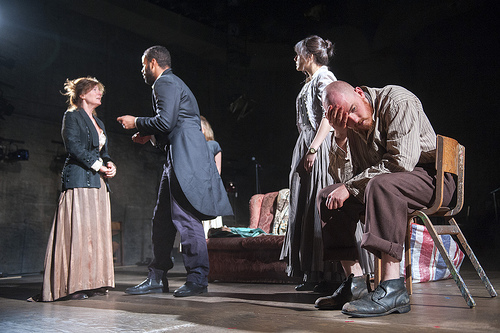
‘Stella’ (Traverse: 19-30 Nov ’13)

Stella Image by Richard Gamper

Image courtesy of Richard Gamper

“An elegant design from Gus Munro, and some emotive acting – particularly from an impassioned Kathyrn Pogson – can’t save it from an over-embellished yet under-developed plot”

Even if you’re up to speed on the history of science, you may never have heard of Caroline Herschel.  A woman working in a world dominated by men, she’s eclipsed by her famous brother William; yet even during her own lifetime, she was recognised as a talented astronomer in her own right.  Using that most time-worn of framing devices – a modern-day woman reading a diary – Stella challenges our ignorance, telling the tale of Herschel’s career as she joins her brother in England.  But if you’re expecting a detailed insight into the unique achievements of this female pioneer… you may well be disappointed.

The clue’s in the subtitle, really.  Stella is “a story of women, their men and astronomy”, very definitely in that order.  We hear a lot about Herschel’s relationship with her brother, whose marriage and fatherhood late in life sets the scene for some classic familial discord, but there’s regrettably little assessment of what she truly contributed to her field of study.  The script skips oddly quickly over her independent discoveries, essentially casting her as a diligent but put-upon helper – and while the notes on the back of the programme go some way towards justifying that choice, the play itself could do much more to explain the nuances and contradictions of her role.

On the plus side, both script and actors convey a fine sense of the mysteries of the cosmos, not least the incomprehensible wonderment surrounding the Herschels’ surprise discovery of the planet Uranus.  Some gentle humour works well, and at the heart of the plot there’s an excellent hook – a black hole of torn-out pages from Caroline’s meticulous diary.  But the script never quite sells that mystery, instead choosing to plod chronologically onwards, always displaying perfect confidence that matters will be revealed in time.

Perhaps because the main storyline’s so conspicuously short on drama, the production adds a second string: a neat parallel between the violence of the Arab Spring and the burning of the ancient Great Library of Alexandria.  It’s rounded out by some telling quotations from the martyred fourth-century female philosopher Hypatia, which serve well to keep things thematically complete.  There’s enough in that clever concept to support a whole separate play, but here it feels like an afterthought – especially since its emotionally-wrought conclusion is so strikingly different to the rest of the tone.

Stella is a missed opportunity.  Rather than exploring what’s distinctive in Herschel’s story, it diverts all too frequently onto expository sidelines, or less-than-subtle parallels with the present day.  An elegant design from Gus Munro, and some emotive acting – particularly from an impassioned Kathyrn Pogson – can’t save it from an over-embellished yet under-developed plot.

Reviewer: Richard Stamp (Seen 19 November)
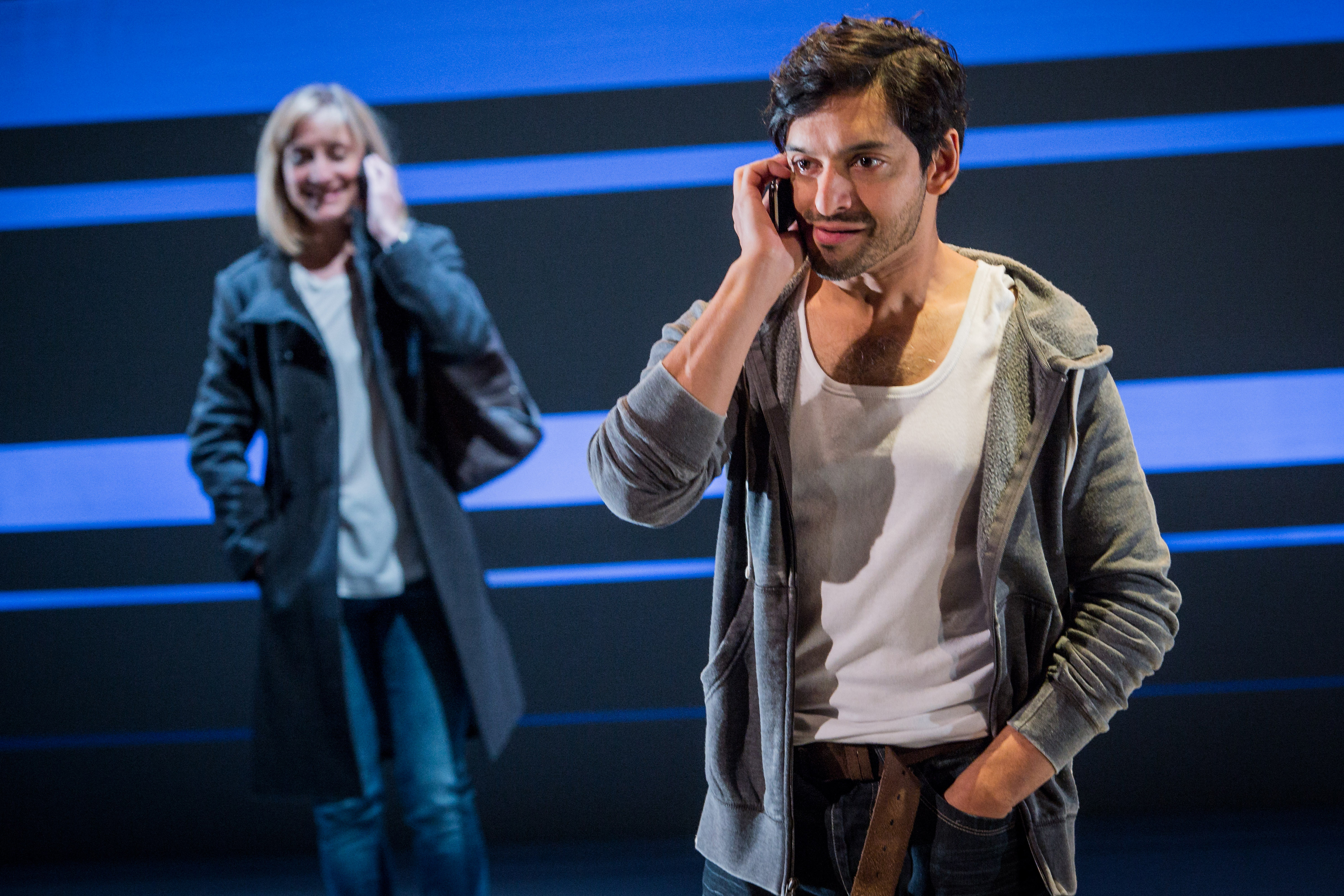
 

‘The Lift’ and ‘Elephant in the Room’ (Bedlam: 20 Nov ’13)

“Bedlam is steaming through the waters it knows best – supporting emerging talent on stage and off.”

Editorial Rating: Unrated

Brass monkeys ain’t in it. It is seriously cold in Bedlam. I should be seeing Dr. Zhivago  or something set in Narnia during the reign of the White Witch. Instead I’m taking my seat for The Lift and The Elephant in the Room, two out of three afternoon entertainments written by Freshers. For such a hit and miss affair there is a great deal on target. The badinage buffet successfully showcased the great things we can expect from Fringe venue 49 in the coming years. Familiar and not so familiar faces breathed life into two daring scripts simply (but effectively) staged.

The Lift (unlike Elevator the forgettable 2011 horror flick in which 9 people are trapped in an elevator) is set in a lift where 9 people have become trapped. Writer Fergus Deery sketches out a series of ludicrous characters – a flatulent vicar and his shrewish wife; a Matt Lacey-esque über-rah; a pompous PhD; two devoted lovebirds; a prickly girl in a wheelchair, accompanied by her patient pushover friend; and a member of the toiling masses. When Über-rah causes the lift’s mechanism to jam, hilarity ensues as the social norms crumple under the weight of frustration and impatience. Don’t expect piercing social insight, the social commentary doesn’t rise much above sprout jokes.

Deery is playing for laughs and he gets them. In the hands of a well-matched, well-balanced ensemble his unaffectionate portraits come to life. The true star of the show is the staging. It’s minimalist, just a wooden border at hip height, but just large enough not to entirely restrict the unfolding drama. Blocking is of course a problem but there are signs of genius lurking in its comic application. The Lift has the feel of a recurring sketch routine (although more Armstrong and Miller than Fry and Laurie). The plot twist can be seen from a mile off which somewhat underwhelms the final third. But it’s a promising first attempt, galloping out of the starting gates, confidently leaping the first hurdles. And although more were clipped than cleared in the home stretch, this is a writer who has established his form and will be one to watch.

The Elephant in the Room is a bold, even reckless narrative by Joe Christie. Charging head on at themes relating to the personal calamity of terminal illness approached from a surrealist angle. Beth, a tour guide at the castle (I’m not sure why except that the outfit must have been to hand) is informed that she’s terminally ill. The sardonic stalwart Henry Conklin (having finally escaped from The Lift) appears to her dressed as an elephant. The effect of the costume on Conklin conjures imaginings of a live action version of the YouTube classic The Wanky Shit Demon. The Elephant offers Beth (nuancedly, understatedly played by Sophie Harris) a choice to either face the realities of her situation or to journey through a shifting dreamscape landscaped by her own mind. A lot is packed into the script including off-the-rails coronations, gay imps, giant crêpes, supervillain queens, and wise mystics.

There are echo’s of the acclaimed Something There That’s Missing, the surprise hit of last Fringe. Elephant in the Room is equally creative, equally absurdist and a vehicle for equally quirky as well as engaging performances. It’s unlucky in the line-up though, following on from the unashamedly boisterous The Lift. I never could like Moulin Rouge after it was shown on a transatlantic flight immediately after my first encounter with Shrek.

Both Elephant in the Room and The Lift made me sorry not to have seen the full cycle – word in the bar was that Amanda Whittington’s Be My Baby was rather good. Both the plays I saw excite a sense that Bedlam is steaming through the waters it knows best – supporting emerging talent on stage and off. The current generations are heirs to a noble tradition. Their commitment to their craft does them credit, honouring that most venerable and lively of Edinburgh theatrical institutions.

Reviewer: Dan Lentell (Seen 20 November)

Visit Bedlam’s homepage here.

‘Ciphers’ (Traverse: 12-14 Nov ’13)

ciphers-008 Grainne Keenan Ronny Jhutti

Image courtesy of http://www.traverse.co.uk

Ciphers’ emotional software is not stripped down but it is obviously engineered. The best scene, I thought, because it is securely plausible, is ‘in a pleasant suburban garden’ where Justine’s father is ‘pottering about sweeping leaves’”

A while back I watched a London Duck Tour run its amphibious vehicle off the Albert Embankment slap bang alongside the MI6 building. The tourists on the DUKW whooped and hollered but that happy eager sound was never going to carry into the showy headquarters of the British Secret Intelligence Service. Accept that Ciphers would take you down a similar edgy slipway and – despite appearances – you get much the same subdued effect.

Ciphers is by Dawn King, whose outstanding debut play Foxfinder won her an 2012 ‘Offie’ award for most promising new playwright. Ciphers has the same director, Blanche McIntyre, but it is very different – check out Michael Billington’s review of ‘Foxfinder’ to see how different – although just as ambitious and it will do King’s CV no harm at all. However, whilst to write a drama about a young woman whose life is taken over by her work for the secret service is superficially attractive – if you can, just think ‘Homeland’ for a moment – it gets a whole lot more demanding when the action and the psychology have to be live and convincing for two hours on a bleached stage. And this is one production that really does not need the distraction of an interval break, let alone ice-creams.

So Justine steps out in defence of the realm but without much protection, mental, physical or electronic. Ciphers’ emotional software is not stripped down but it is obviously engineered. The best scene, I thought, because it is securely plausible, is ‘in a pleasant suburban garden’ where Justine’s father is ‘pottering about sweeping leaves’. His other daughter, Kerry, is on an angry mission. She wants to know why ‘if [Justine] was an analyst why is she fucking dead!’ Neither father nor daughter knows what Justine did all day: ‘Sometimes I imagine her, doing … I don’t know. Spy things …’. Yet there unfortunately is the lameness of Ciphers. The euphemistic ‘intelligence community’ does not do ‘At Home’; its windows are one-way, and its best plots are kept secret.

How to make up the story then? Have large blank screens on stage to project English translations of Russian and a few chat-up lines in Japanese. Slide those screens to smart effect, move time around – a lot, and approach Justine’s story from multiple angles with demanding paired roles.

Gráinne Keenan plays Justine and Kerry, both sensitive and vulnerable; Bruce Alexander is their father, Peter with his garden broom, and is also the predatory, knowing, diplomat, Koplov. Between them Keenan and Alexander have the most reliable, natural, exchanges. It is harder for Ronny Jhutti as artist Kai and youth worker Kareem and for Shereen Martin as Anoushka, Kai’s wife, and as Sunita, an MI5 officer – could be MI6, who knows? These are the shallow roles where lines like ‘I’m shit’ or ‘We don’t have the resources’ are thin. Worse, if like me you’re trying not to decode Ciphers as subfusc Spooks, is the accidentally topical ‘Mohammad’s slipped surveillance. We don’t know where he is’.

Ciphers plays at the Bush Theatre, Hammersmith, from 14 January. That is barely two miles from the river where DUKW tours are suspended after one of the ‘Ducks’ caught fire downstream from the MI6 building. It will be interesting to follow how this spare, edgy, drama goes down. Personally, I don’t think that it rides that high in the water.

Reviewer: Alan Brown (Seen 12 November)

Visit Ciphers’ homepage here.


‘The Tailor of Inverness’ (Summerhall: 1-2 Nov ’13)

Tailor

Image by Tim Morozzo

“the energy boils over from time to time, and a handful of moments of great poignancy felt rushed and under-sold”

Much acclaimed on its earlier runs at the Edinburgh Fringe, The Tailor Of Inverness tells the true life story of the late Mateusz Zajac… who was also performer and playwright Matthew Zajac’s dad.  Displaced from his home in eastern Poland at the onset of the Second World War, Zajac senior’s travels took him across numerous battlefields, before he finally settled in the north of Scotland and lived out the remainder of his life as a respected local craftsman.  It’s a complex tale, but well-judged projections in the background help keep track of the tailor’s journey through life, as he voyages from Poland to war in Africa and a C&A factory in Glasgow.

But here’s the thing.  If you’re over the age of – let’s say – thirty-five, the chances are that you grew up listening to no less fascinating wartime tales. There is a reason to tell Zajac’s story above most others, but the script waits far too long to show the trump cards in its hand.  Too much time early on is given over to the bones of the eponymous tailor’s narrative, which is engaging and sometimes thought-provoking but not, on cold analysis, particularly exceptional.

And the latter parts of the play are disappointingly factual.  Thanks to its extensive use of documentary video recordings, the production feels more than anything like an edition of Who Do You Think You Are?, depriving it of some of the impact a more theatrical approach could have engendered.  It’s particularly sad that we hear so little from the tailor’s character during this second part of the play; the set-up seems perfect for a speculative analysis of his motivations, but some obvious questions about why he behaved the way he did remain almost entirely unexplored.

Actor-playwright Matthew Zajac has earned many deserved plaudits for his role in this play.  His mix of Polish and Scottish accents is a particular delight, and his physical performance is utterly dauntless.  But, five years after he first performed his script, he may have lost a little subtlety – the energy boils over from time to time, and a handful of moments of great poignancy felt rushed and under-sold.  The script also tends to over-use the device of jumping into the middle of an intense scene, a technique which loses its effectiveness when it’s deployed too often.

The Tailor Of Inverness is a fine history lesson – you’ll learn a great deal about how the borders of Eastern Europe were drawn – and an inspiring tale of a loving son’s efforts to piece together the past.  But there’s something missing: a moral, perhaps, or a clear sense of purpose.  The tailor appeals to us to accept him for who he is – at once a Pole, a Ukrainian, a Russian, and a Scot – but aside from Nazi ideologues, nobody in the play seems to have any problem doing exactly that.  This is a story well told, but it’s frustratingly hard to pin down quite what it wants to teach us.


Reviewer: Richard Stamp (Seen 1 November)

‘Crime and Punishment’ (Lyceum: 22 Oct – 9 Nov ’13)

9820696075_7c9c0e2431

Image courtesy of http://www.lyceum.org.uk

“in this busy play-novel of downed vodka and photographic ‘shots’, I found that the drama has the consistency of one of Luzhin’s caramel wafers”

There is a lot of exposure in this production. There is no curtain for a start, no flats, no scene painting, nothing obviously comfortable on stage but utility furniture. Across the back, exposed, is a dressing room, liquor bottles and music kit, for the (a)ttiring house of the Shakespearian theatre equips this new adaptation of Dostoyevsky’s unsettling Crime and Punishment. The company gathers, warming up, as the audience sits down and a full-on Psalm 130, De Profundis, ‘Out of the depths … hear [our] prayer’, shifts seeming rehearsal to actual performance. What you are about to see could be barefaced and brazen.

In fact the way to enjoy this co-production with Glasgow’s Citizens and Liverpool’s Playhouse is to look at it as an amateur photographer and to accept that fiddling with your dramatic settings will affect what you see. Some scenes will be sharp, others appreciably less so; some clearly sequenced, others vaguely. The programme casts this as ‘fluidity of the staging, with its seamless transitions’.

Depth of field, then, is key. Rodion Raskolnikov, the ur-student transgressor, is more in focus than out of it, which is to actor Adam Best’s credit as the character is in the fever grip of irresolution to the point of passing out on his sofa or remaining mute and motionless while a policeman snuggles onto him and licks his shaven head. Raskolnikov’s idea of responding to the love-of-his-life, Sonya, is to bow down before her unhappiness. He is fixated on the genius of Napoleon but has the strategic nouse of a double axe-murderer. Best is lucid and good at the verbal and facial tics that impede Raskolnikov’s nihilistic raptures.

Adjust for comic relief and enter George Costigan first as Marmeladov, drunk, and then as Porfiry Petrovich, detective and examining magistrate. Now we’re learning about portrait photography: the two subjects are nicely observed, properly defined, and hold your attention. However, the entertaining, disconcerting, scenes might as well be framed: Meet a Drunk, Cross-examination, Youdunnit – as they illustrate what happens when police procedural meets comic accent and turn. Costigan’s Petrovich proves a wry nemesis.

Cate Hamer’s two principal roles as Pulkeria, Raskolnikov’s mother, and as Katerina, Marmeladov’s wife, are demanding and prominent but they cannot provide humour. Hamer has to do destitution, torn affections, and mental breakdown in vignettes of scenes where there are no decorative borders. The effect is monochrome.

There is a lot of creative energy and skill expended in this production. Supporting parts are bright and live in the moment, notably Obioma Ugoala as the unselfish Razumikhin. Writer, Chris Hannan, knows his Dostoyevsky and pares the novel down with evident respect and sensitivity. Thematically it is pretty intact, not least its all-Russian face-off between social cataclysm and (Christian) redemption, between the polemic of ‘new ideas, new economics’, and Sonya’s New Testament. Raskolnikov is criminally self-absorbed and the play’s script interrogates him. Stage microphones amplify his breathing; other characters ‘resting’ back-of-stage also judge him. Domininc Hill’s direction is clever – a door on wheels makes for fast entrances and exits, digitised blood slashes red  and the soundscape is close to a Threekopek Opera – but finally, inevitably maybe, in this busy play-novel of downed vodka and photographic ‘shots’, I found that the drama has the consistency of one of Luzhin’s caramel wafers.

Reviewer: Alan Brown (Seen 30 October)

‘Translunar Paradise’ (Traverse: 18-19 Oct ’13)

Translunar Paradise @ MAC by Alex Brenner (_D3C6294)

Image by Alex Brenner

“The piece meanders between the couples’ experience of youth and old age, a personal tragedy, the war and a daily routine that proves hard to break when he is left alone.”

Editorial Rating: Unrated 

A Fringe hit in 2011 and 2012, Theatre Ad Infinitum’s Translunar Paradise has since travelled the globe, appearing everywhere from Colombia to Croatia. Last week, as part of its national tour, it swept into Edinburgh’s familiar surroundings once more.

The production’s global reach is testament to its wonderfully universal nature. The subject matter – the difficulties of losing a loved one – is one that everyone, regardless of culture, status or age, can relate to in their own way, and the delivery of this narrative entirely in mime ensures language is no barrier. Using such a universal story and no spoken word creates a space for each audience member to project their own story, their own experience of loss, onto the characters – leading to a very personal experience and not a few emotional sniffs.

Whilst this is a strength in one respect, in another it leads to a fairly predictable, if touching, story arc: we watch as a man in his twilight years struggles to adjust to daily life after his wife of many years passes away – though her spirit remains, intervening, to help her pained husband move forward. The piece meanders between the couples’ experience of youth and old age, a personal tragedy, the war and a daily routine that proves hard to break when he is left alone.

To illustrate the jumps between youth and old age, the cast employ the use of masks. Initially, these are incredibly effective, Michael Sharman (William, the husband) and Deborah Pugh (Rose, the wife) incorporate them seamlessly into their fantastically crumpled and stiff physicalities, complete with the soundscape of old age: the sighs, strains and the hrumphs. However, as the story progresses the masks begin to hinder rather than help. Once they have been removed once or twice we lose the illusion that they are part of the actors, and increasingly become aware that there is a face behind them, that they are actors playing a character – which could easily have been forgotten in the opening sequence. Moreover, the actors’ faces are so lively and full of expression that when the masks return you become acutely aware of just how much they limit expression, stuck as they are in one position. This became a particular problem in sadder moments as the female mask seems to contain just a hint of a smile.

Accompanying the actors is Kim Heron, who brings her haunting vocals, Yann Tiersen-esque accordion playing and a crucial pair of hands to the production (having actors limited to just one hand while the other holds the mask makes carrying and staging quite tricky. Luckily, Heron’s knack for multitasking – simultaneously singing, playing the accordion and carrying props around for the actors – helps keep the production moving). The accompaniment is beautiful and effectively highlights the mood and period of a scene, for instance using war time classics such as ‘We’ll Meet Again’ ‘It’s a Long Way to Tipperary’. However, its continuous use and somewhat samey feel means it loses effect. By the time the final moments arrive, where a well-placed accompaniment could convert a few sniffs to flowing tears and a much greater emotional climax, it is so familiar that it lacks the impact it could so easily have.

At the moment Translunar Paradise errs on the slower, more drawn out side –not helped by the predictability of the story. However, it is also a warming, gentle piece of theatre, with interesting staging, a lovely universality to it and the potential to do even more.

‘The Lives of the High-Rise Saints’ (Summerhall: 10 – 12 Oct ’13)

 agata-spektakl-sma.preview

Image by pawlowicz.art.pl

“Anyone who has worked on a DIY project will know that there are always bits left over, and this is the starting point of Ameijko’s work. God’s work took six days and on the seventh day he rested – but on the seventh day the flotsam and jetsam from creation gathered together in a tower block.”

Editorial Rating: Unrated 

The Lives of The High-Rise Saints brings a wide range of disciplines to the Summerhall stage. This one woman puppetry show from Agata Kucinska reaches into the reject pile of society to examine the inner strength that people can find to get through their lives.

Many of the visuals are slightly twisted away from the norm, and the inventiveness behind the design is a delight to see. The performance is a technical tour de force that uses everything from very small rod puppets through to larger human-arm puppets, and even Kucinska donning a mask and puppet limbs to physically take on one of the roles herself.

The story itself, adapted from the work of the same name by Poland’s Lidla Amejko, is both dark and challenging. Anyone who has worked on a DIY project will know that there are always bits left over, and this is the starting point of Ameijko’s work. God’s work took six days and on the seventh day he rested – but on the seventh day the flotsam and jetsam from creation gathered together in a tower block. Trusting only in themselves, they scrape out a living at the fringe of society, a motley band of wastrels, tortured souls, and dubious morals, sharing the tales of their lives with each other and the audience.

On the surface there is little to love about these characters. Rejected by the rest of the world, it is very easy to gloss over them on stage and write them off, but this slow burn of characterisation through individual vignettes is countered by the love and energy Kucinska brings to the stage. You approach each character with trepidation and an almost grotesque curiosity before slowly being pulled into their world.

It’s backed with an inventive live sound-scape that mixes foley effects and music to highlight the sadness of this world. This contrasts well with the small moments of joy each character has to look for to break the monotony of their life with brief bursts of joy and satisfaction.

You need to make that journey to appreciate the small moments that make their lives bearable, but the experience and repetition as the script moves through the roll call left me with a sense of exploitation and horror. This is not an easy performance to watch, but it is layered, thoughtful, and has much to say.

Technically Kucinska has mastered the many facets of puppetry used throughout the show, but with the grotesque nature of the characterisation it becomes hard to connect with the characters. This is not aided by the tone, which is almost oppressive in its darkness; while this accurately reflects the world the characters inhabit, it inhibits investment in their plight and results in the show failing to realise its potential to truly captivate the audience’s attention. Dark can work if enough empathy can be created, but the various elements of the show never quite clicked together, resulting in a somewhat disjointed experience.

Everyone in life is dealt some rubbish cards and the occupants of the tower block know just how weak their cards are but they make the best of the trying circumstances and show a great resilience of spirit in the face of depression and hostility. There is a lesson in there for all of us.

‘The Fantasticks’ (Bedlam: 9 – 12 Oct ’13)

1391627_536699813084181_349070085_n

Image by Louise Spence

“Performed in New York almost continuously since 1960, The Fantasticks is a curiously-constructed musical.  The first act is cutesy – sometimes to a fault – telling the knowingly-ridiculous tale of a forbidden teenage romance, and of two fathers’ efforts to control their love-struck offspring.”

Editorial Rating: Unrated

“Try to remember the kind of September / When life was slow, and oh, so mellow,” exhorts The Fantasticks’ famed opening song. Well, they’ve missed September by a week or two, but in every other respect Edinburgh University Theatre Company have fulfilled that brief: this is a warm-hearted, uncomplicated production, which gently lulls you backwards into an agreeably nostalgic haze.  Sadly, however, the lyric also foretells this production’s main weakness.  It’s all just a little bit slow.

Performed in New York almost continuously since 1960, The Fantasticks is a curiously-constructed musical.  The first act is cutesy – sometimes to a fault – telling the knowingly-ridiculous tale of a forbidden teenage romance, and of two fathers’ efforts to control their love-struck offspring.  But after the interval, the scenes grow dream-like and altogether darker, in a dislocating transition which this particular production never quite pulled off.  It doesn’t help that the original boy-meets-girl plot is wrapped up by the end of Act One, leaving the second half to lumber away from an awkward standing start.

But we can’t blame EUTC for the plot’s idiosyncrasies, and they’ve certainly had fun responding to its old-style American charm. Jordan Robert-Laverty neatly captures the clean-cut naivety of a 1950’s college boy, while Claire Saunders excels as his swooning 16-year-old paramour, milking the comedy of her role without ever quite crossing the line into over-acting.  Saunders’ voice lends her songs an almost operatic tone, and contrasts nicely with the more natural style of Alexandre Poole – who brings an understated authority to his multi-faceted role as both villain and narrator.

Muscially, however, the performance suffered from frustrating inconsistency, with almost all the actors delivering showstopping performances for some songs while clearly struggling with others.  The surprising exceptions were Daniel Harris and Thomas Ware, playing the two teenagers’ warring fathers; their characters seem at first to be formulaic comedy chumps, but soon prove to be far more.  Harris and Ware both have fine, comforting voices, and their harmonising duets proved a thoroughly unexpected highlight – enhanced by some genuinely witty, if slightly methodical, dance.

Indeed, the whole production demonstrates a playful sense of physicality, with an impressive swordfight (and gloriously extended death scene) raising the stakes just before the interval.  But whenever the pace wasn’t being dictated by the music, the energy ebbed away.

So EUTC’s production isn’t quite fantastic – but it’s an enjoyable, stylish, and life-affirming version of a cosily charming musical. Credit must also go to pianist Dan Glover and harpist (yes, harpist) Sam MacAdam, whose position at the side of the stage brings them very much into the heart of the performance.  It’s a show I’ll be sure to remember.

‘Dark Road’ (Lyceum: 25 Sept – 19 Oct ’13)

Robert Gwilym as Frank Bowman , Ron Donachie as Fergus McLintock and Maureen Beattie as Isobel McArthur

Image by Douglas McBride

“The production is a mixed bag in most regards.”

Editorial Rating: Unrated

Ian Rankin is no stranger to Edinburgh’s criminal underworld –fictionally, of course. Inspector Rebus, Rankin’s most famous literary creation, is known to millions as the slightly off-beat but loveable curmudgeon, for whom this city’s cobbled streets are home. Perhaps it is no surprise, then, that his theatrical debut (in collaboration with the Lyceum’s own Mark Thomson) is firmly rooted in this world.

It is twenty five years since the conviction of Alfred Chalmers for the murder and mutilation of four young Edinburgh women (there are definite comparisons to be made with the BBC’s hit series The Fall). This, combined with her thirtieth anniversary of being on the force, provokes Superintendent Isobel McArthur (Maureen Beattie) to reflect on what proved a land mark case in her career; or, more specifically, on a nagging doubt she has harboured since that day. Dredging up the past, however, reveals a well of raw emotions in both her closest work colleagues and her only daughter, Alexandra.

The production is a mixed bag in most regards. On the one hand, much of the writing is disappointingly predictable – not simply in terms of the plot, but also the inclusion of well-worn topics such as sexism in the police, the role of a policeman’s ‘hunch’ in conviction, and the bureaucratic barrier of paperwork that stands between policemen and ‘real police work’; a commentary that fails to really add any new angles on these issues. On the other, some of the writing is delicious – finding its strongest moments in scenes of quippy character interaction.

Similarly, a handful of characters were intensely believable – Philip Whitchurch’s portrayal of Alfred Chalmers was magnetic, managing to baffle the audience and leave us in a confused state, somewhere between terror and sympathy. But, at the other end of the spectrum, Sara Vickers (Alexandra) was lumped with a caricature of a teenage girl, whose mood swings between being angsty and angry, and as horny as a bitch in heat, leave her little room for development.

An area of no doubt, however, was staging – which was certainly the production’s strongest suit. The three room revolve worked incredibly well, particularly with the addition of corridors which provided both a realistic edge and an extra dimension to the performance. Furthermore, the soundtrack, ranging from a lamenting violin to Psycho inspired string segments, did much to add dramatic tension in scenes and maintain atmosphere between them; combining well with projections that slowly built a visual backstory for the audience.

Dark Road has the beginnings of a good production, but there is work to be done. It would benefit from some trimming – particularly in the first half, where certain scenes and ideas dragged on too long – and a more careful concealment of the plot to avoid the predictability that currently plagues it. As it stands, Dark Road is middle of the road.

Reviewer: Madeleine Ash (Seen 28 September)

Visit Dark Road homepage here.

‘The Baroness: Karen Blixen’s Final Affair’ (Traverse; 27-28 Sept ’13)

Dogstar Theatre The Baroness Roberta Taylor (Karen Blixen (Isak Dinesen) Photo credit Leila Angus

Image by Leila Angus

 “Among Denmark’s literary superstars few are more fascinating than Karen Blixen, pen name Isak Dinesen (1883-1962). The Baroness is the story of her final affair: a platonic entanglement with a much younger poet.”

Editorial Rating: Unrated

For a country where summer temperatures struggle to exceed 20°C, in terms of cultural exports, Denmark and all things Danish are surprisingly hot right now. Successes such as The Killing and Borgen have rocketed outside awareness and interest. Among Denmark’s literary superstars few are more fascinating than Karen Blixen, pen name Isak Dinesen (1883-1962). The Baroness is the story of her final affair: a platonic entanglement with a much younger poet.

We enter to find two harp-shaped window frames with fewer right angles than the Goetheanum. In one hangs a tribal mask intended to conjure images of Blitzen’s years as a coffee planter in Africa (I think it resembles Norman Tebbit). An eclectic harmony of furniture perfectly captures the sense that we are looking into the dwelling place of a mind born for the Belle Époque. Her young companion is evidently much less at home. He belongs instead to that new generation which Kennedy’s Danish-American speechwriter would describe a year before Blixen’s death as “tempered by war, disciplined by a hard and bitter peace.”

The friendship of Blixen and Thorkild Bjørnvig is a matter of historical record. At times the script creeps into the realm of docudrama. When Blixen encourages her protégée to abandon his wife, child and work in order to compel the flow of his artistic creativity, she laments that Denmark is “flat as a duck pond”. Similarly, the muted script gives little sense of a tempest brewing in, or subsequently howling through, the hearts of the protagonists.

Roberta Taylor as Blixen and Ewan Donald as Bjørnvig provide well-rounded individual character sketches. There are flashes of real insight, such as Donald’s steadily improving posture, but there is little shared fascination. Blixen is portrayed at the centre of a social and cultural web in which she occultishly snares young bloods with which to feed her imagination.

Several of the techniques deployed to fill a stylized frame with stylish content are over hesitant. The dramatic function of the mutual friend (played charmingly by Romana Abercromby), for example, is uncertain – diverting more than developing the over-lengthy central narrative. By the interval I think I’ve got the point. Other than the brightly conceived set transition from Blixen’s home to Bjørnvig’s northern hideaway, not much more is said or done.

Pace was a problem throughout. Far from crisp efficiency, the frequent scene changes are slow (although composer Aiden O’Rourke’s bold, introspective score make this less of a negative). Projection was a problem too, I did not feel played to in the steeply tiered back row of Traverse One.

Dogstar Theatre squeezed hard and a good amount of zesty juice was delivered into the glass. If their future endeavours maintain the very high standards set by The Baroness for smart, funny staging of deep, moody drama then we can expect great things from them in the coming years.

Reviewer: Dan Lentell (Seen 28 September)

Visit The Baroness homepage here.