The Threepenny Opera (King’s Theatre: 15-16 September)

“A charming production full of talent”

Editorial Rating: 4 Stars

The musical legacy of Kurt Weill and Bertolt Brecht’s vibrantly satirical ‘play with music’ The Threepenny Opera is a curious one. Its opening anthem, “Mack the Knife,” has subsequently gained far more acclaim and recognition as a jazz standard in English since its debut in 1928 Berlin. The sultry refrain still tells of the deliciously violent antics of the notorious Macheath — every bit as much a bloodthirsty criminal as a salacious womanizer — but the original Socialist criticisms of capitalism and societal greed inherent in the original context of the character have somewhat faded. However, in their current production of Weill and Brecht’s piece, The Attic Collective yank the socialism and social Darwinism back into focus with grandiosity and verve to spare.

The assembled talent has carefully chosen a threadbare aesthetic and a frantic tone, both of which are appreciated considering it’s nearly three-hour runtime. The blocking, choreographed by Dawn-Claire Irvine, is frenetic, with bodies and props being hurled around the stage with sometimes dizzying energy. The set, managed by Tony King, is almost completely empty, save the minuscule bandstand area and temporary furnishings wheeled on to create a sense of space, which is accomplished well. The band is led with both humour and talent by Simon Goldring, whose musical direction fits well into the play’s dingy background. The most remarkably funny aspect of the stagecraft is the use of projected slides to flatly assert location. Before most scenes, white typeface bluntly explains context, and briefly puts up an Edinburgh equivalent of where these London-set scenes might take place, eliciting many a laugh for their timing and matter-of-factness. Had these been paired with a more self-serious, pretentious production, they would seem tacky; had they been employed by a less dynamic, more straightforwardly silly group, they’d be out of place for their dry humour. But to their credit, The Attic Collective’s decisions like this strike exactly the right tone (more often than not), between gormless and grandiose, threadbare and thrifty, funny and frank.

Max Reid is excellent as the appallingly villainous Mr. Peachum, particularly for the bombast he brings to his first scene, directly after the chorus’s “Mack the Knife” introduction. Reid successfully guides the audience from the familiar sounds of the standard to the viciously satirical tone of the rest of the production, which is no easy feat. As (occasionally) the cruelty and pitch-black comedy of Brecht’s script might come off as too much to find funny, it is particularly commendable that director Susan Worsfold has chosen to emphasise the comedy wherever possible. Toby Williams, as a hapless and clueless beggar, is hilarious with excellent timing, and Hannah Bradley as Mrs Peachum displays a genuinely impressive talent for balancing daft operatic turns of plot and phrase with an accomplished singing voice and terrific stage presence. And this is all the first scene.

Charlie West’s Mack the Knife takes time to get used to, but ultimately shines as the play pushes his character farther and farther from the archetypal ladykiller/people-killer role. His singing is good, and well-suited to the choppiness of Brecht’s plotting, as some intentionally off-kilter scenes and character dynamics look and sound more grating than polished. Given the tone of the production, these are presumably meant to be that way. West also displays nice comedic timing, but the truly gifted comedic dynamic was found more frequently among his criminal posse: Lewis Gribben, Elsa Strachan, John Spilsbury, Mark O’Neill and occasionally Conor McLeod. They all display real camaraderie and genuinely funny quips whenever present: another respite given the sometimes exhausting length of the proceedings.

Mack’s various women, played by Kirsty Punton, Megan Fraser and Sally Cairns, are characterised well, and each command the stage when given the opportunity. Special note goes to Cairns’ exquisitely gauche costume. In fact, the behind-the-scenes decisions are some of the most impressive aspects of the show: the use of the King’s Theatre’s actual boxes during a brothel-based interchange in particular is an inspired choice, delivering further hilarity.

The political and societal implications, are however, noticeably muddled, from the greediness and homoeroticism within head of police Tiger Brown (Andrew Cameron), to the jarring humour on display while Mack languishes in a prison cell waiting to be hanged by the distinctly humourless guard (Adam Butler). The spaces crafted by mime and sparse prop work, including a very funny use of a ladder as all-things-jail-call, but frequently have their implied rules broken, from doors switching to windows, walls vanishing entirely, locks fitting into keyholes where previously there was nothing, and entire crowds miraculously appearing and disappearing: the staging too often does not make any sense. Granted, these are aspects of Brecht’s dismantled view of theatricality in general, but when the plot twists and turns so freely it would have help to define spaces a little bit more.

Overall, The Threepenny Opera is a charming production full of talent and featuring some particularly inspired choices and aesthetics. There could be a little more there in the way of clarity, but hey, it’s Brecht. Most charmingly, it gives a whole lot of context for the flawless “Mack the Knife” standard itself, and for a superfan like myself that’s welcome. And if you weren’t a fan of the song beforehand, you will be once the curtains have closed.

StarStarStarStar

Reviewer: Nathaniel Brimmer-Beller  (Seen 15 September)

Visit the King’s Theatre archive.

THIS REVIEW HAS NOT BEEN SUBEDITED


What Shadows (Lyceum: 7 – 23 September ’17)

Ian McDiarmid as Enoch Powell
Photos: Mihaela Bodlovic

“A remarkable performance, as unsettling as it is astonishing”

Editorial Rating:  4 Stars: Outstanding

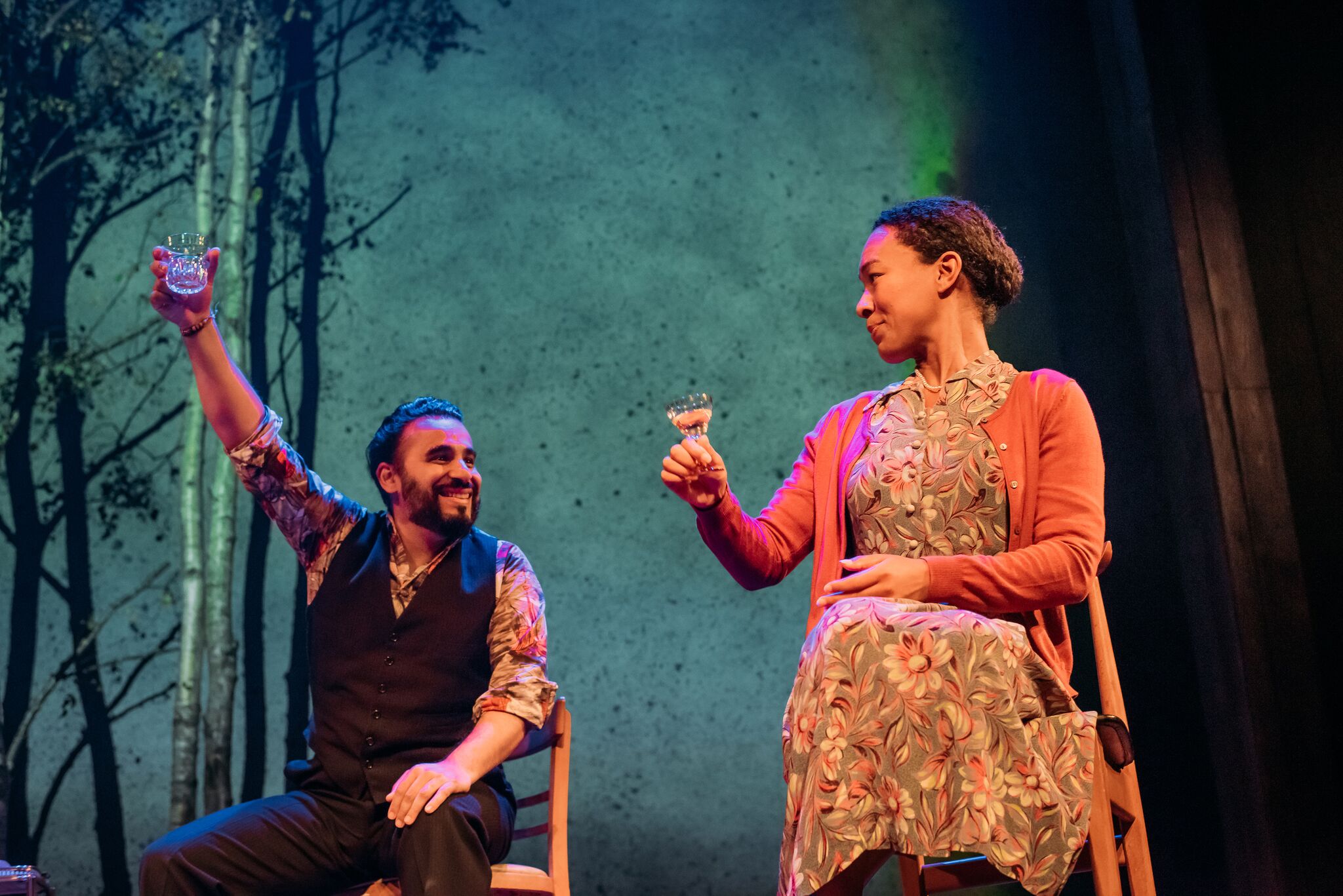
Shadows cast? Shadows fleeting? Shadows lengthening? Take your pick as you find your way back and forth through the many scenes of Chris Hannan’s timely play upon the redoubtable life of Enoch Powell (1912 -1988), for whom – archly – it is ‘in fog [that] you feel England all around you’. As it is what you see is a beautiful copse of silver birches.

This is the standout Birmingham Rep’ production from 2016 directed by Roxanna Silbert. Ian McDiarmid (Powell), Paula Wilcox and Waleed Akthar reprise their roles. McDiarmid, especially and importantly, gives a commanding performance as the radical, absolutist Conservative whose proudest, indisputable claim was that he always spoke for his constituents of Wolverhampton South West, and as their MP from 1950 to 1974 that meant speaking his formidable mind about immigration. For the classical scholar, poet, and theologian whose idea of total Englishness was ‘sunken lanes in Shropshire’, immigration is as unpoetic – but as necessary – as it gets. Lamentable too. For Powell’s close friend, local newspaper editor and Quaker Clem Jones (Nicholas le Prevost), ‘England’ is more subtle – ‘Gary Sobers bowling his slow Chinaman’: surely one, nowadays, for the British Citizenship Test.

What Shadows moves between 1992 and 1967/68. Powell’s notorious ‘Rivers of Blood’ speech, that closes the first half of the play, was given at a Conservative Association meeting in Birmingham on April 20 1968. Twenty-five years on two feuding Oxford history lecturers, one black, one white, Rose Cruickshank (Amelia Donkor) and Sofia Nicol (Joanne Pearce), see a research paper, maybe a book, contextualising that speech, interviewing Powell, and hitting upon Insights-to-Racism-and-How-to-Stop-It. Parody did not seem far away, particularly in their self-righteous, point scoring tones; and they’re certainly no match against Powell, even at the end of his life and shaken by Parkinson’s.

Ameet Chana as Sultan and Amelia Donkor as Joyce Cruickshank

Hannan’s invention is both amusing and accurate. 1967 is a Powell picnic, with his wife Pamela (Joanne Pearce) at her supportive best; it is also a hostess trolley at an awkward New Year’s Eve party, where Grace Hughes (Paula Wilcox) is a white landlady of two Punjabis, the gauche Saeed (Waleed Akthar) and the jovial and appealing Sultan (Ameet Chana), whose war service in Burma included learning ‘I Love a Lassie’ from the 1st Battalion Seaforth Highlanders. 1968 is the Powells leaving an RSC production of ‘King Lear’ at Stratford and being buttonholed by Sultan. “England must be cured of Empire” pronounces Enoch. There’s even a passing reference to the late and great Alan Howard.

In this show, though, it’s Ian McDiarmid whom you must applaud. It is a remarkable performance, as unsettling as it is astonishing. Go to Youtube for Michael Cotterell’s 1995 film portrait of Powell, ‘Odd Man Out’, and realise how close the actor is to his subject. Obviously the words, their clarity, and the curiously accented speech can be the same but there is the tight smile, the nodding assent that is as sympathetic as it is probably dismissive. Powell nearly usurped the Tory party on principle and McDiarmid shows how he did it, without quite turning the man into the near demon / archangel of the Left and Right respectively. Enoch in carpet slippers and dressing gown is still the insurgent and not some benign ambassador for the National Trust.

The ending looks to the future, to whatever England makes of itself. It probably has to be a tad romantic and suffused with colour to offset the gloom of the present day.

outstanding

StarStarStarStar

Reviewer: Alan Brown (Seen 12 September)

Go to What Shadows at the Lyceum & to the Birmingham Repertory Theatre

Visit Edinburgh49 at The Lyceum archive.

Fag/Stag (Underbelly, Cowgate: 3-27th Aug: 16.00: 60mins)

“A triumph… top marks”

Editorial Rating: 5 Stars

When it comes to producing good theatre, sometimes the most simple ideas are the most effective. Fag/Stag is a case in point. It follows the lives of two best friends (Corgan and Jimmy) in the run up to a mutual friend (and former crush)’s wedding and is staged with just two actors – each playing one of the friends – and two stools, plus a couple of token props to help set specific scenes. What unravels is an absolute masterclass in story-telling, from both the written and performed perspective.

While structured as two interweaving monologues, the script contains clever overlaps allowing both characters to present their respective accounts of specific incidents: often to humorous effect, (tempering self-indulgent exaggerations) yet sometimes to fill in poignant details the other may have been too ashamed of (or drunk) to share.

And therein lies the power of this piece – the frankness of story-telling. We get to see the full picture of both characters’ insecurities and weaknesses, either from their own mouth or from the mouth of their friend, which means we get to know and empathise with them very quickly. It’s both comfortable and compelling to watch.

What’s most touching about this performance is how it beautifully and understatedly presents a relationship not often seen on stage – a straight man, Corgan (Chris Isaacs), and his gay best friend Jimmy (Jeffrey Jay Fowler). Theirs is evidently a true and caring friendship, with late night emergency calls to rescue each other from sticky situations, an ease with they can talk about really personal issues, and a bluntness in dealing with each others’ misdemeanours head on-on. Their differing perspectives on specific situations is often amusing, but what comes across most emphatically is the importance of sticking up for your buddy, whoever they are.

The plot itself sees Jimmy try and come to terms with his break-up with his long-term partner, and Corgan’s attempt to deal with the fact his former love is marrying another man. It’s fairly emotive in parts, with longer monologues drilling down into details and feelings, yet performed with the vibrancy and sensitivity required to keep it captivating throughout. There are also plenty of laughs to be had, most notably regarding a certain scent of air freshener referred to on multiple occasions

By keeping the design and direction very simple throughout this piece, The Last Great Hunt allow the story and quality of acting to really shine through. This really is a triumph in getting the basics of a show absolutely right, and many other companies can learn from this production. Top marks.

Star (blue)Star (blue)Star (blue)Star (blue)Star (blue)

Reviewer: Steve Griffin (Seen 24 August)

THIS REVIEW HAS NOT BEEN SUBEDITED

Columns (theSpace on the Mile: 14-26th Aug: 10.55: 60 mins)

“A really joyous production”

Editorial Rating: 3 Stars: Nae Bad

If there were an award for theatre company I most want to be friends with, The Wax House (formed by Laura Day and Alexander Hartley) would win it hands-down. Their smiles, personalities and passion for what they do is infectious, and that’s what’s most resounding about this performance of new work Columns. It feels more like you’ve popped round to a mate’s house for fun story time than a converted hotel function room on the Royal Mile, and the atmosphere of the piece really does transport you to a happy place.

The story follows two main characters: Sophie (Day), a personal trainer with an estranged mother and rather volatile relationship with her father; and Joe (Hartley), a pot-plant enthusiast whose parents upped and disappeared without a word almost two years ago. At its heart is a theme of reconciliation and helping others come to terms with loss.

The mainstay of the story is Sophie’s quest to help Joe deal with his parents’ unexplained disappearance, and the questionable moral choices (such as impersonating his mother in a voicemail message) she makes along the way in so doing. It’s a simple and effective approach to create tension and drive the piece along, as we do follow her thought process and qualms at each step, though it’s a shame how easily it all turns out in the end: some of the journey and struggle is cut short, cheating the audience of a full feeling of satisfaction.

Indeed, what is rather frustrating about Columns overall is the number of loose ends and glossings over of facts that are rather central to the story: proof of a certain phone call, and Sophie’s motivation to undertake her first piece of exploration being key examples. Yet what is there is performed with such warmth and vivre that these flaws are almost forgotten by the end.

The company make clever use of carboard boxes as their set and props throughout, each painted with different patterns and images on each side, and which are then variously arranged to create different scenes. This action adds to the playful, happy nature of the piece, as do the audio interludes accompanying each scene change, seemingly capturing unplanned snippets of Day and Hartley in discussion about the show.

The performance I saw was a relaxed one, adapted specifically to suit those who find the traditional theatre environment too formal to sit still and quiet in for an hour. Day and Hartley certainly make the space welcoming and friendly one to be in, encouraging us all to be ourselves and respond however we felt comfortable to. I’d never been to a relaxed performance before, but would absolutely recommend it for those who might face barriers to access theatre normally.

Overall this is a really joyous production, but needs more work on the script and details of the story to take it to the next level.

nae bad_blue

Star (blue)Star (blue)Star (blue)

Reviewer: Steve Griffin (Seen 24 August)

THIS REVIEW HAS NOT BEEN SUBEDITED

The Girl Who Jumped Off The Hollywood Sign (Assembly Roxy: Until 28 Aug: 11.30: 70 mins)

“Hartstone inhabits her characters (male and female) much as Liz Taylor was supposed to have simply been Cleopatra”

Editorial Rating: 5 Stars: Outstanding

We enter to the strains of Arthur Dooley Wilson singing As Time Goes By. The mood is glamorously sombre. On stage is the top half of the ‘H’ of the Hollywood sign. Onto it steps a figure in black dressed as though for a funeral. How did she get here? What (and who) have pushed her to this?

The story which writer and performer Joanne Hartstone has to tell is eerily familiar. Evelyn Margaret Edwards (or Evie Edwards, to use her stage name), is a naive young lady seeking to change her rags into riches through the magic of the Hollywood limelight. She has dreamed of becoming a star all through the Great Depression, from the stock market crash, via a Hooverville, and the unending grind of a hand-to-mouth existence. But without a fairy godmother her dreams are outshone by the stark realities of the entertainment industry.

A few days back I was interviewing the star of an American Civil Rights drama. With tongue firmly in cheek I asked if she was grateful to President Trump for helping to keep the issues she tackles relevant. “We’ll he’s great for my ticket sales!” she replied with a sad grin. We reflected on the truth that tragedy and suffering are the Fringe writer’s bread and butter – no one ever paid to see a play about contented people happily pottering through an uneventful life.

The good writer tells a tragic story in its time and place. The brilliant do that too, but they also say something universal about the human experience at all times and in all places. Hartstone has written a piece that falls squarely into the latter category. Her script is at once an insider’s tour of Hollywood’s Golden era (for ‘insider’ read, ‘black and white movie nerd’). It is also a profound reflection on the use and abuse of women – their ambitions, their independence, their bodies and souls.

The delivery is paced, but pacy – never lagging or getting ahead of itself. The story unwinds like a spool of luxury cloth under an exacting tailor’s expert eye. Though this is a one-woman show Hartstone inhabits her characters (male and female) much as Liz Taylor was supposed to have simply been Cleopatra while Richard Burton played at being Mark Anthony.

Hartstone is also possessed of a fine, evocative voice which conjures up the spirit of the age in sparkling speech and song. The movement is minimalist, the set perfectly scaled to allow Hartstone to ascend and descend from the ‘H’ with a minimum of fuss. You can honestly imagine that this is the staging Evie Edwards would have designed to best tell her story from.

The Girl Who Jumped off the Hollywood Sign is Fringe theatre at its best – profound without being maudlin, sassy, smart, and above all edgy. This is an iron fist of a script nestling in a velvet glove.

outstanding

StarStarStarStarStar

Reviewer: Dan Lentell (Seen 24 August)

Visit the Assembly Roxy archive.

THIS REVIEW HAS NOT BEEN SUBEDITED
+3 Review: Oskar’s Amazing Adventure (Gilded Balloon Teviot: Until 27 Aug: 11.50: 40min)

“The highest praise I can think of is to jump up and down in my seat squealing ‘Again! Again!'”

Editorial Rating: 5 Stars: Outstanding

It’s the middle of a hard winter in Switzerland. The little house on the top of the mountain is snowbound. Oppressed with cabin fever, fun loving puppy Oskar runs off in search of new friends to play with.

The show is based on the picture book by celebrated children’s author Colin Granger. Colin is of course a part owner of Komedia Brighton, and (once upon a time) was the author of the Heinemann English Grammar (which is yet to be dramatised for the stage). All the original characters are present, including Oskar, his friend the Marmot, the hungry Fox, Grandma, the chickens, the other puppies. The only exception is Mrs Goat who lost her seat on the tour bus to Colin.

We enter to find an alpine backdrop hung from rustic timbers. In front is a canvas pyramid with three of the four sides painted with a particular scene from the narrative that is about to unfold. With the occasional turn of this pyramid by performer Natasha Granger, Oskar’s story is revealed. Not since the Pharaoh Khufu walked out of Dunbar and Sons onto Morningside Road, having just purchased the ultra deluxe funerary care package, has a pyramid been put to such effective use.

This production is a grace and flavour mansion giving Colin Granger’s charming narrative a home away from home. The grace is delivered by his daughter Natasha whose fluid movement melts in and out of the liquid lighting and soundscape. The flavour is unmistakably alpine – crisp, simple, elegant. The interplay of stagecraft and performance is balanced and nuanced. The puppetry (including some shadow play on one side of the pyramid) empowers rather than overpowers. The effect is hugely satisfying, whether this is your first ever show or simply your latest.

It’s a safe bet that the Children’s section of the Fringe guide is the growth area to watch and shows like Oskar’s are in the vanguard. A glance at the reviews on EdFringe.com reveals where that vanguard will encounter the sharpest slings and arrows. Audiences love this show (as they should). The “professionals” are noticeably less excited. Why would they be? It’s fairly obvious that they weren’t accompanied by a reliable preschooler.

You might have noticed that it’s really quite expensive to come to Edinburgh in August and this is true for pundits as well as for producers and punters. Bringing a kid along too (without the support of local grandparents in residence) is a big ask, but it must be better answered. As the children’s section of the Fringe guide grows, reviewers and their publishers need to be much better at reflecting the artistry and talent that shows intended for younger audiences are already delivering.

This was my own preschooler’s first ever live show and I am so massively grateful to Theatre Fideri Fidera for making it such a positive and memorable experience for us both. Oskar’s Adventure may not strike a jaded 20-something as particularly amazing, but for preschoolers first noticing the big wide world (and for those of us privileged to attend them on their journey) the perspective offered is just right. The highest praise I can think of is to jump up and down in my seat squealing “Again! Again!”

outstanding

StarStarStarStarStar

Reviewer: Dan Lentell (Seen 23 August)

THIS REVIEW HAS NOT BEEN SUBEDITED

Fragile Man (theSpace on the Mile: 10-26th Aug: 11.50: 50mins)

“The structure and story are a stroke of genius”

Editorial Rating: 3 Stars: Nae Bad

Suicide is a topic that’s difficult to talk about on all fronts. It is the biggest killer of men in the UK under the age of 50, and this alarming trend doesn’t appear to be fading away any time soon. It’s refreshing, then, that some shows at the Fringe this year approach the issue in a sensitive, accessible way, and Fragile Man is one of them.

Set on a remote hilltop at dusk we meet two men, one apparently on the verge of committing suicide and one who steps in just in time to save him. It seems like a fairly predictable set-up, yet what unfolds is an attempt at reconciling a frank discussion into the hard-hitting issue of male suicide with a thrilling dramatic play. The two sound like they shouldn’t work together, but they almost do. Almost.

While several elements of David Martin’s script are quite clunky and cliched, the overall structure and story Fragile Man follows are a stroke of genius, cleverly peeling away at the layers of the two characters to reveal a gripping and thought-provoking heart. Only in the last few minutes does it all “click” into place, and with some polishing in the sticky areas, the writing could be the basis of a really intelligent piece of theatre.

As an emotive and challenging two-man show, with a hefty amount of multi-roling, it’s a big ask from actors David Martin and Richard Miltiadis to sustain the tension for a whole hour. They make a commendable effort and absolutely give it their all, but at times both seem a bit out of their depth with the magnitude of the piece, often resorting to overly emotional responses and exchanges, when at times a more withdrawn and subtle approach would help create more contrast and power. Though for new company performing a debut piece, I should perhaps cut a little slack.

When it comes to Jacqs Graham’s direction, the physical nature and more stylised elements of the performance, while creative, sometimes feel disingenuous, not aided by the quite choppy scenes and dominating set the actors variously crawl in and out of during the transitions. For me, a simpler approach to both the direction and design would be more effective to maintain a consistent and honest feel throughout. In saying that, some of the cutaways from the main story – including the confession scene and direct address in the lecture – do work very well, flowing seamlessly and maintaining the integrity of the set-up, and it’s a shame the whole piece isn’t performed at this level.

This is an important and interesting play, which, if not quite worth shouting about, should, like the subject it addresses, at least be talked about far and wide.

nae bad_blue

Star (blue)Star (blue)Star (blue)

Reviewer: Steve Griffin (Seen 22 August)

THIS REVIEW HAS NOT BEEN SUBEDITED

Woke (Gilded Balloon Teviot: 4-28 Aug: 14.00: 60mins)

“Quite possibly the best presentation of the nuances of race relations from the unjustly-treated point of view one can experience today.”

Editorial Rating: 5 Stars: Outstanding

Given the many difficulties faced by millions of people around the world in our current climate, every civil rights-focused spotlight is worthy of attention. Apphia Campbell’s Woke, however, is not just another “worthy” civil rights-focused show decrying injustice for being injustice — it cuts deeply into the structures, limits, hypocrisies, and evils that allow racism, injustice, disorder, and oppression to continue and continue and continue. If you have ever claimed or had the urge to claim that the current racial climate is “not that bad,” please let Woke wake you up.

These issues are never simple. Many pop culture statements have garnered great praise, and some rightful ire, for presenting race relations too simply. From Zootopia/Zootropolis to Crash, mainstream outlets seem to eat up stories that are easy to swallow, that present problems as apparently easy to fix. Campbell’s play soars above simplicity by presenting the sometimes charming, sometimes harrowing stories of two black women, one speaking from 2014 onwards, the other speaking from the Black Panther Party of the seventies. She masters not only the nuances of storytelling but of stagecraft as well, as lighting, sound effects, props, and choreography are all of the highest creative quality.

The audio introduction repaints the mental pictures of the shooting of Michael Brown in Ferguson, Missouri in August 2014, and from there Campbell segues into an absorbing rendition of Bessie Smith’s “St. Louis Blues.” The transition, spanning decades yet recalling the same geographical location, Missouri, offers foreshadowing for the overarching structure and central observation of the show — just how far have we come since the ‘Civil Rights Era?’ According to Campbell, certainly not far enough.

What is most striking about the plotting of Woke, is that both characters Campbell breathes life into are not only vividly characterised, with engrossing nuances (credit to director Caitlin Skinner) but also experience a noticeably, tragically similar hardening. Ambrosia, who speaks of 2014, initially believes in the righteousness of the police and questions the legitimacy of the Black Lives Matter movement in her Washington University classes. Yet over time, she experiences so many abusive, prejudiced cruelties at the hands of police officers and the law writ large that she, and the audience, have no choice but to accept that society still fails to treat people like her as equal citizens. The pacing of these developments is gradual, yet her hellish experiences continue and worsen with a palpable, sickening sense of inevitability. Campbell’s writing does well to put the audience in the shoes of Black citizens’ everyday anxieties, from questioning one’s trust in the police to fearing for one’s safety where other citizens would never.

The other character Campbell focuses on is a well-known figure, Assata Shakur, who was convicted of the murder of a state trooper in 1973, and fled to Cuba after escaping prison. The legitimacy of this conviction is dismantled with brilliant progression, as she establishes Shakur’s positivity, righteousness, and honour, before displaying her growing terror as establishment forces seek to slander and imprison her.

The genius of Woke is in its building unease, the sure feeling that something terrible is at play. The steps of injustice are on full display, so the audience can understand it is never just one slight or careless comment that perpetuates racism, but a seemingly impenetrable societal structure. This approach encapsulates the fear at the heart of being “woke” — defined, in my opinion, as learning about, following and speaking out on the injustices faced by disenfranchised members of society. The fear is that one might uncover too much to comfortably continue as a member of society anymore; that understanding the truth of the horrors that white-dominated civilization has inflicted on non-white individuals, it will be too hard to ignore their lasting effects.

In my opinion, Campbell’s production is quite possibly the best presentation of the nuances of race relations from the unjustly-treated point of view one can experience today. Theatrically, it is worth a run of standing ovations. Thematically, it is a revelation. Societally, it is required viewing. Ultimately, Woke is a statement that deserves to be lauded in every way.

outstanding

StarStarStarStarStar


Reviewer: Nathaniel Brimmer-Beller

THIS REVIEW HAS NOT BEEN SUBEDITED

A Girl and a Gun (Summerhall: 2-27 Aug: 18.00: 60mins)

“A greatly rewarding hour of insight and grace for cinephiles, feminists, and iconoclasts everywhere.”

Editorial Rating: 5 Stars: Outstanding

Louise Orwin is one savvy film buff and her one-woman show, A Girl and a Gun (the title of which is derived from Jean-Luc Godard’s notorious quote “All you need to make a film is a girl and a gun”) is sixty minutes of finely crafted satire/tribute/criticism/fun on that very notion. For cinephiles and non-cinephiles alike, A Girl and a Gun offers laughs, thrills, and intimate insights into some of popular culture’s most beloved genres and setups within film, while asserting a masterfully subversive message.

Orwin is an electric performer, constantly keeping the audience guessing and engaged as she flits from scenario to scenario as “Her,” representing the interchangeable, lazily written female in so many Hollywood films. She is accompanied onstage by an unspecific male counterpart, as “Him,” a random actor who had responded to the show’s online call for male performers, and who is a different person every night. “Him” reads his lines from a teleprompter, and is, charmingly, just as surprised, shocked, amused, and impressed at the show’s content as the audience is at every turn. For Orwin has created an amalgam of sorts, of every misogynistic and abusive male-female dynamic presented in male-ego-centered films, to prove how toxic and destructive masculinity in popular culture can be.

“Him” is scripted to seduce, kiss, betray, bully, abuse, physically hit, and generally mistreat “Her” in carefully structured ways, so that sometimes he has free reign to strut around and take advantage of the audience and damsel in front of him, and other times he has no real choice but to act like a heel. Her commentary is strikingly simple, as she uncovers the terrible unfairness and cruelties beneath many a male/female action hero/damsel dynamics.

What is most impressive and reassuring about the show’s approach is the level of research evident behind the faithful recreations of the films it satirises. It is presented in a format all Tarantino fans will recognise; divided into chapters with pseudo-poetic titles like “Cherry Picker” or “Why You Don’t Have to be American to have an American Dream,” which is a particularly impactful one. Taglines, catchphrases and devices from lots of Tarantino’s writing are featured, including dances reminiscent of Pulp Fiction and Death Proof, and the opening theme from Kill Bill – indeed the piece is chock-full of cinematic observations and criticisms that are spot-on if you are a fan of the retro-worshipping, Western-esque American odysseys Orwin comes after. There is a particularly impressive and hilarious sequence in which Orwin and the male actor recite all the typical names of “Him” and “Her” in these films, like Charlie, Bobby, Big Charlie, Big Bobby, Tommy, Tony, Big Tommy, Big Tony; Suzie, Jenny, Little Suzie, Little Jenny, et cetera.

Points like these are also, in a larger sense, what makes Orwin’s show so clever and incisive; there are no individual films or even individual scenes that are criticised on their own. Rather, A Girl and a Gun takes aim at the sheer repetitiveness and laziness of re-used, tired tropes, with great success. One of the most memorable sequences comes near the ‘end’ of the experience, when “Him” has forsaken “Her” and she must, as she does in so many films, die. Orwin’s “Her” dies at least ten times in a row, in various gruesome fashions, from being shot with numerous types of firearms to being tied to a train track and run over. Her point lands with a surprising amount of grace, as we recall so many female characters who have been extinguished simply to prove the male protagonist’s point, and it is the sheer quantity of such deaths that packs the greatest punch.

The attention to detail in this show is also commendable, from the use of projection and subtitling to recall a movie being written and filmed, and on-screen directions for “Him” to don various costumes, play with numerous prop firearms and “act like he is in an action movie”. This device in particular leaves a meaningful impression, presenting both “Him” and “Her” as pawns of the written scripts, and suggesting it is not necessarily inherent to a man’s composition that he acts so cruelly — he is written that way, much as many men may have learned their behaviour from movies where that very same behaviour got the girl and saved the day.

A Girl and a Gun presents an ingenious deconstruction of male ego, cinematic influence, and the truth beneath the beauty of so many of society’s favourite films. It is a greatly rewarding hour of insight and grace, plus a goldmine for cinephiles, feminists, and iconoclasts everywhere.

outstanding

StarStarStarStarStar


Reviewer: Nathaniel Brimmer-Beller

THIS REVIEW HAS NOT BEEN SUBEDITED

Two Sides of the Curtain (theSpace on the Mile: 14-19th Aug: 19.05: 50 mins)

“Emotive and gripping”

Editorial Rating: 2 Stars:

Two Sides of the Curtain follows the struggle of Ada and Erich – lovers on either side of the “curtain”, who long to be together, but, for whatever reason, can’t. At least that’s what I think it’s about. I’ll admit I’m no expert on the history and politics surrounding the Cold War and the specific reasons why people were and weren’t permitted access to certain places, but even by the end of the performance I didn’t feel much the wiser.

Erich seems to have a job that gives him quite a lot of political and practical clout, including the freedom to travel around the country (presumably Germany) as he chooses, while much of Ada’s reluctance to run away with him seems to come from lack of will rather than fear of being caught in the process, though it’s never particularly clear why she makes the decisions she does. Indeed, it’s quite frustrating how little we get to learn about both characters throughout the piece, making it hard to empathise with them at any given moment.

Shifts in time and place are also difficult to comprehend – I spent much of the show trying to work out when and where the action was taking place, with very few clues – in either the script, direction or design – to assist. Token pieces of props or set – had there been any – may have helped to some extent, but it’s the lack of detail in the script which is the main problem. If writer Jack Kelly aims to create a thick fog of mystery surrounding the piece he certainly succeeds, but more detail up front would definitely help laymen like me wade through it with him, rather than being left languishing in an ignorant abyss.

In saying that, the play does have commendable ideas: the struggle of two lovers on either side of a dangerous line is emotive and gripping, as are the twists that develop in the closing couple of scenes – it’s a shame this all comes so late on. The performances are solid: Rachael Naylor as Ada is very natural and easy to watch, while Andrew Crouch as Erich shows great emotional range and charisma. There is potential here to make a really gripping show.

Overall this is a good effort from Sussex University Drama Society, but the flaws and holes in the script just make it too difficult to fully engage with. If you like a show where you have to do a lot of guessing and detective work to piece together what’s going on, or perhaps are a lot more clued up on what it’s like to live in Cold War Berlin than me on any given Saturday evening, this show might be for you. But I’m still trying to work out who, where and when I am.

Star (blue)Star (blue)

Reviewer: Steve Griffin (Seen 19 August)

THIS REVIEW HAS NOT BEEN SUBEDITED