+3 Review: Don’t Panic! It’s Challenge Anneka (Summerhall: 5-28 Aug: 14.50: 1hr)

“A beautiful and emotional journey”

Editorial Rating: 4 Stars: Outstanding

Much like deviser and performer Sophie Winter, I was also a huge fan of the TV programme Challenge Anneka in the 90s, so I couldn’t miss the chance to see a show featuring my favourite presenter from yesteryear. As the audience enters, Winter embodies her heroine – complete with bright jumpsuit, blonde wig and bumbag – welcoming us to the performance and offering treats. It’s a great way to set the tone as one of comfort, support, nostalgia and togetherness.

The piece follows the story of Holly – someone who suffers from anxiety – and we learn what brings it on and how it affects her and those around her. Anneka soon arrives on the scene to help restore Holly to her former happy self, and her challenge unfolds throughout the performance. Winter plays every character throughout the piece, showing great dexterity in capturing personas of people we can all relate to, including the boss who doesn’t listen, the doctor who uses too much technical jargon and the mum who tries to help buy doesn’t really understand.

The performance uses a lot of video, played through an oversized TV on stage, which, as well as demonstrating the level of care and attention put into this piece, allows Winter (as Holly) to react to these characters, and for us to see and feel these reactions close up. Holly comes right into the audience at times, showing her to be just another person like us, and it’s really engaging to see her honest and personal accounts and every side of suffering from anxiety.

I have to say that structurally I did get a little lost and at times I couldn’t quite tell when or where the action was taking place. But this a show where narrative is far less important than the beautiful and emotional journey we are taken on. The overall soul and spirit are absolutely intact and it is a real joy to experience.

As Winter points out at the end, there is no grand resolution to Holly’s anxiety, and that it may well be with her for the rest of her life. Drawing parallels with Anneka Rice’s challenges, the overall message of the piece is that just because a first big step is achieved, that doesn’t mean that the problem is solved. Ongoing support, nurturing, care and hard work are still required, and I think it’s right that this is highlighted, as it shows a real connection and openness with the subject matter.

An important an enjoyable work, on a highly topical subject matter. Please go and see it.

outstanding

StarStarStarStar

Reviewer: Steve Griffin (Seen 14 August)

Visit the Summerhall  archive.
THIS REVIEW HAS NOT BEEN SUBEDITED

+3 Review: Dreaming under the Southern Bough (theSpace @Niddry St, Aug 05 – 13 : 10.55 : 50 mins)

 “Consistently charming and fun to watch”

Editorial Rating: 3 Stars Nae Bad

If asked for which playwright 2016 marks four hundred years in the grave, you could be forgiven for answering “William Shakespeare”, rather than Ming dynasty writer Tang Xianzu. And with Fringe Shakespeare productions soliloquizing on every street corner, it’s almost refreshing to celebrate another famous, dead bard.

Telling an Alice-in-Wonderland-esque tale of transformation, reflection and po-faced absurdity, Dreaming under the Southern Bough follows the story of a veteran soldier gone to the dogs. However, a chance encounter with retainers from the Kingdom of Ants thrusts him into a world of royal intrigue, prophecy and war.

This is a performance which hits its stride when the surreality really hits the fan. As the plot goes into full swing, it’s hard not to be charmed by the performances at play: drunken retainers, pantomimic warlords and purer-than-thou royalty make for an experience which, whilst somewhat eclectic in terms of energy, is consistently charming and fun to watch.

Even with minimalistic lighting, stage and props, the atmosphere of classical mysticism is heavy even with the seemingly lightest of touches. Incorporation of the original Chinese in particular lends this production an often enthralling sense of place and context, adding significant substance to what in other hands may have been flimsy and unconvincing. Although the scenes taking place in the “real world” seem strangely jarring and stiff, the prose and flow of the writing feels right at home as soon as things hit microscopic.

The strongest aspect of this adaptation is the original writing, and it is a significant shame that the edition presented to Edinburgh is abridged – it would have been far more gratifying to spend more time amongst the follies and twists of the Ant Kingdom, rather than the emotionally unsatisfying ersatz-grit of the modern day bookends.
Despite its flaws, Dreaming under the Southern Bough is a pleasant and entertaining way to spend a lazy mid-morning. Whilst its denizens may be ants, it’s clear they’re standing on the shoulders of giants.


nae bad_blue

Star (blue)Star (blue)Star (blue)

Reviewer: Jacob Close (Seen 12 August)

Visit the  Other archive.

THIS REVIEW HAS NOT BEEN SUBEDITED

+3 Review: 2044 (Greenside @ Infirmary Street, 5-20 Aug: 11.30: 50min)

“Twists, turns and tensions aplenty to keep the audience on their toes”

Editorial Rating: 3 Stars: Nae Bad

I’m normally wary of anything that describes itself as dystopian, as I have found that many such works (across all art forms) often struggle to create a world believable or compelling enough to hold my attention. 2044, however, is an intriguing and thoughtful piece, and while a little far-fetched, makes some very interesting conjectures on the future – made all the more timely given the current political landscape.

An independent Scotland, spurred on by a new right-leaning political wave, has developed extremely hostile relations with England, and when floods batter the English coastline, many “southerners” seek refuge north of the border. But, given the political situation, only one member of each family is allowed in – provided they meet the required standards of health, age and skills required for work.

It may seem reminiscent of various events in history, but the situation is presented with a very current and engaging interpretation. The script centres on two such refugees, and their struggle to follow the rules, lest they be seen as a burden on the country’s resources and be punished accordingly. The plot is structured in such a way as to slowly unfurl the background, giving hints at what’s to come, in quite a gripping story. Indeed, the craft and writing of this piece in terms of narrative development are spot-on, there are twists, turns and tensions aplenty to keep the audience on their toes.

Unfortunately though, at times it’s all a little bit melodramatic, and would benefit from a bit more development and depth to allow for greater variation in tone. Every scene feels like yet another “woe is me” announcement, and while intriguing plot developments, it is quite an intense 45 minutes and should really be a longer piece to give itself time to develop and unravel.

Because of the intensity of action, the acting also suffers somewhat. The constant chopping makes it quite frantic and one dimensional, and while some great subtlety is shown by Megan Matheson-Adams as Maria, the cast never feel like they fully hit their stride so the performance falls a little flat. I don’t think it helps that a couple of the monologues are quite forced and obvious, when a more creative way of communicating that information could be found.

Overall, a really commendable effort, particularly with the writing, but not quite the finished article yet.

nae bad_blue

Star (blue)Star (blue)Star (blue)

Reviewer: Steve Griffin (Seen 12 August)

THIS REVIEW HAS NOT BEEN SUBEDITED

+3 Review: Being Norwegian (Gilded Balloon, Aug 3-10 : 23.45 : 40 mins)

“A production wrought from the heart”

Editorial Rating: 3 Stars: Nae Bad

When I was first asked to review David Greig’s Being Norwegian, I expected something to do with hellish darkness and Kjøttboller. And whilst the former was surprisingly on the money, I certainly did not expect a neat, funny little vignette. Especially buried deep underneath the sports bar.

The setup is deceptively simple. Boy meets girl, boy is awkward, girl is Norwegian. Cue characteristic witticisms from Grieg, and a surprisingly dense plot for a play which takes about as much time as roasting a chicken. It’s the stage equivalent of tangled christmas lights.

Tom Hurley is a gem as the awkward and terribly British Sean, hopping between mental distress and crises of politeness with surprising ease. A high point of this production is the clear chemistry between Hurley and co-star Lisa Bennington, who brings a wonderfully sort of flighty etherealness to her part. As the show’s key components they work well together in a sort of chalk-and-cheese way, and it makes for a very easy watch. In terms of staging, it’s abashedly minimalist, but this in no way works against it. As a highly focused, emotional vignette, the staging and lights are just enough to accentuate the overall tone of the piece without feeling bare.

Despite its victories, however, there are a few defeats. At points the show seems to go beyond the pale of theatrical awkwardness, and simply lands in “static”. For some (admittedly smaller portions) it seems as if everyone in the room is waiting for something to happen. And, likewise, some of the more conversational segments seem a little on the stiff side.  However, who could blame them – it is positively criminal to place this show in the venue it has been given. The artful musings of European cultural philosophy are somewhat muddled when the upstairs room has been booked for what sounds like a bath salts eating competition followed by celebratory karaoke.

Despite its flaws, this is a production wrought from the heart. A two-person show, however short, is difficult to pull off – almost as hard as thinking up jokes about Norway.


nae bad_blue

Star (blue)Star (blue)Star (blue)

Reviewer: Jacob Close (Seen 10 August)

Visit the Pleasance, Potterrow & Teviot archive.

THIS REVIEW HAS NOT BEEN SUBEDITED

+3 Review: One Day Moko (Gilded Balloon: 5-29 Aug: 15.45: 1hr)

“A wonderful performance that really deserves to be seen.”

Editorial Rating: 4 Stars

My third review of the day, and my third on the topic of homelessness is really quite a mystery – for the first few hours afterwards I had no idea what to make of it. One Day Moko follows the life of a young homeless man through the encounters he has with others and inadvertently, or perhaps on purpose, says very little about homelessness itself.

Moko is a charming character, who, rather than asking for money, simply asks for requests of songs he can sing. Indeed, it appears this is how he survives. With the thick skin homelessness must give, he’s not afraid to ask direct questions of the audience, and those of us with that stiff British upper lip who might normally just walk past a homeless person are unable to in this experiential performance. It’s confrontational, but in a really charming way. Be prepared to chip in to help make this show come alive.

Stylistically it’s very clever – absorbing, hard-hitting, and unlike anything I’ve ever seen before. It’s a shame that narratively it seems somewhat incomplete. Moko tells various stories of people he meets or observes throughout his day, from Margaret who likes her coffee on a Saturday morning, to James who is bored of his relationship with his girlfriend but doesn’t know how to tell her, and many others. The storytelling is animated and engaging, though we only get teasing snippets – perhaps in reference to the snippets a homeless person may overhear as people walk past. Only James’ story is returned to and developed throughout the piece, and though for the audience it’s not clear why this one gets so much attention, I’ll admit the subtlety may have been lost on me.

While it’s teasing not to know more of each story Moko begins (one feels that they will tie together or thematically link in some way), there are some commonalities identified and shared by Moko, giving an intriguing outsiders’ perspective as to how the “other half” live. One of these is the importance of communication and saying what’s on your mind, perhaps a lesson Moko himself has learned, but sees the normal working person fail at so often.

At times this piece is achingly awkward, but it’s also utterly compelling. Tim Carlsen’s charisma, surprisingly impressive singing voice and physicality make Moko a really likeable and naiive character that it’s genuinely sad to say goodbye to at the end. It’s a wonderful performance that really deserves to be seen.

Star (blue)Star (blue)Star (blue)Star (blue)

Reviewer: Steve Griffin (Seen 12 August)

Visit the Pleasance, Potterrow & Teviot archive.

THIS REVIEW HAS NOT BEEN SUBEDITED

+3 Review: The Marked (Pleasance Dome: 3rd-29th Aug: 13.30: 1hr)

“Remarkable theatre worthy of standing ovation”

Editorial Rating: 4 Stars: Outstanding

With an intricate set and haunting musical score, it’s clear from the off that this is a show that pays close attention to detail and creativity. And while, on the whole, this focus creates some remarkable theatre worthy of the standing ovation it received in this performance, for me at times it does border on being a little too artistic for its own good.

The story is fairly simple: homeless Jack (Bradley Thompson) is unable to sleep, as dreams of his aggressive, alcoholic mother haunt him. But he is able to overcome his demons by helping Sophie (Dorie Kinnear) – another homeless person he meets on the streets – from winding up in the same situation thanks to boyfriend Pete (Tom Stacy).

Told in a very visual way, we get to see into the darkest depths of Jack’s mind: the buried secret he’s been living with for so long, and the struggle he has to go through just to be able to help someone else. In terrifying flashback sequences, Jack becomes a child puppet and his mother a domineering masked figure whose eyes bleed while she brandishes a wine bottle, and in the most gut-wrenching of these she actually smashes the bottle on his head. The music, lighting and other effects come together in these moments to create a gripping dramatic intensity, made all the more stark by the slick changes back to the “real” world and its emptiness.

Through clever use of a repeated street scene (demonstrating the relentlessness and drudgery of homelessness), we see Jack’s journey – from tripping over faceless individuals he’s too scared to look at to start with, to their smiles and humanity at the end when he finally wins through. It’s a really powerful story, and Thompson more than delivers with raw emotion in this physically demanding role. Credit also to Kinnear and Stacy for every other character they play between them, as well as their handling of masks, puppets and various props.

While the visual and technical aspects of this show are absolutely outstanding, one of my main niggles is the appearance of the life-size talking pigeons towards the end (no, I’m not making this up). At this point in the show a bit of light relief is exactly what is needed to break up the emotional intensity of the previous scene, but this device cheapens the production and wholly detracts from what otherwise is a complex and well-thought through piece. To me this is one example of where Theatre Temoin try a bit too hard to be too creative, and at times I would have preferred a little less focus on all the “stuff”, and more on the basics of the acting and narrative.

The Marked is a stunning and unique performance, but perhaps just a little overreached creatively.

outstanding

StarStarStarStar

Reviewer: Steve Griffin (Seen 12 August)

Visit the Pleasance, Potterrow & Teviot  archive.

THIS REVIEW HAS NOT BEEN SUBEDITED

+3 Review: The Six-Sided Man (Assembly Roxy: 3 – 29 Aug. 1150. 1hr10m)

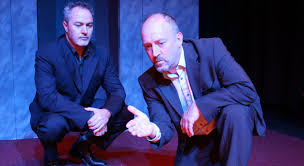
Gavin Robertson (l) & Nicholas Collett (r). Image: Assembly Roxy & Company Gavin Robertson

Gavin Robertson (l) & Nicholas Collett (r).
Image: Assembly Roxy & Company Gavin Robertson

“love its deadpan humour … the whole 4* performance of edge and ease”

Editorial Rating: 4 Stars:Nae Bad

You just know that you’re in expert hands when, to the exact beat of ABBA’s The Name of the Game, the dice are twice shaken and then thrown. Except they’re not, you just believe that you heard the rattle and saw the throw  …. and reckoned the fateful consequence. This is artful, practised, theatre.

The Dice Man appeared in 1971 and became a cult classic. The Six-Sided Man is its stage face, written and adapted by Gavin Robertson and first performed at the Edinburgh Festival in 1987. It’s back (by popular demand?) with Robertson himself playing The Patient and Nicholas Collett as The Psychiatrist. If they could, they’d be spokes on a roulette wheel; as it is they circle around each other, betting each other’s life on the throw of the dice, or die, which is an unfortunate pun.

The reason being, you see, is that the dice are liberating, freeing you of restraint and conformity by determining a single course of action that is irreversible. ‘Should I go out of the window four storeys up?’ becomes, on the throw of a 3, ‘I must go out of the window’. And where there is mortal risk there has to be sweet reward: roll a 6 and it’s the other guy who goes head first. The Winner Takes It All.

But that’s to jump the gun (with just the single bullet in the chamber, of course). The Patient comes to the Psychiatrist with his problems. The doctor is brisk. “Show me”, he says and the rest might be such weird stuff as dreams are made on but you’re not too sure. In fact – if that’s not too loaded an entity – there’s nothing quite so substantially awful as dog poo on your shoe on a first date.

The cure is that the predictable need not be endured or suffered  Yet the dialogue, alongside the high quality of the mime, voice and movement sequences, is unemotional and wary. No great shakes, you might say, but then you realise that there’s a face off here, with neither character prepared to raise the stakes until he’s as certain as he can be that he has the stronger hand. Knowing Me, Knowing You plays on.

The Dice Man was published under the name of Luke Rhinehart. In August 2012 ‘he’ announced his own death. Some believed it, some didn’t. It was a spoof but it allowed Luke to write his own valediction: ‘If you’re comfortable in the selves you’re rolling along with’, he wrote, ‘then roll on. Most people aren’t.’

You’ll roll with The Six-Sided Man and love its deadpan humour and admire the whole 4* performance of edge and ease but you’ll wonder where it’s going; at which point you’ll feel distinctly uncomfortable. Take A Chance on Me? You bet.

nae bad_blue

Star (blue)Star (blue)Star (blue)Star (blue)

Reviewer: Alan Brown  (Seen 8 August)

Go to The Six-Sided Man at Assembly Roxy.

Visit Edinburgh49’s  Assembly Roxy archive.

+3 Review: Nuclear Family (Assembly Roxy: 3 – 29 Aug. 1715. 1h)

Image. Sunday's Child & Fever Dream Theatre.

Image. Sunday’s Child & Fever Dream Theatre.

” .. a drama of a hopeless, unstable, situation”

Editorial Rating:  2 Stars

Torness nuclear power station is 30kms from Edinburgh, strikingly visible from the A1 and from the main line. The MailOnline did a photo feature on it in January last year. A close-up on one of the panels in the Control Room shows the operating switches to Boilers A to D. Understandably, there’s ‘Start Up’, ‘Drain and Warm-Up’, and – critically – ‘Dump’; which is what Ellen, who’s a technician at a nuclear site, has just done to Phil. He takes it very, very badly.

This then is your chance to get up-close and personal with nuclear safety. You play your part in an examination of how Phil, the jilted boyfriend, and a couple of his drunk mates got into the Central Control Room of a nuclear power station and caused a disaster. It’s your job to review the evidence of how it was allowed to happen and to play ‘What Would You Do / What Should They Have Done?’ The results are to be included in the final ‘Prescott’ report. (There is no connection BTW with the former Deputy Prime Minister or indeed, I trust, with any incident at a nuclear installation). As a core idea, it has a lot going for it; but what of its processes?

The audience of eight to ten – it might stretch to 14 or so – sits in a semi-circle. In front of us two actors act out the CCTV footage of the Security desk from that terrible evening. Ellen (Eva O’Connor) is on duty with her brother Joe (Adam Devereux), who is on a verbal warning for telling site managers what they don’t want to hear. This sequence is interrupted on five occasions for  audience participants to look at further evidence: personnel records, transcripts, and the like. A facilitator officiates and calls Time when a decision has to be reached: for example, sound the alarm now or wait? There is a show of hands to determine what happens next.

The acting was by far and away the best part, creating tension even when the plot approached meltdown. However, for me, the ‘interactive’ theatre was a nightmare. I had my senior doubts from the start when the bumbling distribution of iPods did not convince me that this was an official inquiry and then the request for a rapporteur helper was immediately taken up by a man to my right festooned with venue participant lanyards. He started whispering broken instructions on how to open the nano which I tried to follow but I had to give up on the looped audio files. My neighbour to the left seemed to be ‘on task’ and having an engaged conversation but all this activity seemed completely superfluous. It didn’t help, of course, that I was outside the discussions that were taking place. I just wanted to hear more from Joe and Ellen, whose acting was reaching critical levels, rather than wait for the next predictable outcome. Even then it was pretty obvious that whatever decision was reached, at whichever improbable juncture, it would make no difference. When the votes were taken there was no time to really examine the decisions reached. As an immersive simulation it wasn’t working; as a drama of a hopeless, unstable, situation, I liked its fallout.

Star (blue)Star (blue)

Reviewer: Alan Brown (Seen 7 August)

Visit the Assembly Roxy  archive.

+3 Review: Growing Pains (Underbelly, Cowgate: 5-28 Aug: 16.30: 1hr)

“Oozes a quality that is rare and valuable”

Editorial Rating: 5 Stars

There’s a lovely tradition at the Fringe whereby all companies performing at a certain venue are permitted “standby” tickets to other shows at that venue: once all paying ticket holders have been admitted, any empty seats are then up for grabs – if there are any. For this performance Underbelly companies didn’t just fill the few empty seats: staff were frantically laying out two extra rows at the back to cope with a level of demand I’ve never seen before. Within about 10 seconds of the performance starting, I could understand the hype.

As is so achingly trendy at the moment, Growing Pains is written like a performance poem, with rhyme and rhythm, ridiculously clever wordplay, and a lot of witticism. It’s brutal, honest and unflinching in its portrayal of a young man growing up on an estate in Salford and wanting to make it as an actor. Energy is red raw from the get go and you can tell this is going to be an intense and emotional hour.

Central character Tom introduces his friends, portraying each with clear physicality and accent, and we get to laugh at their banter and endeavours to get served at the local pub while underage. Later on we see those same friends grown-up, stuck in a rut and stifled in small-town mentality that Tom so desperately longs to break away from.

Tom Gill gives absolutely everything in this production – from emotive, heart-wrenching pleas to his dad, amusing turns as his Caribbean neighbour and a posture-perfect well-heeled yuppie, to more puns on London tube stations than you can count and a stripped back and haunting break-up scene with an ex-girlfriend: it really is a one man tour-de-force. For me, it’s 2016’s Johnny Bevan.

Oh, and it’s also a musical. With poetic lyricism that effortlessly floats in and out of song it only seems right to blend the two, and it just works. Not in a corny, musical theatre I’m-just-going-to-burst-into-song kind of way, but in a genuine expression of music being the only way for Tom to be able to communicate what’s going on in his head. It’s funny. moving, and incredibly well performed.

However, it’s not perfect – there are several odd little skips, jumps and glossings over within the narrative that could be made clearer or more cleverly interwoven without the need to go to a blackout – but everything about it oozes a quality that is rare and valuable and definitely worth buying a ticket to. Just ask anyone else doing a show at Underbelly.

Star (blue)Star (blue)Star (blue)Star (blue)Star (blue)

Reviewer: Steve Griffin (Seen 8 August)

THIS REVIEW HAS NOT BEEN SUBEDITED

+3 Review: Jane Eyre: An Autobiography (Assembly Roxy: 4 – 29 Aug. 1115. 1h30m)

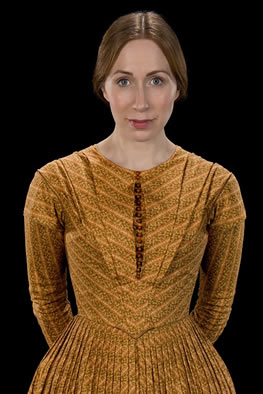
Image. Dyad Productions.

Image. Dyad Productions.

“Rebecca Vaughn’s solo work is outstanding.”

Editorial Rating: 3 Stars Outstanding

” ‘… and when I draw up the curtain this time, reader, you must fancy you see …’  me, plain and plain-spoken Jane Eyre, on stage for ninety minutes as I tell you the story of my life.”

We have an autobiographical telling, dramatic and full of character, with nothing of substance left out and everything of significance retained. From the window seat in the breakfast room, aged 10, to the parlour of Ferndean Manor, some nine years later where the blind Mr Rochester – he of the ‘brow of rock’ – reclaims his darling Jane. Writer Elton Townend Jones calls his work ‘an impressionistic adaptation’ of Charlotte Bronte’s book. Well, fair enough, along with the charged immediacy of the scene(s) comes the solid narrative, fused and monumental.

Performer Rebecca Vaughan is definitely impressive. She is Jane, of course, but she is also everyone else – except the source of crazed laughter from the attic. There is, inevitably, a cartoon Mr Brocklehurst, who might as well be the grim progenitor of today’s (English) free schools. Mr Rivers, impossible for the irreligious to figure, is left pallid and decent. Mr Rochester is gruff and always amused by Jane’s frank determinations. As Jane, Vaughan is upright and indomitable, which makes her excitement and frailty when it comes to the love story just a bit tricky. However, if romance is your thing, then Jane’s virtuous path to happiness is surely realised.

What makes the novel probably undoes its efficient telling. Jane ‘hadn’t intended to love [Rochester]’ but does and she certainly never expected riches but she gets them. That, to use Bronte’s unlikely word, is a ‘stunner’. The stage-succinct explanation of her 20K inheritance does advance a parallel narrative that gives Jane an easy living that is more assured than the trials and anxieties of any self-respecting literary heroine should be. I wondered, listening hard, whether her assessment of Position, Fortune, & Age in the marriage stakes – our century’s life-style choices – was beginning to count for more than love, which (I concede) is rather uncharitable.

Dyad Productions have worked the text of Jane Eyre to lucid and creditable effect and Rebecca Vaughn’s solo work is outstanding. I just found the whole piece satisfying and accomplished rather than remarkable or radical, which the novel is.

outstanding

StarStarStar

Reviewer: Alan Brown (Seen 7 August)

Go to Dyad Productions

Visit Edinburgh49’s Assembly Roxy archive.