‘The Gondoliers’ (Pleasance: 17 – 21 March ’15)

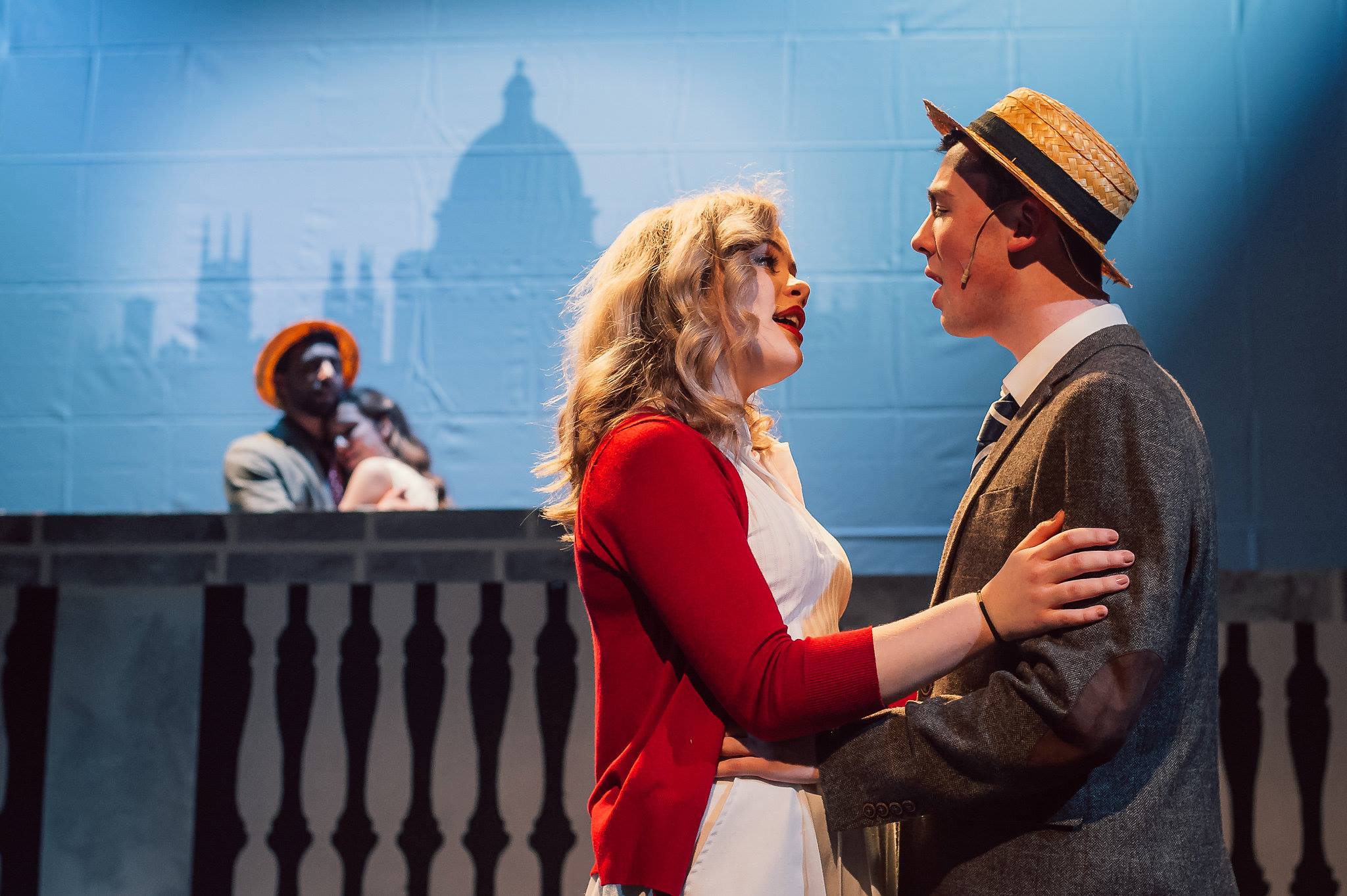
fr. Eleanor Crowe as Gianetta with Harry McGregor as Marco; with Lydia Carrington as Tessa and Sean Marinelli as Giuseppe, behind.

fr. Eleanor Crowe as Gianetta with Harry McGregor as Marco; with Lydia Carrington as Tessa and Sean Marinelli as Giuseppe, behind.

 “The lovers glide through their united vocal performances”

Editorial Rating: 4 Stars:  Nae Bad

Director Thomas Ware and Assistant Director Lucy Evans set out with a vision to create a modernised version of Gilbert and Sullivan’s comic opera The Gondoliers and by the King of Barataria do they succeed! The costumes ooze Fifties glamour and glam their way through prestigious St Mark’s, ‘Oxbridge’; for St Mark is the patron saint of the original setting, Venice. Geddit? We have a show worth seeing.

His debut on the maestro’s podium saw Musical Director Steven Segaud coaxing a sound from the cast that can only be described as stunning. Conducting a 30-piece band and a cast of 33 takes great skill and his hard work paid off. The eleven-strong male chorus is perfectly matched by their female counterparts. The combined choral sound is magical and the principals more than hold their own when on their own.

Gilbert and Sullivan are notorious for weaving multiple devilishly intricate, wordy melodies that can trip up even the well-seasoned EUSOG trouper, but this cast were as quick lipped as they were quick witted. The overall sound and lasting impact more than made up for any bum notes from the band pit or stage.

Set Designer Isobel Williams and her team deserve mention for the unembellished stage design. It was most effective – using silhouettes is a clever way of determining location without having to build separate sets for the two cities and the bridge-turned-platform was also a great asset to the stage dressing; adding both height and opportunity for fun entertainment, should the need arise. What’s more, the gondoliers could then pass through ‘behind’; noticeable but unobtrusive – the audience catching no more than a glimpse of a hat, a head and an oar: a most effective direction.
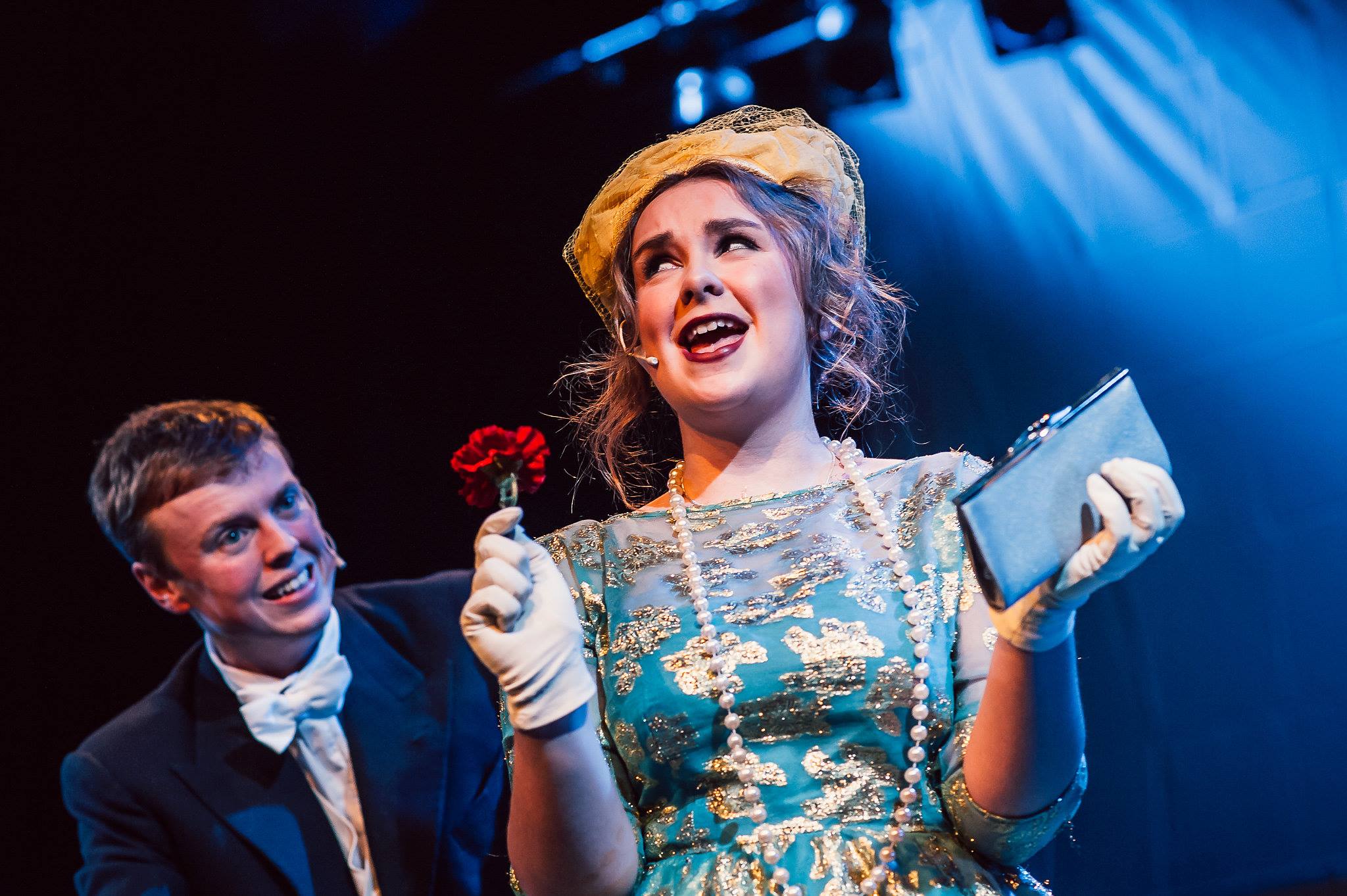
Dominic James Lewis and Lucy Gibbons as the Duke and Duchess of Plaza Toro. Photos: EUSOG

Dominic James Lewis and Lucy Gibbons as the Duke and Duchess of Plaza Toro.
Photos: EUSOG

The added references of pop culture to the script did add to the hilarity of many a situation – most notably the larger-than-life Duke of Plaza Toro and his wife, the Duchess; portrayed by Dominic Lewis and Lucy Gibbons. The evident cracks in their marriage and need for lavish pomp and ceremony resulted in expectant chuckles from the audience as soon as they appeared on stage – such a reaction cannot be misconstrued. The pair’s comic timing and natural awareness and reaction to the other’s antics made for a great laugh.

Harry MacGregor and Sean Marinelli took to the roles of gondoliers Marco and Giuseppe, respectively, with an ease and camaraderie that was a joy to watch on stage. While the brothers’ vocals may not always have reflected their unity, their acting certainly did, especially when acting through technical glitches and finding love. The pair’s love interests, Eleanor Crowe and Lydia Carrington, made easy the chance to revel in G&S splendour – as Gianetta and Tessa; these sopranos worked their instruments well to produce a beautiful sound, and as a quartet, the lovers glide through their united vocal performances.

The most convincing love entanglement springs between Casilda, daughter of the Duchess – and newly made Queen of Barataria – and Luiz, a serving man. This tricky, class conflicted, love was fantastically conveyed by Ethan Baird and Ellie Millar; the pair’s pathetic battle against their feelings was poignantly funny – this poignancy only made more bitter sweet by the mellow melding of the pair’s vocals. Millar rose effortlessly through the high notes and was complemented perfectly by Baird’s rich tenor. And as with all Gilbert and Sullivan fairy tale-esque romances, the queen gets her king, strife is resolved within Barataria and Baird shows he suits both bowler hat and king’s garb.

All in all, farce and fancy that epitomizes what it means to be a Savoy Opera where life’s a pudding full of plums. Tra, la, la, ha, ha, ha, et cetera.

nae bad_blue

Star (blue)Star (blue)Star (blue)Star (blue)

Reviewer: Amy King  (Seen 16 March)

Visit Edinburgh University Savoy Opera Group here.

Visit the  Pleasance archive.

‘Chess’ (Church Hill Theatre: 10 – 14 March’15)

The Chess game between Anatoly Sergievsky (Kenneth Pinkerton) and Freddie Trumper (Ali Floyd). Photo: Alan Potter, StagePics.co.uk

The Chess game between Anatoly Sergievsky (Kenneth Pinkerton) and Freddie Trumper (Ali Floyd).
Photo: Alan Potter, StagePics.co.uk

“Gorgeous creativity”

Editorial Rating: 4 Stars Outstanding


Fifteen years ago, in what can only be classed as a folly of youth, I went all the way to Frankfurt to see a production of Chess. I tell that anecdote to highlight two key points: firstly, that performances of this musical aren’t that easy to find, and secondly that I’m a dyed-in-the-wool Chess nut. You can trust me, then, when I say it’s worth the bus trip to Morningside – because Edinburgh Music Theatre’s interpretation of the story is among the best I’ve seen.

Since its West End opening in 1986, Chess has had an appropriately chequered past. Written by Tim Rice and – of all people – Benny and Björn out of ABBA, it’s a 1970’s tale of Cold War intrigue set against the backdrop of a world-championship chess match. Being a musical, however, it’s also a schmaltzy love story; the juxtaposition doesn’t quite work, and the book’s been through a string of revisions in an attempt to find a winning endgame. Yet for all the plot’s faults, the soft-rock score ranks among my favourites, and there’s a sly humour to be found underpinning some of Rice’s more preposterous rhymes.

Without a doubt, the greatest strength of Edinburgh Music Theatre’s version is its engaging and hard-working ensemble. When they fill the stage, their voices truly fill the room, and I loved the little story vignettes that were often built into their tableaux. It’s a huge group of people, yet they’re made to seem even more numerous by a slew of rapid costume changes: far from the black-and-white styling you might be expecting, we’re treated to an unashamed riot of lumberjack shirts, sparkly pom-poms, leather hot-pants and flamboyant jeans.

There’s a gorgeous creativity to Mike Davies’ direction too – not just in the broad sweep, but in the minor detail, bringing out insights that are unexpected and new. A trivial example will show you what I mean: there’s a particular moment in a particular song when every director has the cast stamp their feet. It’s what the music seems to demand, and it captures the menace inherent in the East – vs – West storyline. But in this production, when the time comes, they look towards each other with cloying false smiles – turning the number on its head, to uncover a glorious comedy of manners.

Unfortunately though, the sheer size of the chorus occasionally overpowers the production. The iconic Anthem, for instance, is all about solitary defiance – and the impressive Kenneth Pinkerton was perfectly capable of holding the stage for it, without having twenty-odd singers troop into the foreground. More significantly, the chorus and the principals sometimes seemed to be in competition, with the leading actors’ lyrics often drowned out by a swelling accompaniment.

Among the other principals, it took me a while to warm to Ali Floyd as the American grandmaster Freddie Trumper; he lacked some of the boorish aggression his lyrics seem to imply. Still, he comprehensively won me over with his character-defining solo ‘Pity The Child’, which he performed with both vicious anger and electrifying restraint. Josephine Heinemeier also delivered some show-stopping moments as his partner Florence, while Lauren Gracie made an all-too-brief appearance as the Soviet grandmaster’s wife Svetlana. Gracie has a stunning voice, and it’s just a shame that the script (which, to be honest, isn’t all that big on women) makes us wait so long to hear it.

In the end though, the crowning achievement of Edinburgh Music Theatre’s production isn’t the solos or even the set-pieces, but the way it tells the story. The pace occasionally slips, but at their best they segue seamlessly from song to scene to song – building a sense of coherence and immediacy that even professional musical productions often lack. The climactic number ‘The Deal (No Deal)’ is genuinely exciting, presided over by a mischievous pair of god-like figures who delight in the havoc they’ve wrought. So if you’re tempted by this one, be sure not to miss it – that would be a folly at any age..


outstanding

StarStarStarStar

Reviewer:  Richard Stamp (Seen 12 March)

Go to Edinburgh Music Theatre here

Visit the Church Hill Theatre archive.

‘The Merchant of Venice’ (Assembly Roxy: 10 – 14 March’15)

Isobel Moulder as Portia and Will Fairhead as Bassanio.

Isobel Moulder as Portia and Will Fairhead as Bassanio.

“From the Rialto to Little Venice, W9,  is neat”

Editorial Rating:  3 Stars

Were Antonio at work today, this stacked play would be even trickier than it already is. He’d be talking about moving cargo rather than sailing ships. His wealth would be in metal boxes to Singapore or Mumbai rather than argosies from Venice. Nevertheless, reassuringly, his sound advice to Bassanio would be the same: “Go, presently inquire where money is”. That would send the enterprising lover to Shylock, who would have friends and funds in Frankfurt and away we go.
However, in this production when Shylock asks “What news from Germany?” (that’s Genoa back then), the context shifts mightily. For now we’re back to September 1939 and the news ain’t good. In fact if you’re Jewish it has been desperate. Director Rae Glasman finds a choice text in Prime Minister Chamberlain’s declaration of war:

   “Now may God bless you all. May He defend the right. It is the evil things that we shall be fighting against – brute force, bad faith, injustice, oppression and persecution – and against them I am certain that the right will prevail.”

That’s not Shakespeare but it works. For a start, which God: Christian or Jewish? Who is the more righteous: backscratching Bassanio, Jew-baiting Gratiano, or is it Antonio, who spits at Shylock in the street? Is it merciful or just to condemn Shylock to near ruin and to force him to convert? Portia, if always an unlikely victim, will find happiness in marriage. There is a happy and flimsy ending, which is why – I suppose – Glasman has that radio broadcast at the end of the play, to make her audience ask what exactly has prevailed here? Actually, I would have welcomed that mooring at the start. There’s the trouble with The Merchant of Venice; it goes all over the place: scenically, tonally, action-wise. Underwhelming and overwhelming.

From the Rialto to the City of London and to Little Venice, W9, is still neat. Portia’s Belmont is relocated to a country house, somewhere in the Chilterns, I guess. That is not a displacement too far but it looked hard to accommodate on the Roxy’s stage. I found the opening and drawing of the full length curtains in-between scenes more distracting than helpful and it’s a No-thank you to the squealing Downton maids at open-the-box time. The Glen Miller sound was melodious though and the cocktail cabinet and fetching evening wear did their elegant, idle, thing well enough.

As do Bassanio’s set of chaps. Portia (Isobel Moulder) sees them – and quite possibly all men – as “bragging Jacks” to be practised upon, which this marble-mouthed lot certainly deserve. She is also properly merciless in the court, where otherwise the languor of the club rooms seemed to have carried over. To supply Bassanio (Will Fairhead) with an Eton education and braces was presumably to allow him to stand nonchalantly, hands in pockets, between the caskets and to give him the manners, surely the compassion, to pick up Shylock’s yarmulke from the floor and to give it back.

Joe Shaw as Shylock with Kirsty Findlay as Jessica. Photos: Aliza Razel

Joe Shaw as Shylock with Kathryn Salmond as Tubal.
Photos: Aliza Razel

I could believe in Shylock (Joe Shaw) as a broken father. “My daughter is my flesh”, he says, and then Jessica abandons him – or is stolen from him. His hair should have been greyer but it is no surprise when – to take like for like – he would cut into a spent Antonio (Pedro Leandro) above his heart. There is real pain in that vengeful effort.

Kirsty Findlay as Jessica and Chaz Watson as Lucy Gobbo.

Kirsty Findlay as Jessica and Chaz Watson as Lucy Gobbo.

There are laughs in the features and antics of preposterous suitors, Arragon and Morocco, and in the crazy work of Lucy Gobbo (Chaz Watson) who sounds like the ‘wauling bagpipe’ of Shylock’s protest and who looks way too bad for Emil and the Detectives.

Rory McIvor as Lorenzo spoke the (blank) verse best and did Moonlight Serenade introduce his scene with Jessica near the close? I can’t recall. I do remember approving Bassanio’s choice of the lead casket, for ‘Thy plainness moves me more than eloquence’, which is where I stand on this production. It looks pretty and sounds attractive but its necessary centre of gravity is away, awry.


Star (blue)Star (blue)Star (blue)

Reviewer: Alan Brown  (Seen 10 March)

Visit the Assembly Roxy archive.

‘The Effect’ (Summerhall: 11 – 14 March’15)

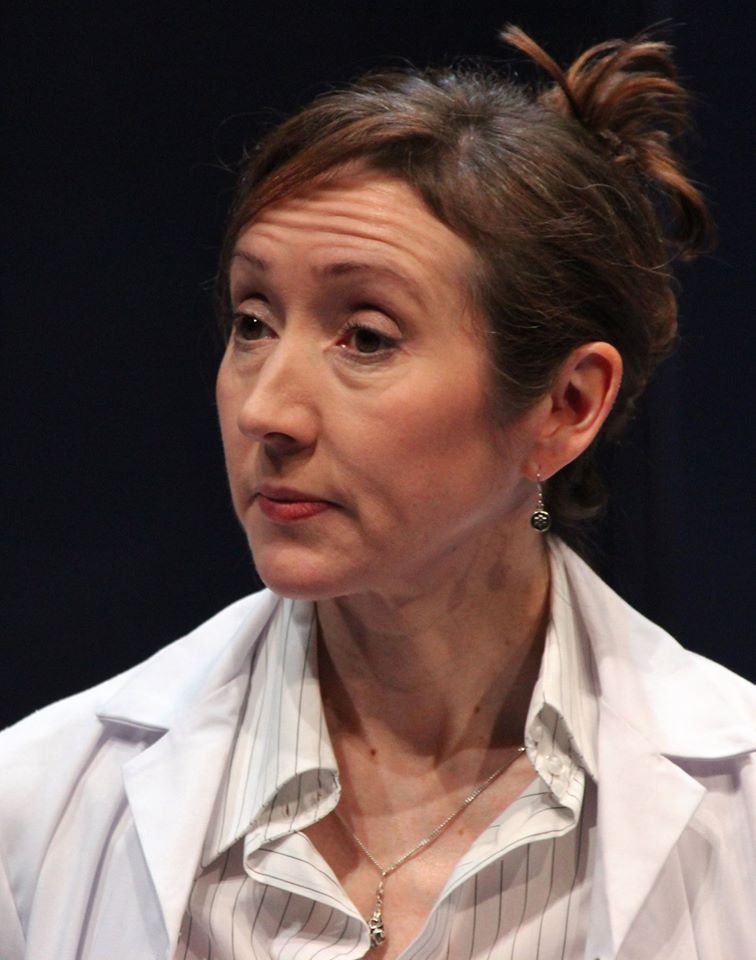
Cameron Crighton as Tristan and Scarlett Mack as Connie All photos: Firebrand.

Cameron Crighton as Tristan and Scarlett Mack as Connie
All photos: Firebrand.

“A well-thought-out and faultlessly-delivered show”

Editorial Rating: 4 Stars: Nae Bad

Set across the four-week span of a clinical drugs trial, The Effect (2012) is a play which tackles perhaps the highest concept of all: our ability to assess and analyse the workings of our own mind. Penned by Lucy Prebble , best known for writing the briefly-sensational ENRON, it’s revived here by Borders-based company Firebrand Theatre. Ironically though, Firebrand’s clinically-excellent performance throws into focus a few pronounced oddities in the script.

The “effect” of the title is the placebo effect – the powerful medical phenomenon which says that if we think we’re taking a drug, we’ll experience at least some of its benefits. Prebble explores that concept through two parallel storylines: a young couple who may or may not be falling in love, and a doctor who may or may not be depressed. Intellectually, I can see how this all hangs together, but it still felt like I was watching two plays uncomfortably squashed into one. “What is love?” and “Do antidepressants work?” are just very different questions, and I’m not sure it’s possible to tackle them both while doing full justice to either.

Much more successful, for me, were the human tales. On the one hand, there’s a sweet boy-meets-girl story – with the requisite courtship, predictable crisis, and the hope of a reconciliation by the end. It’s a time-worn formula, but it’s well-executed, and the tale has a twist that’s genuinely startling yet fully justified by the plot. Actors Scarlett Mack and Cameron Crighton do a fine job delivering characters we can love, with Crighton’s physical restlessness also adding plenty of interest to a series of otherwise quite static scenes.

Pauline Knowles as Lorna

Pauline Knowles as Lorna

Jonathan Coote as Toby

Jonathan Coote as Toby

Alongside them we have Pauline Knowles’ acerbic but secretly-warm-hearted doctor, who provides a lot of deadpan humour but clearly has a vulnerable side too. Knowles impressed me with her ability to inject subtle emotion, as did Jonathan Coote, playing the pharmaceutical-company manager with a secret in his past. It’s hinted early on that these two characters have met before, and the details of their relationship are revealed in carefully-measured doses – an ongoing mystery which underpins the first act of the play.

Fine acting and direction are complemented by an effective design. The whole production is stark and monochrome, filled with medical whites and impersonal greys, a choice which serves to highlight rather than diminish the colourful humanity on display. Every now and then the cast break off into stylised sequences set to a techno-inspired soundtrack, punctuating the wordy script while skipping lightly over the duller parts of the plot. At times it all grows a little protracted – and I certainly wouldn’t have minded if they’d cut the last ten seconds of the sex scene – but all in all, Firebrand Theatre do well to thread a coherent path through a complex storyline.

In the end, the effect of The Effect was a mildly frustrating one: the script tries too hard to draw connections, and ends up feeling both crowded and languid at the same time. But that’s no reflection at all on the production company, who once again (see our reviews of Outlying Islands and of Blackbird) have laid on a well-thought-out and faultlessly-delivered show. All in all, this one’s well worth catching on its remaining dates at Summerhall – for the questions it poses may be disjointed, but they’re still intriguing ones.


nae bad_blue

Star (blue)Star (blue)Star (blue)Star (blue)

Reviewer: Richard Stamp (Seen 11 March)

Go to Firebrand & Summerhall here

Visit the Summerhall archive.

‘Long Live The Little Knife’ (Citizens, Glasgow: 24 – 28 Feb.’15)

Neil McCormack as Jim Wendy Seager as Liz Photo: Tommy Ga-Ken Wan

Neil McCormack as Jim Wendy Saeger as Liz. Photo: Tommy Ga-Ken Wan


“Exquisite performances”

Editorial Rating: 2 Stars Outstanding

nb. Long Live The Litte Knife is now on tour and plays at the Traverse  this Saturday, March 7, at 7.30pm.

This is a show about having balls, which might explain our curious ‘2* Outstanding’ rating, but it doesn’t. That’s down to great acting.

Ballsy, I maintain. Both literally – the “little knife” of the title is the one used to emasculate castratos – and figuratively, too. So here’s a ballsy statement of my own: despite playwright David Leddy’s reputation, despite compelling and committed acting, and despite the plaudits heaped on the show during its run at the Edinburgh Fringe … it isn’t actually very good.

There’s just far, far too much packed in. The play’s themes include love, loss, art, infertility, deception, class, and modern slavery – all tackled at breakneck pace, with alternating comic and tragic tones. At the very end, Leddy brings out the darkest topic of all – one that’s proved more topical than he can possibly have feared when he penned the script back in 2013. But by that point, and perhaps to my shame, I was so overloaded that I couldn’t bring myself to care.

Don’t get me wrong: it’s fine for a script to seem anarchic, as long as there’s something constant threaded through it, something you can recognise and grab onto. The problem with Little Knife is that there’s no central premise – unless you count a foggy concept that things aren’t ever what they seem. The principal characters are confidence tricksters, and the script is pulling a kind of trick of its own: persuading us that, because we’re feeling slightly confused, there must be something deep going on.

But I’m sorry, there isn’t. And that’s a big shame – because there are the outlines of some thought-provoking themes visible through the murk. At one point, it seems that Leddy’s about to deconstruct the whole concept of verbatim theatre, an exercise which could be both entertaining and genuinely profound. But it goes nowhere: there’s some off-the-wall dialogue between an actor and a techie, then the theme is quietly dropped, never to be discussed again.

The avant-garde clichés are abundant – that on-stage techie, actors who announce that they’re actors, stage directions read aloud – and there’s an over-worked set-up for a final flourish, which on the night I attended was thoroughly ruined by a glowing fire-exit sign. As I write this, they’re tweeting that they bought all their equipment from a builder’s yard. So?

Neil McCormack as Jim Wendy Seager as Liz Photo: Tommy Ga-Ken Wan

Neil McCormack as Jim Wendy Saeger as Liz.                                   Photo: Tommy Ga-Ken Wan

What redeems the show, however, are exquisite performances from Wendy Saeger and Neil McCormack, who acquit themselves with considerable distinction in extremely challenging roles. Out of character, they’re friendly and welcoming; once the story begins, they keep the energy high as events become more and more absurd. And on the few occasions they’re allowed a little time, they show intense sensitivity, dropping the mood in an instant as the pain in their past is revealed.

Saeger is particularly powerful when her character recalls a dying son; McCormack, meanwhile, endures a wince-inducing crux scene, which very few actors could make so horribly real. It’s worth watching the background, too, as their reactions to events are often as compelling as the cavorting in centre-stage. So it’s five stars for them – but alas, even stellar performances can’t counteract a thoroughly frustrating and self-indulgent script.

outstanding

StarStar

Reviewer: Richard Stamp (Seen 25 February)

Go to Fire Exit here (!).

Visit the Traverse archive.

‘Equus’ (Bedlam: 3 – 7 March ’15)

Douglas Clark as Alan Strang Samuel Burkett as Nugget, the God Equus Photo: Mihaela Bodlovic.

Douglas Clark as Alan Strang
Samuel Burkett as Nugget, the God Equus
Photo: Mihaela Bodlovic.

“You’re out there with the cowboys”

Editorial Rating:  4 Stars Outstanding

Track suits and gloves of chestnut velour, anyone? Well, maybe in 1973 when Equus first cantered and careered into stage history. Now, we’ve lost the strutted hooves and it’s black Sculpt Tight leggings and sports bras. No matter, for this is a super fit production and the horses look the part. Do not, under any circumstances, think germinal, theatrical, War Horse, for director Emily Aboud achieves blinding drama.

Literally. Alan Strang (17) took a hoof pick to four horses and put out their eyes. (It was six in the original production but play fair with Bedlam’s space). Martin Dysart is the psychiatrist who gets inside Alan’s head to see what went ‘wrong’ and – maybe – to make him ‘well’. These are troubled and relative terms, as becomes extremely clear. Dysart reports Alan’s story as Alan tells it and is assisted by the testimony of parents, girlfriend and employer, and in so doing lays bare his own obsessions and vulnerability. This is one treatment plan where the word sacrificial does not beggar belief.

The two principals are admirable. Douglas Clark as Alan is lean, hurting, and his voice breaks from soft assent to pain and furious anger with remarkable force. His few scenes with Jill (Chloe Allen), his unexpected girl, are both tender and acutely awkward. He is also, in the extraordinary last scene of Act One, and alone with Equus, in complete control of what could be disastrously affected language. Charley Cotton plays Dysart as the decent doctor who has just about given up on the prescription ‘to heal thyself’. His dreadful marriage – to a Scottish dentist! – is as neatly dissected as his vain hopes to discover real pagan Greece in his Kodachrome snaps of Mount Olympus.

Douglas Clark as Alan Strang Chloe Allan as Jill Mason Photo: Mihaela Bodlovic.

Douglas Clark as Alan Strang
Chloe Allan as Jill Mason
Photo: Mihaela Bodlovic.

Designer Emiline Beroud respects Peter Shaffer’s original setting. The cast is on stage throughout, sitting at the back or to the sides when not performing. The centre stage is railed off on two sides and provides consulting room and stable floor. The horse masks hang left and right. Bedlam cannot accommodate the back-drop of tiers of seats, as if in an old anatomy lecture theatre, so Dysart’s talk becomes more confessional than public spirited and – if anything – more characterised by what Shaffer called its ‘dry agony’.

And the visual action is extraordinarily effective. That’s a lot of rehearsal time, I reckon. Mimetic movement, snap-tight lighting (predominately blue) and an electric beat do deliver Shaffer’s choric element. When these horses move and when one is ridden you’re out there with the cowboys of Alan’s wishes. When it all goes dark, in between the strobe flashes, it’s a stampede of the mind.

Equus has an awesome reputation and that’s in the classical, God fearing sense of the word but its notoriety has probably gone and it might seize up and appear contrived. There was some first night stiffness to the supporting roles but for the most part this exacting production gives its language and ideas free rein and exciting liberty.

outstanding

StarStarStarStar

Reviewer: Alan Brown  (Seen 3 March)

Visit Equus at Bedlam here

Visit the Bedlam archive.

THIS REVIEW HAS NOT BEEN SUBEDITED

‘Bitter Sweet’ (Discover 21 Theatre: 27 Feb -1 March ’15)

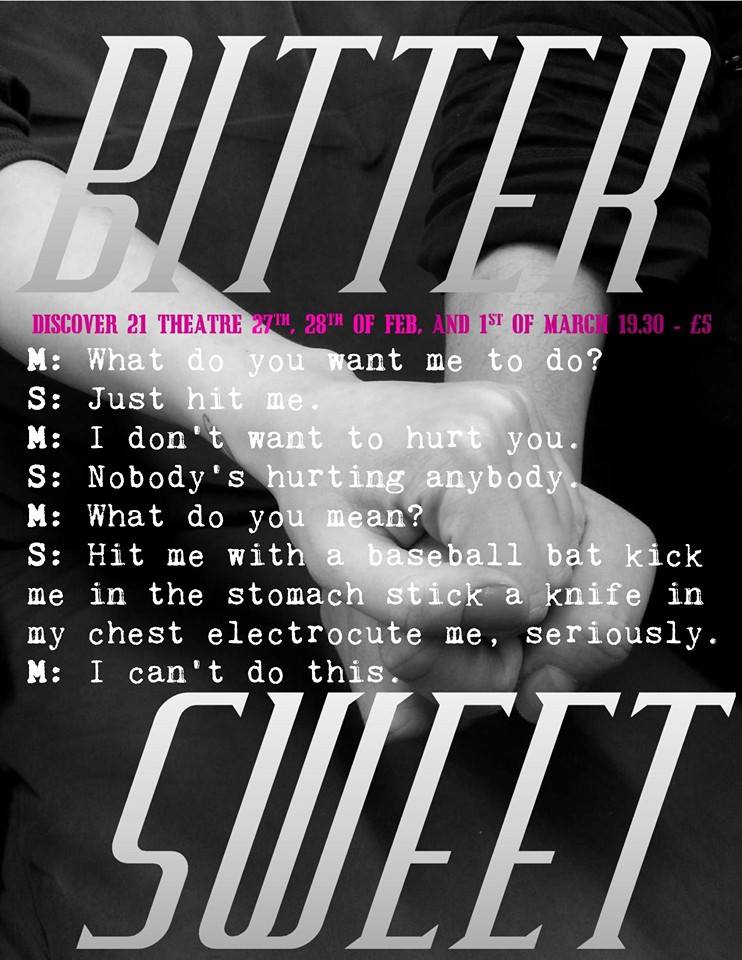
Bitter Sweet 2

“Distorted Love”

Editorial Rating: 3 Stars: Nae Bad

Shocking.

That’s the first word that springs to mind when looking back on the journey followed in Bitter Sweet. Writer and Director Kolbrun Bjort Sigfusdottir created a show that saw reality and fantasy twisted and contorted into a near horror story.

The venue, Discover 21 Theatre, was a perfectly intimate venue that provided closeness to the action that was necessary for this performance to deliver its full impact.

The set was simple, yet detailed. The hints of Steig Larsson’s influence on the script were mirrored in the set – his books featured on the shelves of the bookcase and were reflected in S’s character traits. A small fold-out sofa that sat stage-right was used in a variety of ways that kept the action from becoming too similar and repetitive.

Technically, this play was slick. The music was well-fitted to the rising tensions and served to heighten emotions – both loving and dark. The tone of the scene changed with the lighting cues which was a clever technique to keep the course of the play as disjointed as the relationship.

Both Kate Foley-Scott and Ben Blow tackled this difficult script with a tenacity that is commendable.

Depression and its effects on love feature heavily in this show. Foley-Scott was completely convincing in her portrayal of a manic depressive. Her pleads to be hurt were difficult to watch but impossible to look away from. Her character, known only as S, was desperate to feel anything, while inflicting nothing but pain on her partner. Despite her small stature, Foley-Scott offered a huge performance that was warmly received by the audience.

Ben Blow approached this play masterfully. His constant switching between the softly spoken, sensitive boyfriend and the angry, resentful, jilted lover was fascinating to watch. Blow owned the stage in both roles and that made for confident performance, even the most controversial scenes between the couple were grimly tenable.

The sensitive subject matter of sexual violence left the audience reeling; perhaps it really was too vivid and coarse. A less abrasive way to introduce the idea could have been to perform the scene in a black-out so only the voices could be heard. In all honesty, one scene was too graphic and uncomfortable to the point where it was unwatchable.

It would be wrong to say that this show was enjoyable – what with its dark content – but it certainly grips you. It was a shame that the audience were so few in number, but their appreciation for the performance was genuine and well-deserved.


nae bad_blue

Star (blue)Star (blue)Star (blue)

Reviewer: Amy King  (Seen 27 February)

Visit Discover 21 theatre here .

THIS REVIEW HAS NOT BEEN SUBEDITED

‘Twelve Angry Men’ (King’s: 23 – 28 February ’15)

“Such astute casting goes to show why people go to shows produced by Bill Kenwright.”

Editorial Rating: 5 Stars: Outstanding

What is the surest way to provoke a fist fight amid the genteel splendour of London’s Garrick Club? You could start by loudly telling the one about the Earl of Grantham and the absolutely fabulous Fashion Director – that gets the members catty quick.

To really get them mad, try suggesting that John Laurie must have been better as Shakespeare’s Lear than as Dad’s Army’s Private Frazer. Tables will upturn, CP will get some poor sod in a headlock, NG’s eyes will be rolling as he bellows “We’re aul doom’d” in his best attempt at a Hebridean accent, the ghosts of JMB and AAM will appear, searching out suitable opportunities to glass someone with a broken bottle.

Then again, if you really want the furniture flying through the Irving Room, declare that Tom Conti is the definitive Jeffrey Bernard (which he is – so shut it before I shove this portrait of Dame Nellie Melba where the footlights don’t shine).

Seeing Conti in the titular role of Keith Waterhouse’s masterpiece, and as Joseph in Jesus My Boy, defined my ‘90s adolescent infatuation with theatre. Would seeing him tread the boards years later be like sneakily looking up the school totty on Facebook, only to discover they’ve now got more kids than teeth? No. Conti’s as awesome as ever. As the enigmatic naysayer in Reginald Rose’s jury room classic he does for the part of Juror 8 what Costas did for Shirley Valentine on that Greek boat. Conti lightly leads a heavyweight cast through a meaty narrative.

It’s the story of 12 strangers deciding the outcome of a murder trial. The wheels of justice are in motion, the defendant is on his way to the chair, when a lone voice drops a little doubt into a sea of certainty.

Originally shown on US television in 1954, the script of Twelve Angry Men calls for an up close and personal approach to blocking in order that each juror’s thinking can be established, examined and evolved. Michael Pavelka’s design places much of the action on an imperceptibly revolving platform. Turning the table at which the actors sit neatly enables us to see the tables turned on their characters’ prejudices. The effect is not unlike watching the dog drift off to sleep. His eyes don’t suddenly close, they slide shut slowly, languorously, until suddenly he’s chasing rabbits in the Land of Nod.

I’ve been lucky enough to see David Calvitto catch his share of rabbits at Fringes past. The grace and insight which are his trademarks are perfectly suited to Rose’s Juror 2 – the quiet man who up with this will no longer put. Alexander Forsyth (Juror 5, young) and Paul Beech (Juror 9, old) bookend the group’s age spectrum. Beech’s conversion to doubt is calm and collected, while Foryth’s is the opposite. Perhaps the appeal of Twelve Angry Men endures because it provides a showcase for such raw and careworn performances each alike in dignity.

Dignity is not high on the list of words used to describe bigoted Juror 10. Having lambasted the dignity of others in a hate-fueled tirade directed at the unseen defendant, the advocate for a lynching is hung out to dry when basic decency takes a stand. Included in Denis Lill’s unflinchingly delivery of the part is a degree of pathos unexpected as it is thought-provoking. With this powerful and emotive character study Lill digs out the intellectual foundations on which the final scenes will later rest.

This British production of an American classic superbly catches the rampant class conflict of a drama in which every juror is a king, but no man wears a crown. When Andrew Lancel (Juror 3, the opinionated businessman) locks horns with Mark Carter (as Juror 6, the blue-collar house painter) the tension is ratcheted up notch by furious notch. Such astute casting goes to show why people go to shows produced by Bill Kenwright (an Honorary Prof at TVU when Pater was VC).

Equally inspired is Edward Halsted (Juror 11, the new American). The decision not to reimagine the play in a more contemporary setting opens the goal for Halsted to strike at the original post-war, Cold War totalitarian milieu. Although my companion reckons he’s more Pete Campbell than Don Draper, Gareth David-Lloyd (Juror 12) is the Mad Menic icing on the period cake.

If there is a broad range of acting styles on show, there is also serious depth. Robert Duncan (Juror 4) is the shadow contrasting Conti’s light. Duncan’s not the shouty one, he’s not the juror with the biggest chip on his shoulder, but he is the one Conti needs to beat. Juror 4 is a self-assured stockbroker who doesn’t have a ball game to watch (as does the fabulously flighty Sean Power, Juror 7). He’s got all the time in the world. Conti’s character grinds down the others, the mortar, but it’s Duncan’s guy whose opposition is solid. The cast photo adorning the theatre programme and posters suggest to expect Conti v. Lancel. In actuality it’s Conti v. Duncan, theirs is the dynamic around which the rest orbit.

My aunt (the one who chews broken bottles and makes saltwater crocodiles cry real tears) shows Twelve Angry Men in her RE classes. It’s a morality play in which you might be watching an innocent man set free, or a juvenile delinquent get away with murder. It might be about frailty or egotism, certainty or doubt. What this production absolutely is, to paraphrase Duncan in Drop The Dead Donkey, is a raft for top quality character acting, several rafts in fact, lashed together into a “pontoon of excellence.”

outstanding

StarStarStarStarStar

Reviewer: Dan Lentell (Seen 23 February)

Visit the Assembly Roxy Bedlam Church Hill Theatre Festival Theatre King’s Theatre Other Pleasance, Potterrow & Teviot Summerhall The Lyceum The Stand Traverse archive.

THIS REVIEW HAS NOT BEEN SUBEDITED

‘The Caucasian Chalk Circle’ (Lyceum: 18 Feb. – 14 March ’15)

Grusha :Amy Manson Photo: Alan McCredie

Grusha :Amy Manson
Photo: Alan McCredie

“Compelling”

4 Stars: Outstanding

‘Standing between doorway and gateway, she heard
Or thought she heard …’

Listen up, “I’ve looked into the pockets of the rich and that is [considered] bad language.” Here is a contemporary, full-on production of Bertolt Brecht’s great and humane play; its profane political resonances not so much hanging in the air as gusting out of the wind machine. As it goes, these days and then, HSBC (Swiss arm) could be up there on the gallows with the town judge, the Chief Tax Collector and the rest. At a grim stretch, you’ve seen what’s happening in the eastern Ukraine, well, here we go again.

We’re talking piastres of indeterminate (Ottoman?) origin rather than of pound, franc or euro but who cares provided you’ve got a shedload? And that’s the economics of the piece: “Those who had no share in the fortunes of the mighty / Often have a share in their misfortunes.” Out of confusion, collapse, coup and revolution come the have-nots-have-all stories of brave Grusha and of His Worship the excellent, the most scurrilous Azdak. Theirs, in amongst the rifles, rape and the noose, is the unlikely, virtuous, lyrically unco traffic of our stage.

The Caucasian Chalk Circle is a play with songs and director Mark Thomson realises how entertaining it should and can be, in or out of the shadow of Soviet tractors. Sarah Swire, as the Singer-Narrator, is not Brecht’s ‘sturdy man of simple manners’ but a punchy and versatile performer whose style and presence guides and informs rather than commands. Cast members double as musicians and Composer/Musical Director Claire McKenzie creates a strong and urgent soundscape: the city falls to a fearsome clockwork beat; Grusha is held in a ghastly tango by her brute of a husband. There is dancing, quite rightly, at the close.

The Singer: Sarah Swire Azdak: Christopher Fairbank Photo: Alan McCredie

The Singer: Sarah Swire
Azdak: Christopher Fairbank
Photo: Alan McCredie

The Singer sings of once upon a time, for the legend of the circle of chalk is based upon an old Chinese play. At its centre Brecht places Grusha, the kitchen maid, who saves the Governor’s child and runs for the mountains. These are not kind times. Papa’s head ends up on a lance and soldiers are hunting them down. Grusha’s flight is perilous, not least when she’s crossing a 2000 foot drop on a half rotten bridge. This is terrifically staged, as befits the moment when ‘Grushna Vachnadze decided to be the child’s mother’. Thomson realizes that this play works when an audience is exposed to why people behave the way they do. Azdak’s decision not to hand over the fugitive Grand Duke makes sense when you are gripped by his arch reasoning. Trial by chalk circle is palpably, deliberately, grotesque but it’s a dramatic triumph.

Christopher Fairbank is a stomping success as Azdak. More the truculent Ariel than any burdened mage, he is the rogue Time Lord with an impish spirit who obliges and provokes in the blink of an eye. Amy Manson gives an unwavering performance as the steadfast Grusha and harvests all the sympathy that the audience as collective can supply. Nasty, uncomfortable menace comes from the Sergeant, frighteningly well played by Deborah Arnott whilst Shirley Darroch as fat Prince Kazbeki is a cigar chomping nightmare, only marginally offset by her blaring trombone.

Kazbeki: Shirley Darroch Photo: Alan McCredie

Kazbeki: Shirley Darroch
Photo: Alan McCredie

Alistair Beaton’s translation matches the lucidity of his programme notes on translating Brecht but is not helped when the accents travel far and wide: from the Thames estuary to the Welsh valleys, to Birmingham, to the North East, and to Scots, high and low. Strained rather than epic, I thought. And light features like smooth, RP-ridden lawyers, Barbour-clad farmers, mobiles, and a Lidl bag signify too much, too unnecessarily. You can speak uber German, I’m told, but all the same posh English for the ‘upper’ class is becoming too easy a target to mean much.

Still, “All pleasures have to be rationed” says the Girl Tractor Driver. Actually, not so in this eager and compelling production.


outstanding

StarStarStarStar

Reviewer: Alan Brown (Seen 21 February)

Visit The Caucasian Chalk Circle at the Lyceum here.

Visit the Assembly Roxy Bedlam Church Hill Theatre Festival Theatre King’s Theatre Other Pleasance, Potterrow & Teviot Summerhall The Lyceum The Stand Traverse archive.

THIS REVIEW HAS NOT BEEN SUBEDITED

‘Sister Act’ (King’s: 18 – 21 February ’15)

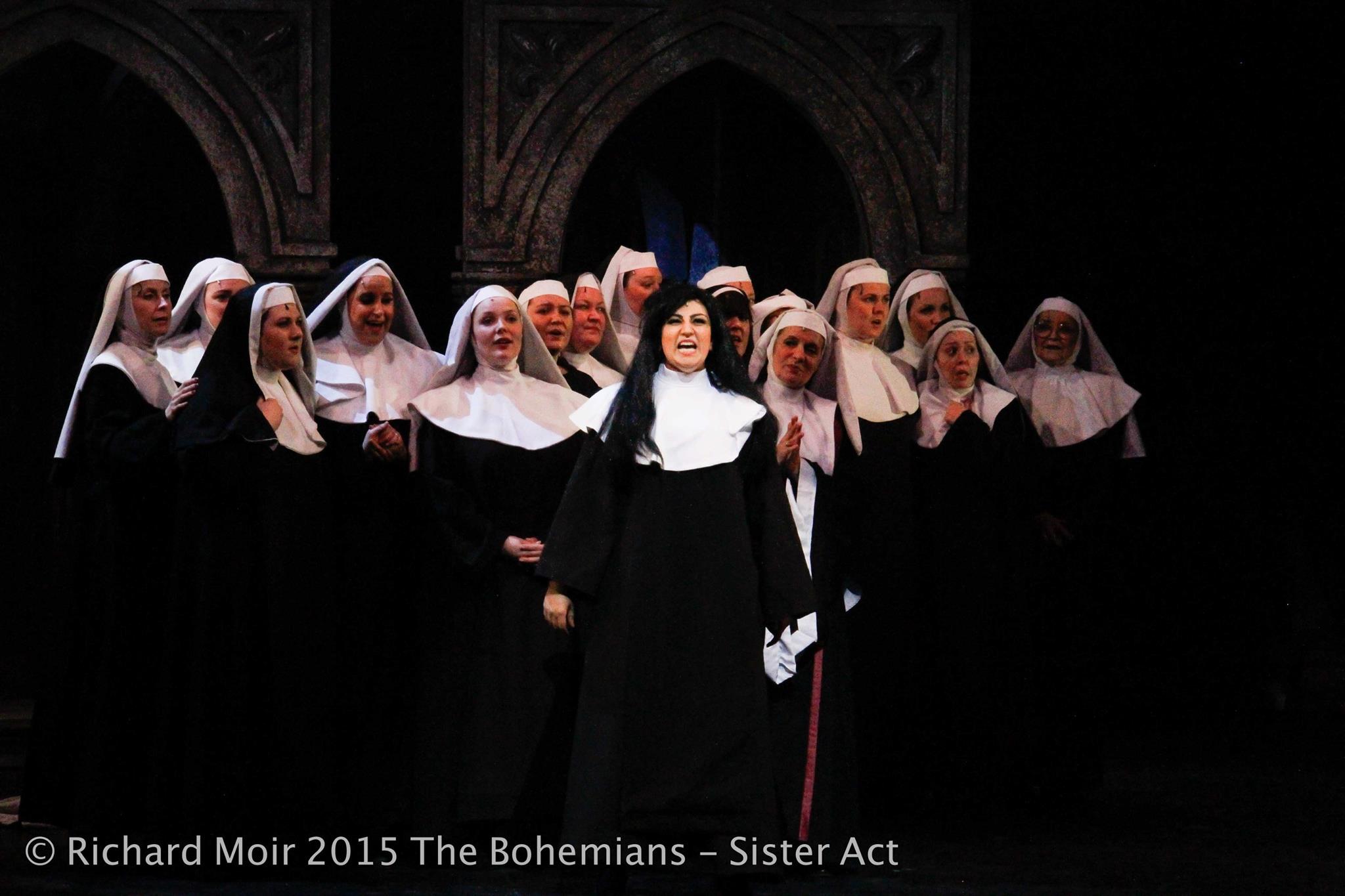
 SisterAct2

“Divine”

Editorial Rating:  4 Stars: Nae Bad 

‘The Bohemians’, established in 1909, are one of Edinburgh’s major amateur musical companies.

Sister Act was one of the first DVDs I was ever given as a child. There was always a magic to the film that I adored and Whoopi Goldberg never failed to have me dancing and singing along with the other nuns. Cheri and Bill Steinkellner adapted the Whoopi Goldberg classic for stage; something I am so glad they did. Bohemians’ director Colin Cairncross took on the challenge, bringing to the stage a production full of vivacity and talent. For an amateur production, this show really did impress.

Ian Monteith-Mathie took on the role of Musical Director for this production and worked with Alan Menken’s music score to create a beautiful sound from the performers – the harmonies in the full cast numbers were incredible. His orchestra carried the cast through the show in funky rhythms and soulful melodies.

Niloo-Far Khan took a walk in Whoopi’s shiny heeled boots as Deloris Van Cartier and commanded stage with ease. Vocally, her performance was faultless and she gave great gusto to her character. Her on-stage rapport with Mother Superior – portrayed by Dorothy Johnstone – was as entertaining as it was electric. The pair shone in the spotlight as they battled to prove the other wrong before finally reconciling their differences. Johnstone carried a wisdom about her that was evident in both action and song and her protective instincts towards the nuns shone through. It was truly delightful to witness the transformation of the choir of nuns – the resulting musicality from the hard work of Deloris (and Monteith-Mathie) raised hairs on the neck. It was, for lack of a better word, divine.

Officer Eddie Souther lamented that he “Could Be That Guy” and if he was referring to a talented singer and a joy to watch on stage, then Gareth Brown certainly was “that guy”. His soft, awkward character was greatly set against the imposing Curtis Jackson. Padraig Hamrogue’s portrayal of Curtis was reminiscent of the black and white gangster movies – his menacing demeanour coupled with a bluesy bass range created an imposing mobster who demanded respect through fear. His three henchmen, Joey, TJ and Pablo juxtaposed his dark humour by lighting the stage with their comical desperation to please their boss. Thomas MacFarlane, Lewis McKenzie and Andrew Knox really threw themselves into their characters and greatly entertained the audience with their antics – their song, “Lady in the Long Black Dress”, was hysterical, offering the comic trio a real chance to hustle the limelight.

The show was bathed in colour. The costumes – a superb effort from Jean Wood and Liz Kenyon – were fantastic; Lighting Designer Jonnie Clough filled the stage with a complex programme of spotlights, colourwashes and dazzling effects. The set design from UK Productions Ltd, although perhaps too large and busy for the stage space, was certainly impressive in its detail. This production was full of glitz and glamour; even the nuns were able to lose the basic black habit for something a little (or a lot) more colourful. The cast raised their voices and they raised the roof. This was an uplifting performance and a fantastic show.

nae bad_blue

Star (blue)Star (blue)Star (blue)Star (blue)

Reviewer: Amy King  (Seen 18 February)

Visit ‘The Bohemians‘ here

Visit the  King’s Theatre archive.

THIS REVIEW HAS NOT BEEN SUBEDITED