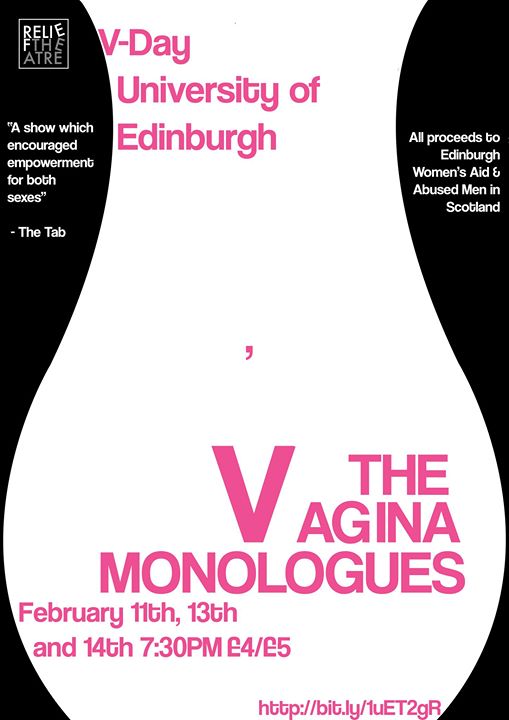
‘The Vagina Monologues’ (Teviot: 11, 13 -14 February ’15)

v monologues

“No hiding.”

Editorial Rating: 4 Stars: Outstanding

Let’s talk about what it means to be a woman, and let’s be real about it.

That is the message of The Vagina Monologues from Edinburgh University’s Relief Theatre.

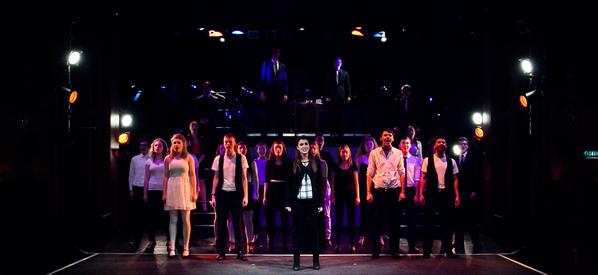
There was no hiding from the awkwardness of the topic. Director Rachel Bussom was not about to allow for the comfort of anonymity that an audience can revel in, cloaked in darkness and removed from the stage space. This theatre-in-the-round was intimate and uncomfortable and sobering. A lack of props kept this show from feeling like a staged event. Instead, it took on the live and shameless persona of an organic story-telling. The close proximity to the actors in a brightly lit room created a close connection; a sense of shared identity regardless of age or gender.

Sex is a common theme in theatre, but sexuality is more obscure. Obscurer still is female sexuality in all its forms. Not today. Today, women were talking, or in the case of Julia Carstairs they were shouting, about vaginas and everything that comes with them.

For instance: hair. Martha Myers’ exasperation and resignation shone through as she hit home about the societal pressures attached to expectations of body image  – something Julia Carstairs’ first monologue, “My Short Skirt”, energetically pulled apart.

The combined efforts of the narrators, Ella Rogers, Caitlin McLean and Maddie Haynes, along with Marina Johnson’s statistical ‘Factbook’, kept the show current and hard-hitting – an impressive task considering the original show premiered nineteen years ago and society’s views on women and womanhood have changed since then. That this strong production is dedicated to the transgender community is also properly noteworthy.

Carstairs’ second monologue, “Cunt”, was a valiant attempt to reclaim a word used solely now as a derogatory term. Her exploration of sound, language and pace was invigorating and allowed a positive humour to surround the controversial language. That humour was carried on by En Thompson who offered a passionate performance in honour of her “Angry Vagina”. Her bluntness and frustration was eye-opening and tore through long-accepted notions of what womanhood means and entails.

Her anger was shared and increased tenfold in a gut-wrenching performance by Kirstyn Petras who fiercely conveyed the utter devastation of the Bosnian women who had been interviewed by playwright Eve Ensler after being subjected to the horror of rape camps. Petras pulled no punches, emulating a loathing that raised hairs and drew tears – the pain so tangible and the truth unbearable.

Jezneen Belleza may have been talking about vaginas, but her performance certainly took a pair of brass ones. As “The Woman Who Loved Vaginas”, she discussed the life of a sex worker with an honesty and intensity that, despite some more uncomfortable moments, made it impossible not to watch, listen and laugh. She lightened the mood with comedic re-enactments and did so with a grace that kept the story from becoming farcical. Instead, her frank analysis reached deep into the beauty and magic of female sexuality.

Both Isobel Dew and Siân Davies tackled sexuality and body image in a kinder manner – managing to capture the incredible feeling of self-discovery, and the subsequent elation, in a beautiful way. Sophie Harris, too, carried an air of hope in her phoenix-like rising from such a dark place to a position of acceptance and learning. Meanwhile, Ruth Brown’s impressive embodiment of generations gone by in her recollection of “The Flood” brought an endearing humour as well as a sense of pity and despair to the play. For Danielle Farrow it is the sheer beauty of womanhood and nature that matters as she recounted being present for the birth of her granddaughter. Her testimony was infectious and heart-warming.

Leaving the venue, I felt elated and empowered. This  is an inspiring production that entertains, empathises and educates. Bussom, assistant director Mary McGuire and sole male of the team – producer Jacob Close – bring together a group of really talented women who do themselves, and all women, justice.

outstanding

StarStarStarStar

Reviewer: Amy King  (Seen 11 February)

Go to Relief Theatre at EUSA here

Visit the Potterrow & Teviot  archive.

THIS REVIEW HAS NOT BEEN SUBEDITED

‘Rent’ (Churchill Theatre: 10 – 14 February ’15)

“Meenan is on interstellar form. His lightning fast, fluid movements suggest he’d be the one to back in a 2-on-1 prize fight against Jackie Chan and Dame Edna.”

Editorial Rating: 5 Stars: Nae Bad

“Dove sono le Puccini?” The gondolier looked up excitedly, “le puttane?!” “Err… no mate. Le Puccini? Opera a palazzo.” The Venetian working-man seemed disappointed. “Non è così buono,” he muttered sadly as we glided off towards an intimate encounter with La bohème.

Italian Giacomo Puccini adapted the narrative from Frenchman Henri Murger’s vignettes about Paris’ bohemian denizens. A century after La bohème’s 1896 premiere in Turin, American Jonathan Larson’s rock musical reimagining opened on New York’s Broadway. From there Rent emerged for one of the longest, most commercially successful, runs in musical history. Murger’s Scènes de la vie de bohème have thus been around the block so many times, the Gondolier’s puttane might have seemed positively virginal by comparison.

It’s Christmas Eve in the East Village. It’s a time before hipsters. A filmmaker and a rock musician – two noble artists, both alike in poverty – are told by their ex-roommate, now their current landlord, that they must pay the back rent owed. Solemnly they refuse. Joe Christie (as filmmaker Mark) and Nitai Levi (as rock musician Roger) establish strong leads, demonstrating possession of the several narrative arcs, the prism through which Larson’s sketchy urban landscape emerges. Jonathan Ip as landlord Benny demonstrates a determined gravity that centres the action.

Rent’s cast of bohemian characters provide fertile ground for a company well-suited to clever character studies. As Tom Collins – the maverik, homosexual college professor – Benjamin Aluwihare stands out as one of those student performers you hope will graduate into the major league. It’s all the more impressive because he is sharing the stage, romance and tragedy with Scott Meenan (as Angel, Collins’ cross-dressing significant other).

Meenan is on interstellar form. His lightning fast, fluid movements suggest he’d be the one to back in a 2-on-1 prize fight against Jackie Chan and Dame Edna. Meenan is camp, courageous, charming and – above all – courteous – daring to share the limelight so as to shine more brightly.

Not since Lily Cade met India Summers has a sapphic combo been as hot as the pairing of Caroline Elms (as lesbian lawyer Joanne) and Roz Ford (as bisexual performance artist Maureen). Both have superb presence, a mastery of pace and comic timing. Together they’re an alchemy reminiscent of Candice Bergen in Murphy Brown, Carla Gugino in Spin City, or Moira Kelly in The West Wing.

If Rent was truly bohemian (rather than theatrical hand sanitizer) we might have seen Rachael Anderson tumbled into their heady mix in a ménage-à-hell-yeah. Anderson’s jaw dropping portrayal of erotic dancer Mimi slips the surly bonds of physicality, lifting this production into a godlike orbit, circling the clumsy trendiness of Lawson’s checklist re-rendering of La Belle Époque original.

Eilidh Bruce Bass’ costumes establish the production’s look and feel as high 90s – existing somewhere between when Fraiser stopped looking like Cheers, but before Friends stopped looking like Seinfeld. Her clever attention to detail provides a palette of subtle retrospection on the period, touching up where Rent’s oh-so earnest themes have faded. The costumes achieve the remarkable feat of blending with the set without being lost in it.

And it really is a brilliant set. The band are incorporated without being outsourced to a balcony or platform. The back lighting comes through grimy green industrial window panes, each one an individual tale of neglect underscoring the dramatic meaning rising from below. The ensemble draw the various levels together passing props up and down with never a fumble. The stage right lighting rig is part of the set. That tubular grey lattice – which in most productions needs to be blanked out by the mind’s eye – it’s hanging there, at an angle, bold as brass. Who’d have thunk it? Well Andrew McDivitt did and it’s why his set designs are worth the ticket price alone (and then some).

As musical theatre Rent is what it is from when it was. The songs aren’t especially catchy, the narrative arcs are a muddled rainbow, the characters are embalmed in worthy sentiment. Jonathan Larson’s tragic death on the opening night of his work in progress denied audiences the chance to see the tweaks and changes he might have made.

Still, it’s hard not to get excited when Footlight’s production time comes around. High professional standards abound, not least from the ensemble who supercharge everything with which they come into contact. First-timer Campbell Keith is first among equals for his infectious enthusiasm, commitment and drive.

For me, as an essentially sedentary being, watching this cast might be what a flightless penguin feels looking up at a flock of starlings – isn’t it marvellous! How do they co-ordinate like that? And what kind of fish do they catch in the sky?

nae bad_blue

Star (blue)Star (blue)Star (blue)Star (blue)Star (blue)

Reviewer: Dan Lentell (Seen 10 February)

Visit Rent & the Edinburgh University Footlights here.

Visit the Assembly Roxy Bedlam Church Hill Theatre Festival Theatre King’s Theatre Other Pleasance, Potterrow & Teviot Summerhall The Lyceum The Stand Traverse archive.

THIS REVIEW HAS NOT BEEN SUBEDITED

‘Journey’s End’ (Bedlam: 3 – 7 February ’15)

“That was a damn plucky sparrow. Did you hear it chirping away, all through the final artillery bombardment?”

Editorial Rating: 3 Stars: Nae Bad

Recent findings, reported in The Journal of Rhetorical Geology, suggest that the best seams of theatrical pathos (the awakening of emotion) are to be found in the scarred and sacred landscape of the Great War. There pathos in its purest form can be located, under layer upon layer of cultural sediment laid down by successive generations struggling to comprehend the bloodshed.

Extracting pathos is relatively simple. Pop down to Armstrongs, buy a few green jackets, then sit around on stage acting out various combinations of maudlin, keen, world-weary and surprisingly chipper. Refining said pathos, into something worthy of the sacrifice of the young men who actually lived and suffered through the realities of trench warfare is, however a much taller order.

We enter to find one of the best sets ever seen at Bedlam. The officers’ dugout is constructed of little more than canvas and suggestion. Somehow it’s both claustrophobic and snugly, a shelter against Gerry’s wizzbangs, a petri dish for festering resentments. Here a mixed cast will achieve mixed results unraveling the social nuance and dark humour of R. C. Sherriff’s classic script.

Based on the writer’s own experience as a Captain on the Western Front, Journey’s End has been revised time and again. It first opened in 1928, starring Laurence Olivier as Stanhope, the company commander stretched passed the limits of mental and physical endurance. It’s the story of men living among the wreckage of their youth, uncertain of their future, certain that nothing can be as it was before.

EUTC’s Ben Schofield steps confidently into the breech focusing his fire on Stanhope’s relationship with the recently posted 2nd Lieutenant Raleigh, a greenhorn from his pre-war past. Tom Trower captures Raleigh’s hero worship of Stanhope without neglecting his own dramatic narrative. A fine bromance disintegrates before our eyes. It’s the one theme signed, sealed, and delivered enough to satisfy even the most finickity marker of an English Lit paper.

Ross Baillie as Osbourne, Stanhope’s second in command, brings Jovian gravity to the picture. His coupling of calm self-possession to undertones of physical menace are reminiscent of those Scottish Green Party political broadcasts featuring The Hound from Game of Thrones. Alex Andrassy provides equally strong character work, catching the comic value of Private Mason, the Baldrickian mess cook, with a bittersweet distillation of timing and physicality.

Jari Fowkes, as Lt. Trotter, bowls the social googly. Trotter isn’t one of the chaps, he’s come up through the ranks. Despite baiting the hook with almost every non-RP middle-class accent variation from the Thames estuary to West Yorkshire, none of the other actors bite and a trick is missed. Ciara Chapman, as the unaccountably poshest Sergeant-Major in British military history, underscores a glaring oversight – yes, the play is set in France, but it’s about a changing Britain.

There are moments when this production is utterly captivating, the acting sharp, the discipline, focus and effort obvious. Equally there are times – such as when a sparrow continues to sing through the final bombardment (rather than poignantly waiting for peace to break out like how John Lloyd had it) – that you find yourself wishing for something informed by more than Blackadder Goes Forth. You start to wish that this had been a production referencing more broadly the artistic expression, across every medium, which the Western Front continues to inspire.

Then the ending reveal happens, the set transforms, and it’s magnificent.

nae bad_blue

Star (blue)Star (blue)Star (blue)

Reviewer: Dan Lentell (Seen 5 February)

Visit the Assembly Roxy Bedlam Church Hill Theatre Festival Theatre King’s Theatre Other Pleasance, Potterrow & Teviot Summerhall The Lyceum The Stand Traverse archive.

THIS REVIEW HAS NOT BEEN SUBEDITED

‘The Real Inspector Hound’ (Bedlam: 28-29 January ’15)

Real Inspector Hound

“…utterly absurd and completely entertaining”

Editorial Rating: 3 Stars: Nae Bad

A buzz of excitement rippled through the café during the wait for the doors to open. Inside the auditorium the audience is greeted with the strains of period music and a spotlight trained on a man in an armchair with a notebook to hand, who would later be introduced to us as Moon, played by Ben Horner.

As can be expected of any of Tom Stoppard’s work, The Read Inspector Hound is a wordy script with many a tricky speech to deliver, which at times proved a challenge  – but not one the actors were defeated by – and a journey for its audience that can be difficult to follow. Director Cameron Scott was brave to tackle this play but his addition of updated jokes including Real McCoys – the crisps – and a myriad of highly comical moments from his cast proved that he was more than capable of handling such a project.

This murder mystery play-within-a-play delved with ease into the absurdity of the human condition and the blurring of lines between what is real and what we desire to be real , drawing the audience in and gripping them from the very beginning with the fast pace and rapidly building hysteria.

The production team’s terrific set design included patio doors, a very large Persian rug and two tables, one holding the drinks, the other waiting for the drinkers. The elevated pair of armchairs, occupied by Moon and his most respectable reviewing counterpart Birdboot, brought to life by Finlay MacAfee, worked well to maintain the separation of reality and imagination – at first.

As a duo, MacAfee and Horner were most convincing; Moon’s nervous disposition and Birdboot’s self-righteous air coloured the play throughout and their back-and-forth monologues were highly entertaining.

Leyla Doany gave a great performance – her busybody Mrs Drudge’s facial expressions, dusty white hair and reactions to the goings on around her kept the stage alive with comic ridicule.

The suave Simon Gascoyne – a smooth delivery from Leopold Glover – and his scorned lovers had the audience in hysterics; both Lady Cynthia Muldoon and Felicity Cunningham proved they could hold their own against the stud. Liss Hansen and Heather Daniel’s respective characters certainly appeared to take some satisfaction in the slaps they delivered so soundly.

Capturing madness and mayhem in his enigmatic performance, Joseph Macaulay’s manic portrayal of Inspector Hound was impressive in its crazed delivery. The long-winded speeches and wrongful assumptions were delivered with a high energy and conviction of character. His deer-stalker, binoculars and wellington boots were comic props used to their fullest potential, much like their owner.

To add to the further absurdity, the casting of Megan Burt as Albert, who was masquerading as the crippled brother Magnus, brought comic timing and a most-amusing manoeuvring of Magnus’s wheelchair. Her adorned beard was a favourite in the costume department. The big reveal at the close of the play – that Albert is also the real ………….. – stays true to the whodunit nature of this bizarre adventure.

A special mention must also be given to Liam Rees who arguably had the most difficult part to play of all – the corpse. How he was able to lie still and play dead surrounded by the onslaught of commotion, without so much as a twitch and a chuckle, is beyond me.

Technically, this production was slick. Jack Simpson’s work on lighting and sound effects did enhance the action with the constant ringing of the telephone (with the cut cable!) and dramatic spotlights at every opportune moment.

As the story unravelled and reviewers Moon and Birdboot are sucked into the madness of the play, the action and pace built and built to a dizzying climax, ending in death and further confusion. Stoppard always keeps you guessing.

The production team – Cameron Scott, producer Tabitha James, stage manager Jonathan Barnett and tech manager Jack Simpson, evidently put a lot of energy into creating this show and their hard work most certainly paid off. All in all, as a reviewer reviewing a play of reviewers reviewing a play, I must admit this show was utterly absurd and completely entertaining.

nae bad_blue

Star (blue)Star (blue)Star (blue)

Reviewer: Amy King  (Seen 28 January)

Visit the Bedlam archive.

THIS REVIEW HAS NOT BEEN SUBEDITED

‘Faith Healer’ (Lyceum: 14 January to 7 February ’15)

Photo: Eoin Carey

Sean O’Callaghan as Frank. Photo: Eoin Carey

“He walks across a cobbled yard and smack into classical tragedy.”

Editorial Rating: 4 Stars: Outstanding

I don’t suppose Glasgow’s Celtic Connections features a whippet on the bagpipes. Well, Brian Friel’s forlorn yet devout play has one. It also has an Academy Award Best Original Song, from 1936, in The Way you Look Tonight and the Troon to Larne ferry. From Ceann Loch Biorbhaih (aka Kinlochbervie) in Sutherland to Welsh Methodist halls to Donegal to digs in rundown Paddington, Faith Healer – first performed in 1980 – has evocative mileage.

It is all in the voice and the story telling and in the sad and unaccountable distance between them. Three characters explain themselves to their audience. Simples. Each in turn stands alone on stage and talks of how it was when they were together, how it is now, and how it might have been – or might have seemed. Memory is fallible. What you once thought you had learnt by heart or by experience, bitter or sweet, can be a struggle to recall. Their time is provisional. Contingent. (Go to Philip Larkin in Ambulances where ‘what cohered ..across the years .. the unique random blend .. At last begin to loosen’.) You cannot miss the tatty banner, centre, ‘Fantastic Francis Hardy, Faith Healer. One Night Only’.

We have a correlated but discrepant narrative. That’s four monologues in four scenes. Francis, or Frank, appears first and last; first, anxious to justify his billing, dismissive of rhetoric but still fervent of speech and gesture. An act, in effect, that he protests is balanced between ‘the absurd and the momentous’. And last, in an extraordinary extended coda, he is steadier, a little prouder, and with a crumpled press clipping of ‘10 Healed in Glamorgan’ he walks across a cobbled yard and smack into classical tragedy. Grace, mother of his child, loves him selflessly but suffers incomprehension and loss. She has the second scene, casting Frank as immoderately talented but possessed by his own impossible calling. Then, after the interval, there’s Teddy from down the Old Kent Road or Stepney or Bow. Breezy, enduring, big-hearted Teddy: skint impresario, dog lover, pigeon manager, fixer, van driver and bedsit philosopher. Teddy’s responsible for the ‘Fan-tas-tic’ on the banner and his exasperated, “For Gawd’s sake!” is about as Christian as this play gets. Friel, after all, dumped the priesthood.

Nevertheless, I think director John Dove is going for Frank’s miraculous redemption here. Earnest self-doubt proves definitive, more so than the poetic drifts over Loch Clash. The set may be cheerless and angular with a job lot of bistro chairs arranged left stage but then Frank is lucky if more than half a dozen of the lame or the disfigured roll up to receive his ‘gift’.  The keen monologue form is necessarily upfront and in your face, as it were, but even so the acting is unusually expressive and open. Gesture is weighted. The lightest it gets is Teddy (Patrick Driver) wafting another pale ale onto the table. Frank (Sean O’Callaghan) seeks rest and certainty with dire conviction. Grace (Niamh McCann), fighting despair, is bright eyed with hope. Driver’s performance does stand out, “Dear ‘earts”, almost too much maybe, but Teddy’s bow tie and patter can do soul searching as well as the single crucifix high on the side wall and when he chokes up it is all the more compelling.

Anticipating the ignorant and hapless English soldiers of Friel’s next play, Translations, Teddy is not understood in the Irish-speaking community of Baile Beag / Ballybeg. Regardless, this is an eloquent production. Admirable in fact.

(By n’ by, listen up for Translations on BBC Radio 4 Extra on Sunday 25 January at 1330.)


outstanding

StarStarStarStar

Reviewer: Alan Brown  (Seen 17 January)

Visit Faith Healer at the Lyceum here

Visit the Assembly Roxy Bedlam Church Hill Theatre Festival Theatre King’s Theatre Other Pleasance, Potterrow & Teviot Summerhall The Lyceum The Stand Traverse archive.

THIS REVIEW HAS NOT BEEN SUBEDITED

‘The Devil Masters’ (Traverse: 10 – 24 December’14)

Photo: Mihaela Bodlovic

Photo: Mihaela Bodlovic

“Chains, mordant humour and lashings of sharp comment”

Editorial Rating: 3 Stars Nae Bad

Admire the set. Designed by Anthony Lamble and lit by Colin Grenfell. Very tasteful, very Royal Circus; to begin with, at least, and then it looks unhinged.

It is Christmas Eve and Cameron and Lara Leishman are ‘At Home’ for drinkies, the remains of a chinese carry-out and lots of presents, just the two of them and their Skye terrier, Maximilian, and that’s how they like it. That these two advocates are self-satisfied is to put it mildly, but then their swish garden flat is in the New Town and no doubt they have worked so very hard to afford it. You might have called round earlier, expressing mild surprise that Cameron isn’t a QC yet and thought it all a touch chichi, maybe, but it is still absolutely fabulous … “and do have a lovely time this evening, just the two of you”.

Except that they don’t, not at all.

‘Season’s Greetings’ are a joke when it comes to what happens to the Leishman’s. For a start, Max’ gets dognapped and second there’s that pun in their name. Iain Finlay Macleod gives us pedigree ‘Christmas Carol’, the writer’s mega cut. No redemption is offered but this story has chains, mordant humour and lashings of sharp comment .

The first gift is unwrapped and admired and Cameron and Lara receive an unexpected and unwelcome visitor. John watches ‘The Wire’, so he says he’s from ‘the projects’. For Lara he’s a schemie, feral, the low life of the Sheriff’s Courts. He needs house training. Cameron, well bred, is a little more accommodating. He realises that for John to have had to leave Fettes junior school after only a couple of years was not one of life’s lucky breaks (!). John (Keith Fleming) has nerve, wit and honesty but gets it in the neck. He’s walking wounded in a nasty class war that Lara (Barbara Rafferty) prosecutes with all her vicious might. Cameron (Johnny Bett) would intercede but plays junior counsel to his partner’s vengeful brief. Director Orla O’Loughlin brings on action that is outrageous, radge and lurid.

Photo: Mihaela Bodlovic

Photo: Mihaela Bodlovic

It is close to home. Some will wince in recognition at lookalike ANTA interiors. There’s Albinoni on the invisible Sonos wireless system. Cameron knocks plebian Glasgow. Edinburgh lawyers acquire frightfully mannered English accents. There’s the EH3 postcode, Georgian cornicing, John’s pals from Pilton with their howling dogs, fireworks at New Year, and a legal profession prejudicially bent on fee income. But there’s more to it. David Hume’s statue is arraigned, or more accurately his toe is. What would the great philosopher make of the Leishman’s behaviour? For sure, they only actually do anything – as opposed to decorating their tree with photographs of past pooches – when they’re frightened or threatened. At best this is difficult to live with; at worst, it’s deranged.

I’ll stay with Christmas rather than moral philosophy. Go to ‘The Devil Masters’ with this text in mind: ‘He came unto his own, and his own received him not. (John 1:11) ’. Dispute ownership.


nae bad_blue

Star (blue)Star (blue)Star (blue)

Reviewer: Alan Brown  (Seen 10 December)

Visit ‘The Devil Masters’ at the Traverse here.

Visit our Assembly Roxy Bedlam Church Hill Theatre Festival Theatre King’s Theatre Other Pleasance, Potterrow & Teviot Summerhall The Lyceum The Stand Traverse archive.

THIS REVIEW HAS NOT BEEN SUBEDITED

‘Aladdin’ (King’s: 29 Nov’ 14 – 18 Jan.’15)

Aladdin 1

I’m a Believer

Editorial Rating: 4 Stars: Nae Bad

Actually, literally, which is tricky during a panto, I prefer ‘Al – la – din’. That has distance and colourful resonance. Losing that second ‘d’ does away with the Highland laddie and puts our local hero Southside, somewhere between and above the Mosque Kitchen and the Nile Valley Café . Only momentarily though, for the gong gongs and we’re away to Peking of old. ‘Somewhere in Egypt’ is scene 12 of 16.

The King’s 2014  ‘Al – la – din’ is no call to prayer, although it does co-opt I’m a Believer as its signature belter. No, this is a serious magical treat, remarkably served after only ten days of full rehearsal. The reach and back-up power of producers Qdos Entertainment beggars the imagination, which is also what young Aladdin is about. He is poor but bold, his Mum runs the steamie off the street of 1,000 chopsticks, and he’s going to marry the most beautiful and loaded girl in the land, sorry, Empire. Yes he is and you should not doubt it. For a start Greg Barrowman as Aladdin has One Direction quality and the spangled charms of the Slave of the Ring to help him, in an appealing and graceful performance by Lisa Lynch. Kohl eyed Princess Jasmine (Miriam Elwell-Sutton), all brocade and style, just clocks him the once and she immediately wants “to talk to that boy – alone”. Lucky lad.

So dump the suspense and bring on the dancers, young and old, and give in to the moment, to the scene painting, to the costumes and to the out and out marvellous: the Vanishing Princess, Escape from the Table of Death, and an absolutely wicked, jaw dropping, example of Defying Gravity. Then enter, upstage and tall, the Mighty Nasty Cobra and the Giant Genie (a very droll, almost child-friendly Malcom Tucker). Take hold, my son, of the The Lamp of Amazing Power. Capital!Aladdin 2

Actually, again, there are three presiding comic genies of panto at the King’s. Three denizens of this Christmas cave of wonders: Allan Stewart as Widow Twankey, Andy Gray as Wishee Washee, and Grant Stott as Abanazar the bad, bad, Wizard. Rub that lamp for all it’s worth and you could not wish for more fun than these three familiars provide. “Oh, the acting!”, despairs Washee, as in “Our acting’s pants”, but what’s not to enjoy in amongst the topical gags (listen out for the 45/55 result), shuttling tongue-twisters, celebrity laundry, and hilarious routines? Their final skit of ‘If I Were Not Upon the Stage’, when they are joined by James Paterson (prev. the Emperor of China), is pure wallaping music hall.

This ‘Aladdin’ is an extravaganza, up there with flying carpets, and is tip-top admirable. My one queasy, senior, misgiving – because I’m not good off the ground – is that if there is a command message, it’s not ‘Open Sesame’ but ‘Get rich, and the girl’s yours’.

nae bad_blue

Star (blue)Star (blue)Star (blue)Star (blue)

Reviewer: Alan Brown (Seen 4 December)

Visit ‘Aladdin’ at the King’s here

Visit our Assembly Roxy Bedlam Church Hill Theatre Festival Theatre King’s Theatre Other Pleasance, Potterrow & Teviot Summerhall The Lyceum The Stand Traverse archive.

THIS REVIEW HAS NOT BEEN SUBEDITED

‘The BFG’ (Royal Lyceum Theatre: 28 November ’14 – 3 January ’15)

Photo: Tommy Ga-Ken Wan

Photo: Tommy Ga-Ken Wan

“This is where dreams is beginning…”

Editorial Rating: 4 Stars: Outstanding

This is the Lyceum’s Christmassy adaptation of Roald Dahl’s ginormous classic. Its message is of humility and caution, all intertwined, and it’s very enjoyable. I loved Dahl’s children stories and still do. It was therefore a delight to hear David Wood’s success in retaining the whimsical language for this play within a play and to see director Andrew Panton realise it all on stage.

What better to represent the many rooms of childhood imaginings than a doll’s house? That’s designer Becky Minto’s large doll’s house across the breadth of the Lyceum’s stage and there’s a 00-Super gauge train track going around it, just as would be expected of any child’s play room. However, arguably the most enchanting aspect of the set is the BFG’s cave and specifically the hanging shelves that are lowered into view, adorned with jars of multi-coloured dreams. Simple but so effective. And there are the bright and innovative costumes to match. In and out of onesies, dresses and tops; on and off with hats and shoes; all changed at a quick pace – a pace wholly in keeping with the never-ending imaginations of children. One of the most impressive costumes in the wardrobe is the Queen’s – a majestic Claire Knight – whose wellie boots are topped with fur and whose royal emblem is emblazoned on a red gilet.

An integral part of this production is its combination of live music and pre-recorded sound effects. The cast’s rounded musical performances only serve to further enchant a spell-bound audience. The hard work of Claire McKenzie – musical director and composer– is evident in polished but yet playful performances. Her marriage of jaunty Scottish rhythms, fiddles and drums with children’s nursery rhymes and kazoos is expertly balanced.

BFG 2

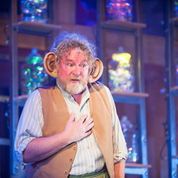
Any decent toy box has its puppets and they are brought out to play big time in this production. The medium provides much comic input as well as creating numerous characters in the hands of a small cast. The puppetry is an original and attractive feature and gives literal form to the make-believe on stage. Robyn Milne’s infectious giggle and expressive performance brings the Sophie doll vibrantly to life whilst Lewis Howden’s mysterious and magnificent BFG is not so much scaled down – except for those ears! – as uplifted. Clumsy on his feet and tripping over his gobblefunk speech this BFG warms the hearts of the audience.
Children and adults alike respond happily to the energy and enjoyment of the performances and repeated ‘whizzpopping’ had the children – and many adults – giggling with glee. This is, after all, a treasured story that seems to have lived a lot longer than its thirty-two years might suggest. There is wonderful fancy evoked here, escapism and delightful nostalgia.

“Human beans is not thinking giants exist.” Well, after this great big and magic production this human bean thinks otherwise.

outstanding

StarStarStarStar

Reviewer: Amy King (Seen 3 December)

Visit ‘BFG’ at the Lyceum here

Visit our Assembly Roxy Bedlam Church Hill Theatre Festival Theatre King’s Theatre Other Pleasance, Potterrow & Teviot Summerhall The Lyceum The Stand Traverse archive.

THIS REVIEW HAS BEEN SUBEDITED

‘Chess: The Musical’ (Pleasance Theatre: 18 – 22 November ’14)

Photo: Oliver Buchanan

Photo: Oliver Buchanan

“Without Clark’s poise on which to pivot, the story might have given up and defected to the bar.”

Editorial Rating: 4 Stars: Outstanding

Priests, poets and psychiatrists all agree that the border between pure genius and melancholy madness is chequered with 64 black and white squares (with a white one always on the right). Next time you encounter that tramp in Potterrow Port, the one who’s convinced he’s Marcel Duchamp, ask him whether mad people gravitate to chess, or if chess makes them so. Chances are he’ll mutter darkly about the Lasker-Reichhelm position, but he might respond that the dedicated player lives “a monk-like existence and know[s] more rejection than any artist.”

The real Duchamp, the one who’d never been seen dead with a trolley from Aldi, directed those words to American prodigy Bobby Fischer, upon whose bizarre biography, Benny Andersson and Björn Ulvaeus (loosely) based a musical.

Inspired by the 1972 match between Fischer and Boris Spassky, the ABBA alumni spun a yarn interweaving two grandmasters’ competition in the arena, over a lady, and among the ideological roadblocks of Cold War politics. Truthfully, Gilbert and Sullivan Chess is not. The undeniable success of this production says more about EUSOG’s commitment to sampling work pas a la D’Oyly Carte than it does about Andersson & Ulvaeus’ capacity for profound historical commentary post-1815.

We enter to find the orchestra have escaped from their pit, and are lording it above the action. Production Manager Tom Turner has crammed more steeldeck into the set than went into South Park’s Ladder to Heaven. Visually the effect is elegant, the band’s movements in stylish harmony with Sam Burkett’s clever choreography. However x4 keys, drums, bass guitar, x3 violins, x2 cellos, flute, x2 clarinet, x3 trumpets, trombone, bassoon, oboe, french horn as well as percussion will tend to make a fair bit of noise and some dampening field needed to be generated for the sake of the singers down below.

Douglas Clark shone as Anatoly, making the script & song his own so as to cover the extensive narrative arc laid out for him. Without Clark’s poise on which to pivot, the story might have given up and defected to the bar. Tadgh Cullen (as Freddie) nailed Fischer’s astonishing angst. It was easy to see why Lydia Carrington (as Florence, the lady interest) would love him, and even easier to see why she left. I thought having Cullen sing his big number an octave higher than his vocal range was a brilliant piece of 4th wall smashing artistry, subtly underlining Freddie’s inner turmoil. My companion, smarter than your average bear, though it was a Boo-Boo. Cullen’s commitment held out. Our cheering was long, loud and genuine.

Giselle Yonace (as the tournament arbiter), Caroline Hickling (as Anatoly’s Russian wife), Peter Green (as the US manager), and Steven Segaud (as the mendacious USSR fixer) found the space to establish bold performances, spotlighting and supporting the main cast’s quirks and qualities. When Segaud tapped the vein of comic villainy in his character, I wasn’t the only one LMAO.

Ethan Baird’s direction emphasised the characters and the story they had to tell. But rather like flat pack furniture after the third house move, Chess is starting to show both its age and essential flimsiness. The producers are a bit young (and far too stylish) to embrace an ‘80s nostalgic short hand, but would one double-breasted suit have killed them? Would a visual of tactical nuclear warheads rolling through Red Square been so amiss? Several pieces were missing from this puzzling-out of a not so retro script.

If a musical about chess, written by the blokes from ABBA, set in the Evil Empire’s dreary dying days isn’t enough to float your Typhoon-Class, then here’s the only reason you’ll ever need to get out and kill, maim or mutilate whatever man or beast stands between you and the front row seats: Lydia Carrington.

She’s amazing. Her gorgeous voice battles down the band like Eva Green casually knocking down Greeks in the latest 300 movie. Carrington’s give and take with the male leads is as beguiling as Keira Knightley, as sexy as Elisha Cuthbert, and as anticipateringly exciting as when Elizabeth Warren made a cameo opposite John Goodman in Alpha House.

If you don’t see Carrington now, you’ll only have to pretend you did later. Unlike my VHS of Learn Chess with Nigel Short (ft. Carol Vorderman) this is one to watch.

outstanding

StarStarStarStar

Reviewer: Dan Lentell (Seen 19 November)

Visit EUSOG here

Visit our Pleasance, Potterrow & Teviot archive.

THIS REVIEW HAS NOT BEEN SUBEDITED

editor@edinburgh49.com

‘Seven Dwarves’ (The Vault: 12 – 16 November ’14)

Seven-Dwarves-Photo-Charlotte-Productiosn-538x302

“Glimpses of Laura Witz’s peculiar genius for distant intimacy shoot from the confusion of Seven Dwarves, and are as welcome as will be the snowdrops when winter’s worst is done.”

Editorial Rating: 2 Stars

When the director is also the writer, and is also on stage in a main role, it would be reasonable to suppose that a production will pivot towards a particular personality. In the topsy-turvy creative world of Laura Witz however, more is less. Too little in fact.

I number myself among Charlotte Productions (& Witz in particular)’s biggest fans. Glimpses of her peculiar genius for distant intimacy shoot from the confusion of Seven Dwarves, and are as welcome as the snowdrops will be when winter’s worst is done. Had Witz not been so much below decks, on stage and in the engine room, she might have been able to steer a clearer course.*

We enter to find the titular small people prepping a theatrical production of the fairy tale. (I think, like I say, one definite casualty of the confusion was the narrative arc.) Doc, Sleazy, Happy, Bashful, Grumpy, Jumpy and Dopey are waiting on confirmation that they are to perform before the Queen and her beautiful daughter.

Samuel Pashby is Prince Edward, the Princess’ nice but dim fiancé. He’s on hand to deliver, or rescind, the command for performance, depending on the royal whim of his future mother-in-law. Thus, the stage is set for a discourse on Disney-esque notions of female perfection versus the experience of most women (I think).

As the only guy on stage, Pashby is more Chris Noth than Ron Livingston, or heaven forbid Mikhail Baryshnikov. Yet his pinpoint maneuvering fails to find a plug. In this he is not alone, the bonny bubbliness of Erin Elkin (as Jumpy) is never given an opportunity to contrast fully with the brooding bristles of Blanca Siljedahl (as Grumpy). Trapped on stage, Sarah Calmus has to be constantly Happy, Daphne-fying her onstage presence into a towering laurel tree in whose shadow other performances sometimes struggle to show. In fact, Calmus dressed up as a tree at one point. (I’m not entirely sure why.)

However, Miriam Wright (as Sleazy) nails the part. What’s more, she possesses the reactive powers to suit her gear to the road ahead. It is hard to be off stage while on it, and not all the cast succeeded in this essential talent as well as Wright. As the only character with a unique storyline, Sara Shaarawi (as Doc) needed (and deserved) the space to establish the conflict between her romance and reality. Krisztina Szemerey (as Dopey) provided much needed physicality with a comic twist. She was also responsible for the Lotte Reiniger-style shadow puppetry.

Now, it’s fair to say I have a mixed history with puppets. I’ve been escorted from a super-tedious Vietnamese Water puppet show after trying to drown the dragon. I’ve been in a fist fight with Terry Eurovision. In the case of Seven Dwarves however, I’m going to take their side. Szemerey et al delivered a stylish, useful piece of staging which could have been extended to cover the spaces filled with jarring slides of perfect princelings from the Disney magic factory.

In the blocking, Witz was attempting to resolve the clutter and confusion of the stage, and she was not Bashful in taking an unmistakably directorial position. She stands out, but was not far enough back to take control. For her fans, boosters, and supporters, Seven Dwarves is a magic eye example of Laura Witz’s style – you need to be looking at it from a very particular position if it is to make any sense.

*Witz was a stand-in for Bridgette Richards, who was originally cast in the role of Bashful.

Star (blue)Star (blue)

Reviewer: Dan Lentell (Seen 12 November)

Visit our Assembly Roxy Bedlam Church Hill Theatre Festival Theatre King’s Theatre Other Pleasance, Potterrow & Teviot Summerhall The Lyceum The Stand Traverse archive.

THIS REVIEW HAS BEEN SUBEDITED