‘Flying with Swans’ (Traverse: 4 – 8 November ’14)

Photo: Leslie Black

Photo: Leslie Black

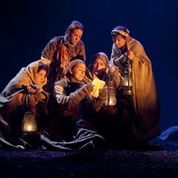
“Well-met, if slightly over the guard rail”

Editorial Rating: 4 Stars

Last in the autumn season of A Play, A Pie and a Pint.

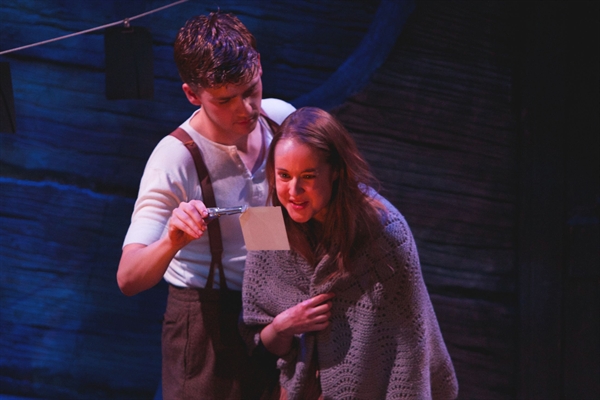
Three elderly women embark upon on a “Great Day Out” to Arran, and indeed it kind of turns out that way. The weather is mild, the ice cream is good, and they stay on deck for the entire crossing. Brodick is dead ahead, but this is forty-five minutes of diverting, mischievous dialogue from Glasgow writer Jack Dickson. Its most acute moments are pin-sharp sad, but the piece is funny and kind-hearted too. Sage, no’ Saga.

As over seventy fives, Dolly, Jean, and Mona go back years, and there is some fond reminiscing, which is where the whooper swans fly in. However, the old girls talk as much of the present as of the past. For a start, there’s Mona’s ‘borrowed’ and bashed car that retired and repressed solicitor-advocate Dolly feels obliged to report to the police. Meanwhile, Jean is escaping an anxious daughter who is taking her duty of care to neurotic heights.

The play is, naturally, a tale of age and loss but not in any mawkish fashion. No one’s sick on this CalMac service. However, the passage of time has probably hurt Dolly (Anne Kidd) the most. Her schnauzers are gone, and she may appear trim and resolute and but her friends know the truth, and offer her the love and support that she needs – and finally accepts. For carefree, absconding Mona (Karen Ramsay), it’s different, which you can see from her nightie and Nessie hoodie! Vague, intuitive Jean (Kay Gallie), with her bag full of blue and red pills, probably has the most telling line. “I miss me,” she says.

The casting is excellent and the three performances are well-met, if slightly over the guard rail, for Dickson is writing incautiously and with affection. His programme credit reads that Flying with Swans is offered as ‘a tribute to the women who feature in all our lives’. I’m on board with him.

Star (blue)Star (blue)Star (blue)Star (blue)

Reviewer: Alan Brown (Seen 4 November)

Visit Traverse Homepage here

Visit our Assembly Roxy Bedlam Church Hill Theatre Festival Theatre King’s Theatre Other Pleasance, Potterrow & Teviot Summerhall The Lyceum The Stand Traverse archive.

THIS REVIEW HAS BEEN SUBEDITED

‘Bondagers’ (Lyceum: 22 October – 15 November ’14)

Bondagers 1

Photos: Drew Farrell

“a fertile, sure-yield production “

Editorial Rating: 4 Stars

First performed by the Traverse Theatre Company at the Tramway, Glasgow, and then the Traverse, Edinburgh, in May 1991. Listed by the National Library of Scotland as one of the 12 key Scottish plays of the past forty years.

There is the straight open road and there is the wide open field. We are likely, through pig-ignorance, to love the first and disregard the second. However, Sue Glover’s Bondagers will change your mind, and if it doesn’t, you’re past saving. For this bonneted, bonny, holy play almost makes the invisible visible. Almost, for there are small molehills of socio-economics and human geography to flatten first.

In his peerless survey of theatrical landscapes, Peter Brook ends chapter 2 of The Empty Space with this question: ‘Where should we look for [holy theatre]? In the clouds or on the ground?’ You can smell the answer in Lu Kemp’s fertile, sure-yield production. An earthy top dressing covers the Lyceum stage, and when it’s hoed, watered or shovelled, you could be in the fields alongside the A697, just past Greenlaw. In Bondagers, which is part keepsake, part platform, this Berwickshire acreage matters hugely.

For most of us, farmland is now remote, somehow indistinguishable territory. Once upon a time, really not so long ago, over the Lammermuir hills a married ploughman (a hind) was bound to provide a woman (a bondager) to also work on the farm. She might be his wife, but not when there were infant children to raise. By the 1890’s, a good master would have paid his bondager ten pence a day. Women’s work for women’s pay was still holding firm.

Bondagers2

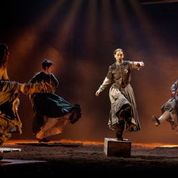
You’d have to split the Lyceum to set Bondagers in the round, but the creative team gets close to the vision thing, whose horizon(s) stretch way beyond the box beds in the cottage row, not that you see them anyway. There are no doors, no flats, and no fly-on-the-wall positions, as the scenery is a wide semi-circle of tan planking, thin and loosely joined, with the mist floating beneath it. The sights and sounds of this piece are filmic but solidity is vested in the spirits of six women. When fifteen year old Tottie calls out to her father in Saskatchewan the Canadian prairie seems as close as the Cheviots. Sara, the sturdy elder, leaves no room for doubt or longing, and Ellen, once bound over but now the tenant farmer’s young wife, is still bold and outspoken. Meanwhile, plainly and keenly, there are the folk songs: by turns affecting, burdened or bawdy, they keep time and period in step. Those warm, singing hearts lie under bulky wraps that are a triumph of research and costuming by the Wardrobe department. Additionally, the movement director, Ian Spink, deserves applause in his own right. From hiring to flitting the year round weather seems autumnal and chill. When the light does come, right at the end, the advancing glaring beams are of a different nature altogether.

In this rare atmosphere and with their own language a’ aboot them, the six bondagers share their lives. Sara (a fabulous Wendy Seagar) is the embodiment of moral dignity; good wife Maggie (Pauline Lockhart) scuttles undiminished from bairn to crib to table; Liza (Jayd Johnson) and Jenny (Charlene Boyd) chop neeps by day and gaze for lovers in their broken mirror by night. Innocent, wilder, emblematic Tottie (Cath Whitefield) strays outside the fold and suffers grievous harm. Mistress Ellen (Nora Waddell) brings knowledge of farm economy and crop rotation alongside her desire for a baby.

This is substantial and enthralling theatre by director Kemp and designer Jamie Vartan and yet its make-believe is vulnerable. I’d call Bondagers rhapsodic but there’s dissonance. A working girl can still be seduced into marriage by the promise of a clock, a dresser and a bed. Worse, there are bogeymen around: a sheriff who orders an arrest and a marquess who raises the rent. That brief combination is enough to silence the women well before the badass harvester turns off into the fields.

Still, the road’s clear to Coldstream and you can see for miles. Enjoy the view and love Bondagers.

Star (blue)Star (blue)Star (blue)Star (blue)

Reviewer: Alan Brown  (Seen 28 October)

Visit the Lyceum Homepage here

Visit our Assembly Roxy Bedlam Church Hill Theatre Festival Theatre King’s Theatre Other Pleasance, Potterrow & Teviot Summerhall The Lyceum The Stand Traverse archive.

THIS REVIEW HAS BEEN SUBEDITED

Crash (Traverse: 28 Oct – 1 Nov ’14)

Photo. Leslie Black

Photo. Leslie Black

“More slo-mo skid and shunt than full-on collision, more  crunch than splat”

Editorial Rating:  4 Stars: Nae Bad

In the Autumn line-up of A Play, A Pie and a A Pint.

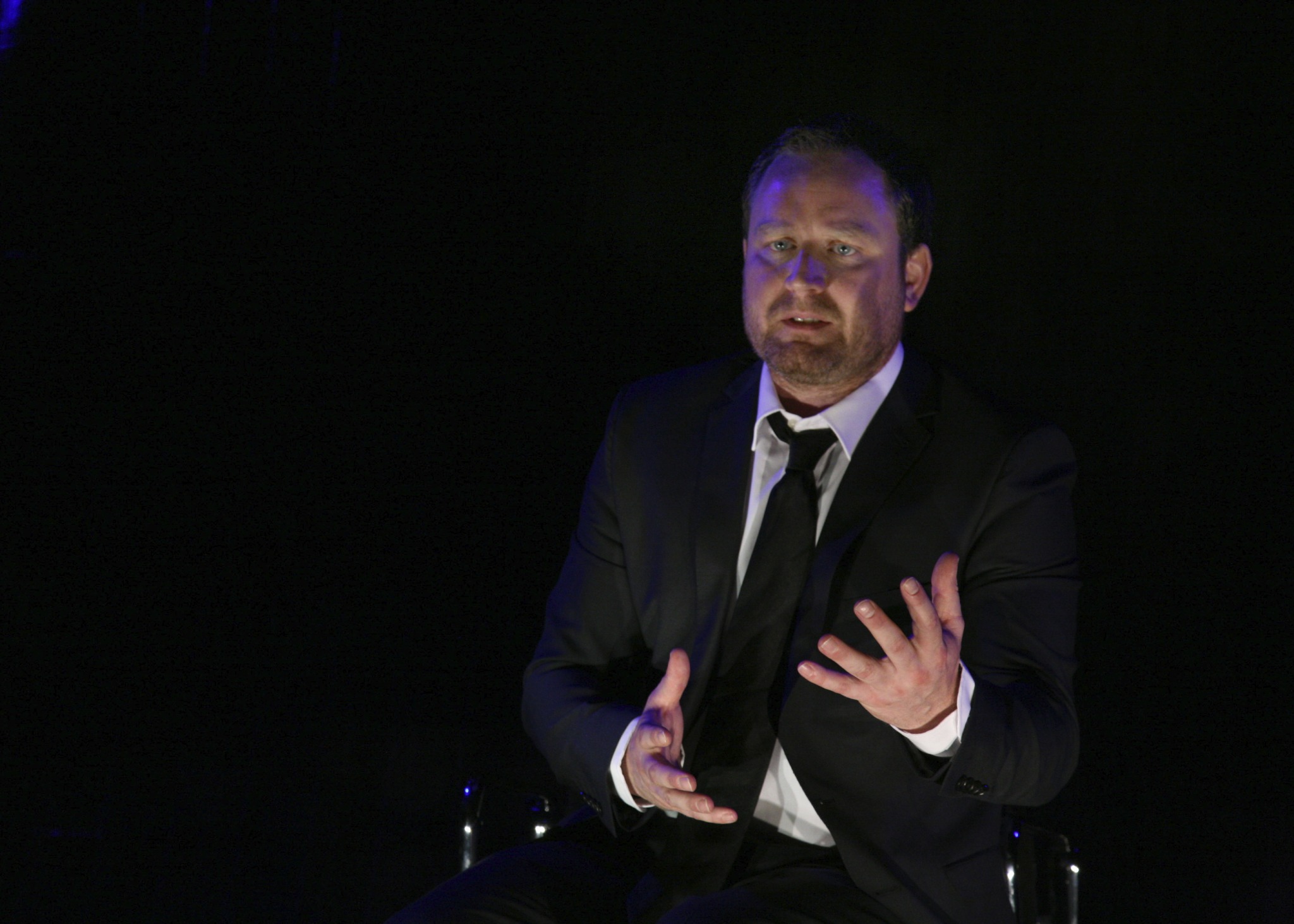
A whacked City trader speaks. He’s Scottish but it’s a quids in, pound sterling monologue, unassuming and on the level; a penny plain real deal, in fact, provided you accept that asset management is an emotional as well as a financial business. Finally, even naturally, the ‘game’ wastes you. There’s a wreck at the end of the tunnel.

Writer Andy Duffy’s single character has no name. He is a man alone in a sober suit and tie on a shiny office chair in a smooth glossy space. He could be in Aberdeen or across the way in Standard Life House, but still I incline to the Square Mile. His story begins on the night of 23 August 2007. (For the record Lehman Brothers declared bankruptcy on 15 November 2008.) He is precise like that; where he can he will enumerate, when he can’t he’ll simply point out that you don’t make money by being careful. And, instinctively, he has made and is still making lots of it.

Man (Jamie Michie) reads a piece in the ‘Financial Times’. His new girlfriend, Kate, prefers novels, which he considers to be self-indulgent pap. Man had a wife once but Alison died, which he’s sorry about, but shit happens when you lose control at the wheel, or when your investments go south. That’s ‘unprecedented volatility’ for you, which is where I’d bring in Russell Brand, who had lunch with the FT just last week. Brand finds the pink pages ‘hard to understand’ and opposes his ardent belief in spiritual ideologies to the FT’s economic one(s). So too even our trader, bruised and shaken by his wife’s death, attends meditation classes where in mid-mantra he finds consolation in … Kate’s long blond hair and tight figure. Nothing too revolutionary there to upset the capital markets .

Crash is more slo-mo skid and shunt than full-on collision, more crunch than splat, and so more revealing. There is the head-rest proposition that ‘money equals power and freedom’ but how is that supportable? Every now and again something is going to pile in from behind and the result will be bloody. You can hear it happening. There is a thrum of white noise – not Traverse 2’s air con – and the lighting gets colder. I was reminded of a Tube train coming into Bank. Man rises from his chair and/or collapses on a park bench and you wonder, not for the first time since the last financial horror show, if getting minted is worth it.

A driven, strong play that is expertly directed by Emma Callander and impressively performed by Jamie Michie.

nae bad_blue

Star (blue)Star (blue)Star (blue)Star (blue)

Reviewer: Alan Brown (Seen 28 October)

Visit Traverse Homepage here

Visit our Assembly Roxy Bedlam Church Hill Theatre Festival Theatre King’s Theatre Other Pleasance, Potterrow & Teviot Summerhall The Lyceum The Stand Traverse archive.

THIS REVIEW HAS NOT BEEN SUBEDITED

‘The Last Straw’ (Bedlam: 21 – 25 October ’14)

The Last Straw 1

Photos: Ummatiddle

“…  impro cuts loose, and cries of ‘F –ing awesome’ applaud play and cast.”

Editorial Rating: 3 Stars: Outstanding

A tale of two exclamations from ole stage coach territory. There’s “Whoa!” (Slow down) or “Wow!” (Stop right there. That’s too much). Either way, forget it. The foot brake’s worn, the wheel brake’s a joke, and you’re gonna get hurt, lady, if you stay up top. Best ride is in here, in Bedlam, with us. It’s a long journey of near on two and a half hours but it’s fun.

Director and writer Eric Geistfeld is from somewhere in Minnesota. Home is unlikely to be Bemidji but what the heck, The Last Straw is tv’s Fargo in a gothic farce. It’s intrepid. No quavering, gathered strings here; no hole in the ice but a useful trapdoor. There is breakneck writing, lunatic action, a menagerie of oddball characters, a yellow sex doll, and a lot of laughs.

Upright, young Edward, true-buttoned Brit and in financial services, is just married to Judy, all-American sweetheart, ‘pajamaed’ and with her teddy. They are to live with Violet, Judy’s mother, in Terror Towers. It might as well be Marine Corps ville. Ronald Reagan is venerated and there is a dead butler, resident throughout the first half, who wears aviators and is fed cake, but it’s gum-chewing, pistol packing Violet (Isobel Moulder) who calls the shots, literally. There will be no kids until she’s ashes and she’d be much obliged if her son in law would smoke them after she’s gone. Not that she plans to let him live long. Edward (Macleod Stephen) is a good sort, articulates so well, but realises that his body bag is being prepared. Ma has to go so he puts out a contract on her life, as she has on his.

The Last Straw 2

There is live keyboard but you hang onto the soundtrack. The Magnificent Seven sets us off and then it’s a trip through The First Cut is the Deepest, Our House, The House of the Rising Sun and, of course, Sweet Dreams are Made of This. By this point Edward has taken a slice of sponged cocaine cake and is away, tally-ho, with his toilet plunger and the weird fairies from the basement. The fourth wall crumbled a while back, impro cuts loose,  and cries of ‘F –ing awesome’ applaud play and cast.

The Last Straw goes out to glad-hand its audience. Is it like the Lothian state fair on the Meadows? Kind of. Scenes are gaudy, wisecracking sideshows, neatly divided by a door on wheels. They put their trust in ‘Together we’ll go far’, which just happens to be the slogan of the Wells Fargo bank. Especially successful are ‘The Murderelli Brothers’, possibly from Brooklyn, whose take on Alan Rickman is actually to die for; ‘The Existential Hecklers’ from outta Sartre and ‘The Sad Killer’. What of the main act in amongst these diversions? Beyond the closing cheer of ‘Happy Families’, there needn’t be one. For the best of reasons The Last Straw is a fearless, crowded, tiring, play.

And so to our adventurous rating and ranking of 3* OUTSTANDING. Three stars (safe) because you won’t be disappointed by such a full-on, have-a go, production. Colour coded red – Outstanding – because The Last Straw is remarkable rather than unbearable. I thought so, anyway.

outstanding

StarStarStar

Reviewer: Alan Brown (Seen 22 October)

Visit Bedlam Homepage here

Visit our Assembly Roxy Bedlam Church Hill Theatre Festival Theatre King’s Theatre Other Pleasance, Potterrow & Teviot Summerhall The Lyceum The Stand Traverse archive.

THIS REVIEW HAS NOT BEEN SUBEDITED

‘Top Hat’ (Festival Theatre: 7 – 18 October ’14)

“Hayward is Wodehousian perfection – the only actor who might do justice as Stanley Featherstonehaugh Ukridge.”

Editorial Rating: 5 Stars: Nae Bad

Michael Clarke Duncan, as death row inmate John Coffey in The Green Mile (1999), got it about right. The night before he becomes a dead man walking, Coffey is granted a clandestine glimpse of Ginger Rogers and Fred Astaire dancing cheek to cheek in Irving Berlin’s Hollywood classic Top Hat (1935). “They’s just like angels” he declares, utterly awestruck.

Expectations couldn’t be higher as we take our seats for the stage adaptation. “I wish Monty was here!” laments Companion A to Companion B, “he loves Strictly.” Monty-The-Dog’s inclusion in the lasses’ Saturday night ritual might suggest he’s more Withnail and I than WWII general. But like millions of contemporary Brits, Monty is a sucker for a sequin dress spinning at a bajillion miles an hour. If he were here, he’d be wanting dance, laughs, toe-tappin’, and above all, glamour… with a capital BLING! He would not be disappointed.

The plot is as subtle as a Shakespeare comedy, mistaken identity taking true love on a harebrained, helter-skelter ride. Boy annoys girl by dancing night and day in the hotel room above hers at an hour when even the coal porter is asleep. When she complains, he falls in love. She doesn’t and, much to the vexation of the theatrical producer of the West End show this boy is meant to be focused on, boy pursues girl from Hyde Park to Lido di Venezia.

Hildegard Bechtler’s set is a triumph, it’s how you want the 1930s to look. Art Deco, modernist, functional, and not a hint of a black shirt sneaking across il Ponte della Libertà. It’s not flawless – how come the parkscape scenery doesn’t move when the carriage does, and why is there a gap above the dressing table? But if you measure a set by how much you want to sit down in it- maybe sipping a Jack Rose while watching Katherine Hepburn mud wrestle Lucy Mercer – then Bechtler’s done alright.

The chemistry between Alan Burkitt (Jerry Travers) and Charlotte Gooch (Dale Tremont), never entirely ignites. Burkitt, former All England Tap Dancer of the Year and a Strictly Come Dancing favourite is superb, interstellar even. Gooch is both sultry and supercharged, staying cheek to cheek and toe to toe with Burkitt. They’re individually strong performances, worth the entry price alone, however they don’t seem to mesh. The double-edged lyrics of Wild About You fall disappointingly flat, while the inclusion of Rogers’ oft-quoted trusim, “I did everything he did, backwards … and in high heels,” is delivered more like a professional rebuke than a playful remark.

In contrast, the magnetic attraction of Clive Hayward (as producer Horace Hardwick) and Rebecca Thornhill (Madge, his socialite spouse) provides a true dose of human interest and drama. Hayward is Wodehousian perfection. He’s so good in fact that he may be the only actor who could do justice as Stanley Featherstonehaugh Ukridge.

Sebastien Torkia, as Tremont’s flamboyant BFF, and John Conroy, as Hardwick’s laconic gentleman’s personal gentleman, tap out Top Hat’s theatrical high notes. Torkia takes it to the edge and over, defying gravity to reach a level of lunacy that must be seen to be believed. Conroy is no less ambitious and equally brilliant, delivering each put down, as well as the story’s clever resolution, with a knowing confidence that never slips into arrogance.

Accompanying vignettes by the cast add to the seamless sparkle. I especially like the interplay between Lucy Ashenden and Edinburgh’s own John McManus in the hotel scenes which add depth and contrast. The great success of this great production is that amid all the careful choreography is a joyous piece of live theatre that will score with huffy hubby as assuredly as any bevy of sassy Strictly seekers.

Come for the dancing but stay for the theatricals. Bravo!

nae bad_blue

Star (blue)Star (blue)Star (blue)Star (blue)Star (blue)

Reviewer: Dan Lentell (Seen 9 October)

Visit our Festival Theatre archive.

THIS REVIEW HAS BEEN SUBEDITED

‘Outlying Islands’ (Traverse: 1 – 4 October ’14)

Martin Richardson. Photo: Graham Riddell

Martin Richardson.
Photo: Graham Riddell

“Wide, invigorating views in a small space”

Editorial Rating: 4 Stars: Outstanding

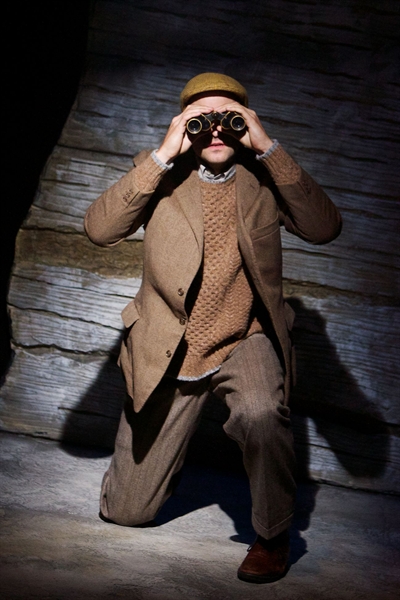
“‘Scuse my French,” says birdwatcher John – repeatedly. This thoroughly decent young man, BA. Cantab., has had enough – again! The year is 1939 and John is on the remotest of the Western Isles with stinking socks and his gimlet-eyed pal, Robert, who is bound to get the sweet girl first. You might hear the romantic airs of Local Hero within Outlying Islands, for the Celtic soundscape is lovely, but instead I see a fab, screwed up Tintin-esque adventure amongst the fork tailed petrels.

I reckon playwright David Greig likes Hergé’s impeccable line, after all, he did adapt Tintin in Tibet  for a Christmas show at the Barbican in 2005. Outlying Islands has the same startling and redemptive quality of that blameless story. However, the play’s audience also sees scary biological warfare and delightful sex.

It is the sharp clarity of the piece that impresses most. The first lines open with “I have noticed,” and it as if the audience are the ones with the binoculars, watching intently and enjoying what they discover. A bright and acute script paired with alert, insightful direction by Richard Baron is as effective as fixer in old style photographic processing, which you’ll be reminded of. We get focus and definition all throughout, with flashbulbs and nae pixels.

James Rottger and Helen Mackay. Photo: Graham Riddell

James Rottger and Helen Mackay.
Photo: Graham Riddell

We are way out west, literally in a rock burrow, and cinematically in Laurel and Hardy territory. Their 1937 film is Ellen’s favourite but for her ‘Free’ church uncle, Kirk (!), the cinema is a place of darkness where only the Fallen gather. London, by way of the same Calvinist conviction, is a ‘gannetry of random defecation’. What’s a young woman to do – apart from prepare puffin stew? Ellen’s happiness at finding an answer in unforeseen liberty is wonderful, and Helen MacKay is jubilant in the role. Nice John or Johnny, played straight and true by James Rotger, is not a happy chappie when confronted by deep feelings – arguably like Tintin – therefore his discomfort, naked on the kitchen table, is understandable. Martin Richardson is utterly convincing as Robert. Probably amoral, certainly sensitive, fiercely rational, and undoubtedly bad for Kirk’s health, he has the dash of the pagan about him. Crawford Logan has the unsympathetic (adult) roles, playing Kirk, who is mean in spirit, calculating, a relic to be parodied, and, very briefly, the Captain of the ship that returns to take them off the island and back to …. Ullapool?

During the referendum campaign David Greig spoke of Scotland and a Scottish population that had been wearing UK goggles for long enough: ‘goggles which say you never ask questions’. ‘Outlying Islands’ has come back, post Yes/No, and offers wide, invigorating views in a small space. You might pick holes at some cartoonish excess or at the fly-away innocence of the plot or even at some speech bubble dialogue, but I saw an excellent production from  Firebrand Theatre; the same company that brought ‘Blackbird’ (not Leach’s petrel) to Summerhall in February. That was outstanding too.

outstanding

StarStarStarStar

Reviewer: Alan Brown (Seen 1 October)

Visit Outlying Islands homepage here.

THIS REVIEW HAS BEEN SUBEDITED
‘Regeneration’ (King’s: 30 September – 4 October ’14)

Jack Monaghan (Prior) & Garmon Rhys (Owen). Photo: Manuel Harlan

Jack Monaghan (Prior) & Garmon Rhys (Owen).
Photo: Manuel Harlan

“‘Anthem for Dead Youth’”

Editorial Rating:  3 Stars

 By 1917, Post-Traumatic Stress Disorder’s designation in army speak is ‘Not Yet Diagnosed (Nervous),’ which then becomes ‘Shell Shock (wound)’ or ‘Shell Shock (sick)’. You could suffer both. Either way, it was identified as a ‘disability … caused by military service’. Watch this eager, opportune, play and you can add ‘unspeakable,’ ‘crippling’ or ‘shocking’ to the official terms.

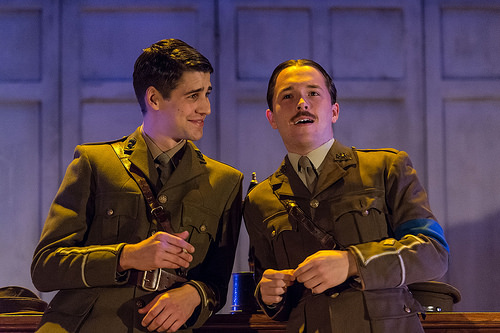
Furthermore, pull open one of the gun metal drawers in the War Poets Collection at Craiglockhart and you’ll see an open medical register with ‘Neurasthenia’ entered alongside every one of the thirty plus names down the page. The ledger is matter-of-fact, inoffensive, prosaic for its time. However, writer Pat Barker turned that upside down in the terrific pages of ‘Regeneration,’ and Gillies MacKinnon took that book and made an excellent film of it. Now, Nicholas Wright’s adaptation tries it out on stage, with Simon Godwin directing and aiming high.

It is a fascinating, half-true story. Mutinous ‘Mad Jack’ Siegfried Sassoon (31) did meet Wilfred Owen (24) in Craiglockhart hospital during the summer of 1917. Sassoon did encourage Owen to write about the war. His pencilled revisions are all over a draft of ‘Anthem for Dead Youth’, along the lines of “No, make that… Doomed Youth’. Good man!” Sassoon’s doctor was William Rivers, anthropologist and pioneering psychiatrist. Owen recovers his health, Sassoon accepts counseling. Both officers choose to be ‘discharged to duty’. Both will return to the front line.

Stephen Boxer (Rivers). Photo: Manuel Harlan

Stephen Boxer (Rivers).
Photo: Manuel Harlan

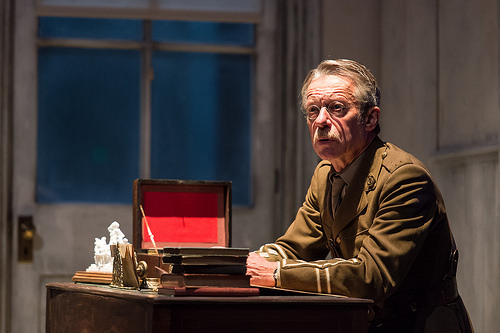
Rivers also has another patient, Billy Prior, a boy from Bradford who knows all too well that he’s only made it to 2nd Lieutenant because the army is fast running out of the privately educated, well spoken type. The exchanges between Rivers – in a fine undemonstrative performance by Stephen Boxer – and the chippy but likeable Prior (Jack Monaghan) are the most forward and challenging in the play. Questions of class, upbringing and sex are insistently between them.

However, the relationship is less spiky between Owen and Sassoon. Garmon Rhys plays the younger man, gauche and pliable, who gains confidence and dignity by the close. Tim Delap is a debonair Sassoon, who has his own terrors in the night but whose brocade dressing gown stands them down. Between the two of them, the love that dare not speak it’s name gets treacherously close.

This production  is ambitious, brisk, and inventive, but its pace reinforces an episodic, fleeting quality. Reflective moments – Rivers dictating case notes, Mr Prior under hypnosis – are precious, but soon give way to the next happening. A burst of machine gun fire or a flash of howitzer blast are like fugitive subtitles, and the compressed script begins to sound sententious, light remarks diverting attention from tough themes. The stark set is washed out, bleached almost, and in need of some gloomy Edwardian mahogany. Additionally, the small marble of Laocoön on Rivers’ desk is a weighty feature that does its job, but otherwise, the fact that the Conservative Club on Princes Street, where Sassoon entertained, is now a Debenhams is indicative of a play piling literary stock and selling low. ‘The Parable of the Old Man and the Young’ it cannot be, although Capt. Rivers remains a merciful saint.


Star (blue)Star (blue)Star (blue)

Reviewer: Alan Brown (Seen 30 September)

Visit Regeneration‘s homepage here.

THIS REVIEW HAS BEEN SUBEDITED

‘Kill Johnny Glendenning’ (Lyceum: 17 September – 11 October ’14)

“A Lock and Load comedy with the safety Off”

Editorial Rating:  4 Stars

How mental do you like your Glasgow? I say ‘your’ advisedly, as this play has barreled its way down the M8 in that distinct, uncompromising “Up yours!” way that makes Edinburgh appear po-faced. D C Jackson has written a lock and load comedy with the safety off. ‘Kill Johnny Glendenning’ is fast, almost ludicrous, and not a little gross.

Droll Weegie humour is too dark for Strathclyde noir. This explosive plot begins with a bang as Bruce Wilson, the crime writer of Glasgow’s ‘Daily Reporter’, is to be taken out of harm’s way before his scurrilous biography of loyalist para-military Johnny Glendenning catches up with him. However, Johnny’s solid and inescapable desire for revenge makes Bruce Wilson’s survival somewhat unlikely. In fact, Johnny G. has set his sights on more than one unlucky victim, as he also goes after Andrew MacPherson, a ‘businessman’, who has cocaine deals to finance. Unfortunately, MacPherson’s laddies, sheepish Dominic (Philip Cairns) and numpty dumpty Skootch (Josh Whitelaw), mess up from accidental start to blood soaked finish. Dominic’s wife, Kimberly (Joanne Thomson), is the surprising Lady Macbeth of the piece, albiet very pregnant one, and one well in tune with Leona Lewis’s ‘Bleeding Love’.

Paul Samson (l) and David Ireland (r)

Paul Samson (l) and David Ireland (r)

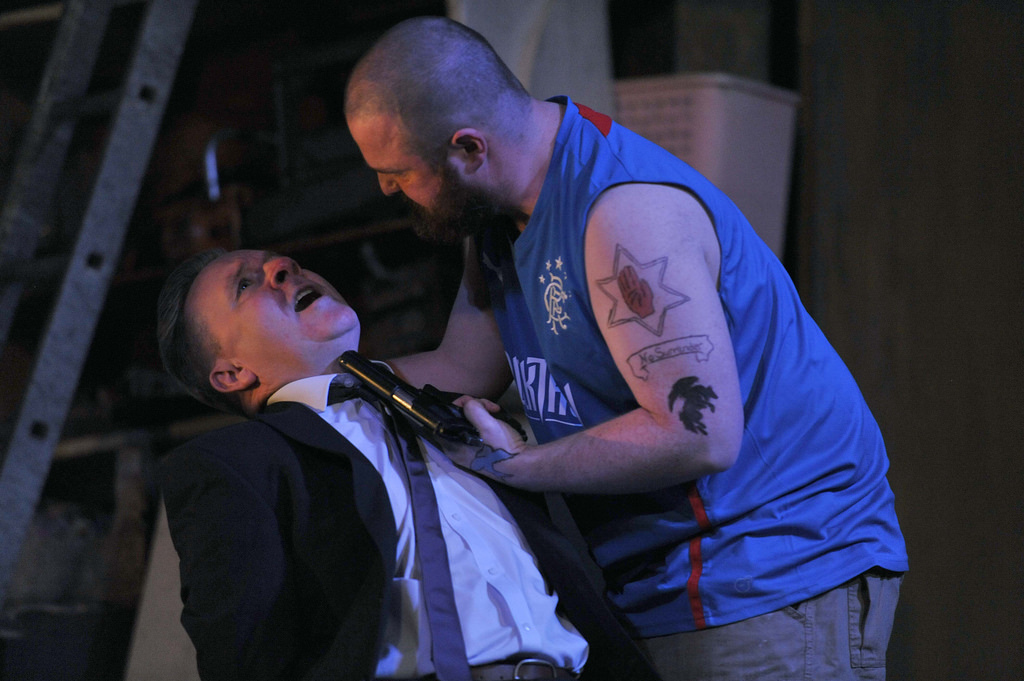
The action is as lurid as Skootch’s cream suit, modelled – of course – after Pacino’s in ‘Scarface’. Johnny is a dab hand at pulling teeth and at castration by combat knife. There is lots of gunfire and a maniacal stabbing. The first act, down on Auld John’s farm, ends with bodies being soaked in petrol. Normally in Ayrshire these poor souls would be fed to the pigs, but it is onto douce Hyndland, in Glasgow’s West End, for the second act and a marginally tidier, intelligent backstory.

David Ireland’s Johnny might be a headcase but he remains a neat act. His easy movement, trim beard, and smart banter make the killer look and sound almost companionable, but the mild Ulster accent is as unnerving as the tattoos. Paul Samson as MacPherson, whose respectability is a vicious lie, keeps his character closer to the edge. Bruce (Steven McNicoll) is the journalist with no conscience who suffers that nice, well-bred, immunity from actual violence until it happens to him. He wears carpet slippers to his sorry end. Kern Falconer as scarecrow Auld John is frighteningly at one with his pigs, as well as his scary mither up the ladder.

(l to r) Philip Cairns, SteveMcNicol, Josh Whitelaw

(l to r) Philip Cairns, Steve McNicol, Josh Whitelaw

However, ‘Kill Johnny Glendenning’ is more than an unhinged caper. One read of the imaginative programme and a glance at the stage curtain for a lookalike Amazon listing of tales from Bar-L will tell you that Jackson and director Mark Thomson are firing off some cultural bullet points. Hard men and hard boys are the obvious target but you could easily add sectarian shite, corruption of the press, Glasgow itself and mobile phone apps to that list. An entertaining, close-range blast from ‘Yes’ land.

Star (blue)Star (blue)Star (blue)Star (blue)

Reviewer: Alan Brown (Seen 20 September)

Visit Kill Johnny Glendenning’s homepage here.

THIS REVIEW HAS BEEN SUBEDITED

Star Ratings Announcement

Star (blue)StarStar (blue)

Edinburgh49 is dedicated to supporting creative work and those who make it happen. Our purpose is to write dependable reviews and interesting features and to provide producers with some useful and knowledgeable comment.  Edinburgh49 addresses all aspects of the work seen – not the work as it might, should or could have been.

As of September 2014 Edinburgh49 will be using star ratings!

Like some other review titles Edinburgh49 has been wary of star ratings. A show rated 3 stars or less might not attract the audiences that solid work, done well, deserves. Additionally, perceived ‘star inflation’, especially at the Fringe, has seemed to devalue the endorsement of a high star rating.

However, after our first year we’ve determined that the positives outweigh the negatives. Star ratings are helpful indicators. So long as readers are reasonably clear how a title awards its stars, and so long as producers continue to use pull-quotes to support the endorsement, star ratings serve as reliable shortcuts to the best reviews and to the best productions.

We’ll still be using ‘Nae Bad’ & ‘Outstanding’

A good review should be able to take subjective views into account while still presenting a balanced and informed opinion.

The Edinburgh49 team will retain our cherished ‘Nae Bad’ & ‘Outstanding’ labels as a means of articulating their personal reaction to the show. Thus a 3 star show might still be thought ‘Outstanding’ if our writer thinks something truly memorable has been achieved.

nae bad_blueoutstanding

Trying new things is what the arts are all about. Sometime we succeed. Sometimes we fail. It’s not the falling down, it’s the getting up that matters. Creative endeavor deserves talented cheer-leading. Grab your pom-poms folks! There’s 49 weeks of capital artistry ahead!


Want to join our review team and support the art you care about? Get in touch via e-mail or Twitter.

49 Things You Should Know About The Fringe 2014 pt.3 (38-49)

The Edinburgh Fringe is unique. Uniquely big as well as uniquely varied, and therefore, uniquely competitive.

52 weeks in a year minus 3 weeks of the Fringe = Edinburgh49

Edinburgh49 is a collaboration between Edinburgh-based writers from some of the most respected Fringe Theatre review titles. Their insights combine detailed local knowledge with a comprehensive overview of the Fringe.

49 Things You Should Know About The Fringe will help you get the most out of your experience this August. In Part One we examined how shows get noticed and what to do when you are.  In Part 2 we met the various media titles whose reviewers you’ll be courting. Now, as the clock ticks down towards the launch of Fringe ’14, we offer some more esoteric thoughts which, we hope, will help you squeeze every drop of juice from the extraordinary month ahead.


COUNTING DOWN TO FRINGE 2014! 

  1. Each venue will have its own Press Office. Some are better than others. Even the largest press office staff don’t have time to do your stapling for you. However, if they do display reviews or attach ratings to posters shown in house, make sure they’re doing it promptly. You’re the customer. You paid to use this venue. Demand a quality after-sales service.
  1. The Fringe is home to some really great chat & revue shows where punters can hear directly from participants. The legendary Merv Stutter is among the best established. Don’t be shy in approaching producers and asking to feature on their sofa in front of an audience. New acts especially need content.
  1. There’s a whole article to be written about Twitter and the Fringe. It ought to start with the obvious warning that not every Fringe-goer is on social media. Our 5 golden rules for Twitter: don’t pester; don’t churn; don’t quarrel; don’t insult and don’t forget to retweet, follow & favourite beyond the usual suspects.
  1. Read Broadway Baby’s How to write a press release journalists will want to read. Then re-read it and pass it on to every public relations professional you know. Then read it again.
  1. Even if it’s just a single side of black and white A5, consider providing your audience with a programme. There are sound audience engagement reasons for doing so (introducing your company, script, vision etc.) Besides, reviewers can’t name names if they don’t know who anyone is. If you have, or are in, other shows, it’s a good place to mention it. Don’t forget to include your social media contact details.
  1. Always use a local printer to avoid disappointment. If you need something fast, try talking to Paul at Pace Print and tell him we sent you. [NB. They didn’t pay us, or even ask us to write this. We’ve used Pace Print for a long time and they consistently impress us.]
  1. The Free Fringe is among the most interesting developments within the Fringe for some time. For established theatre companies the Fringe is a trade show. Their priority is as much to sell shows (to national venue managers) as it is to sell tickets. The costs/benefits involved in setting out their stalls at the #Freestival may one day be in competition with traditional big venues…perhaps. Less in doubt are the huge advantages the Free Fringe offers to new players.
  1. Free Fringe audiences exist on a spectrum running from folk who won’t stay past 5 lines of bad dialogue; to those who stay rooted in a venue from dawn till dusk seeing everything in the lineup.
  1.  Late to the party? If you arrive in Edinburgh after the start of the Fringe, don’t despair. You’re fresh and eager. Lamentably, few Fringe-goers abandon hearth and home for the full run, so there is always a steady stream of audiences. Still, take nothing for granted.
  1. See Edinburgh! It’s a great city and there are plenty of low and no-cost ways to see it, from the Radical Road to the Walter Scott Monument. The sunsets over the Firth of Forth this time of year are gorgeous, especially when viewed from the Starbank Inn. On the far side of town, the Sheeps Heid in picturesque Duddingston village offers traditional fare on a site which has been continuously occupied by a pub since 1360.
  1. Say goodbye to your money. For many coming to the Fringe is a once in a lifetime experience. For others it’s the start or end of a continuing tour. For everyone it’s a place to workshop ideas in front of an actual audience, night after night. That doesn’t come cheap, so make sure it stays cheerful.
  1. Don’t Panic!

Good luck to everyone participating in The Edinburgh Festivals of 2014! Edinburgh49 will return in September!