49 Things You Should Know About The Fringe 2015 pt.2 (17-37)

The Edinburgh Fringe is unique. Uniquely big as well as uniquely varied, and therefore uniquely competitive.

52 weeks in a year minus 3 weeks of the Fringe = Edinburgh49

Edinburgh49 is a collaboration between Edinburgh-based writers from some of the most respected Fringe Theatre review titles. Their insights combine detailed local knowledge with a comprehensive Fringe overview.

49 Things You Should Know About The Fringe will help you get the most out of your experience this August. In Part One we examined how shows get noticed and what to do when you are.  In Part 2 we meet the various media titles whose reviewers you’ll be courting.


THE ONE EVENT YOU CANNOT AFFORD TO MISS

  1. ‘Meet the Media’ is organised by the Edinburgh Festival Fringe Society. It’s an event unlike any other where you can spend face-to-face time with media representatives from the various titles. Remember to bring hard copies of your marketing materials and be prepared to queue! Meet the Media 2014: Aug 3: 14:00 (4h): Fringe Central: Free & Non-ticketed.

PULL-OUT QUOTES & STAR RATINGS

  1. The use, usefulness and misuse of star ratings remains a hot discussion topic among producers and pundits. Are stars the best shorthand for what a reviewer thinks, or do they obscure the overall impression? Is a three star show worth seeing? If not why not? Are some titles offering too many stars for too little? How do 5 stars for stand-up equate to 5 stars in traditional theatre?
  1. Include pull-quotes from each review to sit alongside the star rating. Pick quotes that express some insight into your work, rather than just selecting the most favorable single adjectives. If you’re not confident in the number of stars, just include a pull-quote.
  1. Pull-quotes make for reliable daily Twitter content. You should try and draw multiple quotes from one review (so long as you properly reference each).
  1. When tweeting pull-quotes, include the reviewer’s & title’s account to encourage retweets.

TRADITIONAL PRINT MEDIA

  1. Don’t rely too much on the traditional print and broadcast outlets. Budgets are like tyres, if you slash them you won’t get far. The big titles have fewer resources to cover the Fringe than ever. If you concentrate exclusively on household-name brands you may find you end up with no coverage at all.
  1. Not all reviewers are the same. Some are experienced arts writers with production pedigrees of their own, while others are enthusiastic amateurs starting out their careers through practical training schemes. Some are writing for highly commercial operations, others are taking time out from their paid engagements to pursue their passion for the arts.
  1. A good review from The Scotsman remains the most valued endorsement at the Fringe. But with its last reported daily circulation figures dipping below 30,000, you will still need to make a lot of noise in your own marketing to feel the full benefit.
  1. The Herald is dangerously easy to overlook; it’s The Scotsman’s big local rival and an increasingly important voice at the Fringe. Their highly prestigious awards, Herald Angels, are almost unique in the fact that absolutely any show is eligible to win one – but you’re only in with a chance if you manage to get one of their reviewers in.
  1. The Edinburgh Evening News is from the same stable as The Scotsman, but it’s editorially independent. It has a quite different readership too, so it’s well worth approaching both. Controversially, they rate out of 7 stars rather than the conventional 5.
  1. Don’t discount the free paper Metro – it has relatively extensive Fringe coverage and a large circulation. A good review in Metro isn’t (yet) a badge of pride, but we’ve heard anecdotally that it does great things for ticket sales.
  1. UK national newspapers also have a presence in Edinburgh, though they’re not the force they once were. If you manage to get coverage, enjoy your good fortune. The Guardian, Times, Daily Telegraph and Daily Mail are among the most visible, while a review in the Financial Times is one of the most prestigious.
  1. Founded in 2002, Fest Magazine has grown to produce 125,000 free copies in six issues during the Fringe. Published every Tuesday and Friday, including a July preview guide. Fest’s online archive is impressively comprehensive but rather old skool to navigate. Fest is notoriously (and proudly) stingy with its star ratings.

NEW MEDIA

  1. The Festival Media Network strives to improve the coverage of arts festivals and promote collaboration between member media. FMN’s members are Broadway BabyEdinburgh Nights, Fringe Guru, FringeReviewHairline and ThreeWeeks.
  1. All Edinburgh Theatre is run by Thom Dibdin, freelance journalist and Scotland Correspondent of The Stage newspaper. The website started out as the Annals of the Edinburgh Stage in 2009, before transforming into All Edinburgh Theatre in 2013.
  1. Broadway Baby has existed since 1996 when it launched as a free resource for actors to publish their CVs. In 2004 publisher Pete Shaw started adding reviews, since when Broadway Baby has become a major new force with over 6,000 reviews published of work staged at Edinburgh, Brighton, New York and London. As well as sourcing articulate and lively writers Broadway Baby copy edits everything that it publishes and boasts cutting-edge behind the scenes IT wizardry.
  1. Edinburgh49 DOES NOT OPERATE DURING THE FRINGE but our writers do. We’ll be back in September committed to supporting punters and producers through the other 49 weeks of the city’s arts calendar.
  1. Edinburgh Nights is a weekly show for Scotland’s Capital City promoting shows, events, and music that will be taking place that weekend across Edinburgh. Rooted in the Fringe the show is available online and as a podcast. Edinburgh Nights is produced and hosted by the BAFTA nominated broadcaster, and occasional Edinburgh49er, Ewan Spence.
  1. Fringe Guru, co-founded by Edinburgh49er Richard Stamp, aims for selective quality coverage, in preference to ‘completism’ or rapid growth. Fringe Guru is about trust over size.  In contrast to most independent media, Fringe Guru’s reviewers are generally professional writers rather than active arts practitioners.
  1. FringeReview, covers Fringe Festivals from Adelaide to Edinburgh and is edited in August by Edinburgh49er Dan Lentell. A passion-project by founder Paul Levy, FringeReview seeks out innovation, challenge, competence and creativity putting an emphasis on supporting producers with peer-review style insight. Billed as ‘The Good Fringe Guide’ FringeReview does not offer star ratings, or publish reviews falling below minimum standards.
  1. ThreeWeeks is the longest established magazine at the Edinburgh Festival. The stable includes not only a free weekly magazine but also a daily update, website and podcast with coverage of all that goes on in Edinburgh during August, including the International, Book, Art and Politics festivals as well as the Fringe. Since 1996 ThreeWeeks has run a media-skills training programme, providing formal on-the-ground arts journalism training to hundreds of young writers.
Coming up in part 3 of our 49 Things You Should Know About The Fringe: The absolutely essential stuff.

The Edinburgh49 Prize: for distinctive and memorable theatre (2014). Winners!

outstanding

“CONGRATULATIONS!”

Editorial Rating: Outstanding

The winners of the first ever Edinburgh49 Prize: for distinctive & memorable theatre (sponsored by Alechemy Brewing) were announced on 10 July at our ‘End of Normality’ party held at Assembly Roxy.

The event marked the city’s transition into full-on Festivals mode and was a chance to celebrate all that’s weird and wonderful about the other 49 weeks in the arts calendar.

Not only did our sponsor, Alechemy Brewing of Livingstone, ensure that everyone was well watered throughout the night, they also provided the star prize for our winning pub quiz team, a powerful combination of Royal Lyceum’s marketing team and NTS producers, who received a chance to sample 11 bottles from across Alechemy’s range.

Despite on-going tours and pre-Fringe commitments, we were delighted to welcome so many friends old and new to join us for the official announcement of the 6 winning productions, chosen from the more than 75 shows reviewed by us since last September.

In date order, the winning shows are:

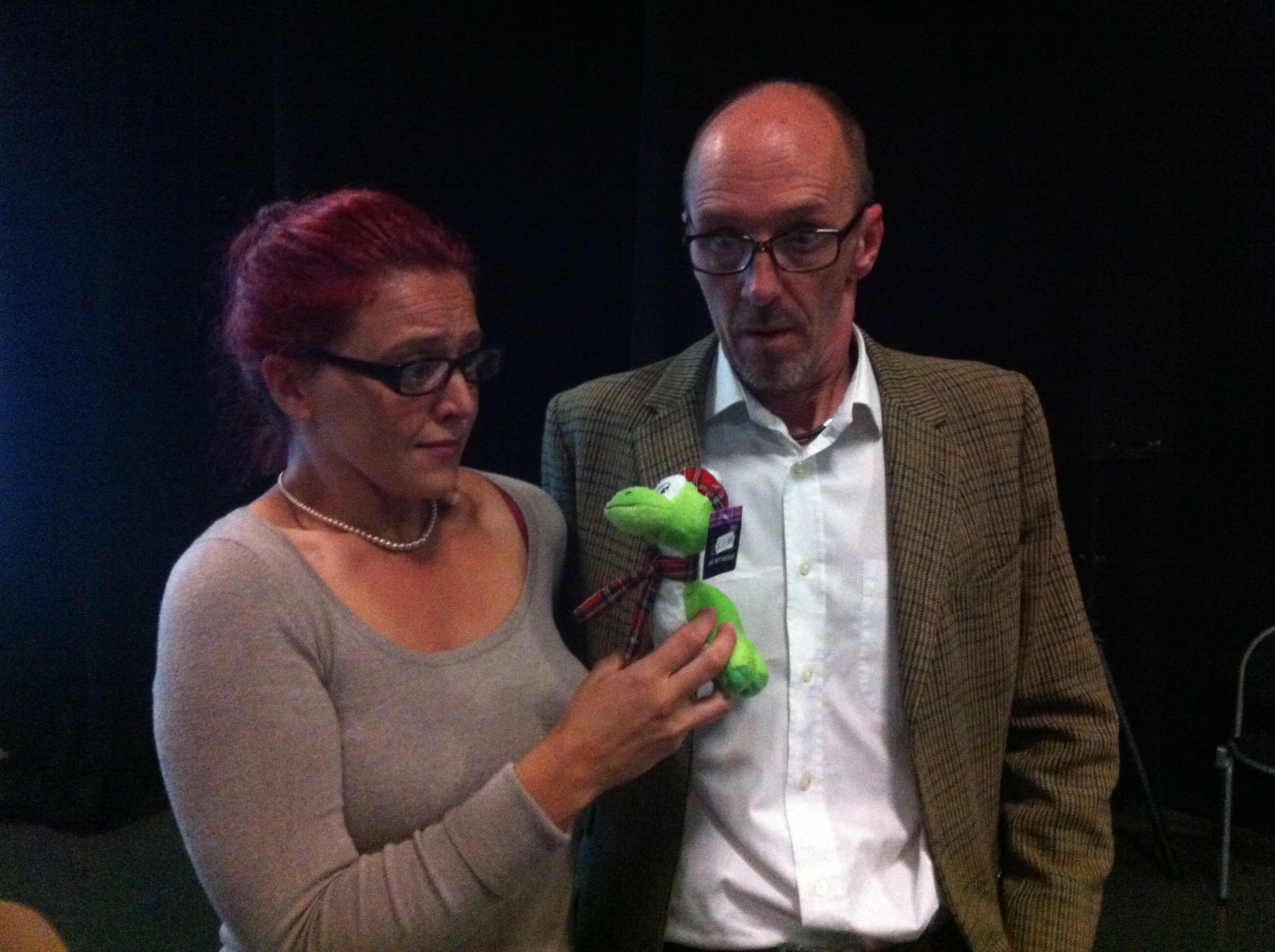
With special mention of The #1 Loch Ness Monster Experience performed by Bruce Morton and Karen Fraser Docherty at Edinburgh College, 24 June, 2014 as part of the National Theatre of Scotland’s The Great, Yes, No, 5 Minute Theatre Show.

Charlotte Productions celebrate the sucess of Goblin's Story in style.

Charlotte Productions celebrate the sucess of Goblin’s Story in style.

Many congratulations again to all the winners and many, many thanks again to all the companies, participants and venues who have made 2013-14 such a wonderful year with which to begin Edinburgh49. Our job for 2013-14 was to establish the title and prove it could endure from one Fringe to another. We’ve done that. Next year we’d like to expand our coverage into new genres – can you help us?

There are some incredibly talented individuals operating across the genres in this city. If you think you can help amplify word-of-mouth with passionate, peer-review style reviews which help producers and punters alike – please get in touch!

No more reviews for now, as we circle around the Fringe and live up to our name, but we will be back in September.

See you on the far side!

Alan, Richard & Dan

‘The Great Yes, No, Don’t Know 5 Minute Theatre Show (Edinburgh Coll’ege: 24 June ’14)

Loch Ness Monster  Experience

Karen Fraser Docherty & Bruce Morton in Andrew Learmonth’s The #1 Loch Ness Monster Experience

“We’re waiting for applause from Dumfries.”

Editorial Rating: Nae Bad

“We’re waiting for applause from Dumfries” the words tumble down into the performance space from the AV desk, located up behind the cheap seats. These are the kind of words you should expect to hear, waiting for the next show to take to the virtual stage. Live performances are being streamed from seven live hubs across Scotland. The one we’re at is in the smart environs of Edinburgh College – the FE entity spliced from Stevenson, Jewel and Esk as well as Telford Colleges.

The long intervals between performances provides plenty of time for gazing, espresso in hand, at the car park. Look right and you see Granton Gasholder No. 1, still there, listed and historic. The Great Yes, No, Don’t Know 5 minute Theatre Show was the espressos, punchy flavours packed tightly into tiny wee cups. The intervals were the view, the neutral palate-cleansing glass of tap water with which to prepare for the next full taste.

We saw only five mini shows from the over 180 scheduled. We look forward to seeing how the National Theatre of Scotland intends to save and make available this ‘democratic, dramatic, response to the theme of independence’.


Vote with your Feet by Anita John moved its audience left/YES to right/NO across the stage, with the helpful Don’t Know white line down the middle. 39 questions or statements sorted the adventurous from the careful: ie. “Will you go to bed on the night of September 18th?”; “Will you pay for the removal of nuclear weapons from Scotland?”; “Should Alex Salmond receive a knighthood?” In other words, The Thirty Nine Steps … on the run to independence or no. Three seconds to decide.

The format was reminiscent of those Facebook memes which determine which George Orwell book you are (Burmese Days and Homage To Catalonia in our respective cases). If the hurried pace was intended to encourage conversation it failed. The only one of us who voted ‘no’ to the question “Will you vote on September 18th” would have liked to have explained that they have a postal vote.


Democracy, produced by John Naples-Campbell, narrated the recent rioting in Venezuela from the perspective of an expat Scot out there teaching. 3 student actors covered a nuanced spectrum ranging through concern, bewilderment, constant fear and immediate alarm. Technical difficulties meant that we saw the performance 3 times. It lost nothing in the retelling. In fact, rather like a John Constable landscape, new features emerged with each review.


Ade Oshineye stood still and told the desperate story of Ruby, fighting for her own survival (call it anguished independence at a stretch) and that of baby Pearl in The House Next Door. You have to wonder what the neighbours were doing. Part angry rap at incestuous violence, part offended lament that this could happen, its intensity was in Oshineye’s quiet telling. Clearly one to watch, Oshineye moved like a butterfly under his heavy load, delivering the drama with gracious gravity.


Student theatre is many things. Most often it’s anxious: body image, pollution, the bestial nature of beastliness. Free Wifi Available took on the ultra-contemporary concern that social media isolates. Is constant connectivity really permanent disconnection? No. Clearly a medium that allows friends and families, oceans and continents apart, to communicate freely, intimately and daily is no bad thing. But for the sake of the old skool mediums who have a commercial interest in bashing open access formats let’s pretend it is.

The movement and staging were bright, bold and effective. Square red tape boxes on the floor (a stage hand’s wet dream – perform in there and no where else) supercharged an atmosphere already made moody by traverse staging.


The #1 Loch Ness Monster Experience  by Andrew Learmonth is in Drumnadrochit after ‘Nessie’ has stomped it to pieces. The cuddly toy of the parcel shelf is nae mair. The tourist economy is wrecked or at least is looking for redefinition via Godzilla. Hamish and Agnes stand in what is left of their shop and dispute the consequences. It is very funny, wickedly canny, and brilliantly Scottish. The BBC should take it nationwide – that’s UK wide – late on the evening of September 17th.


We watched these few pieces in PASS (Edinburgh College’s Performing Arts Studio) and they demonstrated all the character and enthusiasm that an educational setting should provide and that the producers of The Great Yes, No, Don’t Know 5 minute Theatre Show could have wished for. Hopefully the full event realised their ambitious purpose.

The proof will be in how the material collected will be distributed. Will we be able to see each play online separately? Will we be able to see a profile of each participant? Yes, this was live theatre on a virtual stage, but no, that does not mean it cannot be revisited.

nae bad_blue

Reviewers: Alan Brown & Dan Lentell (Seen 24 June)

Visit National Theatre of Scotland Yes, No, Don’t Know homepage here.

49 Things You Should Know About The Fringe 2014 pt.1 (1-16)

The Edinburgh Fringe is unique. Uniquely big as well as uniquely varied, and therefore uniquely competitive.

52 weeks in a year minus 3 weeks of the Fringe = Edinburgh49

Edinburgh49 is a collaboration between Edinburgh-based writers from some of the most respected Fringe Theatre review titles. Their insights combine detailed local knowledge with a comprehensive Fringe overview.

49 Things You Should Know About The Fringe will help you get the most out of your experience this August. In Part One we examine how shows get noticed and what to do when you are.


Introduction

  1. Locals can be slow to embrace the Fringe. They are often annoyed by the crowds and since many of the venues operate under different names during August are sometimes left feeling like tourists in their own city. BUT the Fringe is worth over a quarter of a billion pounds to the Scottish economy annually and brings in £245m to Edinburgh alone.*
  1. AND new year-round venues such as Summerhall (Europe’s largest privately-owned arts centre) and Assembly Roxy (part of the international family of venues) are blurring the lines between August and the rest of the year.

Getting Noticed

  1. Standing out from the crowd is hard. The streets are filled to bursting with the weird and wonderful. Even the brightest and best-conceived attention-grabbing stunt can be drowned out by the background hum of excitement.
  1. That’s why no serious festival goer (producer or punter) should be without the free Festival Fringe Programme, published by the Edinburgh Festival Fringe Society. It’s also available in digital and app formats, but reading the paper copy cover-to-cover is essential if you are going to know what’s happening, what you’d like to see, and what else your potential audiences might also be interested in.
  1. Cross-pollinate your publicity! Ask yourself, ‘What should your audience see after attending your show?’ Contact the other shows’ producers and ask if you can hand flyers to their audiences before or (more usually) after their show is over. Offer them the same.
  1. Punters like to talk with informed and informative promoters. If you have friends or have hired someone to help sell your show, make sure they are as enthused and excited as you are. Have they all seen your show? Why not? It’s so uninspiring to hear, “Would you like to see some comedy tonight? Well, I’ve not seen him myself but I’ve heard he’s really funny.”
  1. Use the VIP lounges. ‘Important person’ is a relative concept but each of the main venues has a lounge where producers and pundits can escape the crowds. You’ll find as much friendly advice, support and sympathy as you will posturing and preening.
  1. The Fringe features live performance from across the genres. Media editors covering the spectrum from stand-up to ballet will develop their own standardised measures for critiquing each piece of work.
  1. Understanding how each title balances its reviews and awards its ratings is essential if you are going to manage your resources effectively.
  1. Some shows come into the Fringe as part of a wider tour. Others make a standing start. Whatever the genre of show, it’s important to demonstrate media interest as soon as it happens. Get stapling! No flyer or poster should be without fresh ratings and reviews.
  1. With the rise of crowdfunding sites such as Kickstarter, more projects than ever are beginning online. How do you stack up against what other producers are already doing? Check out Edinburgh49’s previews of shows coming to Edinburgh using Kickstater and make up your own mind about what does and doesn’t work. Are the producers talking about the work, or are they talking about themselves? Have they explained what they are trying to do? Are you at all interested in what they are doing?

“The essential marketing tactics of the Fringe: online, in print, face to face and (most importantly) word of mouth.”

  1. There is such a thing as bad publicity! If your materials are unengaging, badly formulated, contradictory or plain uninteresting then you might as well not have bothered. You won’t have time to waste. Here, 13 to 16,  are some examples of bad deployments of each essential marketing tactic.
  1. Online. Make sure essential information about times and venues are on your front page. Punters using smartphones with uncertain connectivity don’t want to trawl through your entire online back catalogue of old rehearsal photos before finding what they really want to know.
  1. In print. With so many posters and flyers vying for attention, most will only be glanced at. Final judgements are made in seconds. Your printed materials are your main channel of communication, so keep it clear! Examples: Victorian costume drama = frock coat. Hamlet = skull.
  1. Face to face. Working a line of cricket fans queuing to see the blokes from Test Match Special, explaining to each in turn the background to your biopic about a Hollywood producer from the ‘70s, may keep THEM occupied until doors open, but YOU won’t sell many tickets. Read the schedules. Target the audiences most likely to be interested in your show.
  1. Word of Mouth. There’s no such thing as an empty house. Behind the lighting and sound desk is likely to be a seriously astute critic. Techies talk, so do front of house folk. Engage with them. Get them along and get them on board. When punters ask box office staff for recommendations you want your show to get first mention.

Coming up in part 2 of our 49 Things You Should Know About The Fringe: Meet the media; understanding the different titles, their policies and practices. DON’T FORGET TO CHECK OUT PART 3 LIVE NOW!!!

‘Tales of Correction’ (Vault: 31 May & 1 June ’14)

Tales of Correction

‘Quite how to distinguish the proper from the improper is all to do.’

Editorial Rating: Nae Bad

“We are now returning to Edinburgh to get some preferment in the Acting way.”  From Love and Friendship (1790) by Jane Austen.

The Vault in Merchant Street is a good venue for Tales of Correction. It is hard by the garage of the Edinburgh Sheriff Court where prison vans deliver and collect. As it happens, and an awful lot does happen in these two short plays, the feckless, unfortunate Augustus in Love and Friendship does time in Newgate before being thrown out of an overturned carriage – and dying.

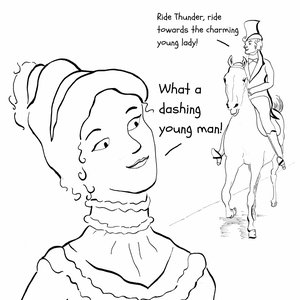
This Charlotte Productions double bill is a preview of the ‘project’ that this strong student born company is taking to the Jane Austen Festival in Bath in September where it is bound to be well received as both literary exercise and imaginative response.

Mansfield Presents is first on. We are in a cosy ‘back-stage’, back parlour space during on-off rehearsals of Lovers’ Vows, the actual society theatrical within-the-novel. As in Austen’s story, Fanny Price has a lot of needle-work to do and exactly as on-the-page(s) she has the admirable intelligence to stay quiet as all around her sound off. The red velveteen curtain is hung and the characters that matter are in place, costumes are just so, Rushworth’s sword has gone missing, and Maria is swooning over Henry Crawford. Edmund will, for sure, love Fanny and she him, but not yet. For the time being all the talk is of sexy subterfuge and Lovers’ Vows and of those related, tantalising questions: is it suitable for a private party (when ladies are present) and how does true delicacy show itself? Quite how to distinguish the proper from the improper is all to do.

Florence Bedell-Brill as Fanny is a study in self-possession; James Stewart, in wonderful voice as Mr Crawford, is the perfect gentleman for 1800, at least in her presence. Grace Knight as Mary Crawford provides the ringlets, wit and the fun whilst James Beagon and Jess Flood, as Edmund and Maria Bertram, embody good sense and trembling sensibility respectively. Leaving George Selwyn Sharpe – there’s a Regency name for you – as the loud buffoon in a cloak, which he inhabits handsomely.

The second play, Love and Friendship, with the same six actors, is writer Laura Witz’s adaptation of the 14 year old Austen’s parody of the sentimental novel. It is a glad, ludicrous and enjoyable piece where the broad comedy is still clever and effective. A melancholy cello plays on (ironically) while costumes change with bewildering speed from out of a suitcase and James Stewart, as an elm tree, sways in the wind that is George Selwyn Sharpe. Jess Flood narrates throughout and conveys just the right touch of wonder, incredulity and hand over breast excitement. Now it is Florence Bedell-Brill’s turn to swoon, which she does splendidly, taking Grace Knight down with her. James Beagon manages the rare double-act of coachman and pawing horse.

The two Tales of Correction are in order (i) heady, as in Think About This, because you should; and (ii) headlong, as in “Whoa!”, the wheels could come off. Well, they don’t because the direction, also by Laura Witz, is secure and the performances stay together.

Perhaps a young woman could review the plays in Bath. Laurie Penny would be my choice, echoing Edmund’s question in Chapter 15 of Mansfield Park, “But what do you do for women?”


nae bad_blue

Reviewer: Alan Brown  (Seen 1 June)

Visit about Charlotte Productions here.

‘A Slow Air’ (King’s: 22 – 24 May ’14)

A Slow Air

‘Plainsong for our secular times’

Editorial Rating: Nae Bad

Written and directed by David Harrower.

As you listen to A Slow Air you applaud the art of storytelling. The Scottish Storytelling Centre on the Royal Mile is now contained within ‘Traditional Arts and Culture Scotland’. One day, sometime, David Harrower’s 2011 play will be in there and part of Scotland’s ‘rich story heritage’. Unaffected, moving, A Slow Air is that good.

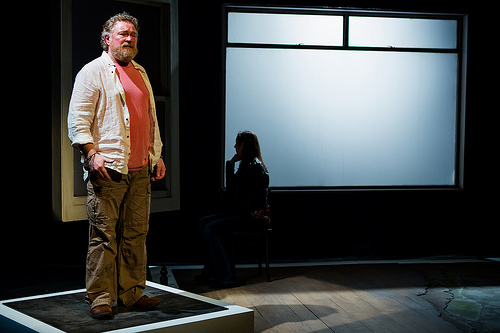
For the time being Ayr based Borderline Theatre has brought this play to the King’s after touring it through 17 Scottish venues – and 1 Welsh. It is easily portable: two bentwood chairs on a slightly raised platform stage and three-fold back flats with opaque windows that admit white, blue, or amber light. Daniel Padden’s quiet sound design is pitch perfect – Celtic strings, viola (?) and piano. It all creates a spare, open, space for two actors and an exceptional script.

Morna and Athol are brother and sister who have not seen or spoken to one another for 14 years. She, a single mother, stays in Edinburgh, off the Dalry Road; he, with wife Evelyn, is out in Houston, Renfrewshire, fifteen minutes’ drive from Glasgow airport, which is significant because it is 2007, and a short while after a green Cherokee Jeep loaded with propane gas canisters was driven straight at the glass doors of the terminal building.

Joshua, Morna’s 20 year old son is fascinated by that attack, probably because it has already acquired the vivid colours of the graphic novels that he loves to read, the comic strip immediacy of his sketches and drawings. They may have been crap terrorists and anyway “fanatics are hard to draw” but unwitting uncle Athol had been inside their house to give an estimate for a floor tiling job. Joshua, never seen, always reported, has all the qualities of the eejit young artist: maddening, unpredictable, lovable. It is Joshua who, in wacky fashion, would bring Morna and Athol back together.

Brother and sister come forward and talk and explain in turn. Pauline Knowles is ballsy, defiant, Morna, who is just about holding it together, despite seriously hard breaks. Morna cleans for alliterated Rosie and Randolph in their massive house in the Grange and in their empty flat in the New Town. She hits on the idea of using the flat for Joshua’s 21st. Pure brilliant! Lewis Howden’s performance as Athol is more reflective, more crumpled than wired, but nonetheless absorbing. Athol hates golf but has to try and play it to get business. We are treated to one botched round. In sum, mellow ‘Let There Be Love’ by ‘Simple Minds’ for him; & ‘U2s’ provocative ‘Pride (In the Name of Love’) for Morna. Hence Joshua, of course.

It is the innate sense of grounded, familial, story that you get – and gets you. Athol narrates. Morna responds in kind. Parents rest on sofa suites and live safe behind their double-glazing. Place and locality are everywhere: on the bus over the Bridges, Dick Place, Craigiehall, the Black Bitch pub in Linlithgow. SupaSnaps stores are on the High Street and Atholl marvels that Joshua could sleep well on a budget IKEA mattress.

David Harrower is the writer of Blackbird (2005), a recent production of which was reviewed on this site as ‘Outstanding’. Plainsong for our secular times, A Slow Air, is gentler, but no less compelling.


nae bad_blue

Reviewer: Alan Brown (Seen 22 May)

Visit A Slow Air homepage here.

Save the Date! — Thurs. July 10 — The End of Normality

As the city gears up for the Edinburgh Festivals, the Edinburgh49 team, together with Alechemy Brewing, invite you to join them at Assembly Roxy to celebrate the end of normality. See below for details of how to get on the guest list.

52 weeks of the year minus 3 weeks of the Fringe = Edinburgh49

Last September Edinburgh-based writers covering the Festivals got together and started a new review site dedicated to the city’s year-round arts scene. What is there in Edinburgh outside the Fringe? Not much. Not after you’ve discounted:

  • World-class venues of every shape and size
  • Unrivaled technical expertise and professional know-how
  • Audiences who know their Marlowe from their Molière
  • A flourishing student theatre scene
  • Prestigious touring companies
  • Innovative new writing

BUT apart from the over-used Monty Python reference, what has happened in Edinburgh since the end of August 2013? Come find out!

The Edinburgh49 Yet-To-Be-Titled Year-Round Theatre Awards

On the night of Thursday 10 July the recipients of the 49th most prestigious award in the South East of Scotland will be announced.

The winners will be those 6 productions who have done most to showcase that Edinburgh is the home, incubator and top destination for the planet’s most talented producers.

SAVE THE DATE! & WATCH THIS SPACE!


Get on the guest list:

When: Thursday 10 July

Where: Assembly Roxy, 2 Roxburgh Place

From: 7:30pm

How to RSVP: guestlist@edinburgh49.com

‘Takin’ Over The Asylum’ (Studio at the Festival: 15 – 17 May ’14)

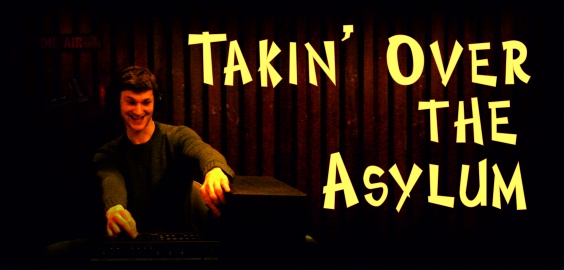
Takin' over the Asylum

‘Mike Paton, as the schizophrenic computer wizard, provides a deeply moving performance, rather lost in all that excess material like a thong in a duvet.’

Editorial Rating: Nae Bad

Eddie’s dreams of becoming a celebrated DJ have not exactly worked out. He’s not on Radio 1. Nor is he headlining at Radio Clyde. Instead he’s eking out a living as a double-glazing salesmen. When the opportunity to run St. Jude’s hospital radio comes about, Eddie seizes the chance to share his love of Soul music with a captive audience.

His in-patient listeners are an assortment of characters, each struggling with mental health issues serious enough for them to require round-the-clock supervision. With no other agenda than playing his records, the tables are turned. In Eddie the patients, especially the frenergetic young radio enthusiast Campbell, find a sympathetic ear into which they can pour their frustrations and confidences.

Donna Francechild’s script is partly the product of her own battle with the effects of bi-polar. Softly spoken Eddie (Alan Richardson) is its focus. He’s an ideal sounding board, reflecting the inner and outer turmoils of the patients. Richardson’s reactions in each of his onstage relationships help to reveal something far more intricate than the traditional stereotype of those with mental health problems.

Richardson is fortunate to be playing along with a highly capable cast who set their individual portraits into a greater whole. The effect is not unlike John Trumbull’s Declaration of Independence. As with the painting there is a sense of inclusion, a painstaking accuracy and attention detail but also a starchiness. It doesn’t help that Francechild’s canvas is too big; untrimmed material unstretched.

Takin’ Over The Asylum is a reimagining of a 20 year old BBC TV script (originally starring Ken Stott and David Tennant). But 1994 is not 2014. If you don’t agree then compare John Simm in the all but forgotten sitcom Men of the World with what he’s got up to more recently in Prey. Already something of a hybrid, One Flew Over the Cuckoo’s Nest spliced with Good Morning Vietnam, the uping-to-dating of Takin’ (references to podcasting and internet radio) fails to address how private an act listening to music is in the age of MP3. Why the reimaging? What was wrong with 1994 as a time and place?

What has been preserved is the episodic feel of the TV series. The sense of a single overarching narrative, one focused on a particular set of key events, is dimmed to the point of obscurity. Relationships progress suddenly out of no where. Confidences are exchanged when the scene before the characters were strangers to one another.

None of this detracts from the essential point that the onstage work in this production is of a very high order. For all that there is a lack of theatrical devices and the scene changes are painfully slow, there is some fantastic character work on offer. Calum Barbour as Campbell never flags or falters. He’s so good I even find myself warming to the twerpish Campbell. Pacy and racy, Lynsey Crawford as Francine is superb, revealing her scars with a tender emotion that presents a person as well as a victim – and I’m not just saying that because she lists kickboxing as a hobby.

Mike Paton, as the schizophrenic computer wizard, Fergus (who was an electrical engineer in the TV series), provides a deeply moving performance, rather lost in all that excess material like a thong in a duvet. Jane Black as the OCD Rosalie was truly sensational. I feel in love with her. Cared about her. And can’t bear to think about what she will have to face on the outside when she leaves St Jude’s.

Derek Blackwood’s set design is spot on and elegantly lit. This was my first venture into the Studio at the Festival (entrance via Potterrow) and it was great to see the space being used so well.

I’m not sure why they decided on assigned seating. Octopussing over the back rows, enjoying all the space that I was not sharing with the tightly packed rows below. I couldn’t help but feel that we might all have relaxed into Francechild’s razor sharp comedy if everyone else had been less constrained. But then as Matthew Thomson, as Stuart the nurse shows, asylums do tend to be more fun if you aren’t the one in the straitjacket.

nae bad_blue

Reviewer: Dan Lentell (Seen 15 May)

Visit Takin’ Over the Asylum‘s homepage here.

‘Pressure’ (Lyceum: 1 – 24 May ‘ 14)

Pressure handbill

‘The clock counts down, isobars group, weather fronts advance’

Editorial Rating: Outstanding

A new play by David Haig. Directed by John Dove.

Pressure blows up a storm of anticipation. Remember the first handbill: warships steaming full ahead out of the binoculars and heading straight for you? If you have seen The Longest Day, the film about D-Day and the Normandy landings on June 6 1944 (but it helps if you’re over 50 and a boy), then remember that scene when a German officer adjusts his Zeiss lenses and sees the invasion force emerge through the dawn mist. Shock and awe big time! Impossible to create much the same on stage? Not if you can read a barometer and like the joke of employing a meteorologist to forecast shooting conditions for Gone with the Wind.

That was filming in 1939 in sunny LA County, whereas Pressure builds over four actual days in 1945 in Southwick House, near Portsmouth. US General Dwight D. Eisenhower is in command but depends upon a plumber’s son from Dalkeith to tell him what the weather is going to do. High winds mean high seas, overturned landing craft and limited air cover. Should he or should he not postpone? And, General, this is British weather we’re talking about.

Enter James Stagg PhD, RAF pro tem, ace meteorologist on tenterhooks. Cue very big charts, 5 to 6 low pressure systems, 2 high ones, flurries of weather reports, black Bakelite telephones, pots of caffeine and introduce the fact that beyond 24 to 36 hours the science of forecasting is all informed guesswork. Where, over there and by the way, are Rommel’s tank divisions? You grasp the fog of war.

The uncomplicated story takes hold very quickly. Stagg’s gloomy, inclement forecast is opposed by his American opposite number, trained in Beverley Hills and on the Italian beachheads. Lt. Kay Summersby and Eisenhower are an established item; conceivably a chaste one. The clock counts down, isobars group, weather fronts advance and Stagg suffers personal agonies of his own.

Writer David Haig is James Stagg and is a near elemental force. He stands awkwardly to attention in front of his commanders but provides reports of such detail that you … are blown away, as it were. This is a man, you sense, who cannot be sure that he is right but will move heaven and earth to move the odds in his favour.

In his life Eisenhower was a lucky general. Malcolm Sinclair plays him on a long fuse and a tight smile, unbowed by his massive responsibility and with a winning streak straight out of the end zone. It is a calm, light time (rare in Pressure) when Stagg tries to explain rugby football to the general who clearly will never understand why the ball is passed backwards.

Laura Rogers as Kay Summersby is a delight. The compassionate role moves her imperturbably to and fro between the five star general, whom she has known for two years, and the private, undemonstrative, scientist and allows both characters to open up. In this reading Summersby is probably David Haig at his most imaginative.

Director John Dove has those fine, clear- sighted Lyceum productions of Arthur Miller plays to his credit. In relation to this current production The Man Who Had All the Luck might as well be Eisenhower’s experience. In Pressure Dove succeeds not simply with pace and control but he also has stage actors in uniform to contend with, which weighs more significantly than civilian costume, and is never to be taken for granted. We are behind the lines, of course, but you never doubt that there is a war going on. There is just the one violent reminder when a plane goes ‘down’ and that seems a little unnecessary given the intensity of the on-stage action. Pressure is a taut, winning drama and you will appreciate the energy and skills of the creative team behind it, from blackout lighting to the drone of bomber formations.

It is, finally, David Haig’s play and is, I think, a major achievement. An exciting, dramatized, chronicle.

outstanding

Reviewer: Alan Brown (Seen 8 May)

Visit Pressure homepage here.

‘Uncle Varick’ (King’s: 7 – 10 May ’14)

l.to r. Willie John (Dave Anderson), Michael (George Anton) & Varick (Jimmy Chisholm) Photo: Richard Campbell

Willie John (Dave Anderson), Michael (George Anton) and Varick (Jimmy Chisholm). Photo: Richard Campbell

‘Inappropriate for Invergordon’

Editorial Rating: Unrated

“Don’t catch the sleeper. Stay at my place”, pleads Michael, Highlands GP, ardent ecologist and would-be lover. The married lady takes the train. So much for the ‘Swinging Sixties’.

Writer and artist John Byrne wrote Uncle Varick in 2004 and sets it in 1967 within a 20 room pile on a Highland estate, all dark wood panelling, tick-tock, and parlour room landscapes. This Rapture theatre production invites you to see it as if framed within a distressed gilt surround. Its parent, Chekhov’s Uncle Vania, subtitled Scenes from Country Life in Four Acts, and very much the choice soundboard of Byrne’s work was written in the Crimea, 1500k from Moscow where it was first performed in 1899. No mention of trains in the Chekhov, just horses to carry you between those fiendish, prime, poles of town / fabby and country /boring, ‘parochial’.

London is where Varick’s brother in law, overblown art critic Sandy, lives. First in Swiss Cottage, then in Maida Vale, but now – the impression gathers certainty – it is all proving too expensive and he finds himself cash poor, on painful legs, and has only the estate to sell. Only it’s not quite his to sell. He would have investment income and a small villa in Majorca. Of course he would, just as Chekhov’s retired professor, another Alexander, would have his wee dacha in Finland. Michael, once Mihail Astrov, has a map of the estate as it was fifty years ago – in 1917 or 1849, as you will – that charts a picture of decay as the old ways give out to be replaced by … by what exactly?

And so the doubling continues between the uncles, Vania and Varick. Byrne’s idea is canny and pretty neat but now, only ten years on, it appears a little forced, a little hung up. For all their appeal, the Scottish characters approach caricature: there’s Kirsty Morag, the old housekeeper and sweet guardian of Scots, as in ‘muckle chainsaw, ken?’ and kind Willie John in cap, sporting breeks and Fairisle sweater. He plays sweet guitar though and sings three great and apposite Beatles songs from Rubber Soul (1965). A dun, knee length pleated skirt out of Dingwall Drapers opposes a showy 60s minidress from Lady Jane’s in Carnaby Street; bold is not the word for that hemline. Inappropriate for Invergordon would do.

But there’s wild haired Jimmy Chisholm as Byrne’s Varick and he is well beyond naïve portraiture. Kirsty Morag would call him pawky. It’s a quick, spry, part that is both entertaining and woebegone. Chisholm may be dressed in baggy cords or pyjamas, dressing gown and slippers but that will not divert you from the nippy spirit of his performance. His opposition to vainglorious and impossible brother-in-law Sandy, is at Vania / Varick’s heart and while you just want Sandy to get ‘orf’ and away back to London (so strong is John Stahl in the part) you do enjoy Chisholm’s performance.

Varick is heartbroken as well, which just adds crummy self-esteem to injustice. No requited love for him from Elaine (Selina Boyack), Sandy’s second wife. When Shona (Ashley Smith), Varick’s niece and all-round lovely person, sings Cry Me a River you know the emotional landscape is unrelieved and forlorn. In such a place it is Michael, a poignantly lucid George Anton, whom you notice and listen to.

There are amusing moments: smile at the use of flock wallpaper and laugh at a couple of funny break-out lunacies – but otherwise Uncle Varick is more serious and contemplative than you might think. Can it bring Ross and Cromarty, with its estimated population of 50,000, to Greater London’s 9 million? Perish the thought! All we do have in definite motion in 2014 is the Invitation to Tender for a separate Caledonian Sleeper Service ‘in order … to develop a transformed product offering that will secure its future as a sustainable business.’ Well, all the more reason for Elaine to refuse Michael’s bed.


Reviewer: Alan Brown (Seen 7 May)

Visit Uncle Varick homepage here.