‘The Medea’ (The Vault: 2 – 5 April ’14)

10153047_619181111495743_1639459291_n

Sophie Harris as Medea and Olivier Husband as Jason.

‘Sophie Harris’s Medea has as much self-loathing as hatred for Jason – her love for him does not make her weak, it hurts her and she wants the pain to stop.’

Editorial Rating: Nae Bad

Rosy-shouldered dawn shrugs disconsolately at the thick fog which has covered the Grange for days. The smell of wild garlic perfumes the air as I trudge earlymorningedly through the lanes. While Monty-The-Dog, a single headed cerberus, sniffs daintily at lampposts through his muzzle, Robert Graves’ The Golden Fleece tumbles from my iPod.

Graves’ Argonauts are a fractious lot, just about held together by the strings of Orpheus’ lyre. His Jason, a somewhat querulous figure, is little more than the unwitting product of circumstances and Chiron’s peerless tutelage. It’s easy to see how Graves’ Jason might have ended up on stage at the Vault in Victoria Fairlie’s adaptation of the Euripidean afterword.

Where I was dragged up you didn’t win the school classics prize if you described the story of Jason’s divorce from the headstrong princess Medea as an ‘afterword’ to the swashbuckling Argonautica. Edinburgh49’s editor (a former teacher himself) assures me this holds true most everywhere.

Up until last night I never fully appreciated the reasoning (other than antiquity) for the play’s enduring appeal. Euripides’ take on the jilted wife, who spites her lost love by destroying his new wife and father-in-law, before slaughtering her own two children by him for the sake of revenge, had always rather baffled me. What is there in a statement on the nexus of neurosis inherent in a barbarian woman who has betrayed her own kind to be with a foreign prince who in turn betrays her?

Through Fairlie’s well-scaled adaption I have (belatedly) come to appreciate that The Medea holds universal insights into the sorrow of falling out of love. Sophie Harris in the title role was sensational. Her strong, perfectly-paced voice opened proceedings, and her subtle variations kept the darkness bright. Harris’s Medea has as much self-loathing as hatred for Jason – her love for him does not make her weak, it hurts her and she wants the pain to stop.

The cast excel at squeezing the juice out of Fairlie’s lines until the pips squeak. “Don’t get me wrong, I love Medea.” My keyboard lacks punctuation marks expressive enough to encapsulate what James Beagon, as Marnes, did with that line. Another instance is the interplay between Medea and her importunate friend Althaia (Leyla Rana Doany). When the latter states, “A man is not your life” Medea retorts, “Maybe not every man, but this one was.”

The Classics Society should know its material like their degrees depended on it. That they do shows up in some A* character summations. Medea is “a shuddering mess of a woman,” whereas Jason’s new wife, Glauce, is “a pretty woman with an empty life.”

Fairlie calzones the script, flipping one half over the other to preserve the heat and amplify the flavour. Rather than relying on the traditional Chorus, the narration is provided by simultaneous retrospection from a Medea haunted by the incarnations of her good and bad angels. Maddie Haynes and Alice Vail shoulder something of the weight of expectations carried so artfully by Harris. They tease out her nuance, throwing up ideal dramatic uplighting.

Gone with the Chorus is Creon’s kingship. Cormac Rae presents Jason’s new father-in-law as a shady figure, wielding influence, rather than power, as might a supreme mafioso. Rae’s clipped tones saturate simple lines such as, “I’d like you to stop,” with quietly assertive menace. His crucial scene with Medea is played with a beguiling understatement. It’s very different from the bombast so often deployed at this familiar moment in the drama. Rae’s Creon is a concerned but devoted father. Perhaps he even harbours an apologetic sympathy for Medea denied disclosure by family loyalty.

Harris’ reactions are as essential as her acting. She is fortunate in her soundingboards, who bring depth and creativity to their roles. I’d like to see the colossally tall Josh Reid fending off bi-planes as he clings to the outside of the David Hume Tower, clutching the diminutive Harris in his hand. The difference in their size may be comic, but the exchanges between them crackle with sombre tension when Reid as Aegeus convinces Medea to connive.

I was not much taken with Olivier Huband’s previous outing as Jason, during the Dionysia. In his reprise of the role he has reached further and achieved more. The somewhat slimy efforts to overpower Medea with sexual magnetism are gone, replaced by a more thoughtful and thought-provoking interplay with Harris. Huband has tremendous poise, shaping himself to the moment as though he has stepped from an Attic vase. He also posses a powerful delivery. In the reprise he has proven he can use it to be more E-Type Jag than Centaur Tank.

This production and adaptation were not without faults. The tinkering with the death of Glauce and Creon’s needless survival were unimpressive. The backdrop of electoral politics hindered rather than helped the contemporary feel. Neither did the script allow Medea to do much more than scorch her bridges with Creon, when for the plot’s sake they needed to be burned entirely. The swearing was unnecessary. If an audience can cope with infanticide they’re not going to be upset by the f-word.

A good production avoids its weaknesses as much as it displays its strength. This was not the cast to present grief stricken fathers coming upon the fresh corpses of innocent children. The ending was downright muddled. If Beagon wants to be credited as a script editor, he needs to demonstrate at least as much ruthlessness as when he reduced Sword at Sunset to a mere three and half hours.

Reflecting on how much Fairlie’s adaptation has furthered my understanding of this oh so dark tale, I cannot help but be mightily impressed – it’s what you want from a Classics Society production. The venue may suit lines about cold, dark and dank environs but, as Harris so flawlessly demonstrates, the Vault is a great incubator of vibrant, compelling talent.
nae bad_blue

Reviewer: Dan Lentell (Seen 2 April)

Visit The Edinburgh University Classics Society’s Facebook page here.
‘Love With a Capital ‘L” (Traverse: 1 – 5 April’14)

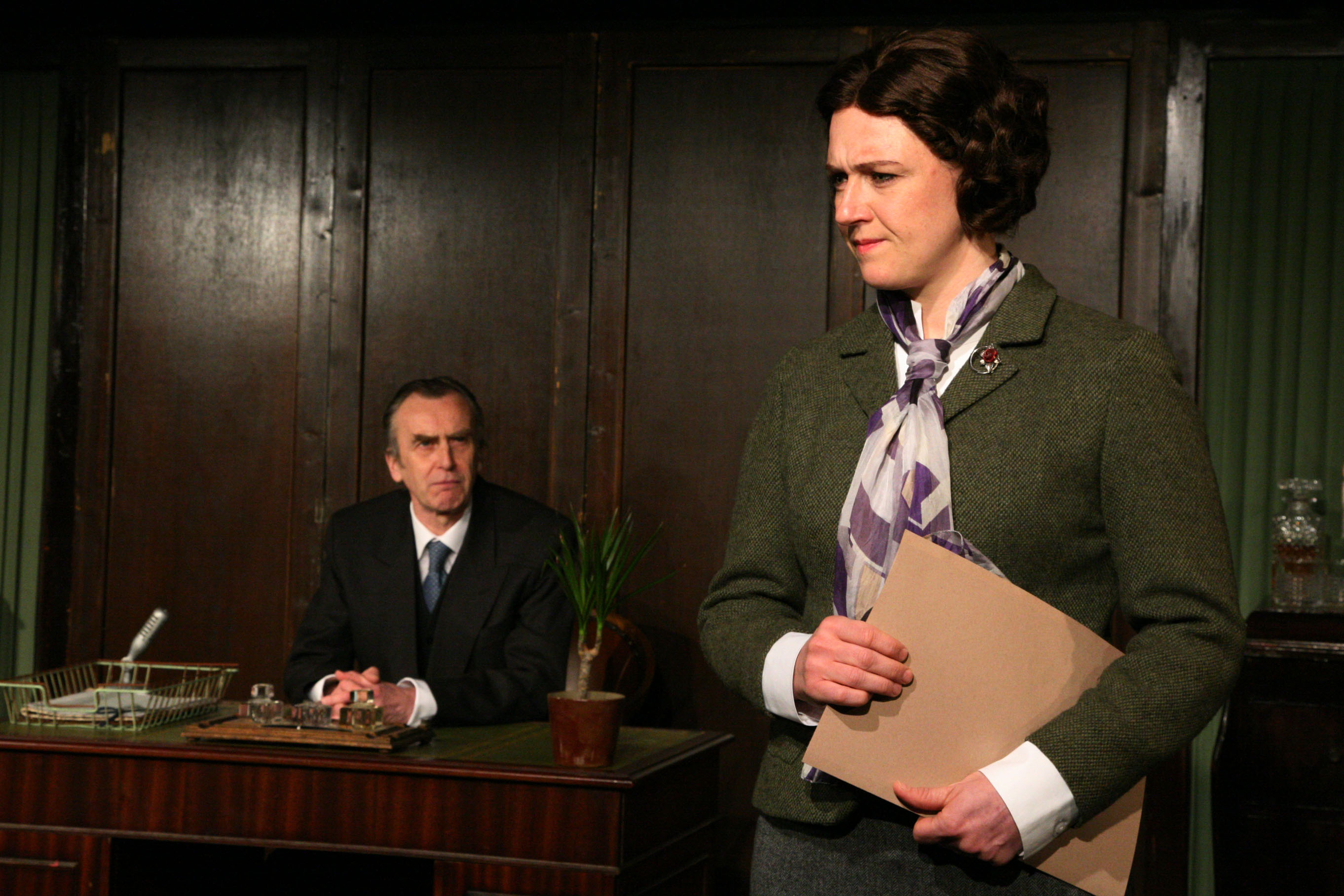
Benny Young and Lesley Hart. Photo by Lesley BlackPhoto: Lesley Black

‘How, in the name of all that is haughty and holy ….. ?’

Editorial Rating: Nae Bad

The first of the five short plays within the annual ‘A Play, A Pie and A Pint’ series that runs through April. Edinburgh49 is reviewing all five.

Loved it. And I’m not just talking about the Scotch pie and the pint before or afterwards. [Hot tip: the venison pies go quickly.]

Writer Tony Cox’s first stage play, directed by Hamish Pirie, is top-drawer work. A cross-examination of (i) rectitude on air and of (ii) the sneaky premise that all marriages are like potted plants – terminally pot bound – Love With a Capital ‘L’ is Radio4’s Thought for the Day with attitude.

It is ethically spiky. John Reith, the BBC’s first Director General, challenges Hilda Matheson, the Corporation’s ‘Head of Talks’. She, in straight-backed, imperturbable, manner, challenges him back and … a nice yucca plant is smashed to the floor.

This well-researched script is right in there at the beginning of public service broadcasting. We are in Reith’s office in Savoy Hill in June 1929. The BBC employs around 400 people at that time. Matheson has invited H G Wells to go on the radio to talk about world peace. George Bernard Shaw is due ‘on’ the election. Reith, son o’ the Free manse, regards both as ‘Reds’ and Bolshevik apologists but what really riles him is the air time being given to the Bloomsbury set and in particular to Vita Sackville-West and to her husband Harold Nicholson. Their views on marriage, open affairs, ‘free’ love, and the rest of it – most of it gay – appal him. How, in the name of all that is haughty and holy can ‘the keeper of the nation’s conscience’, allow it? Answer, if you would, Miss Matheson, please.

Easy: in brief, “Will that be all, Director General? I have work to do.”

Actually, that is far from all, as Reith has Matheson read his diary. Personal history will out and both characters are drawn sympathetically, if briefly, together.

Benny Young plays John Reith. It is the driven self-control, self-censorship, and the tight smile that gets you and the force of the interrogatory “Why?” Reith, momentarily wobbling, quotes Puck who will ‘put a girdle round about the earth / In forty minutes’ and you acknowledge that what Reith created at the BBC was unique and valuable. What Young gives us, also in forty minutes or so, is a more compassionate man than the unsparing biographies would suggest.

Lesley Hart is Hilda Matheson, who would have been forty-one in 1929; one year older than John Reith. Hart does not flinch once and plays Matheson as the extraordinary and successful woman she must have been. The script provides wit and intelligence enough but the confident bearing and sense of self-worth is Hart’s doing.

It is not on the wireless but you will want to listen in to Love With a Capital ‘L’. Its subject and its acting reward that kind of close attention.


nae bad_blue

Reviewer: Alan Brown  (Seen 1 April)

Visit PPP Love With a Capital L homepage here.

‘Banknote’ (Lauriston Hall: 26 – 30 March’14)

BanknoteCM Photography

“The offbeat ideas just roll gloriously on”

Editorial Rating: Unrated

According to their website, Theatre Paradok aim to be “experimental without being exclusive” – and if Banknote is anything to go by, they’ve got that brief comprehensively nailed. In the space of 90 minutes, their eminently experimental play anthropomorphises the Bank of Scotland £1 note, imagining it as – what else? – a Victorian-era burlesque star. The eponymous banknote’s key virtues (like being trustworthy, or difficult to copy) are exhibited in a series of broadly-comic vignettes; and those vignettes lampoon distinctly non-Victorian cultural phenomena, ranging from The Proclaimers to ‘Blind Date’. This is every bit as perplexing as it sounds.

But Paradok get away with such a bizarre concept, because their pecuniary antics are laugh-out-loud funny almost the whole way through. Star of the show is Euan Dickson, who plays compere to most of the set-pieces and brings just the right level of pantomime exaggeration to his role. The gaggle of “burlesque dancers” aren’t quite as burlesque as they want to be, but they successfully develop rounded individual characters and perform with genuine skill. And there’s a welcome change of pace from a compelling performance poet, despite the fact that his appearance ended in what may or may not have been scripted confusion.

There are sharper moments – at one point a dippy, put-upon dancer casually reveals a far more intelligent side – but in the main, the offbeat ideas just roll gloriously on. As is mandatory in experimental theatre, the cast drop out of character to conduct an artistic quarrel. There’s a well-timed intervention from a bare-chested man in boxing gloves (who’s spent three-quarters of the play standing at the back of the room doing absolutely nothing at all). And it all ends with the most cheerfully tuneless song-and-dance number you’ll ever have heard – which still contrived, through sheer chutzpah and charisma, to get the whole audience happily chanting along.

What’s missing, though, is an overall sense of coherence. While there is a narrative thread running through the set-pieces, it isn’t strong enough to stitch them together, leaving the work as a whole with an episodic and juddering feel. For a minute or two after the interval, there’s a glimpse of the anchoring theme this play so badly needed; the obsessive chemist Alexander Crum Brown takes centre stage, describing his quest to develop the “impossible” perfect banknote. But that promising insight is passed over in a moment, lost among a flurry of over-complex allegory and wilfully-anachronistic humour.

In short, Theatre Paradok’s experiment has bubbled somewhat out of control. Never mind though; it was hugely enjoyable to watch, and I’m sure it was just as much fun to perform in. Student theatre’s allowed to be freewheeling – they have the rest of their lives to rein their imagination in.

Reviewer:Richard Stamp (Seen 28 March)

Visit Banknote homepage here.

‘Double Bill’ (Traverse: 27 – 29 March’14)

Double Bill

“Open-sourced quality”

Editorial Rating: Nae Bad

This is the Traverse Theatre Company’s starred pairing of Clean by Sabrina Mahfouz and of A Respectable Widow Takes to Vulgarity by Douglas Maxwell; both plays directed by Orla O’Loughlin. Indisputable showcase productions, they’re looking sharp for the Brits Off-Broadway season on the 59E59 ‘A’ stage from 2nd to 27th April.

Clean is as in, “We searched her and her luggage and she was clean”. Only unapologetic protagonists Zainab, Chlöe and Katya, are not. It is just that they specialise in criminal work that scrubs up well: credit card fraud, emerald smuggling, and share price ‘protection’. They work and talk alone until one lucrative job and an evil Mr Big brings them together.

They make a game trio on the same spare platform, which is Mahfouz’s point. Clean is Bold Girls (at Level 1) on an Android OS: mobile, smart and sassy. Its story might as well be released for a PS4 console in search of female characters. Mahfouz’s on-off poetry is attractive with quick dialogue pressing hard on ‘Refresh’, providing feminist content and voice(s) within an all-user setting.

The performances display just as distinctly. Emma Dennis Edwards is Zainab. Hackney street-wise and ‘sick’, man; save that this is one sorted 23 year old who does not need a man in her life. She moves, sometimes raps, in-between poised, posh Chlöe (Jade Anouka) and Russki, Katya (Chloe Massey), whose accent is as hard, probably, as her steel toe-caps. OK it’s off-script, but you don’t ask Lara Croft if she has a younger sister, obvs.

Clean deserves to clean up in New York, which is more than Candy Crush’s listing managed.

A Respectable Widow Takes to Vulgarity has the same open-sourced quality as Clean. It looks explicitly to class and culture but plays nicely alongside the character graphics of Mahfouz’s piece. Director Orla O’Loughlin puts this on second, probably because it is funnier, less edgy and virtual, I suppose. Regardless, the direction is just as tight.

Writer Douglas Maxwell describes it as “My Fair Lady in reverse”. Sounds good. Well-spoken Annabel from purlieus douce meets young employee Jim Dick at her husband’s funeral. He’s emphatically not James Dick of Dick Place, EH9, the most expensive street in Scotland. Annabel would converse, he cannot without tripping into his f’ing vernacular that embarrasses him and fascinates her. There you have it. Flippin’ Pygmalion flipped.

Joanna Tope is Annabel and has just to adjust her scarf for you to realise that she does not shop at Accessorize, as the spelling would appal her. Her speech is pitched so well that ‘cadence’ probably registered on her P1 report. Gavin Jon Wright as James plays very reluctant, wired, ‘teacher’ with the merriment of an actor who knows he has a gift of a part. See him on the terraces when Annabel goes one word too far!

A crude joke of a name ends the piece and has them both choking on their Big Macs. An appetite for language is always healthy.


nae bad_blue

Reviewer: Alan Brown (Seen 27 March)

Visit Double Bill’s homepage here.

‘The Picture of Dorian Gray’ (Bedlam: 26 – 29 March ’14)

Dorian Gray

Wil Fairhead as Dorian Gray. Photo. Paul Alistair Collins

“The contrast between Gray and his aging associates was very well handled and provided the actors with opportunities to show off their powers of reaction, in which they all excelled.”

Editorial Rating: Unrated

I’ve been told to stop sending hectoring emails to the producers of Epic Rap Battles of History. Apparently they aren’t going to be pitting Dorian Gray against Doctor Faustus in the present series, and that’s an end of it. It’s too epic for EpicLLOYD and Nice Peter isn’t so nice when cease and desist letters start flying around. If the line, “you’re a puny little dandy, as weak as lager shandy” doesn’t clinch the deal, it seems nothing will.

Oscar Wilde’s The Picture of Dorian Gray is the story of a handsome fellow who sells his soul for the outward appearance of eternal youth. Under the mephistophelian tutelage of his friend Lord Henry, Gray shuns the simple life betraying the trust of those he befriends. After breaking the heart of his first love, Sybil, a beautiful young actress, Gray realises that while he never ages, his sins are being scored upon a portrait painted in his prime.

Published in 1890, Wilde’s only novel courted controversy like a magnet attracts filings. It is arguably his most important work, the one in which his gorgeous worldview is most cunningly elaborated. Adapting The Picture for the stage might be considered an impious undertaking – certainly the path to hell is paved with unsold copies of Oliver Parker’s 2009 film version.

Neil Bartlett’s adaptation is more faithful to Wilde’s original, but the perfect proportioning of gothic subtlety is lost. For all its larger failings, what annoys me most about the script is that Sybil, performing in Romeo and Juliet, is called to the stage for beginners’ positions even though she won’t appear until scene 3. Wilde did details like Ozwald Boateng does, if you’re going to muck around with him do it right.

Jonathan Ip, as Lord Henry, has the fuzziest end of the lollipop. Huge chunks of semidigested monologue blocked his route through the first couple of scenes – a grueling marathon run with hurdles. Under the sheer weight of words, Ip’s delivery of Wildean wit is muted, and about as jolly as Reading Gaol on a rainy day.

Together with Wil Fairhead in the title role, Ip took to hiding behind his props. The obsessive smoking of e-cigarettes, as well as the constant imbibing from tumblers of neat spirits, suggested that the lads were finding it all a bit much. It’s a wonder director Kirstyn Petras hasn’t got them attending an AA meeting or two.

Fairhead was a strong lead, though noticeably better playing the bastard than the boy. The contrast between Gray and his aging associates was very well handled and provided the actors with opportunities to show off their powers of reaction, in which they all excelled. Both Ip and Dean Joffe (as Basil Hallward) found themselves in their characters’ older selves.

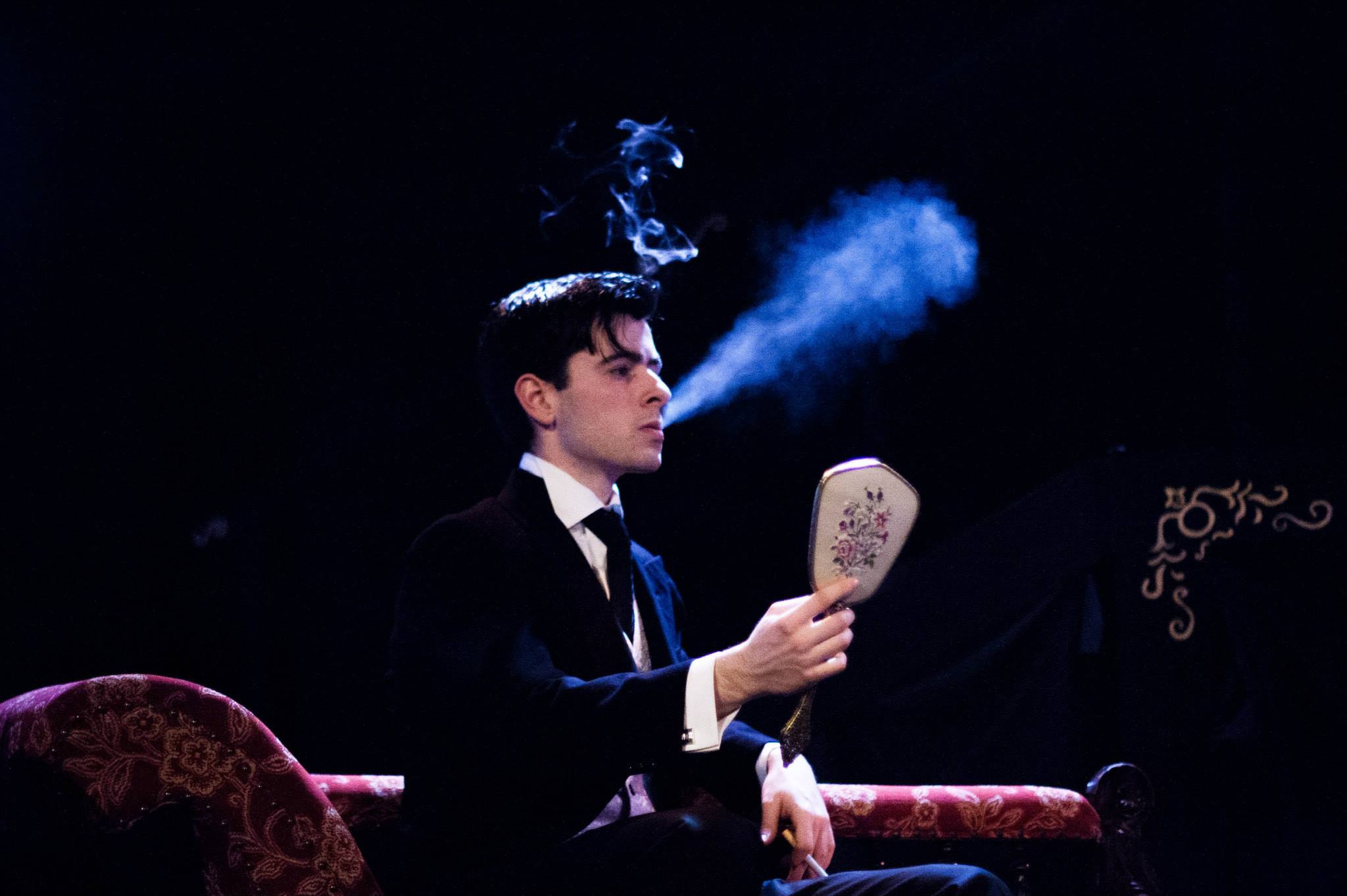
The overall set design was smart, and would have suited a tighter script. It is impossible for a production to stay pacy when it has so many scene changes, necessitating the movement of masses of trinket bedecked and bulky furniture – dropping a hand mirror on stage must bring seriously bad luck.

A platform at the back, with attractive gold detailing, provided Gray with an attic in which to conceal his shame, and the bulky furniture with a place come and go from. To the sides were galleries for the supporting cast who were excellent throughout. Some very strong performances were on show demonstrating that those crowding the wings were not just clothes hangers for Sophie Guise’s superbly tailored costumes. It’s nice to see someone who knows the difference between morning and evening wear, even if Ip’s waistcoat stuck out from the latter. Also, giving the ladies slippers might have reduced the noise of the perpetual scene changes.

With so much participation from the team behind In The Heights, Edinburgh University Footlights’ outstanding recent outing, this production pulled one rabbit from the battered top hat. Jimi Mitchell’s dance routine was spectacular. It was what the cast had been waiting for. Perhaps it was a little too interwar but it showed what the players were capable of when freed from the confines of the script.

This was a production posing more questions than it provided answers. Why did the script refer to the portrait’s golden curls when Fairhead is dark haired? Why was the portrait shown at all when there was no picture, just a black canvas? Wouldn’t reactions to the unseen have been more effective? When you’ve got Benjamin Aluwihare and Jordan Roberts-Lavery in a cast, why wouldn’t you put them front and centre? How many butlers and valets were there? Was it strictly necessary to employ the entire membership of the Junior Ganymede Club?

I would have preferred to see this capable cast and crew tackling an actual Oscar Wilde play, rather than an inadequate adaptation of the great man’s only novel. Not only would there have been more scope for the actresses but the men could have enjoyed playing rallies of banter against one another. Instead they were stuck struggling with a script as stiff as the day old corpse of a portrait artist being carried down from an attic.

Reviewer: Dan Lentell (Seen 28 March)

Visit The Picture of Dorian Gray‘s homepage here.

‘Union’ (Lyceum: 20 March – 12 April’14)

Josh Whitelaw as Allan Ramsay in Tim Barrow's Union. Photo by Tim Morozzo

Josh Whitelaw as Allan Ramsay.   Photo by Tim Morozzo

“A valiant shagging of historical event and character”

Editorial Rating: Unrated

England and Scotland have been at it for a good while.

Once upon a time there was some rough wooing. Then, once upon a time – again – there was the Union of the Crowns, which sounds more consensual, and then, once upon a … etc., there was the Act of Union, which obviously came straight out of the The Joy of Sex and now – just reported today – we have a time of conscious uncoupling.

Fancy a flutter on the outcome? Tim Barrow wagers you will. His new play, Union, is a valiant shagging of historical event and character that is really, really, not into contraception. Probity is not on top either. See, on the common stage in gilded London, the seventeen pregnancies of Queen Anne. That’s Anne the last of the slimy Stuarts, as we’re in the realm of Horrible Histories; and meanwhile in the vennels of Edinburgh there is the whoring of Grace and Favour.

Scotland is up for sale: 20 old K should do it, not least because in 1707 one English pound was equal to twelve Scottish. ‘What cares our land for coin?’ is the noble poet’s cry. Actually, pal (only John Dalrymple, Earl of Stair, is no friend to Allan Ramsay, makar) there are those who care a lot. And so on 16 January 1707 the treaty of Union is passed by Scotland’s Parliament by forty- one votes, 110 to 69.

The headcount in the script is 10. Ten actors do it all: only Josh Whitelaw (Allan Ramsay), Sally Reid (Grace) and Irene Allan (Queen Anne) do not have other parts. That works well and the scenes play out within eye-catching projected sets that turn and turnabout: Edinburgh is Celtic chords, rain, tankards, cards, and clustered wigs; the Queen’s showy rooms in Kensington Palace are just the place to take exotic teas and to play catch-the-crown.

I thought the safety curtain was the huge Union flag, which has a certain metaphorical fit to it. No fire risk, we’re ‘Better Together’ and all that; but this is one production, I put it out again, that does not want to stay protected. Think of the Darien scheme and go for broke.

And, despite much concerted entertainment, Union does break in two. Allan’s love for Grace and for Scotland is too soft to hold when all about them is political and [sorry] priapic disorder. Liam Brennan is a riot as The Duke of Queensberry and as a mincing teasalesman at court. At times Queen Anne’s part turns Irene Allan into Queenie from Blackadder. Andrew Vincent as Marlborough has a comic swagger that batters belief. By contrast Tony Cownie’s performance as Stair and Walpole is too good, too convincing, not to place him in Congreve’s The Way of the World. The line-up of Scottish nobles, pro-union ‘Yes’ on the left, outraged ‘No’ on the right, has to happen but it looks awkward and is – literally – staged. When Allan sets his verses free on the water you stay as unconvinced as Grace is of the power of scribbling.

To return. Now, are you sitting comfortably? Once upon a time the Duke of Marlborough drew his pistols at table and blew his daughter’s hamster apart. In a way that is how I feel about Union. Its remains are in your lap rather than in your head. More gross than shocking. As ballsy as Scotland’s Future? Has to be.

Reviewer: Alan Brown (Seen 25 March)

Visit Union homepage here.

‘The Strange Undoing Of Prudencia Hart’ (Assembly Roxy: 18 – 22 March ’14)

Photo: Johan Perrson

“Few playwrights would find the chutzpah to rhyme ‘dangerous speed’ with ‘Berwick-on-Tweed’, and even fewer would have the skill to make it funny…”

Editorial Rating: Nae Bad

It has been gathering acclaim for the last three years, so the chances are you’ve already heard of The Strange Undoing Of Prudencia Hart.  And if you’ve picked up a passing reference to a few of its themes – witchcraft, devilry, a damsel dragged into Hell – you might be picturing a grimly ancient story, set on a desolate moor a handful of centuries ago.  But think again.  The eponymous Prudencia Hart isn’t a mediaeval wench, but a thoroughly modern and thoroughly capable woman.  And her “strange undoing” happens at a conference.  An academic conference.  In Kelso.

That’s just the first of the pleasant incongruities which define David Greig’s now-celebrated script.  He’s penned a bawdy and raucous play – but it’s shamelessly intellectual, too.  It pays homage to the fine traditions of the Border ballads, yet it derides those who try too hard to understand them.  And for this repeat run in Edinburgh, even the performance space is a kind of contradiction: built like a church, but laid out like a pub, with the audience clustered round tables and a well-stocked bar close at hand.

Echoing the ballads whose study is Prudencia’s life work, Greig’s script is written in verse – and like all the best examples of their type, his rhyming couplets invite groans as much as laughter.  Few playwrights would find the chutzpah to rhyme “dangerous speed” with “Berwick-on-Tweed”, and even fewer would have the skill to make it funny.  The boisterous, free-wheeling spirit of the poetry extends to the performance too; you’ll find you spend a fair part of the evening swivelling in your seat, as you strain to follow the actors cavorting around (and often atop) the bar tables.

Some of that cavorting isn’t for the faint of heart, but when you look past the music and the drunken ribaldry, The Strange Undoing of Prudencia Hart is far subtler than it seems.  Greig’s script is filled with sly self-references, and he frequently builds biting humour around things guaranteed to annoy the educated elite.  His characters are stereotypes, but oh-so-delightfully drawn – the feminist, the populist, the blokeish boor – and he’s particularly incisive in his deconstruction of Scottish academe, with its self-obsessive tendency to find fashionable hidden meanings among once-straightforward tales.

It’s a demanding production for the five-strong cast, who are required to be both strong actors and capable musicians too.  Melody Grove holds things together as the poised Prudencia, descending into a delightful blend of primly-accented profanity, as her day – no, her eternity – begins to go awry.  Some details of Wils Wilson’s direction stand out as well, especially the striking use of hand-held torches as Prudencia’s world turns to black.

But there’s one shortcoming which does, to a small but definable degree, undo Prudencia Hart.  Notwithstanding a few poignant interludes, the play only truly works when it barrels relentlessly forward – hurtling from jig to caper to karaoke session, never pausing, lest a moment’s hesitation let mood-killing cynicism creep back into its audience’s minds; but sometimes the barrel-ride stalls. Too often they go for one repetition too many, or prolong a joke for just a beat too long.  And when you do have time to watch with a more jaundiced eye, you suddenly realise that – for a two-and-a-half-hour play – both plot and character development are really rather thin.

But as Prudencia herself suggests, it’s folly to search too hard for a deeper meaning; sometimes, it’s enough to recognise beauty.  And this modern ballad does do something beautiful – it creates a precious sense of joy-filled unity, powerful enough to make a straight-laced Edinburgh audience sing and sway like a football crowd.  It’s not the most tightly-plotted narrative, but it’s a theatrical experience like almost no other.  If you’ve strangely missed Prudencia Hart for the last three years, undo that omission now.

nae bad_blue

Reviewer: Richard Stamp (Seen 19 March)

Visit Prudencia Hart homepage here.

‘The Gentleman’s Stratagem’ (The Vault: 18 – 23 March ’14)

GS3

“Rebecca Smith, as Lady Henrietta, establishes herself across the emotional range of the script. When she’s happy, she’s happy. When she’s angry, Lord help you.”

Editorial Rating: Nae Bad

The traffic was bad coming in from Livingstone and the Current Mrs. Dan was feeling rushed. “I’m glad we’re seeing this tonight and not the other stuff you’ve seen this week,” she confided. We’re on the same page. Last November she’d been left unaccustomedly speechless by Charlotte Productions’ Goblin’s Story – the best thing I’ve seen since the Fringe.

For Gentleman’s Stratagem director Laura Witz took the same straightforwardly tangential approach to under-read literature of yesteryear. Her script is a remodeling of Maria Theresa Kemble’s Smiles and Tears, or The Widow’s Stratagem. Witz started by knocking through the script’s internal walls, reducing the original locations to a single, open plan scene set in the reception room and garden of a smart house in Richmond Upon Thames.

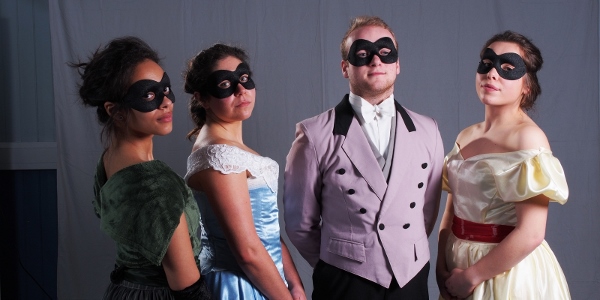
Lord Earnest Gerald, together with his friend Mr. Belmore, is attending a masque ball. Lord Earnest’s aunt, Mrs Stanly, wants him wed to the frightfully ambitious Lady Delaval, but Earnest has eyes only for Miss O’Donolan. Mr. Belmore is embroiled in litigation, his affairs are in a precarious state. Will the gents be able to find resolutions to their affairs among the studied graces of the smart set at play?

Witz is no embalmer. With the assured hand of the truly reverential, she surgically removed Kemble’s “sentimental narrative.” This would not have gone down well with the original audiences (a bolshy lot at the best of times), but for a 21st century audience the fashion for high melodrama is as remote as powdered wigs and smallpox.

Witz delivers a bright and breezy script, full of life, wit and sparkle. No one, but no one, does timing like Witz. The play runs not a moment too long or too short – its elegant proportions are genuine Georgian.

“They should have gone more Cruel Intentions and not tried to do it in costume.” I suggest afterwards.

“Rubbish!” The Current Mrs Dan was having none of it. “I loved the costumes. It was so P&P.”

I’m not sure what postage and packaging have to do with it, but on reflection the Austen-era costume was great fun and made the clothes swap at the centre of the plot properly entertaining.

The set, however, felt cluttered. The cane screen which severed the stage created too much dead space. Neither did it effectively delineate inside from outside, garden from ballroom, as was perhaps the intention.

Upstage right there’s a door from a mid-century suburban semi, with the handle on upside down. Why? There’s nothing similar on the opposite side also used for comings and goings. Overhead paper lanterns, set amid floating fabrics, flicker distractingly. The Vault might do chinoiserie – provided it’s of the Maoist, brutalist kind.

The start of the show was partially drowned out by an unsuitable cacophony. There was also a heater on full blast, until it was poked at with a stick. The music too eventually settled down to something more reflective and sedate.

George Selwyn Sharpe, who played Lord Earnest, must be one of those method actors. Other than deciding that his character had been traumatised by tales of Sweeney Todd, the demon barber of Fleet Street, I can’t think why he’d be sporting 5 o’clock shadow to a high class ball. He’s got strong stage presence, a confident mastery of his lines and a playful approach to their delivery, but Sweeney was a Victorian invention, so maybe Earnest can have a shave after all.

Michael Heard-Snow and Nuri Syed Corser are the yin and yang of footmen. Heard-Snow is poised, deferential, dry as Gin Lane. Syed Corser, by contrast, is a labradoodle in a tailcoat who ought to look to Catherine Livesey and Francesca Street for tips on the art of being supernumerary without being superfluous.

Rebecca Smith, as Lady Henrietta, establishes herself across the emotional range of the script. When she’s happy, she’s happy. When she’s angry, Lord help you. Her performance is the most in keeping with the direction of the script – primary colours not shades of grey.

The kindling romance between Florence Bedell-Brill as Lady Henrietta and Bryon Jaffe as Mr. Belmore was sophisticatedly adolescent, Wildian almost. Jaffe is moving up the batting order, mastering some bolder strokes than when I saw him in The Birds.

Saskia Ashdown as the villainous Lady Delaval struggles to find her inner bitch. Ashdown is young and pretty. She doesn’t quite inhabit the ageing, cloying, clawing Delaval. Similarly, Shannon Rollins as Mrs Stanly is not quite the dreadnaught doyenne. I can’t help but blame the cane screen – it has a such muting effect, not least because it so physically imposes on the limited space available.

I’d spent the day starting to reorder World FringeReview, the online hub for performers and reviews at Fringe festivals from Adelaide to Edinburgh. I made sure to keep up the many pictures of the late, hugely lamented Adrian Bunting – he who developed Kemble’s Riot into such a hit with audiences.

Bunting was fascinated by Maria Theresa Kemble and her family. I hope he’d have liked what Witz has done with one of her scripts, especially how she inverted the characters’ genders. Reverential yes, but where there might be disagreements of taste Witz remained respectful, while being right to make the changes she did.

nae bad_blue

Reviewer: Dan Lentell (Seen 20 March)

Visit The Gentleman’s Stratagem‘s homepage here.

‘Bloody Trams; A Rapid Response’ (Traverse: 19 – 20 March ’14)

image

“The overall tone went a long way to suggesting that if the voice of the people is the voice of God, then stepping aboard a tram may incur the wrath of heaven.”

Editorial Rating: Nae Bad

“You’ll have had your trams.” Not since Aneirin, court poet at Din Eidyn in the sixth century, rhymed ‘Ywain’ and ‘cairn’ has a line so pithily captured local frustration. The intervening history is spectacularly dotted with SNAFUs – Flodden, the muddleheaded wombatry of Edinbuggers during the ‘45, lacking Nashville’s knack of reconstructing Parthenons, and of course the reinstallation of the trams ripped out during the mid-twentieth century’s fetish for civic self-harm.

Joe Douglas, he of Educating Ronnie fame, has been out and about interviewing folk for their take on the city’s 7 year itch. Douglas arranged the material, collected from sources in and out of the loop, into 50 minutes of dramatically rendered vox pop. The overall tone went a long way to suggesting that if the voice of the people is the voice of God, then stepping aboard a tram may incur the wrath of heaven.

We enter to find an upright piano, manned stage right by David Paul Jones; a fluorescent jacket hanging on a coat stand far upstage centre; and two chairs downstage, leftish, occupied by Nicola Roy and Jonathan Holt. To the sound of Jones’ seductive tickling of the ivories – “Once I built a railroad, now it’s done, Brother, can you spare a dime?” – Roy and Holt set out to distill Douglas’ captured voices into a lotion of essential oil.

It’s not always clear if this balm is intended to soothe or aggravate. At times I get to wondering where lies the line between satire, sackcloth and ashes. Tribal identity is a strange thing. If a bloke’s kickball team teeters on the edge of relegation he feels personally embarrassed. If his cooncil ignorantly mismanages a major infrastructure project he feels personally shamed.

Several of the interviewees argued that the trams would damage Edinburgh’s reputation. Perhaps I am too divorced from the starched self-regard of the city’s professional classes, but I suspect globetrotters will not be crossing Auld Reekie off their to do list because of the trams – it would be like avoiding the Nuit Blanche festival because Toronto’s mayor likes the hard stuff.

Roy and Holt heave and rally, dragging up the dead weight (after all there is only so much entertainment to be drawn from the politics of civil engineering) with style and flare. Watching them is like observing a competitive game of dress up, as each leaps into the voice (if not always the movement) of the character they are inhabiting.

Roy was flawless: dynamic control matched by a powerful delivery. Holt might have been this too, only his villainous German contractor accent (surely there was comedy gold to be had there) was so bad he’d have struggled to be admitted to the cast of ‘Allo ‘Allo!

My old Newcastle People’s Theatre pal Tom Saunders on the sound and lighting desk did what he does best, being artful without being showy. Despite the minimalist staging, Saunders created 3 distinct spaces with an interplay of sparingly applied foundation. If, for the sake of a Cancer Research promoting selfie, this production decided to do without his makeup it might well have appeared noticeably more harassed and haggard.

This was a serious-minded production for serious-minded people. Although I didn’t stay for the after show talk, I had a prior engagement to gnaw my own leg off, I would like to have seen Douglas producing something beyond the earnest range he conquered in Educating Ronnie. He does a great line in upfront sincerity – as does Edinburgh’s most recent famous son, Tony Blair.

The use of recorded prompts feeding into the ears of Roy and Holt was a bold move. It provided meaty monologue on short notice, might have gone horribly wrong, but paid off handsomely. For all that Holt isn’t going to be playing Willy Brandt any time soon, (he does a fine impression of his director BTW), both he and Roy demonstrated a discipline under pressure matched only by their lightness of touch. The clay rose from their wheel into an innovative, engaging piece of fringe theatre.

nae bad_blue

Reviewer: Dan Lentell (Seen 19 March)

Visit Bloody Trams homepage here.

‘Eternal Love’ (Kings: 18 – 22 March ’14)

image

“Derrick Zieba’s sound design and William Lyons’ composition were delightful, filling the air like a rhapsody of gorgeous butterflies.”

Editorial Rating: Unrated

Their forbidden love broke all the rules. Their passion tore their lives apart, ripping through the loose fabric of twelfth century mores. The devotion of Abelard and Heloise continues to inspire the deepest affection in those who have born witness to their story.

Eternal Love (formerly titled In Extremis) is set in medieval Paris in the age of the great Peter Abelard. The French capital is the epicenter of a proto-renaissance. New modes of thinking are challenging the old order. Ecclesiastical certainties are coming under the scrutiny of innovative thinkers like Abelard.

Having quarreled with his old fashioned teacher, William of Champeaux, Abelard establishes a philosophical academy of his own. It’s a runaway success, elevating the trendy young scholar into the most fashionable circles. Every inquiring mind wants to be shaped by him, and few are more engaged than the beautiful Heloise.

When her uncle hires Abelard to provide private tuition, Heloise is brought into the intellectual and sexual orbit of a man with many powerful enemies.

Howard Brenton’s script is a vehicle not only for one of Europe’s most cherished love stories, but also for deeper musings about the interplay of intellectual and physical love. It is a sly and wily creature, coiling around familiar events, unafraid to flex its comic muscles.

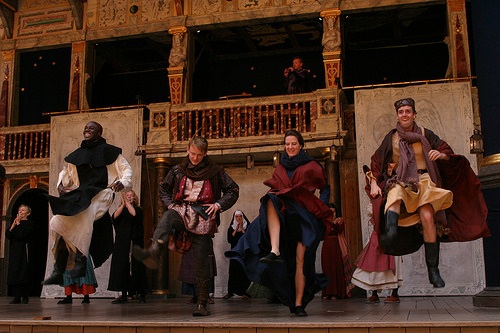
However, John Dove’s direction recalls the sad tale of the actor, made famous by a long-running TV improv show, who found himself unable to work without exaggeration. Perhaps this production would have worked in the frenetic intimacy of London’s Globe Theatre in which it was born, but something was badly lost in translation.

The actors were spread across the broader canvas of the Kings like cold butter straight from the fridge. The blocking was as blocky as Duplo and so were several of the performances. A last minute substitution in the cast may not have helped, but at no point was the love, the very birth of romance, in evidence. The violence of Abelard’s fate worse than death was muted, monotonal even.

The set was barely a set. A wishy-washy shadow, a pale imitation of the Globe. Entrances? Check. Musician’s gallery? Check. Some trees? Check. Anything else? Not really. This was a prop-lite production well turned out in medieval clobber but with the feeling of a functional business suite rather than brilliant tailoring.

Euterpe was the only saving grace. Derrick Zieba’s sound design and William Lyons’ composition were delightful, filling the air like a rhapsody of gorgeous butterflies. Together with Rebecca Austen-Brown and Arngeir Hauksson, Lyons found the quick heart of Brenton’s script. Measured, witty, soulful and soul-filled, I just wish the rest of the production could have looked up from the stage and played as well as the gallery.

Reviewer: Dan Lentell (Seen 18 March)

Visit Eternal Love‘s homepage here.