‘The Hold’ (NMS: 12 – 16 March ’14)

“Howie so naturally slips into the physicality of his role as William, a museum security guard, that several times he disappears in plain sight.”

Editorial Rating: Nae Bad

“That’s the way to do it. They’re really good.” My companion, an HR honcho at an international hotel chain, is seriously impressed by the smooth operation of the ushers who are taking us around the National Museum. They’re moving several dozen people from point to point through the usual Saturday throng of visitors. With smiling (but ruthless) efficiency we are maneuvered into the best spots from which to view the drama unfold.

The lads are in rather splendid tartan waistcoats, the lasses in sashes. Half the waistcoats and sashes are backed in gold, the other in blue. The intention is to help orientate the tour’s two tracks. The effect is to fill the NMS entry concourse with figures costumed like they are serving command and science roles aboard the USS Excelsior – the starship on which Scotty served as Captain.

Peter is being forced to take stock. The long retired museum worker is moving on. Surrounded by boxes and boxes (and more boxes) of mementos, he sets out on a journey into his past punctuated by the stories held in each carefully cherished item. As is revealed to his acerbic young assistant, Sally, Peter’s story involves both love and loss. He can hold onto objects but struggles to remain close to people.

The underlay of writer Adrian Osmond’s narrative weave is a satisfyingly springy comic conceit – a retired museum worker who is also a compulsive hoarder. John Edgar as Peter perfectly balances the sympathy due to his elderly character without ever flinching from exposing those curiosities in Peter’s personality which make him such an oddball.

Teri Robb as Sally is Edgar’s idea foil. Her reactions, together with her growing understanding of Peter, pilot us through the script’s twists, turns and flashbacks. Robb is the valve through which we can all let off steam.

We see Peter as a young man bashfully courting Alice, his muse. Rising star Derek Darvell justifies his reputation as one to watch by filling out Edgar’s portrayal of Peter with intricate touches and touching intricacies. Nicola Tuxworth as Alice is poised and stylish – it’s not hard to see why Peter fell so hard for her.

Brilliant. It’s the only word to describe Stephen Tait as the bumptious, terribly busy Professor Stone, proprietor and chief curator of Peter’s museum. From the deadpan bossiness with which he opens proceedings, through the pitch perfect comic timing of his lecture on the nature of objects, to the final scenes in which he closes the drama, Tait offers up a masterclass in disciplined, pacy work.

The pairing of Tait with Mark Howie is pure genius – the best since someone put David Jason and Nicholas Lyndhurst in a room together. Howie so naturally slips into the physicality of his role as William, a museum security guard, that several times he disappears in plain sight. As Stone’s shadow, William deflates his pomposity even while building up his boss’ authority.

Osmond’s script is a triumvirate of duos with one exception. Emma McCaffrey as Bridget plays a bad hand well. Without a partner to whom she can position her delivery, too much of her performance is lost in the cacophonous hubbub of the venue. Noise bleed was more than a problem. Especially in the early scenes it became the woolly mammoth in the Renaissance Gallery. Too often it was a real strain to hear what was going on. The impact of the final scene was lost altogether when we stood under a gantry echoing with footsteps overhead.

Since it’s the fashion to believe that under-10s learn best by osmosis, I tend to avoid the museum at weekends, when it’s packed with noisy children learning about the stone age through proximity to arrowheads. Staging a mature drama amid the shrieking hordes of Tamsins and Hamishes was a daft idea.

It’s a real shame because so much of the staging was so clever and engaged. The tent in the Neolithic Room, the pine cones by the Roman headstones – devices which set the scene and dressed the stage with the speed and clarity of a signal lamp. Not since Henry VI Part III has a paper crown been used to such effect as it was in Stone’s lecture.

Set against a haunting backdrop of live music, which sent a thrill down the spine, director Maria Oller delivered a Scandinavian-style flatpack of concepts quickly assembled by a well drilled yet fluid company. The Hold set weighty ideas on a very human scale. This hard working, talented cast deserved the serenity of an after hours outing.

nae bad_blue

Reviewer: Dan Lentell (Seen 15 March)

Visit The Hold‘s homepage here.

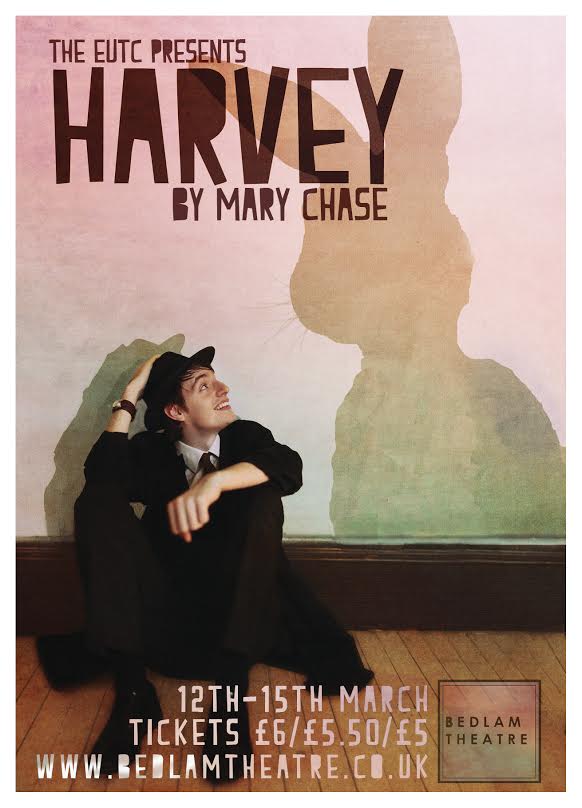
‘Harvey’ (Bedlam, 12 – 15 March ’14)

Harvey

Harvey does not do selfies”

Editorial Rating: Nae Bad

Our rabbit, Toffee, died of a heart attack when the builders came in. Harvey, however, lives; for Harvey is immortal, a stage and movie legend, and stands 6ft 3½ins high. It would be nice to see him leaning against the gates of Pollock Halls, in the Bristo Bar. You can see him, sort of, in Bedlam until Saturday. When he’s not on stage he’ll probably be out back in the Whisky Snug of the Hotel du Vin.

Harvey does not do selfies, as (i) they’re dime-store cheap and (ii) he’s invisible anyway, give or take his hat and coat. This pooka, avatar, rabbit has ineffable presence just as his companion, Elwood P. Dowd (47) has matchless, gentle, manners.

Craig Methven plays Elwood and is great at it. It is not just the faultless accent – Elwood and Harvey are from Denver, Colorado – but intonation, timing, gesture; all convincing. And the look! A beanpole with trousers just too short, jacket sleeves just too short, a trilby perched on top. A complete oddball with a smiling front of teeth that Oral-B would pay top dollar for. When Elwood says “Doctor I’ve wrestled with reality for 40 years and I’m happy to say that I’ve finally won out over it”, you cheer. You love him when, to save his sister from a life of nerve-shredding collapse (hilarious, by the way), he is prepared to take a mind-bending drug and forsake Harvey: “Say goodbye to the old fellow, would you?” Weep at it.

Psychology and psychiatry butt against comic form. It’s not One Flew Over the Cuckoo’s Nest meets Peter Rabbit but it’s there in the wacky sanatorium where Doctors Sanderson, handsome, (Stephen Macleod), and Chumley, crumpled, (Callum O’Dwyer) mess up. Pretty Nurse Kelly (Elsa van der Wal) is stuck in-between them with only the near lunatic, knuckle-dragging Charge Nurse Wilson (Martin Maclennan) for support. Chumley takes to his own couch and fantasises about Akron, a silent young woman – not Mrs Chumley (Rachel Bussum) – beneath maple trees and cold beer. Elwood, bless him, counsels whisky and – progressive fella – that the lady be allowed to talk.

It is, with Harvey about, still a richly comic and US neighbourhood. A cab driver (Ian Culleton) dispenses philosophy and Judge Omar Gaffney (Eric Geistfeld) drawls his speech back to Louisiana. You might find Harvey at Charley’s Place on 12th and Main, or at the 4th Ave. Fire House, or at Blondie’s Chicken Inn or even in the grain elevator but it is at the Dowd residence at 343 Temple Drive that the comedy is really at home. Veta and Myrtle Mae are Elwood’s older sister and niece respectively. Their situation is becoming impossible and Veta (Caroline Elms) is beside herself, which in psychiatric terms is problematic. Elms goes for it in a Mid-West/ Mitteleuropäische speak which is as funny as it is fluent. Her outrage after an unfortunate and naked session in the sanatorium’s Hydrotub is an object lesson in how to put the flounce into speech. Meanwhile, Myrtle Mae (Emily Deans), lipstick forward, responds ardently to any suggestion of ‘sexual urges’.

For some private, delightful, reason, Elwood likes the phrase ‘the evening wore on’ – preferably in bars, I guess. Directors Henry Conklin and Lauren Moreau prove that Mary Chase’s play can still put time aside and put charm in its place. Okay, the lighting cues are ragged and the nurse for doctor crush is dodgy, but there’s Glen Miller and Sinatra on the soundtrack and a fine oil painting of Harvey and Elwood above the fireplace.

nae bad_blue

Reviewer: Alan Brown (Seen 12 March)

Visit Bedlam, ‘Harvey’ homepage here.

‘The Confessions of Gordon Brown’ (Traverse, 11-15 March ’14)

The Confessions of Gordon Brown by Many Rivers Productions

Neither Etonian, nor Fettesian, he”

Editorial Rating: Nae Bad

Written & directed by Kevin Toolis.

Mary Rivers Productions inadvertently demonstrates canny timing in bringing The Confessions of Gordon Brown back to Edinburgh after its month long Fringe run at the Pleasance last year. On Monday Mr Brown was speaking in Tollcross, Glasgow, and even The Guardian reported that ‘the TV pictures looked terrible. Brown was pacing up and down within a small space, like a bear trapped in a cage. And his arms were flapping all over the place’. Apparently focus groups always see Mr Brown as a bear in a Volvo.

That’s seriously unfair, isn’t it? The former prime minister spoke well in St Joseph’s Hall, very well in fact; he had substance and that gravitas thing; and yet, and yet, image can still be all. At least, that is the common view mercilessly examined in Kevin Toolis’ play. Mr Brown may not be bald, he stands foursquare and tall enough, but smooth he ain’t. Neither Etonian, nor Fettesian, he; thank the (Presbyterian) Lord, you might add.

Billy Hartman is Gordon Brown and does not really need the brief warm-up that precedes his entry as ‘the Leader’. It is perturbing to be urged to clap with enthusiasm, comrades, for a trashed political act that is synonymous with tragicomedy.

Hartman’s First Lord of the Treasury – end June 2007 to end May 2010 – is doleful. He is beyond welfare. The man stands there ill at ease, with just his mirrored image for company, heartsore. He would be composed, steadfast, but if you can have sober and lucid intemperance, here it is. His time in No.10, after Tony’s tenure, is a fagend and the clock on the wall stays at 5.40pm.

The political intelligence is unremitting. More diatribe than expiation, the Confessions put hope and promise(s) up against Realpolitik and you learn what happens to grounded principle when – nice image – Northern Rock turns to northern diarrhoea.

It is long at 90 plus minutes but the insistent recall of contemporary history is compelling. Mention of Mr Blair, usurper and ‘snivelling runt’, seems satisfying these days. Robin Cook, John Smith, Alex Salmond, pass momentarily but what stays is the pitiless account of unfeeling, falsifying, democratic process. Spotlit occasions of electoral victory and the promise of change snap out and the scene returns to Downing Street, where power is wretched. It gets more personal and darker at the close.

Scenes from a thrawn and cyncial biopic or a more sympathetic creation? You might wonder at the comparison with Napoleon on St. Helena but otherwise Hartman’s absorbing performance is easily good enough, for me at least, to think that this Right Honourable Gordon Brown MP is a better man for having confessed.

nae bad_blue

Reviewer: Alan Brown (Seen 11 March)

Visit Traverse, Confessions, homepage here.

‘The Tempest’ (Pleasance, 4 – 8 March ’14)

The Tempest

A turbulent Tempest: noisy and exciting, amusing and drunken.”

Editorial Rating: Nae Bad

…  and why not set The Tempest atop a deep water oil platform? If Shakespeare didn’t have a geo-political imagination by 1610, which is doubtful given Othello on Cyprus and the exotic confusions of Pericles, he would have by now. Natural gas from the Tamar field off southern Israel has been on the market since March last year. Gonzalo’s resourceful prayer for ‘an acre of barren ground’ rather than ‘a thousand furlongs of [raging] sea’ is set spinning.

Then, unsurprisingly, there’s the issue of sovereignty. Whose ‘island’ is it? Prospero’s or Caliban’s? Israel’s or Palestine’s? It will be contentious and tricky for sure, which is where this EUSC production would set us down, somewhere off Tunis reckons Shakespeare, but the Magnus field, north-east of Shetland, would do just as well. Trinculo, a cod Italian, can wish to be in England but BP says it will continue to invest in Scotland.

There are two small red navigation lights on the installation. Why set low-down, I wondered? Anyhow, they pulse quietly away and are quietly reassuring as action succeeds action, bizarre encounter by bizarre encounter.

The stormy opening is terrific: a pounding beat drowns out air traffic comms. as the crew bring down the sails. Speech is lost to the wind but that’s a director’s license for you.  So too, I guess, the decision to equip Prospero with an aluminium pole for a staff. I guess at its metal but it looked pretty unbreakable to me, even with his potent art. You should believe that magic cloak, book, and staff, are given up or else the grave Prospero’s quiet retirement to Milan will be the stuff of The Dark Knight Returns.

First off, this is a turbulent Tempest: noisy and exciting, amusing and drunken. There is live music, there are jigs and drinking songs, almost a choreographed masque, a carry-out pizza menu and fun use of the smartphone – No signal, haha! – but there is some contemporary fallout that you might question. Adrian (Laurie Motherwell) – is it Adrian or the Boatswain or both? – takes point with aviators, head-torch and war paint. Shades of Lord of the Flies meets Rambo. Antonio (Alex Poole) and Sebastian (Will Hearle) do a distinct lean and mean and sinful but a pen-knife is not a sword.  Scale that up and you realise that one shiny scaffolding tower and discarded blue barrels (plastic) do not a derrick and oil platform make, abandoned or not. Pipe sections on the thrust deck, a hard hat or two, a cable spool, wiring, ExxonMobil advertising; anything for the illusion of fabric from the stalls, however insubstantial or baseless.

Shakespeare’s company really just dressed up, or down, or across. Alonso is become Alonsa (Lucile Taylor), which is simple and effective.

Costume then; and with not a stained Shell logo in sight. Miranda and Caliban’s torn and distressed look is innocent cool and dirty cool respectively; Gonzalo’s jacket, tie and waistcoat tie are on the button, right out of a wardrobe in Toad Hall; butler outfit for Stefano and ridiculous shirt for jester Trinculo, all quite fitting. Life-jacket and white pressed jeans for Ferdinand. Fly. But Prospero and Ariel, who should be up there in colour and magic garments, appear grounded by heavy overcoat and figure-hugging black. Too dull for words.

The rest, the real business of making good – invest in people now, oil futures later – is all about speech and performance. Virtuous parts first.

Ariel (Ellie Deans) loves her commanding master and possibly more than the promise of her liberty, which is original and affecting. This rushing spirit is more eager than delicate, is loyal and kind, and deserves her freedom. Prospero (Sacha Timaeus) presides with a style and sardonic nobility, but he would be in Davos and not the library. Miranda (Poppy Weir) is wonderful and young and not at all bound by her ‘virgin-knot’. Ferdinand (Will Fairhead) cannot help but love her in bashful fashion and their courtship is indeed goodly, beauteous and admirable.

Jon Oldfield as Gonzalo is a venerable act. He bumbles, he stumbles, but he is not the buffoon and sententious bore of shallow productions. Oldfield waves a carrot with more skill and pronounces to better effect than any Renaissance prince around.

To the things and creatures of darkness, who always threaten to steal the show. Joe Shaw is Caliban, who will grovel for a Pot Noodle and eat his own bogies. Shaw plays brutish, ignorant and fearful with real appetite but mouths his words with care and feeling (Miranda taught him after all) so the nature / nurture debate is properly kept wide open. Trinculo (Dean Joffe) and Stephano (Connor Jones) play Caliban like a fish on the line. They are funny and cruel and craven and – of course – the audience laughs with them, a lot, until reminded to laugh at them.

The Tempest is a marvellous play so you can take it to any stage or platform that you please. Jack Kinross, cast and crew, inhabit it with due respect and great spirit, even though some of its magic is still onshore.

‘Farewell, dear island of our wreck:
All have been restored to health,
All have seen the Commonwealth.
There is nothing to forgive.’

From W.H Auden’s The Sea and the Mirror (1940), a commentary on The Tempest

nae bad_blue

Reviewer: Alan Brown (Seen 6 March)

Visit The Tempest homepage here.

‘Titanic 2; Pig in the City’ (Bedlam: 6th March ’14)

Titanic 2 intro

“Spygood is as arrogant as Lord Flashheart, deranged as ‘The High Life’s’ Captain Duff, anarchic as Sir Digby Chicken Caesar.”

Editorial Rating: Unrated

A stream of audience is pouring into a great gash in the side of Bedlam. Unlike the waters of the North Atlantic, there’s nothing chilly about them – although it’s cold inside. Under the weight of expectation, the packed venue crackles with joyous anticipation.

Sketch comedy is to theatre what frescos are to painting. The form can be subtle as Livia’s villa, boisterous as the Banqueting House, majestic as the US Capitol’s rotunda, daring as the Sistine Chapel – and of course it has to be funny.

We enter to find white drapes framing the glow of a projector beneath which are a half dozen dining chairs and one green leather armchair. This will turn out to be a prop-lite production. The emphasis will be on the writing and performances.

It is my companion’s first visit to Bedlam. Alex Harwood as Jim and Jodie Mitchell as Rosie made the perfect first impression. Disciplined, energetic, and gut-achingly well matched, the shame-faced romance between society girl and awkward oik is the turbocharged mechanism driving the script forward. Their material is cruder than the OPEC Reference Basket but it is beguilingly delivered with an (almost) untainted innocence.

Other comic creations staple the scenes together – Jakey Rowling, the foul-mouthed children’s author, also played by Mitchell, and pseudo-psychic Poirot, played by the bloke who carries David Bard’s hair around, are among the more successful. And then, of course, there’s Lord Spygood, the ship’s captain.

Spygood is as arrogant as Lord Flashheart, as deranged as The High Life’s Captain Duff, as anarchic as Sir Digby Chicken Caesar. He’s the plumb in the pudding, the plumbing that fills the boat with gravy. Andrew Blair inhabits the role like a glove. Is this Spygood’s The Dangerous Brothers phase – the unpolished period when Mayall and Edmondson first carved out the archetypes that would run them from The Young Ones through Filthy, Rich and Catflap to Bottom?

Although an adequate vehicle for Harwood and Mitchell as well as Spygood, the script does not exactly hold together. Say what you will about James Cameron’s Titanic – that you hated it at the time, that it proved huge in Afghanistan, that you’ve kind of grown to like it – the one unsinkable truth about the 1997 classic is that it provides a clear narrative arc. They get on the boat. They ride around on the boat. The boat starts sinking. They try to get off the boat. They’re in the sea.

The producers of Titanic 2 left so much deadwood in the lineup it’s a wonder anyone managed to drown for lack of something to float on. The result was that some seriously good material was dragged under and lost.

Rather like when Crusoe and Friday fight off wolves in the Pyrenees during the final scenes of Defoe’s novel, the end to Titanic 2 is somewhat superfluous. With a concerted editorial effort to chuck some of the Jonah japes overboard this production would have enjoyed much smoother sailing.

As it was, a wealth of time combined with a poverty of properties, lighting and sound effects saw the soufflé deflate into a cheesy mess. Chutney Exhibition prides itself on being an experimental incubator. There was not one idea in this production which did not deserve to come off the drawing board. Fewer, however, were ready for the transition from workshop to stage.

Sketch comedy is like fresco painting, you can’t leave it so long that the plaster dries out entirely. It’s all about the timing.

Reviewer: Dan Lentell (Seen 6 March)

Visit Titanic 2‘s homepage here.

‘Gym Party’ (Traverse: 4 – 5 March’14)

Gym Party - production shot 3

Try saving face with your head in a bucket of water”

Editorial Rating: Nae Bad

Created by Made in China for a mental and physical work out.

I see that Made in China has the same optimistic regard for web addressing as Edinburgh49.  Search for this review site and you used to get lots of EH postcodes and street numbers. Search for Made in China and – well, it’s predictable – you get, ‘Your source for Quality Products.com’. Tag ‘Made in China’ with ‘theatre’ and you hit quality stage work.

The company’s Gym Party was at Summerhall during the Fringe and is back for two nights at the Traverse before moving on. In my onetime professional opinion it should play at high schools and colleges up and down the land because this is a show that would fit any ‘Curriculum for Excellence’ and put PSHE (Personal, Social & Health Education) up there in LED and neon.

For S5 and S6 only, perhaps, for ‘Take a bow and get off the fucking podium’ is not, on the face of it, the best lesson for the younger years; although actually it makes perfect (and entertaining) sense and in that all-important cross-curricular sense too. How should we measure achievement? Is it ‘above’ understanding? Are grades better than marks? What counts? How do we grow up: ‘Evolve? Fight or flight?’ Importantly, who cares for the losers? At one time or another we are all on the C/D, Pass/Fail border.

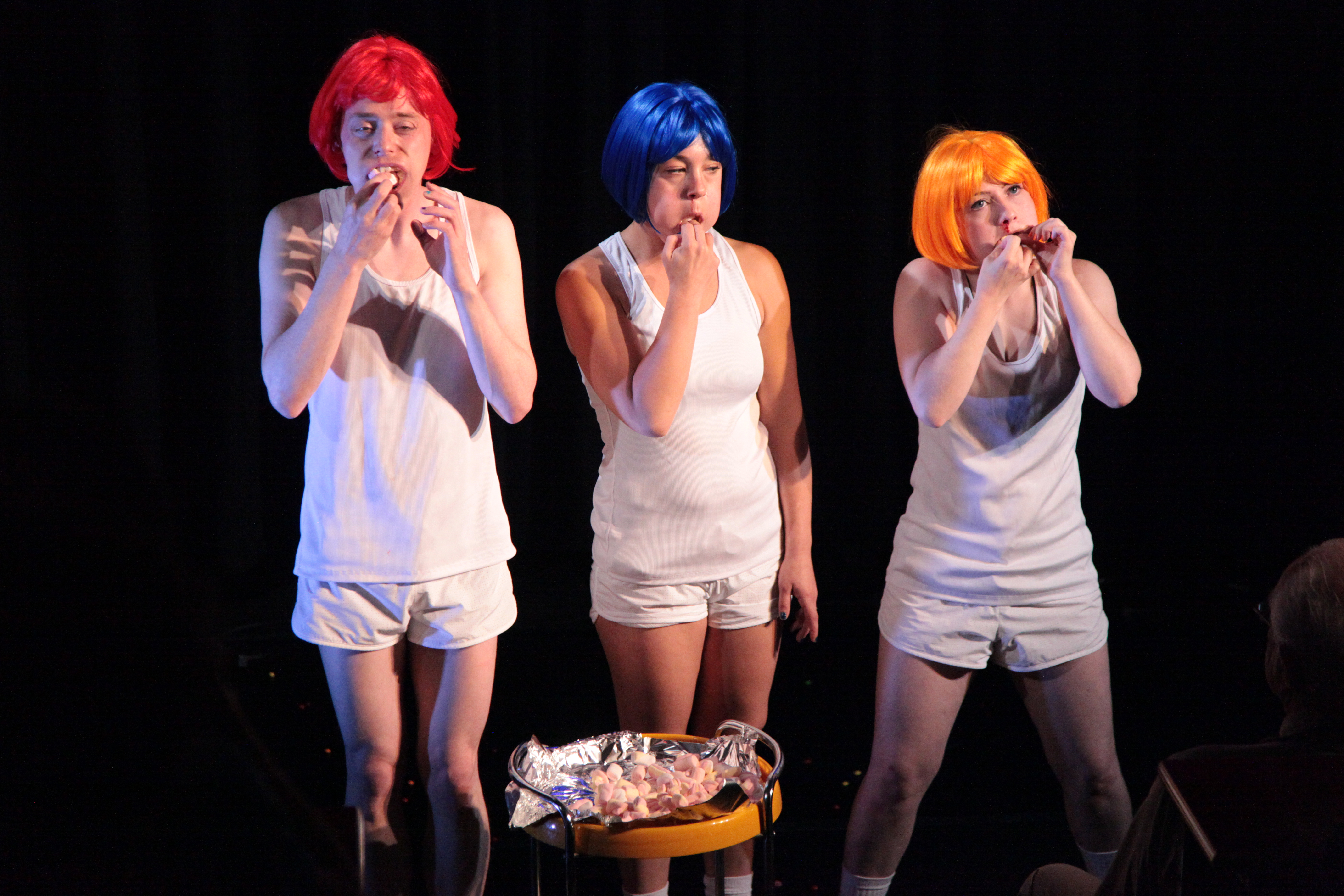
Gym Party is moral exercise. Literally. Three contestants – Ira, Chris’ and Jess (tellingly their real names) – compete for points and for applause.  In regulation 1960s issue PE kit, white singlet & shorts, but with red Converses and vividly mop-headed, they do Games and suffer the results. Ask yourself, age 12, what it took to win and then, in turn, try wacky, awkward, aerobics, and then stuff your mouth with Skittles, marshmallows, and little oranges. It looks daft, is hilarious, but how did you feel with only 17 marshmallows next to the winner, your ‘friend’ maybe, with 22?

Edifying? Up to a point, for sure. Try out for the next round: who, of the three, is the most attractive, the richest, the best kisser, the most trustworthy? Who, the class question, had the best upbringing? Suddenly, you’re not twelve anymore and the playground is not so much fun, especially when failure is penalised. Try saving face with your head in a bucket of water, held under by a fellow contestant.

Adult stretch and pull is all the while provided by extended use of the audience, ‘the group, the pack, the whole’. ‘We’re here for you’ is just one of those exhausted mantras that puts us in the spotlight or under the glitterball of frustration and loss . Actors/contestants look for support, ie. your votes, as they go through their desperate routines. In the confessional rest breaks you just about share their (chewing) gum with the same appalled mix of relief and nerves.

I particularly liked the use of accent: Canadian/New York state (Chris’), NYC American (Jess’), boarding school Home Counties English (Ira) and quizmaster sonorous (anon.).  The natural combination worked a sweet treat in terms of providing the mawkish cheer of game show tv.

Gym Party is fun, energetic and loaded.

nae bad_blue

Reviewer: Alan Brown (Seen 4 March)

Visit Made in China homepage here.

‘Blackbird’ (Summerhall: 26 February – 1 March ’14)

“An outstanding performance from both cast and crew… the kind of production which makes it impossible to imagine the play in anyone else’s hands”

Editorial Rating: Outstanding

First performed in 2005, Blackbird is a terrifying play.  It’s terrifying because of its subject matter: a sexual relationship between a 12-year-old girl and a middle-aged man.  It’s terrifying because it highlights the lifelong consequences, both for the victim and her abuser.  But more than that, it’s terrifying because it dares to ask some forbidden questions – evoking just the slightest touch of sympathy for the devil, and challenging us to wonder how a once-decent man can possibly have fallen so far.  It’s morally troublesome, sexually explicit, and profoundly disturbing at times.

A decade after her defilement – and now a young woman – Una returns unexpectedly, determined to confront her abuser Ray.  Ray, in the meantime, has admitted his sins and served his time in prison, and seems to have re-built a modestly respectable life.  But that, of course, isn’t quite the full story; at the heart of the play is a series of well-paced revelations, which lead the audience through the gamut of possible responses to such a shocking tale.  And they’re all delivered through a single, credible dialogue, a masterclass in exposition done well.

But all that counts for nothing if the actors aren’t up to the task – and in Greg Wagland and Romana Abercromby, Blackbird finds the cast such a challenging script demands.  Both actors bring a reckless intensity to their roles, an urgent mutual desire to tell their shared tale.  As Una, Abercromby is sassy and bold, coolly aware of the power she now wields – a veneer which makes it all the more shocking when the true impact of the abuse is finally revealed.  Wagland, meanwhile, presents a desperate, imploring Ray, yet shows a hint of imperiousness too; it’s a many-layered performance, that delivers a lot more subtlety than first meets the eye.

While the principal actors each have their moments in the spotlight, the pivotal scene belongs to Abercromby.  As Una recalls how her life unravelled, she’s helped by Jon Beales’ haunting sound design – which carries just enough echoes of a seaside town at midnight to transport us into her painfully-remembered world.  It’s details like that which make this production so impressive, and Abercromby’s words are perfectly synchronized with the soundscape.  The whole play, in fact, is flawlessly well-performed.

Firebrand Theatre bill their production as a “site-specific staging”, which is rather stretching the point, but director Richard Baron does make excellent use of the unconventional space at Summerhall.  He turns the old-style lecture theatre into a claustrophobic and uncompromising arena – a courtroom where the audience sits in uneasy judgement on both accuser and accused.  And Baron and the actors have crafted a restlessly physical performance, using constant movement to stoke the pressure without ever feeling unnatural or forced.

If there’s a criticism to make of Harrower’s script, it’s that his symbolism is often heavy-handed: the sordid nature of the story is reflected by a squalid, rubbish-strewn stage.  And the narrative stops more than it ends, as though even the playwright didn’t know quite how to respond to his worrying final revelation.  But this is an outstanding performance from both cast and crew – the kind of production which makes it impossible to imagine the play in anyone else’s hands.  Firebrand’s reputation preceded them to Edinburgh, and it’s clear that reputation is very much deserved.

outstanding

Reviewer: Richard Stamp (Seen 27 February)

Visit Firebrand Theatre homepage here.

‘Four Steps Back’ (Summerhall: 27 February – 1 March ’14)

1015634_10152657641782334_1722498035_o1-300x260

Four Steps Back was presented by the University’s English Literature Department Play in support of Voluntary Service Overseas in order to support disadvantaged communities.

Editorial Rating: Nae Bad

At the bar of the Royal Dick gastropub, in the heart of Europe’s largest privately-owned arts complex, Robert McDowell the man who makes Summerhall happen, is tucking into steak done rare. “The secret of a good production,” he opines, “is that it uses, rather than hides, the space it’s in.”

“He’s not wrong” I think as later that night when the Current Mrs Dan and I take our seats in the Red Lecture Theatre. Strung right across the space is a washing line bedecked in glittering crimsons and saffrons – there is also a paisley Knightsbridge scarf which I am sure I saw in Armstrongs not so long back. The lighting is moody, the divide between house lights and stage is blurred.

Rekha, the first in a line up of four short new scripts, is a reflection on the human scale of great conflicts. Rajesh (powerfully played by Satnaam Dusanj) recounts the story of how he and his childhood playmate, Rekha, got caught up in an outbreak of interreligious violence while out playing. Rajesh’s innocent love of Rekha is beyond the ken of his brother Sanjay, who is old enough and wise enough to know that hatred trumps all else.

The brooding Dusanj is perfectly contrasted by the gleeful mischief of Arrti Singh in the title role. From the moment she enters through the audience she captivates, conjuring up both the reality and Rajesh’s idealised memories of Rekha. Sporting a magnificent pair of braided pigtails, suggestive that the Vikings and their valkyries might have sailed up the Sutlej, Singh gives as well as takes leaving space and pace in all the right places.

Alexei Veprentev as Sanjay and Maria Kheyfets as Indrani are the icing on the cake, squeezing every drop of nuance from writer Michael Chakraverty’s complex simplicity.

Rekha would be a very sombre piece, except that producers hit upon two veins of comic gold: small and playful actress poking her head through the glittering crimsons and saffrons on the washing line as she hides and seeks with Rajesh; as well as bearded actor playing a nine year old having a strop at his mum for not letting him go out and have fun. It’s the bitter sweet tamarind in the mix that brings out the darker flavours.


The staging for Maria Williamson’s Leaving Mary could not be more different. Dezie is sitting on a capacious armchair having his fine head of hair combed by his wife, Mary. Dezie is a talker with a well polished repertoire of blarney. Mary is quieter, stiller waters running deep. Already there is divergence between what is spoken and unspoken.

When their son Michael visits home from London, bringing with him their grandson Danny, the gulf widens and Mary’s struggle with dementia become more apparent. Michael’s domestic situation, he is separated from Danny’s mother, drags up old issues relating to Mary’s postnatal depression and Dezie’s love of the drink. In her confusion Mary struggles to delineate past traumas from present pain.

If there is justice in the world then it will not be long before Leaving Mary starts being mentioned in the same breath as Conor McPherson’s The Weir which I first saw on a visiting weekend in 1997. “But it’s just people sitting around telling stories.” I whined to my own father, also Michael, as we took a walk round Sloane Square during the interval. “Ah Danny,” came his response, “would that not be the point?”

Angela Milton as Mary provides the evening’s most sophisticated performance. When she moves, she moves. When she’s still, she’s still. She inhabits the character most successfully. Never does she allow us to feel pity for Mary. She captures the essential tragedy sure enough, but her reactions to her fellow players are what put her performance into orbit.

As Dezie (Toby Williams) and his pal Leo (Joey Thurston) talk through their problems in the local we know exactly who they are talking about. This is not just because Williamson is such a phenomenal sketcher of personality and persona, but because Milton has breathed life into every aspect of her character.

Daniel Omnes as Michael completes this well rounded ensemble, delivering the cosmopolitan contrast which so unsettles Dezie.


Toby Williams makes his second appearance of the night as Callum in A Fortiori. Dale Neuringer’s kitchen sink drama chronicles Laura’s passage through shiva, the ritualised Jewish mourning period. Laura’s husband has died suddenly, her brother-in-law Callum is the last house caller of four who have each undertaken the mitzvah of a home visit to the bereaved.

As with Laura’s friends Caroline (Jillian Bagriel) and Melinda (Emeline Beroud) as well as her mother (Lorraine McCann), Callum has an agenda all his own, somewhat removed from Laura’s immediate needs as a grieving widow. Neuringer unflinchingly examines how we express our innate self absorption even in our supposed altruism.

The staging is the most involved of the night – shelves and nick-nacks, tables and chairs, portions of comfort food and the essential covered mirror. The effect is to centre the drama, focusing the energy onto Blanca Siljedahl as Laura. As she is buffeted by unwelcome advice from her nearest and dearest Siljedahl maintains an introspective repose which not even the expanding buffet can penetrate.

It’s a shame the mirror hangs on the far stage right wall and is not free standing. The Current Mrs Dan (a shiksa) doesn’t notice the business of each visitor uncovering it to check their reflection. It’s a great device, as is McCann’s use of air freshener to intimate Laura’s mother’s fussy intrusion as she starts cleaning the house.

McCann, a stalwart of the Edinburgh Graduate Theatre Group, has a flawless accent, just as Beroud does a great line in first world problems. I’m just not sure the cast have remembered the funny though. Siljedahl establishes and maintains a great sounding board, but the comic echos don’t come through. We don’t need to live her grief so exactly.

The disconnect between Neuringer’s script and director Matthew Jebb’s staging is to be lamented. On a double bill with Leaving Mary there is serious potential for a successful Fringe run. But the round peg of dark Jewish comedy needs to be much better fitted into the square peg of ‘50s era British social realism.


Blitzed by Rebecca Leary closes the night with a bang. Sarah lives in a fantasy world. With the bombs of WWII falling all around her neighbourhood, who can blame her? In the aftermath of a particularly hard pounding Sarah’s sister, Toffy, tries to reach her in more ways than one.

Blitzed was the least ready of the four performances. I was never entirely sure what was going on. Who is Lizzie, the other worldly girl always on stage but only acknowledged by Sarah? Is she real, was she ever? Why is Sarah so disconnected from her family, even though they live so close by? What has become of the menfolk away fighting?

If feels like the script has been foreshortened to fit into the night and that quite a lot of essential signposting (as happened in wartime) has been removed to disorientate the enemy. According to the programme Leary’s original intention had been to present the play in Dundonian dialect. The alien phonetics were removed though, the thinking being that the results would be too confusing for civilized Edinbuggers.

As it was a claustrophobic script was hesitantly presented. By the end understanding what was being said seemed of slender consequence. Ideally, time would have permitted flashbacks and context to enlighten the plot. As it was the script could have been much more artfully tailored to contour what could be shown in the time allowed.

Hopefully, with a greater supply of props, script and theatrical devices the tightly packed, closely guarded mysteries of the play can be revealed to the waiting world.


Four Steps Back was presented in support of Voluntary Service Overseas in order to support disadvantaged communities. More information can be found at www.vso.org.uk

nae bad_blue

Reviewer: Dan Lentell (Seen 27 February)

Visit Four Steps Back homepage here.

‘Sword at Sunset’ (Bedlam: 25 February – 1 March ’14)

IMG_5783-200x300

“Beagon’s careful and respectful adaptation of Sword at Sunset far excels the 2011 movie version of The Eagle of the Ninth.”

Editorial Rating: Nae Bad

The problem with British history in the late Roman/early medieval period, according to Robert Graves at any rate, is that unlike the Byzantine east – where written sources document the doings of Justinian, Theodora and Count Belisarius – all there is in Britain is Arthurian myth. This hasn’t stopped the intervening generations filling their libraries, galleries and film sets with countless depictions of King Arthur and his Cnutish fight to hold back the sea of invading despoilers bent on snuffing out the flickering light of civilization.

Sword at Sunset, based on the best-selling 1963 novel by Rosemary Sutcliff, chronicles the career of Artos from his service as a cavalry commander under his uncle, the British high king Ambrosius, through to his donning of the imperial purple as a later-day Caesar. Incorporating Artos’ seduction by his vengeful half-sister Ygerna; his strategic marriage to Guenhumara; his friendships; his battles; successes and failures, James Beagon’s adaptation would be a very tall order for any company.

Thus there is a kind of symmetry between the weight of expectations placed on Artos and upon Jacob Close who plays him. There are times when it seems that he has been hopelessly miscast, lost in a cacophony of happenings far beyond his control. Then again there are moments of magnetic dynamism which truly lift the spirit – the same can be said of Close’s bold on stage brushstrokes. It’s a heroic performance worthy of the legend.

Not everybody would leave a 3 and a half hour theatrical epic (sans budget) wanting more, but I did. I wanted more of Sophie Craik’s Celtic mysticism as Ygerna and more of the chemistry between Guenhumara (Miriam Wright) and Bedwyr (Adam Butler). Each thread was worthy of a tapestry in its own right, deserved the directorial attention and creative design of a separate staging. As it was the results felt foreshortened.

I’d like to see this script produced as a radio series. Historical novels often struggle to be adapted for the screen or stage. On television I, Claudius is only marginally better than the best forgotten The Cleopatras of a similar vintage. The surviving clips of the intended 1937 Hollywood feature starring Charles Laughton suggest that all trace of Graves’ original subtly would have been lost there too. The selective focus of the 1988 TV mini-series of Gore Vidal’s Lincoln means it is better than average but, as the 2012 Spielberg myopic (sic) demonstrates, the bar is not very high.

Jacob Close as Artos and Miriam Wright as Guenhumara

Jacob Close as Artos and Miriam Wright as Guenhumara

Of the two or three weddings I have been forcibly removed from, the most memorable was in Lewes. “How can you say you don’t like Rosemary Sutcliff?” I angrily demanded of the classicist groom, “You’re getting married in the very Sussex Downs that fired her imagination.” The desk sergeant who brought me morning tea in the cells agreed. Even more so than either Graves or Vidal, Sutcliff’s novels are about time, place and above all atmosphere.

In this paramount aspect Beagon’s careful and respectful adaptation of Sword at Sunset far excels the 2011 movie version of The Eagle of the Ninth. I’d very much like to see him presented with the $25m that went into the film if only to further demonstrate my hypothesis that the best adaptations stick closest to the novelist’s intentions. Compare the ludicrously off-piste take of that late-’90s Hornblower TV series with the shipshape Master and Commander of 2003 and you’ll get what I’m driving at.

As is to be expected with an earnest student production biting off far more than it can chew there are plenty of notes: Bedwyr needs to love his harp and never let it go; if the symbolism of the imperial cloak isn’t to be lost then no other character should wear purple; and while the large wooden broadswords add to the overall sense of unwieldy bulk, they do get rather in the way.

But there is also some really classy individual and team work on offer here: the sword fights are fluid, with a bit more umph they might even be swashbuckling; the smoky hearth effect centre stage is ingenious; and the use of twin exits and entrances for inside and out adds much needed pace, although these occasionally get rather clogged with actors moving props about.

As the drawn out evening draws to a close I am pleased to have got what I came for, a strong adaptation robustly performed by a company unafraid to reach for the unobtainable.

nae bad_blue

Reviewer: Dan Lentell (Seen 26 February)

Visit Sword at Sunset homepage here.

‘The Dionysia’ (Bedlam: 20 February ’14)

1964877_10153821418800346_1434992075_n (1)

“The most important decision taken was that a portion of points would be awarded for how each show represented the style of the producing society.”

Editorial Rating: Nae Bad

They never had anything like this in my day. As EUSA’s last non-sabbatical Societies Convenor I would loudly lament the lack of inter-Society activities. I didn’t do anything about it, that’s not the point of student politics, but I did passionately (and lengthily) express my views at SRC meetings.

“Don’t worry about it Dan,” replied my colleagues. “Next year some guys at Harvard are going to invent a thing called ‘social media’ and when that comes online it’ll be easy for students from across the university to come together and make magic happen.”

The first Dionysia Festival held, as part of Innovative Learning Week (they didn’t have that in my day either), at Bedlam brought together four student societies in a friendly competition. Inspired by the Athenian original, Bedlam’s Dionysia focused a wealth of creative effort on new writing, innovative staging and classical and contemporary interpretations of ancient dramas.

At 1pm archons and epimeletai from each of the competing societies, as well as two outside judges (yours truly among them), gathered in the cafe at Bedlam to set the ground rules. The most important decision taken was that a portion of points would be awarded for how each show represented the style of the producing society.

When the uninitiated attend Freshers’ Fairs they are presented with a flow chart to identify the raison d’etre of the various dramatic groups at Edinburgh. If you want to put on a puppet show – and have some experience – go to the University Theatre Society (Bedlam). If you want to put on a puppet show about Oedipus – go to Classics. If you’ve never put on a puppet show before but want to try – go to Relief. If you want to put on a puppet show as you throw ducks off a rooftop, whilst covered in white paint, rolling around on the floor and crying – go to Paradok.

Hats off to the day’s agonothetai, the game organizers. James Beagon, Rachel Bussom and Sophie Harris delivered a brilliant lineup showcasing the University’s established and emerging thespian, technical, artistic and musical talent.


Bedlam kicked off proceedings with a new script inspired by the part of King Creon in Sophocles’s Antigone. An isolated, hesitant ruler presides over an apocalyptic landscape devastated by a civil war in which the fallout from WMD has literally and figuratively disfigured the country.

Creon’s niece, Antigone, the daughter of Oedipus by his own mother Jocasta, is betrothed to Creon’s son Haemon. In order to ensure her warring brothers a proper burial, Antigone defies the prohibition against entering the fallout zone. Creon is faced with a dilemma that will test his leadership to breaking point.

First time writer Thomas Ware’s bold script demonstrates a wealth of subtle insight and profound musing on the original. The architecture is monumental but the necessary engineering is absent. In parts the weight presses down on the actors and it isn’t long before cracks begin emerging. There is little let up for Matthias Vollhardt as Creon as he shifts back and forth between intimate family moments and the hard-headed affairs of state. He seems to have fun shouting “Hail Thebes!” though.

Greek tragedy is underpinned by the notion that from small things come great and tragic things. Ware takes the opposite approach and, like a pyramid build upside down, it is only a matter of time before the tipping point.

There are minor issues: why is there an Archbishop in a polytheistic society? Is a city-state big enough to have a nuclear civil war? Why does Vollhardt wear his totalitarian armband on the right arm when others wear it on the left? Why is the recorded voice of one character performed by a different actor from the one on stage? Why hasn’t the chorus been given a device to cover her verbatim reading of her lines? Why does Chancellor Creon use his mobile phone to make an ever-so secret plan?

But there is a deeper question, and it isn’t that perennial A-Level exam essay: ‘Should Antigone be titled Creon?’ The script sails into murky waters in its treatment of Antigone. Ware presents her as deserving to be punished, wanting to be punished, it’s all her fault. Beagon and I both found something fascinating about our shoelaces as our fellow judges vented their annoyance. But then fleets of more experienced writers have also broken on the rocks of Athenian misogyny.


The Eumenides, performed by The Classical Society, followed the pursuit of Orestes by the vengeful Furies, avengers of matricides and patricides. Orestes killed his mother Clytemnestra for having murdered his father Agamemnon. Although he did so with the blessing of Apollo, the Furies hunt him down to a shrine of Athena. The great goddess presides over a trial at which the argument is put forward that in marriage men are more important that women. Having been immaculately conceived without a mother, exploding from the head of Zeus, Athena is open to this line of argument.

This is a big performance with the tone being set early on by a delphic Christina M. Intrator as Apollo’s oracle. The contrast with what preceded is rather like stepping back from an Adam Elsheimer canvas to discover it’s been hung on Mount Rushmore. The dust is shaken up by a trio troupe of drummers who drive pace into the heart of everything happening on stage.

The Furies (Tamsyn Lonsdale-Smith, Susan Kidd and Tara McKeaney) are fearsome, I’m shaking, my teeth are chattering and not just because of Bedlam’s supernatural ability to be colder inside than it is on the street. They weren’t totally in sync but this adds to the terrifying sense that three individuals are totally combined to one end. What they were was what William-Adolphe Bouguereau was driving at.

Frances Heatherington made up for a slightly grating lack of other props and theatrical formatting with a set of artistic, artful masks. I distrust masks. In the wrong hands they become a substitute for acting rather than a flavour enhancer. Not so here. They are simply wonderful and wonderfully deployed: enigmatic while engaging so as to highlight a script rainbowed with shades of grey.

Mia Allen and Tab Machin presented a swirling medley of script and sound, painted with an infinite lightness of touch. Strong performances by Ella Atterton and Eleanor Affleck completed a hard working, effective ensemble.


Paradok’s take on Medea, the story of a jilted wife’s refusal to play the victim, was most ambitious. There was much more acting, accents, set, costumes and even puppetry. There was also more formatting and features, some more necessary and accomplished than others.

The most successful of all was the chorus, three tightly choreographed figures shimmering in and out of the action. In white face paint (the Paradok signature) and white suits they were everything a dyed-in-the-wool Classicist could desire. Incidentally, Paradok founder Anya Bowman went on to found that insightful compendium of ancient wisdom for modern minds ClassicalWisdom.com.

From the start it was a Goldilocks ensemble, cast across a spectrum of dramatic impact. Joanna Pidcock as the nurse skirts the outer edges of Father Ted’s Mrs. Doyle. In a less straight-laced production something could have been made of that.

Similarly, Isabel Palmstierna as Medea, sounds out the pitch black comic possibilities – for the first time watching this play I am made to fully understand why men are fascinated by Medea’s mind as well as her ferocious, biting wit. Regrettably, this potential went untapped. The line between tragedy and comedy was fussily preserved.

After a strong start Olivier Huband’s momentum as Jason was soon spent. No less so than Medea, Jason is a part offering limitless avenues of interpretation. Huband played it safe. He portrayed neither a sensualist, opportunist, honest fool, malign social climber, nor a moral coward. If stage presence was all that was needed he’d have delivered the goods. He wasn’t bowled out by Palmstierna but neither did he find his sweet spot as she sent challenging pitch after challenging pitch hurtling towards the crease.

This was a production plagued with technical difficulties. The projector didn’t work (and when it finally did I wished it hadn’t). There were lighting failures, missed lines and what is worse an over-enthusiastic prompt.

But the positives outweighed the negatives. With more rehearsals and closer attention to the possibilities of the script, this production would have swung through the nervous nineties and scored a century.


Keep It Up Sisyphus! was a much needed break in the tension. This comic concoction chronicled the misadventures of a London wide-boy, who might have been the love child of Del Trotter and Harry Lime. It was set in an Allo! Allo! period French bar owned by Sisyphus’ long-suffering fiancee.

If not exactly a Classical script as such, James W. Woë and Andrew Blair’s play was a vehicle for creative minds doing what they do best. David Bard in the title role romped about the place, not letting the war get under his skin and keeping his masses of hair on. Carrying no small amount of sparkle himself, he also Seinfelded the situation so as to allow his fellow players to shine out too.

Rebecca Speedie as his laconic better half, with Nuri Corser and Imy Wyatt Corner as the resistance fighters, managed to set the scene and hold it under an onslaught of pacy absurdity. The set was perfect and perfectly used. A bar, a table, some chairs and a curtain – simple but effective.

Someone once described Rory Kelly as the Robbie Coltrane of our time, and they were right. As Greek Chorus he delivered an Izzard-esque stream of absurdity in a flat, deadpan that had the audience howling with laughter. Like one of those new compact deodorant bottles, Eric Geistfeld, as the villainous General Nichteinnettermann, squeezed every cubic centimetre of funny from The Producers into his short, snappy scenes.

It takes discipline to be this off beat, rehearsal to be this spontaneous and trust to be this individual.

I had a few minor gripes: would it have killed them to put some cold tea in the Jack Daniels bottle and couldn’t Sisyphus have tied his boot laces for a trek across Europe rather than a night on the tiles? But this was a show that knew what it was about, even if it wasn’t exactly about classical Greek theatre.


This was the first Dionysia Festival, organised as a platform to showcase the multifaceted talents of the student body. Funding was provided by Innovative Learning Week, but the true value was seeing just how bright are the bright young things from whom we can expect more fine work in the not-too-distant future.


THE AWARDS

Best Techie – Marina Johnson (Kreon)
Best Actor – Eric Geistfeld (Sisyphus)
Best Actress – Isabel Palmstierna (Medea)
Best Chorus Leader – Tamsyn Lonsdale-Smith (The Eumenides)

Best Chorus – Medea (Paradok)
Best Other Chorus – Sisyphus (Relief)
Best Design – Eumenides (Classics)
Best Tech – Kreon (Bedlam/EUTC)

Runners Up – Medea (Paradok)
Winners – The Eumenides (Classics)


nae bad_blue

Reviewer: Dan Lentell (Seen 20 February)

Visit The Dionysia homepage here.