‘Ciphers’ (Traverse: 12-14 Nov ’13)

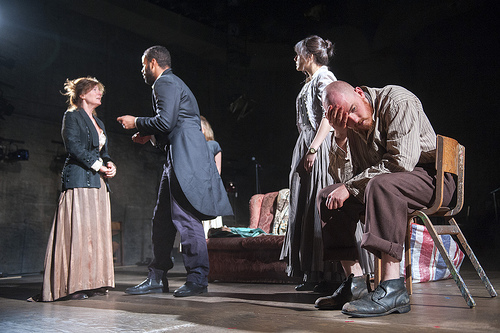
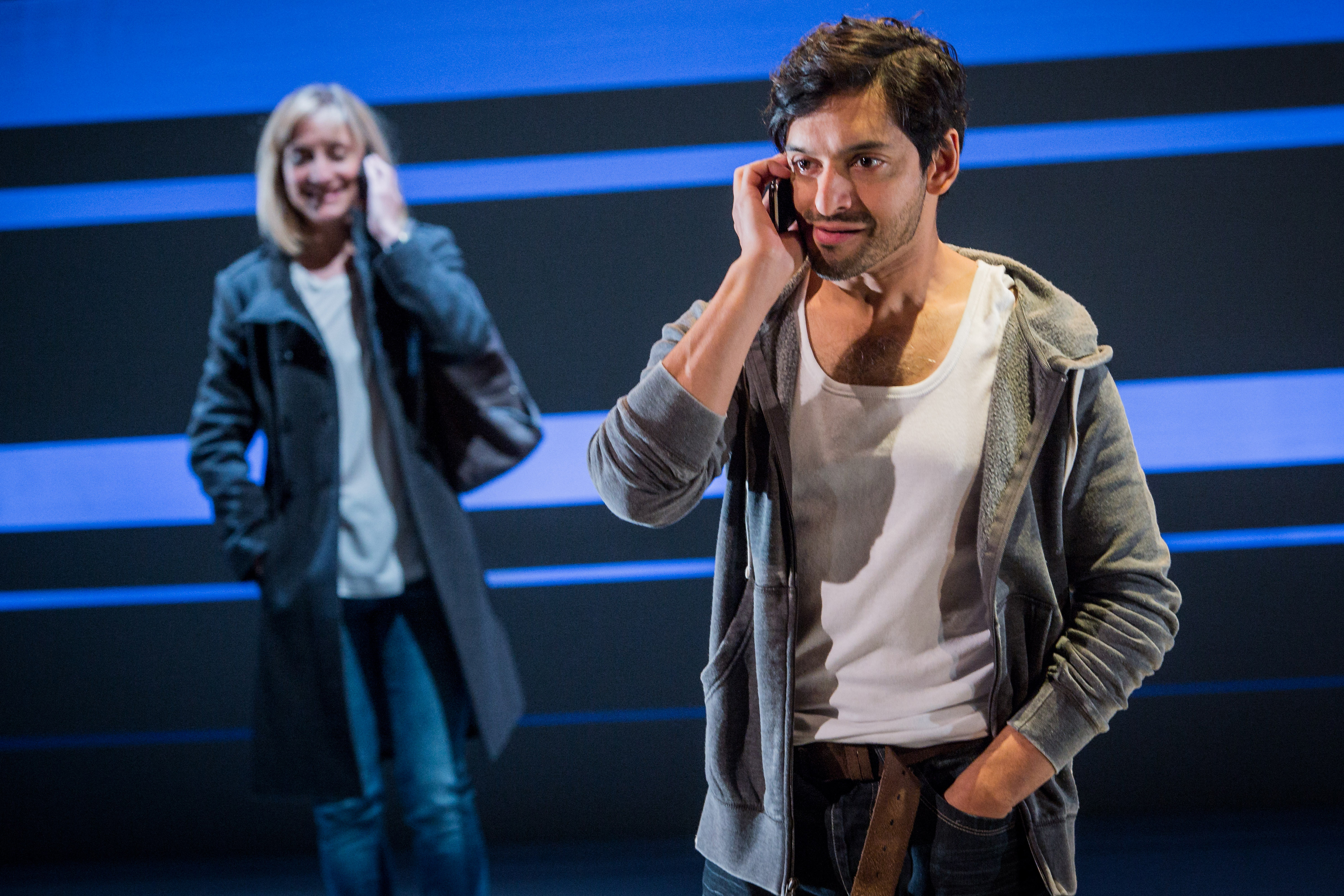
ciphers-008 Grainne Keenan Ronny Jhutti

Image courtesy of http://www.traverse.co.uk

Ciphers’ emotional software is not stripped down but it is obviously engineered. The best scene, I thought, because it is securely plausible, is ‘in a pleasant suburban garden’ where Justine’s father is ‘pottering about sweeping leaves’”

A while back I watched a London Duck Tour run its amphibious vehicle off the Albert Embankment slap bang alongside the MI6 building. The tourists on the DUKW whooped and hollered but that happy eager sound was never going to carry into the showy headquarters of the British Secret Intelligence Service. Accept that Ciphers would take you down a similar edgy slipway and – despite appearances – you get much the same subdued effect.

Ciphers is by Dawn King, whose outstanding debut play Foxfinder won her an 2012 ‘Offie’ award for most promising new playwright. Ciphers has the same director, Blanche McIntyre, but it is very different – check out Michael Billington’s review of ‘Foxfinder’ to see how different – although just as ambitious and it will do King’s CV no harm at all. However, whilst to write a drama about a young woman whose life is taken over by her work for the secret service is superficially attractive – if you can, just think ‘Homeland’ for a moment – it gets a whole lot more demanding when the action and the psychology have to be live and convincing for two hours on a bleached stage. And this is one production that really does not need the distraction of an interval break, let alone ice-creams.

So Justine steps out in defence of the realm but without much protection, mental, physical or electronic. Ciphers’ emotional software is not stripped down but it is obviously engineered. The best scene, I thought, because it is securely plausible, is ‘in a pleasant suburban garden’ where Justine’s father is ‘pottering about sweeping leaves’. His other daughter, Kerry, is on an angry mission. She wants to know why ‘if [Justine] was an analyst why is she fucking dead!’ Neither father nor daughter knows what Justine did all day: ‘Sometimes I imagine her, doing … I don’t know. Spy things …’. Yet there unfortunately is the lameness of Ciphers. The euphemistic ‘intelligence community’ does not do ‘At Home’; its windows are one-way, and its best plots are kept secret.

How to make up the story then? Have large blank screens on stage to project English translations of Russian and a few chat-up lines in Japanese. Slide those screens to smart effect, move time around – a lot, and approach Justine’s story from multiple angles with demanding paired roles.

Gráinne Keenan plays Justine and Kerry, both sensitive and vulnerable; Bruce Alexander is their father, Peter with his garden broom, and is also the predatory, knowing, diplomat, Koplov. Between them Keenan and Alexander have the most reliable, natural, exchanges. It is harder for Ronny Jhutti as artist Kai and youth worker Kareem and for Shereen Martin as Anoushka, Kai’s wife, and as Sunita, an MI5 officer – could be MI6, who knows? These are the shallow roles where lines like ‘I’m shit’ or ‘We don’t have the resources’ are thin. Worse, if like me you’re trying not to decode Ciphers as subfusc Spooks, is the accidentally topical ‘Mohammad’s slipped surveillance. We don’t know where he is’.

Ciphers plays at the Bush Theatre, Hammersmith, from 14 January. That is barely two miles from the river where DUKW tours are suspended after one of the ‘Ducks’ caught fire downstream from the MI6 building. It will be interesting to follow how this spare, edgy, drama goes down. Personally, I don’t think that it rides that high in the water.

Reviewer: Alan Brown (Seen 12 November)

Visit Ciphers’ homepage here.
 

‘The Importance of Being Interested’ (The Stand: 10 Nov ’13)

” Thereafter Ince takes his time, circles his subject(s), and loves the fact that when you engage him you get a ‘Rent-a-Gob’ actor-comedian who does intersecting illustrated monologues way before brevity”

Editorial Rating: Nae Bad

‘And speaking of the science of Life, have you got the cucumber sandwiches cut for Lady Bracknell?’

Robin Ince’s stand-up promotion of scientific understanding has serious pedigree now. There was his 2008 Fringe show Things I Like About Carl Sagan And Others, the 2009 Night of a Billion Stars, last year’s Happiness Through Science tour, and now this one, The Importance of Being Interested, which does exactly what it says on the tin. Boldly search for ‘Pedigree Chum’ and top of the Google tree comes ‘Pedigree Brighter Futures’, which is where Ince would land us.

Initial lift comes from an explosive tribute to Brian Blessed which actually has enough energy to fuel the whole show. Thereafter Ince takes his time, circles his subject(s), and loves the fact that when you engage him you get a ‘Rent-a-Gob’ actor-comedian who does intersecting illustrated monologues way before brevity. Of course, it’s an act and is far better navigated and controlled than this self-deprecating drift suggests.
Space is tight at ‘The Stand’ and the analogy of a black hole is never far away. You do not escape Ince’s argument that what really counts is to notice things. What things? It doesn’t matter as long as you look and learn. Ince does not mention that particular weekly magazine for children published from 1962 until 1982, preferring for his stage the more adult and risible Unexplained, but Look and Learn is most certainly where his 44 year old heart is. There and with his five year old son, Archie, who can do no wrong and whose grasp of quantum theory is cute, for ‘Observe me [being bad] and I’ll collapse into a state of good behaviour’.
Perhaps there is too much of little Archie in extortionate Legoland and in the bath exploring himself and not enough of Charles Darwin and Richard Feynman, but Ince’s sincerity makes that forgivable. He bends double in near fury as he fulminates against the stupidity of rote learning in schools and is wicked about the telltale physiognomy of Secretaries Gove and Osborne. Crawley, presumably disfigured by Gatwick airport, gets it in the neck and ends up on the event horizon of non-existence, as do former Archbishop George Carey and the fatuous DJs on commercial radio that no self-respecting alien would listen to.
Co-host of BBC4’s The Infinite Monkey Cage, Ince can only admire the size of Darwin’s nose – that unbelievably almost denied him passage on HMS Beagle – and would defend to the last piglet squid, earth worm, or naked mole rat the right of a child to ask questions of their universe. That way we get to understand it a little more and can wear the ‘tribal scars’ of a BCG jag with pride. This comedian’s rational, humanist credentials are right up there with the Voyager programme. Ince doesn’t get heckled, he gets footnotes, addendums … (his joke).


nae bad_blue

Reviewer: Alan Brown (Seen 10 November)


‘The Birds’ (Summerhall: 14-16 Nov ’13)

“Josephy McAulay is Bowie-esque as Tereus, King of the Birds. Flamboyant yet balanced. He owns the stage but is prepared to share.”

Editorial Rating: Nae Bad

Rosy fingered dawn breaks through the floor to ceiling windows of the Edinburgh49 conference room. Scylla and Charybdis have nothing on our esteemed editor when she’s on the warpath. If you’re lucky she’ll just turn you to stone gorgon-style. If not you’ll find yourself clutching a short straw waiting in line to see something so bad the shade of Achilles would thank his lucky stars he gets to flit about all day in the underworld.

But I’m in luck! Not only have I not been turned to stone (rock hard abs aside) but I’m in the queue to see Edinburgh University Classics Society (EUCS) performing Aristophanes, and I love Aristophanes. I love Aristophanes so much I have an autographed poster of Douglas M. MacDowell on my wall.

What is it reasonable to expect from students producing work likely to fall among their set texts? Obviously a solid, even reverential approach from young minds absorbed in the comic genius of ancient knob gags and innuendo – in your endo. But if you’re anticipating ropey acting, adequate costumes and limited choreography – you’d be wrong. Far from delivering an earnest but ham-dram performance, this production of Emily Ingram and Lauren Moreau’s adaptation of The Birds is well on the road to the Dionysia.

We enter to find Summerhall’s demonstration room bathed in dry ice. A piano keyboard sits upstage right and drawings of birds are pinned aside the chalkboard (also featuring a bird). This helps to illustrate that The Birds is about Birds. Or rather it is about two Athenian wideboys convincing the King of the Birds to blockade Olympus by stopping smoke rising to heaven from sacrifices offered to the gods by men.

Euan Dickson is Pisthetaerus, the brains behind the operation. Max Cumming as Euelpides is his birdbrained confederate. Aristophanes deploys their self-imposed (or maybe self-preserving) exile as a means to take satirical target at the foibles of his fellow Athenians. Where other adaptations might have entirely respun these comic threads into contemporary cloth, here the antique flavours are preserved. As opposed to the coach-tour approach of say, Fringe landmark Shakespeare for Breakfast, this production is free of naff pop-culture references (actually, there is one but it is essential to the plot). The audience, composed largely of classicists, is expected to make the ascent unaided.

Plenty of spectacle lines the script’s path so that even my companion, despite being a semi-barbarous science type, is never lost. Josephy McAulay is Bowie-esque as Tereus, King of the Birds. Flamboyant yet balanced. He owns the stage but is prepared to share. And there is plenty of talent to go round. Some great character work is on offer from Jacob Close (calm, pacy – the ideal foil to Dickson), Byron Jaffe (a middle order master of horizontal bat shots) and Matthias Vollhardt as the wandering poet lost in himself reminded me so much of Thom Dibdin I nearly fell off my bench in surprise.

A quick look down the cast & crew list suggests The Birds might be a rather plummy affair. Fortunately Rachel Bussom (as Tereus’ consort, Procne) and Jodie Mitchell (as his deadpan, pun-dropping doorkeeper) provide laconic counterpoise to the home counties Attic. While the chaps are larking about, they prick egos on stage and off – scorching without burning. Bussom is the best thing we’re likely to see before Jennifer Saunders returns in the second series of Blandings.

Birds in general, and the birds in The Birds in particular, are a showy order of creature. All feathers and dance steps, they’re never happier than when being admired. Tereus’ court centres on his spectacular daily cabaret. It’s a fantastically tall order for a production staged in a rather dreary auld lecture theatre. The dance routines were devised to look impressive without over-taxing the mixed company. Colourful (if malting) feather boas combine with garish, lacy things from the parts of Primark unseen by men to raunchercise proceedings – as does Gaia Arcagni (whose charming physical range runs the full gamut from crow to flamingo). Tamsyn Lonsdale-Smith all but steals the show with her brilliantly conceived entrance as Iris, floating in on the herculean arms of her devoted attendants.

The Birds is not without its shortcomings. The cast are under-directed when not centre stage. Dickson and Cumming do not blend into the background and their slapstick needs much polishing, as do Cumming’s shoes. The production is too prop light. The business necessary to successfully be off stage while on it is absent. Several of the birds decide to take up smoking for want of anything better to do – if they had wings instead of fingers the result could not be any clumsier. The pianist is utterly lost amid the hilarity with little to do. Either he needs a mask, or a bell with which to mark the passing of each bird-related pun. The venue acoustics are awkward and some are managing better than others.

This is a production deserving a much longer run. Over the course of a Fringe it would be polished and perfected so that it might exceed the success of the original 414 BC outing of The Birds and claim first prize. Even so, much effort has gone in and more that is clever, witty and insightful has come out. This is a great production which you’ll remember fondly even when pinned down by angry Spartans in a walled orchard listening to goatsong.

nae bad_blue

Reviewer: Dan Lentell (Seen 15 November)

Visit The Birds homepage here.

‘Twonkey’s Blue Cadabra’ (Mary King’s Close: 6 Nov ’13)

Twonkey pic three 2013

“Vickers weaves bizarre, bamboozling, absurdly nonsensical stories, which he tells with a mix of puppetry and song “

Editorial Rating: Nae Bad

Who is Twonkey?  What is a cadabra?  Why is Twonkey’s cadabra blue?  All your questions will be answered – sort of – in the course of this weirdly compelling performance, which combines freewheeling inventiveness with some genuinely touching storytelling.  Fresh from a much-starred run at the Edinburgh Fringe, this one-off appearance in the depths of Mary King’s Close also included some new material destined for next year’s follow-up show.

Any attempt to describe Paul Vickers’ one-man act is doomed to inadequacy, but here’s a quick list of just a few of the things he covers.  An oven talks; a tailor flies; a creepy cat just keeps coming back, and our host explains the best way to sneak up on an unsuspecting microphone.  Vickers weaves bizarre, bamboozling, absurdly nonsensical stories, which he tells with a mix of puppetry and song.  His parallel worlds have an internal consistency, and enough points of reference to hang onto – but if you’re expecting a close connection with reality, you’ll be set to rights within the first few minutes of his pleasantly perplexing routine.

It simply wouldn’t work if you took it too seriously.  But Vickers, who drifts in and out of character as Mr Twonkey, develops a rapid rapport with his audience; the crowd grew noticeably more relaxed with his complex material as the show wore on.  There’s a fair amount of comic bungling – it takes real panache to lose your props quite so endearingly, quite so often – and selected punters have their minds probed by psychic underwear, an ice-breaker which actually works remarkably well.

But for all the random wackiness, there’s a real poignancy to some of the storytelling.  Vickers’ biography of Stan Laurel might be untroubled by actual facts, but his imagined anecdote touches on big questions of fame, friendship, and the things a celebrity must leave behind.  And the most moving story of all was the very last one he told, which used a run-in with a drunken postman as the jumping-off point for a tale of lost love.  Suddenly, and very quietly, the whimsical took a devastatingly serious turn.

It might have been a touch more satisfying if the stories linked together – absurdist non-sequiturs can only take you so far – but Vickers’ greatest achievement is to leave you feeling that, in a way you can’t quite express, it all made perfect sense in the end.  A show like this is bound to split opinion, and if you want to be led by the hand through an intricately-constructed narrative you really won’t like it at all.  But if you relish the occasional outbreak of nonsense, you’ll find Twonkey’s Blue Cadabra a gloriously colourful show.


nae bad_blue

Reviewer: Richard Stamp (Seen 6 November)

Visit Twonkey’s Blue Cadabra homepage here.


‘The Tailor of Inverness’ (Summerhall: 1-2 Nov ’13)

Tailor

Image by Tim Morozzo

“the energy boils over from time to time, and a handful of moments of great poignancy felt rushed and under-sold”

Much acclaimed on its earlier runs at the Edinburgh Fringe, The Tailor Of Inverness tells the true life story of the late Mateusz Zajac… who was also performer and playwright Matthew Zajac’s dad.  Displaced from his home in eastern Poland at the onset of the Second World War, Zajac senior’s travels took him across numerous battlefields, before he finally settled in the north of Scotland and lived out the remainder of his life as a respected local craftsman.  It’s a complex tale, but well-judged projections in the background help keep track of the tailor’s journey through life, as he voyages from Poland to war in Africa and a C&A factory in Glasgow.

But here’s the thing.  If you’re over the age of – let’s say – thirty-five, the chances are that you grew up listening to no less fascinating wartime tales. There is a reason to tell Zajac’s story above most others, but the script waits far too long to show the trump cards in its hand.  Too much time early on is given over to the bones of the eponymous tailor’s narrative, which is engaging and sometimes thought-provoking but not, on cold analysis, particularly exceptional.

And the latter parts of the play are disappointingly factual.  Thanks to its extensive use of documentary video recordings, the production feels more than anything like an edition of Who Do You Think You Are?, depriving it of some of the impact a more theatrical approach could have engendered.  It’s particularly sad that we hear so little from the tailor’s character during this second part of the play; the set-up seems perfect for a speculative analysis of his motivations, but some obvious questions about why he behaved the way he did remain almost entirely unexplored.

Actor-playwright Matthew Zajac has earned many deserved plaudits for his role in this play.  His mix of Polish and Scottish accents is a particular delight, and his physical performance is utterly dauntless.  But, five years after he first performed his script, he may have lost a little subtlety – the energy boils over from time to time, and a handful of moments of great poignancy felt rushed and under-sold.  The script also tends to over-use the device of jumping into the middle of an intense scene, a technique which loses its effectiveness when it’s deployed too often.

The Tailor Of Inverness is a fine history lesson – you’ll learn a great deal about how the borders of Eastern Europe were drawn – and an inspiring tale of a loving son’s efforts to piece together the past.  But there’s something missing: a moral, perhaps, or a clear sense of purpose.  The tailor appeals to us to accept him for who he is – at once a Pole, a Ukrainian, a Russian, and a Scot – but aside from Nazi ideologues, nobody in the play seems to have any problem doing exactly that.  This is a story well told, but it’s frustratingly hard to pin down quite what it wants to teach us.


Reviewer: Richard Stamp (Seen 1 November)

‘Crime and Punishment’ (Lyceum: 22 Oct – 9 Nov ’13)

9820696075_7c9c0e2431

Image courtesy of http://www.lyceum.org.uk

“in this busy play-novel of downed vodka and photographic ‘shots’, I found that the drama has the consistency of one of Luzhin’s caramel wafers”

There is a lot of exposure in this production. There is no curtain for a start, no flats, no scene painting, nothing obviously comfortable on stage but utility furniture. Across the back, exposed, is a dressing room, liquor bottles and music kit, for the (a)ttiring house of the Shakespearian theatre equips this new adaptation of Dostoyevsky’s unsettling Crime and Punishment. The company gathers, warming up, as the audience sits down and a full-on Psalm 130, De Profundis, ‘Out of the depths … hear [our] prayer’, shifts seeming rehearsal to actual performance. What you are about to see could be barefaced and brazen.

In fact the way to enjoy this co-production with Glasgow’s Citizens and Liverpool’s Playhouse is to look at it as an amateur photographer and to accept that fiddling with your dramatic settings will affect what you see. Some scenes will be sharp, others appreciably less so; some clearly sequenced, others vaguely. The programme casts this as ‘fluidity of the staging, with its seamless transitions’.

Depth of field, then, is key. Rodion Raskolnikov, the ur-student transgressor, is more in focus than out of it, which is to actor Adam Best’s credit as the character is in the fever grip of irresolution to the point of passing out on his sofa or remaining mute and motionless while a policeman snuggles onto him and licks his shaven head. Raskolnikov’s idea of responding to the love-of-his-life, Sonya, is to bow down before her unhappiness. He is fixated on the genius of Napoleon but has the strategic nouse of a double axe-murderer. Best is lucid and good at the verbal and facial tics that impede Raskolnikov’s nihilistic raptures.

Adjust for comic relief and enter George Costigan first as Marmeladov, drunk, and then as Porfiry Petrovich, detective and examining magistrate. Now we’re learning about portrait photography: the two subjects are nicely observed, properly defined, and hold your attention. However, the entertaining, disconcerting, scenes might as well be framed: Meet a Drunk, Cross-examination, Youdunnit – as they illustrate what happens when police procedural meets comic accent and turn. Costigan’s Petrovich proves a wry nemesis.

Cate Hamer’s two principal roles as Pulkeria, Raskolnikov’s mother, and as Katerina, Marmeladov’s wife, are demanding and prominent but they cannot provide humour. Hamer has to do destitution, torn affections, and mental breakdown in vignettes of scenes where there are no decorative borders. The effect is monochrome.

There is a lot of creative energy and skill expended in this production. Supporting parts are bright and live in the moment, notably Obioma Ugoala as the unselfish Razumikhin. Writer, Chris Hannan, knows his Dostoyevsky and pares the novel down with evident respect and sensitivity. Thematically it is pretty intact, not least its all-Russian face-off between social cataclysm and (Christian) redemption, between the polemic of ‘new ideas, new economics’, and Sonya’s New Testament. Raskolnikov is criminally self-absorbed and the play’s script interrogates him. Stage microphones amplify his breathing; other characters ‘resting’ back-of-stage also judge him. Domininc Hill’s direction is clever – a door on wheels makes for fast entrances and exits, digitised blood slashes red  and the soundscape is close to a Threekopek Opera – but finally, inevitably maybe, in this busy play-novel of downed vodka and photographic ‘shots’, I found that the drama has the consistency of one of Luzhin’s caramel wafers.

Reviewer: Alan Brown (Seen 30 October)

‘Dragon’ (Traverse: 30 Oct – 2 Nov ’13)

Dragon prod pic 4 Drew Farrell

Image by Drew Farrell

“And there are dragons!  Dragons everywhere.  Not the gold-hoarding recluses of British folklore, but the sensuous, bewitching creatures of the Orient”

Editorial Rating: Outstanding

A play for older children and big-hearted grown-ups, Dragon is filled with beauty from its very first scene.  A comforting kind of magic flows from its enchanting, nostalgic backdrop: searchlights pick out a city’s rooftops, while ghostly clouds hang in the moonlit sky.  But this isn’t a Disney fairytale. Within seconds of the opening, we’re thrust into a hospital ward – and there we witness a young teenager, Tommy, bidding his dying mother goodbye.

A host of motifs come together in this stylish, inventive performance.  Black-clad actors prowl the stage, wielding props which make up a dynamic and ever-changing set.  At its best, the choreography is breathtaking; look out for the scenes at Tommy’s school, where he sits still in the centre of the stage and classroom after classroom appears around him.  There’s plenty of humour, and there are elements of stage magic worked in too – props and even actors appear as if from nowhere, thanks to clever misdirection or ingenious tricks of the light.

And there are dragons!  Dragons everywhere.  Not the gold-hoarding recluses of British folklore, but the sensuous, bewitching creatures of the Orient, evoked here through a smattering of technical wizardry and a wealth of compelling puppetry.  As the story rolls on, you’ll come to recognise what Tommy’s dragon represents, and you’ll notice it growing and changing over the course of the play.  Sometimes it’s sinister, sometimes it’s as cute as a puppy, but towards the end it’s a monster… a terror to be fled, or faced down.

As befits a family-friendly show, Dragon’s plot is straightforward, and the emotions it plays on are big and simple ones.  Unaccompanied grown-ups might wish it were a little more nuanced, but if you’ve taken the kids you’ll find plenty of important themes to talk through later.  Tommy’s story encompasses loss, grief, anger and acceptance; along the way he discovers the importance of connecting with others, and learns that inner dragons always seem less scary when you bring yourself to face them head-on.

There’s very little spoken dialogue – which, incidentally, makes Dragon eminently accessible for people who are Deaf or hard of hearing – but the visual delight is accompanied by an atmospheric soundscape, lending tempo and portent to the action on stage.  Being picky, the lighting wasn’t executed quite as flawlessly as the rest of the production, and the slow-mo fight sequences felt hackneyed at times.  But the ending has a beguiling simplicity which complements that gorgeous opening, and there’s wonderment and poignancy in all that comes in between.  A must-see show for children aged 9 and up, and for adults who remember how to play.

outstanding

Reviewer: Richard Stamp (Seen 30 October)

Dan Lentell in Conversation with Craig Miller re. Close Fest

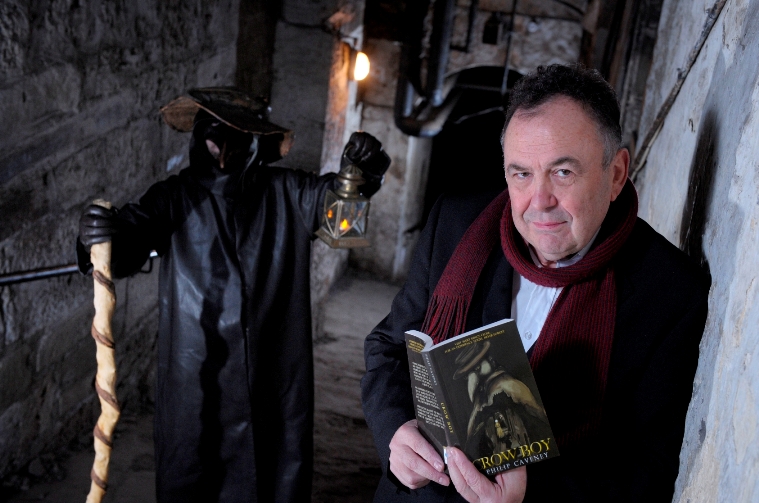
Philip Caveney with Plague Doctor on The Close

Crow Boy author Philip Caveney with Plague Doctor on Mary King’s Close

“We don’t do disappointment!”

On the afternoon of 28 October Dan Lentell spoke with Craig Miller, manager of landmark attraction Mary King’s Close about the upcoming Close Fest which will run from 31 October – 9 November. Craig enthuses about the venue as a dramatic setting; talks about the challenges of utilizing the space for live performance; and describes how The Close will grow as a local resource during its second decade.

Listen to our interview with Craig Miller

See all the events in the Close Fest line up here.

‘Translunar Paradise’ (Traverse: 18-19 Oct ’13)

Translunar Paradise @ MAC by Alex Brenner (_D3C6294)

Image by Alex Brenner

“The piece meanders between the couples’ experience of youth and old age, a personal tragedy, the war and a daily routine that proves hard to break when he is left alone.”

Editorial Rating: Unrated 

A Fringe hit in 2011 and 2012, Theatre Ad Infinitum’s Translunar Paradise has since travelled the globe, appearing everywhere from Colombia to Croatia. Last week, as part of its national tour, it swept into Edinburgh’s familiar surroundings once more.

The production’s global reach is testament to its wonderfully universal nature. The subject matter – the difficulties of losing a loved one – is one that everyone, regardless of culture, status or age, can relate to in their own way, and the delivery of this narrative entirely in mime ensures language is no barrier. Using such a universal story and no spoken word creates a space for each audience member to project their own story, their own experience of loss, onto the characters – leading to a very personal experience and not a few emotional sniffs.

Whilst this is a strength in one respect, in another it leads to a fairly predictable, if touching, story arc: we watch as a man in his twilight years struggles to adjust to daily life after his wife of many years passes away – though her spirit remains, intervening, to help her pained husband move forward. The piece meanders between the couples’ experience of youth and old age, a personal tragedy, the war and a daily routine that proves hard to break when he is left alone.

To illustrate the jumps between youth and old age, the cast employ the use of masks. Initially, these are incredibly effective, Michael Sharman (William, the husband) and Deborah Pugh (Rose, the wife) incorporate them seamlessly into their fantastically crumpled and stiff physicalities, complete with the soundscape of old age: the sighs, strains and the hrumphs. However, as the story progresses the masks begin to hinder rather than help. Once they have been removed once or twice we lose the illusion that they are part of the actors, and increasingly become aware that there is a face behind them, that they are actors playing a character – which could easily have been forgotten in the opening sequence. Moreover, the actors’ faces are so lively and full of expression that when the masks return you become acutely aware of just how much they limit expression, stuck as they are in one position. This became a particular problem in sadder moments as the female mask seems to contain just a hint of a smile.

Accompanying the actors is Kim Heron, who brings her haunting vocals, Yann Tiersen-esque accordion playing and a crucial pair of hands to the production (having actors limited to just one hand while the other holds the mask makes carrying and staging quite tricky. Luckily, Heron’s knack for multitasking – simultaneously singing, playing the accordion and carrying props around for the actors – helps keep the production moving). The accompaniment is beautiful and effectively highlights the mood and period of a scene, for instance using war time classics such as ‘We’ll Meet Again’ ‘It’s a Long Way to Tipperary’. However, its continuous use and somewhat samey feel means it loses effect. By the time the final moments arrive, where a well-placed accompaniment could convert a few sniffs to flowing tears and a much greater emotional climax, it is so familiar that it lacks the impact it could so easily have.

At the moment Translunar Paradise errs on the slower, more drawn out side –not helped by the predictability of the story. However, it is also a warming, gentle piece of theatre, with interesting staging, a lovely universality to it and the potential to do even more.

‘Paul Bright’s Confessions of a Justified Sinner’ (Summerhall: 17-26 Oct ’13)

Paul Bright's Confessions prod 2 credit Tommy Ga-Ken Wan

Image by Tommy Ga-Ken Wan

“It is with wry humour, almost touched with disappointment, that the 1987-89 history of Confessions is presented.”

Editorial Rating: Nae Bad

This intriguing piece is ‘reconstructed’ by Untitled Projects. Any reassuring solidity provided by co-producers, National Theatre of Scotland, is shaky for this is a bit of a shape-shifter. It provides dramatic form, of that multi-media sort, to James Hogg’s astonishing Private Memoirs and Confessions of a Justified Sinner, published anonymously in 1824, and to the afflicted, near mad, efforts of actor/director Paul Bright in the late 1980s to put this resurgent, mind-bending, novel onto some kind of stage. It helps a lot if you accept the invitation to go to the four room exhibition – downstairs at the Summerhall – both before and after the show. It’s stark down there but there is much of real interest: archive film footage; Fringe fliers, past reviews, stuffed corbies – that substantiate what you will see/ have seen. And there’s a welcome wee dram to close with.

The host – actor George Anton – does it all, introducing Hogg’s book, introducing himself, meditating on acting, chronicling the history of Bright’s work, playing Bright in impassioned bursts, telling of their time together. He is well qualified to do so as Bright’s co-actor in three (of six ‘Episodes’ of the Confessions) and as his friend, which was clearly – in retrospect at least – one hell of a job.

A large screen assists all the while, showing captions, film – mostly grainy, jumpy and silent – various artefacts, and here-and-now interviews with others who knew and worked with Bright. If you know the book, then the split-screen, Gilmartin/Wringhim, Bright/Anton, doppelgänger scenes are especially successful; not least when you learn that Bright (brought up in Ettrick; but that is Ettrick, Kwa-Zulu Natal, & not Hogg’s Ettrick near Selkirk) had a twin brother who drowned when they were swimming together.

Bright protested Nature above Psychology and he would have his theatre ‘alive, dirty and dangerous’ and that does act against this production which is more intelligent composition, reflective anecdote and report than anything more forward or disturbing. It is with wry humour, almost touched with disappointment, that the 1987-89 history of Confessions is presented. The third Episode, ‘Trials’, was staged at the Queen’s Hall as original Scottish drama and as part of the Edinburgh International Festival . It was a ghastly trial for everyone, lasting nine hours and was a disaster: ‘an incomprehensible and pretentious assault on Scotland’s literary heritage’ was John Gross’s opinion in the Sunday Telegraph.

Unsurprisingly the last Episode 6, ‘The Road to the Suicide’s Grave,’ never happened. However,  here’s the real, valedictory, reconstruction that this production achieves. Paul Bright died in Brussels in 2010 at the age of forty-seven and up on the screen appears a fair sized box that George Anton got in the post from Belgium. It contained personal effects: notebooks, sketches, Bright’s copy of Hogg’s Confessions and a tape from a telephone answering machine. Listen to the message on that tape, watch the appreciably long final sequence and you understand that it is all underscored by affection for a lost friend who could not let go of an impossible project.

‘What can this work be?’ asks Hogg’s editor at the end of the sinner’s memoirs. ‘I cannot tell’ is his conclusion. Actor George Anton, writer Pamela Carter and director Stewart Laing create something more tangible of Paul Bright’s Confessions and in the end more definitive.

nae bad_blue