The Oak Tree (Bedlam: 16 – 17 Oct ’13)

965268_10153333436155858_1026221967_o

Image by Daniel Alexander Harris

The Oak Tree is the debut script from young author Ellie Deans, and it’s an impressive start to her writing career.”

Editorial Rating: Nae Bad

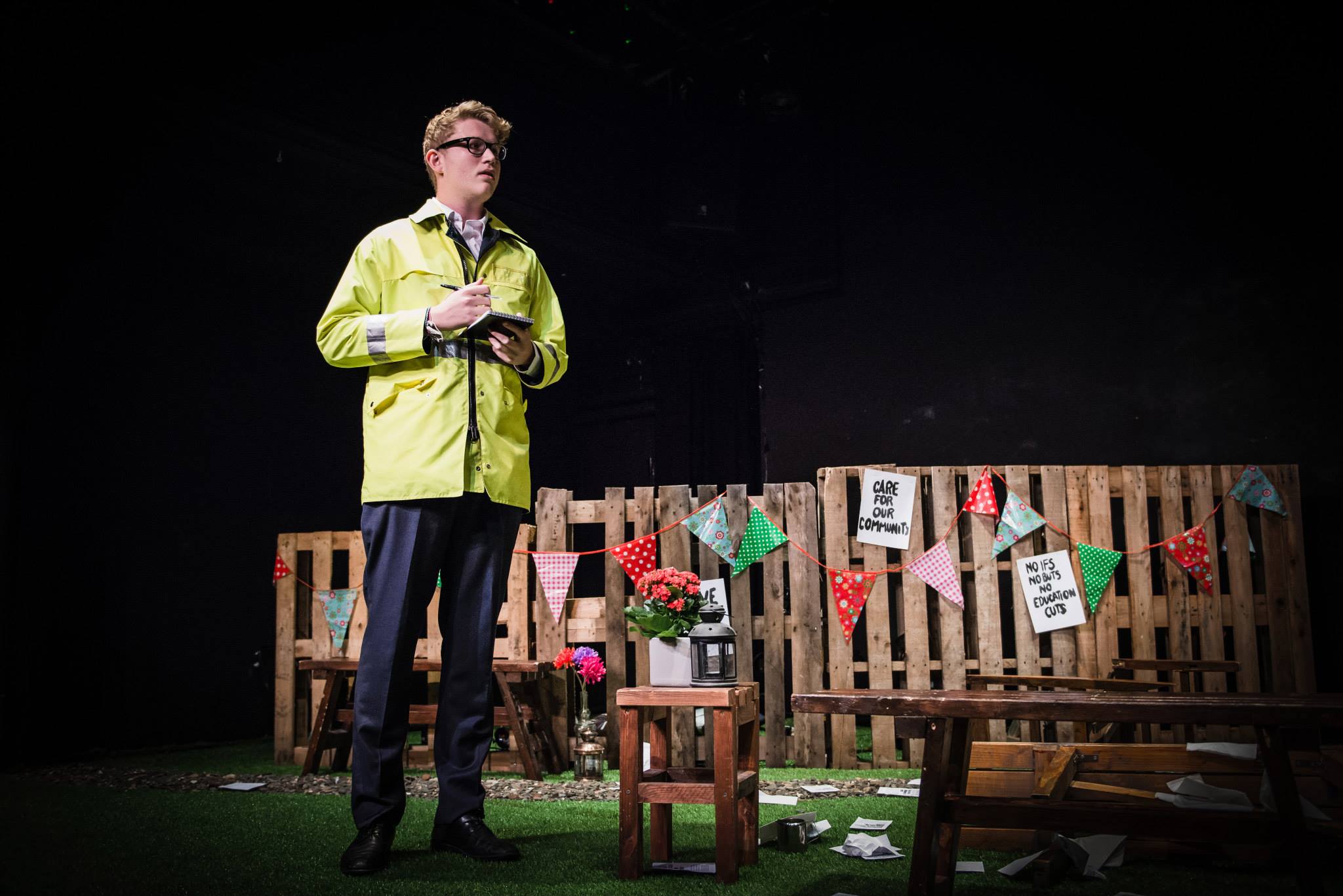
There’s a lot to catch your eye about this brand-new play – but the first thing you’ll notice is its expansive set.  Astro-turfing the whole Bedlam stage, it impeccably evokes the eponymous Oak Tree, a fading outdoor café in an equally fading part of London.  With its rustic fence and crunching gravel, the Oak Tree is both timeless and reassuringly familiar… but a man called Mark Duggan has just died in Tottenham, and in the course of a summer’s night, everything will change.

The Oak Tree is the debut script from young author Ellie Deans, and it’s an impressive start to her writing career.  The story’s revealed through well-paced dialogue, free from clumsy exposition; an occasional tendency to labour plot points is the only notable flaw.  Although it’s a political play, the tone is balanced and genuinely thought-provoking, and the characters are refreshingly nuanced too.

There’s both cleverness and chutzpah in the play’s construction, with a frothily entertaining first half yielding after the interval to a far darker tone.  Early highlights include a set-piece comic misunderstanding – which would stand scrutiny alongside many a TV sitcom – and a gloriously toe-curling business pitch, delivered in fearlessly hammy style by actor Robbie Nicol.  There are subtler motifs too: a touching bond between brother and sister, the burden of untold secrets, and the piquant realisation that the things we love can’t last forever.

But the script loses its way a little when it confronts its motivating theme, the riots of August 2011.  What caused the disorder?  Who should we blame? Is there room for understanding, or must we simply condemn?  The play touches on these important questions, but it doesn’t have time to explore many answers.  Deans is at her strongest when she’s pursuing a simpler agenda: illustrating how that summer’s shocking events tore families and communities apart in the parts of London left to deal with the aftermath on their own.

She’s aided in that task by a strong and confident cast.  Will Fairhead plays lascivious rich kid James with considerable relish, successfully drawing just a hint of likeability from his endlessly crass character.  Ella Rogers has the family matriarch nailed, bringing a gut-wrenching sense of tragedy to one emotional scene, while Casey Enochs puts in a finely-balanced performance as the other-worldly Annie – perhaps the most intriguing of Deans’ creations, and certainly the most saddening.

The Oak Tree undulates through a landscape of moods – from uplands of optimism to bleak valleys of despair – and at times, it’s deeply cynical.  But it’s defined throughout by a gentle, affectionate humour, and by characters complex enough to make you care.  Both playwright and cast deserve considerable credit for this engaging, inventive production.

nae bad_blue

‘The Lives of the High-Rise Saints’ (Summerhall: 10 – 12 Oct ’13)

 agata-spektakl-sma.preview

Image by pawlowicz.art.pl

“Anyone who has worked on a DIY project will know that there are always bits left over, and this is the starting point of Ameijko’s work. God’s work took six days and on the seventh day he rested – but on the seventh day the flotsam and jetsam from creation gathered together in a tower block.”

Editorial Rating: Unrated 

The Lives of The High-Rise Saints brings a wide range of disciplines to the Summerhall stage. This one woman puppetry show from Agata Kucinska reaches into the reject pile of society to examine the inner strength that people can find to get through their lives.

Many of the visuals are slightly twisted away from the norm, and the inventiveness behind the design is a delight to see. The performance is a technical tour de force that uses everything from very small rod puppets through to larger human-arm puppets, and even Kucinska donning a mask and puppet limbs to physically take on one of the roles herself.

The story itself, adapted from the work of the same name by Poland’s Lidla Amejko, is both dark and challenging. Anyone who has worked on a DIY project will know that there are always bits left over, and this is the starting point of Ameijko’s work. God’s work took six days and on the seventh day he rested – but on the seventh day the flotsam and jetsam from creation gathered together in a tower block. Trusting only in themselves, they scrape out a living at the fringe of society, a motley band of wastrels, tortured souls, and dubious morals, sharing the tales of their lives with each other and the audience.

On the surface there is little to love about these characters. Rejected by the rest of the world, it is very easy to gloss over them on stage and write them off, but this slow burn of characterisation through individual vignettes is countered by the love and energy Kucinska brings to the stage. You approach each character with trepidation and an almost grotesque curiosity before slowly being pulled into their world.

It’s backed with an inventive live sound-scape that mixes foley effects and music to highlight the sadness of this world. This contrasts well with the small moments of joy each character has to look for to break the monotony of their life with brief bursts of joy and satisfaction.

You need to make that journey to appreciate the small moments that make their lives bearable, but the experience and repetition as the script moves through the roll call left me with a sense of exploitation and horror. This is not an easy performance to watch, but it is layered, thoughtful, and has much to say.

Technically Kucinska has mastered the many facets of puppetry used throughout the show, but with the grotesque nature of the characterisation it becomes hard to connect with the characters. This is not aided by the tone, which is almost oppressive in its darkness; while this accurately reflects the world the characters inhabit, it inhibits investment in their plight and results in the show failing to realise its potential to truly captivate the audience’s attention. Dark can work if enough empathy can be created, but the various elements of the show never quite clicked together, resulting in a somewhat disjointed experience.

Everyone in life is dealt some rubbish cards and the occupants of the tower block know just how weak their cards are but they make the best of the trying circumstances and show a great resilience of spirit in the face of depression and hostility. There is a lesson in there for all of us.

‘Oedipussy’ (Traverse: 9 – 12 Oct ’13)

6

“The poet did not write ‘Agamemnon, Parthenon, Taramasalata’ but in Oedipussy it is intoned as a choric reminder that Greek tragedy developed from the earlier satyr plays whose revels and antics are right up there with Spymonkey’s use of song and physical theatre.”

Editorial Rating: Nae Bad 

Dangle an adapted classic in front of a critic and you invite trouble. So it was fun to hear Spymonkey open Oedipussy with a swipe at a hostile review of their Moby Dick (Edinburgh, February 2010). The boot went onto the other, platformed, foot with wicked intent and not a little of the ensemble playing that would follow.

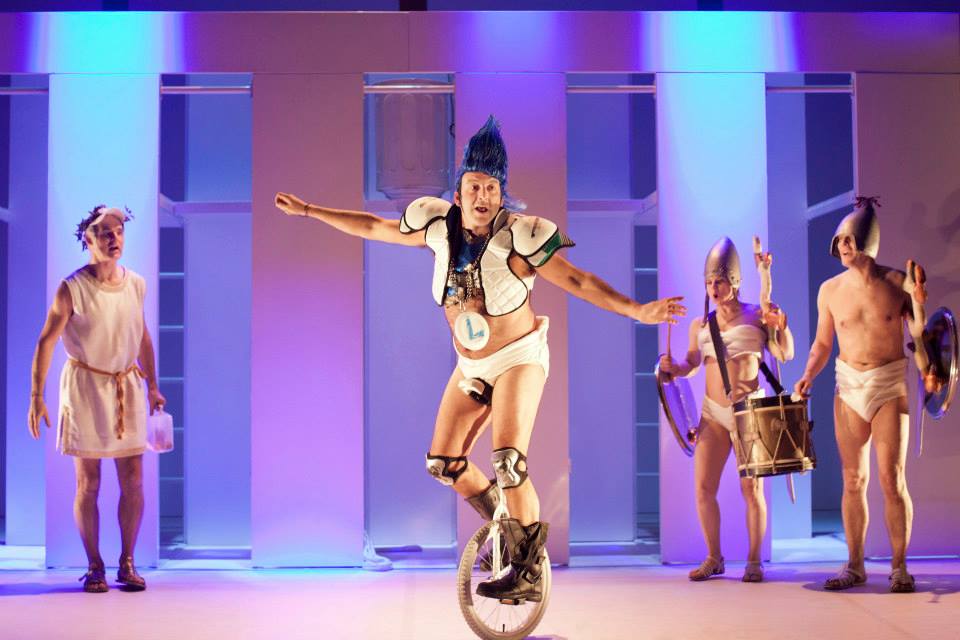
Oedipus has swollen feet, of course, which is not surprising as they are ‘pinned’ here using a cordless drill. Just one of the modern tools – add a unicycle, saxophone(s) and radio mic – that this production uses to ‘build up a dazzling mockery of delight’. The poet did not write ‘Agamemnon, Parthenon, Taramasalata’ but in Oedipussy it is intoned as a choric reminder that Greek tragedy developed from the earlier satyr plays whose revels and antics are right up there with Spymonkey’s use of song and physical theatre. ‘Woman-breasted Fate’ has her naked moment on stage as a wardrobe accident but otherwise the action is more ‘hot, hard, and in your face’ than anything stylised or reflective.

That said, ‘It’s not bloody panto’ either, as Jocasta (Petra Massey) would have the audience realise. The oracle may be hilariously represented by ballooned eyeballs – plus a red nose in a later manifestation – but the episodes are all here, from the infant Oedipus on Mount Kithairon to Jocasta’s suicide.

It is a post-modern piece though, if you allow 007 a mythic quality. Characters deconstruct as the four actors protest – along with Oedipus – that ‘this is the [real] me’: Petra Massey has problems with her feet and cannot have children; Aitor Basauri says he is not fat and tries out as a stand-up comic and Stephan Kreiss (Oedipus), at 51, needs pain relief from wild acting, and longs to go home to a more ordered Germany.

The Chorus (Park) does its job, singly, with a broken column on his head, and it seems is forever twirling in time as his robes wrap and unwrap around the white, ingeniously available set. Park is also Tiresias the blind prophet who has a remarkable turn as ‘a very bad David Bowie’ with outrageous pink cans on his head. Those costumes do stand out. They are colourful and outrageous, much more ‘Barbarella’(1968) than ‘Atlantis’ (2013).

Nevertheless, blood splatters and streams onto the stage and there are drum rolls to accompany the Eels’ ‘It’s a Motherf-’ – and, whilst the poetry is long gone, Oedipussy has its own tragic face. The production finally plays out to ‘Nobody does it better’, which is fair enough.

nae bad_blue

‘The Fantasticks’ (Bedlam: 9 – 12 Oct ’13)

1391627_536699813084181_349070085_n

Image by Louise Spence

“Performed in New York almost continuously since 1960, The Fantasticks is a curiously-constructed musical.  The first act is cutesy – sometimes to a fault – telling the knowingly-ridiculous tale of a forbidden teenage romance, and of two fathers’ efforts to control their love-struck offspring.”

Editorial Rating: Unrated

“Try to remember the kind of September / When life was slow, and oh, so mellow,” exhorts The Fantasticks’ famed opening song. Well, they’ve missed September by a week or two, but in every other respect Edinburgh University Theatre Company have fulfilled that brief: this is a warm-hearted, uncomplicated production, which gently lulls you backwards into an agreeably nostalgic haze.  Sadly, however, the lyric also foretells this production’s main weakness.  It’s all just a little bit slow.

Performed in New York almost continuously since 1960, The Fantasticks is a curiously-constructed musical.  The first act is cutesy – sometimes to a fault – telling the knowingly-ridiculous tale of a forbidden teenage romance, and of two fathers’ efforts to control their love-struck offspring.  But after the interval, the scenes grow dream-like and altogether darker, in a dislocating transition which this particular production never quite pulled off.  It doesn’t help that the original boy-meets-girl plot is wrapped up by the end of Act One, leaving the second half to lumber away from an awkward standing start.

But we can’t blame EUTC for the plot’s idiosyncrasies, and they’ve certainly had fun responding to its old-style American charm. Jordan Robert-Laverty neatly captures the clean-cut naivety of a 1950’s college boy, while Claire Saunders excels as his swooning 16-year-old paramour, milking the comedy of her role without ever quite crossing the line into over-acting.  Saunders’ voice lends her songs an almost operatic tone, and contrasts nicely with the more natural style of Alexandre Poole – who brings an understated authority to his multi-faceted role as both villain and narrator.

Muscially, however, the performance suffered from frustrating inconsistency, with almost all the actors delivering showstopping performances for some songs while clearly struggling with others.  The surprising exceptions were Daniel Harris and Thomas Ware, playing the two teenagers’ warring fathers; their characters seem at first to be formulaic comedy chumps, but soon prove to be far more.  Harris and Ware both have fine, comforting voices, and their harmonising duets proved a thoroughly unexpected highlight – enhanced by some genuinely witty, if slightly methodical, dance.

Indeed, the whole production demonstrates a playful sense of physicality, with an impressive swordfight (and gloriously extended death scene) raising the stakes just before the interval.  But whenever the pace wasn’t being dictated by the music, the energy ebbed away.

So EUTC’s production isn’t quite fantastic – but it’s an enjoyable, stylish, and life-affirming version of a cosily charming musical. Credit must also go to pianist Dan Glover and harpist (yes, harpist) Sam MacAdam, whose position at the side of the stage brings them very much into the heart of the performance.  It’s a show I’ll be sure to remember.

Dan Lentell in Conversation with Toby Park re. ‘Oedipussy’

oedipussy150

On the afternoon of 9 October ’13 Edinburgh49‘s Dan Lentell met up with Toby Park, artistic director of Spymonkey productions to talk about their unconventional take on an old classic.

https://getyourcoatson.com/wp-content/uploads/2013/10/listen-to-our-interview-with-toby-park.mp3

Listen to our interview with Toby Park

Visit Oedipussy homepage here.

Read Alan Brown’s review of the show (forthcoming).

‘Educating Ronnie’ (Traverse: 2 – 5 Oct ’13)


MacRobert Arts Centre

“The money Joe sent would have provided the deposit on a house in a northern industrial town, or in more personal terms an engagement ring.”

Editorial Rating: Nae Bad

It is a touching story. It touched Joe Douglas for near on £19,300. By the end of the show, at the end of their story, Joe calculates exactly what it cost him over ten years to educate a young Ugandan, Ronnie.

It is a true morality tale that begins in 2002 with Joe, an 18 year old out of Stockport, enjoying a six week gap-year trip to Uganda, whose sights and sounds hit him ‘like a pop-up book’. It is not long after returning home that Ronnie ask Joe for help.

We never meet Ronnie but read and hear his emails and txts. They are pretty short, spell out how much money he needs to keep his education going and – later – how much to compensate the family of a fatal road traffic accident; how much to pay the hospital for his dying mother. The emails present on a video screen of a blackboard and then, diminished, pile up into an on-going reminder of Ronnie’s situation. There are beer mugs up there too, a nice calculation in student terms of how many pints can be bought for the £20 regularly sent to Ronnie by Western Union money transfer.

Joe introduces his story with the lights up. He is not a trained actor (the programme notes make clear his credentials as a director) and he would apologise for that. No need really; his one-man performance starts as he talks fondly to the seat reserved for his aunt Maria in the front row, for it is his auntie who looked after him in Uganda, and who interestingly did not take to Ronnie.

The money Joe sent would have provided the deposit on a house in a northern industrial town, or in more personal terms an engagement ring. He does actually take a ring out of his pocket and smiles, remarking that his parents paid for the wedding. And Ronnie? The BBC World Service went looking for him when this story was first staged at the Fringe in 2012. He has a FaceBook page apparently and does not want a copy of the script.

This work, a co-production by Macrobert and Utter, is smooth. Its careful technicals are well-rehearsed, the soundtrack is appropriate without sentimentality, Joe Douglas’s performance is characterful and honest. His story asks you to risk a leap of faith. I’m glad I did.

nae bad_blue

Reviewer: Alan Brown (Seen 2 October)

Visit Educating Ronnie homepage here.

‘Dark Road’ (Lyceum: 25 Sept – 19 Oct ’13)

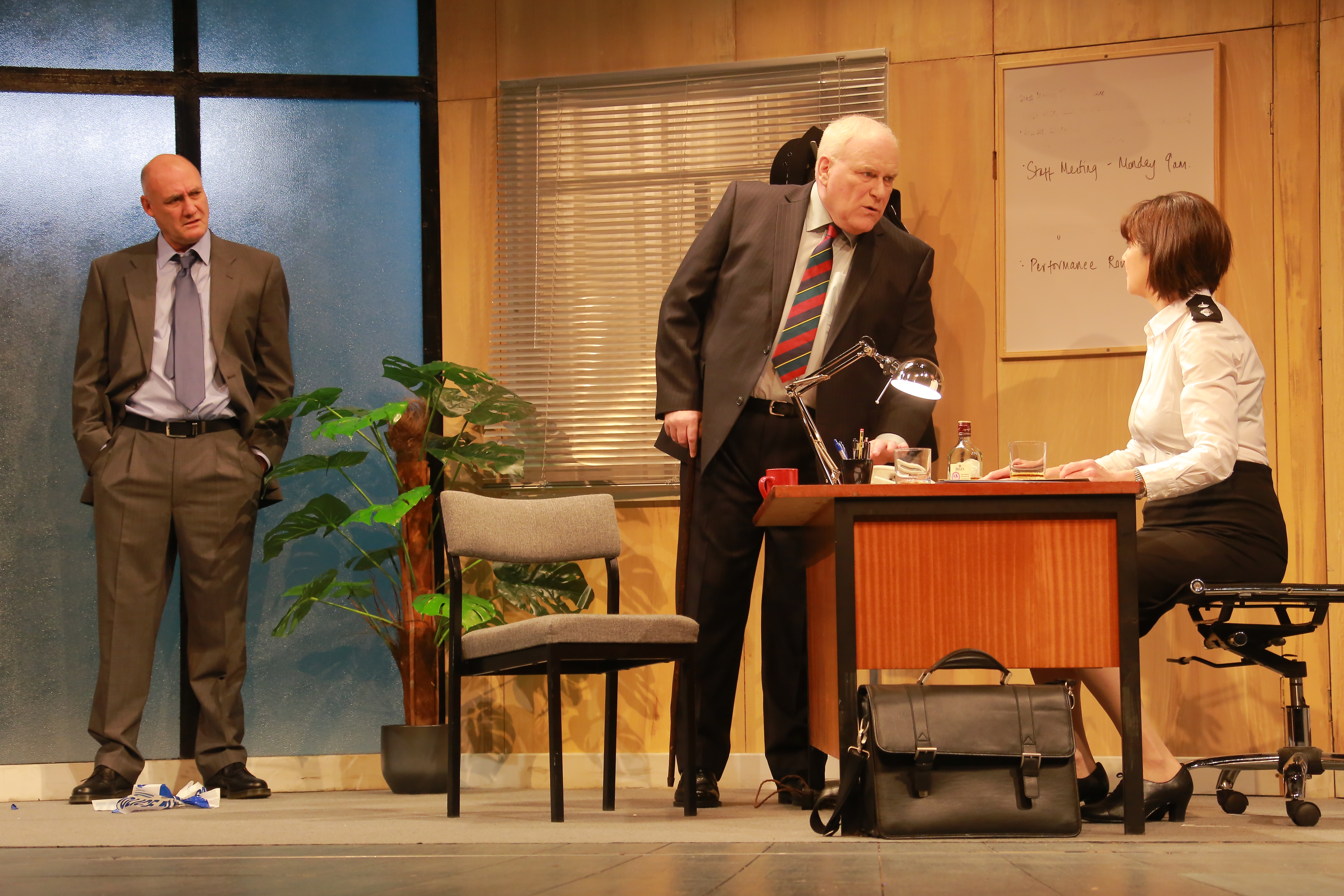
Robert Gwilym as Frank Bowman , Ron Donachie as Fergus McLintock and Maureen Beattie as Isobel McArthur

Image by Douglas McBride

“The production is a mixed bag in most regards.”

Editorial Rating: Unrated

Ian Rankin is no stranger to Edinburgh’s criminal underworld –fictionally, of course. Inspector Rebus, Rankin’s most famous literary creation, is known to millions as the slightly off-beat but loveable curmudgeon, for whom this city’s cobbled streets are home. Perhaps it is no surprise, then, that his theatrical debut (in collaboration with the Lyceum’s own Mark Thomson) is firmly rooted in this world.

It is twenty five years since the conviction of Alfred Chalmers for the murder and mutilation of four young Edinburgh women (there are definite comparisons to be made with the BBC’s hit series The Fall). This, combined with her thirtieth anniversary of being on the force, provokes Superintendent Isobel McArthur (Maureen Beattie) to reflect on what proved a land mark case in her career; or, more specifically, on a nagging doubt she has harboured since that day. Dredging up the past, however, reveals a well of raw emotions in both her closest work colleagues and her only daughter, Alexandra.

The production is a mixed bag in most regards. On the one hand, much of the writing is disappointingly predictable – not simply in terms of the plot, but also the inclusion of well-worn topics such as sexism in the police, the role of a policeman’s ‘hunch’ in conviction, and the bureaucratic barrier of paperwork that stands between policemen and ‘real police work’; a commentary that fails to really add any new angles on these issues. On the other, some of the writing is delicious – finding its strongest moments in scenes of quippy character interaction.

Similarly, a handful of characters were intensely believable – Philip Whitchurch’s portrayal of Alfred Chalmers was magnetic, managing to baffle the audience and leave us in a confused state, somewhere between terror and sympathy. But, at the other end of the spectrum, Sara Vickers (Alexandra) was lumped with a caricature of a teenage girl, whose mood swings between being angsty and angry, and as horny as a bitch in heat, leave her little room for development.

An area of no doubt, however, was staging – which was certainly the production’s strongest suit. The three room revolve worked incredibly well, particularly with the addition of corridors which provided both a realistic edge and an extra dimension to the performance. Furthermore, the soundtrack, ranging from a lamenting violin to Psycho inspired string segments, did much to add dramatic tension in scenes and maintain atmosphere between them; combining well with projections that slowly built a visual backstory for the audience.

Dark Road has the beginnings of a good production, but there is work to be done. It would benefit from some trimming – particularly in the first half, where certain scenes and ideas dragged on too long – and a more careful concealment of the plot to avoid the predictability that currently plagues it. As it stands, Dark Road is middle of the road.

Reviewer: Madeleine Ash (Seen 28 September)

Visit Dark Road homepage here.

‘The Baroness: Karen Blixen’s Final Affair’ (Traverse; 27-28 Sept ’13)

Dogstar Theatre The Baroness Roberta Taylor (Karen Blixen (Isak Dinesen) Photo credit Leila Angus

Image by Leila Angus

 “Among Denmark’s literary superstars few are more fascinating than Karen Blixen, pen name Isak Dinesen (1883-1962). The Baroness is the story of her final affair: a platonic entanglement with a much younger poet.”

Editorial Rating: Unrated

For a country where summer temperatures struggle to exceed 20°C, in terms of cultural exports, Denmark and all things Danish are surprisingly hot right now. Successes such as The Killing and Borgen have rocketed outside awareness and interest. Among Denmark’s literary superstars few are more fascinating than Karen Blixen, pen name Isak Dinesen (1883-1962). The Baroness is the story of her final affair: a platonic entanglement with a much younger poet.

We enter to find two harp-shaped window frames with fewer right angles than the Goetheanum. In one hangs a tribal mask intended to conjure images of Blitzen’s years as a coffee planter in Africa (I think it resembles Norman Tebbit). An eclectic harmony of furniture perfectly captures the sense that we are looking into the dwelling place of a mind born for the Belle Époque. Her young companion is evidently much less at home. He belongs instead to that new generation which Kennedy’s Danish-American speechwriter would describe a year before Blixen’s death as “tempered by war, disciplined by a hard and bitter peace.”

The friendship of Blixen and Thorkild Bjørnvig is a matter of historical record. At times the script creeps into the realm of docudrama. When Blixen encourages her protégée to abandon his wife, child and work in order to compel the flow of his artistic creativity, she laments that Denmark is “flat as a duck pond”. Similarly, the muted script gives little sense of a tempest brewing in, or subsequently howling through, the hearts of the protagonists.

Roberta Taylor as Blixen and Ewan Donald as Bjørnvig provide well-rounded individual character sketches. There are flashes of real insight, such as Donald’s steadily improving posture, but there is little shared fascination. Blixen is portrayed at the centre of a social and cultural web in which she occultishly snares young bloods with which to feed her imagination.

Several of the techniques deployed to fill a stylized frame with stylish content are over hesitant. The dramatic function of the mutual friend (played charmingly by Romana Abercromby), for example, is uncertain – diverting more than developing the over-lengthy central narrative. By the interval I think I’ve got the point. Other than the brightly conceived set transition from Blixen’s home to Bjørnvig’s northern hideaway, not much more is said or done.

Pace was a problem throughout. Far from crisp efficiency, the frequent scene changes are slow (although composer Aiden O’Rourke’s bold, introspective score make this less of a negative). Projection was a problem too, I did not feel played to in the steeply tiered back row of Traverse One.

Dogstar Theatre squeezed hard and a good amount of zesty juice was delivered into the glass. If their future endeavours maintain the very high standards set by The Baroness for smart, funny staging of deep, moody drama then we can expect great things from them in the coming years.

Reviewer: Dan Lentell (Seen 28 September)

Visit The Baroness homepage here.