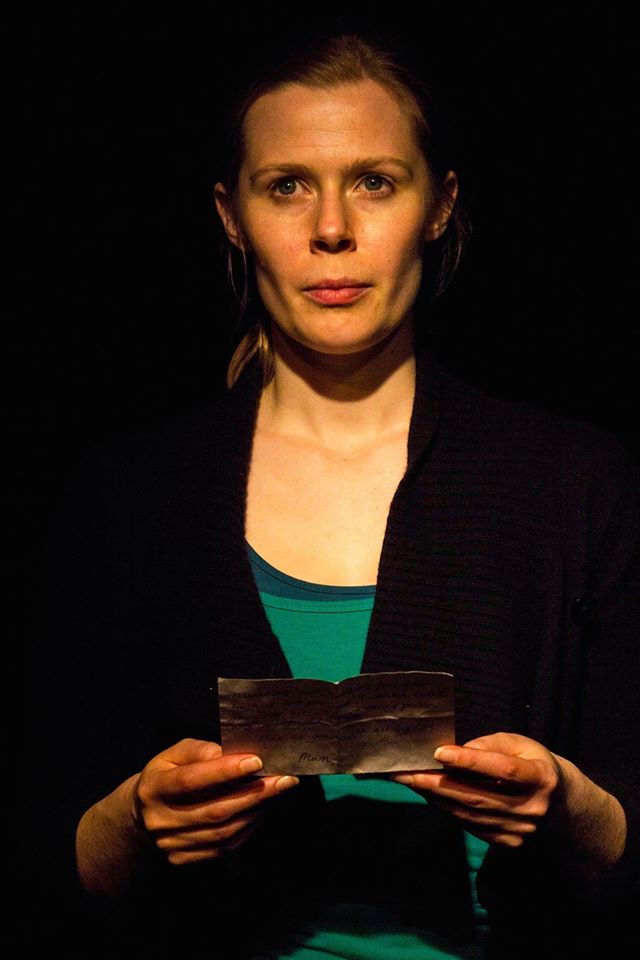
I, Elizabeth (Assembly Roxy, Aug 7-9, 12-16, 19-23, 26-31 : 11:45 : 1hr 15mins)

I, Elizabeth at Edinburgh Fringe Festival Banner

“Vaughn’s command of the stage is utterly iron-fisted.”

Editorial Rating: 4 Stars Nae Bad

The two hardest things as an actor, at least in my experience, are to memorise your lines and then make to them appear spontaneous and real. To do so without ever losing energy, alone and over a period of a straight hour is nothing short of astounding – and, a feat which Rebecca Vaughn pulls off as Queen Elizabeth nearly effortlessly.
I, Elizabeth is a monologue act pieced together from the Tudor Queen’s assorted letters, poems and private correspondence, and offers a glimpse into the chaotic and rich emotional life behind one of England’s most memorable rulers as presented by the Queen herself.

Vaughn’s character work is undeniably slick: she channels both regality and humility so realistically and so honestly that, even watching from the front, I often forgot I was watching an act at all. And even more impressive was her talent at making irregular, Tudor-style cadence not only make sense to a modern audience, but do it so well that it becomes compelling and, when she wants it to, genuinely funny. Unlike her character’s sometimes shaky political life, Vaughn’s command of the stage is utterly iron-fisted.

But Vaughn’s considerable talent cannot suspend reality by itself, and was aided by a very talented makeup and costume team; the result being a costume with such substance and attention to detail that it wouldn’t have looked out of place in a high-budget period drama. However, just as Vaughn portrayed a partly flawed monarch, so did her performance. Occasionally her emotional energy bordered on the melodramatic, and her tight emotional u-turns sometimes meant that gaps of monologue were lost as the volume increased. And perhaps I’m simply not smart enough to understand it, but some of the tech decisions- particularly a strange, electrical jolting sound to punctuate the monologue – seemed utterly out of place in what was otherwise a very faithful historical recreation, and sometimes completely broke the show’s atmosphere.

Despite these shortcomings, the rest of the show was nothing short of regal. Vaughn should be praised for her unmistakeable dedication to character work. Short of necromancy, it seems she is the woman to call for bringing the long dead back to complex, compelling life.

 

nae bad_blue

Star (blue)Star (blue)Star (blue)Star (blue)

Reviewer: Jacob Close (Seen 7 August)

Visit the Assembly Roxy archive.

THIS REVIEW HAS NOT BEEN SUBEDITED

The Very Grey Matter of Edward Blank (Assembly Roxy, 7 – 31 Aug : 17.35 : 55mins)

https://s3.amazonaws.com/assembly_production/wp-content/uploads/2015/05/The-Very-Grey-Matter-of-Edward-Blank-square.jpg

“A potential creative masterpiece whose shortcomings locked it into simply being “alright””

Editorial Rating: 3 Stars

I’m a firm believer that the human mind is one of the most complicated and amazing pieces of organic engineering the world has ever seen. Therefore, a witty, entertaining show exploring its contents is like my personal holy grail; and whilst I nearly found it in The Very Grey Matter of Edward Blank, it fell excruciatingly short of something which could have been incredible.

The show tells the story of its titular, reclusive protagonist as he struggles with his own ill mind in a desperate attempt to identify a voice on an old tape; both helped and hindered by his inner voices, who clown and joke their way through his surprisingly dark existence. A nuanced and creative genius, Blank’s goal takes him into the often nonsensical depths of his own sick psyche, and his inner voices are all along for the ride.

To start with, members of the team whose job relies on hardly noticing their work: a huge congratulations to the set and team, who succeeded in creating an on-stage apartment which was not only visually pleasing, but also functioned very cleverly in some of the most simple yet effective visual trickery I’ve seen in a long time. And similar kudos must go to the costume and makeup which went into the creation of the simultaneously ghoulish and comic “Mister Boo-bag” (whose mime work was worth every second).

With regards to the acting talent on show, Edward Blank’s mad, clowning inner characters all had flashes of utter comic genius, and showed a cohesion in their onstage chemistry which many theatre companies could take lessons from. And especial praise must be given to Sam Redway, who played the eponymous Edward, for managing to play an unstable character who remained endearing, charming and dynamic without fail.

However, this was a show which was constantly leaving me wanting to see more, and unfortunately not in a good way. I often wanted to see more energy and dynamism from most of the inner voices, who were always tantalising close to having the physicality and force to really hammer their characters home, but only occasionally hit the target. And perhaps it was a matter of the (admittedly, very witty) writing, or some fault of the occasional silences or unintended moments of stillness, but the show seemed to have a problem maintaining it’s dramatic momentum. And, even worse, the show ended abruptly with a whimper rather than a bang. I was left feeling like I’d gotten to the last glorious bites of a meal, only to have it slapped out of my hand. Had this show’s world been able to maintain itself with the extra needed force, I would have been hooked. But as it stood, I couldn’t quite get into it.

Would I see Edward Blank again? With a few tweaks, gladly. But despite strong performances and clever writing, the show’s shortcomings often ripped me out of what could have been an utterly engrossing story – and even more frustratingly, it’s weaknesses felt just a draft away from being solved. This was a potential creative masterpiece whose shortcomings locked it into simply being “alright”.

If this returns to Fringe in any altered form, I’ll be the first in line – but until then, Edward Blank left me feeling a little grey.

Star (blue)Star (blue)Star (blue)

Reviewer:Jacob Close (Seen 7 August)

Visit the Assembly Roxy  archive.
THIS REVIEW HAS NOT BEEN SUBEDITED

Jurassic Park (Assembly Roxy: 5 – 30 Aug : 18.50 : 1hr)

“A show with so much heart mine nearly burst”

Editorial Rating: 4 Stars: Outstanding

I was slightly worried, from the name, that this would be one of those overly geeky shows where the actors become a bit self-absorbed in being dinosaurs that they lose the plot – literally. Thankfully, this production strikes a wonderful balance between storytelling, humour and a moving tribute to one of the world’s best loved films.

It really is a show with everything – packed with laughs from start to finish, touching moments of tenderness, dinosaurs, family dramas, a ballad to the triceratops and even a Britney Spears dance break. More importantly, it’s performed with so much energy, love and conviction that one can’t help but be carried along with the fun.

The premise: a father (Terry) and his two children (Noah and Jade) welcome the audience to the village hall for a screening of their favourite family movie (Jurassic Park), as a tribute to Terry’s wife and the children’s mother Madeline, who died a year ago. What follows is a tale of a broken family, love, heartache… and dinsoaurs.

As a piece devised and performed by a Lecoq-trained company, it is understandably very physical, with each of the actors switching between human character, dinosaur and the cast of Jurassic Park with ease and finesse. Moments involving lifts and embodying the larger dinosaurs are particularly impressive, as is the creative use of props – who knew a rucksack could look quite so much like a Tyrannosaurus’s mouth?!

I would have liked to have seen the initial scene (in the village hall) developed throughout and have gotten to know the character of Madeline a bit better, perhaps at the sacrifice of one or two of the scenes involving the film’s reenactment. If any of these are intended to show parallels to the family’s story, the references are too subtle and disjointed to be effective. Some of the transitions between scenes also come across as somewhat forced, but in all other respects this show is hard to fault.

The cast work incredibly hard to deliver an hour of non-stop action, with personalities that really shine: Maria Askew as Jade is the perfect moody teenager, Frode Gjerløw is perhaps most impressive with his array of character changes, while Simon Maeder is just incredibly likeable – even while pretending to be a porn star!

This is a hilarious yet touching tale of one family’s coming to terms with grief through the medium of Jurassic Park, and I give it a roar of approval.

outstanding

StarStarStarStar

Reviewer: Steve Griffin  (Seen 6 August)

Visit the Assembly Roxy archive.

THIS REVIEW HAS NOT BEEN SUBEDITED

Bonsoir Monsieur Nightfall (Assembly Roxy, 5 Aug – 30 Aug : 22:45 : 1hr)

“A voice so deep and gloriously textured you could happily drown in it.”

Editorial Rating: 4 Stars  Outstanding

In French (I’m told) there’s a term “à l’ouest” which, if not taken literally, means a dreamer, or someone “from another planet”. It seems only fitting then that Helenē Clark not only made the long journey west from France to Britain, but is also utterly out of this world.

Taking inspiration from her time out on the streets, Clark’s set was an audial rollercoaster, ranging from almost stingingly raw despair to jubilation and joy. Deeply varied to say the least, but it did so without ever feeling disjointed – owing in large part to Clark’s evocative and smoky singing. She has a voice so deep and gloriously textured you could happily drown in it. Up against a gauntlet of styles ranging from junk guitar to tango, Clark’s range and tone were utterly without fault.

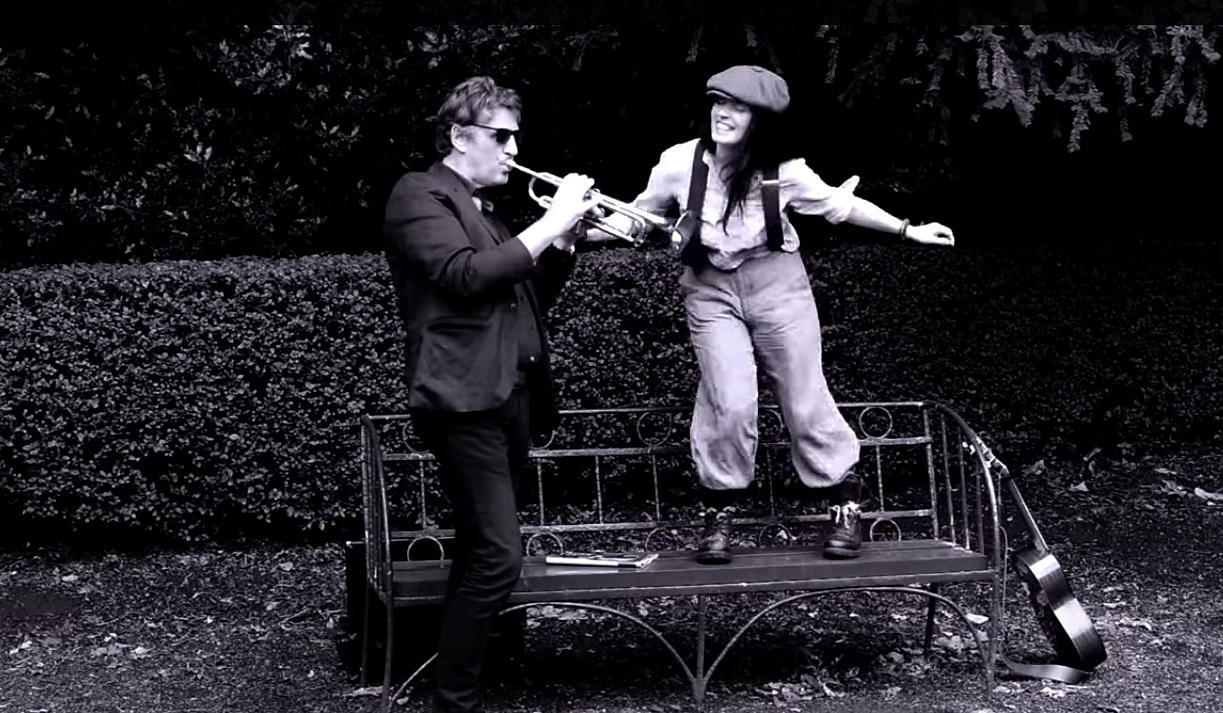
But the mightiest mountains do not stand alone. And whilst the main event was undeniably Clark, full credit must be given to her backing instrumentalists, who all were utterly on point with their performances and energy. Andy Shuttleworth and Dick Playfair especially impressed, the former showing off a beautiful and often mesmerising skill in fingerpicking, and the latter scoring points for utterly blowing me away with the strength and energy of his punchy jazz trumpeteering.

Of course, no show is without shortcomings. Clark’s vocal tone sometimes betrayed her enunciation, meaning that her lyrical work sometimes felt wasted as certain verses were lost to a rumbling growl. And, whilst her stories between songs added substance, they sometimes bordered on good natured but stunted rambling.
But any and all faults were immediately forgiven by the closing number, referred to cheekily by Clarke as their “Calypso Carnival”. It typified what made Bonsoir Monsieur Nightfall so engrossing: never before have I seen a group of musicians so obviously having a blast with their craft, and doing so with such sustain and finesse. Sorrowful, sultry and absurdly fun all in one, ‘Bonsoir Monsieur Nightfall’ never missed a beat.

If you can sit through this show without at least once cracking a smile, I’d recommend getting your pulse checked. This is not one to be missed.

outstanding

StarStarStarStar

Reviewer: Jacob Close

Visit the Assembly Roxy archive.

THIS REVIEW HAS NOT BEEN SUBEDITED

‘Normal / Madness’ (Assembly Roxy: 12 – 13 May ’15)

Photos: Kidder theatre

Photos: Kidder theatre

“A show that is performed with great sympathy that you will take heart from”

Editorial Rating:  4 Stars: Nae Bad

You say ‘Normal’, slash, ‘Madness’; I say ‘Normal’, oblique, ‘Madness’. WTF; you’re right, ‘slash’ is sharper, more definite. But it cuts both ways. Yes, there’s separation but they’re related, surely?

And that’s the point. Look at the flyer for Kidder theatre’s Normal / Madness. Mother and daughter, backs to the camera, are walking down a railway track holding hands; each balances on one rail, each supports the other. They walk beneath a star filled sky – in golden light – and it’s a lovely, endearing picture; but were it for real we’d have an irresponsible, lunatic, piece of parenting.

Here’s the crass response: “Pull yourself together woman!” Oh, is that all you have to do? What if you can’t because you’re ill? What if your whole life can become precarious in an instant? That’d be mental, then.

Kirsty McKenzie, 30, tells it how it is and how it was. Her mother, Mary, has schizoaffective disorder and has had it for a long time. She suffers psychotic symptoms, similar to schizophrenia, and the mood symptoms of the manic depressive. We see Mary overwhelmed and scared. We see Kirsty caring, trying to help and to understand.

Writer/Actor Fiona Geddes is alone on stage. She’s Kirsty with a broad smile, a ready sense of humour and a wonderful positive manner. She’s also Mary, low, terribly anxious and scrabbling in the sand for the six pounds in coppers that she buried and now cannot find. The tide is coming in along the Moray Firth and the children’s treasure hunt has had it. As a metaphor for how mental illness wipes you out, time and again, that’s hard to beat.

Fiona Geddes as Kirsty

Fiona Geddes as Kirsty

We get to learn a fair bit about schizoaffective disorder. Medical information is relayed in tones halfway patronising and/or foreign. I couldn’t help wishing for some projected slides with bullet points to do a professional job. More time with Mary, Kirsty, and bipolar boyfriend Patrick, would have been better, especially as mother and Patrick don’t get on. The familiar, homely, strains of ‘Coronation Street’ are almost therapeutic and are certainly ironic.

You’ll like Kirsty because of her honesty and because she is a loving person. Yes, the issue is her Mum’s condition but the story is Kirsty’s. Consider the choices she (& Patrick) have to make regarding children of their own. Genetic counselling gives you fair enough odds but ….

Geddes and director Jessica Beck brought Normal / Madness to the Fringe last year. Now, during Mental Health Awareness Week, it is back in Edinburgh and on tour. It’s on next at The Tron in Glasgow . The charity ‘Rethink Mental Illness’ supports this production, which – forgive me – is a no-brainer. It is a show that is performed with great sympathy that you will take heart from. ‘Help and Hope’ is the message.

nae bad_blue

Star (blue)Star (blue)Star (blue)Star (blue)

Reviewer: Alan Brown (Seen 12 May)

Go to ‘Normal / Madness’ at Kidder here

Visit the Assembly Roxy archive.

‘Hatters!’ (Assembly Roxy: 31 March – 3 April’15)

“Awash with lots of individually interesting ensemble moments and devices.”

Editorial Rating: 3 Stars: Nae Bad

Hatters is an intriguing piece of ensemble theatre. It follows the story of Robert, a hapless member of the Bright Young Things in 1930s London, and his attempts to navigate a minefield of sinister characters and mistaken identities in order to marry his fiancé.

Loosely inspired the Evelyn Waugh novel Vile Bodies, the company devised the production around the novel’s key dramatic moments and characters. Keeping very much in theme with the “modernist” style adopted by Waugh in his book, a more experimental approach is used by the company in its presentation of society in the run up to World War 2.

It’s a very physical production, which at times hinders the narrative of the piece as the actors often parade around from scene to scene embodying furniture, cars and general London street scenes. This makes it quite difficult for the audience to know what’s going on. In fact, the show opens with all nine actors stood in a circle facing inwards, and one by one they appear to suffer some sort of epileptic fit before ending in a pile on the floor. By the end of the performance we still had no idea what relevance this had to everything else, and moments like this unfortunately detracted from what was actually a very interesting exploration of modernist theatrical storytelling.

In saying that, in many of the physical sections the action was accompanied by human soundscaping, which worked particularly well in creating atmosphere, and was executed with just the right level of depth and detail. In some cases though, a subtler approach could have been more effective and less jarring to the main action, which was on the whole, very well executed.

As a devised work, facilitated by the passionate Sibylla Archdale Kalid, Hatters is awash with lots of individually interesting ensemble moments and devices. One good example of this was the tea party scene, where actors swapped character with each other many times, but managed to maintain continuity and clarity of action and dialogue. Indeed, the cast’s overall approach to and execution of characterisation, aided by different hats to help identify them, was a real strength of the show.

However, the fragmented style and seeming need to cram in everything that had been devised for fear of wasting it did end up being a bit overkill. With so many different devices and styles used, the piece lacked some consistency. It would have been more effective to see more themes running throughout the performance, rather than something new adopted for every new scene.

The production was certainly not without its laughing moments. Comic timing was very good throughout, as was delivery of some of the witty one-liners worked into the script. My particular favourite was uttered by Robert’s fiancé, just after he’d had to sell her to pay off his debts: “These feelings don’t just go away when you’re sold!” Something about the pure innocence in the delivery had the whole audience in stitches.

Overall, this was a courageous and admirable effort, with a lot of potential to be expanded and developed over time. It’s just not quite there yet.

nae bad_blue

Star (blue)Star (blue)Star (blue)

Reviewer: Steve Griffin  (Seen 3 April)

Visit the Assembly Roxy Bedlam Church Hill Theatre Festival Theatre King’s Theatre Other Pleasance, Potterrow & Teviot Summerhall The Lyceum The Stand Traverse archive.

THIS REVIEW HAS NOT BEEN SUBEDITED

‘The Merchant of Venice’ (Assembly Roxy: 10 – 14 March’15)

Isobel Moulder as Portia and Will Fairhead as Bassanio.

Isobel Moulder as Portia and Will Fairhead as Bassanio.

“From the Rialto to Little Venice, W9,  is neat”

Editorial Rating:  3 Stars

Were Antonio at work today, this stacked play would be even trickier than it already is. He’d be talking about moving cargo rather than sailing ships. His wealth would be in metal boxes to Singapore or Mumbai rather than argosies from Venice. Nevertheless, reassuringly, his sound advice to Bassanio would be the same: “Go, presently inquire where money is”. That would send the enterprising lover to Shylock, who would have friends and funds in Frankfurt and away we go.
However, in this production when Shylock asks “What news from Germany?” (that’s Genoa back then), the context shifts mightily. For now we’re back to September 1939 and the news ain’t good. In fact if you’re Jewish it has been desperate. Director Rae Glasman finds a choice text in Prime Minister Chamberlain’s declaration of war:

   “Now may God bless you all. May He defend the right. It is the evil things that we shall be fighting against – brute force, bad faith, injustice, oppression and persecution – and against them I am certain that the right will prevail.”

That’s not Shakespeare but it works. For a start, which God: Christian or Jewish? Who is the more righteous: backscratching Bassanio, Jew-baiting Gratiano, or is it Antonio, who spits at Shylock in the street? Is it merciful or just to condemn Shylock to near ruin and to force him to convert? Portia, if always an unlikely victim, will find happiness in marriage. There is a happy and flimsy ending, which is why – I suppose – Glasman has that radio broadcast at the end of the play, to make her audience ask what exactly has prevailed here? Actually, I would have welcomed that mooring at the start. There’s the trouble with The Merchant of Venice; it goes all over the place: scenically, tonally, action-wise. Underwhelming and overwhelming.

From the Rialto to the City of London and to Little Venice, W9, is still neat. Portia’s Belmont is relocated to a country house, somewhere in the Chilterns, I guess. That is not a displacement too far but it looked hard to accommodate on the Roxy’s stage. I found the opening and drawing of the full length curtains in-between scenes more distracting than helpful and it’s a No-thank you to the squealing Downton maids at open-the-box time. The Glen Miller sound was melodious though and the cocktail cabinet and fetching evening wear did their elegant, idle, thing well enough.

As do Bassanio’s set of chaps. Portia (Isobel Moulder) sees them – and quite possibly all men – as “bragging Jacks” to be practised upon, which this marble-mouthed lot certainly deserve. She is also properly merciless in the court, where otherwise the languor of the club rooms seemed to have carried over. To supply Bassanio (Will Fairhead) with an Eton education and braces was presumably to allow him to stand nonchalantly, hands in pockets, between the caskets and to give him the manners, surely the compassion, to pick up Shylock’s yarmulke from the floor and to give it back.

Joe Shaw as Shylock with Kirsty Findlay as Jessica. Photos: Aliza Razel

Joe Shaw as Shylock with Kathryn Salmond as Tubal.
Photos: Aliza Razel

I could believe in Shylock (Joe Shaw) as a broken father. “My daughter is my flesh”, he says, and then Jessica abandons him – or is stolen from him. His hair should have been greyer but it is no surprise when – to take like for like – he would cut into a spent Antonio (Pedro Leandro) above his heart. There is real pain in that vengeful effort.

Kirsty Findlay as Jessica and Chaz Watson as Lucy Gobbo.

Kirsty Findlay as Jessica and Chaz Watson as Lucy Gobbo.

There are laughs in the features and antics of preposterous suitors, Arragon and Morocco, and in the crazy work of Lucy Gobbo (Chaz Watson) who sounds like the ‘wauling bagpipe’ of Shylock’s protest and who looks way too bad for Emil and the Detectives.

Rory McIvor as Lorenzo spoke the (blank) verse best and did Moonlight Serenade introduce his scene with Jessica near the close? I can’t recall. I do remember approving Bassanio’s choice of the lead casket, for ‘Thy plainness moves me more than eloquence’, which is where I stand on this production. It looks pretty and sounds attractive but its necessary centre of gravity is away, awry.


Star (blue)Star (blue)Star (blue)

Reviewer: Alan Brown  (Seen 10 March)

Visit the Assembly Roxy archive.

‘The Strange Undoing Of Prudencia Hart’ (Assembly Roxy: 18 – 22 March ’14)

Photo: Johan Perrson

“Few playwrights would find the chutzpah to rhyme ‘dangerous speed’ with ‘Berwick-on-Tweed’, and even fewer would have the skill to make it funny…”

Editorial Rating: Nae Bad

It has been gathering acclaim for the last three years, so the chances are you’ve already heard of The Strange Undoing Of Prudencia Hart.  And if you’ve picked up a passing reference to a few of its themes – witchcraft, devilry, a damsel dragged into Hell – you might be picturing a grimly ancient story, set on a desolate moor a handful of centuries ago.  But think again.  The eponymous Prudencia Hart isn’t a mediaeval wench, but a thoroughly modern and thoroughly capable woman.  And her “strange undoing” happens at a conference.  An academic conference.  In Kelso.

That’s just the first of the pleasant incongruities which define David Greig’s now-celebrated script.  He’s penned a bawdy and raucous play – but it’s shamelessly intellectual, too.  It pays homage to the fine traditions of the Border ballads, yet it derides those who try too hard to understand them.  And for this repeat run in Edinburgh, even the performance space is a kind of contradiction: built like a church, but laid out like a pub, with the audience clustered round tables and a well-stocked bar close at hand.

Echoing the ballads whose study is Prudencia’s life work, Greig’s script is written in verse – and like all the best examples of their type, his rhyming couplets invite groans as much as laughter.  Few playwrights would find the chutzpah to rhyme “dangerous speed” with “Berwick-on-Tweed”, and even fewer would have the skill to make it funny.  The boisterous, free-wheeling spirit of the poetry extends to the performance too; you’ll find you spend a fair part of the evening swivelling in your seat, as you strain to follow the actors cavorting around (and often atop) the bar tables.

Some of that cavorting isn’t for the faint of heart, but when you look past the music and the drunken ribaldry, The Strange Undoing of Prudencia Hart is far subtler than it seems.  Greig’s script is filled with sly self-references, and he frequently builds biting humour around things guaranteed to annoy the educated elite.  His characters are stereotypes, but oh-so-delightfully drawn – the feminist, the populist, the blokeish boor – and he’s particularly incisive in his deconstruction of Scottish academe, with its self-obsessive tendency to find fashionable hidden meanings among once-straightforward tales.

It’s a demanding production for the five-strong cast, who are required to be both strong actors and capable musicians too.  Melody Grove holds things together as the poised Prudencia, descending into a delightful blend of primly-accented profanity, as her day – no, her eternity – begins to go awry.  Some details of Wils Wilson’s direction stand out as well, especially the striking use of hand-held torches as Prudencia’s world turns to black.

But there’s one shortcoming which does, to a small but definable degree, undo Prudencia Hart.  Notwithstanding a few poignant interludes, the play only truly works when it barrels relentlessly forward – hurtling from jig to caper to karaoke session, never pausing, lest a moment’s hesitation let mood-killing cynicism creep back into its audience’s minds; but sometimes the barrel-ride stalls. Too often they go for one repetition too many, or prolong a joke for just a beat too long.  And when you do have time to watch with a more jaundiced eye, you suddenly realise that – for a two-and-a-half-hour play – both plot and character development are really rather thin.

But as Prudencia herself suggests, it’s folly to search too hard for a deeper meaning; sometimes, it’s enough to recognise beauty.  And this modern ballad does do something beautiful – it creates a precious sense of joy-filled unity, powerful enough to make a straight-laced Edinburgh audience sing and sway like a football crowd.  It’s not the most tightly-plotted narrative, but it’s a theatrical experience like almost no other.  If you’ve strangely missed Prudencia Hart for the last three years, undo that omission now.

nae bad_blue

Reviewer: Richard Stamp (Seen 19 March)

Visit Prudencia Hart homepage here.