‘The Picture of Dorian Gray’ (Bedlam: 26 – 29 March ’14)

Dorian Gray

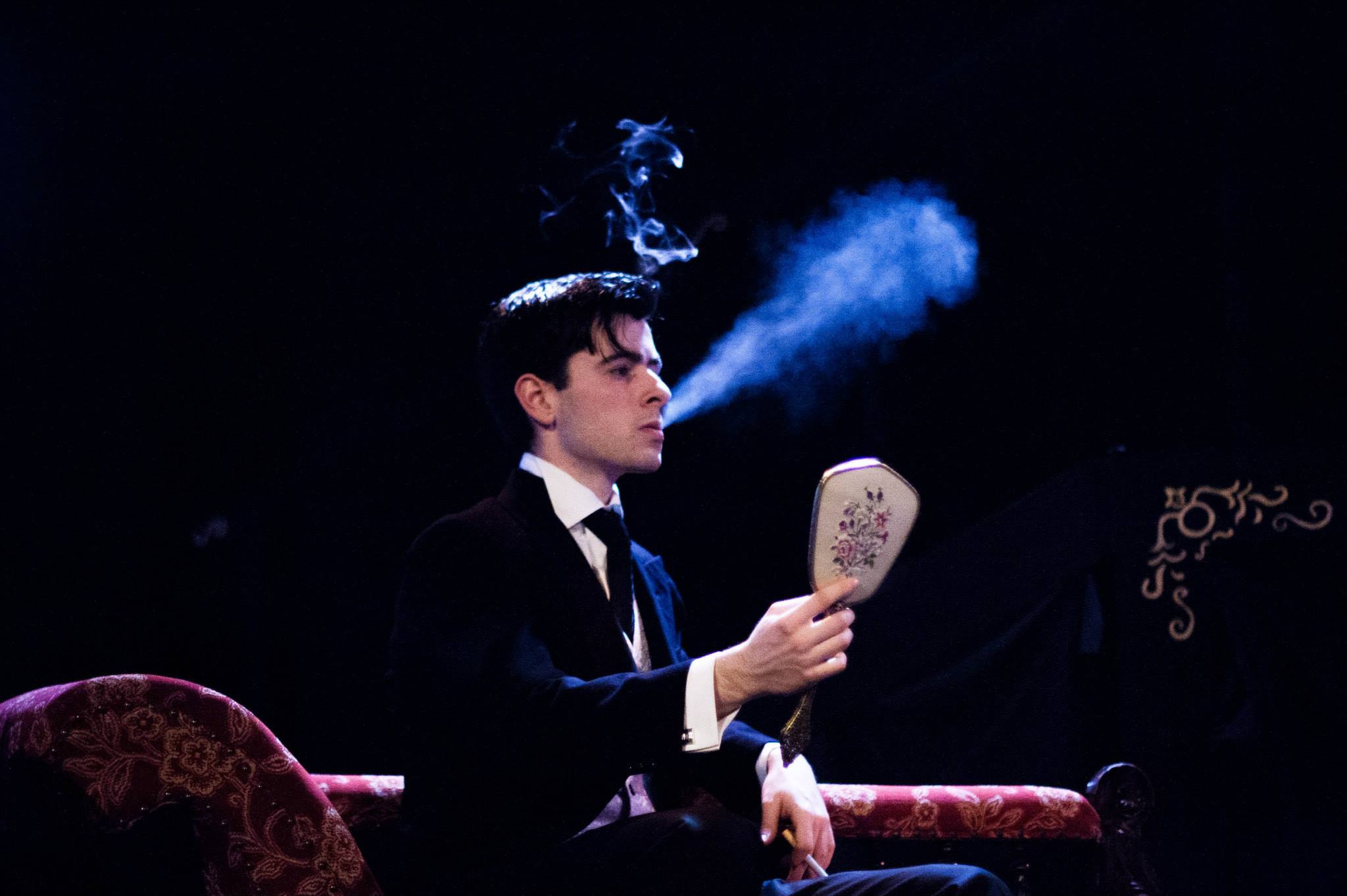
Wil Fairhead as Dorian Gray. Photo. Paul Alistair Collins

“The contrast between Gray and his aging associates was very well handled and provided the actors with opportunities to show off their powers of reaction, in which they all excelled.”

Editorial Rating: Unrated

I’ve been told to stop sending hectoring emails to the producers of Epic Rap Battles of History. Apparently they aren’t going to be pitting Dorian Gray against Doctor Faustus in the present series, and that’s an end of it. It’s too epic for EpicLLOYD and Nice Peter isn’t so nice when cease and desist letters start flying around. If the line, “you’re a puny little dandy, as weak as lager shandy” doesn’t clinch the deal, it seems nothing will.

Oscar Wilde’s The Picture of Dorian Gray is the story of a handsome fellow who sells his soul for the outward appearance of eternal youth. Under the mephistophelian tutelage of his friend Lord Henry, Gray shuns the simple life betraying the trust of those he befriends. After breaking the heart of his first love, Sybil, a beautiful young actress, Gray realises that while he never ages, his sins are being scored upon a portrait painted in his prime.

Published in 1890, Wilde’s only novel courted controversy like a magnet attracts filings. It is arguably his most important work, the one in which his gorgeous worldview is most cunningly elaborated. Adapting The Picture for the stage might be considered an impious undertaking – certainly the path to hell is paved with unsold copies of Oliver Parker’s 2009 film version.

Neil Bartlett’s adaptation is more faithful to Wilde’s original, but the perfect proportioning of gothic subtlety is lost. For all its larger failings, what annoys me most about the script is that Sybil, performing in Romeo and Juliet, is called to the stage for beginners’ positions even though she won’t appear until scene 3. Wilde did details like Ozwald Boateng does, if you’re going to muck around with him do it right.

Jonathan Ip, as Lord Henry, has the fuzziest end of the lollipop. Huge chunks of semidigested monologue blocked his route through the first couple of scenes – a grueling marathon run with hurdles. Under the sheer weight of words, Ip’s delivery of Wildean wit is muted, and about as jolly as Reading Gaol on a rainy day.

Together with Wil Fairhead in the title role, Ip took to hiding behind his props. The obsessive smoking of e-cigarettes, as well as the constant imbibing from tumblers of neat spirits, suggested that the lads were finding it all a bit much. It’s a wonder director Kirstyn Petras hasn’t got them attending an AA meeting or two.

Fairhead was a strong lead, though noticeably better playing the bastard than the boy. The contrast between Gray and his aging associates was very well handled and provided the actors with opportunities to show off their powers of reaction, in which they all excelled. Both Ip and Dean Joffe (as Basil Hallward) found themselves in their characters’ older selves.

The overall set design was smart, and would have suited a tighter script. It is impossible for a production to stay pacy when it has so many scene changes, necessitating the movement of masses of trinket bedecked and bulky furniture – dropping a hand mirror on stage must bring seriously bad luck.

A platform at the back, with attractive gold detailing, provided Gray with an attic in which to conceal his shame, and the bulky furniture with a place come and go from. To the sides were galleries for the supporting cast who were excellent throughout. Some very strong performances were on show demonstrating that those crowding the wings were not just clothes hangers for Sophie Guise’s superbly tailored costumes. It’s nice to see someone who knows the difference between morning and evening wear, even if Ip’s waistcoat stuck out from the latter. Also, giving the ladies slippers might have reduced the noise of the perpetual scene changes.

With so much participation from the team behind In The Heights, Edinburgh University Footlights’ outstanding recent outing, this production pulled one rabbit from the battered top hat. Jimi Mitchell’s dance routine was spectacular. It was what the cast had been waiting for. Perhaps it was a little too interwar but it showed what the players were capable of when freed from the confines of the script.

This was a production posing more questions than it provided answers. Why did the script refer to the portrait’s golden curls when Fairhead is dark haired? Why was the portrait shown at all when there was no picture, just a black canvas? Wouldn’t reactions to the unseen have been more effective? When you’ve got Benjamin Aluwihare and Jordan Roberts-Lavery in a cast, why wouldn’t you put them front and centre? How many butlers and valets were there? Was it strictly necessary to employ the entire membership of the Junior Ganymede Club?

I would have preferred to see this capable cast and crew tackling an actual Oscar Wilde play, rather than an inadequate adaptation of the great man’s only novel. Not only would there have been more scope for the actresses but the men could have enjoyed playing rallies of banter against one another. Instead they were stuck struggling with a script as stiff as the day old corpse of a portrait artist being carried down from an attic.

Reviewer: Dan Lentell (Seen 28 March)

Visit The Picture of Dorian Gray‘s homepage here.

‘Harvey’ (Bedlam, 12 – 15 March ’14)

Harvey

Harvey does not do selfies”

Editorial Rating: Nae Bad

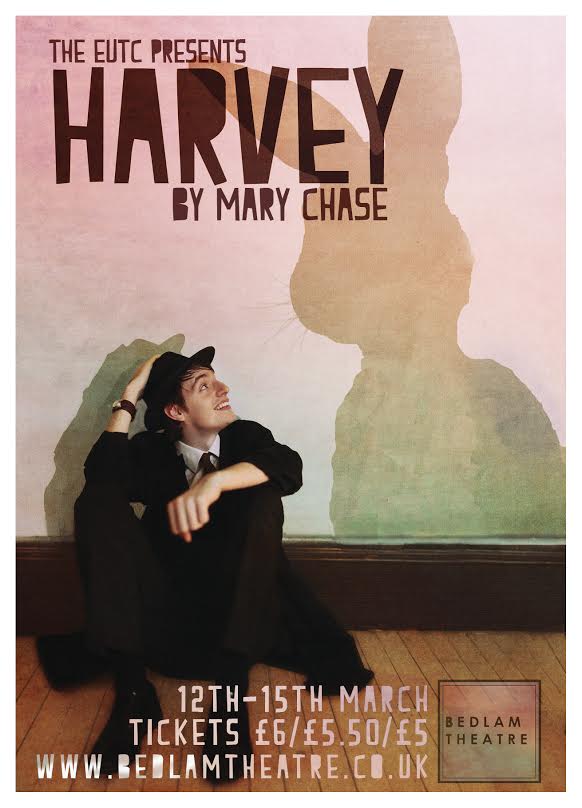
Our rabbit, Toffee, died of a heart attack when the builders came in. Harvey, however, lives; for Harvey is immortal, a stage and movie legend, and stands 6ft 3½ins high. It would be nice to see him leaning against the gates of Pollock Halls, in the Bristo Bar. You can see him, sort of, in Bedlam until Saturday. When he’s not on stage he’ll probably be out back in the Whisky Snug of the Hotel du Vin.

Harvey does not do selfies, as (i) they’re dime-store cheap and (ii) he’s invisible anyway, give or take his hat and coat. This pooka, avatar, rabbit has ineffable presence just as his companion, Elwood P. Dowd (47) has matchless, gentle, manners.

Craig Methven plays Elwood and is great at it. It is not just the faultless accent – Elwood and Harvey are from Denver, Colorado – but intonation, timing, gesture; all convincing. And the look! A beanpole with trousers just too short, jacket sleeves just too short, a trilby perched on top. A complete oddball with a smiling front of teeth that Oral-B would pay top dollar for. When Elwood says “Doctor I’ve wrestled with reality for 40 years and I’m happy to say that I’ve finally won out over it”, you cheer. You love him when, to save his sister from a life of nerve-shredding collapse (hilarious, by the way), he is prepared to take a mind-bending drug and forsake Harvey: “Say goodbye to the old fellow, would you?” Weep at it.

Psychology and psychiatry butt against comic form. It’s not One Flew Over the Cuckoo’s Nest meets Peter Rabbit but it’s there in the wacky sanatorium where Doctors Sanderson, handsome, (Stephen Macleod), and Chumley, crumpled, (Callum O’Dwyer) mess up. Pretty Nurse Kelly (Elsa van der Wal) is stuck in-between them with only the near lunatic, knuckle-dragging Charge Nurse Wilson (Martin Maclennan) for support. Chumley takes to his own couch and fantasises about Akron, a silent young woman – not Mrs Chumley (Rachel Bussum) – beneath maple trees and cold beer. Elwood, bless him, counsels whisky and – progressive fella – that the lady be allowed to talk.

It is, with Harvey about, still a richly comic and US neighbourhood. A cab driver (Ian Culleton) dispenses philosophy and Judge Omar Gaffney (Eric Geistfeld) drawls his speech back to Louisiana. You might find Harvey at Charley’s Place on 12th and Main, or at the 4th Ave. Fire House, or at Blondie’s Chicken Inn or even in the grain elevator but it is at the Dowd residence at 343 Temple Drive that the comedy is really at home. Veta and Myrtle Mae are Elwood’s older sister and niece respectively. Their situation is becoming impossible and Veta (Caroline Elms) is beside herself, which in psychiatric terms is problematic. Elms goes for it in a Mid-West/ Mitteleuropäische speak which is as funny as it is fluent. Her outrage after an unfortunate and naked session in the sanatorium’s Hydrotub is an object lesson in how to put the flounce into speech. Meanwhile, Myrtle Mae (Emily Deans), lipstick forward, responds ardently to any suggestion of ‘sexual urges’.

For some private, delightful, reason, Elwood likes the phrase ‘the evening wore on’ – preferably in bars, I guess. Directors Henry Conklin and Lauren Moreau prove that Mary Chase’s play can still put time aside and put charm in its place. Okay, the lighting cues are ragged and the nurse for doctor crush is dodgy, but there’s Glen Miller and Sinatra on the soundtrack and a fine oil painting of Harvey and Elwood above the fireplace.

nae bad_blue

Reviewer: Alan Brown (Seen 12 March)

Visit Bedlam, ‘Harvey’ homepage here.

‘Sword at Sunset’ (Bedlam: 25 February – 1 March ’14)

IMG_5783-200x300

“Beagon’s careful and respectful adaptation of Sword at Sunset far excels the 2011 movie version of The Eagle of the Ninth.”

Editorial Rating: Nae Bad

The problem with British history in the late Roman/early medieval period, according to Robert Graves at any rate, is that unlike the Byzantine east – where written sources document the doings of Justinian, Theodora and Count Belisarius – all there is in Britain is Arthurian myth. This hasn’t stopped the intervening generations filling their libraries, galleries and film sets with countless depictions of King Arthur and his Cnutish fight to hold back the sea of invading despoilers bent on snuffing out the flickering light of civilization.

Sword at Sunset, based on the best-selling 1963 novel by Rosemary Sutcliff, chronicles the career of Artos from his service as a cavalry commander under his uncle, the British high king Ambrosius, through to his donning of the imperial purple as a later-day Caesar. Incorporating Artos’ seduction by his vengeful half-sister Ygerna; his strategic marriage to Guenhumara; his friendships; his battles; successes and failures, James Beagon’s adaptation would be a very tall order for any company.

Thus there is a kind of symmetry between the weight of expectations placed on Artos and upon Jacob Close who plays him. There are times when it seems that he has been hopelessly miscast, lost in a cacophony of happenings far beyond his control. Then again there are moments of magnetic dynamism which truly lift the spirit – the same can be said of Close’s bold on stage brushstrokes. It’s a heroic performance worthy of the legend.

Not everybody would leave a 3 and a half hour theatrical epic (sans budget) wanting more, but I did. I wanted more of Sophie Craik’s Celtic mysticism as Ygerna and more of the chemistry between Guenhumara (Miriam Wright) and Bedwyr (Adam Butler). Each thread was worthy of a tapestry in its own right, deserved the directorial attention and creative design of a separate staging. As it was the results felt foreshortened.

I’d like to see this script produced as a radio series. Historical novels often struggle to be adapted for the screen or stage. On television I, Claudius is only marginally better than the best forgotten The Cleopatras of a similar vintage. The surviving clips of the intended 1937 Hollywood feature starring Charles Laughton suggest that all trace of Graves’ original subtly would have been lost there too. The selective focus of the 1988 TV mini-series of Gore Vidal’s Lincoln means it is better than average but, as the 2012 Spielberg myopic (sic) demonstrates, the bar is not very high.

Jacob Close as Artos and Miriam Wright as Guenhumara

Jacob Close as Artos and Miriam Wright as Guenhumara

Of the two or three weddings I have been forcibly removed from, the most memorable was in Lewes. “How can you say you don’t like Rosemary Sutcliff?” I angrily demanded of the classicist groom, “You’re getting married in the very Sussex Downs that fired her imagination.” The desk sergeant who brought me morning tea in the cells agreed. Even more so than either Graves or Vidal, Sutcliff’s novels are about time, place and above all atmosphere.

In this paramount aspect Beagon’s careful and respectful adaptation of Sword at Sunset far excels the 2011 movie version of The Eagle of the Ninth. I’d very much like to see him presented with the $25m that went into the film if only to further demonstrate my hypothesis that the best adaptations stick closest to the novelist’s intentions. Compare the ludicrously off-piste take of that late-’90s Hornblower TV series with the shipshape Master and Commander of 2003 and you’ll get what I’m driving at.

As is to be expected with an earnest student production biting off far more than it can chew there are plenty of notes: Bedwyr needs to love his harp and never let it go; if the symbolism of the imperial cloak isn’t to be lost then no other character should wear purple; and while the large wooden broadswords add to the overall sense of unwieldy bulk, they do get rather in the way.

But there is also some really classy individual and team work on offer here: the sword fights are fluid, with a bit more umph they might even be swashbuckling; the smoky hearth effect centre stage is ingenious; and the use of twin exits and entrances for inside and out adds much needed pace, although these occasionally get rather clogged with actors moving props about.

As the drawn out evening draws to a close I am pleased to have got what I came for, a strong adaptation robustly performed by a company unafraid to reach for the unobtainable.

nae bad_blue

Reviewer: Dan Lentell (Seen 26 February)

Visit Sword at Sunset homepage here.

‘The Dionysia’ (Bedlam: 20 February ’14)

1964877_10153821418800346_1434992075_n (1)

“The most important decision taken was that a portion of points would be awarded for how each show represented the style of the producing society.”

Editorial Rating: Nae Bad

They never had anything like this in my day. As EUSA’s last non-sabbatical Societies Convenor I would loudly lament the lack of inter-Society activities. I didn’t do anything about it, that’s not the point of student politics, but I did passionately (and lengthily) express my views at SRC meetings.

“Don’t worry about it Dan,” replied my colleagues. “Next year some guys at Harvard are going to invent a thing called ‘social media’ and when that comes online it’ll be easy for students from across the university to come together and make magic happen.”

The first Dionysia Festival held, as part of Innovative Learning Week (they didn’t have that in my day either), at Bedlam brought together four student societies in a friendly competition. Inspired by the Athenian original, Bedlam’s Dionysia focused a wealth of creative effort on new writing, innovative staging and classical and contemporary interpretations of ancient dramas.

At 1pm archons and epimeletai from each of the competing societies, as well as two outside judges (yours truly among them), gathered in the cafe at Bedlam to set the ground rules. The most important decision taken was that a portion of points would be awarded for how each show represented the style of the producing society.

When the uninitiated attend Freshers’ Fairs they are presented with a flow chart to identify the raison d’etre of the various dramatic groups at Edinburgh. If you want to put on a puppet show – and have some experience – go to the University Theatre Society (Bedlam). If you want to put on a puppet show about Oedipus – go to Classics. If you’ve never put on a puppet show before but want to try – go to Relief. If you want to put on a puppet show as you throw ducks off a rooftop, whilst covered in white paint, rolling around on the floor and crying – go to Paradok.

Hats off to the day’s agonothetai, the game organizers. James Beagon, Rachel Bussom and Sophie Harris delivered a brilliant lineup showcasing the University’s established and emerging thespian, technical, artistic and musical talent.


Bedlam kicked off proceedings with a new script inspired by the part of King Creon in Sophocles’s Antigone. An isolated, hesitant ruler presides over an apocalyptic landscape devastated by a civil war in which the fallout from WMD has literally and figuratively disfigured the country.

Creon’s niece, Antigone, the daughter of Oedipus by his own mother Jocasta, is betrothed to Creon’s son Haemon. In order to ensure her warring brothers a proper burial, Antigone defies the prohibition against entering the fallout zone. Creon is faced with a dilemma that will test his leadership to breaking point.

First time writer Thomas Ware’s bold script demonstrates a wealth of subtle insight and profound musing on the original. The architecture is monumental but the necessary engineering is absent. In parts the weight presses down on the actors and it isn’t long before cracks begin emerging. There is little let up for Matthias Vollhardt as Creon as he shifts back and forth between intimate family moments and the hard-headed affairs of state. He seems to have fun shouting “Hail Thebes!” though.

Greek tragedy is underpinned by the notion that from small things come great and tragic things. Ware takes the opposite approach and, like a pyramid build upside down, it is only a matter of time before the tipping point.

There are minor issues: why is there an Archbishop in a polytheistic society? Is a city-state big enough to have a nuclear civil war? Why does Vollhardt wear his totalitarian armband on the right arm when others wear it on the left? Why is the recorded voice of one character performed by a different actor from the one on stage? Why hasn’t the chorus been given a device to cover her verbatim reading of her lines? Why does Chancellor Creon use his mobile phone to make an ever-so secret plan?

But there is a deeper question, and it isn’t that perennial A-Level exam essay: ‘Should Antigone be titled Creon?’ The script sails into murky waters in its treatment of Antigone. Ware presents her as deserving to be punished, wanting to be punished, it’s all her fault. Beagon and I both found something fascinating about our shoelaces as our fellow judges vented their annoyance. But then fleets of more experienced writers have also broken on the rocks of Athenian misogyny.


The Eumenides, performed by The Classical Society, followed the pursuit of Orestes by the vengeful Furies, avengers of matricides and patricides. Orestes killed his mother Clytemnestra for having murdered his father Agamemnon. Although he did so with the blessing of Apollo, the Furies hunt him down to a shrine of Athena. The great goddess presides over a trial at which the argument is put forward that in marriage men are more important that women. Having been immaculately conceived without a mother, exploding from the head of Zeus, Athena is open to this line of argument.

This is a big performance with the tone being set early on by a delphic Christina M. Intrator as Apollo’s oracle. The contrast with what preceded is rather like stepping back from an Adam Elsheimer canvas to discover it’s been hung on Mount Rushmore. The dust is shaken up by a trio troupe of drummers who drive pace into the heart of everything happening on stage.

The Furies (Tamsyn Lonsdale-Smith, Susan Kidd and Tara McKeaney) are fearsome, I’m shaking, my teeth are chattering and not just because of Bedlam’s supernatural ability to be colder inside than it is on the street. They weren’t totally in sync but this adds to the terrifying sense that three individuals are totally combined to one end. What they were was what William-Adolphe Bouguereau was driving at.

Frances Heatherington made up for a slightly grating lack of other props and theatrical formatting with a set of artistic, artful masks. I distrust masks. In the wrong hands they become a substitute for acting rather than a flavour enhancer. Not so here. They are simply wonderful and wonderfully deployed: enigmatic while engaging so as to highlight a script rainbowed with shades of grey.

Mia Allen and Tab Machin presented a swirling medley of script and sound, painted with an infinite lightness of touch. Strong performances by Ella Atterton and Eleanor Affleck completed a hard working, effective ensemble.


Paradok’s take on Medea, the story of a jilted wife’s refusal to play the victim, was most ambitious. There was much more acting, accents, set, costumes and even puppetry. There was also more formatting and features, some more necessary and accomplished than others.

The most successful of all was the chorus, three tightly choreographed figures shimmering in and out of the action. In white face paint (the Paradok signature) and white suits they were everything a dyed-in-the-wool Classicist could desire. Incidentally, Paradok founder Anya Bowman went on to found that insightful compendium of ancient wisdom for modern minds ClassicalWisdom.com.

From the start it was a Goldilocks ensemble, cast across a spectrum of dramatic impact. Joanna Pidcock as the nurse skirts the outer edges of Father Ted’s Mrs. Doyle. In a less straight-laced production something could have been made of that.

Similarly, Isabel Palmstierna as Medea, sounds out the pitch black comic possibilities – for the first time watching this play I am made to fully understand why men are fascinated by Medea’s mind as well as her ferocious, biting wit. Regrettably, this potential went untapped. The line between tragedy and comedy was fussily preserved.

After a strong start Olivier Huband’s momentum as Jason was soon spent. No less so than Medea, Jason is a part offering limitless avenues of interpretation. Huband played it safe. He portrayed neither a sensualist, opportunist, honest fool, malign social climber, nor a moral coward. If stage presence was all that was needed he’d have delivered the goods. He wasn’t bowled out by Palmstierna but neither did he find his sweet spot as she sent challenging pitch after challenging pitch hurtling towards the crease.

This was a production plagued with technical difficulties. The projector didn’t work (and when it finally did I wished it hadn’t). There were lighting failures, missed lines and what is worse an over-enthusiastic prompt.

But the positives outweighed the negatives. With more rehearsals and closer attention to the possibilities of the script, this production would have swung through the nervous nineties and scored a century.


Keep It Up Sisyphus! was a much needed break in the tension. This comic concoction chronicled the misadventures of a London wide-boy, who might have been the love child of Del Trotter and Harry Lime. It was set in an Allo! Allo! period French bar owned by Sisyphus’ long-suffering fiancee.

If not exactly a Classical script as such, James W. Woë and Andrew Blair’s play was a vehicle for creative minds doing what they do best. David Bard in the title role romped about the place, not letting the war get under his skin and keeping his masses of hair on. Carrying no small amount of sparkle himself, he also Seinfelded the situation so as to allow his fellow players to shine out too.

Rebecca Speedie as his laconic better half, with Nuri Corser and Imy Wyatt Corner as the resistance fighters, managed to set the scene and hold it under an onslaught of pacy absurdity. The set was perfect and perfectly used. A bar, a table, some chairs and a curtain – simple but effective.

Someone once described Rory Kelly as the Robbie Coltrane of our time, and they were right. As Greek Chorus he delivered an Izzard-esque stream of absurdity in a flat, deadpan that had the audience howling with laughter. Like one of those new compact deodorant bottles, Eric Geistfeld, as the villainous General Nichteinnettermann, squeezed every cubic centimetre of funny from The Producers into his short, snappy scenes.

It takes discipline to be this off beat, rehearsal to be this spontaneous and trust to be this individual.

I had a few minor gripes: would it have killed them to put some cold tea in the Jack Daniels bottle and couldn’t Sisyphus have tied his boot laces for a trek across Europe rather than a night on the tiles? But this was a show that knew what it was about, even if it wasn’t exactly about classical Greek theatre.


This was the first Dionysia Festival, organised as a platform to showcase the multifaceted talents of the student body. Funding was provided by Innovative Learning Week, but the true value was seeing just how bright are the bright young things from whom we can expect more fine work in the not-too-distant future.


THE AWARDS

Best Techie – Marina Johnson (Kreon)
Best Actor – Eric Geistfeld (Sisyphus)
Best Actress – Isabel Palmstierna (Medea)
Best Chorus Leader – Tamsyn Lonsdale-Smith (The Eumenides)

Best Chorus – Medea (Paradok)
Best Other Chorus – Sisyphus (Relief)
Best Design – Eumenides (Classics)
Best Tech – Kreon (Bedlam/EUTC)

Runners Up – Medea (Paradok)
Winners – The Eumenides (Classics)

nae bad_blue

Reviewer: Dan Lentell (Seen 20 February)

Visit The Dionysia homepage here.

Arcadia (Bedlam: 5-8 Feb.’14)

Arcadia apple   Arcadia2

the counterpoint of rhetoric as chat-show”

Editorial Rating: Nae Bad

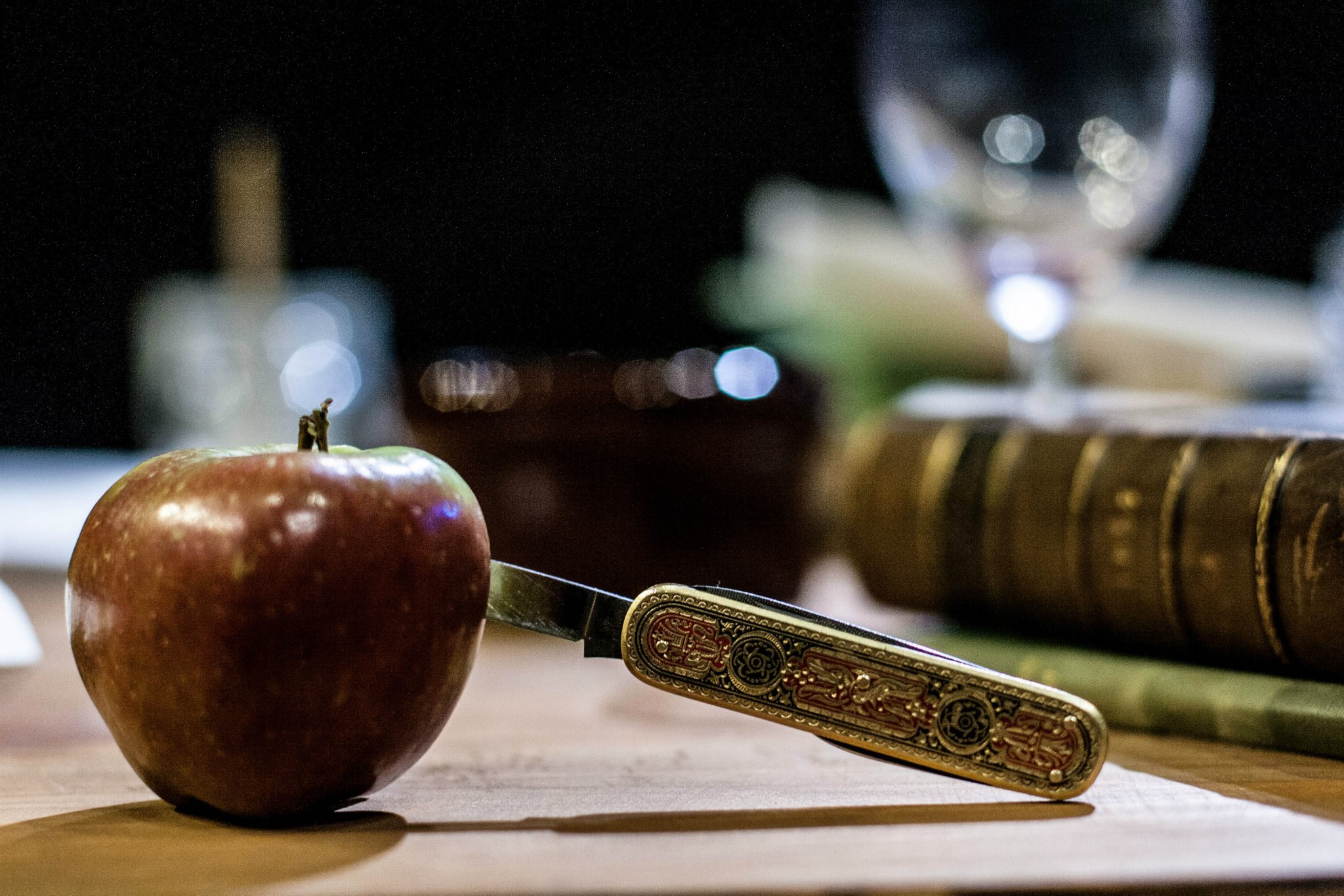
Tom Stoppard’s Arcadia (1993) still has time on its side. There are two apples on the table, the original that Gus offers Hannah at the end of scene two and now there’s Valentine’s MacBook.  Whether ‘Pro’ or ‘Air’ I don’t know but – for a while – let’s stay with ‘Pro’ because this is a student production with professional heft.

The principal roles carry with admirable ease; big ideas don’t sound too heavy; and the impression grows of well-rehearsed supportive work, for even the closing waltzers look to be in step.

Anyway, you don’t ‘do’ Arcadia lightly. This is a recognised heavyweight of modern British drama. Go to The New Yorker online for ‘Tom Stoppard’s Arcadia, at Twenty’ and see what I mean. The plot need not be reviewed – ‘I can’t do plots and have no interest in plots’, said Stoppard when interviewed for the Paris Review in 1988. OK, a soundbite and before Arcadia, but he makes it clear that he does not like ‘narrative mechanics’. What matters is structure (most difficult) and dialogue (easiest). He looks forward to writing ‘a literature play rather than an event play…. in one setting …. where all the time and the energy can be devoted to language, thought process, and emotion’. Eh voilà, a few years later, Arcadia, where Thomasina (13 and brilliant) picks up the leaf of the apple and says “We will start with something simple. I will plot this leaf and deduce its equation”. Note restricted use of ‘plot’. That, as it happens, leads to iterated algorithms of grouse numbers on the MacBook in Act 2 but Arcadia, for all its astonishing architecture, breadth and ingenuity, is a stage play and not a spreadsheet.

A pertinent example:
Bernard:     Because time is reversed. Tock, Tick goes the universe and then recovers itself, but it was enough, you were in there and you bloody know!
Valentine:   Are you talking about Lord Byron the poet?
Bernard:     No, you fucking idiot, we’re talking about Lord Byron the chartered accountant.
Valentine:   (Unoffended) Oh well, he was here all right, the poet.

Not that directors Eric Geistfeld & Charlotte Hodge have much room to enjoy this. The Bedlam stage has to be extended to accommodate the large table at its centre. Additional seating is provided onstage, left and right, but is unhelpful. Stoppard’s own description is of a bare room, uncarpeted, where ‘nothing is impressive but the scale’. Shooting parties are heard as noises-off and the schoolroom table accumulates the right props: folders, books, paper, pen, ink, an aged tortoise called ‘Lightening’ doubling as a paperweight. In the last scene, importantly, there is a pot of dwarf dahlias but otherwise the very large country house in Derbyshire in 1809, a stately home in 2014, is a distant setting in Bristo Place.

Upfront, down stage and around the table, however, there is solid, focused performance. Lauren Moreau is Thomasina Coverly and is entirely convincing as genius pupil and smart child (think Outnumbered Karen), who is as fascinated by jam in her rice pudding as she is by kissing. Pedro Leandro is her tutor, Septimus Hodge, who does languid and attractive intelligence to the nth degree of Fermat’s last theorem. Stoppard’s George in Jumpers (1972) belongs ‘to a school which regards all sudden movements as ill-bred’. Septimus went to Harrow, maybe played in the eleven with Byron, and learnt the same lesson. Leandro voices the elegant wit of the gentleman scholar as if to the manner born. Peter Stanley as Valentine Coverly, post-grad mathematician and modern day heir to Sidley Park, has the other sort of manor but the same gift of lazy concentration. As with Septimus, Valentine’s words provide rhythmic measure and reflection and Stanley makes you listen. Rik Hart as Bernard Nightingale provides the counterpoint of rhetoric as chat-show. Almost insufferable, ‘bouncy on his feet’, an academic bloodhound, the part drives the actor and Hart controls it very well.  Sita Sharma, as Hannah, has to manage this clever, unrelenting, assault and still stand her own ground. A threatened kick in the balls and calling him an “absolute shit” gives her an encouraging, winning, start that a poised Sharma does not relinquish.

Supporting roles are better than also-rans but it is uneven going. Arcadia is an unforgiving estate in 1809. The costumes looked really good but this is not period drama and the physical comedy cramped up. Braying outrage from Henry Conklin as Chater and a glowering Capt.Brice RN. (Sebastian King) were fun but … too much. Rosie Pierce as Lady Croom went all out for pure-bred aplomb and witty hauteur, leaving Derbyshire far behind. Poor Mr Noakes (Lewis Robertson), jobbing landscape gardener, had no defence but a soft Scottish accent, which was nice. The remaining household: butler Jellaby (Will Naameh) and Lord Augustus (James Beagon) – stay impassive, dumb in my lordship’s case, and that served well.

In contemporary Sidley Park, Catherine Livesey is Chloe Coverly, 18 – giddy, kind and susceptible; whilst James Beagon is back and now speaks as ‘Gus, at Eton and pretty cool.

As students might plough a tough exam it is entirely possible to plough  Arcadia and bury it. But not this time. Directors Eric Geistfeld & Charlotte Hodge and cast should reap a reward.

nae bad_blue

Reviewer: Alan Brown (Seen 5 February)

Visit Arcadia homepage here.

Bedlam Festival 2014: 3 ‘shorts’ – ‘Seawall’; ‘On One Knee’; ‘Rob and Roberta’

Bedlam Festival 2014

“and – magic – you have theatrical Snapchat”

Editorial Rating: Unrated 

LOWDOWN: The ‘Bedam Festival’ is a six day festival … operated by the longest running student theatre in Britain … completely administered, staffed and performed by students and young people primarily studying at Edinburgh University.’ 

In case you wondered (because you’re not a student), the Bedlam Theatre is the ninety seat theatre housed in the old New North Free Church on Bristo Pl, looking down towards George IV Bridge. It is Fringe venue No49 in August when use of the pa. system seems important. Last week, on the one occasion that I heard a solemn “The House is now open”, it was laughingly decried as ‘train station posh’.I saw three productions on consecutive evenings at 6.00pm. Audience numbers looked good at around 50+. Rob and Roberta had two performances; Seawall and On One Knee were one-offs.

Seawall by Simon Stephens.  This is a surprising and effective piece. It is a grief-stricken story of sudden loss and immanent mourning. Jonathan Oldfield as Alex is quietly alone on stage and is looking back at what happened and would bring his audience with him to the edge of his personal darkness. The submerged seawall of the title is where you back away from the depths of misery on its other side. This tale is thirty minutes in the telling but you wouldn’t know it. Alex moves you through in tones half conversational, half confessional, and the emotional tug is unremitting. There are sorrow smudged sketches of his partner, Helen; of her father, Arthur; and of their child Lucy; but it is Alex alone who gains real definition.  Oldfield’s monologue would be heart-breaking in its gathering intensity but writer Simon Stephens waives the sentimental, preferring a body blow to the stomach. Alex used to cry at anything – that moment in Groundforce, for instance, when the made-over garden is revealed to its surprised owner – but not anymore. Oldfield’s performance has real gut-churning weight behind it.

On One Knee by Delia Bloom is thirty minutes of original writing for EUTC and opens up with Bruno Mars’ ‘Marry You’, whose dance track is just right for this light and irrationally accurate show. ‘Looking for something dumb to do’? Easy, put one lovelorn loon, Jamie, on the left of the stage to propose marriage to Christine and put his two pals Tom and Erica on sofas to the right with lots of vodka shots.   John Forster is sweet Jamie and a very credible sucker for Imy Wyatt Corner as Christine who – of course – fancies another, fitter, laddie. So much, so deliberately cringeworthy; but meanwhile there’s comic action across at the flat where friends Tom (Jonathan Barnett) and Erica (Isabella De Vere Rogers) are texting to save Jamie from himself.  Writer Delia Bloom gets it right here: life for this merry band is ‘one story after another’, just link arms and skip from one side of the stage to the other and – magic – you have theatrical Snapchat. De Vere Rogers, sassy, and Barnett, smart, work well together and try out stylish Anna (Blanca Siljedahl) as a better girlfriend for Jamie. How ‘better’? Who cares baby, let’s just play ‘The Settlers of Catan’. Congradulations (sic) to director Sally Pendelton.

Rob and Roberta by Rory Keller is more loaded. You are still in flat share land but there’s talk of careers underway – the law, medicine – and relationships are heavier to shift. Rob (Laurie Motherwell) is weary before his time and relieves the weight by being snide to his best friend, Roberta (Emma Nevell), and it is a wonder she puts up with him as cheerfully as she does. If he had lots of words Rob would be messing with the heads of his friends, as it is he contents himself by pulling them away from each other. Rida (Daniel Orejon) loves Cheeto (Adam Butler) in less time than it takes to crunch a cornmeal snack but that kind of wholesome enjoyment is not for the jaded Rob. He is therefore the challenge that pert and determined Rachel (Izzy Hourihane) is looking for. She will ‘fix’ her man within a year, she declares, and the play’s action describes that attempt. Hourihane’s energy is vital and holds your attention through multiple scenes past and present but at times I, for one, was wondering ‘What for? Is Rob worth it?’ He does resolve this for himself at the play’s shocking end but I got the distinct impression that Rob and Roberta is a psychological drama that had lost its plot.

I really would have liked to have seen more shows; I should have done.

Reviewer: Alan Brown (Seen 22, 23, 24 January)

Visit Bedlam Festival 2014 homepage here.

‘The Lift’ and ‘Elephant in the Room’ (Bedlam: 20 Nov ’13)

“Bedlam is steaming through the waters it knows best – supporting emerging talent on stage and off.”

Editorial Rating: Unrated

Brass monkeys ain’t in it. It is seriously cold in Bedlam. I should be seeing Dr. Zhivago  or something set in Narnia during the reign of the White Witch. Instead I’m taking my seat for The Lift and The Elephant in the Room, two out of three afternoon entertainments written by Freshers. For such a hit and miss affair there is a great deal on target. The badinage buffet successfully showcased the great things we can expect from Fringe venue 49 in the coming years. Familiar and not so familiar faces breathed life into two daring scripts simply (but effectively) staged.

The Lift (unlike Elevator the forgettable 2011 horror flick in which 9 people are trapped in an elevator) is set in a lift where 9 people have become trapped. Writer Fergus Deery sketches out a series of ludicrous characters – a flatulent vicar and his shrewish wife; a Matt Lacey-esque über-rah; a pompous PhD; two devoted lovebirds; a prickly girl in a wheelchair, accompanied by her patient pushover friend; and a member of the toiling masses. When Über-rah causes the lift’s mechanism to jam, hilarity ensues as the social norms crumple under the weight of frustration and impatience. Don’t expect piercing social insight, the social commentary doesn’t rise much above sprout jokes.

Deery is playing for laughs and he gets them. In the hands of a well-matched, well-balanced ensemble his unaffectionate portraits come to life. The true star of the show is the staging. It’s minimalist, just a wooden border at hip height, but just large enough not to entirely restrict the unfolding drama. Blocking is of course a problem but there are signs of genius lurking in its comic application. The Lift has the feel of a recurring sketch routine (although more Armstrong and Miller than Fry and Laurie). The plot twist can be seen from a mile off which somewhat underwhelms the final third. But it’s a promising first attempt, galloping out of the starting gates, confidently leaping the first hurdles. And although more were clipped than cleared in the home stretch, this is a writer who has established his form and will be one to watch.

The Elephant in the Room is a bold, even reckless narrative by Joe Christie. Charging head on at themes relating to the personal calamity of terminal illness approached from a surrealist angle. Beth, a tour guide at the castle (I’m not sure why except that the outfit must have been to hand) is informed that she’s terminally ill. The sardonic stalwart Henry Conklin (having finally escaped from The Lift) appears to her dressed as an elephant. The effect of the costume on Conklin conjures imaginings of a live action version of the YouTube classic The Wanky Shit Demon. The Elephant offers Beth (nuancedly, understatedly played by Sophie Harris) a choice to either face the realities of her situation or to journey through a shifting dreamscape landscaped by her own mind. A lot is packed into the script including off-the-rails coronations, gay imps, giant crêpes, supervillain queens, and wise mystics.

There are echo’s of the acclaimed Something There That’s Missing, the surprise hit of last Fringe. Elephant in the Room is equally creative, equally absurdist and a vehicle for equally quirky as well as engaging performances. It’s unlucky in the line-up though, following on from the unashamedly boisterous The Lift. I never could like Moulin Rouge after it was shown on a transatlantic flight immediately after my first encounter with Shrek.

Both Elephant in the Room and The Lift made me sorry not to have seen the full cycle – word in the bar was that Amanda Whittington’s Be My Baby was rather good. Both the plays I saw excite a sense that Bedlam is steaming through the waters it knows best – supporting emerging talent on stage and off. The current generations are heirs to a noble tradition. Their commitment to their craft does them credit, honouring that most venerable and lively of Edinburgh theatrical institutions.

Reviewer: Dan Lentell (Seen 20 November)

Visit Bedlam’s homepage here.

The Oak Tree (Bedlam: 16 – 17 Oct ’13)

965268_10153333436155858_1026221967_o

Image by Daniel Alexander Harris

The Oak Tree is the debut script from young author Ellie Deans, and it’s an impressive start to her writing career.”

Editorial Rating: Nae Bad

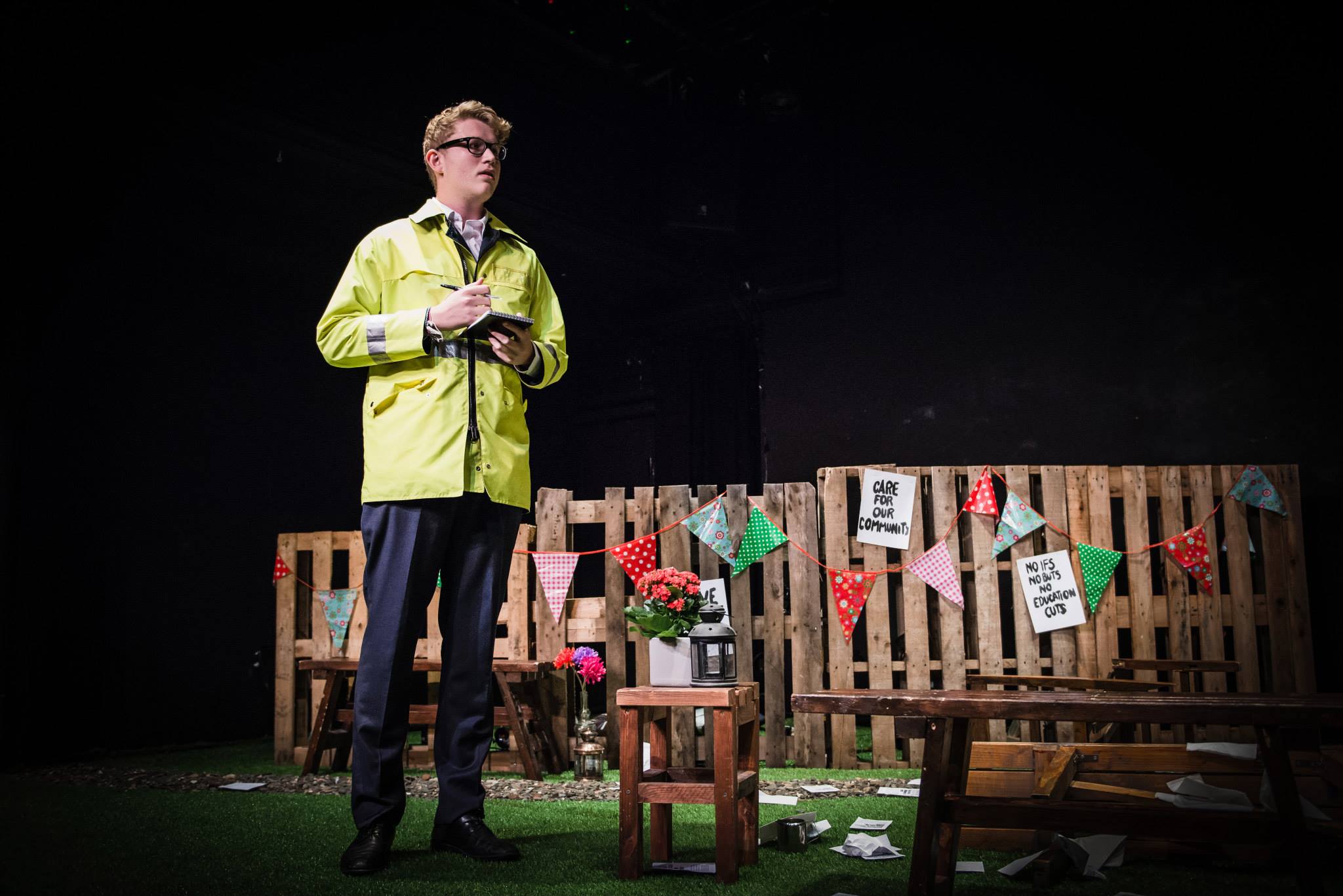
There’s a lot to catch your eye about this brand-new play – but the first thing you’ll notice is its expansive set.  Astro-turfing the whole Bedlam stage, it impeccably evokes the eponymous Oak Tree, a fading outdoor café in an equally fading part of London.  With its rustic fence and crunching gravel, the Oak Tree is both timeless and reassuringly familiar… but a man called Mark Duggan has just died in Tottenham, and in the course of a summer’s night, everything will change.

The Oak Tree is the debut script from young author Ellie Deans, and it’s an impressive start to her writing career.  The story’s revealed through well-paced dialogue, free from clumsy exposition; an occasional tendency to labour plot points is the only notable flaw.  Although it’s a political play, the tone is balanced and genuinely thought-provoking, and the characters are refreshingly nuanced too.

There’s both cleverness and chutzpah in the play’s construction, with a frothily entertaining first half yielding after the interval to a far darker tone.  Early highlights include a set-piece comic misunderstanding – which would stand scrutiny alongside many a TV sitcom – and a gloriously toe-curling business pitch, delivered in fearlessly hammy style by actor Robbie Nicol.  There are subtler motifs too: a touching bond between brother and sister, the burden of untold secrets, and the piquant realisation that the things we love can’t last forever.

But the script loses its way a little when it confronts its motivating theme, the riots of August 2011.  What caused the disorder?  Who should we blame? Is there room for understanding, or must we simply condemn?  The play touches on these important questions, but it doesn’t have time to explore many answers.  Deans is at her strongest when she’s pursuing a simpler agenda: illustrating how that summer’s shocking events tore families and communities apart in the parts of London left to deal with the aftermath on their own.

She’s aided in that task by a strong and confident cast.  Will Fairhead plays lascivious rich kid James with considerable relish, successfully drawing just a hint of likeability from his endlessly crass character.  Ella Rogers has the family matriarch nailed, bringing a gut-wrenching sense of tragedy to one emotional scene, while Casey Enochs puts in a finely-balanced performance as the other-worldly Annie – perhaps the most intriguing of Deans’ creations, and certainly the most saddening.

The Oak Tree undulates through a landscape of moods – from uplands of optimism to bleak valleys of despair – and at times, it’s deeply cynical.  But it’s defined throughout by a gentle, affectionate humour, and by characters complex enough to make you care.  Both playwright and cast deserve considerable credit for this engaging, inventive production.

nae bad_blue

‘The Fantasticks’ (Bedlam: 9 – 12 Oct ’13)

1391627_536699813084181_349070085_n

Image by Louise Spence

“Performed in New York almost continuously since 1960, The Fantasticks is a curiously-constructed musical.  The first act is cutesy – sometimes to a fault – telling the knowingly-ridiculous tale of a forbidden teenage romance, and of two fathers’ efforts to control their love-struck offspring.”

Editorial Rating: Unrated

“Try to remember the kind of September / When life was slow, and oh, so mellow,” exhorts The Fantasticks’ famed opening song. Well, they’ve missed September by a week or two, but in every other respect Edinburgh University Theatre Company have fulfilled that brief: this is a warm-hearted, uncomplicated production, which gently lulls you backwards into an agreeably nostalgic haze.  Sadly, however, the lyric also foretells this production’s main weakness.  It’s all just a little bit slow.

Performed in New York almost continuously since 1960, The Fantasticks is a curiously-constructed musical.  The first act is cutesy – sometimes to a fault – telling the knowingly-ridiculous tale of a forbidden teenage romance, and of two fathers’ efforts to control their love-struck offspring.  But after the interval, the scenes grow dream-like and altogether darker, in a dislocating transition which this particular production never quite pulled off.  It doesn’t help that the original boy-meets-girl plot is wrapped up by the end of Act One, leaving the second half to lumber away from an awkward standing start.

But we can’t blame EUTC for the plot’s idiosyncrasies, and they’ve certainly had fun responding to its old-style American charm. Jordan Robert-Laverty neatly captures the clean-cut naivety of a 1950’s college boy, while Claire Saunders excels as his swooning 16-year-old paramour, milking the comedy of her role without ever quite crossing the line into over-acting.  Saunders’ voice lends her songs an almost operatic tone, and contrasts nicely with the more natural style of Alexandre Poole – who brings an understated authority to his multi-faceted role as both villain and narrator.

Muscially, however, the performance suffered from frustrating inconsistency, with almost all the actors delivering showstopping performances for some songs while clearly struggling with others.  The surprising exceptions were Daniel Harris and Thomas Ware, playing the two teenagers’ warring fathers; their characters seem at first to be formulaic comedy chumps, but soon prove to be far more.  Harris and Ware both have fine, comforting voices, and their harmonising duets proved a thoroughly unexpected highlight – enhanced by some genuinely witty, if slightly methodical, dance.

Indeed, the whole production demonstrates a playful sense of physicality, with an impressive swordfight (and gloriously extended death scene) raising the stakes just before the interval.  But whenever the pace wasn’t being dictated by the music, the energy ebbed away.

So EUTC’s production isn’t quite fantastic – but it’s an enjoyable, stylish, and life-affirming version of a cosily charming musical. Credit must also go to pianist Dan Glover and harpist (yes, harpist) Sam MacAdam, whose position at the side of the stage brings them very much into the heart of the performance.  It’s a show I’ll be sure to remember.