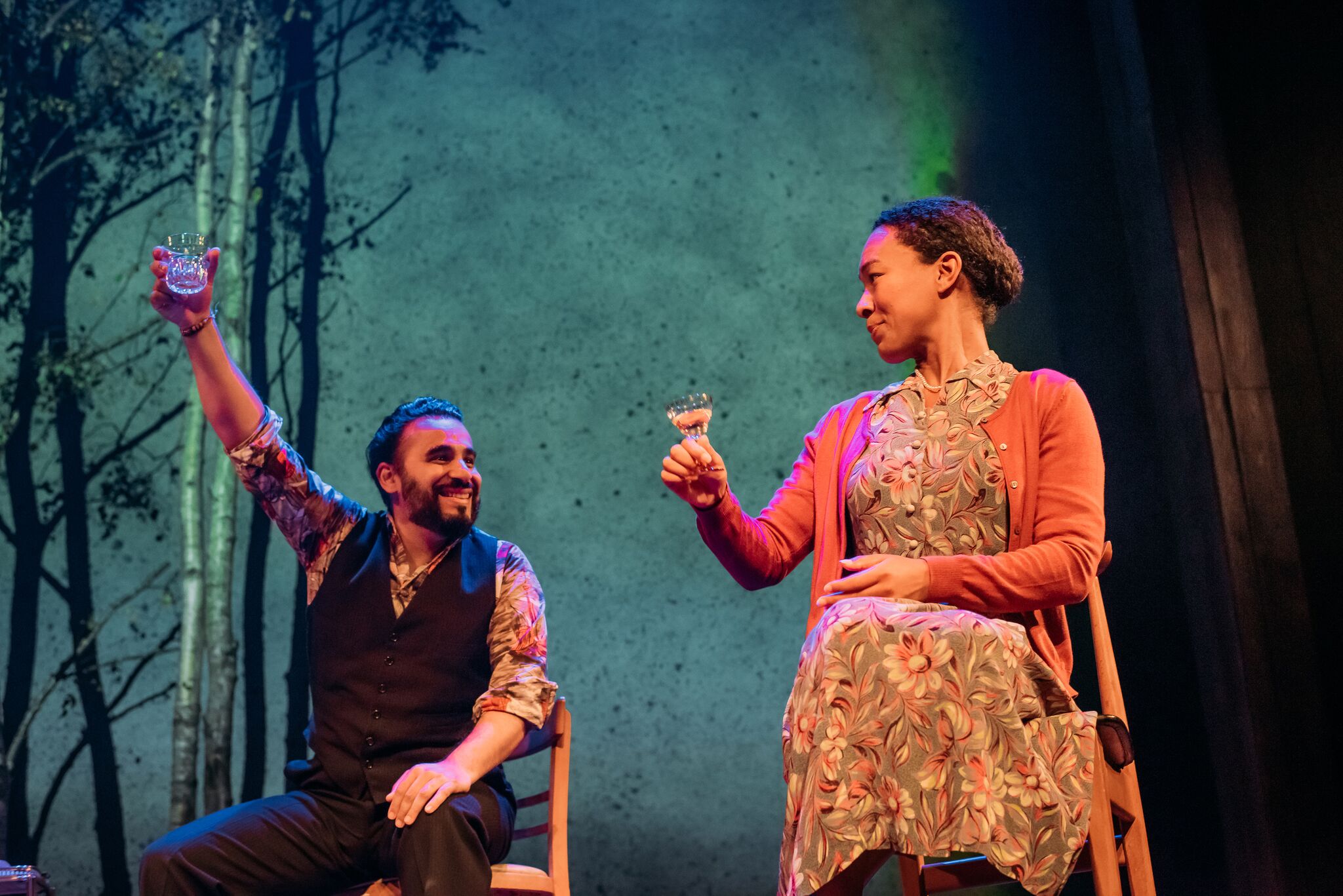
Cockpit (Lyceum: 6 – 28 October ’17)

Photo. Mihaela Bodlovic

“Director Wils Wilson goes all out to create predicament and danger”

Editorial Rating: 4 Stars: Nae Bad

Albert Camus’ La Peste was published in June 1947. The first Edinburgh International Festival was in August 1947. Bruno Walter conducted the Vienna Philharmonic in the closing concert and reckoned that “Here human relations have been renewed”. Bridget Boland’s Cockpit opened at the Playhouse, London, in February 1948 and mashed pestilence and optimism together. Now it’s back, thanks to David Greig, and fit for purpose: a raw and vehement history play, but without princes and kings.

London’s Cockpit theatre was on Drury Lane. It was probably another ‘Wooden O’, built around an actual cock pit. Boland’s play goes one better than Shakespeare’s Henry V, her ‘swelling [and vicious] scene’ holding not only ‘the vasty fields of France’ but the whole of Europe. Cockpit is actually set in a theatre. You get the immersive idea pretty quickly when you notice that the Lyceum has been commandeered by the ‘Allied Government’. It’s late 1945, it’s punishingly cold, and there’s still the reverberation of pulverising bombardment. We’re in the British Zone of Occupied Germany and a theatre is being used as an assembly centre for displaced persons (DPs), hundreds of them. They’re even huddled on the stage. Cast-off clothes are over the backs of the seats. There are ladders from boxes, screened by sacking, to the Stalls and – we’re told – German corpses in the boiler room. Transport is being arranged to take you home (whether you want to go back or not …).  You in the Dress Circle are going West. Those of you in the Stalls are going East. Jiri, on stage and silent, is from Lidice and has no home left. Willkommen im Umwelttheater!, as ingeniously constructed by designer Ana Inés Jabares-Pita.

It is a babel of Slavic voices and trouble. But surely a British officer can sort this lot out, provided he has a desk and reason on his side. Young Captain Ridley has been detached from his regiment because he has School Certificate German. He does have his service revolver. His sergeant, Sergeant Barnes, has no German, just loud Geordie and a Sten gun. Between them they put on a brave ‘show’ – in the choice Army sense of the word – but there’s a limit to how long they can just ‘Carry on’.

Conflict starts with ‘Who’s pinched my sauce pan?’ and very quickly turns serious, not least because the Poles hate the Jews ( – ouch!) and the Russians will kill the Poles and the Chetniks will kill anybody, especially socialist partisans. A French collaborator – but forced labour would qualify that – is certain that Marie, a Resistance fighter, will falsely denounce him. Add infectious disease and Capt. Ridley is in a desperate jam. There is some rallying round but a different kind of ‘show’ is needed to relieve the tension; after all, we’re in a playhouse. When it comes, two thirds through, we get an operatic cloth and a bravura performance from Sandra Kassman.

(L-R) Nebli Basani, Peter Hannah, Dylan Read (Bauer), Sandra Kassman (stairs), Kaisa Hammarlund (stairs) and Adam Tompa. Photo. Mihaela Bodlovic

This is Boland’s brilliant conceit. When the German stage manager, Bauer, says “You will need the theatre – afterwards”, you believe him. And when faced with the possibility that his theatre – probably one of the few buildings left standing in his flattened city – might be burnt down to halt contagion, the man is stricken with sadness. Bauer (Dylan Read), as comic denizen of his place, living in the flies, and true Propsmeister, is almost the only source of laughter in an otherwise sombre drama. Read also plays Duval, whose occasional spoken French, is so good that you appreciate the difficulties of staging a script that demands heavily accented English from several characters. Whatever ‘European’ means, this cast is it.

Director Wils Wilson goes all out to create predicament and danger. A chant is either angry or sorrowful and certainly incomprehensible (unless you’re Romanian). Rush and hurry can subordinate the personal stories. There is a stretch of choreographed movement for the whole company that would express the plight of the displaced anywhere, at any time. The excellent music by Aly Macrae is often discordant and broken, except for the quiet piano at the beginning of the second half. Capt. Ridley (sturdy by Peter Hannah) might be resolute, almost heroic, but it’s not enough. There is a passing mention of a major somewhere else but the chain of command appears well and truly absent, which will irritate Army types.

Cockpit is bold work, both then and now. It is theatrical but – more importantly – it’s humane. A Russian DP proclaims “20 million Russians died. It must not happen again”. That’s from the Stalls, going East. Primo Levi, after Auschwitz and going West, got it exactly right: ‘It happened, therefore it can happen again’.

nae bad_blue

Star (blue)Star (blue)Star (blue)Star (blue)

Reviewer: Alan Brown (Seen 10 October)

Go to Cockpit at the Lyceum

Visit Edinburgh49 at the The Lyceum  archive.
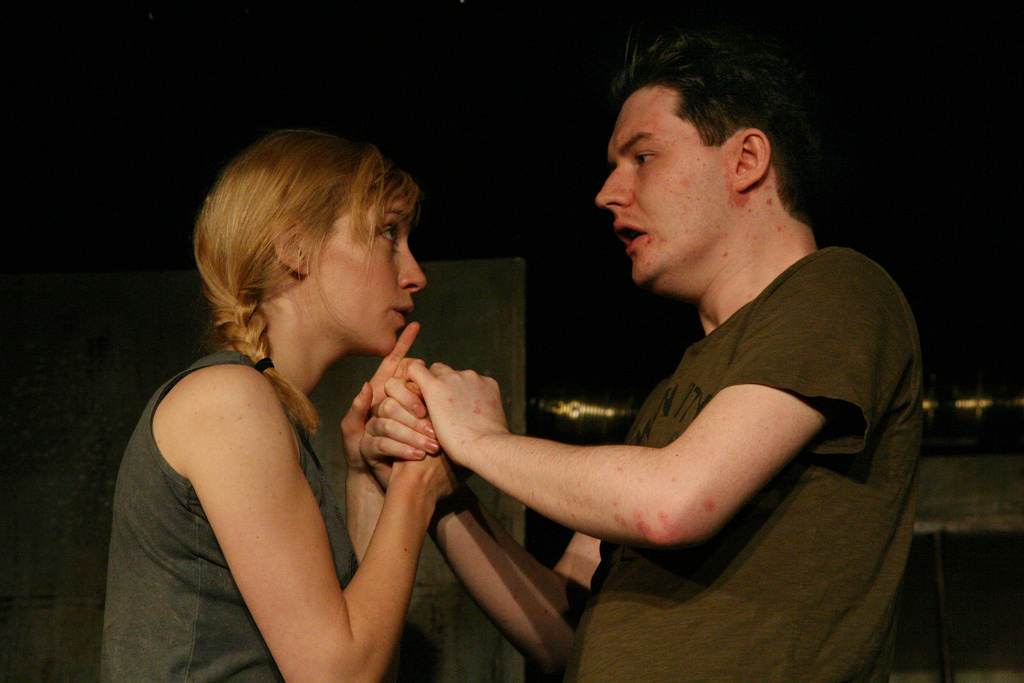
Jury Play (Traverse: 3-7 October ’17)

“The fourth wall isn’t so much broken as shattered”

Editorial Rating: 4 Stars: Outstanding

Sometimes the power and excitement of a show begin long before you take your seat, and remain with you for several days after. For Jury Play, a detailed email briefing is circulated in advance of the performance/court appearance, creating intrigue into what the evening will entail: it’s worth saying at this point that this is in no way like your standard trip to the theatre. The excitement only builds as you go through “security”, enter the (optional) ballot to become a jury member, and start to leaf through your court information pack while taking in Emily James’s impressive and sizeable courtroom set.

Yet what, on the surface, appears to be conceived as an interactive courtroom drama, where the prosecution and defence present facts about a given crime and a resolution is reached by the audience/jury, what Jury Play peels away at is what effect the trial process has on individual members of the jury, specifically for trials that last for weeks.

At various points during the trial, voiceovers expressing jury members’ thoughts are overlaid with the action, which include worries about getting children to school, paying bills, what specific legal terms mean, and even staying awake. Snippets of video conversation between writers Dr Jenny Scott and Ben Harrison about the performance also add a pleasingly Brecthian feel and help break up some of the monotony of the trial itself. So far, so so. Everything changes in Act ii, however, when the formal trial is over and the power lies in the jury’s hands. I won’t give away all the spoilers, but I shall simply reveal that organised chaos ensues, and the meat of the piece really comes out as an intelligent, human, and common sense discussion into the way we conduct trials.

When it comes to the performance it is John Betts as Judge who commands the show, and with his hilarious doddery asides and sensitive chairing of the discussion in the second half of the piece, you feel like you’re in his space, and he decides at any given point how comfortable anyone is to feel. Helen Mackay is also excellent as the conscious “everyman” figure Janis, who just wants to do her duty, and the cast as a whole make the performance very accessible: the fourth wall isn’t so much broken as shattered, with a piece of it distributed to each and every person in the room.

For me, though perhaps a reflection on the subject matter it discusses, Scott and Harrison’s script is too laboured and lengthy at points – missing some crucial details to aid comprehension in the first half, and dragging out its point in the second. The ending, while interesting and fitting stylistically with the piece, also feels like a bit of a cop-out and rather abrupt – as if the ideas just ran out at that point and there was nowhere else to go.

Overall this is a fascinating insight into the legal system, what it’s like to be a jury member, and how seemingly unfit for purpose the whole setup is – especially for people like me who have very little knowledge of its intricacies. Jury Play is absolutely worth taking part in, if there’s any room left in the public gallery.


outstanding

StarStarStarStar

Reviewer: Steve Griffin (Seen 5 October)

Visit the Traverse archive.

THIS REVIEW HAS NOT BEEN SUBEDITED

Pleading (Traverse: 3 – 7 October ’17)

Kim Allan and Daniel Cameron
Photo: Oran Mor

““Everything is negotiable””

Editorial Rating: 3 Stars

Pleading is the first up of five plays in this season’s ‘A Play, A Pie and A Pint’. This is a spiky three-hander by Rob Drummond, surely a playwright on a roll; and there is something of a wrestling bout to its twists and holds. Heard as a radio drama on BBC4 in January, Pleading comes to the stage – but call it a mat – with a narrative thwack.

Michael (19) and Freya, his girl next door /one-time sweetheart, have been banged up in a foreign jail for three weeks now. They are brought together to talk to their assigned lawyer, Amelia Singh. Where exactly they are  is not given but they do face the death penalty for attempting to smuggle Class 1 drugs. That fate – and their flight itinerary: Singapore > Perth > Brisbane > prison – would suggest Malaysia or Thailand. No worries (really?), for Freya’s dad is a QC and in that part of the world “We’re not foreign, we’re British.” Er …? Cue Boris Johnson and the Road to Mandalay?

If ever a defence lawyer was gobsmacked and keeps talking, then it’s the calm and collected Amelia (Nicole Cooper). How to convince her jumpy clients to plead guilty and serve a prison sentence? Maybe then Daddy can come and flap his silk. “Everything is negotiable”, declares Amelia, but it helps if you keep your story straight and consistent. So, over 50 minutes, Freya and Michael ‘negotiate’ the possibilities of how heroin ended up in her backpack. It is conceivable that the truth is told at the end but who can tell? It’s always salutary to be reminded of our talent for lying.

It is an unsparing and sweaty tussle that is ably performed. Freya (Kim Allan) is more in control but her account is the more wayward. Michael (Daniel Cameron) is more fragile, even desperate. At the close they are hanging onto each other for support and the law is somewhere else entirely.

Director David Ian Neville has a good play for voices to work with. Movement is conspicuous and time parcelled out by Amelia’s visits to the remarkably quiet prison. There is credible tension and there is sympathy and anxiety but as a drama I felt it wanted more fear and a lawyer on the ropes.

Star (blue)Star (blue)Star (blue)

Reviewer: Alan Brown (Seen 3 October)

Go to Pleading at the Traverse

Visit Edinburgh49 at the Traverse archive.

The Threepenny Opera (King’s Theatre: 15-16 September)

“A charming production full of talent”

Editorial Rating: 4 Stars

The musical legacy of Kurt Weill and Bertolt Brecht’s vibrantly satirical ‘play with music’ The Threepenny Opera is a curious one. Its opening anthem, “Mack the Knife,” has subsequently gained far more acclaim and recognition as a jazz standard in English since its debut in 1928 Berlin. The sultry refrain still tells of the deliciously violent antics of the notorious Macheath — every bit as much a bloodthirsty criminal as a salacious womanizer — but the original Socialist criticisms of capitalism and societal greed inherent in the original context of the character have somewhat faded. However, in their current production of Weill and Brecht’s piece, The Attic Collective yank the socialism and social Darwinism back into focus with grandiosity and verve to spare.

The assembled talent has carefully chosen a threadbare aesthetic and a frantic tone, both of which are appreciated considering it’s nearly three-hour runtime. The blocking, choreographed by Dawn-Claire Irvine, is frenetic, with bodies and props being hurled around the stage with sometimes dizzying energy. The set, managed by Tony King, is almost completely empty, save the minuscule bandstand area and temporary furnishings wheeled on to create a sense of space, which is accomplished well. The band is led with both humour and talent by Simon Goldring, whose musical direction fits well into the play’s dingy background. The most remarkably funny aspect of the stagecraft is the use of projected slides to flatly assert location. Before most scenes, white typeface bluntly explains context, and briefly puts up an Edinburgh equivalent of where these London-set scenes might take place, eliciting many a laugh for their timing and matter-of-factness. Had these been paired with a more self-serious, pretentious production, they would seem tacky; had they been employed by a less dynamic, more straightforwardly silly group, they’d be out of place for their dry humour. But to their credit, The Attic Collective’s decisions like this strike exactly the right tone (more often than not), between gormless and grandiose, threadbare and thrifty, funny and frank.

Max Reid is excellent as the appallingly villainous Mr. Peachum, particularly for the bombast he brings to his first scene, directly after the chorus’s “Mack the Knife” introduction. Reid successfully guides the audience from the familiar sounds of the standard to the viciously satirical tone of the rest of the production, which is no easy feat. As (occasionally) the cruelty and pitch-black comedy of Brecht’s script might come off as too much to find funny, it is particularly commendable that director Susan Worsfold has chosen to emphasise the comedy wherever possible. Toby Williams, as a hapless and clueless beggar, is hilarious with excellent timing, and Hannah Bradley as Mrs Peachum displays a genuinely impressive talent for balancing daft operatic turns of plot and phrase with an accomplished singing voice and terrific stage presence. And this is all the first scene.

Charlie West’s Mack the Knife takes time to get used to, but ultimately shines as the play pushes his character farther and farther from the archetypal ladykiller/people-killer role. His singing is good, and well-suited to the choppiness of Brecht’s plotting, as some intentionally off-kilter scenes and character dynamics look and sound more grating than polished. Given the tone of the production, these are presumably meant to be that way. West also displays nice comedic timing, but the truly gifted comedic dynamic was found more frequently among his criminal posse: Lewis Gribben, Elsa Strachan, John Spilsbury, Mark O’Neill and occasionally Conor McLeod. They all display real camaraderie and genuinely funny quips whenever present: another respite given the sometimes exhausting length of the proceedings.

Mack’s various women, played by Kirsty Punton, Megan Fraser and Sally Cairns, are characterised well, and each command the stage when given the opportunity. Special note goes to Cairns’ exquisitely gauche costume. In fact, the behind-the-scenes decisions are some of the most impressive aspects of the show: the use of the King’s Theatre’s actual boxes during a brothel-based interchange in particular is an inspired choice, delivering further hilarity.

The political and societal implications, are however, noticeably muddled, from the greediness and homoeroticism within head of police Tiger Brown (Andrew Cameron), to the jarring humour on display while Mack languishes in a prison cell waiting to be hanged by the distinctly humourless guard (Adam Butler). The spaces crafted by mime and sparse prop work, including a very funny use of a ladder as all-things-jail-call, but frequently have their implied rules broken, from doors switching to windows, walls vanishing entirely, locks fitting into keyholes where previously there was nothing, and entire crowds miraculously appearing and disappearing: the staging too often does not make any sense. Granted, these are aspects of Brecht’s dismantled view of theatricality in general, but when the plot twists and turns so freely it would have help to define spaces a little bit more.

Overall, The Threepenny Opera is a charming production full of talent and featuring some particularly inspired choices and aesthetics. There could be a little more there in the way of clarity, but hey, it’s Brecht. Most charmingly, it gives a whole lot of context for the flawless “Mack the Knife” standard itself, and for a superfan like myself that’s welcome. And if you weren’t a fan of the song beforehand, you will be once the curtains have closed.

StarStarStarStar

Reviewer: Nathaniel Brimmer-Beller  (Seen 15 September)

Visit the King’s Theatre archive.

THIS REVIEW HAS NOT BEEN SUBEDITED


What Shadows (Lyceum: 7 – 23 September ’17)

Ian McDiarmid as Enoch Powell
Photos: Mihaela Bodlovic

“A remarkable performance, as unsettling as it is astonishing”

Editorial Rating:  4 Stars: Outstanding

Shadows cast? Shadows fleeting? Shadows lengthening? Take your pick as you find your way back and forth through the many scenes of Chris Hannan’s timely play upon the redoubtable life of Enoch Powell (1912 -1988), for whom – archly – it is ‘in fog [that] you feel England all around you’. As it is what you see is a beautiful copse of silver birches.

This is the standout Birmingham Rep’ production from 2016 directed by Roxanna Silbert. Ian McDiarmid (Powell), Paula Wilcox and Waleed Akthar reprise their roles. McDiarmid, especially and importantly, gives a commanding performance as the radical, absolutist Conservative whose proudest, indisputable claim was that he always spoke for his constituents of Wolverhampton South West, and as their MP from 1950 to 1974 that meant speaking his formidable mind about immigration. For the classical scholar, poet, and theologian whose idea of total Englishness was ‘sunken lanes in Shropshire’, immigration is as unpoetic – but as necessary – as it gets. Lamentable too. For Powell’s close friend, local newspaper editor and Quaker Clem Jones (Nicholas le Prevost), ‘England’ is more subtle – ‘Gary Sobers bowling his slow Chinaman’: surely one, nowadays, for the British Citizenship Test.

What Shadows moves between 1992 and 1967/68. Powell’s notorious ‘Rivers of Blood’ speech, that closes the first half of the play, was given at a Conservative Association meeting in Birmingham on April 20 1968. Twenty-five years on two feuding Oxford history lecturers, one black, one white, Rose Cruickshank (Amelia Donkor) and Sofia Nicol (Joanne Pearce), see a research paper, maybe a book, contextualising that speech, interviewing Powell, and hitting upon Insights-to-Racism-and-How-to-Stop-It. Parody did not seem far away, particularly in their self-righteous, point scoring tones; and they’re certainly no match against Powell, even at the end of his life and shaken by Parkinson’s.

Ameet Chana as Sultan and Amelia Donkor as Joyce Cruickshank

Hannan’s invention is both amusing and accurate. 1967 is a Powell picnic, with his wife Pamela (Joanne Pearce) at her supportive best; it is also a hostess trolley at an awkward New Year’s Eve party, where Grace Hughes (Paula Wilcox) is a white landlady of two Punjabis, the gauche Saeed (Waleed Akthar) and the jovial and appealing Sultan (Ameet Chana), whose war service in Burma included learning ‘I Love a Lassie’ from the 1st Battalion Seaforth Highlanders. 1968 is the Powells leaving an RSC production of ‘King Lear’ at Stratford and being buttonholed by Sultan. “England must be cured of Empire” pronounces Enoch. There’s even a passing reference to the late and great Alan Howard.

In this show, though, it’s Ian McDiarmid whom you must applaud. It is a remarkable performance, as unsettling as it is astonishing. Go to Youtube for Michael Cotterell’s 1995 film portrait of Powell, ‘Odd Man Out’, and realise how close the actor is to his subject. Obviously the words, their clarity, and the curiously accented speech can be the same but there is the tight smile, the nodding assent that is as sympathetic as it is probably dismissive. Powell nearly usurped the Tory party on principle and McDiarmid shows how he did it, without quite turning the man into the near demon / archangel of the Left and Right respectively. Enoch in carpet slippers and dressing gown is still the insurgent and not some benign ambassador for the National Trust.

The ending looks to the future, to whatever England makes of itself. It probably has to be a tad romantic and suffused with colour to offset the gloom of the present day.

outstanding

StarStarStarStar

Reviewer: Alan Brown (Seen 12 September)

Go to What Shadows at the Lyceum & to the Birmingham Repertory Theatre

Visit Edinburgh49 at The Lyceum archive.

Fag/Stag (Underbelly, Cowgate: 3-27th Aug: 16.00: 60mins)

“A triumph… top marks”

Editorial Rating: 5 Stars

When it comes to producing good theatre, sometimes the most simple ideas are the most effective. Fag/Stag is a case in point. It follows the lives of two best friends (Corgan and Jimmy) in the run up to a mutual friend (and former crush)’s wedding and is staged with just two actors – each playing one of the friends – and two stools, plus a couple of token props to help set specific scenes. What unravels is an absolute masterclass in story-telling, from both the written and performed perspective.

While structured as two interweaving monologues, the script contains clever overlaps allowing both characters to present their respective accounts of specific incidents: often to humorous effect, (tempering self-indulgent exaggerations) yet sometimes to fill in poignant details the other may have been too ashamed of (or drunk) to share.

And therein lies the power of this piece – the frankness of story-telling. We get to see the full picture of both characters’ insecurities and weaknesses, either from their own mouth or from the mouth of their friend, which means we get to know and empathise with them very quickly. It’s both comfortable and compelling to watch.

What’s most touching about this performance is how it beautifully and understatedly presents a relationship not often seen on stage – a straight man, Corgan (Chris Isaacs), and his gay best friend Jimmy (Jeffrey Jay Fowler). Theirs is evidently a true and caring friendship, with late night emergency calls to rescue each other from sticky situations, an ease with they can talk about really personal issues, and a bluntness in dealing with each others’ misdemeanours head on-on. Their differing perspectives on specific situations is often amusing, but what comes across most emphatically is the importance of sticking up for your buddy, whoever they are.

The plot itself sees Jimmy try and come to terms with his break-up with his long-term partner, and Corgan’s attempt to deal with the fact his former love is marrying another man. It’s fairly emotive in parts, with longer monologues drilling down into details and feelings, yet performed with the vibrancy and sensitivity required to keep it captivating throughout. There are also plenty of laughs to be had, most notably regarding a certain scent of air freshener referred to on multiple occasions

By keeping the design and direction very simple throughout this piece, The Last Great Hunt allow the story and quality of acting to really shine through. This really is a triumph in getting the basics of a show absolutely right, and many other companies can learn from this production. Top marks.

Star (blue)Star (blue)Star (blue)Star (blue)Star (blue)

Reviewer: Steve Griffin (Seen 24 August)

THIS REVIEW HAS NOT BEEN SUBEDITED

The Girl Who Jumped Off The Hollywood Sign (Assembly Roxy: Until 28 Aug: 11.30: 70 mins)

“Hartstone inhabits her characters (male and female) much as Liz Taylor was supposed to have simply been Cleopatra”

Editorial Rating: 5 Stars: Outstanding

We enter to the strains of Arthur Dooley Wilson singing As Time Goes By. The mood is glamorously sombre. On stage is the top half of the ‘H’ of the Hollywood sign. Onto it steps a figure in black dressed as though for a funeral. How did she get here? What (and who) have pushed her to this?

The story which writer and performer Joanne Hartstone has to tell is eerily familiar. Evelyn Margaret Edwards (or Evie Edwards, to use her stage name), is a naive young lady seeking to change her rags into riches through the magic of the Hollywood limelight. She has dreamed of becoming a star all through the Great Depression, from the stock market crash, via a Hooverville, and the unending grind of a hand-to-mouth existence. But without a fairy godmother her dreams are outshone by the stark realities of the entertainment industry.

A few days back I was interviewing the star of an American Civil Rights drama. With tongue firmly in cheek I asked if she was grateful to President Trump for helping to keep the issues she tackles relevant. “We’ll he’s great for my ticket sales!” she replied with a sad grin. We reflected on the truth that tragedy and suffering are the Fringe writer’s bread and butter – no one ever paid to see a play about contented people happily pottering through an uneventful life.

The good writer tells a tragic story in its time and place. The brilliant do that too, but they also say something universal about the human experience at all times and in all places. Hartstone has written a piece that falls squarely into the latter category. Her script is at once an insider’s tour of Hollywood’s Golden era (for ‘insider’ read, ‘black and white movie nerd’). It is also a profound reflection on the use and abuse of women – their ambitions, their independence, their bodies and souls.

The delivery is paced, but pacy – never lagging or getting ahead of itself. The story unwinds like a spool of luxury cloth under an exacting tailor’s expert eye. Though this is a one-woman show Hartstone inhabits her characters (male and female) much as Liz Taylor was supposed to have simply been Cleopatra while Richard Burton played at being Mark Anthony.

Hartstone is also possessed of a fine, evocative voice which conjures up the spirit of the age in sparkling speech and song. The movement is minimalist, the set perfectly scaled to allow Hartstone to ascend and descend from the ‘H’ with a minimum of fuss. You can honestly imagine that this is the staging Evie Edwards would have designed to best tell her story from.

The Girl Who Jumped off the Hollywood Sign is Fringe theatre at its best – profound without being maudlin, sassy, smart, and above all edgy. This is an iron fist of a script nestling in a velvet glove.

outstanding

StarStarStarStarStar

Reviewer: Dan Lentell (Seen 24 August)

Visit the Assembly Roxy archive.

THIS REVIEW HAS NOT BEEN SUBEDITED

#JeSuis (Zoo Southside: 16-26th Aug: 20.30: 45 mins)

“Hugely powerful…all this show needs is an audience”

Editorial Rating: 5 Stars: Outstanding

#JeSuis isn’t just a stunning piece of contemporary dance from Aakash Odedra Company. It’s a galling political movement in response to the global media disparity in coverage of the growing number of displaced people worldwide. And what hits hardest in this performance is the sheer determination and resilience of a group desperate to have their voice heard.

On a basic level #JeSuis presents the hopeless waiting, the loneliness, danger, shaming and stigma of being a refugee, through a series cleverly woven scenes and images that are at once beautiful and brutal. The piece starts slow, as we see the performers wait for something, anything to happen, and when a grizzly authority figure enters and the phone rings, desperation boils over and violence erupts. The use of structural and architectural lighting in this section reflects the harsh rules and boundaries displaced people often find themselves within, adding an extra layer of discomfort as dancers are enclosed within small spaces of light, thrown away from the light, or have a spotlight shone directly in their faces.

The movements are frantic and jagged – as if each limb is under remote control of a six-year-old child on speed – and the quality signifies the alarming lack of control the individuals have over their situation. The imagery created is stark: we see dancers desperately attempt to move freely, to being physically wrapped in layers of cling film while they continue to fight, to the more aggressive restraining of an individual who reaches for the ever-present microphone to one side of the stage. But perhaps most powerful in the early part of the performance is an apparent sexual assault conducted by the authority figure, leaving his victim broken while the others can only look on.

Yet it’s not all darkness and depression – a sense of comradery builds between the group to over-throw their oppressor towards the second half, with rousing unison sequences and a role-reversal as they hold back the authority figure from achieving his own goals. The token use of sung and spoken word are a perfect complement to all the other ways the dancers attempt to express themselves throughout the piece, and it’s evident that something has to give. Yet even as the next chapter emerges at the show’s climax, it’s with a distinctly bitter-sweet sentiment, as the rigid unison once again feels like overbearing control of a different kind.

This performance of #JeSuis is a work in progress, with further development scheduled for the second half of the year, though from here it’s hard to see how much better it can get. From a theatrical perspective seeing some of the individual characters and journeys developed would help build a greater empathetic connection with their stories, otherwise all this show needs is an audience. Even as a work in progress this is a hugely powerful piece of contemporary dance, perhaps made all the more poignant given the fact it is unfinished, like many of the struggles faced by those it represents.

outstanding

StarStarStarStarStar

Reviewer: Steve Griffin (Seen 22 August)

THIS REVIEW HAS NOT BEEN SUBEDITED

+3 Review: Oskar’s Amazing Adventure (Gilded Balloon Teviot: Until 27 Aug: 11.50: 40min)

“The highest praise I can think of is to jump up and down in my seat squealing ‘Again! Again!'”

Editorial Rating: 5 Stars: Outstanding

It’s the middle of a hard winter in Switzerland. The little house on the top of the mountain is snowbound. Oppressed with cabin fever, fun loving puppy Oskar runs off in search of new friends to play with.

The show is based on the picture book by celebrated children’s author Colin Granger. Colin is of course a part owner of Komedia Brighton, and (once upon a time) was the author of the Heinemann English Grammar (which is yet to be dramatised for the stage). All the original characters are present, including Oskar, his friend the Marmot, the hungry Fox, Grandma, the chickens, the other puppies. The only exception is Mrs Goat who lost her seat on the tour bus to Colin.

We enter to find an alpine backdrop hung from rustic timbers. In front is a canvas pyramid with three of the four sides painted with a particular scene from the narrative that is about to unfold. With the occasional turn of this pyramid by performer Natasha Granger, Oskar’s story is revealed. Not since the Pharaoh Khufu walked out of Dunbar and Sons onto Morningside Road, having just purchased the ultra deluxe funerary care package, has a pyramid been put to such effective use.

This production is a grace and flavour mansion giving Colin Granger’s charming narrative a home away from home. The grace is delivered by his daughter Natasha whose fluid movement melts in and out of the liquid lighting and soundscape. The flavour is unmistakably alpine – crisp, simple, elegant. The interplay of stagecraft and performance is balanced and nuanced. The puppetry (including some shadow play on one side of the pyramid) empowers rather than overpowers. The effect is hugely satisfying, whether this is your first ever show or simply your latest.

It’s a safe bet that the Children’s section of the Fringe guide is the growth area to watch and shows like Oskar’s are in the vanguard. A glance at the reviews on EdFringe.com reveals where that vanguard will encounter the sharpest slings and arrows. Audiences love this show (as they should). The “professionals” are noticeably less excited. Why would they be? It’s fairly obvious that they weren’t accompanied by a reliable preschooler.

You might have noticed that it’s really quite expensive to come to Edinburgh in August and this is true for pundits as well as for producers and punters. Bringing a kid along too (without the support of local grandparents in residence) is a big ask, but it must be better answered. As the children’s section of the Fringe guide grows, reviewers and their publishers need to be much better at reflecting the artistry and talent that shows intended for younger audiences are already delivering.

This was my own preschooler’s first ever live show and I am so massively grateful to Theatre Fideri Fidera for making it such a positive and memorable experience for us both. Oskar’s Adventure may not strike a jaded 20-something as particularly amazing, but for preschoolers first noticing the big wide world (and for those of us privileged to attend them on their journey) the perspective offered is just right. The highest praise I can think of is to jump up and down in my seat squealing “Again! Again!”

outstanding

StarStarStarStarStar

Reviewer: Dan Lentell (Seen 23 August)

THIS REVIEW HAS NOT BEEN SUBEDITED

Woke (Gilded Balloon Teviot: 4-28 Aug: 14.00: 60mins)

“Quite possibly the best presentation of the nuances of race relations from the unjustly-treated point of view one can experience today.”

Editorial Rating: 5 Stars: Outstanding

Given the many difficulties faced by millions of people around the world in our current climate, every civil rights-focused spotlight is worthy of attention. Apphia Campbell’s Woke, however, is not just another “worthy” civil rights-focused show decrying injustice for being injustice — it cuts deeply into the structures, limits, hypocrisies, and evils that allow racism, injustice, disorder, and oppression to continue and continue and continue. If you have ever claimed or had the urge to claim that the current racial climate is “not that bad,” please let Woke wake you up.

These issues are never simple. Many pop culture statements have garnered great praise, and some rightful ire, for presenting race relations too simply. From Zootopia/Zootropolis to Crash, mainstream outlets seem to eat up stories that are easy to swallow, that present problems as apparently easy to fix. Campbell’s play soars above simplicity by presenting the sometimes charming, sometimes harrowing stories of two black women, one speaking from 2014 onwards, the other speaking from the Black Panther Party of the seventies. She masters not only the nuances of storytelling but of stagecraft as well, as lighting, sound effects, props, and choreography are all of the highest creative quality.

The audio introduction repaints the mental pictures of the shooting of Michael Brown in Ferguson, Missouri in August 2014, and from there Campbell segues into an absorbing rendition of Bessie Smith’s “St. Louis Blues.” The transition, spanning decades yet recalling the same geographical location, Missouri, offers foreshadowing for the overarching structure and central observation of the show — just how far have we come since the ‘Civil Rights Era?’ According to Campbell, certainly not far enough.

What is most striking about the plotting of Woke, is that both characters Campbell breathes life into are not only vividly characterised, with engrossing nuances (credit to director Caitlin Skinner) but also experience a noticeably, tragically similar hardening. Ambrosia, who speaks of 2014, initially believes in the righteousness of the police and questions the legitimacy of the Black Lives Matter movement in her Washington University classes. Yet over time, she experiences so many abusive, prejudiced cruelties at the hands of police officers and the law writ large that she, and the audience, have no choice but to accept that society still fails to treat people like her as equal citizens. The pacing of these developments is gradual, yet her hellish experiences continue and worsen with a palpable, sickening sense of inevitability. Campbell’s writing does well to put the audience in the shoes of Black citizens’ everyday anxieties, from questioning one’s trust in the police to fearing for one’s safety where other citizens would never.

The other character Campbell focuses on is a well-known figure, Assata Shakur, who was convicted of the murder of a state trooper in 1973, and fled to Cuba after escaping prison. The legitimacy of this conviction is dismantled with brilliant progression, as she establishes Shakur’s positivity, righteousness, and honour, before displaying her growing terror as establishment forces seek to slander and imprison her.

The genius of Woke is in its building unease, the sure feeling that something terrible is at play. The steps of injustice are on full display, so the audience can understand it is never just one slight or careless comment that perpetuates racism, but a seemingly impenetrable societal structure. This approach encapsulates the fear at the heart of being “woke” — defined, in my opinion, as learning about, following and speaking out on the injustices faced by disenfranchised members of society. The fear is that one might uncover too much to comfortably continue as a member of society anymore; that understanding the truth of the horrors that white-dominated civilization has inflicted on non-white individuals, it will be too hard to ignore their lasting effects.

In my opinion, Campbell’s production is quite possibly the best presentation of the nuances of race relations from the unjustly-treated point of view one can experience today. Theatrically, it is worth a run of standing ovations. Thematically, it is a revelation. Societally, it is required viewing. Ultimately, Woke is a statement that deserves to be lauded in every way.

outstanding

StarStarStarStarStar


Reviewer: Nathaniel Brimmer-Beller

THIS REVIEW HAS NOT BEEN SUBEDITED