Pomona (Summerhall: 21 -25 November ’17)

Oliver Beaumont as Zeppo, Lauren Robinson as Ollie & (masked) Eilidh Northridge as Keaton
Photography by Andrew Perry.

“Provokes incredulity, fascination, and applause”

Editorial Rating:  4 Stars:  Nae Bad

It’s brownfield land with serious history in central Manchester. It’s a Metrolink tram stop. It’s also Alistair McDowall’s award winning play set in a ‘hole in the middle of the city’ – ‘hole’ as in a rank pit. Pomona (2014) provokes incredulity, fascination, and applause. Without the applause you’d have a WTF play, so it’s a risky business doing this one.

All credit, therefore, to Edinburgh University’s Theatre Paradok for taking Pomona on and finding the perfect venue in Summerhall’s Demonstration Room. The fairy lights on the approach are a fortuitous joke. Little could be less seasonal than the bare grey walls, tiered wooden seating, electrical trunking and peeling paint. As the play requires a ‘concrete island’ in amongst ‘cracked asphalt and weeds’ we’re all set. Not forgetting the open box of cold chicken nuggets and the octopus monster mask.

Ollie (Lauren Robinson) meets zany Zeppo (Oliver Beaumont at stunning top speed). They could be at the tram stop. You might consider a post-apocalyptic situation, with The Road re-surfaced as the M60 Ring, but, no, property is still owned – much of it by Zeppo – and there’s odd but respectful mention of the police. Still, Ollie does not want police help to find her sister. Directions to the likeliest neighbourhood will do. That’ll be to creepy Pomona Strand then.

Indirection more like. For the play twists and turns and the different characters come and go within a looping time frame. Rubik cubes befuddle and provide a handy metaphor for the mixed-up story. It is puzzling but it is doable. There’s Moe (Liam Bradbury) who has had it with people, mainly because he beats them up for a living. There’s Fay (Abi Ahmadzadeh), a sex worker, whose husband hurt her and their child. Moe and Fay share a rare tender moment. Then Fay steals a laptop and valuable data from overseer Gale (Megan Lambie), but it’s all to the good, despite the ‘Kill’ order on Fay’s head. One figure, Keaton (Eilidh Northridge), seems to have the presence to sort it all out but she could just as well be a character out of Charlie’s (Tom Hindle) role playing game box. Charlie really is a bit of a droll card, complete with wacky, sticky fantasy and roaring daftness as and when the dice roll. Zeppo’s back at the close, but this time as a vengeful seagull.

For all his interest in, and skill at, spiel and character McDowall does supply an explanation of what’s going on inside the security fence on the ‘island’ and it’s gross and melodramatic and sensibly left unexplored; no doubt contributing to Moe’s feeling that he’s ‘drowning in an ocean of piss’.

Pomona is fitful and outlandish with no comfortable ‘Home’ for Ollie to navigate to, which very probably explains its appeal to a student audience, who loved its waywardness. Tom Whiston, Director, and Madeleine Flint, Movement Director, work the play with a stylish and disciplined assurance that is easy to underestimate and the cast respond in kind. Personally, I’d rather have Springsteen’s Darkness on the Edge of Town as music to leave by but that was 1978 and students have moved onto more uncertain and contemporary ground. Go occupy.

 

nae bad_blue

Star (blue)Star (blue)Star (blue)Star (blue)

Reviewer: Alan Brown (Seen 22 November)

Go to Theatre Paradok on Facebook

Visit Edinburgh49 at the Summerhall  archive.

Hansel and Gretel (Roxy: 9-11 November ’17)

“A futuristic and fantastical interpretation of the age-old story”

Editorial Rating: 3 Stars

One of the many charms of fairy tales is their enduring relevance, and the Grimm Brother’s Hansel and Gretel is no exception. In their production of Engelbert Humperdinck’s fairly short opera of the same name, Le Petit Verre attempt to present a futuristic and fantastical interpretation of the age-old story, which, while daring and creative, often gets a bit lost in its own figurative forest.

Given its simple set-up and small cast it’s a wise choice of show for this new student company to flex their imagination and demonstrate their talent, and they certainly go all out with intricate theming and design of almost every aspect of the production.

Yet while some of the company’s artistic choices bring a pleasingly modern and relevant twist to proceedings (Hansel’s choreography and overall styling as a street-wise teenager, for example), unfortunately most of the creative elements suffer from a lack of congruence resulting in a rather disjointed production.

The programme notes and opening lyrics of the piece place the action firmly in a modern (potentially post-nuclear war) poverty-stricken household with no food, and where children are left alone to do chores for hours on end. It’s somewhat confusing, then, to see the all performers in glittery costumes with elaborate hair and make-up – and it’s never clear how these two themes are reconciled. The ad hoc appearance of a robotic masked chorus certainly doesn’t ease any of the comprehension.

Musically though, the assembled 40-piece orchestra makes an impressive sound and the singing on the whole is well-matched to the instrumentation, though it’s a shame the lack of microphones prevent the vocals from really being able to soar throughout the production. Patrick Dodd impresses most as the Father with his rich, warming baritone voice, while the rare duet moments between Hansel (Claire Lumsden) and Gretel (Alexandra Elvidge) are delightful to listen to. Hebe James is charming as the Gingerbread Witch and Deborah Holborn brings great characterisation to the role of the Mother.

Underneath all the gloss and glitter of this production there are lots of lovely things going on, and it’s great to see young companies coming through and taking risks with their work. While this one is a little too rough and unready, there are plenty of positives to take away from this debut production, and I look forward to Le Petit Verre’s next show.


Star (blue)Star (blue)Star (blue)

Reviewer: Steve Griffin (Seen 11 November)

Visit the Assembly Roxy archive.

THIS REVIEW HAS NOT BEEN SUBEDITED

RSNO: Gomez, Sunwoo (Usher Hall:10 Nov.’17)

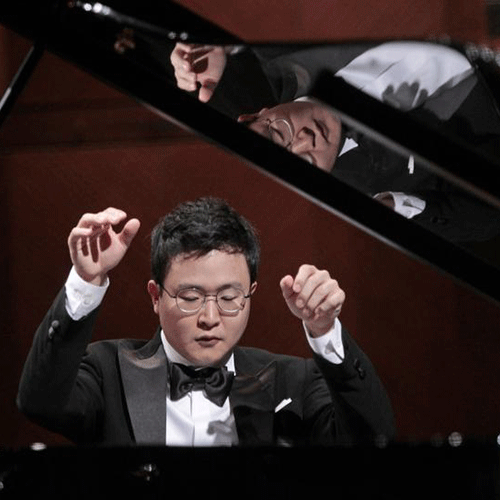
Yekwon Sunwoo
Photo: Philadelphia Chamber Music Society

“Sunwoo’s opening was utterly assured in its relaxed confidence, disposing of the keys with easy liquidity so that we were leaning forward in our seats to capture every nuance of interpretation”

Editorial Rating:  5 Stars Outstanding


I have written before of the RSNO’s skill in concert programming, often successfully juxtaposing contrasting yet somehow complementary works. Friday’s concert was to be a full blown Romantic affair in the Russian 20th century genre starting with the exquisite and rarely performed Vocalise, but, alas, illness, so common in the concert world at this time of the year, forced a programme and artist change. No Vocalise. Instead, we got Zulu, by British composer Daniel Kidane (b.1986). Quite a change.


Yet after the initial upset there was no room for disappointment. Jose Luis Gomez stood in for the indisposed Christian Macelaru at the last minute and arrived from America with a score of the symphony in his pocket. “Who doesn’t travel with Shostakovich 12?” His credentials were impressive, Assistant to Paavo Jarvi at the Frankfurt Radio Symphony Orchestra and in 2010 winner of First Prize in the Solti Conducting Competition. Currently he is Music Director of the Tucson Symphony Orchestra.


Prize winning credentials were also the order of the day for piano soloist Yekwon Sunwoo, prizewinner at the 2017 Van Cliburn International Piano Competition, and the programme change from Rach 2 to Rach 3 was in fact a welcome change from the much played second concerto to its slightly less well known, but in every other way equal sibling.


So on to the playing. Zulu was five minutes of noise. Enthusiastic brass playing, well orchestrated, good rhythm and momentum. Composer Daniel Kidane has studied at the Royal Northern, Royal College and privately at St Petersburg. The work was chosen from his participation in the RSNOs Composers’ Hub. It was a conceptual stretch to include it in the programme, but it made for a lively opening.


Next up was Rachmaninov’s Piano Concerto No 3 in D minor. I have seldom heard this work played so well, certainly not in the hands of a 21 year old. Sunwoo’s opening was utterly assured in its relaxed confidence, disposing of the keys with easy liquidity so that we were leaning forward in our seats to capture every nuance of interpretation. As the first movement Allegro ma non tanto developed so did Sunwoo’s attack, holding nothing back yet stopping way short of pastiche. You do not have to wear Rachmaninov on your sleeve to get the best out of of it. The RSNO accompanied him with playing that was glorious in its phrasing and intensity. The work has long solo and barely accompanied passages, not exactly cadenzas, but close. Time and again Sunwoo nursed and coaxed freshness of interpretation from this well known, much loved piece. Notwithstanding 45 minutes of bravura playing we were treated to an encore. The quiet and restful interpretation of Tchaikovsky’s Autumn Song from the Seasons lasted a full five minutes bringing the dramatic first half of the evening to a relaxing, introspective close. If you don’t know it, find it here on You Tube.


The second part of the evening was an assured, storming interpretation of Shostakovich’s 12th Symphony The Year 1917. Written in 1961 when Shostakovich was still not out of the political woods it is obviously a political work but without taking anything away from its inherent musicality. “Revolutionary Petrograd” started with typically haunting, bleak cellos and basses suggesting barren topographical (and political) landscapes full of desolation and foreboding before being joined by the upper strings in a more purposeful and positive timbre. Played continuously for 40 minutes the demanding work gave the whole orchestra, from expertly played woodwind soloists to stunning percussion, the opportunity to give the best possible account of themselves, which they did. The work built up though tableaux such as “Razliv” (Lenin’s revolutionary headquarters), “Aurora” (the battleship that fired the opening shots of the Bolshevik coup) and, finally the optimistically named “Dawn of Humanity” which was at least in musical terms a summation of all the themes that had gone before, and gave the orchestra the opportunity to demonstrate fluent, assured playing that whilst on occasions very loud, was never forced.


I have often said that one of the reasons live music is so exciting is the risk of failure. Here we had a last minute change of two out of the three pieces in the programme and a conductor no one had met or played under before the previous day. The result? Perhaps the most exciting and enjoyable concert I have been to this year. The RSNO continues to improve and impress


StarStarStarStarStar

Reviewer: Charles Stokes (Seen 10 November)

Go to the RSNO, Scotland’s National Orchestra

Visit Edinburgh49 at the Usher Hall archive.

RSNO: Oundijan; Vogler; Wang. Usher Hall. 3 Nov.’17

Related image

Jan Vogler

“Great if you like twelve-tone. Not so great if you don’t”

Editorial Rating:  4 Stars


Combined concerti for violin and cello are relatively rare, and on Friday at the Usher Hall we got two, separated in composition by 128 years. Such was the nature of the new work, however, that it was more like a comparison of the Viennese Salon of the 1890s and the 1930s’ Second Viennese School.


As is his custom, conductor and Director of Music Peter Oundjian gave us an introductory talk alongside cello soloist and this year’s Artist in Residence Jan Vogler. Not unreasonably, the majority of the talk was about the UK premiered work Duo Concerto by Wolfgang Rihm. Rihm was born in 1952 in Karlsruhe and is a professor of composition at the University of Music there. The work was commissioned by the Friends of Dresden Music Foundation to celebrate ten years since the reopening of the Frauenkirche and received its world premiere in Purchase, NY and in Europe in Dresden in 2015. It was written for performance by Vogler and tonight’s violin soloist, Mira Wang. Vogel’s association with the work, and his being the orchestra’s Artist In Residence, explains its choice on tonight’s programme in addition to its legitimacy as a composition.


The work lasts for 25 minutes in one movement. The soloists are in play almost the entire time, and the work has a heavy texture and is written in the twelve-tone technique. “Great if you like twelve-tone”, said Vogler. “Not so great if you don’t”. The work in fact had momentum, good orchestration, and a particularly demanding part for violin soloist Mira Wang. It was, perhaps, down to the limitations of twelve tone that it sounded remarkably similar to Schoenberg albeit composed seventy years later.


Our hardworking soloists carried straight on into the Brahms Double Concerto in A minor. Brahms is the master of melody, and we were into a glorious cello theme just four bars in. Whereas Wang did most of the heavy lifting in the Rihm, this work was Vogel’s and in fact a case could be made for writing out the violin part altogether, taking nothing away from Wang’s fine playing and   interplaying with Vogel beautifully when the score allowed it. The orchestra played with excellent phrasing and balance and were clearly very comfortable in their skin, supporting the soloists with all effortlessly harmonised under Oundjian’s baton.


After the interval we returned for Beethoven’s Symphony No 6 in F major, the ‘Pastoral’. What can a music writer add to the reams that have already been written about this glorious work? Well, you could feel the hall relax as we snuggled into this closing number, the orchestra were on top form, fully rehearsed and sure of foot, and familiarity did not disappoint. One notable difference in interpretation were the strings playing of the first subject in the final movement (Shepherd’s Song), Oundjian holding them back just a little so we could hear more of the supporting wind. He bought them back to the fore before the finale.


And did you know the Shepherd’s Song was used as music in the TV commercial for Lentheric’s Tweed fragrance in the 1960s? Now, you will find that degree of historical research only in Edinburgh49.


Star (blue)Star (blue)Star (blue)Star (blue)

Reviewd by Charles Stokes (Seen 3 November)

Go to the RSNO, Scotland’s National Orchestra

Visit Edinburgh49 at the Usher Hall archive.

Our Fathers (Traverse: 24 – 28 October ’17)

Rob Drummond (l) & Nicholas Bone (r)
Photo by Mihaela Bodlovic

“‘All Things Bright and Beautiful’ this is not, as a caustic version makes clear.”

Editorial Rating:

4 Stars: Nae Bad

Yet this is a kind piece, just possibly milder and more forgiving than its writers first intended. Rob Drummond and Nicholas Bone got together – which is a mighty draw in the first place – and offer Our Fathers as a sincere appraisal of their own lives as the doubting sons of clergymen. Their text – for this is a messaging service too – is Edmund Gosse’s celebrated memoir Father and Son (1907) with its epigraph, ‘Belief, like love, cannot be compelled’.

 Written and performed by Rob Drummond and Nicholas Bone, I should add, which is testament to the play’s personal and affecting quality. Whilst they take the parts of Philip Gosse (Drummond) and Edmund (Bone), they are also themselves, appearing friendly and unassuming, and only getting cross with one another rather than with the world. If anyone disappoints, and it is as sorrowful as it is a raging disappointment, it is the God of their fathers, who has definitely messed up. ‘All Things Bright and Beautiful’ this is not, as a caustic version makes clear.

Gosse the father was a biologist as well as an evangelical churchman, putting him squarely in the round hole of being a Christian scientist. He could write Evenings at the Microscope (1859) and still find plenty of time to rubbish the idea of evolution. One of his vivid illustrations of a jellyfish is revealed in the church hall cupboard, upstage right. Karen Tennent’s jewel of a set, so precisely lit by Simon Wilkinson, is particularly successful at focusing attention. The Victorian underslip is puzzling (a beloved dead mother?) but the fossils next to the plain wooden cross speak volumes. And there’s the fishbowl in which to dunk the book – [Told you that they get cross]. There’s an available reference to Prospero, promising to drown his learning [Like hell he will!] but then you could see it as some inventive gloss on baptism, which Drummond is especially keen to dish and seeks audience support to do so.

In Chapter 1 of Father and Son Edmund Gosse writes, ‘Several things tended at this time to alienate my conscience from the line which my father had so rigidly traced for it’. That ‘line’ is in the severe  clerical dress, the chalked up 5th commandment, and in the earnest hymn singing, but there’s also the sheer size of Philip (Drummond) alongside the much slighter Edmund, who draws up his little chair to his father’s big table. So it’s amusing that it’s Nicholas Bone who stands firm against Rob Drummond’s pleading to ‘play’ the son and it’s sad when young Edmund’s prayers fail and his looked-for faith is nowhere to be seen.

But all told Our Fathers is an easeful piece. Drummond makes light of the ribbing he got at school for ‘being the son a preacher man’. Hopefully it was good-natured, for let’s presume that he was, indeed is, ‘the sweet talking son of a preacher man’. Both men – tricky to call them actors at this affectionate point – hold up photographs of their fathers, whose recorded voices we hear.

On reflection, which is very much the point, I’m with the storyteller of Genesis 1:31: ‘God saw everything that he had made [including sons], and, behold, it was very good.’ This original, deceptively modest work, is also very good at what it asks and does.

nae bad_blue

Star (blue)Star (blue)Star (blue)Star (blue)

Reviewer: Alan Brown  (Seen 25 October)

Go to Our Fathers at the Traverse and touring with Magnetic North

Visit Edinburgh49 at the Traverse archive.

RSNO: Norrington (Usher Hall 21 Oct’ 2017)


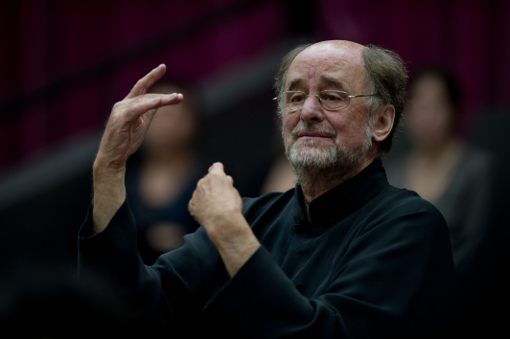
Sir Roger Norrington
Photo: Alberto Venzago

“Sometimes good things come in small packages”

Editorial Rating: 4 Stars


There was much more to Friday’s excellent RSNO/Roger Norrington gig than met the eye. Of course it was a thrill to be in the hands of the maestro of historically informed musical performance, last seen here at the Edinburgh Festival for his assured and thrilling Monteverdi performances, as well as for the reassurance of an evening’s accessible, if not easy listening, classical music. Yet we got so much more, namely an insight into the deceptively futuristic ahead-of-its-time works of Robert Schumann and Felix Mendelssohn-Bartholdy.

The first question one was forced to ask oneself was, “When is a symphony not a symphony?” The initial work, Schumann’s Overture, Scherzo and Finale was originally titled Symphonette and played out in three movements in around 19 minutes. Both Prokofiev and Shostakovich wrote symphonies of lesser duration, the former at the beginning and the latter towards the end of their symphonic canon, so why the name change? In admittedly three movements rather than four, it was greater than the sum of its parts and was a satisfying, rounded piece developing all the way through towards a Finale: Allegro molto vivace that was recognisably mature Schumann as compared to its more Mozartian beginnings.

After the deftest of scene changes (only three first violin desks to move out of the way in this cut down band) to bring on the concert grand Steinway, Roman Rabinovich delighted us in a relaxed, assured and thrilling interpretation of Mendelssohn’s Piano Concerto No 1 in G minor.   In an underrated work clearly ahead of its time – that reminded me of Brahms and Tchaikovsky a generation later  – we were treated to excellent solo and ensemble playing of a dramatic operatic opening followed by a strong melodic line and taut together playing under Norrington’s understated, enabling direction.

The evening concluded with Schumann’s Symphony No 1 in B flat minor (Spring). I cannot find any reference to Tchaikovsky being influenced by Schumann in his ground breaking fourth symphony but the opening two bars of the Spring symphony were near identical. The orchestra were sufficiently beefed up for this work to make one forget it was contemporaneous with the opening number. We went from two French horns to five, nought to three trombones and were full on for more than half an hour. The playing and direction were disciplined and effective with well-managed crescendos and an elaborate brass coda in the first movement. The band continued to provide a rich tone in the second, but in the elaborate and extended finale, following on a beautiful flute intervention, the brass gave into themselves showing tone a little coarsened by virtue of their evident enthusiasm. Never mind, this was joyous music making.

As I left the auditorium I noticed that I was leaving at the remarkably early hour of ten past nine. We had, in fact, just one and a quarter hours of music making when on a good night one can expect nearer two hours. Yet it was a well-put together programme and hard to see how it could have been justifiably fleshed out. Some times good things come in small packages.


Star (blue)Star (blue)Star (blue)Star (blue)

Reviewer: Charles Stokes (Seen 20 October)

Go to  the RSNO, Scotland’s National Orchestra

Visit Edinburgh49 at the  Usher Hall .

Hedda Gabler (Festival Theatre: 17-21 October ’17)

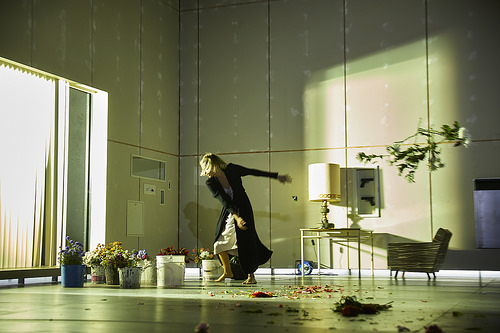
Photo. National Theatre, London

“Glistens with sparkling elements”

Editorial Rating: 3 Stars

I wonder if there is a word, other than bewilderment, for the reaction to a writer who receives praise despite mediocre work. This is what Patrick Marber’s writing stokes inside me. His re-writing of Henrik Ibsen’s Hedda Gabler is by far the most lamentable element of this National Theatre production, which sometimes glistens with sparkling elements, but includes far too many misjudgments at the head-in-hands level .

To name a few: Leonard Cohen’s lovely yet done-to-death “Hallelujah” plays over a somber transition. Pale blue lights shine intermittently on the assembled actors, for no apparent reason. Physicality is dishearteningly overplayed at times, making the performers appear more like wet marionettes than characters telling a story. And yet, Marber’s script outdoes them all.

The play concerns itself with a day and a night in the apartment of academic wet blanket Tesman and the eponymous Hedda, his new, unfulfilled wife. Friends and former lovers of theirs come and go to moan and wail about their various woes, from dead-end marriages to unrequited love to jealousy over academic rivals’ successes. There are intriguing elements to these episodic entrances and exits, most compellingly when Tesman’s semi-rival Lovborg lays out his plan for his next work. This is what most frustrates about this show: there are so many glimmers of intriguing theatre, many stemming from Ivo Van Hove’s smart (yet here unexceptional) direction, but they are all but snuffed out by Marber’s tone-deaf phrasing and (I hazard) self-importance.

Hedda, a groundbreaking and fresh character in 1891, is nowadays much less extraordinary. She is the daughter of a prestigious general, and a young woman with many suitors, yet lacks any real goals or interests in life. This “poverty of spirit” as the play decides to call it, leads her to seek out increasingly sadistic means of exerting some kind of power over something, whether it be tearing up flowers or firing her father’s pistols at unsuspecting guests, and eventually much worse. This kind of bourgeois-fetishizing story creates just the sort of middle-of-the-road tension and intrigue that should be right up Marber’s alley. Is Tesman going to get his professorship? Is Hedda fulfilled? What is that maid doing there? Yet Marber seems to think he doesn’t need to convince an audience to care about these central questions of the script. So he fails to.

Much like in his magnum opus, Closer, Marber’s word choices can prove unfortunate and even unpleasant. The storyline is treated with such carelessness that it is unclear whether it is satirizing its own pomposity or reveling in it. It looks like Ibsen’s text has suffered a form of quantitative easing and the original is struggling to get back into shape. Certain big monologues (that strain the runtime for no apparent reason) are answered by brief ironic retort: when one character loses the precious, handwritten single draft of his upcoming masterpiece, he waxes poetic for no less than five minutes about his loss — to which another character quietly quips: “It’s just a book.” Somehow, this self-awareness gets squashed and replaced with showiness and shiny things.

There are many shiny things. The set is the unfurnished apartment owned by Hedda and Tesman and is immaculately underdressed. Hedda’s costume is a shiny nightgown. The lights gleaming out of an impressive side window are shiny, as is the display Hedda creates as she plays with the blinds out of increasingly aggressive boredom. The two handguns on show in their upstage glass case  are shiny, and even shinier when they are — spoiler alert — fired at certain characters. But shiny objects do not tell good stories by themselves. We seem to have a production that thinks having a smooth set and glossy production values can make up for a certain percentage of the narrative. They cannot. Some more work on character dynamics and relationships and a little less time stapling roses to walls would have helped quite a lot.

That being said, there is still much to be appreciated in the production. For their stamina alone, the actors deserve some credit. Wading through these lines with such patience must have been hard. Lead actress Lizzy Watts gives Hedda some delightfully cruel ticks, from turning her back on anyone she finds unworthy, to consciously tormenting her guests with their worst vices. Her dynamic with Richard Pyros, playing Lovborg, was the most electric to watch, especially as she toys with his teetotalism in the most vicious way. Adam Best as corrupt judge Brack is the most bombastic onstage presence by far, and his was a refreshing performance. Annabel Bates is good at looking sad, that’s for sure. Abhin Galeya waves his hands around far too much, but otherwise is a solid Tesman — though the character seemed meant to be much more pathetic than the relatively proud man Galeya has created. Christine Kavanagh is a charming red herring at the beginning, as her Aunt Juliana character deftly introduces the audience to the show, then disappears — which is a shame, as Kavanagh’s energy was possibly the best-measured. Madlena Nedeva is a solemn and well-crafted presence as Berte, the maid, yet her character is so untapped that she quite literally becomes more a piece of furniture than a participant.

Overall, an underwhelming and overwritten production of an important play. It is surprising and disappointing that others have eaten it up nonetheless.

Star (blue)Star (blue)Star (blue)

Reviewer: Nathaniel Brimmer-Beller  (Seen 17 October)

Go to Hedda Gabler at the Festival Theatre

Go to Edinburgh49‘s Festival Theatre archive.


Love Song to Lavender Menace (Lyceum Studio: 12 – 21 October ’17)

16.(L-R) Matthew McVarish and Pierce Reid. Photo credit - Aly Wight

Matthew McVarish and Pierce Reid. Photo credit – Aly Wight

“A delightful gem of a show”

Editorial Rating: 4 Stars

Bookshops, especially independent ones, often have a comforting and homey feel to them, providing a peaceful sanctuary and hidden paradise of worlds waiting to be explored. Indeed, that’s what Lavender Menace proved to be for many of those that visited it back in the 1980s, as Edinburgh’s foremost seller of LGBT and feminist literature – and that same feeling is what James Ley’s latest play captures in his moving and comical tribute not just to that shop, but to Edinburgh’s gay scene at the time, and the colourful characters that made it.

Set during the night after the shop’s final day’s trading, we meet two of its employees, Glen (Matthew McVarish) and Lewis (Pierce Reid) who spend the night packing away the books, while reminiscing and creating an homage about the place to perform for its founders the next morning. The pair recount how the bookshop came to be, the antics that occurred, and how their own friendship has developed during that time. It’s a simple setup, and while a little lacking in dramatic tension to really drive the piece forward, the stories themselves are easy to engage with, Ros Phillips’ direction keeps everything moving at a decent pace, and there are many laughs to be had throughout the various capers presented.

What’s most delightful about this performance is the vitality and honesty that oozes from its stars Reid and McVarish. The duo are instantly likeable storytellers, while their skill at multi-roling with speed and dexterity must also be applauded. Watching a full-length play with just two actors can sometimes be a bit of a slog, but this one flies by like an evening spent with good friends. Ley’s writing on the whole is very natural, providing some genuinely lovely snapshots of the shop’s history, but it’s Reid and McVarish who really bring those snapshots to life.

It’s a shame the structure of the play goes a little awry in the second half with various seemingly random changes in time, place and character. While such devices work smoothly early on in the production, seamlessly weaving together the different stories, it becomes much harder to follow as the piece progresses. Perhaps something around the hysteria of the characters, who have clearly been up most of the night by this point kicks in, but the tightness of Ley’s writing does unravel somewhat. For me, the love story between the two also seems a little shoe-horned in for dramatic effect, though its resolution is ultimately satisfying.

Overall, this is a delightful gem of a show, which, like a well-loved bookshop, might not be as glossy and polished as the more mainstream ones, but is definitely one I would be happy to visit again.

Star (blue)Star (blue)Star (blue)Star (blue)

Reviewer: Steve Griffin (Seen 13 October)

Visit the The Lyceum archive.

THIS REVIEW HAS NOT BEEN SUBEDITED

Cockpit (Lyceum: 6 – 28 October ’17)

Photo. Mihaela Bodlovic

“Director Wils Wilson goes all out to create predicament and danger”

Editorial Rating: 4 Stars: Nae Bad

Albert Camus’ La Peste was published in June 1947. The first Edinburgh International Festival was in August 1947. Bruno Walter conducted the Vienna Philharmonic in the closing concert and reckoned that “Here human relations have been renewed”. Bridget Boland’s Cockpit opened at the Playhouse, London, in February 1948 and mashed pestilence and optimism together. Now it’s back, thanks to David Greig, and fit for purpose: a raw and vehement history play, but without princes and kings.

London’s Cockpit theatre was on Drury Lane. It was probably another ‘Wooden O’, built around an actual cock pit. Boland’s play goes one better than Shakespeare’s Henry V, her ‘swelling [and vicious] scene’ holding not only ‘the vasty fields of France’ but the whole of Europe. Cockpit is actually set in a theatre. You get the immersive idea pretty quickly when you notice that the Lyceum has been commandeered by the ‘Allied Government’. It’s late 1945, it’s punishingly cold, and there’s still the reverberation of pulverising bombardment. We’re in the British Zone of Occupied Germany and a theatre is being used as an assembly centre for displaced persons (DPs), hundreds of them. They’re even huddled on the stage. Cast-off clothes are over the backs of the seats. There are ladders from boxes, screened by sacking, to the Stalls and – we’re told – German corpses in the boiler room. Transport is being arranged to take you home (whether you want to go back or not …).  You in the Dress Circle are going West. Those of you in the Stalls are going East. Jiri, on stage and silent, is from Lidice and has no home left. Willkommen im Umwelttheater!, as ingeniously constructed by designer Ana Inés Jabares-Pita.

It is a babel of Slavic voices and trouble. But surely a British officer can sort this lot out, provided he has a desk and reason on his side. Young Captain Ridley has been detached from his regiment because he has School Certificate German. He does have his service revolver. His sergeant, Sergeant Barnes, has no German, just loud Geordie and a Sten gun. Between them they put on a brave ‘show’ – in the choice Army sense of the word – but there’s a limit to how long they can just ‘Carry on’.

Conflict starts with ‘Who’s pinched my sauce pan?’ and very quickly turns serious, not least because the Poles hate the Jews ( – ouch!) and the Russians will kill the Poles and the Chetniks will kill anybody, especially socialist partisans. A French collaborator – but forced labour would qualify that – is certain that Marie, a Resistance fighter, will falsely denounce him. Add infectious disease and Capt. Ridley is in a desperate jam. There is some rallying round but a different kind of ‘show’ is needed to relieve the tension; after all, we’re in a playhouse. When it comes, two thirds through, we get an operatic cloth and a bravura performance from Sandra Kassman.

(L-R) Nebli Basani, Peter Hannah, Dylan Read (Bauer), Sandra Kassman (stairs), Kaisa Hammarlund (stairs) and Adam Tompa. Photo. Mihaela Bodlovic

This is Boland’s brilliant conceit. When the German stage manager, Bauer, says “You will need the theatre – afterwards”, you believe him. And when faced with the possibility that his theatre – probably one of the few buildings left standing in his flattened city – might be burnt down to halt contagion, the man is stricken with sadness. Bauer (Dylan Read), as comic denizen of his place, living in the flies, and true Propsmeister, is almost the only source of laughter in an otherwise sombre drama. Read also plays Duval, whose occasional spoken French, is so good that you appreciate the difficulties of staging a script that demands heavily accented English from several characters. Whatever ‘European’ means, this cast is it.

Director Wils Wilson goes all out to create predicament and danger. A chant is either angry or sorrowful and certainly incomprehensible (unless you’re Romanian). Rush and hurry can subordinate the personal stories. There is a stretch of choreographed movement for the whole company that would express the plight of the displaced anywhere, at any time. The excellent music by Aly Macrae is often discordant and broken, except for the quiet piano at the beginning of the second half. Capt. Ridley (sturdy by Peter Hannah) might be resolute, almost heroic, but it’s not enough. There is a passing mention of a major somewhere else but the chain of command appears well and truly absent, which will irritate Army types.

Cockpit is bold work, both then and now. It is theatrical but – more importantly – it’s humane. A Russian DP proclaims “20 million Russians died. It must not happen again”. That’s from the Stalls, going East. Primo Levi, after Auschwitz and going West, got it exactly right: ‘It happened, therefore it can happen again’.

nae bad_blue

Star (blue)Star (blue)Star (blue)Star (blue)

Reviewer: Alan Brown (Seen 10 October)

Go to Cockpit at the Lyceum

Visit Edinburgh49 at the The Lyceum  archive.

Jury Play (Traverse: 3-7 October ’17)

“The fourth wall isn’t so much broken as shattered”

Editorial Rating: 4 Stars: Outstanding

Sometimes the power and excitement of a show begin long before you take your seat, and remain with you for several days after. For Jury Play, a detailed email briefing is circulated in advance of the performance/court appearance, creating intrigue into what the evening will entail: it’s worth saying at this point that this is in no way like your standard trip to the theatre. The excitement only builds as you go through “security”, enter the (optional) ballot to become a jury member, and start to leaf through your court information pack while taking in Emily James’s impressive and sizeable courtroom set.

Yet what, on the surface, appears to be conceived as an interactive courtroom drama, where the prosecution and defence present facts about a given crime and a resolution is reached by the audience/jury, what Jury Play peels away at is what effect the trial process has on individual members of the jury, specifically for trials that last for weeks.

At various points during the trial, voiceovers expressing jury members’ thoughts are overlaid with the action, which include worries about getting children to school, paying bills, what specific legal terms mean, and even staying awake. Snippets of video conversation between writers Dr Jenny Scott and Ben Harrison about the performance also add a pleasingly Brecthian feel and help break up some of the monotony of the trial itself. So far, so so. Everything changes in Act ii, however, when the formal trial is over and the power lies in the jury’s hands. I won’t give away all the spoilers, but I shall simply reveal that organised chaos ensues, and the meat of the piece really comes out as an intelligent, human, and common sense discussion into the way we conduct trials.

When it comes to the performance it is John Betts as Judge who commands the show, and with his hilarious doddery asides and sensitive chairing of the discussion in the second half of the piece, you feel like you’re in his space, and he decides at any given point how comfortable anyone is to feel. Helen Mackay is also excellent as the conscious “everyman” figure Janis, who just wants to do her duty, and the cast as a whole make the performance very accessible: the fourth wall isn’t so much broken as shattered, with a piece of it distributed to each and every person in the room.

For me, though perhaps a reflection on the subject matter it discusses, Scott and Harrison’s script is too laboured and lengthy at points – missing some crucial details to aid comprehension in the first half, and dragging out its point in the second. The ending, while interesting and fitting stylistically with the piece, also feels like a bit of a cop-out and rather abrupt – as if the ideas just ran out at that point and there was nowhere else to go.

Overall this is a fascinating insight into the legal system, what it’s like to be a jury member, and how seemingly unfit for purpose the whole setup is – especially for people like me who have very little knowledge of its intricacies. Jury Play is absolutely worth taking part in, if there’s any room left in the public gallery.


outstanding

StarStarStarStar

Reviewer: Steve Griffin (Seen 5 October)

Visit the Traverse archive.

THIS REVIEW HAS NOT BEEN SUBEDITED