RSNO: Leticia Moreno; Thomas Sondergard: Usher Hall: 6 May ’16

“They really went for it full on, you got everything you wanted and hoped to hear, but it was never over the top…..terrific playing…..quite something!”

Editorial Rating:  4 Stars:  Nae Bad

The RSNO’s Friday night Edinburgh concerts really set you up for the weekend, and last Friday’s cornucopia of delights was eagerly awaited: Bartok and Stravinsky, an orgy of brass, dissonance and full on orchestral razzmatazz. We were not disappointed.

There was much in the plots that drove the ballet suite parts of the programme that was descriptive writing of the louche – if not actually sordid – kind, not to mention the fecund. Robbers setting up a young girl as bait, consent to coition in order to effect the death of the punter, and Spring as the enduring symbol not just of birth, but of fertility, and finally the sacrifice of a virgin to appease, one suspects, not only the Gods but also senile and jealous Elders. No wonder the performances as ballets caused such a stir in the early part of the twentieth century.

First off was Bartok’s Suite from the ballet The Miraculous Mandarin. As for the story, Google it for all the gory details, but suffice it to say the premiere in Cologne in 1926 (conducted by none less than the composer Erno Dohnanyi) caused catcalls, whistles, boos, stamping and a walk out by the clergy present, with the work being banned in a number of cities. Nothing could do more to promote the piece. As for the music, well, exciting is not a strong enough word, and what impressed me is how the band got into the groove of this really quite demanding work straight away: dissonant, chaotic, resemblant of street life, some pointers to Walton’s Belshazzar’s Feast. The lilting, seductive melodies supplanted by raucous, glorious trombones and brass in general, with the strings coming in at the end and taking us away like furies. Wow! A great start to the evening, twenty minutes of exquisite bombast.

There followed Stravinsky’s Violin Concerto played by Spanish violinist Leticia Moreno on a 1762 Gagliano. The Concerto as a musical form is often compared as either a contest or a love affair between soloist and orchestra, with early examples (e.g. Vivaldi) featuring the soloist as first among equals, and later composers taking the soloist more out front. This latter approach is inherently more difficult with instruments such as the violin and guitar that find it difficult through volume limitations to stand out as a piano or trumpet would, and this limitation is the more obvious in later, more heavily orchestrated works, of which the Stravinsky is certainly one. Only in the second and final movements did the soloist really come to the fore, with a lightly supported melody in the second, and a lively toccata in the fourth enabling her to do so. Elsewhere conductor Thomas Sondergard was doing what he could to restrain the orchestra without rendering them inaudible. This also resulted in too soft playing from the clarinet so unfortunately the performance as a whole of this underestimated, supposedly austere work never quite satisfied. The audience nonetheless delighted in it and sent the players off to the interval with enthusiastic applause ringing in their ears.

The last work of the evening was Stravinsky’s  The Rite of Spring, a brilliant choice of programming given the glorious Spring day that was now drawing to a close. The playing here was absolutely first class with spectacularly clear and well articulated woodwind – not at all outdone by the “heavier” brass – playing with real clean attack and verve; but by the time the work was over you knew that everyone in the 105 piece band had had their moment in the sun, from the ten timpani, three huge Wagner tubas, seven trumpets, eight horns, washboard, rattle, tam-tam etc. – get it? The strings soared gloriously and one was reminded that, as is so often the case, although this sounded like it was chaotic, it is in fact a highly structured, cleverly orchestrated work that raised the roof and actually caused a riot when it premiered in Paris in 1913. One hundred years on its excitement and sheer jaw-dropping daring nature does not pale and the RSNO gave the sort of performance a seasoned concertgoer loves. They really went for it full-on and you got everything you wanted and hoped to hear, but it was never over the top. Terrific playing with the structure and discipline that strong composition enables. Quite something!
 

nae bad_blue

Star (blue)Star (blue)Star (blue)Star (blue)

Reviewer: Charles Stokes (Seen 6 May)

Go to the RSNO here
Visit Edinburgh49‘s Usher Hall archive.

The Iliad (Lyceum: 20 April – 14 May ’16)

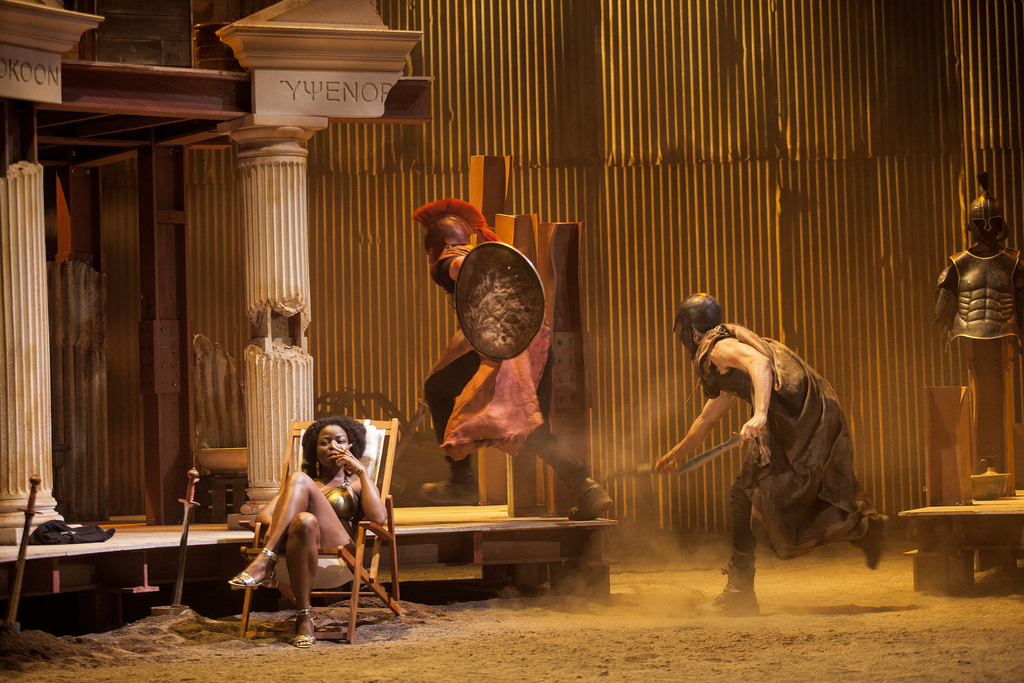
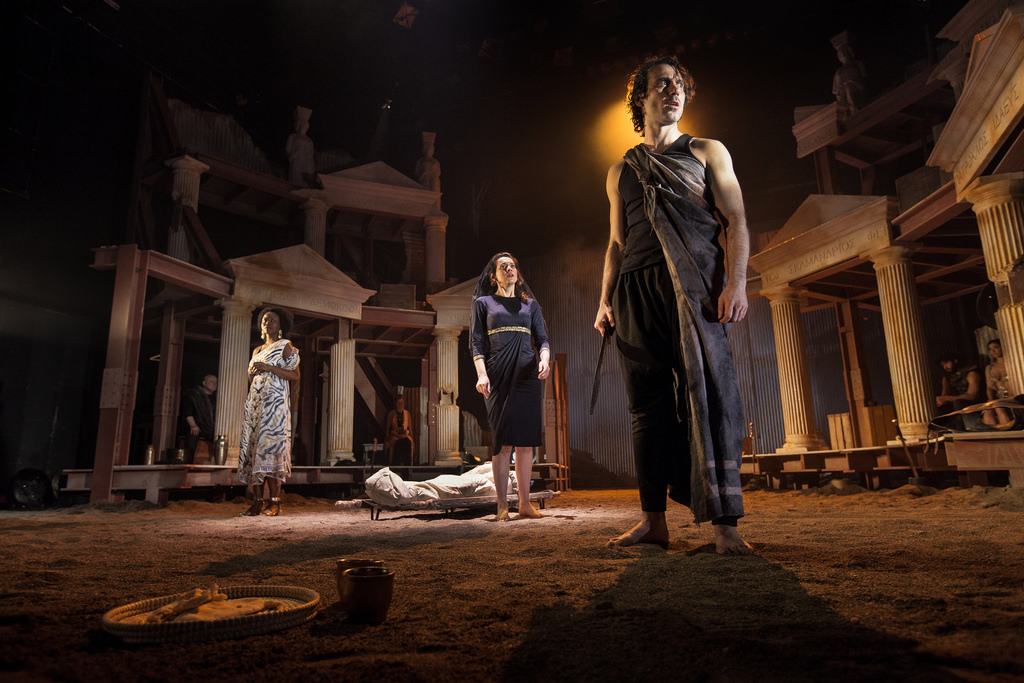
Ben Turner, downstage; Melody Grove, centre; & Emmanuella Cole, upstage.

Ben Turner, downstage; Melody Grove, centre; & Emmanuella Cole, upstage.

“This Iliad is forcefully staged and has the vehemence and colour of its core story.”

Editorial Rating:3 Stars Nae Bad

Mark Thomson’s last production as Artistic Director of the Lyceum for the past 13 years.

It is unsurprising that there’s plague about. There are no zips on the body bags on this beachhead and the Scamander River is full to overflowing with the dead. There’s Achilles’ refusal to dispose of Patroclus’s corpse until after he has killed Hector and then there’s the desecration of Hector’s body by lashing it to a chariot and dragging it through the dirt for twelve days, face down. No wonder – actually, yes, a lot of wonder is required – that Apollo took pity and ‘round him … wrapped the golden shield of storm so his skin would never rip’. Some say it was rose oil.

As epic tales go The Iliad is still the catchy, highly contagious one. It has tragic, raging action, love and sex, heroes and honour. There are no villains to speak of, just the ‘terrible beauty’ of Helen and the ‘smooth, full breasts’ of Aphrodite to sing of. Communicable? Certainly. Containable? Hardly.

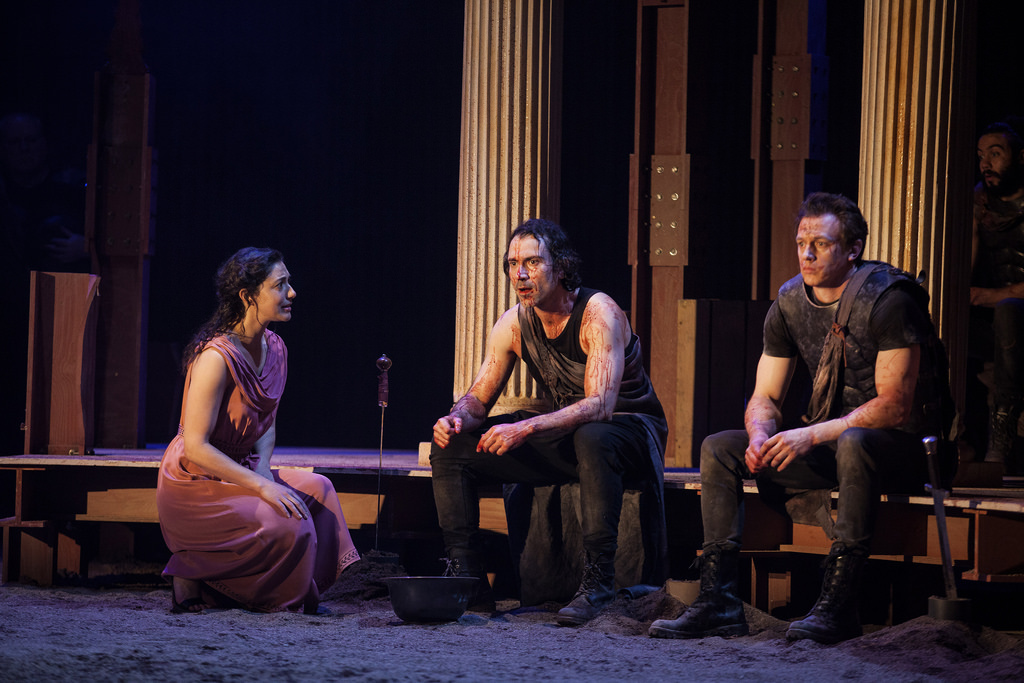
Emmanuella Cole, left; Ben Dilloway centre; & Rueben Johnson, right, as Diomede.

Emmanuella Cole, left; Ben Dilloway centre; & Rueben Johnson, right, as Diomede.

Fearless Mark Thomson takes writer Chris Hannan’s evocative script and directs an intrepid cast of twelve. Karen Tennent’s imposing set has broken columns and half pediments left and right with plenty of space and height for gods to take it easy in and for the Trojan women to look out anxiously over the ramparts. A massive wall of corrugated ‘bronze’ curves around them and the dust sometimes hangs in the air around a leather cuirass and plumed, hollow eyed helmet. The lighting design by Simon Wilkinson is as careful and as atmospheric as his work in Bondagers.

But there are 15,693 hexameter lines in Homer’s Iliad and probably as many ‘brazen spear points’ and slamming shields. What to do with them all? Thomson – to make an attractive prosaic point – starts his theatrical shebang with a baby’s cry and a cobbler hitting nails into a boot. (Think the traditional 3 knocks that alert a French audience to the start of a performance). More formally, several scenes begin and end as characters are dressed for their part, accompanied by near liturgical chant. No need though for Zeus (Richard Conlan) to dress up. His boxers and loose robe are as much Mustique as Olympus. Hephaestus (Daniel Poyser) has his iPad on the beach. ‘White-armed’ Hera (Emmanuella Cole) drifts in straight off Ebony magazine’s style pages and tells all. This is one all-mighty queen god who seems to owe her name to having had it up-to-here with her philandering husband (and brother BTW). We’re with you there, sister.

I worship Thetis,  because of passionate playing from Melody Grove, but otherwise these gods are the diverting side-show and narrative markers to the centre stage profiling of Achilles (Ben Turner). He stands, blood streaked, against all-comers, starting with ‘wine-mouth’ Agamemnon (Ron Donachie). There is pathos in the fine scene between the moping and vengeful Achilles and the shade of his beloved Patroclus (Mark Holgate) and the song at his companion’s funeral of his ‘head like a poppy drooping’ is an unlikely hit,  but it’s Thetis’s son vs. Hector (Benjamin Dilloway) that exercises fight director Raymond Short to his utmost. As well it might when he’s up against Brad Pitt and CGI – and a younger audience. Perhaps pounding Hector’s brains out is beyond even a screenplay.

Amiera Darwish, left, as Briseis; Ben Turner, centre; & Mark Holgate, right, as Patroclus.

Amiera Darwish, left, as Briseis; Ben Turner, centre; & Mark Holgate, right, as Patroclus.

This Iliad is forcefully staged and has the vehemence and colour of its core story. It is fiercely directed and there is a heart and soul to every performance, mortal or immortal, but it is so down to earth that it puts gods into deckchairs on a flyblown lido and so the topless towers of Ilium are levelled. I think it’s Hecuba (Jennifer Black) who says, ‘You clutch at emotions like clutching at straws’. That’s the problem when you go head-to-head with Homer.


nae bad_blue

Star (blue)Star (blue)Star (blue)

Reviewer: Alan Brown (Seen 26 April)

Go to The Iliad at the Lyceum.

Visit Edinburgh49‘s Lyceum archive.

Right Now (Traverse: 19 April – 7 May ’16)

Photos: Helen Murray

Photos: Helen Murray

“Funny and clever, disturbing and salacious”

Editorial Rating: 4 Stars

A Traverse Theatre Company, Theatre Royal Bath Ustinov Studio and Bush Theatre co-production.

Ben is a junior doctor. He and Alice have been together for seven years and their work/life balance is screwed. As it happens, so far so familiar. Right now they’ve been in their new flat for six months, have just got the baby’s room to do, and things will get better. Only they don’t. Instead neighbours Juliette and Gilles and their son François come right on in from across the hall ….. Meet the Fockers from Quebec, everyone: with a ‘u’, inappropriate, out of order and way, way, out of bounds.

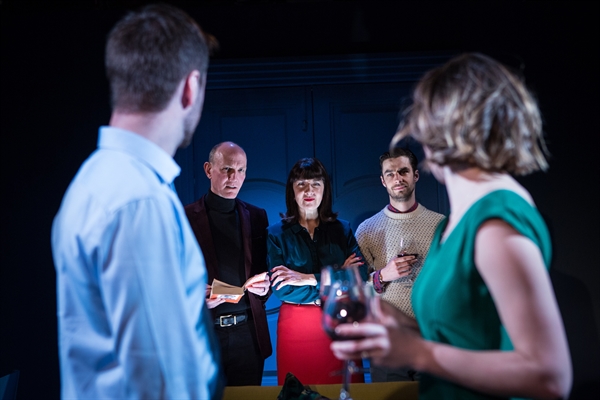
You watch your step in this pressing and uncomfortable comedy. You’re never too sure what’s underfoot or where it’s going. There’s a godawful squeaky toy behind the sofa and half a glass of red on the floor. ‘Beware’ should travel around the set like LED advertising at a sports ground. Beware Juliette with her penchant for flashing her knickers; beware Gilles’ prurient touch and tongue; beware François’s lacerating commentary. “They’re a bit odd” is Alice’s bang on estimate. “I like them” is Ben’s disastrous opinion. It’s funny and clever, disturbing and salacious, and very well performed.

Michael Boyd directs this production, which is a cracking compliment to French-Canadian writer Catherine-Anne Toupin. It looks clean, like a Farrow and Ball paint job by designer Madeleine Girling where the quality of the finish should never be in question. All the more effective, then, when a kind of moral distemper takes hold and it all gets corrupted, goes off-colour and becomes dubious. Guy Williams as Gilles is absolutely loathsome because his seduction of Alice is like a pet research project. He also, incidentally, proves that a black roll neck jumper and brown jacket are about as louche as it gets. Maureen Beattie, ever the mistress of the bewitching voice, is Juliette the mother temptress, against whom all resistance is futile. Just sticking a plaster on Dr. Ben’s hand makes him go weak at the knees. François – jittery and wacky by Dyfan Dwfor – may be appalled by his parents’ behaviour but is just as complicit.

Lindsey Campbell as Alice

Lindsey Campbell as Alice

If Toupin isolates a character, it’s Alice. The plot would push her under but she won’t go. Listen up in scene 5 for the psycho pairing of Ben (Sean Biggerstaff) and ‘Benny’ (that would be Biggerstaff too) but Alice stays there, screaming for help really. Lindsey Campbell has to do grieving and dirty dancing and horribly vulnerable all at once, which is why the sex is so desperate. It’s a class act and I think is what the show’s flier describes as traumatic, ‘teasing and thrilling’.

Right Now is as billed. It’s edgy, imminent, and contemporary, which makes it kind of Shakespearean: François as Feste maybe, Alice as the abused and distraught Ophelia; Juliette becomes Lady Macbeth, who has given suck, etc. Weird.

Star (blue)Star (blue)Star (blue)Star (blue)

Reviewer: Alan Brown (Seen 19 April)

See Right Now at the Traverse

Visit Edinburgh49‘s Traverse archive.

Ring Road (Traverse: 12 – 16 April ’16)

Martin Donaghy as Mark and Angela Darcy as Lisa. Photo. Traverse theatre.

Martin Donaghy as Mark and Angela Darcy as Lisa.
Photo. Traverse theatre.

“Both actors perform brilliantly in a small space (and on a narrow bed)”

Editorial Rating: 4 Stars Outstanding

Fifth and last in this Spring season of A Play, A Pie and a Pint.

It was the prickly cactus that did it, that brought to mind Love’s Labour’s Lost and fun puns on pricks, butts and horns. Mark notices it by the Reception desk of the hotel that’s just off the ring road. He reckons he’s there for sex (oh, not the archery then) and he’s right. Lisa does want him but it’s more his sperm than his good self that she’s targeting. She desires a baby while Mark just fancies the pants off his teacher sister-in-law. Ouch!

Anita Vettesse has written a painfully entertaining comedy and director Johnny McKnight does indeed make the pants fly off the bed. Ring Road is frisky, certainly, but it is also sensitive to what Lisa is feeling. She is 40 years old, has ‘grown to love’ her husband, but is still without a child. The pressure is on big time.

A late afternoon’s delight via Dayuse.com might be all very well but Lisa (Angela Darcy) sees Mark (Martin Donaghy) more as a ‘facilitator’, which he’s not best pleased about. He is even less keen on the idea when brother Paul (a wry, downcast voice-over from Robbie Jack), Lisa’s husband, joins them by being put ‘on speaker’. The two brothers are plumbers, sharing the same van, rather than the same women but it’s still odds-on that the dismissive reference to Screwfix is deliberate.

Mark’s spattered overalls and rigger boots look strange in the tidy, unexciting hotel room and he knows that the whole situation is just not right. Twin beds are bad enough – and that ‘art’ on the wall!- but the twitchy tension is the real passion killer. Lisa, in particular and unsurprisingly, is a bundle of nerves. At worst Mark is confused, but she is probably more conflicted at the end than at the beginning, which is touching and sadly credible.

Both actors perform brilliantly in a small space (and on a narrow bed). Donaghy does “For fuck’s sake” as baffled, happy, hurt and kind all at once, while Darcy is no less expressive, just more couth and desperate. The fact that Ring Road is also very funny is down to the quality of Vettesse’s writing.


outstanding

StarStarStarStar

Reviewer: Alan Brown (Seen 12 April)

Go to Ring Road at the Traverse.

Visit Edinburgh49′s Traverse archive.

The Silent Treatment (Traverse: 7 – 9 April ’16)

Photo: Lung Ha Theatre

Photo: Lung Ha Theatre

“A lot of barmy mischief making”

Editorial Rating: 3 Stars

Lung Ha Theatre Company is a leading theatre company for people with learning disabiities, in Scotland and internationally.

Shout it out: Lung Ha bucks trend! By the latest UK stats worker output per hour is down; well, not when you put 21 actors on stage and keep them acting all the while. All the more testing, when there’s little to no dialogue in Douglas Maxwell’s script of stage directions.

The Silent Treatment subjects its cast to keeping shtum – and alert. For the most part it is full on music and sound (by M J McCarthy) that cues the action. After Lung Ha’s Thingummy Bob with Cliff and The Shadows I had my old money on ‘Silence is Golden’ for some signature backing; but, no, that was 1967 and this play needs mobiles, scratchcards, emoticons and a chainsaw. Still, The Tremeloes’ lyrics have something relevant to say: here’s the second verse,

Talkin’ is cheap …
How could she tell? He deceived her so well.
Pity she’ll be the last one to know.

Billie (Nicola Tuxworth) thinks she has the secret to end all secrets. In fact, it’s her boyfriend (Stephan Tait) who’s got it and she won’t find it out until the end, when she will be speechless. In the meantime Billie goes with her little secret and sets out to try and wreck the sponsored silence that is being held to raise money for her mum, who’s in and out of hospital. Why would she do such a thing? That’s her secret and she’s not telling.

And, of course, no-one else is saying anything. The writing on the blackboard spells it out: SPONSORED SILENCE. No Phones (ignored), No Sleeping (impossible), No Eating (not when there’s a packet of Penguin biscuits around), No Knitting (didn’t see any), wheel noises and body noises don’t count (fair enough). It is the irrepressible Kenneth Ainslie as Toby who has real trouble with the rules but even he doesn’t speak.

Billie finds a helper in Stacey (Emma Clark) and the two of them, in and out of disguises and of the windows, do a lot of barmy mischief making under the stern nose of dominie Kitty (Kay Ann Jacobs); but it’s the four strong building crew (with foreman Mark Howie unmistakeably in charge) in high-vis vests and bowlers who do the heavy lifting, paying no attention whatsoever to Kitty’s gong.

The audience did not want to break the silence either. Hearty laughter seemed somehow disrespectful to Maria Oller’s close direction and the disciplined work of the performers on stage. With one great, if unholy, exception, the ingenious visual gags were met with appreciative chuckles rather than guffaws , and so when the end came – when it blossomed is actually more accurate – the applause was for hard study and successful work rather than for easy laughs.

Star (blue)Star (blue)Star (blue)

Reviewer: Alan Brown (Seen 7 April)

Go to The Silent Treatment and to Lung Ha Theatre Company

Visit Edinburgh49‘s Traverse archive.

Neither God Nor Angel (Traverse 5 – 9 April ’16)

Jimmy Chisholm as James VI and Gavin Wright as William. Photo: Leslie Black

Jimmy Chisholm as James VI and Gavin Wright as William.
Photo: Leslie Black

“To an eloquent vocabulary!”

Editorial Rating: 4 Stars

4th in this Spring’s season of a Play, a Pie and a Pint.

Union (2014), Tim Barrow’s second play, was full of the joys of the Referendum campaign – vigorous, disputatious, even romantic. Neither God Nor Angel, his third, is not ‘Union the prequel’ (by a century), but more of a light amuse-bouche to that earlier rich and hearty fare. This is a waggish two-hander, chummier, a pawky chamber piece.

It is an entertaining fact that James VI, King of Scotland, must have spent some part of the night of April 4th 1603 in Holyrood wondering what it was going to be like to be James I of England (& Ireland) to boot. He was away to London the following morning. Did he blow hot and cold about the whole enterprise? The Incarnation probably sprang to the mind of this godly, seriously literate and absolute monarch who, in 1598 and blessedly free of irony, wrote of ‘the Reciprock and Mutuall Dutie betwixt a free King and his naturall Subiectes’. Let there then steal upon the scene, for the purposes of comic wrangling over glasses of good Rhenish wine, one such subject.

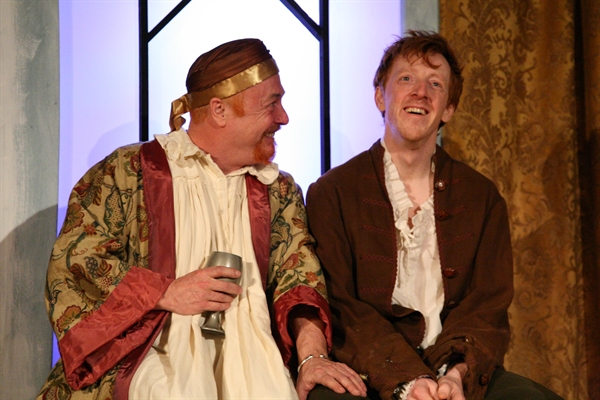
Levity, clearly, is heaven-sent. Enter gawky William (Gavin Wright) to cheek and cheer his King, who has been in peevish sorts. James (Jimmy Chisholm) welcomes – and would embrace in all innocence – the impertinent company of a serving man. Better William, any day, than those ‘devious bastards, the bankers, with their velvet draped bollocks’; and so the toast, raised by His Majesty, ‘To an eloquent vocabulary!’

William speaks Leith and James, crowned at thirteen months, speaks privilege with moments of dainty Morningside. “Would you ken where yon bottle is hid?” might well be an habitual question in Hermitage Gardens but the interesting parts, in amidst the humour, is the forgotten or unfamiliar history: Royal pal Esmé Stewart is pined for; recall of Gowrie and the Ruthven raid shakes the King; his wife, Anne of Denmark, is cherished; and William is sacked for spilling wine on John Ramsay’s silk doublet, which could have happened. I liked all this, almost as much as the use of quill on paper.

It’s a good title, Neither God Nor Angel, provided you can accept that the king’s a man for a’ that, which he ain’t really. Director Ryan Dewar and his two actors do very well with this pithy play of make-believe.

Star (blue)Star (blue)Star (blue)Star (blue)

Reviewer: Alan Brown  (Seen 5 April )

Go to Neither God Nor Angel at the Traverse

Visit Edinburgh49‘s Traverse archive.

1984 (Festival: 31 March – 2 April ’16)

Tobias Batley and Martha Leebolt as Winston and Julia in 1984. Photo Emma Kauldhar.

Tobias Batley and Martha Leebolt as Winston and Julia in 1984. Photo Emma Kauldhar.

“A spine-tingling masterpiece”

Editorial Rating: 5 Stars: Outstanding

To this day, Northern Ballet’s The Great Gatsby is the most beautiful thing I have ever seen on a stage, so I was excited and intrigued to see what the company would do with another classic novel, albeit a completely different genre and tone. What they’ve created is another spine-tingling masterpiece.

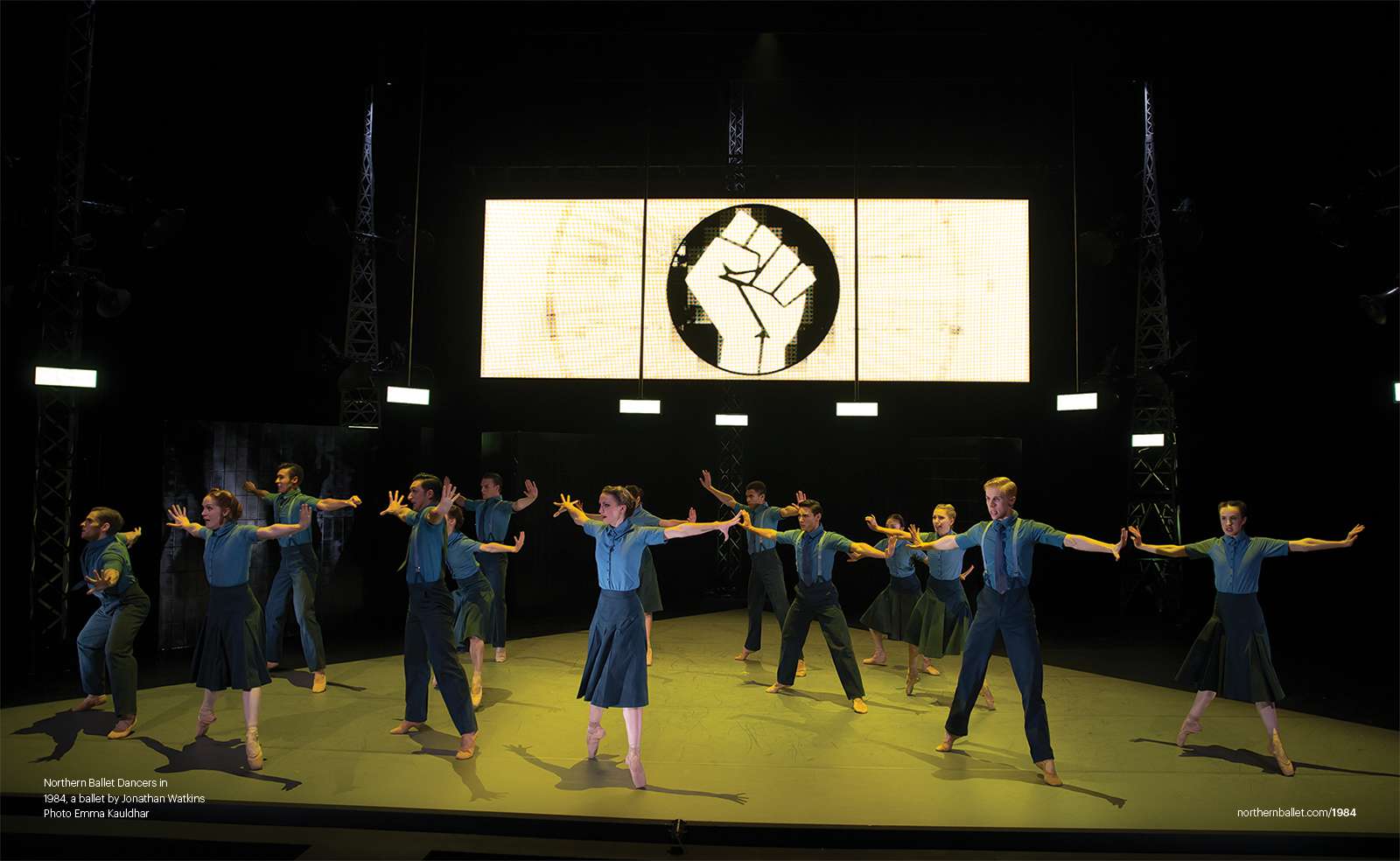
Jonathan Watkins’ choreography is created with all the intricacy and intelligence necessary to portray the complex ideas and changing moods within Orwell’s book. The workers’ unison sections are very crisp and powerful, with many recurring motifs of straight lines and triangles, both in individual movements and formation, which cleverly reflect the “all seeing eye”. Canon variations are used throughout for interest, which work very well to create production line style sequences, again very relevant to the era. In contrast, the Proles’ movements are easily identified through curves, contact improvisation and individuality of style. The lovers’ duet captures all the breath-taking beauty one might expect from a traditional ballet, while the fight scene towards the end is both graceful and gutting, as we see Winston fall and give in to the higher power.

Alex Baronowski’s score is full of accented beats and staccato rhythms which perfectly translate to the repeated motifs of the workers under the control of Big Brother, while the more romantic elements are brought out with strings and flowing, rousing melodies. Much like experimental music of the time, the orchestra uses an assortment of non-traditional instruments to create clashing tinny sounds and altogether this results in an authentic, haunting and sympathetic accompaniment to the action on stage.

Northern Ballet dancers in 1984. Photo Emma Kauldhar.

Northern Ballet dancers in 1984. Photo Emma Kauldhar.

While the relationship between music and movement are clearly intertwined, the design of this production seems equally balanced with the other elements. Chris Davey’s lighting is stark and structural, creating yet more triangles and straight lines for the dancers to follow and stay within, and Simon Daw’s set of moving walls and simple blank spaces adds to the feeling of isolation and hopelessness. Use of colour is also very powerful, from the traditional blue of the workers uniforms, to the bright yellow of hate to the oranges and browns of the Proles, this is clearly a production that pays high regard to many details, making it a joy to watch.

As can be expected in such an interpretation, not every nuance of the book is covered on stage, and sacrifices have to be made to adapt the work for this new form. It’s a shame that some sections aren’t made more of – the final quarter in particular seems a little rushed – but overall the piece strikes a fine balance between narrative progression and beauty of form. For those unfamiliar with the story this production may be somewhat difficult to follow, but even then, the artistry on display is of such high quality that it almost doesn’t matter.

outstanding

StarStarStarStarStar

Reviewer: Steve Griffin (Seen 1 April)

Go to Northern Ballet’s  1984

Visit the Festival Theatre archive.

Uncanny Valley (Summerhall: 29 – 31 March) – part of Edinburgh International Science Festival

Photo:.Borderline Theatre

Photo:.Borderline Theatre

“Educational and entertaining, well-worth taking the kids to”

Editorial Rating: 3 Stars: Nae Bad

As a child I was never particularly into science. At school the lessons were boring and didn’t challenge me to think creatively or engage with it in real life situations. Uncanny Valley, however, does both, placing today’s children at the heart of a situation we may well find ourselves in 30 years’ time.

Essentially it’s a show about humans and robots, and the difference between the two. With the world becoming ever more robotic, the subject matter is engaging for audiences of all ages and I certainly learned a thing or two about artificial intelligence and the Turing Test during the performance. While I imagine 9-year-old me might have struggled with some of the concepts and sitting still through some of the longer “lesson” parts, many of the younger audience members seemed to grasp it fairly well and engage in the interactive elements.

As a children’s piece, one can forgive a certain amount of ridiculousness and be able to suspend disbelief to still be able to enjoy the action. Credit goes to the actors for keeping the performance engaging, with boundless energy creating big, bold characters that are instantly relatable. Kirsty Stuart in particular shines as the cut-throat Mayor who’ll stop at nothing to eliminate robots in her town.

I would have liked closer attention paid to the narrative to keep it seamless all the way through: there were quite a few unexplained jumps in time and location in the story, and I never quite believed Ada’s relationship with her adopted parents. In saying that, some of the theatrical elements are very well done: the Turing Test at the end of the show is funny and gripping; the open moral discussion about whether to swerve a car off road and kill a group of chickens to save yourself is very thought-provoking, and I was even able to feel emotional connection with the robot characters of OKAY and SARA, which adds a really nice dimension.

The beginning is a little confusing – I feel that Rob Drummond as facilitator perhaps tries too hard to convey a lot of factual information early on and doesn’t seem as comfortable in parts of audience interaction as I would expect from an experienced TIE professional. These are only small moments throughout the piece though, as on the whole it’s quite slick and professional.

Overall, Uncanny Valley is educational and entertaining, and well-worth taking the kids to, as long as you’re ready for a bit of thinking! Theatrically it is a bit rough around the edges but still full of heart.

nae bad_blue

Star (blue)Star (blue)Star (blue)

Reviewer: Steve Griffin (Seen 31 March)

Visit the Summerhall archive.

International Waters (Traverse: 30 March – 3 April ’16)

International Waters 1

Photos: Tommy Ga-Ken Wan

“Almost edifying”

Editorial Rating:3 Stars Outstanding

You have to wonder. Fifty minutes into the heaving swell of International Waters when we’re all dramatically well and truly cast off, the fire alarm lights flash red and the theatre is evacuated. It has to be a Fire Exit production. And the prime minister announces that there will be no fire sale of the UK’s steel industry but it could still all go down the pan; which is pretty much where David Leddy’s new play takes us. It’s gut-churning with intent, from programme-as-origami downwards. This is theatre in the raw; its passage probably indigestible without great work by Becky Minto (Design), Nich Smith (Lighting) and Danny Krass (Sound).

For the U-bend see a cabin suite for the super-rich in the bowels of a super-tanker, complete with champagne buffet and karaoke machine. Cheaper accommodation is in assorted containers where you might be stacked next to a tiger or two. It is all rather make-do, rather urgent, for this is the last ship out of London where the banks have really, really, done their mucky worst. It’s safe to assume that the ATMs are empty and that the poor are on the streets and burning porsches. Still, if you have shedloads of ready money you can look good in white linen, enjoy the Moët, do a line of coke, and singalong to doomsday. Unfortunately it turns out that Sarah, Ben, Sophia, and Arian are in the Caliban suite for a less than delightful reason and that their ‘escape’ will end wretchedly. There’s no mage on the bridge to save them or to get them away from each other’s throats … or crotches.

International Waters 2

Down below, gripped by burning cabin fever and flushing itself out, is the fabled 1%: powerful and greedy, vulnerable and unhappy. Sarah (Claire Dargo), Ben (Robin Laing), Sophia (Selina Boyack), and Arian (Lesley Hart) go at it with astonishing abandon, pulling each other’s chains – just to stay with the scatological – and soiling themselves and their values in the process. It’s abject, messy, and ridiculous and yet the acutely angled and allusive content is almost edifying.

Leddy unships a bulk load of issues: rogue algorithms, flagrant wealth, economic migrants, drowned refugees; the paranoid survivalist versus the self-obsessed, #Blessed; Twitter storms, Old Testament retribution and the gospel strains of New Testament promise. This is one crowded ark of a stage, freighted with ideas, that spills more than it holds, deliberately upset by intemperate behaviour, bad language, and scary discordant sound. If the play is dead in the water at its conclusion, it’s not rudderless or overblown, but simply exhausted.

FYI. The show continued after the fire alarm, which says a lot about the quality of the performance and the unlikely integrity of the piece. It is preposterous and explicitly farcical, yet Leddy goes in behind the theatrical facade. He says (see programme note) that he’s also after the romantic sublime. Well, here’s Adele on a comparable course from Rolling in the Deep: “Go ‘head and sell me out and I’ll lay your shit bare.” Nice!


outstanding

StarStarStar

Reviewer: Alan Brown (Seen 30 March)

Go to International Waters at the Traverse and at Fire Exit .

Visit Edinburgh49‘s  Traverse archive.

I Am Thomas (Lyceum: 23 March – 9 April ’16)

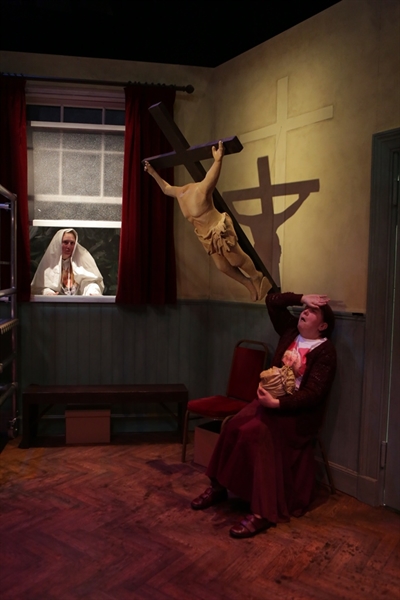
'Our God above is a God of Love' with Dominic Marsh, Hannah McPake (back), Amanda Hadingue, Charlie Folorunsho (back), Myra McFadyen, John Cobb, Iain Johnstone.

‘Our God above is a God of Love’ with Dominic Marsh, Hannah McPake (back), Amanda Hadingue, Charlie Folorunsho (back), Myra McFadyen, John Cobb, Iain Johnstone (back).

“Fiercely well executed”

Editorial Rating: 4 Stars

I suppose that it is justifiable that Edinburgh’s Gallow Lee was half a mile down Leith Walk and not on East(er) Road. You don’t want too much of the promise of the resurrection to hang about the gibbet. And what do atheists care anyway? Let the foul mouthed blasphemer swing. Or maybe not. It depends on the law, on the Kirk, on freedom of expression, on private conscience, on your reception of I Am Thomas.

Here’s an examination in popular, not judicial, terms of ‘Extreme Justice’ in its unholy alliance with the Scottish Presbytery of 1696. Did Thomas Aikenhead, a gobby twenty year old student at Edinburgh Uni., deserve to be put to death for railing and cursing against his God? Well, no, not in the opinion of this fiercely well executed (Ha!) piece of musical theatre.

There was just the one Thomas A. but there are several red T shirts with his name on it; one in French with ‘Je suis Thomas’ delivering its contemporary message of defiance in the face of intolerance, inhumanity and murder. Thomas might be Everyman but there is an Archie Gemmill shirt too and Match of the Day, for there’s the entertaining conceit – if you like football – of Thomas as a player who is beginning to make a name for himself. Archie Macpherson analyses his game while Thomas sets about committing offences. A short story by author James Robertson is credited as providing inspiration for this ‘brutal comedy with songs’; just possibly his ‘Portugal 5, Scotland 0’.

The songs are intense, all the more so when set against wicked ensemble work and vivid backcloths. Consequential lyrics, expertly crafted, are by Oxford Professor of Poetry Simon Armitage and musical direction is by composer Iain Johnstone, who is also on stage and does his ‘turn’ as Thomas and as penitent John Fraser, who picks up a yellow. There are eight performers and there is a lot of music making, if it’s only a moaning wind from a piano accordion. Listen up for Thomas’ ‘Rhapsody of Nonsense’ sung by Hannah McPake that really puts the boot into the Divinity – and gets him red-carded. As for Charlie Folorunsho’s ‘Our God above is a God of Love’, that is a LOL belter to grimace at.

Charlie Folorunsho and Dominic Marsh. Photos. Manuel Harlan

Charlie Folorunsho and Dominic Marsh.
Photos. Manuel Harlan

The referee plays a blinding, prosecuting role that shouldn’t be his to play, of course; but then Thomas is monumentally unlucky with officialdom. It is bad enough that the chief witness against him is his friend Mungo Craig but to have the Lord Advocate James Stewart (Dominic Marsh) in charge is one hell of a sad joke. Stewart, himself indicted and condemned for treason and author of ‘The People’s Right to Defend Themselves’, characterises himself as the ‘rat catcher’ and is a problem for writers Told by an Idiot. The company excels in creating theatre that is larger than life but wily Jamie has an outsize history all of his own and it is his story, rather than poor young Thomas’s, that often starts to claim the audience’s attention. Still, the result of chronicling the two lives is an inventive, fluid and colourful montage that – you could say – is nearly always on the ball. Only in the second ‘half’, when Aikenhead moves onto exalted ground, with Messiah status and personal glitterball, does it get stuck in an heroic, almost self-regarding mode. There’s a call to freedom in there in an African strain that director Paul Hunter is obviously keen to liberate but I found it more distracting than helpful.

And there you have it: in I Am Thomas the lauded Scottish Enlightenment (not Harry Lauder) stays in the dressing room. What’s on stage is uglier, funnier and shockingly legitimate.


Star (blue)Star (blue)Star (blue)Star (blue)

Reviewer: Alan Brown (Seen 24 March)

Go to the Lyceum theatre, to the National Theatre of Scotland and to Told By An Idiot

Visit Edinburgh49‘s The Lyceum  archive.