King Lear (Pleasance: 1 – 5 March ’16)

MacLeod Stephen as Poor Tom (Edgar) & Will Fairhead as Lear. Photos: Louise Spence.

MacLeod Stephen as Poor Tom (Edgar) & Will Fairhead as Lear.
Photos: Louise Spence.

“Expressionist-noir”

Editorial Rating: 4 Stars

In this ‘Year of Lear’ the Edinburgh University Shakespeare Company is not afraid. It should be though, for the ‘True Chronicle Historie of the life and death of King Lear and his three daughters’ is a terrifying play. The voracious, great, Samuel Johnson could not stomach its last scenes and for near on 200 years it had to put up with the rewrite to end all rewrites. This is the tragedy that puts the brave into bravo.

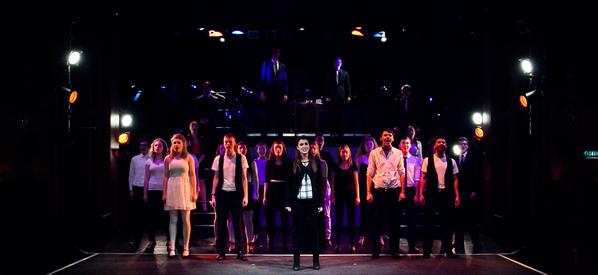
And, first off, there were standing cheers at the curtain call. Will Fairhead’s performance as the foolhardy, maddening, mad, Lear deserved them. MacLeod Stephen acted out of his skin and nearly out of Poor Tom’s loincloth. Goneril (Caroline Elms) and Regan (Agnes Kenig) did that nasty, alluring thing with crystal diction on high heels and Cordelia (Marina Windsor) would break any father’s heart. Oliver Huband put the bad boy into whoreson, if that’s possible, and Tom Stuchfield made the worthy Earl of Kent positively exciting. Dual death by dagger thrust – Cornwall’s (Jordan Roberts-Laverty) and of the servant who dares protest at the blinding of Gloucester – is admirably dealt and nothing, nothing, disguises the naked brutality of the action that follows the ‘hideous rashness’ of Lear’s decision to dismember his kingdom. Cue the ‘What is Britain?’ line, topical then as now.

Still, forget history, or politics come to that, which is a professional undertaking. Henry Conklin directs a student production that bleaches affection and colour in favour of cold and dreadful suffering. The air drums relentlessly. Grey / blue, white and black predominate in a setting that may as well be called expressionist-noir. Only the all-licensed Fool is allowed to stand out but where, oh where, is the motley coat? A cheeky alpine hat is not enough support, even for the accomplished and confident Pedro Leandro. The wit and the timing worked well enough in the moment, prompting chuckles, but the effect was more often glib than penetrating. There was too much bleak distance between the king and his fool to reach across. Rid them of sympathy and these huge lines get the shakes:

Fool:    Thou shouldst not have been old till thou hadst been wise.
Lear:    O! Let me not be mad, not mad, sweet heaven;
Keep me in temper; I would not be mad!

Actually, of all things, it was near indistinguishable costume not age or aging that looked inescapable. No one stoops and Edgar, as poor bare Tom, is unmissable. Lear, mad, should appear ‘fantastically dressed with wild flowers’. You are more likely to notice his pronounced twitching and swinging arm than his headband. Presumably, in a man of eighty plus, this is a sign of Parkinson’s but then it makes sense to join the destruction of Lear’s reason to a modern interpretation that trembles upon Alzheimer’s.

Caroline Elms as Goneril & Oliver Huband as Edmund.

Caroline Elms as Goneril & Oliver Huband as Edmund.

Set aside the difficulties of keeping the verse safe – and some of it is gunned down – Lear can still be a bewildering nightmare of a play, if not downright disorientating, which might put an audience alongside the blind Gloucester (Ben Schofield) who thinks that he has just thrown himself off the white cliffs of Dover when he’s just taken a tumble in a field. Incriminating letters fall out of pockets and the foul Edmund proves irresistible to both Goneril and Regan, which provoked some inopportune laughter. For some reason, at the herald’s command, ‘Sound’ [trumpet] you hear a bell. Swords are fencing foils and you are treated to some impressive attacks and parries.

At heart, of course, this is a production where that throwaway “Love you” at the end of a 21st century phone call meets Lear’s last howling entry with Cordelia dead in his arms. Conklin and cast have done their very best to get you back to 1606 when it really hurts.


Star (blue)Star (blue)Star (blue)Star (blue)

Reviewer: Alan Brown (Seen 3 March)

Go to Edinburgh University Shakespeare Company

Visit Edinburgh49’s Pleasance archive.

The Addams Family (Pleasance: 17 – 21 Nov ’15)

Photos: Oliver Buchanan

Photos: Oliver Buchanan

“Funny to the point of tears…”

Editorial Rating: 4 Stars Nae Bad

I hate The Addams Family theme song. It’s not that I think it’s bad, I think it’s too good. It’s every bit as iconic as it is catchy. No matter who you are or what you do, as soon as you hear that da da dadum *click click*, you’ll be reduced to a finger-snapping, grinning mess. Driving a car? Doesn’t matter. Operating heavy machinery? Tough luck nerd. You’re on a one way bus trip to Addams-town and there’s only one song playing on the radio.

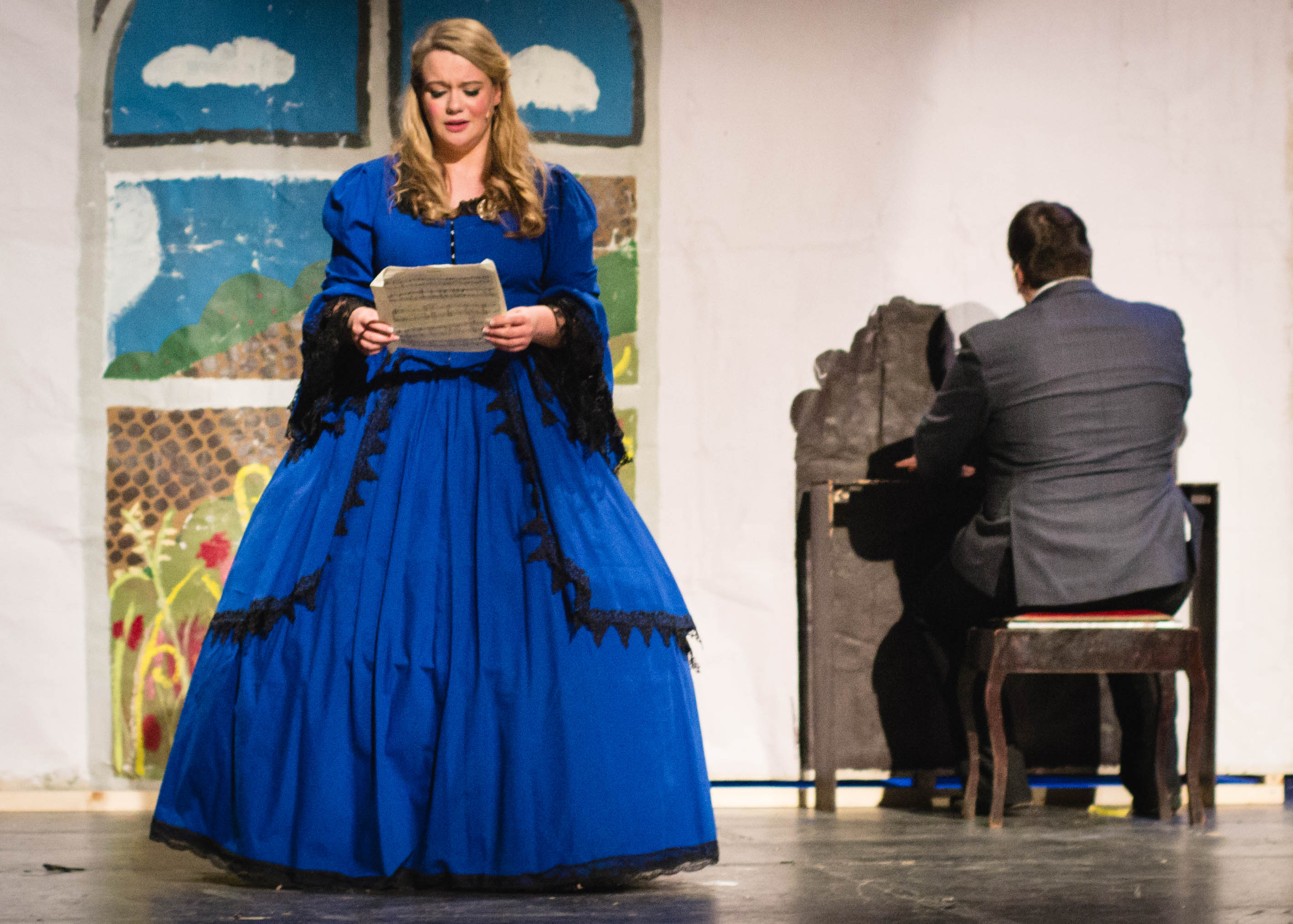
And just as epochal is the tune’s creepy, kooky subject matter. The cemetery-dirt stained shoes of the Addams family are impossibly large ones to fill, and although EUSOG’s ambitious production fell an inch or two short of six feet under, it’s a performance so bouncy and entertaining that you’d hardly even notice.

It’s crisis in the Addams household: Wednesday (Ashleigh More) is growing up fast, and even worse, she’s fallen in love with a guy so normal he makes white bread look like a Harley Davidson. Now, his parents are coming to town, and the family needs to be on their best behaviour. It goes just about as well as it sounds like it might. It’s hardly a daring new direction in terms of plot cliché, but there are fine seeds growing in this well-trod ground.

From the outset, it’s very clear that this is a talented cast. Scott Meenan’s Gomez is an utter joy to watch, and an even greater one to listen to. His comic timing and twitchy crispness of movement enhanced an already impressively funny repertoire of gags. But even more impressive was his emotional range: it’s easy to tickle a funnybone, but less so to pull a heartstring.

And whilst Melani Carrie’s Morticia often lacked the steely, sultry smugness which forms the character’s backbone, it’s hard not to be blown away by her voice – not to mention her knack for latin footwork. She was very much the smoky family matriarch, but when next to Meenan, she seemed oddly muted. However, this never affected the performance to the point of becoming a significant problem, and all feelings of flatness were limited to the spoken portions of the show. When Carrie opens her mouth, it’s like being hit by a verbal sledgehammer.

Though perhaps more nuanced than the footwork was More’s Wednesday Addams. Although usually presented as a monotone proto-goth, I was pleasantly surprised by More’s characterization. She perfectly embodies the sense of being pulled in two directions, and manages to do so in such an entertaining and genuine way that it never falls into the usual trap of feeling hackneyed or trope-ish. This was an excellent performance in every sense – especially the oddly sweet chemistry between her and masochistic brother Pugsley (Holly Marsden).

Championing the side of “normalcy” is the impressive Nitai Levi; having traded his moody rocker persona a-la Rent for  wonderfully dorky fianceé Lucas, he provided a great foil for More’s Wednesday, delicately dancing the line between nerdily sincere and annoying. And it seems like the talent runs in the family: Mother Alice (Esmee Cook) and Father Mal (Patrick Wilmott) inject ever more laughter into what is already a show bursting at the seams.

Addams Family 2

But if stealing a show was a jailable offence, Campbell Keith would be going away for a very long time. Acting as the show’s narrator, Keith’s Uncle Fester dominated the stage every time his weirdly pale head popped out of the wings. It’s hard to make a man who looks like Humpty Dumpty’s goth cousin charismatic, but I’ll be damned if he didn’t succeed.

But all the talent in the world, unfortunately, can’t control a tech setup. Whilst the swell of voices (especially thanks to the ghostly chorus of Ancestors) managed to rise above the band, the microphones were simply too quiet. I lost most of the lyrics in the first half, and the problem still persisted through some numbers in the second act.  And the lights, whilst vibrant and interesting, sometimes felt oddly out of sync with the action on stage. In isolation, either of these issues may not matter. But eventually, grains of sand do become a heap.

And although the chorus should be applauded for their brilliance in terms of both movement and vocal work, the choreography sometimes felt cluttered. There were times I was genuinely afraid an overenthusiastic kick might KO the cellist. Having fewer objects and people on stage may have helped this production breathe easy.

However, I’m loathe to admit the above for a number of reasons. The first being that it would be a crying shame to lose any of the strong chorus, and the masterful musical section – the former never faltering even in the show’s faster and more energetic sections. And secondly, changing the stage would mean altering the breathtakingly Burton-esque set dreamed up by Lu Kocaurek. I’d feel more comfortable pushing over a henge.

Although blighted by a few blips, this was a show more than worthy of its pedigree. Funny to the point of tears and touching to very much the same end, EUSOG’s Addams Family is just as creepy and kooky as that damned theme song promises. Check this one out while you can: Kate Pasola and Rebecca Simmonds have conjured up a brilliant show indeed.

nae bad_blue

Star (blue)Star (blue)Star (blue)Star (blue)

Reviewer: Jacob Close (Seen 17 November).

Go to EUSOG for The Addams Family & cast list.

Visit the  Pleasance archive.

Sophie Pelham: Country Files (Pleasance Courtyard, 7 – 30 Aug : 16.45 : 1hr)

“Likeable, effusive, hilarious”

Editorial Rating: 3 Stars: Nae Bad

Upon entering the Pleasance Cellar (sorry, Dorset) the audience is offered a tot of sherry and a sausage roll to get into the mood. For me, in this, my third back-to-back show, this seemed like a dream come true. And indeed the dream continued for the first 10 minutes or so when Pelham, as village lady-of-leisure Vanessa Bluwer hilariously tells us about life in Kilmington, her noble employers, and the various courses she runs on a voluntary basis (everything from breast-feeding to bereavement counselling). As this character Pelham is likeable, effusive and strikes a good balance between prepared material and audience interaction.

Alas, after this the show falters somewhat, with a series of less well developed characters, too much audience interaction and little drive to keep the performance moving. Pelham’s Lord Ponsanby, a drunken country gent utters my funniest line of the show “I’m not homosexual, just bloody posh”, but falls flat after a few minutes and it’s a bit of a relief when she goes off to change again. Two of her characters are animals (a badger and a fox respectively, the less said about those the better), but posh school girl Primrose and yummy mummy Sulky Waterboat are both enjoyable, making fun of relevant stereotypes.

While some parts of the audience interaction in this show were great – getting various members to hold a hobby horse, read a letter and answer the odd question – I felt that on the whole there was an over reliance on this, and as the show went on there was a definite sense of awkwardness in the room, particularly among those in the front row who seemed to get “picked on” multiple times.

And just as the level of audience interaction was pushing it, sometimes her jokes also strayed over the line into being somewhat cringeworthy, the worst offender of these definitely being the one about the Muslims… hushed silence all round. Some gags were spot on tone-wise though: safer topics included politics and class, both suitably ridiculed, while even references to underage sex got a few chuckles.

Overall, I think this show has the bones of something that could be really special, but would be better if it focused on fewer individual characters, and having a clearer sense of narrative between them, to keep the show flowing from one scene to the next. A good effort.

nae bad_blue

Star (blue)Star (blue)Star (blue)

Reviewer: Steve Griffin (Seen 22 August)

Visit the Pleasance, Potterrow & Teviot archive.

THIS REVIEW HAS NOT BEEN SUBEDITED

Trans Scripts (Pleasance Courtyard, 5 – 31 Aug : 15.00 : 1hr 30 mins)

“Gutsy, inspiring and emotional… get a ticket by any means possible”

Editorial Rating: 5 Stars

Trans Scripts is a verbatim play, which examines the lives of six transgender women, and is performed by six fantastic transgender actresses. It’s simply structured as six monologues, interwoven and staged with very little fuss and theatricality, allowing the stories to speak for themselves.

We follow the women from when they knew something was wrong with their bodies, through reactions from their families and peers, their transitions, and their lives since. Each story is unique and heartbreaking in its own right, but when told as a collection, you do really get to see many different sides to being trans. We see familial acceptance, we see homelessness, we see violence, suicide attempts, broken relationships and even the reaction of a church. There are highs, lows, twists, turns, and a real cross-section of experiences that go some way to representing a very misunderstood group.

One example is Josephine (played by Catherine Fitzgerald), who becomes trans when she’s married with children, and longs just to fit in as a woman. She’s managed to maintain an amazing relationship with her wife, but struggles to comprehend the reaction of her wife’s colleagues and friends. The most touching story for me though, which reduced me to tears many times, was that of Eden, who having been born with both female and male genitalia, was made a “boy” at the insistence of her father. We follow her struggle with her identity, relationships and family, learning about how she almost died during her gender reassignment surgery, and her first steps to meeting her mum again, having been estranged for over 20 years. The delivery of this monologue was gut-wrenchingly powerful from Rebecca Root, who really stood out with impressive physicality and emotive range throughout.

While very much six individual stories, there are occasional moments of interaction between the characters as well. The most interesting of these involved a heated discussion as to the necessity of having the full operation, and how this affects identity. As became evident, even within the trans community there are differences of opinion as to whether such steps are necessary to really fit in, shining further light on the struggle to be accepted and happy in their own bodies.

Overall, this is a very important and engaging piece of theatre, which has been crafted with precision and sensitivity by writer Paul Lucas, and is a gutsy, inspiring and emotional performance from six women who’ve all made incredible journeys in their lives. Get a ticket by any means possible.


Star (blue)Star (blue)Star (blue)Star (blue)Star (blue)

Reviewer: Steve Griffin (Seen 22 August)

Visit the Pleasance, Potterrow & Teviot archive.

THIS REVIEW HAS NOT BEEN SUBEDITED

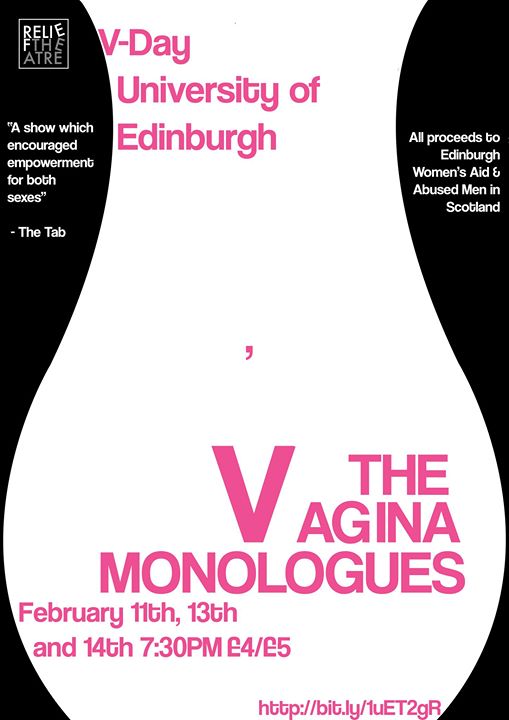
‘The Vagina Monologues’ (Teviot: 11, 13 -14 February ’15)

v monologues

“No hiding.”

Editorial Rating: 4 Stars: Outstanding

Let’s talk about what it means to be a woman, and let’s be real about it.

That is the message of The Vagina Monologues from Edinburgh University’s Relief Theatre.

There was no hiding from the awkwardness of the topic. Director Rachel Bussom was not about to allow for the comfort of anonymity that an audience can revel in, cloaked in darkness and removed from the stage space. This theatre-in-the-round was intimate and uncomfortable and sobering. A lack of props kept this show from feeling like a staged event. Instead, it took on the live and shameless persona of an organic story-telling. The close proximity to the actors in a brightly lit room created a close connection; a sense of shared identity regardless of age or gender.

Sex is a common theme in theatre, but sexuality is more obscure. Obscurer still is female sexuality in all its forms. Not today. Today, women were talking, or in the case of Julia Carstairs they were shouting, about vaginas and everything that comes with them.

For instance: hair. Martha Myers’ exasperation and resignation shone through as she hit home about the societal pressures attached to expectations of body image  – something Julia Carstairs’ first monologue, “My Short Skirt”, energetically pulled apart.

The combined efforts of the narrators, Ella Rogers, Caitlin McLean and Maddie Haynes, along with Marina Johnson’s statistical ‘Factbook’, kept the show current and hard-hitting – an impressive task considering the original show premiered nineteen years ago and society’s views on women and womanhood have changed since then. That this strong production is dedicated to the transgender community is also properly noteworthy.

Carstairs’ second monologue, “Cunt”, was a valiant attempt to reclaim a word used solely now as a derogatory term. Her exploration of sound, language and pace was invigorating and allowed a positive humour to surround the controversial language. That humour was carried on by En Thompson who offered a passionate performance in honour of her “Angry Vagina”. Her bluntness and frustration was eye-opening and tore through long-accepted notions of what womanhood means and entails.

Her anger was shared and increased tenfold in a gut-wrenching performance by Kirstyn Petras who fiercely conveyed the utter devastation of the Bosnian women who had been interviewed by playwright Eve Ensler after being subjected to the horror of rape camps. Petras pulled no punches, emulating a loathing that raised hairs and drew tears – the pain so tangible and the truth unbearable.

Jezneen Belleza may have been talking about vaginas, but her performance certainly took a pair of brass ones. As “The Woman Who Loved Vaginas”, she discussed the life of a sex worker with an honesty and intensity that, despite some more uncomfortable moments, made it impossible not to watch, listen and laugh. She lightened the mood with comedic re-enactments and did so with a grace that kept the story from becoming farcical. Instead, her frank analysis reached deep into the beauty and magic of female sexuality.

Both Isobel Dew and Siân Davies tackled sexuality and body image in a kinder manner – managing to capture the incredible feeling of self-discovery, and the subsequent elation, in a beautiful way. Sophie Harris, too, carried an air of hope in her phoenix-like rising from such a dark place to a position of acceptance and learning. Meanwhile, Ruth Brown’s impressive embodiment of generations gone by in her recollection of “The Flood” brought an endearing humour as well as a sense of pity and despair to the play. For Danielle Farrow it is the sheer beauty of womanhood and nature that matters as she recounted being present for the birth of her granddaughter. Her testimony was infectious and heart-warming.

Leaving the venue, I felt elated and empowered. This  is an inspiring production that entertains, empathises and educates. Bussom, assistant director Mary McGuire and sole male of the team – producer Jacob Close – bring together a group of really talented women who do themselves, and all women, justice.

outstanding

StarStarStarStar

Reviewer: Amy King  (Seen 11 February)

Go to Relief Theatre at EUSA here

Visit the Potterrow & Teviot  archive.

THIS REVIEW HAS NOT BEEN SUBEDITED

‘Chess: The Musical’ (Pleasance Theatre: 18 – 22 November ’14)

Photo: Oliver Buchanan

Photo: Oliver Buchanan

“Without Clark’s poise on which to pivot, the story might have given up and defected to the bar.”

Editorial Rating: 4 Stars: Outstanding

Priests, poets and psychiatrists all agree that the border between pure genius and melancholy madness is chequered with 64 black and white squares (with a white one always on the right). Next time you encounter that tramp in Potterrow Port, the one who’s convinced he’s Marcel Duchamp, ask him whether mad people gravitate to chess, or if chess makes them so. Chances are he’ll mutter darkly about the Lasker-Reichhelm position, but he might respond that the dedicated player lives “a monk-like existence and know[s] more rejection than any artist.”

The real Duchamp, the one who’d never been seen dead with a trolley from Aldi, directed those words to American prodigy Bobby Fischer, upon whose bizarre biography, Benny Andersson and Björn Ulvaeus (loosely) based a musical.

Inspired by the 1972 match between Fischer and Boris Spassky, the ABBA alumni spun a yarn interweaving two grandmasters’ competition in the arena, over a lady, and among the ideological roadblocks of Cold War politics. Truthfully, Gilbert and Sullivan Chess is not. The undeniable success of this production says more about EUSOG’s commitment to sampling work pas a la D’Oyly Carte than it does about Andersson & Ulvaeus’ capacity for profound historical commentary post-1815.

We enter to find the orchestra have escaped from their pit, and are lording it above the action. Production Manager Tom Turner has crammed more steeldeck into the set than went into South Park’s Ladder to Heaven. Visually the effect is elegant, the band’s movements in stylish harmony with Sam Burkett’s clever choreography. However x4 keys, drums, bass guitar, x3 violins, x2 cellos, flute, x2 clarinet, x3 trumpets, trombone, bassoon, oboe, french horn as well as percussion will tend to make a fair bit of noise and some dampening field needed to be generated for the sake of the singers down below.

Douglas Clark shone as Anatoly, making the script & song his own so as to cover the extensive narrative arc laid out for him. Without Clark’s poise on which to pivot, the story might have given up and defected to the bar. Tadgh Cullen (as Freddie) nailed Fischer’s astonishing angst. It was easy to see why Lydia Carrington (as Florence, the lady interest) would love him, and even easier to see why she left. I thought having Cullen sing his big number an octave higher than his vocal range was a brilliant piece of 4th wall smashing artistry, subtly underlining Freddie’s inner turmoil. My companion, smarter than your average bear, though it was a Boo-Boo. Cullen’s commitment held out. Our cheering was long, loud and genuine.

Giselle Yonace (as the tournament arbiter), Caroline Hickling (as Anatoly’s Russian wife), Peter Green (as the US manager), and Steven Segaud (as the mendacious USSR fixer) found the space to establish bold performances, spotlighting and supporting the main cast’s quirks and qualities. When Segaud tapped the vein of comic villainy in his character, I wasn’t the only one LMAO.

Ethan Baird’s direction emphasised the characters and the story they had to tell. But rather like flat pack furniture after the third house move, Chess is starting to show both its age and essential flimsiness. The producers are a bit young (and far too stylish) to embrace an ‘80s nostalgic short hand, but would one double-breasted suit have killed them? Would a visual of tactical nuclear warheads rolling through Red Square been so amiss? Several pieces were missing from this puzzling-out of a not so retro script.

If a musical about chess, written by the blokes from ABBA, set in the Evil Empire’s dreary dying days isn’t enough to float your Typhoon-Class, then here’s the only reason you’ll ever need to get out and kill, maim or mutilate whatever man or beast stands between you and the front row seats: Lydia Carrington.

She’s amazing. Her gorgeous voice battles down the band like Eva Green casually knocking down Greeks in the latest 300 movie. Carrington’s give and take with the male leads is as beguiling as Keira Knightley, as sexy as Elisha Cuthbert, and as anticipateringly exciting as when Elizabeth Warren made a cameo opposite John Goodman in Alpha House.

If you don’t see Carrington now, you’ll only have to pretend you did later. Unlike my VHS of Learn Chess with Nigel Short (ft. Carol Vorderman) this is one to watch.

outstanding

StarStarStarStar

Reviewer: Dan Lentell (Seen 19 November)

Visit EUSOG here

Visit our Pleasance, Potterrow & Teviot archive.

THIS REVIEW HAS NOT BEEN SUBEDITED

editor@edinburgh49.com

‘The Tempest’ (Pleasance, 4 – 8 March ’14)

The Tempest

A turbulent Tempest: noisy and exciting, amusing and drunken.”

Editorial Rating: Nae Bad

…  and why not set The Tempest atop a deep water oil platform? If Shakespeare didn’t have a geo-political imagination by 1610, which is doubtful given Othello on Cyprus and the exotic confusions of Pericles, he would have by now. Natural gas from the Tamar field off southern Israel has been on the market since March last year. Gonzalo’s resourceful prayer for ‘an acre of barren ground’ rather than ‘a thousand furlongs of [raging] sea’ is set spinning.

Then, unsurprisingly, there’s the issue of sovereignty. Whose ‘island’ is it? Prospero’s or Caliban’s? Israel’s or Palestine’s? It will be contentious and tricky for sure, which is where this EUSC production would set us down, somewhere off Tunis reckons Shakespeare, but the Magnus field, north-east of Shetland, would do just as well. Trinculo, a cod Italian, can wish to be in England but BP says it will continue to invest in Scotland.

There are two small red navigation lights on the installation. Why set low-down, I wondered? Anyhow, they pulse quietly away and are quietly reassuring as action succeeds action, bizarre encounter by bizarre encounter.

The stormy opening is terrific: a pounding beat drowns out air traffic comms. as the crew bring down the sails. Speech is lost to the wind but that’s a director’s license for you.  So too, I guess, the decision to equip Prospero with an aluminium pole for a staff. I guess at its metal but it looked pretty unbreakable to me, even with his potent art. You should believe that magic cloak, book, and staff, are given up or else the grave Prospero’s quiet retirement to Milan will be the stuff of The Dark Knight Returns.

First off, this is a turbulent Tempest: noisy and exciting, amusing and drunken. There is live music, there are jigs and drinking songs, almost a choreographed masque, a carry-out pizza menu and fun use of the smartphone – No signal, haha! – but there is some contemporary fallout that you might question. Adrian (Laurie Motherwell) – is it Adrian or the Boatswain or both? – takes point with aviators, head-torch and war paint. Shades of Lord of the Flies meets Rambo. Antonio (Alex Poole) and Sebastian (Will Hearle) do a distinct lean and mean and sinful but a pen-knife is not a sword.  Scale that up and you realise that one shiny scaffolding tower and discarded blue barrels (plastic) do not a derrick and oil platform make, abandoned or not. Pipe sections on the thrust deck, a hard hat or two, a cable spool, wiring, ExxonMobil advertising; anything for the illusion of fabric from the stalls, however insubstantial or baseless.

Shakespeare’s company really just dressed up, or down, or across. Alonso is become Alonsa (Lucile Taylor), which is simple and effective.

Costume then; and with not a stained Shell logo in sight. Miranda and Caliban’s torn and distressed look is innocent cool and dirty cool respectively; Gonzalo’s jacket, tie and waistcoat tie are on the button, right out of a wardrobe in Toad Hall; butler outfit for Stefano and ridiculous shirt for jester Trinculo, all quite fitting. Life-jacket and white pressed jeans for Ferdinand. Fly. But Prospero and Ariel, who should be up there in colour and magic garments, appear grounded by heavy overcoat and figure-hugging black. Too dull for words.

The rest, the real business of making good – invest in people now, oil futures later – is all about speech and performance. Virtuous parts first.

Ariel (Ellie Deans) loves her commanding master and possibly more than the promise of her liberty, which is original and affecting. This rushing spirit is more eager than delicate, is loyal and kind, and deserves her freedom. Prospero (Sacha Timaeus) presides with a style and sardonic nobility, but he would be in Davos and not the library. Miranda (Poppy Weir) is wonderful and young and not at all bound by her ‘virgin-knot’. Ferdinand (Will Fairhead) cannot help but love her in bashful fashion and their courtship is indeed goodly, beauteous and admirable.

Jon Oldfield as Gonzalo is a venerable act. He bumbles, he stumbles, but he is not the buffoon and sententious bore of shallow productions. Oldfield waves a carrot with more skill and pronounces to better effect than any Renaissance prince around.

To the things and creatures of darkness, who always threaten to steal the show. Joe Shaw is Caliban, who will grovel for a Pot Noodle and eat his own bogies. Shaw plays brutish, ignorant and fearful with real appetite but mouths his words with care and feeling (Miranda taught him after all) so the nature / nurture debate is properly kept wide open. Trinculo (Dean Joffe) and Stephano (Connor Jones) play Caliban like a fish on the line. They are funny and cruel and craven and – of course – the audience laughs with them, a lot, until reminded to laugh at them.

The Tempest is a marvellous play so you can take it to any stage or platform that you please. Jack Kinross, cast and crew, inhabit it with due respect and great spirit, even though some of its magic is still onshore.

‘Farewell, dear island of our wreck:
All have been restored to health,
All have seen the Commonwealth.
There is nothing to forgive.’

From W.H Auden’s The Sea and the Mirror (1940), a commentary on The Tempest

nae bad_blue

Reviewer: Alan Brown (Seen 6 March)

Visit The Tempest homepage here.

‘The Mystery of Edwin Drood’ (Pleasance Theatre: 19-23 Nov ’13)

DSC_0242 (1)

“The songs are catchy, the dialogue’s sharp, and there’s a delightful knowingness to the banter with the audience”

Editorial Rating: Nae Bad 

Who killed Edwin Drood?  Many have wondered – but nobody quite knows, since Charles Dickens’ untimely death left his novel tantalisingly poised before the story’s dénouement.  This high-energy, high-risk production addresses the problem in twenty-first century style, by asking the audience to cast their votes on just who the miscreant should be.  Oh yes!  And by doing the whole thing as a musical.

It sounds an odd proposition, but by the time the curtain falls, it’s clear why Rupert Holmes’ innovative production was acclaimed on its debut in 1985. The songs are catchy, the dialogue’s sharp, and there’s a delightful knowingness to the banter with the audience.  And this student version from the Edinburgh University Savoy Opera Group retains the sense of daring which must have defined this first-ever interactive musical, with a vibe of joyful chaos and the cast electioneering amidst the crowd.

Before the vote can happen, though, there’s a whole load of Dickens to cavort through.  Actor Campbell Keith bears much of the responsibility for driving the plot, and duly gives it both barrels as the villainous Mr Jasper; if you enjoy his powerful early solo number, just wait till you see him dance. Rosa Bud, the target of Jasper’s lecherous affections, is beautifully portrayed by Alexandra Pittock, whose fine singing voice eloquently captures Rosa’s mix of chaste purity and independent spark.  Other stand-outs among the large cast include Ari L’Hevender as a big-hearted lady of ill repute, and Giselle Yonance, who gives a nuanced performance in the title role.

Holmes’ Tony-award-winning book pictures Edwin Drood performed in a late-Victorian music hall – complete with bickering divas, ill-disciplined clowns and a bombastic MC.  It’s a set-up that licenses some glorious over-acting, and EUSOG embrace that liberty with gusto; Austin Nuckols’ Reverend Crisparkle grows especially hilarious as time wears on.

The humour tends to broad parody – ranging from cor-blimey stereotype accents to a long-running lampoon of the entire musical form – and the treatment of a few key scenes might benefit from more light and shade.  In particular, the choir-master’s advances on his pupil Rosa deserve to be more stomach-churning, given the sad procession of stories of real-life abuse which has emerged over the past few years.  It must also be said that there were quite a few genuine bloopers mixed in among the accidental-on-purpose ones, though all were saved with engaging good humour by a supportive and adaptive cast.

So this isn’t the subtlest or most polished of work, but it’s big, it’s daring and it’s a whole load of fun.  What’s more, at a flab-free two-hours-forty, it’s great value too.  It is, in short, exactly what a student musical ought to be; see it if you can.

nae bad_blue

Reviewer: Richard Stamp (Seen 20 November)

Visit The Mystery of Edwin Drood homepage here.