‘Faith Healer’ (Lyceum: 14 January to 7 February ’15)

Photo: Eoin Carey

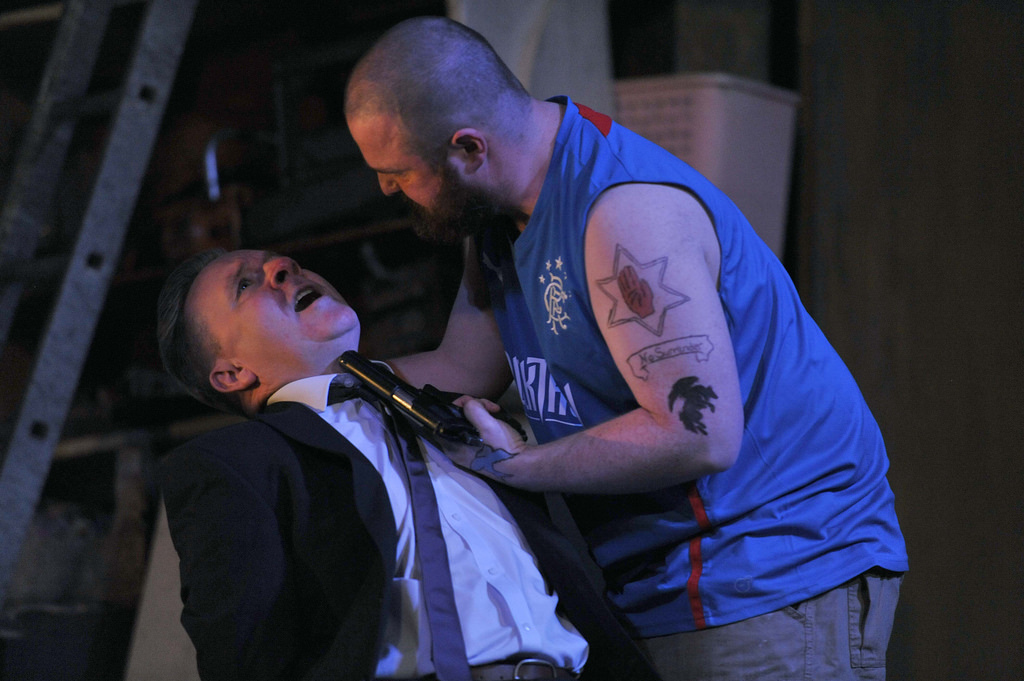
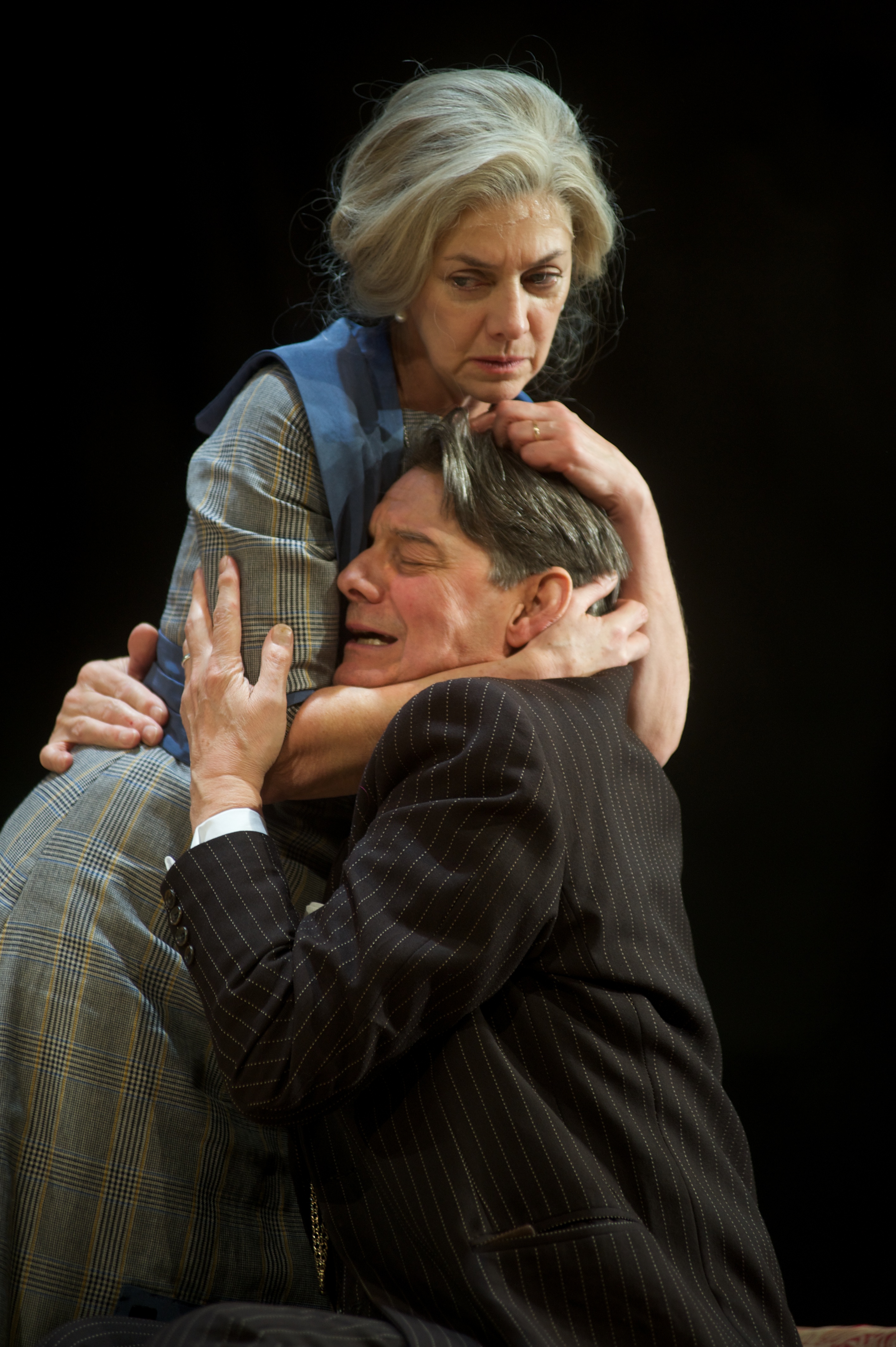
Sean O’Callaghan as Frank. Photo: Eoin Carey

“He walks across a cobbled yard and smack into classical tragedy.”

Editorial Rating: 4 Stars: Outstanding

I don’t suppose Glasgow’s Celtic Connections features a whippet on the bagpipes. Well, Brian Friel’s forlorn yet devout play has one. It also has an Academy Award Best Original Song, from 1936, in The Way you Look Tonight and the Troon to Larne ferry. From Ceann Loch Biorbhaih (aka Kinlochbervie) in Sutherland to Welsh Methodist halls to Donegal to digs in rundown Paddington, Faith Healer – first performed in 1980 – has evocative mileage.

It is all in the voice and the story telling and in the sad and unaccountable distance between them. Three characters explain themselves to their audience. Simples. Each in turn stands alone on stage and talks of how it was when they were together, how it is now, and how it might have been – or might have seemed. Memory is fallible. What you once thought you had learnt by heart or by experience, bitter or sweet, can be a struggle to recall. Their time is provisional. Contingent. (Go to Philip Larkin in Ambulances where ‘what cohered ..across the years .. the unique random blend .. At last begin to loosen’.) You cannot miss the tatty banner, centre, ‘Fantastic Francis Hardy, Faith Healer. One Night Only’.

We have a correlated but discrepant narrative. That’s four monologues in four scenes. Francis, or Frank, appears first and last; first, anxious to justify his billing, dismissive of rhetoric but still fervent of speech and gesture. An act, in effect, that he protests is balanced between ‘the absurd and the momentous’. And last, in an extraordinary extended coda, he is steadier, a little prouder, and with a crumpled press clipping of ‘10 Healed in Glamorgan’ he walks across a cobbled yard and smack into classical tragedy. Grace, mother of his child, loves him selflessly but suffers incomprehension and loss. She has the second scene, casting Frank as immoderately talented but possessed by his own impossible calling. Then, after the interval, there’s Teddy from down the Old Kent Road or Stepney or Bow. Breezy, enduring, big-hearted Teddy: skint impresario, dog lover, pigeon manager, fixer, van driver and bedsit philosopher. Teddy’s responsible for the ‘Fan-tas-tic’ on the banner and his exasperated, “For Gawd’s sake!” is about as Christian as this play gets. Friel, after all, dumped the priesthood.

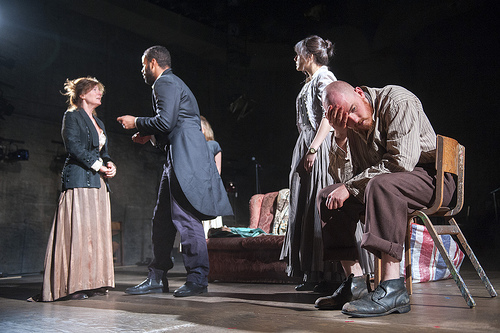
Nevertheless, I think director John Dove is going for Frank’s miraculous redemption here. Earnest self-doubt proves definitive, more so than the poetic drifts over Loch Clash. The set may be cheerless and angular with a job lot of bistro chairs arranged left stage but then Frank is lucky if more than half a dozen of the lame or the disfigured roll up to receive his ‘gift’.  The keen monologue form is necessarily upfront and in your face, as it were, but even so the acting is unusually expressive and open. Gesture is weighted. The lightest it gets is Teddy (Patrick Driver) wafting another pale ale onto the table. Frank (Sean O’Callaghan) seeks rest and certainty with dire conviction. Grace (Niamh McCann), fighting despair, is bright eyed with hope. Driver’s performance does stand out, “Dear ‘earts”, almost too much maybe, but Teddy’s bow tie and patter can do soul searching as well as the single crucifix high on the side wall and when he chokes up it is all the more compelling.

Anticipating the ignorant and hapless English soldiers of Friel’s next play, Translations, Teddy is not understood in the Irish-speaking community of Baile Beag / Ballybeg. Regardless, this is an eloquent production. Admirable in fact.

(By n’ by, listen up for Translations on BBC Radio 4 Extra on Sunday 25 January at 1330.)


outstanding

StarStarStarStar

Reviewer: Alan Brown  (Seen 17 January)

Visit Faith Healer at the Lyceum here

Visit the Assembly Roxy Bedlam Church Hill Theatre Festival Theatre King’s Theatre Other Pleasance, Potterrow & Teviot Summerhall The Lyceum The Stand Traverse archive.
THIS REVIEW HAS NOT BEEN SUBEDITED

‘The BFG’ (Royal Lyceum Theatre: 28 November ’14 – 3 January ’15)

Photo: Tommy Ga-Ken Wan

Photo: Tommy Ga-Ken Wan

“This is where dreams is beginning…”

Editorial Rating: 4 Stars: Outstanding

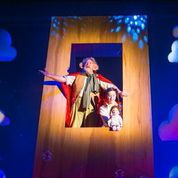
This is the Lyceum’s Christmassy adaptation of Roald Dahl’s ginormous classic. Its message is of humility and caution, all intertwined, and it’s very enjoyable. I loved Dahl’s children stories and still do. It was therefore a delight to hear David Wood’s success in retaining the whimsical language for this play within a play and to see director Andrew Panton realise it all on stage.

What better to represent the many rooms of childhood imaginings than a doll’s house? That’s designer Becky Minto’s large doll’s house across the breadth of the Lyceum’s stage and there’s a 00-Super gauge train track going around it, just as would be expected of any child’s play room. However, arguably the most enchanting aspect of the set is the BFG’s cave and specifically the hanging shelves that are lowered into view, adorned with jars of multi-coloured dreams. Simple but so effective. And there are the bright and innovative costumes to match. In and out of onesies, dresses and tops; on and off with hats and shoes; all changed at a quick pace – a pace wholly in keeping with the never-ending imaginations of children. One of the most impressive costumes in the wardrobe is the Queen’s – a majestic Claire Knight – whose wellie boots are topped with fur and whose royal emblem is emblazoned on a red gilet.

An integral part of this production is its combination of live music and pre-recorded sound effects. The cast’s rounded musical performances only serve to further enchant a spell-bound audience. The hard work of Claire McKenzie – musical director and composer– is evident in polished but yet playful performances. Her marriage of jaunty Scottish rhythms, fiddles and drums with children’s nursery rhymes and kazoos is expertly balanced.

BFG 2

Any decent toy box has its puppets and they are brought out to play big time in this production. The medium provides much comic input as well as creating numerous characters in the hands of a small cast. The puppetry is an original and attractive feature and gives literal form to the make-believe on stage. Robyn Milne’s infectious giggle and expressive performance brings the Sophie doll vibrantly to life whilst Lewis Howden’s mysterious and magnificent BFG is not so much scaled down – except for those ears! – as uplifted. Clumsy on his feet and tripping over his gobblefunk speech this BFG warms the hearts of the audience.
Children and adults alike respond happily to the energy and enjoyment of the performances and repeated ‘whizzpopping’ had the children – and many adults – giggling with glee. This is, after all, a treasured story that seems to have lived a lot longer than its thirty-two years might suggest. There is wonderful fancy evoked here, escapism and delightful nostalgia.

“Human beans is not thinking giants exist.” Well, after this great big and magic production this human bean thinks otherwise.

outstanding

StarStarStarStar

Reviewer: Amy King (Seen 3 December)

Visit ‘BFG’ at the Lyceum here

Visit our Assembly Roxy Bedlam Church Hill Theatre Festival Theatre King’s Theatre Other Pleasance, Potterrow & Teviot Summerhall The Lyceum The Stand Traverse archive.

THIS REVIEW HAS BEEN SUBEDITED

‘Bondagers’ (Lyceum: 22 October – 15 November ’14)

Bondagers 1

Photos: Drew Farrell

“a fertile, sure-yield production “

Editorial Rating: 4 Stars

First performed by the Traverse Theatre Company at the Tramway, Glasgow, and then the Traverse, Edinburgh, in May 1991. Listed by the National Library of Scotland as one of the 12 key Scottish plays of the past forty years.

There is the straight open road and there is the wide open field. We are likely, through pig-ignorance, to love the first and disregard the second. However, Sue Glover’s Bondagers will change your mind, and if it doesn’t, you’re past saving. For this bonneted, bonny, holy play almost makes the invisible visible. Almost, for there are small molehills of socio-economics and human geography to flatten first.

In his peerless survey of theatrical landscapes, Peter Brook ends chapter 2 of The Empty Space with this question: ‘Where should we look for [holy theatre]? In the clouds or on the ground?’ You can smell the answer in Lu Kemp’s fertile, sure-yield production. An earthy top dressing covers the Lyceum stage, and when it’s hoed, watered or shovelled, you could be in the fields alongside the A697, just past Greenlaw. In Bondagers, which is part keepsake, part platform, this Berwickshire acreage matters hugely.

For most of us, farmland is now remote, somehow indistinguishable territory. Once upon a time, really not so long ago, over the Lammermuir hills a married ploughman (a hind) was bound to provide a woman (a bondager) to also work on the farm. She might be his wife, but not when there were infant children to raise. By the 1890’s, a good master would have paid his bondager ten pence a day. Women’s work for women’s pay was still holding firm.

Bondagers2

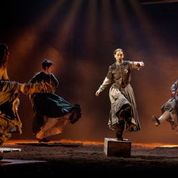
You’d have to split the Lyceum to set Bondagers in the round, but the creative team gets close to the vision thing, whose horizon(s) stretch way beyond the box beds in the cottage row, not that you see them anyway. There are no doors, no flats, and no fly-on-the-wall positions, as the scenery is a wide semi-circle of tan planking, thin and loosely joined, with the mist floating beneath it. The sights and sounds of this piece are filmic but solidity is vested in the spirits of six women. When fifteen year old Tottie calls out to her father in Saskatchewan the Canadian prairie seems as close as the Cheviots. Sara, the sturdy elder, leaves no room for doubt or longing, and Ellen, once bound over but now the tenant farmer’s young wife, is still bold and outspoken. Meanwhile, plainly and keenly, there are the folk songs: by turns affecting, burdened or bawdy, they keep time and period in step. Those warm, singing hearts lie under bulky wraps that are a triumph of research and costuming by the Wardrobe department. Additionally, the movement director, Ian Spink, deserves applause in his own right. From hiring to flitting the year round weather seems autumnal and chill. When the light does come, right at the end, the advancing glaring beams are of a different nature altogether.

In this rare atmosphere and with their own language a’ aboot them, the six bondagers share their lives. Sara (a fabulous Wendy Seagar) is the embodiment of moral dignity; good wife Maggie (Pauline Lockhart) scuttles undiminished from bairn to crib to table; Liza (Jayd Johnson) and Jenny (Charlene Boyd) chop neeps by day and gaze for lovers in their broken mirror by night. Innocent, wilder, emblematic Tottie (Cath Whitefield) strays outside the fold and suffers grievous harm. Mistress Ellen (Nora Waddell) brings knowledge of farm economy and crop rotation alongside her desire for a baby.

This is substantial and enthralling theatre by director Kemp and designer Jamie Vartan and yet its make-believe is vulnerable. I’d call Bondagers rhapsodic but there’s dissonance. A working girl can still be seduced into marriage by the promise of a clock, a dresser and a bed. Worse, there are bogeymen around: a sheriff who orders an arrest and a marquess who raises the rent. That brief combination is enough to silence the women well before the badass harvester turns off into the fields.

Still, the road’s clear to Coldstream and you can see for miles. Enjoy the view and love Bondagers.

Star (blue)Star (blue)Star (blue)Star (blue)

Reviewer: Alan Brown  (Seen 28 October)

Visit the Lyceum Homepage here

Visit our Assembly Roxy Bedlam Church Hill Theatre Festival Theatre King’s Theatre Other Pleasance, Potterrow & Teviot Summerhall The Lyceum The Stand Traverse archive.
THIS REVIEW HAS BEEN SUBEDITED

‘Kill Johnny Glendenning’ (Lyceum: 17 September – 11 October ’14)

“A Lock and Load comedy with the safety Off”

Editorial Rating:  4 Stars

How mental do you like your Glasgow? I say ‘your’ advisedly, as this play has barreled its way down the M8 in that distinct, uncompromising “Up yours!” way that makes Edinburgh appear po-faced. D C Jackson has written a lock and load comedy with the safety off. ‘Kill Johnny Glendenning’ is fast, almost ludicrous, and not a little gross.

Droll Weegie humour is too dark for Strathclyde noir. This explosive plot begins with a bang as Bruce Wilson, the crime writer of Glasgow’s ‘Daily Reporter’, is to be taken out of harm’s way before his scurrilous biography of loyalist para-military Johnny Glendenning catches up with him. However, Johnny’s solid and inescapable desire for revenge makes Bruce Wilson’s survival somewhat unlikely. In fact, Johnny G. has set his sights on more than one unlucky victim, as he also goes after Andrew MacPherson, a ‘businessman’, who has cocaine deals to finance. Unfortunately, MacPherson’s laddies, sheepish Dominic (Philip Cairns) and numpty dumpty Skootch (Josh Whitelaw), mess up from accidental start to blood soaked finish. Dominic’s wife, Kimberly (Joanne Thomson), is the surprising Lady Macbeth of the piece, albiet very pregnant one, and one well in tune with Leona Lewis’s ‘Bleeding Love’.

Paul Samson (l) and David Ireland (r)

Paul Samson (l) and David Ireland (r)

The action is as lurid as Skootch’s cream suit, modelled – of course – after Pacino’s in ‘Scarface’. Johnny is a dab hand at pulling teeth and at castration by combat knife. There is lots of gunfire and a maniacal stabbing. The first act, down on Auld John’s farm, ends with bodies being soaked in petrol. Normally in Ayrshire these poor souls would be fed to the pigs, but it is onto douce Hyndland, in Glasgow’s West End, for the second act and a marginally tidier, intelligent backstory.

David Ireland’s Johnny might be a headcase but he remains a neat act. His easy movement, trim beard, and smart banter make the killer look and sound almost companionable, but the mild Ulster accent is as unnerving as the tattoos. Paul Samson as MacPherson, whose respectability is a vicious lie, keeps his character closer to the edge. Bruce (Steven McNicoll) is the journalist with no conscience who suffers that nice, well-bred, immunity from actual violence until it happens to him. He wears carpet slippers to his sorry end. Kern Falconer as scarecrow Auld John is frighteningly at one with his pigs, as well as his scary mither up the ladder.

(l to r) Philip Cairns, SteveMcNicol, Josh Whitelaw

(l to r) Philip Cairns, Steve McNicol, Josh Whitelaw

However, ‘Kill Johnny Glendenning’ is more than an unhinged caper. One read of the imaginative programme and a glance at the stage curtain for a lookalike Amazon listing of tales from Bar-L will tell you that Jackson and director Mark Thomson are firing off some cultural bullet points. Hard men and hard boys are the obvious target but you could easily add sectarian shite, corruption of the press, Glasgow itself and mobile phone apps to that list. An entertaining, close-range blast from ‘Yes’ land.

Star (blue)Star (blue)Star (blue)Star (blue)

Reviewer: Alan Brown (Seen 20 September)

Visit Kill Johnny Glendenning’s homepage here.

THIS REVIEW HAS BEEN SUBEDITED

‘Pressure’ (Lyceum: 1 – 24 May ‘ 14)

Pressure handbill

‘The clock counts down, isobars group, weather fronts advance’

Editorial Rating: Outstanding

A new play by David Haig. Directed by John Dove.

Pressure blows up a storm of anticipation. Remember the first handbill: warships steaming full ahead out of the binoculars and heading straight for you? If you have seen The Longest Day, the film about D-Day and the Normandy landings on June 6 1944 (but it helps if you’re over 50 and a boy), then remember that scene when a German officer adjusts his Zeiss lenses and sees the invasion force emerge through the dawn mist. Shock and awe big time! Impossible to create much the same on stage? Not if you can read a barometer and like the joke of employing a meteorologist to forecast shooting conditions for Gone with the Wind.

That was filming in 1939 in sunny LA County, whereas Pressure builds over four actual days in 1945 in Southwick House, near Portsmouth. US General Dwight D. Eisenhower is in command but depends upon a plumber’s son from Dalkeith to tell him what the weather is going to do. High winds mean high seas, overturned landing craft and limited air cover. Should he or should he not postpone? And, General, this is British weather we’re talking about.

Enter James Stagg PhD, RAF pro tem, ace meteorologist on tenterhooks. Cue very big charts, 5 to 6 low pressure systems, 2 high ones, flurries of weather reports, black Bakelite telephones, pots of caffeine and introduce the fact that beyond 24 to 36 hours the science of forecasting is all informed guesswork. Where, over there and by the way, are Rommel’s tank divisions? You grasp the fog of war.

The uncomplicated story takes hold very quickly. Stagg’s gloomy, inclement forecast is opposed by his American opposite number, trained in Beverley Hills and on the Italian beachheads. Lt. Kay Summersby and Eisenhower are an established item; conceivably a chaste one. The clock counts down, isobars group, weather fronts advance and Stagg suffers personal agonies of his own.

Writer David Haig is James Stagg and is a near elemental force. He stands awkwardly to attention in front of his commanders but provides reports of such detail that you … are blown away, as it were. This is a man, you sense, who cannot be sure that he is right but will move heaven and earth to move the odds in his favour.

In his life Eisenhower was a lucky general. Malcolm Sinclair plays him on a long fuse and a tight smile, unbowed by his massive responsibility and with a winning streak straight out of the end zone. It is a calm, light time (rare in Pressure) when Stagg tries to explain rugby football to the general who clearly will never understand why the ball is passed backwards.

Laura Rogers as Kay Summersby is a delight. The compassionate role moves her imperturbably to and fro between the five star general, whom she has known for two years, and the private, undemonstrative, scientist and allows both characters to open up. In this reading Summersby is probably David Haig at his most imaginative.

Director John Dove has those fine, clear- sighted Lyceum productions of Arthur Miller plays to his credit. In relation to this current production The Man Who Had All the Luck might as well be Eisenhower’s experience. In Pressure Dove succeeds not simply with pace and control but he also has stage actors in uniform to contend with, which weighs more significantly than civilian costume, and is never to be taken for granted. We are behind the lines, of course, but you never doubt that there is a war going on. There is just the one violent reminder when a plane goes ‘down’ and that seems a little unnecessary given the intensity of the on-stage action. Pressure is a taut, winning drama and you will appreciate the energy and skills of the creative team behind it, from blackout lighting to the drone of bomber formations.

It is, finally, David Haig’s play and is, I think, a major achievement. An exciting, dramatized, chronicle.

outstanding

Reviewer: Alan Brown (Seen 8 May)

Visit Pressure homepage here.

‘7 Billion Others and Me’ (Lyceum Youth Theatre: 28 March & 4 April’14)

7 Billion Others and Me

“It is Andy Murray’s Will He – Won’t He? victory at the All England Club last year that ends the roll-call “

Editorial Rating: Unrated

Directed by Christie O’Carroll and devised by the Company.

It is a fun, effective, image. The kilt, Royal Stewart tartan no less, the plain sock, the half-tied All Star Converse resting on a slightly squashed globe. Some photoshopping might just have had the heel depressing England but, no, that would not have been right.

7 Billion Others and Me had two performances, both prior to evening performances of Union. That too made sense, as did the three Perspex voting boxes at the Exit doors: ‘Yes’, ‘No’, ‘Don’t Knows’. When I saw them the piles of votes were evenly distributed. This LYT show might influence your views on the independence referendum but that is not its intention. This engaging piece of youth theatre is much more to do with proposing community and friendship as the proper platform for whatever we stand for – or on.

The islands of St Kilda are used to tell a shared story. To begin with there is island history: a nasty but comic severed hand, puffin catching, puffed-up ‘Morning Manly Meetings’, and mention of May 1918 when a German submarine blew apart the island’s signal station. In August 1930 the remaining thirty-six inhabitants leave for the mainland at their own request. There follow scenes of modern and popular Scottish history – highly selective but of near legendary proportions, if you are 15 – the amalgamation of proud regiments; The Bay City Rollers; Lockerbie; Dunblane (sensitively not named); wicked Mrs Thatcher and her poll tax; and almost to top them all, CBBC’s Raven, 2002 – 10; but it is Andy Murray’s Will He – Won’t He? victory at the All England Club last year that ends the roll-call and brings us to the ‘Yes’ / ‘No’ seesaw of the referendum debate.

7 Billion Raven

The confident young cast (? S3-S4) embodied a sense of their history being made. The repacking of the belongings of the Lockerbie victims is especially sad and evocative. Courtney and Keir carry their romancing and their love through from the earliest times to the present day. Ironic and familiar ‘sides’ of latte, jaffa cakes and sushi accompany the main narrative that employs voice, song and movement to keep it fresh and memorable.

Raven (and improbably, magnificiently, Mrs T) appear in fine costume but otherwise all is kept plain and unaffected. The message is plainly voiced that even if you are one in seven billion you still count and that, again on the plus side, there are lots of people around to join hands with.

“Are you ready? Then let the challenge… begin.”


Reviewer: Alan Brown (Seen 4 April)

Visit LYT homepage here.

‘Union’ (Lyceum: 20 March – 12 April’14)

Josh Whitelaw as Allan Ramsay in Tim Barrow's Union. Photo by Tim Morozzo

Josh Whitelaw as Allan Ramsay.   Photo by Tim Morozzo

“A valiant shagging of historical event and character”

Editorial Rating: Unrated

England and Scotland have been at it for a good while.

Once upon a time there was some rough wooing. Then, once upon a time – again – there was the Union of the Crowns, which sounds more consensual, and then, once upon a … etc., there was the Act of Union, which obviously came straight out of the The Joy of Sex and now – just reported today – we have a time of conscious uncoupling.

Fancy a flutter on the outcome? Tim Barrow wagers you will. His new play, Union, is a valiant shagging of historical event and character that is really, really, not into contraception. Probity is not on top either. See, on the common stage in gilded London, the seventeen pregnancies of Queen Anne. That’s Anne the last of the slimy Stuarts, as we’re in the realm of Horrible Histories; and meanwhile in the vennels of Edinburgh there is the whoring of Grace and Favour.

Scotland is up for sale: 20 old K should do it, not least because in 1707 one English pound was equal to twelve Scottish. ‘What cares our land for coin?’ is the noble poet’s cry. Actually, pal (only John Dalrymple, Earl of Stair, is no friend to Allan Ramsay, makar) there are those who care a lot. And so on 16 January 1707 the treaty of Union is passed by Scotland’s Parliament by forty- one votes, 110 to 69.

The headcount in the script is 10. Ten actors do it all: only Josh Whitelaw (Allan Ramsay), Sally Reid (Grace) and Irene Allan (Queen Anne) do not have other parts. That works well and the scenes play out within eye-catching projected sets that turn and turnabout: Edinburgh is Celtic chords, rain, tankards, cards, and clustered wigs; the Queen’s showy rooms in Kensington Palace are just the place to take exotic teas and to play catch-the-crown.

I thought the safety curtain was the huge Union flag, which has a certain metaphorical fit to it. No fire risk, we’re ‘Better Together’ and all that; but this is one production, I put it out again, that does not want to stay protected. Think of the Darien scheme and go for broke.

And, despite much concerted entertainment, Union does break in two. Allan’s love for Grace and for Scotland is too soft to hold when all about them is political and [sorry] priapic disorder. Liam Brennan is a riot as The Duke of Queensberry and as a mincing teasalesman at court. At times Queen Anne’s part turns Irene Allan into Queenie from Blackadder. Andrew Vincent as Marlborough has a comic swagger that batters belief. By contrast Tony Cownie’s performance as Stair and Walpole is too good, too convincing, not to place him in Congreve’s The Way of the World. The line-up of Scottish nobles, pro-union ‘Yes’ on the left, outraged ‘No’ on the right, has to happen but it looks awkward and is – literally – staged. When Allan sets his verses free on the water you stay as unconvinced as Grace is of the power of scribbling.

To return. Now, are you sitting comfortably? Once upon a time the Duke of Marlborough drew his pistols at table and blew his daughter’s hamster apart. In a way that is how I feel about Union. Its remains are in your lap rather than in your head. More gross than shocking. As ballsy as Scotland’s Future? Has to be.

Reviewer: Alan Brown (Seen 25 March)

Visit Union homepage here.

‘Private Lives’ (Lyceum: 14 Feb – 8 March ’14)

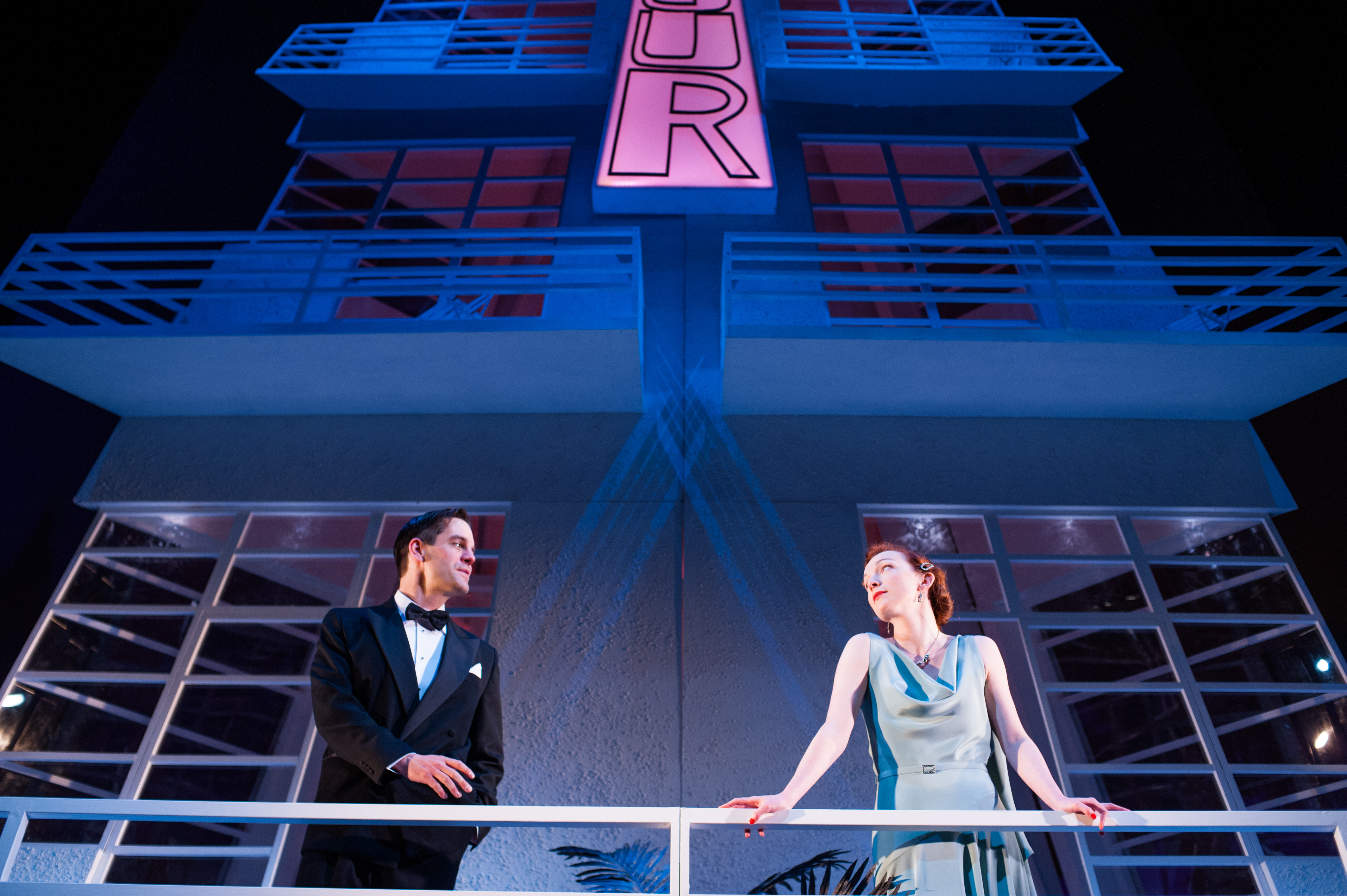
John Hopkins as Elyot Chase and Kirsty Besterman as Amanda Prynne by Tommy Ga -Ken Wan

John Hopkins as Elyot Chase and Kirsty Besterman as Amanda Prynne by Tommy Ga -Ken Wan

“This production is highly quaffable, bubbly and intoxicating. It’s not vintage stuff but it’s as near as makes no odds.”

Editorial Rating: Nae Bad

It’s the age old story told time and again down the ages. First boy meets first girl, falls in love and, three years laters, falls back out of love. Five years later first boy and first girl have remarried to second girl and second boy respectively. But, horror of horrors, all four find themselves sharing neighbouring honeymoon suites in a French hotel. And so first boy and first girl are forced to realize that only in the most awkward of situations can their tempestuous love be sustained.

First produced in 1930, Noël Coward’s Private Lives is a situation comedy of manners providing four (and a half) sparkling character sketches crafted by the only man in the entire history of English slang to whom the term ‘wicked’ can be applied in every sense of the word. Mark Duncan, director of the 2014 Royal Lyceum Theatre Company’s production, is tasked with balancing the script’s period topicality as well as its universality. His twin supports are a hugely ambitious set and a focused team of character actors.

We enter to find that a hybrid of Benidorm and Burgh Island has landed in Edinburgh’s West End. A hotel tower block rises from the stage at an angle to make us in the cheap seats feel slightly queazy. The focus is on a balcony divided between two apartments. The success of this design is that it concentrates the tragi-comedy into a relatively small space. It’s a tight canvas on to which John Hopkins as Elyot Chase, and Emily Woodward as his new wife Sybil are the first to step.

Hopkins perfectly captures the essence of Elyot’s laconic detachment from life, triple refining his portrayal through layers of insecurity, malice and childish bewilderment. He mixes a jerky suavity with an uncontrolled natural passion. The result is a volatile cocktail which, as will become clear, no woman can fully fathom.

Woodward places Sybil between a rock and a nutcase. On the one hand her character is inexorably drawn to Elyot’s strength of character, on the other her subtle charms can hardly penetrate his granite outer surface. The script affords Woodward little space to leave her mark in the first act. What there is she artfully fills out with breadcrumbs pointing the way to later developments.

From the few biographies of Coward I have read, Sheridan Morley’s being the most unequalled, it’s pretty clear that if the great man took a dislike to you, you’d know about it pretty quickly. I don’t think Coward liked Victor Prynne. In fact I think he loathed every aspect that went into the first girl’s, Amanda’s, second husband.

Victor is priggish, stuffy, over-confident and underwhelming – the worst example of what an antipodean social commentator might aptly term ‘a whinging pommy bastard.’ Ben Deery steers this straw man expertly, so as to catch every lash from Amanda’s tongue, everyone of Elyot’s barbs and the full force of Sybil’s irre. Still, we are left feeling more sorry for the inanimate wreckage of Amanda and Elyot’s quarreling than for Victor – just as it should be.

Kirsty Besterman completes the foursome with an uncompromising vision of Amanda. Amanda likes to get sunburnt, knowing that after the pain and discomfort will come the perfect tan. She likes to play with fire in other ways and expects to get burnt. Besterman doesn’t have the spring of one-liners Coward bestowed on Elyot from which to draw strength. Instead she discovers the inner-source of Amanda’s power to fascinate and infuriate, measuring it out with a spontaneous grace both beguiling and bewitching.

All four actors do an excellent job of amplifying their characters’ traits. As with the rest of the Coward cannon, the writing is subtle but not deep. We don’t know why these people behave as they do. They are not run through a gauntlet of reprisals for their actions and behaviour. We must take them as we see them. As with the other great comic writer of his age, Wodehouse, Coward is not presenting critical social analysis. This is entertainment not moral philosophy.

To judge a classical rendition of Private Lives is to determine whether Duncan has achieved the balance between topicality and universality.

The topicality is emphasised through period pieces in the lighting, sound, set and properties. In the main these are all highly accomplished. However, unlike the set for Act 1, the hotel balconies, that for Acts 2 and 3, Amanda’s Parisian bolthole, failures to condense the drama. Somewhat artificially, the two couples are compelled to share an under-sized chaise lounge in the massive living area of her pied-à-terre. I can’t see the entrances to stage right, and much of the decor is lost upstage. The set is certainly impressive and impressively dressed but does it do the business? Not really.

None-the-less the universality of couples falling in and out of love is there. So too is the pretence and passion of romance. This production is highly quaffable, bubbly and intoxicating. It’s not vintage stuff but it’s as near as makes no odds.

nae bad_blue

Reviewer: Dan Lentell (Seen 18 February)

Visit Private Lives’ homepage here.

Long Day’s Journey into Night (Lyceum : 17 Jan. – 8 Feb.’14)

Production photos for "Long Days Journey Into Night"

‘‘Health and happiness ’ and then, perfectly, ‘that’s a joke’.’

Editorial Rating: Nae Bad

By now Long Day’s Journey into Night has a lot of followers. Written in 1941 this is Eugene O’Neill’s Facebook page from hell – and back – and without any privacy settings. Received by the New York Times in 1956 as a ‘saga of the damned …. like a Dostoevsky novel in which Strindberg had written the narrative’ it is a remarkable and important play. Watch it (occasionally not easy), follow its story (not difficult) and you’ll realise, in epic Facebook terms, its ‘social utility’ for our time.

You will like the kind and sympathetic realization of character in this Lyceum production. Diana Kent, who plays Mary Tyrone, says “There’s no baddie in the play. Everybody is flawed, everybody damages everybody else, but there’s a reason for it, and everybody can be forgiven. It’s a hugely compassionate play” (HeraldScotland, 5 January). For director Tony Cownie it’s ‘a very personal family situation [turned] into a very meaningful intense drama’ (Lyceum programme). Guilt and retribution – the acid feed of some productions – come a discordant second to underscored themes of conflicted love and understanding. A word here for the dialect coaching of Lynn Bains, for the accents are never strained, however keenly pitched. Cue also sorrowful cello, piano, and a quiet sea  – off-stage right  – rather than screaming strings and raucous gulls.

Paul Shelley is James Tyrone, handsomely retired actor, who at sixty-five would still command the stage or living room with debonair gesture and manner. Seduced by $35000 a year net profit at the box office he gave up on Othello and Shakespeare for the lead in melodramas. He shows off his cigars but does not smoke them and the theatrical metaphor is never far away. ‘The final curtain will be in the poor house’ he declaims but whilst he can guard his whiskey (he’s an Irish American remember) and wryly attack the fecklessness of his sons he is again losing his wife to her morphine habit. Shelley shows the pronounced make-up of a man whose dignity and loyalties are keeping him together but are wearing him out at the same time.

Tyrone often holds his wife of thirty-six years but Mary is not really there. He might as well embrace the air for Diana Kent plays Mary as a woman in love with a happy, momentary, past. Her speech is limpid clear and sounds as lonely as she feels. Even when animated and with their vivacious young housekeeper, Cathleen (Nicola Roy), Mary is receding. Her addiction will reclaim her, is reaching her all the while, as inescapable and as all-enveloping as the sea fog that O’Neill would fold her in.  A muted foghorn signals the same. Kent’s performance is one to admire and to think about.

The two Tyrone ‘boys’, James Jnr (33) and Edmund (23), do love their parents and it is naturally selfless, unlike what came next in O’Neill’s A Moon for the Misbegotten (1947). Adam Best as James Jnr. and Timothy Evers as Edmund are very well matched. Their open exchanges provide a sure solidity and warmth that shore up the fragile state of their parents’ relationship. Granted they do drink a lot of whiskey but that allows Edmund, of all people, to propose ‘Health and happiness’ and then, perfectly, ‘that’s a joke’.

However, as is the case here, cut over an hour from O’Neill’s script and put too much distance between the Tyrones and the play’s autobiographical anguish, then you might, cheekily, unfairly, plot this Journey to a few miles out of Elie or maybe Troon. The Tyrone’s car might be a Lexus (actually it’s a Packard) but it looks cheap compared to their neighbour’s S class Mercedes. James Tyrone routinely buys to let and is cash poor; he worries about his electricity bill. He expects his sons to make money. He’s meanly content with the state hospital rather than pay out for private healthcare. Mary wants a proper upholstered home, preferably in the city. The men change into dapper suits to go to town. The full-on wooden wall of the ‘cottage’ interior looks like the neat cladding of apartments in Edinburgh’s Quartermile. There is, I think, a bourgeois milieu here that is pretty comfortable and spacious, some way off O’Neill’s cabined and pathological closeness, and that has to limit the tragedy of a family on the rocks.

Is it helpful to salvage significant pity and modest understanding from the fuller, near mythical qualities of this great American drama? Yes. This is a good, clear-sighted, production of Long Day’s Journey into Night that stops well short of the gloaming.

nae bad_blue

Reviewer: Alan Brown (Seen 21 January)

Visit Long Day’s Journey Into Night homepage here.

‘Crime and Punishment’ (Lyceum: 22 Oct – 9 Nov ’13)

9820696075_7c9c0e2431

Image courtesy of http://www.lyceum.org.uk

“in this busy play-novel of downed vodka and photographic ‘shots’, I found that the drama has the consistency of one of Luzhin’s caramel wafers”

There is a lot of exposure in this production. There is no curtain for a start, no flats, no scene painting, nothing obviously comfortable on stage but utility furniture. Across the back, exposed, is a dressing room, liquor bottles and music kit, for the (a)ttiring house of the Shakespearian theatre equips this new adaptation of Dostoyevsky’s unsettling Crime and Punishment. The company gathers, warming up, as the audience sits down and a full-on Psalm 130, De Profundis, ‘Out of the depths … hear [our] prayer’, shifts seeming rehearsal to actual performance. What you are about to see could be barefaced and brazen.

In fact the way to enjoy this co-production with Glasgow’s Citizens and Liverpool’s Playhouse is to look at it as an amateur photographer and to accept that fiddling with your dramatic settings will affect what you see. Some scenes will be sharp, others appreciably less so; some clearly sequenced, others vaguely. The programme casts this as ‘fluidity of the staging, with its seamless transitions’.

Depth of field, then, is key. Rodion Raskolnikov, the ur-student transgressor, is more in focus than out of it, which is to actor Adam Best’s credit as the character is in the fever grip of irresolution to the point of passing out on his sofa or remaining mute and motionless while a policeman snuggles onto him and licks his shaven head. Raskolnikov’s idea of responding to the love-of-his-life, Sonya, is to bow down before her unhappiness. He is fixated on the genius of Napoleon but has the strategic nouse of a double axe-murderer. Best is lucid and good at the verbal and facial tics that impede Raskolnikov’s nihilistic raptures.

Adjust for comic relief and enter George Costigan first as Marmeladov, drunk, and then as Porfiry Petrovich, detective and examining magistrate. Now we’re learning about portrait photography: the two subjects are nicely observed, properly defined, and hold your attention. However, the entertaining, disconcerting, scenes might as well be framed: Meet a Drunk, Cross-examination, Youdunnit – as they illustrate what happens when police procedural meets comic accent and turn. Costigan’s Petrovich proves a wry nemesis.

Cate Hamer’s two principal roles as Pulkeria, Raskolnikov’s mother, and as Katerina, Marmeladov’s wife, are demanding and prominent but they cannot provide humour. Hamer has to do destitution, torn affections, and mental breakdown in vignettes of scenes where there are no decorative borders. The effect is monochrome.

There is a lot of creative energy and skill expended in this production. Supporting parts are bright and live in the moment, notably Obioma Ugoala as the unselfish Razumikhin. Writer, Chris Hannan, knows his Dostoyevsky and pares the novel down with evident respect and sensitivity. Thematically it is pretty intact, not least its all-Russian face-off between social cataclysm and (Christian) redemption, between the polemic of ‘new ideas, new economics’, and Sonya’s New Testament. Raskolnikov is criminally self-absorbed and the play’s script interrogates him. Stage microphones amplify his breathing; other characters ‘resting’ back-of-stage also judge him. Domininc Hill’s direction is clever – a door on wheels makes for fast entrances and exits, digitised blood slashes red  and the soundscape is close to a Threekopek Opera – but finally, inevitably maybe, in this busy play-novel of downed vodka and photographic ‘shots’, I found that the drama has the consistency of one of Luzhin’s caramel wafers.

Reviewer: Alan Brown (Seen 30 October)