Grain in the Blood (Traverse: 1 – 12 Nov.’16)

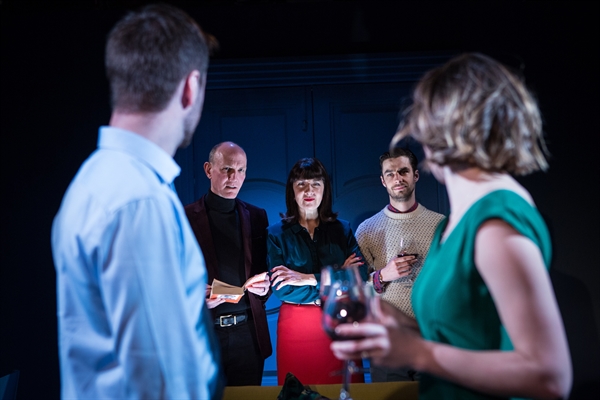
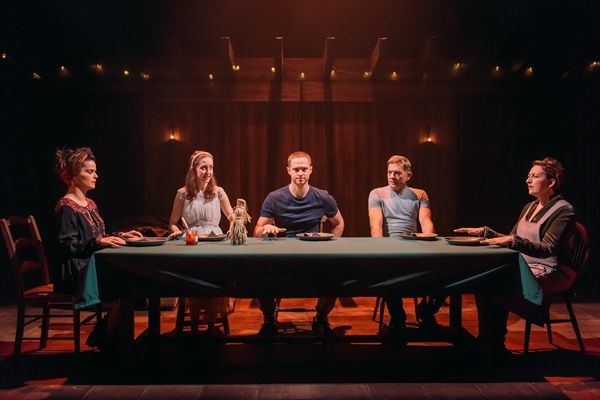
l to r: Frances Thorburn (Violet), Sarah Miele, Andrew Rothney, John Michie, Blythe Duff. Photos: Mihaela Bodlovic

l to r: Frances Thorburn (Violet), Sarah Miele, Andrew Rothney, John Michie, Blythe Duff.
Photos: Mihaela Bodlovic

“This hair-trigger of a play”

Editorial Rating: 5 Stars: Nae Bad

What is it about valleys? There’s the BBC’s Happy Valley and Edward Norton in Down in the Valley, also far from ‘happy’, and – seminally – there’s the Valley of the Shadow of Death, which is as good a place as any in which to locate Rob Drummond’s latest enthralling work. Once upon a time, ‘for hundreds of years in the valley everything was just so’, but then the thanksgiving poetry ran out, like blood. Time now, then, for a spell of compassionate release.

That’s the hope anyway, and it is hope that supports Sophia, whose grand-daughter Autumn, needs a kidney transplant if she is to live much beyond her twelfth birthday. Isaac, Sophia’s grown son, has it in him to help but naturally, dramatically, it is not as easy as that. In fact, after 85 minutes, it has all still to be decided, either by the words of a child terribly wise beyond her years or out of the barrels of a 12 bore shotgun. Orla O’Loughlin’s direction respects this hair-trigger of a play right to its showdown.

The action rises over 3½ days, counted as ‘three sleeps’ by Autumn, who is brat reporter and ancient Chorus combined. She knows the ‘Verses of the Harvest’ by heart and the rhythmic invocation of the Grain Mother as provider of health and happiness- sad joke –  sounds solemn and serious, ‘even though She doesn’t fucking exist’. That’s the thing about Autumn (Sarah Miele): she has that unnerving sacrilegious streak that adults can’t manage.

So, there is proper tension down on the farm. There’s even a game of ‘Truth or Dare?’ that contains the greatest reveal of them all, which is wickedly ironic as Isaac (Andrew Rothney) is described as ‘low risk’. Sophia (Blythe Duff) needs to believe that assessment whilst Burt (John Michie), is there as the phlegmatic companion to threatening circumstance. These two play out a nice challenge of ‘Would you kill scumbags to save your daughter?’, which just digs deeper into the disturbing, teasing, ethical dilemmas that Drummond delights in. Go to his Uncanny Valley for starters.

grain-in-the-blood-2

The remote rural location is part of the piece. Where better to unearth the unsettling and the rooted? The harvest moon can glint off Isaac’s blade and there’s the suffering of Auntie Violet’s horse to put alongside Sophia’s claim that ‘We’re all animals’, which might be what her veterinary practice has taught her. Her house is modern, of machined and polished wood, where you might expect low ceilings, wood smoke and warped timbers. The spare, snappy dialogue and careful movement suits the space, whose back wall slides away to show Autumn’s bed with its blood drip stand, or the barn, site of an earlier, bloodier horror. Introducing classical tragedy for our times, anyone?

Intrigued? You should be, because this is fascinating theatre, still and severe in its way, but emotionally resonant, well-focused and very well performed.

nae bad_blue

Star (blue)Star (blue)Star (blue)Star (blue)Star (blue)

Reviewer: Alan Brown  (Seen 1 November)

Go to Grain in the Blood at the Traverse

Visit Edinburgh49‘s Traverse archive
Dr Johnson Goes to Scotland (Traverse: 1 – 5 Nov. ’16)

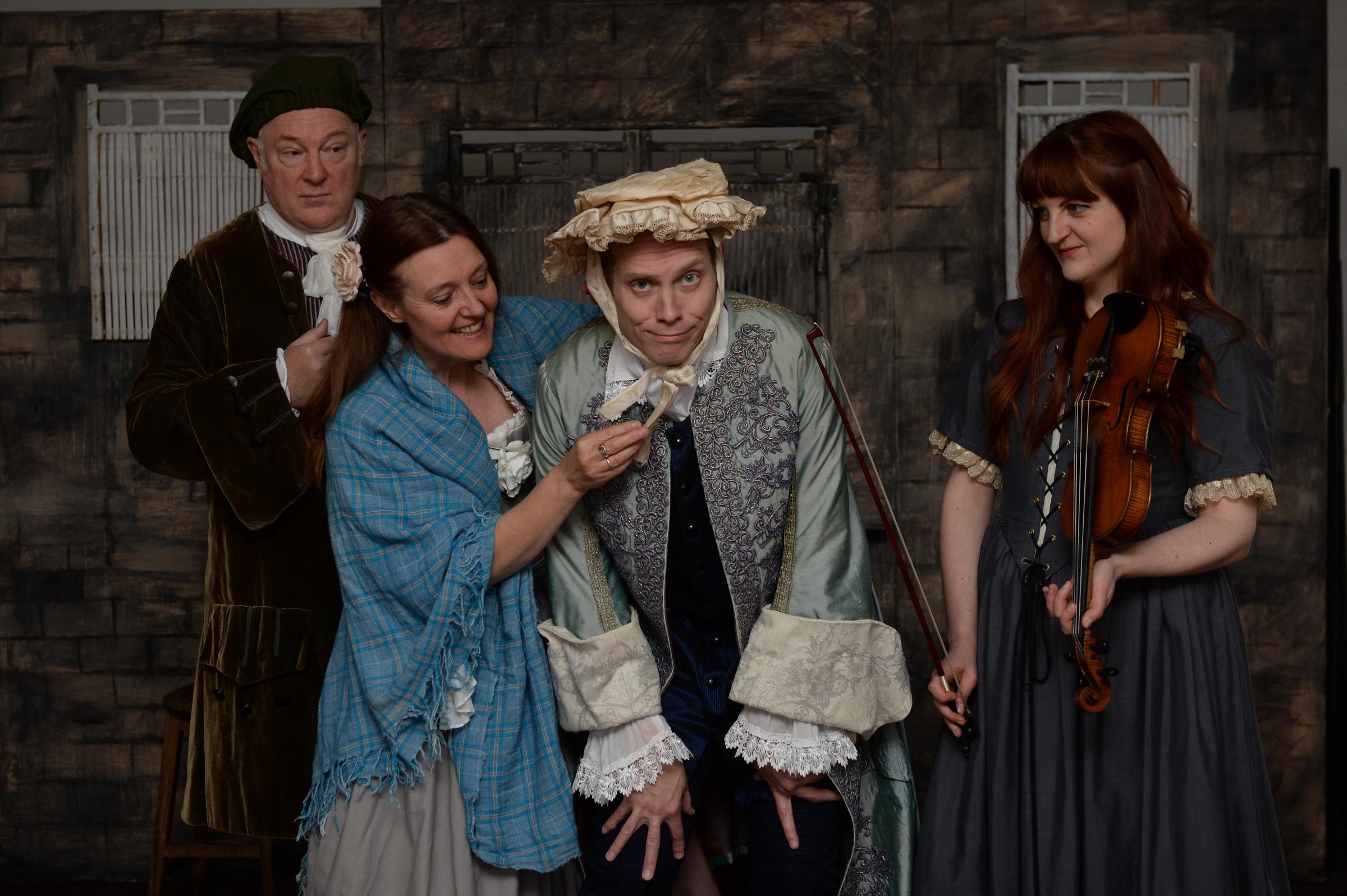
l to r. Lewis Howden, Gerda Stevenson, Simon Donaldson, and Morna Young. Photo: Kirsty Anderson

l to r. Lewis Howden, Gerda Stevenson, Simon Donaldson, and Morna Young.
Photo: Kirsty Anderson

“Comic effect knocks against an open coffin on Iona”

Editorial Rating: 3 Stars

Would Samuel Johnson, heroic dictionary maker, essayist, critic, and celebrity wit ever have appeared on ‘Strictly’? Perhaps. He was, after all, prone to nervous shakes and tics and he would have been mercilessly brilliant at discombobulating the judges. Anyhow, in the last of the current season of a Play, a Pie, and a Pint, the big man is in polished boots and plaid and he steps up to a jig and seems to enjoy it.

And verily this is the same Dr Johnson, who noticed that ‘the whole [of Edinburgh] bears some resemblance to the old part of Birmingham’. Writer James Runcie continues his rehabilitation of the arch English nationalist by rowing him thoughtfully and fondly over the sea to Skye (and to Mull and Raasay). A Word with Dr Johnson – at the Traverse in October last year – was about the man, his wife, and his English dictionary; this time (1773) he’s in the boondocks and the heather and the Gaelic. For the proto London-centric it’s an ear-bending peregrination in a land where ‘you have more words than people’, which could well have been its chief attraction.

Lewis Howden plays Johnson sympathetically, of splendid girth and with orotund voice, and with a baffled interest in all things Scottish. An exploration of Fingal’s Cave, lantern in hand, leaves him only dimly enlightened but his enthusiasm for Thomas Braidwood’s school for the deaf and dumb is obviously sincere.  His companion throughout is, of course, the amiable James Boswell (admirable by Simon Donaldson), who treats us to evocative latin from Dunbar’s ‘Lament for the Makars’, whilst guarding his distinguished author friend from the sublime and local peril of being called a bampot.

So then, a pleasing trot through good old Scottish ways ? Runcie even brings on ‘Macbeth’ and the Bonnie Prince, which is fine until their comic effect knocks against an open coffin on Iona and a poem of freedom in earnest pursuit of the Scottish nation. Supporting roles by Gerda Stevenson and Morna Young are amusing and/or tuneful but my distinct impression was of looking in at the tartan themed windows of discount booksellers, The Works, on Princes Street. The learned Dr.’s eye would take in a remaindered copy of his  ‘A Journey to the Western Islands’; he would harrumph, say “I’m deeply obliged”, and move on.

Star (blue)Star (blue)Star (blue)

Reviewer: Alan Brown (Seen 1 November)

Go to Dr Johnson Goes to Scotland at the Traverse

Visit Edinburgh49‘s Traverse archive.

One Thinks of It All as a Dream (Traverse: 25-29 October ’16)

“Euan Cuthbertson as Syd shows great range and dexterity”

Editorial Rating: 3 Stars

Competent, solid, predictable: words probably rarely used to describe Pink Floyd’s music, but to me the most apt in summarising One Thinks of It All as a Dream – the latest instalment in the Traverse Theatre’s A Play, A Pie and A Pint season. The play, which follows the band’s early years, in particular Syd Barrett’s influence, is interesting for those that know little of the history, but in all other respects doesn’t give much to shout about.

For a theatre piece about such a genre-defining and experimental band, one might expect an edgy or original approach to form and structure to creatively fit the subject matter (drugs and mental illness are common themes), but instead this production follows a simple linear narrative and style typical of (and there have been so many) a musical star’s biopic.

It is structured well in giving nods to all the necessary turning points and dramatic moments to keep interest in the narrative, and the second half flows very naturally in terms of building up tension and allowing the actors to really sell the story. Early on the dialogue is quite forced to convey necessary information – in particular in one party scene the characters all sit around discussing what’s just happened, which comes across as very stilted.

The more engaging parts of this show are the longer and more developed scenes – the first television interview, Roger’s meeting with a psychiatrist and the final few minutes in particular enable the development of more emotional involvement with the action. As quite a pacy piece covering several years it’s quite hard to build a connection with each moment: before you know it you’re off somewhere else again, trying to keep up with who’s who and where and when we are.

The acting is good, Euan Cuthbertson as Syd shows great range and dexterity, particularly in scenes with his father, and the other actors give credible support to keep the action moving. Jonathan Scott’s design should also receive special mention, creating a flexible yet stylish space for the actors to move around in and facilitate a smooth performance.

It’s a perfectly passable show, but not a great show. For me, another brick in the wall.

Star (blue)Star (blue)Star (blue)

Reviewer: Steve Griffin (Seen 25 October)

Visit the Traverse archive.

THIS REVIEW HAS NOT BEEN SUBEDITED

Walking on Walls (Traverse: 18 – 22 October’16)

Image: Leslie Black

Image: Leslie Black

“Funny and searching by turns”

Editorial Rating: 4 Stars

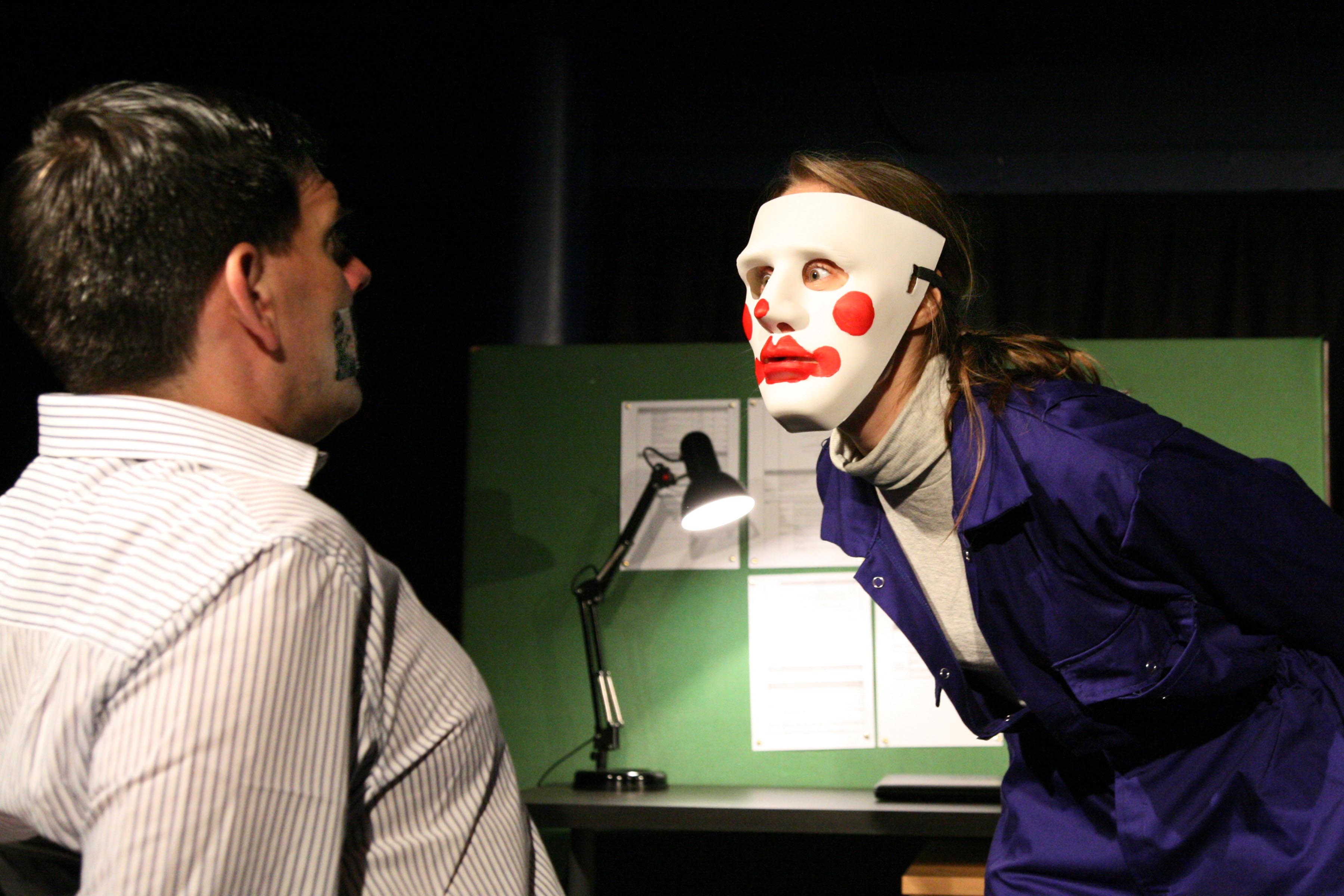
You would not take Claire for a creepy clown. Have there been any sightings in Edinburgh yet? With Halloween around the corner there may well be a few popping up at the window or from behind a wall, which is where Claire comes into her own. She’s the ever so earnest social scientist who doubles as a Super Helpful Person, who just happens to wear a clown mask when she’s out at night looking after people. You could say she looks over them.

Nobody’s laughing at the sinister clown craze, least of all the police, and we shouldn’t laugh at Claire, who has just called them – again; but we do laugh at her, just as the police do, because Morna Pearson’s script makes it all too easy to. Poor Claire with her big round specs and love of chat-defying stats, who’ll never be down the pub after work. But this is the same Claire who notices that (normal) ‘people don’t board themselves up’ unless they’ve been hurt and are vulnerable.

You’ll hear a lot from Claire (Helen MacKay) as she explains herself and her wacky, neighbourly, exploits. She is admirably audible, even from behind the mask. You’ll hear less from Fraser (Andy Clark), not least because of the duct tape across his mouth, but he’s impressive at being incredulous, dumb, and helpless. Unsurprisingly he’s in WTF mode and tries to stay there until he too is affected by Claire’s story. Well, he might be affected, and that’s the point of Pearson’s stinging, interrogatory close.

It is a questioning piece, funny and searching by turns. Who’s the victim here, for one thing, and what’s their space like? Andy is literally bound in his and is pushed around by a young woman, which has to be a valuable experience for him. With Claire it is more complicated. Work is probably the featureless desk, stage left. Home seems to have shut behind her and seems inextricably part of a very unhappy time at school. She sees the empty Buckie bottles and used condoms in the street and it’s all pretty ugly.

There’s tension, of sorts. I saw and heard the opening out and folding up of Claire’s neighbourhood map – with its anti-social ‘hotspots’ – and thought, characteristically, ‘Metaphor-for-Anomie’, which is almost certainly to go too far. Walking on Walls is more interested in seeking kindness than anything else.

Walking on Walls is the third play in the Traverse’s current series of ‘A Play, a Pie, and a Pint’ from Oran Mor, Glasgow.

Star (blue)Star (blue)Star (blue)Star (blue)

Reviewer: Alan Brown (Seen 18 October)

Go to Walking on Walls at the Traverse

Visit Edinburgh49‘s Traverse archive.

Mischief (Traverse: 11-15 Oct ’16)

“Life-affirming and devastating in equal measure”

Editorial Rating: 3 Stars: Nae Bad

Ronnat and Brigid, mother and daughter, live alone on a small island, save for some cows that they tend to for a group of monks on a neighbouring island. But when the handsome young sailor Fari washes up on their beach, their little world is set to be changed forever. For his own good, Fari is sent off to live with the monks with the next dispatch of milk, but he soon becomes responsible for transporting the milk back and forward, meaning frequent visits to the women on the island, which have deeper effects on them all than any of them initially realise.

It’s a simple but intriguing set up, and Ellie Stewart’s writing creates a believable world and relationship web between the three characters that slowly unfurls as the play progresses. The plot is full of changes in direction and power between each one, keeping the tension alive throughout, and leading to a final scene and denouement that’s both life-affirming and devastating in equal measure.

While covering quite a “serious” overall topic, a fair amount of comedy is woven in, largely through quite overt sexualisation. Such moments are generally amusing, though do perhaps cheapen the play and divert attention away from the main drama, which is the piece’s real strength. Traditional singing and movement are also used throughout which in some ways add to the sense of history and ritual one would expect from such a setup, but in others seem a bit gratuitous in trying to cram in too many devices. Overall I think Mischief (a slightly misleading title) tries a bit too hard to do too much in such a short space of time.

What would make this play more effective would be a greater sense of stillness and time – there are quite a few scenes and scene changes as the story progresses at a pretty rollicking pace, but given the life-changing themes and choices presented, Gerda Stevenson’s slick direction never really gives enough opportunity for the situation or newly revealed facts to just hang and be absorbed. The young cast, in their earnestness, also seem very keen to over-emote and play up to stereotypical roles, when a subtler and more grounded approach would help make the play’s decisive moments stand out.

It’s a moving and captivating piece that’s cleverly written, but not realised to its full potential in this production.

nae bad_blue

Star (blue)Star (blue)Star (blue)

Reviewer: Steve Griffin (Seen 11 October)

Visit the Traverse archive.

THIS REVIEW HAS NOT BEEN SUBEDITED

Breaking the Ice (Traverse: 4-8 Oct ’16)

“[Why no] Danish pastries at a convention attended by the Danish?”

Editorial Rating: 3 Stars

The Arctic. Surrounded by seven of the world’s most prosperous and empire-building countries, and ripe for colonisation – if they can all agree on the best way to approach it. Breaking the Ice is set during The Arctic Council’s General Assembly 2016, where negotiations are to take place, and Frank, geologist and stand-in scientific advisor to the big dogs, is due to address the delegates upon the potential impacts of various courses of action. That’s if he manages to find his speech and get his suit dry-cleaned in time after spilling yogurt down it at breakfast.

From the opening few lines it’s clearly a comedy piece, with discussions into the lack of Danish pastries at a convention attended by the Danish and the merits of embossing on business cards, setting the tone somewhere between Dario Fo and Fawlty Towers. Steven McNicoll as Frank is a commanding and charismatic storyteller, and, dressed in a bath robe throughout (due to the yogurt debacle), can clearly be trusted to tell it as it is rather than giving any politico spin. He’s vulnerable, likeable, with a sense of being completely out of his depth but enjoying the ride anyway.

What’s disappointing though, is that as the play progresses (with kidnappings, arrests, and encounters with locals and lawyers), McNicoll’s tone and demeanour show very little variation or development, and by the time he finally gets to address the conference (late, and still in his bathrobe), he appears to be in no way affected by all that has gone before, approaching it as he would making a cup of tea. There is a distinct lack of build-up in tension towards the climax (which in itself fizzles into nothingness), meaning the whole thing feels a bit pointless.

That’s not to say the structure doesn’t facilitate a suspenseful build-up. Throughout his morning Frank encounters many different characters, all of whom have a different point of view on the conference and proposed developments, and all of whom try to persuade Frank to consider theirs when making his speech. It’s a great device to get these viewpoints across, but their rapidity, comic delivery and minimal effect on Frank make them seem like little more then neighbours passing comment about the Jones’s new car than individuals whose livelihoods are set to be deeply affected by the outcome of the conference. It doesn’t quite fit together.

McNicoll as Frank is certainly clear and engaging, if quite one-dimensional in his journey. Jimmy Chisholm is more impressive with his range of characters, creating strong contrasts to communicate the complexity of the situation, yet Nicola Roy’s more melodramatic style seems to be at odds with everything else on stage resulting in a bit of a mismatch in interpretation of the script and lack of consistency throughout.

While there are plentiful very witty lines, some of the dialogue seems quite forced in order to shoe-horn in the humour – in particular, a discussion into an environmental activist’s kidnapping prowess smacks of being thrown in for comic effect, given how little it adds to the overall piece. I spent much of this performance wishing they would just get on with it.

Ironically, Breaking the Ice does quite the opposite – merely skimming the surface of the debate into the economic and geological future of the Arctic, without ever prodding deep enough to build a strong connection with the issues to leave a lasting impression. Much like an iceberg, this production feels like there could be much more to it, but we’re not able to see it.

Star (blue)Star (blue)Star (blue)

Reviewer: Steve Griffin (Seen 4 October)

Visit the Traverse archive.

THIS REVIEW HAS NOT BEEN SUBEDITED

Right Now (Traverse: 19 April – 7 May ’16)

Photos: Helen Murray

Photos: Helen Murray

“Funny and clever, disturbing and salacious”

Editorial Rating: 4 Stars

A Traverse Theatre Company, Theatre Royal Bath Ustinov Studio and Bush Theatre co-production.

Ben is a junior doctor. He and Alice have been together for seven years and their work/life balance is screwed. As it happens, so far so familiar. Right now they’ve been in their new flat for six months, have just got the baby’s room to do, and things will get better. Only they don’t. Instead neighbours Juliette and Gilles and their son François come right on in from across the hall ….. Meet the Fockers from Quebec, everyone: with a ‘u’, inappropriate, out of order and way, way, out of bounds.

You watch your step in this pressing and uncomfortable comedy. You’re never too sure what’s underfoot or where it’s going. There’s a godawful squeaky toy behind the sofa and half a glass of red on the floor. ‘Beware’ should travel around the set like LED advertising at a sports ground. Beware Juliette with her penchant for flashing her knickers; beware Gilles’ prurient touch and tongue; beware François’s lacerating commentary. “They’re a bit odd” is Alice’s bang on estimate. “I like them” is Ben’s disastrous opinion. It’s funny and clever, disturbing and salacious, and very well performed.

Michael Boyd directs this production, which is a cracking compliment to French-Canadian writer Catherine-Anne Toupin. It looks clean, like a Farrow and Ball paint job by designer Madeleine Girling where the quality of the finish should never be in question. All the more effective, then, when a kind of moral distemper takes hold and it all gets corrupted, goes off-colour and becomes dubious. Guy Williams as Gilles is absolutely loathsome because his seduction of Alice is like a pet research project. He also, incidentally, proves that a black roll neck jumper and brown jacket are about as louche as it gets. Maureen Beattie, ever the mistress of the bewitching voice, is Juliette the mother temptress, against whom all resistance is futile. Just sticking a plaster on Dr. Ben’s hand makes him go weak at the knees. François – jittery and wacky by Dyfan Dwfor – may be appalled by his parents’ behaviour but is just as complicit.

Lindsey Campbell as Alice

Lindsey Campbell as Alice

If Toupin isolates a character, it’s Alice. The plot would push her under but she won’t go. Listen up in scene 5 for the psycho pairing of Ben (Sean Biggerstaff) and ‘Benny’ (that would be Biggerstaff too) but Alice stays there, screaming for help really. Lindsey Campbell has to do grieving and dirty dancing and horribly vulnerable all at once, which is why the sex is so desperate. It’s a class act and I think is what the show’s flier describes as traumatic, ‘teasing and thrilling’.

Right Now is as billed. It’s edgy, imminent, and contemporary, which makes it kind of Shakespearean: François as Feste maybe, Alice as the abused and distraught Ophelia; Juliette becomes Lady Macbeth, who has given suck, etc. Weird.

Star (blue)Star (blue)Star (blue)Star (blue)

Reviewer: Alan Brown (Seen 19 April)

See Right Now at the Traverse

Visit Edinburgh49‘s Traverse archive.

Ring Road (Traverse: 12 – 16 April ’16)

Martin Donaghy as Mark and Angela Darcy as Lisa. Photo. Traverse theatre.

Martin Donaghy as Mark and Angela Darcy as Lisa.
Photo. Traverse theatre.

“Both actors perform brilliantly in a small space (and on a narrow bed)”

Editorial Rating: 4 Stars Outstanding

Fifth and last in this Spring season of A Play, A Pie and a Pint.

It was the prickly cactus that did it, that brought to mind Love’s Labour’s Lost and fun puns on pricks, butts and horns. Mark notices it by the Reception desk of the hotel that’s just off the ring road. He reckons he’s there for sex (oh, not the archery then) and he’s right. Lisa does want him but it’s more his sperm than his good self that she’s targeting. She desires a baby while Mark just fancies the pants off his teacher sister-in-law. Ouch!

Anita Vettesse has written a painfully entertaining comedy and director Johnny McKnight does indeed make the pants fly off the bed. Ring Road is frisky, certainly, but it is also sensitive to what Lisa is feeling. She is 40 years old, has ‘grown to love’ her husband, but is still without a child. The pressure is on big time.

A late afternoon’s delight via Dayuse.com might be all very well but Lisa (Angela Darcy) sees Mark (Martin Donaghy) more as a ‘facilitator’, which he’s not best pleased about. He is even less keen on the idea when brother Paul (a wry, downcast voice-over from Robbie Jack), Lisa’s husband, joins them by being put ‘on speaker’. The two brothers are plumbers, sharing the same van, rather than the same women but it’s still odds-on that the dismissive reference to Screwfix is deliberate.

Mark’s spattered overalls and rigger boots look strange in the tidy, unexciting hotel room and he knows that the whole situation is just not right. Twin beds are bad enough – and that ‘art’ on the wall!- but the twitchy tension is the real passion killer. Lisa, in particular and unsurprisingly, is a bundle of nerves. At worst Mark is confused, but she is probably more conflicted at the end than at the beginning, which is touching and sadly credible.

Both actors perform brilliantly in a small space (and on a narrow bed). Donaghy does “For fuck’s sake” as baffled, happy, hurt and kind all at once, while Darcy is no less expressive, just more couth and desperate. The fact that Ring Road is also very funny is down to the quality of Vettesse’s writing.


outstanding

StarStarStarStar

Reviewer: Alan Brown (Seen 12 April)

Go to Ring Road at the Traverse.

Visit Edinburgh49′s Traverse archive.

The Silent Treatment (Traverse: 7 – 9 April ’16)

Photo: Lung Ha Theatre

Photo: Lung Ha Theatre

“A lot of barmy mischief making”

Editorial Rating: 3 Stars

Lung Ha Theatre Company is a leading theatre company for people with learning disabiities, in Scotland and internationally.

Shout it out: Lung Ha bucks trend! By the latest UK stats worker output per hour is down; well, not when you put 21 actors on stage and keep them acting all the while. All the more testing, when there’s little to no dialogue in Douglas Maxwell’s script of stage directions.

The Silent Treatment subjects its cast to keeping shtum – and alert. For the most part it is full on music and sound (by M J McCarthy) that cues the action. After Lung Ha’s Thingummy Bob with Cliff and The Shadows I had my old money on ‘Silence is Golden’ for some signature backing; but, no, that was 1967 and this play needs mobiles, scratchcards, emoticons and a chainsaw. Still, The Tremeloes’ lyrics have something relevant to say: here’s the second verse,

Talkin’ is cheap …
How could she tell? He deceived her so well.
Pity she’ll be the last one to know.

Billie (Nicola Tuxworth) thinks she has the secret to end all secrets. In fact, it’s her boyfriend (Stephan Tait) who’s got it and she won’t find it out until the end, when she will be speechless. In the meantime Billie goes with her little secret and sets out to try and wreck the sponsored silence that is being held to raise money for her mum, who’s in and out of hospital. Why would she do such a thing? That’s her secret and she’s not telling.

And, of course, no-one else is saying anything. The writing on the blackboard spells it out: SPONSORED SILENCE. No Phones (ignored), No Sleeping (impossible), No Eating (not when there’s a packet of Penguin biscuits around), No Knitting (didn’t see any), wheel noises and body noises don’t count (fair enough). It is the irrepressible Kenneth Ainslie as Toby who has real trouble with the rules but even he doesn’t speak.

Billie finds a helper in Stacey (Emma Clark) and the two of them, in and out of disguises and of the windows, do a lot of barmy mischief making under the stern nose of dominie Kitty (Kay Ann Jacobs); but it’s the four strong building crew (with foreman Mark Howie unmistakeably in charge) in high-vis vests and bowlers who do the heavy lifting, paying no attention whatsoever to Kitty’s gong.

The audience did not want to break the silence either. Hearty laughter seemed somehow disrespectful to Maria Oller’s close direction and the disciplined work of the performers on stage. With one great, if unholy, exception, the ingenious visual gags were met with appreciative chuckles rather than guffaws , and so when the end came – when it blossomed is actually more accurate – the applause was for hard study and successful work rather than for easy laughs.

Star (blue)Star (blue)Star (blue)

Reviewer: Alan Brown (Seen 7 April)

Go to The Silent Treatment and to Lung Ha Theatre Company

Visit Edinburgh49‘s Traverse archive.

Neither God Nor Angel (Traverse 5 – 9 April ’16)

Jimmy Chisholm as James VI and Gavin Wright as William. Photo: Leslie Black

Jimmy Chisholm as James VI and Gavin Wright as William.
Photo: Leslie Black

“To an eloquent vocabulary!”

Editorial Rating: 4 Stars

4th in this Spring’s season of a Play, a Pie and a Pint.

Union (2014), Tim Barrow’s second play, was full of the joys of the Referendum campaign – vigorous, disputatious, even romantic. Neither God Nor Angel, his third, is not ‘Union the prequel’ (by a century), but more of a light amuse-bouche to that earlier rich and hearty fare. This is a waggish two-hander, chummier, a pawky chamber piece.

It is an entertaining fact that James VI, King of Scotland, must have spent some part of the night of April 4th 1603 in Holyrood wondering what it was going to be like to be James I of England (& Ireland) to boot. He was away to London the following morning. Did he blow hot and cold about the whole enterprise? The Incarnation probably sprang to the mind of this godly, seriously literate and absolute monarch who, in 1598 and blessedly free of irony, wrote of ‘the Reciprock and Mutuall Dutie betwixt a free King and his naturall Subiectes’. Let there then steal upon the scene, for the purposes of comic wrangling over glasses of good Rhenish wine, one such subject.

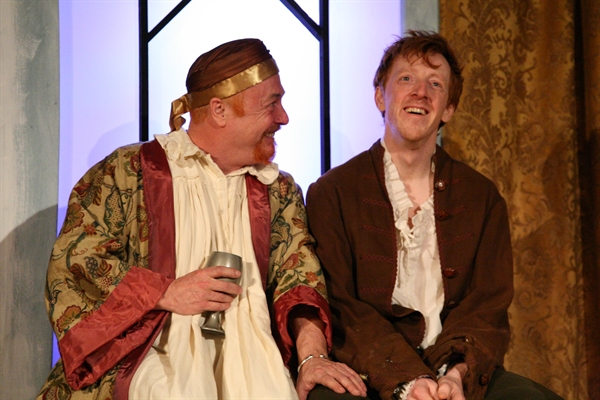
Levity, clearly, is heaven-sent. Enter gawky William (Gavin Wright) to cheek and cheer his King, who has been in peevish sorts. James (Jimmy Chisholm) welcomes – and would embrace in all innocence – the impertinent company of a serving man. Better William, any day, than those ‘devious bastards, the bankers, with their velvet draped bollocks’; and so the toast, raised by His Majesty, ‘To an eloquent vocabulary!’

William speaks Leith and James, crowned at thirteen months, speaks privilege with moments of dainty Morningside. “Would you ken where yon bottle is hid?” might well be an habitual question in Hermitage Gardens but the interesting parts, in amidst the humour, is the forgotten or unfamiliar history: Royal pal Esmé Stewart is pined for; recall of Gowrie and the Ruthven raid shakes the King; his wife, Anne of Denmark, is cherished; and William is sacked for spilling wine on John Ramsay’s silk doublet, which could have happened. I liked all this, almost as much as the use of quill on paper.

It’s a good title, Neither God Nor Angel, provided you can accept that the king’s a man for a’ that, which he ain’t really. Director Ryan Dewar and his two actors do very well with this pithy play of make-believe.

Star (blue)Star (blue)Star (blue)Star (blue)

Reviewer: Alan Brown  (Seen 5 April )

Go to Neither God Nor Angel at the Traverse

Visit Edinburgh49‘s Traverse archive.