RSNO: Oundijan; Vogler; Wang. Usher Hall. 3 Nov.’17

Related image

Jan Vogler

“Great if you like twelve-tone. Not so great if you don’t”

Editorial Rating:  4 Stars


Combined concerti for violin and cello are relatively rare, and on Friday at the Usher Hall we got two, separated in composition by 128 years. Such was the nature of the new work, however, that it was more like a comparison of the Viennese Salon of the 1890s and the 1930s’ Second Viennese School.


As is his custom, conductor and Director of Music Peter Oundjian gave us an introductory talk alongside cello soloist and this year’s Artist in Residence Jan Vogler. Not unreasonably, the majority of the talk was about the UK premiered work Duo Concerto by Wolfgang Rihm. Rihm was born in 1952 in Karlsruhe and is a professor of composition at the University of Music there. The work was commissioned by the Friends of Dresden Music Foundation to celebrate ten years since the reopening of the Frauenkirche and received its world premiere in Purchase, NY and in Europe in Dresden in 2015. It was written for performance by Vogler and tonight’s violin soloist, Mira Wang. Vogel’s association with the work, and his being the orchestra’s Artist In Residence, explains its choice on tonight’s programme in addition to its legitimacy as a composition.


The work lasts for 25 minutes in one movement. The soloists are in play almost the entire time, and the work has a heavy texture and is written in the twelve-tone technique. “Great if you like twelve-tone”, said Vogler. “Not so great if you don’t”. The work in fact had momentum, good orchestration, and a particularly demanding part for violin soloist Mira Wang. It was, perhaps, down to the limitations of twelve tone that it sounded remarkably similar to Schoenberg albeit composed seventy years later.


Our hardworking soloists carried straight on into the Brahms Double Concerto in A minor. Brahms is the master of melody, and we were into a glorious cello theme just four bars in. Whereas Wang did most of the heavy lifting in the Rihm, this work was Vogel’s and in fact a case could be made for writing out the violin part altogether, taking nothing away from Wang’s fine playing and   interplaying with Vogel beautifully when the score allowed it. The orchestra played with excellent phrasing and balance and were clearly very comfortable in their skin, supporting the soloists with all effortlessly harmonised under Oundjian’s baton.


After the interval we returned for Beethoven’s Symphony No 6 in F major, the ‘Pastoral’. What can a music writer add to the reams that have already been written about this glorious work? Well, you could feel the hall relax as we snuggled into this closing number, the orchestra were on top form, fully rehearsed and sure of foot, and familiarity did not disappoint. One notable difference in interpretation were the strings playing of the first subject in the final movement (Shepherd’s Song), Oundjian holding them back just a little so we could hear more of the supporting wind. He bought them back to the fore before the finale.


And did you know the Shepherd’s Song was used as music in the TV commercial for Lentheric’s Tweed fragrance in the 1960s? Now, you will find that degree of historical research only in Edinburgh49.


Star (blue)Star (blue)Star (blue)Star (blue)

Reviewd by Charles Stokes (Seen 3 November)

Go to the RSNO, Scotland’s National Orchestra

Visit Edinburgh49 at the Usher Hall archive.
RSNO: Norrington (Usher Hall 21 Oct’ 2017)


Sir Roger Norrington
Photo: Alberto Venzago

“Sometimes good things come in small packages”

Editorial Rating: 4 Stars


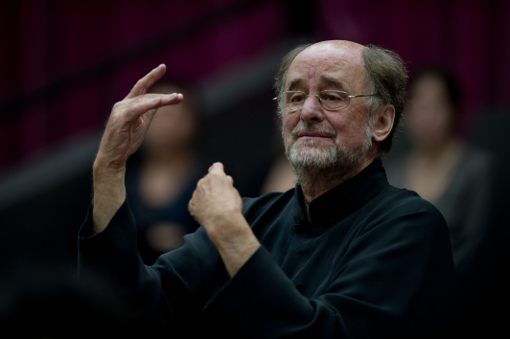
There was much more to Friday’s excellent RSNO/Roger Norrington gig than met the eye. Of course it was a thrill to be in the hands of the maestro of historically informed musical performance, last seen here at the Edinburgh Festival for his assured and thrilling Monteverdi performances, as well as for the reassurance of an evening’s accessible, if not easy listening, classical music. Yet we got so much more, namely an insight into the deceptively futuristic ahead-of-its-time works of Robert Schumann and Felix Mendelssohn-Bartholdy.

The first question one was forced to ask oneself was, “When is a symphony not a symphony?” The initial work, Schumann’s Overture, Scherzo and Finale was originally titled Symphonette and played out in three movements in around 19 minutes. Both Prokofiev and Shostakovich wrote symphonies of lesser duration, the former at the beginning and the latter towards the end of their symphonic canon, so why the name change? In admittedly three movements rather than four, it was greater than the sum of its parts and was a satisfying, rounded piece developing all the way through towards a Finale: Allegro molto vivace that was recognisably mature Schumann as compared to its more Mozartian beginnings.

After the deftest of scene changes (only three first violin desks to move out of the way in this cut down band) to bring on the concert grand Steinway, Roman Rabinovich delighted us in a relaxed, assured and thrilling interpretation of Mendelssohn’s Piano Concerto No 1 in G minor.   In an underrated work clearly ahead of its time – that reminded me of Brahms and Tchaikovsky a generation later  – we were treated to excellent solo and ensemble playing of a dramatic operatic opening followed by a strong melodic line and taut together playing under Norrington’s understated, enabling direction.

The evening concluded with Schumann’s Symphony No 1 in B flat minor (Spring). I cannot find any reference to Tchaikovsky being influenced by Schumann in his ground breaking fourth symphony but the opening two bars of the Spring symphony were near identical. The orchestra were sufficiently beefed up for this work to make one forget it was contemporaneous with the opening number. We went from two French horns to five, nought to three trombones and were full on for more than half an hour. The playing and direction were disciplined and effective with well-managed crescendos and an elaborate brass coda in the first movement. The band continued to provide a rich tone in the second, but in the elaborate and extended finale, following on a beautiful flute intervention, the brass gave into themselves showing tone a little coarsened by virtue of their evident enthusiasm. Never mind, this was joyous music making.

As I left the auditorium I noticed that I was leaving at the remarkably early hour of ten past nine. We had, in fact, just one and a quarter hours of music making when on a good night one can expect nearer two hours. Yet it was a well-put together programme and hard to see how it could have been justifiably fleshed out. Some times good things come in small packages.


Star (blue)Star (blue)Star (blue)Star (blue)

Reviewer: Charles Stokes (Seen 20 October)

Go to  the RSNO, Scotland’s National Orchestra

Visit Edinburgh49 at the  Usher Hall .

RSNO. Sondergard, Williams: Beethoven, Mahler, Sibelius (Usher Hall: 21 April ’17)

Image result for Sibelius pictures

Jean Sibelius (1865-1957)

“Their playing of Sibelius’s Finlandia was one of the best, if not the best, I have ever heard, live or recorded. “

Editorial Rating: : 4 Stars: Nae Bad

One of the excitements of live music is that you never know quite how it is going to turn out on the night. You think you’ve got it at rehearsal, but performance is something different. Only a very few orchestras turn out a consistently really high standard, time after time.

After two years in Edinburgh I am becoming increasingly impressed by the quality of the local bands, and Friday’s concert contained some excellent playing in a well chosen, thoughtful programme that while relatively well supported was deserving of a larger audience. Clearly the Florida sun has sown benefits. It was a very good concert indeed.

The RSNO’s opening numbers are sometimes a little shaky before they get into their stride. Not so tonight. Their playing of Sibelius’s Finlandia was one of the best, if not the best, I have ever heard, live or recorded. The opening chords of the brass were well rounded and melodic whilst still conveying the angst of the Russian threat to the mother country in this highly nationalistic piece. Not a trace of blaring or vulgarity. The mournful strings provided a similarly well-rounded tone in what was a very well executed opening number, convincing and moving. Applause was loud and long. Deservedly.

It was a very interesting choice to follow with Mahler’s Der Knaben Wunderhorn, a less austere work than Kindertotenlieder, or, for example, Das Klagende Liede.   Five songs were selected from the original 24 settings, covering nature, folklore and soldiers’ tales. Baritone Roderick Williams gave a well-executed performance in which the orchestra again shone, but perhaps a little too brightly. There were issues of balance between soloist and orchestra and one would have preferred the soloist not to have referred to his music.   This notwithstanding, the intriguingly named “St. Anthony of Padua’s Sermon to the Fish” was sung and played beautifully, and was well balanced. Also, “Where the Fair Trumpets Sound” was the star of the set with gentle orchestral backing, melodic singing.

After the interval it was back to Sibelius and The Oceanides. I confess I had not heard this 11 minute miniature before and I loved it. It started with a most unusual but effective piece of string writing that reminded me of sea mists and tides, to be followed by the increasingly effective flute section before building to something stronger involving the whole orchestra evoking the ocean’s sheer vastness and permanence. Commissioned and first performed in America, one critic described the new work (1914) as “the finest evocation of the sea which has ever been produced in music”. Well, there is plenty of competition for that, not least Debussy’s La Mer, but it certainly stands the comparison.

Our evening was brought to a close by Beethoven’s Symphony No 1 in C Major. Critics have often categorised his first two symphonies as Mozartian, with the composer coming of age with the Eroica. I am not so sure. The first few bars’ shifting harmonic sands alone, quite startling in early 19th century Vienna, point to something more revolutionary, and although there is a classical theme overall  – such as can be found in both Mozart and Haydn –  as Tovey said, the symphony has “more of the 19th century Beethoven in its depths than he allows to appear on the surface.” This contention was certainly supported by Thomas Sondergard’s interpretation, which was mature and grounded in what was a hugely enjoyable performance by an orchestra that was clearly loving what it was doing. So did we.

nae bad_blue

Star (blue)Star (blue)Star (blue)Star (blue)

Reviewer: Charles Stokes (Seen 21 April )

Go to the RSNO website

Visit Edinburgh49 at the Usher Hall archive.

Benedetti; Oundjian; RSNO (Usher Hall 10 Mar.’17)

Image result for RSNO Images

“I was happy to leave the concert hall with a spring in my step and wish them bon voyage on their long flight to Orlando”

Editorial Rating:  3 Stars

The RSNO are rounding off their glorious 125th Season with a tour of the USA, Florida to be exact. Why Florida? Because classical music’s largest constituency is older people, and Florida is a state where they are legion, both full time residents and the “Snowbirds” who go for the winter. And Florida has more world-class concert halls than any other state in the USA. Five, no less. They played their final concerts in Glasgow on Thursday, and Edinburgh on Friday. There was a real whiff of excitement in the air. The last time they toured the States was 1992, before the fabulous Nicola Benedetti was born.

So Friday night’s audience, loyal to their orchestra and adoring of their favourite soloist, were in no mood to be troubled by the niceties of musical criticism, they were there to have a good time, and they did. Alas, it is the job of the music writer to point out the subtler issues.

The first half of the concert was, on paper, a romantic’s dream, Debussy’s Prelude a l’apres-midi d’un faune, followed by the ultra romantic Bruch violin concerto. This writer anticipated both eagerly. Both disappointed.

Principal flute Katharine Bryan led off the Debussy confidently and competently in what is an extremely exposed solo in a difficult register. The orchestra answered in a well played ten minute exposition of the theme, but only on a fairly superficial level. This work has mystery, shades of eroticism and soul, and we didn’t get this. Indeed, in the entire first half of the concert Peter Oundjian’s baton was there for the score, but too restrained in the exposition.

By all accounts Nicola Benedetti had given a bravura performance of the Brahms’s Violin Concerto in Glasgow the previous evening. Tonight we were all well up for the Bruch, arguably the most romantic violin concerto ever written, if not as great a work as the other three German concerti: by Beethoven, Brahms, & Mendelssohn. While one doesn’t want the soloist – or orchestra – to wear their hearts on their sleeves, there was much more that could have been brought out of the work by the soloist in terms of phrasing, power and sheer bravura of performance. Competently executed and, yes, restrained, we were left feeling puzzled and short changed. The presence of sheet music tucked away on a stand suggested a performer perhaps a little weary before the USA trip, allied with, unusually, no encore. Yet, of course, in the eyes of the RSNO claque she can do no wrong, and was applauded enthusiastically. The orchestra played well.

Live music is a fickle mistress and often provides the unexpected, both disappointing and pleasing. What on earth could the RSNO bring to Beethoven’s Fifth Symphony, and what new is there to write about it?

Well, the RSNO brought a fresh, lively approach to the work from the beginning of the well known opening theme. It was as if they had received a half time pep talk. They made a lively pace throughout, notably the cellos in the andante con moto, along with the cleverest, anticipatory build up to the final Allegro. Clearly a game of two halves, I was happy to leave the concert hall with a spring in my step and wish them bon voyage on their long flight to Orlando


Star (blue)Star (blue)Star (blue)

Reviewer: Charles Stokes (Seen 10 March)

Go the the RSNO

Visit Edinburgh49 at the Usher Hall


RSNO: Remmereit, Bryan. Vaughan Williams, Martin Suckling, Ravel. (Usher Hall: 3 Feb ’17)

The Lark Ascending

“In Katharine Bryan we heard some of the finest flute playing around today”

Editorial Rating: 4 Stars

The RSNO chose interesting, offbeat fare for their Sir Alexander Gibson Memorial Concert on Friday night, by way of complete contrast to what will be an immensely popular Rachmaninov/Tchaikovsky melange this coming week. Good for them, and I am sure that the great man, who brought so much to the RSNO in his extraordinary twenty-five year tenure and yet died at the relatively young age of 68, would have thoroughly approved.

The first piece was not without controversy: Vaughan Williams’s The Lark Ascending transposed for flute by the RSNO’s Principal Flautist, and soloist on the night, Katharine Bryan. This well known work – indeed, it is number one in Classic FM’s Hall of Fame (make of that what you will) – while for some overexposed, is to me almost sacred. I first heard it as a schoolboy played in a concert in Dorchester Abbey in Oxfordshire by one of my peers, Richard Deakin, who went on to teach music at the Royal Academy and found the Orchestra of St John’s Smith Square. An early summer evening by the Thames with the fading sun streaming through the Abbey’s stained glass windows … and the piece moved onto my spiritual and emotional hard drives for ever.

To transpose it to flute had me and a number of others worried. Yet for me, full of reservation, it was a triumph. The warmth and roundness of the flautist’s timbre brought a new dimension to the work outwith the capacity of the violin. Bryan’s playing was exquisite: her control of her breathing in long passages extraordinary, her phrasing superb, her control and precision utterly convincing. So much so that I shall buy the recording. Now there’s a compliment in this age of streaming and downloads.

Composer Martin Suckling came on next to introduce his world premiere performance of our next piece,  The White Road. Interesting as this prologue was, it later became clear  – as our flautist returned  in a shimmering white dress rather than her earlier red version –  that this was a fill in. No matter, it gave the next quite difficult fifteen minutes some context.

Notwithstanding the composer’s aspirations the work essentially was a back and forth between sharp musical bites from the flute echoed by percussion, with minimal brass, wind and string support and unconvincing body bops by the soloist to accentuate the to and fro with little added value from the microtones. Melody went missing until the end of the work and I found it unremarkable. Fairly typical of the modern genre, I suppose, but it really only came into itself at its close.

Our nerves were soothed by Bryan’s blissful rendering of Massenet’s Thais as an encore, accompanied only by harp. Luscious.

Following the interval we were treated to Daphnis and Chloe Suites No’s 1 and 2. This piece is a conductor’s nightmare in terms of its fluidity and apparent lack of time signature, so it would be timely to point out that the baton was being held on the night by Arild Remmereit standing in for the indisposed Peter Oundijan. A fine job he made of it (and for the rest of the evening, too). You never felt the orchestra were out of control and their disciplined playing impressed. The work opened with a flute solo and lo and behold, there was Katharine Bryan again, now in black dress, back in her familiar principal flute’s chair. The Danse Guerriere at the conclusion of the first suite showed real verve and the Lever de Jour opening Suite No 2 was well realised and convincing. Remmereit got everything he could out of the band in the Danse Generale which ended our evening with a – or rather, several – bangs.

So in conclusion,  this was a concert that entertained with the familiar, challenged with new takes on familiar themes, and also with new material. Sir Alexander would have been proud of his orchestra’s playing and in Katharine Bryan we heard some of the finest flute playing around today.


Star (blue)Star (blue)Star (blue)Star (blue)

Reviewer: Charles Stokes (Seen 3 January)

Go to the RSNO, Scotland’s National Orchestra

Visit Edinburgh49 at the Usher Hall archive.

RSNO, Prieto and others (Usher Hall: 2 Dec’16)

Image result for verdi

“…this was a strong, conviction performance of a great work with some fine playing and singing”

Editorial Rating:  4 Stars: Nae Bad

“An opera in ecclesiastical robes” (Von Bulow”). “Bulow has blundered. It is a work of genius” (Brahms). But Von Bulow was not necessarily being pejorative. So what if the Verdi Requiem is an opera in ecclesiastical robes? This perennial argument does have some merit in criticism of the work. I see nothing wrong in celebrating a requiem in operatic style, but it is the structure and intervals within the requiem format that get in the way of the flow of the work. It is a series of seven moments, apart from the enjoyably more substantial Dies Irae and Libera Me. To me, its enjoyment is entirely secular. If I want a spiritual or religious high, I turn to Faure, or Mozart or, indeed, Brahms. If I want music to die for (le mot juste?), then it’s Verdi.

Friday night’s wonderful performance by the RSNO, RSNO Chorus and four soloists: soprano Evelina Dobraceva, mezzo-soprano Elizabeth DeShong, tenor Edgaras Montvidas and Bass-Baritone Hanno Muller-Brachmann – under the baton of Carlos Miguel Prieto was at times spoilt by the audience. On the whole I have a lot of time for the RSNO followers, who do not whoop or whistle, do not clap between movements, and allow a respectful interval at the end of a piece before applauding, but on Friday they coughed and they croaked as and when they pleased, spluttering just a few moments into the desperately fragile pianissimo Requiem. Surely they could have held back at least until the forte passages. I relished – in the fortissimo Dies Irae – the thought of drowning them out myself. This may be the price you pay for live music in winter, but perhaps the Usher Hall could print a few useful tips on muting the effect, as they do in the programme notes at the Royal Festival Hall.

Enough of the audience and on to the artists. The 120 strong chorus managed to keep precision and intensity in their pianissimo entrance, and sang throughout with discipline, force and feeling. Sopranos never harsh, well balanced between the four parts and every entry spot on; basses clear, and good mid range from the altos and tenors. They sang the Dies Irae and Libera Me as well as I have ever heard it sung. Bearing in mind the size of their catchment area this pays a real compliment to their talent and training.

The orchestra were also well up to the task and played with feeling and élan. The “stereo” effect of placing two trumpets up in the gods at the back of the hall in reply to the others on the stage in the Tuba Mirum worked very effectively – it doesn’t always – and it was a revelation to hear, again in the Dies Irae, a double fortissimo, that’s four fortes, without any blaring or coarseness.

The casting of the four soloists from America, Lithuania, Germany and Russia, coming together for a couple of gigs in Glasgow and Edinburgh shows what an international world classical music is, and how Scotland is right up there with the best of them in its ability to attract such talent. The work is not easy on the soloists, especially when singing with each other in duet format. Individual soloists sang well with the orchestra but the two sopranos struggled to sound homogenous in the Recodare, Jesu Pie in the Dies Irae but had got more used to each other in the kinder Agnus Dei. One felt bass-baritone Hanno Muller-Brachmman wasn’t entirely comfortable in the Mors Stupebit and Confutatis maledictus in the Dies Irae, but he entranced us later in the Lux Aeterna. Their quartet for the Offerterio worked well, and soprano Evelina Dobraceva thrilled us in the concluding Libera Me where she really nailed it.

Overall this was a strong, conviction performance of a great work with some fine playing and singing with just a few issues of coordination and integration between soloists, which is always a risk with a live performance of a work that really puts them on the spot. There was a respectable pause before enthsiastic applause broke out, showing that the audience’s heart was in the right place, even if their fitful larynxes were not.

nae bad_blue

Star (blue)Star (blue)Star (blue)Star (blue)

Reviewer: Charles Stokes (Seen 2 December)

Go to the Royal Scottish National Orchestra

Visit Edinburgh49‘s Usher Hall archive.

RSNO: SONDEGARD, SOLLIMA (Usher Hall: 18 Nov ‘16)

Image result for shostakovich

 “Was this the new Russia? Who cares? The music was amazing.”

Editorial Rating:  3 Stars

“Football is a game of two halves” as the crass saying goes. The intimation is, there is a good half, and a bad half. Friday’s RSNO concert can be explained in such terms. Relatively speaking, the first half disappointed, the second enthralled.

Cellist Giovanni Sollima was the soloist for the Dvorak Cello Concerto, and, to kick the evening off, in his own piece Violoncelles, vibrez! (in fact a duo for two cellos and orchestra) he shared the soloist platform with Aleksei Kiseliov, the RSNO’s principal cellist. Written to mark the tenth anniversary of the death of Sollima’s teacher, Antonio Janigro, and dedicated to Sollima’s fellow student Mario Brunello, one might have expected a deeply personal, even reflective work. It was, however, rather light, and reminded me in places of works by Max Richter, barely in the classical genre. The first movement did contain some long melodic lines but the work was neither unpleasant nor particularly demanding. The orchestra gave good support.

Then came the Dvorak. Dvorak as a concerto composer has never satisfied me as much as his fine symphonic or string quartet writing. Plainly, the orchestration is there, but the solo pieces (less so in the violin concerto) just do not seem to fit in so well, the exact opposite, for example, of Chopin. This facet of the work was exacerbated by some less than convincing playing by Sollima. The long orchestral opening of the opening Allegro was masterfully handled by the RSNO, who played their part with relish, sometimes, indeed often to the detriment of the overall balance with the soloist. Sollima did not seem particularly in command, Sondergard was standing in at short notice. The end of the first movement, much of the second and the majority of the third were a more comfortable experience. Sollima’s encore left one in no doubt as to his virtuosity.

I was looking forward to hearing Shostakovich’s Fifth Symphony again, and to see what the RSNO, in such good form this season, would make of it. They did not disappoint. Much has been said and written of the political background to the composition of this symphony under Stalin’s gaze, “A Soviet Artist’s reply to just criticism” but to me this is largely irrelevant: Shostakovich was a pragmatist, the symphony is an outstanding work and for many people its relative accessibility makes it a welcome introduction to the oeuvre of one of the twentieth century’s greatest composers.

Meticulous, sparse playing brought out all the fear and austerity suggested by the opening Moderato, quickly followed by woodwind and brass creating a marvellous, confident orchestral sound. This was just the beginning. Powerful basses and cellos introduced the subsequent Allegretto as the work grew increasingly manic. The third movement Largo was electrifying, and the Allegro non troppo finale bursting with optimism and confidence. Was this the new Russia? Who cares? The music was amazing.


Star (blue)Star (blue)Star (blue)

Reviewer: Charles Stokes (Seen 18th November)

THIS REVIEW HAS NOT BEEN SUBEDITED

RSNO. Jensen. Lugansky: Usher Hall 4 Nov ’16.

nd

Image result for prokofiev

“The RSNO is maintaining an extraordinarily high standard of repertoire and performance”

Editorial Rating:  4 Stars

The RSNO’s 2016/17 season continues apace with intelligent programming and excellent playing. On Friday we also had significant added value inasmuch as we heard not one but two piano concertos, in a splendid celebration of Russian music from the first half of the 20th century.

The orchestra led off with The Enchanted Lake by Anatoli Liadov. Liadov was an enigma with a somewhat mystical approach to life as well as music, delighted to maintain that “Art is a figment, a fairy tale, a phantom. Give me a fairy tale, a dragon, a water sprite, a wood demon – give me something that is unreal, and I am happy.”  And sure enough, The Enchanted Lake follows no clear story and is an impressionistic portrait of a magical lake populated by all manner of water nymphs and wood sprites. It is a gentle piece that has evocations of Delius’s Walk to the Paradise Garden written some eight years earlier in 1901. The RSNO’s playing was suitably, lyrically, intoned as we settled comfortably in our seats.

We were rapidly shaken out of them by Nicolai Lugansky’s bravura rendition of Prokofiev’s Fifth Piano Concerto. “Nicolai has been coming to us for twenty years” one of the RSNO staffers enthusiastically told me, and it is commendable that this orchestra has such long-standing relationships with star players. Clearly this is reciprocated, because Lugansky learnt the work by heart in a week before the concert.

The work is of mixed quality and rather bitty. Five movements in twenty-five minutes, but only the last two are of any substance. There is far more “music” in the first concerto, a 15-minute work but less slender, which came after the interval. Nonetheless Lugansky took hold of it, easily disposing of its demanding notation, with the orchestra providing enthusiastic support. The fourth movement Larghetto was the most melodic, at least at the start until it built into a strong climax. The fifth, appropriately named Vivo, provided a lively conclusion.

After the interval the indomitable Lugansky appeared again for  Prokofiev’s First Piano Concerto, the more rounded one. This 15-minute tour de force is an object lesson in less means more, and much as I enjoy the other four concerti this one stirs me most. From its confident three chord brass opening in D flat major the piano and orchestra belted out the near frantic theme in unison until the orchestra took off on its own with the soloist following in a series of bravura passages, pausing only for a few minutes’ reflection in the second section of what is really a one-movement work. It was a joyride: taut, together, highly effective orchestral playing under the confident and relaxed baton of Eivind Gullberg Jensen, with soloist Lubansky clearly a master of his art. The theme sang out again when the pace returned in the third section and ended in a blaze of glory with the addition of glockenspiel.

The evening was brought to a close by Rachmaninov’s Third Symphony, premiered in 1936 by no less than Stokowski and the Philadelphia Orchestra, and by a short head the most recently composed piece of the evening. Rachmaninov was a master of the romantic genre and this work is close to film music, and none the worse for it. However, unlike the utterly romantic Second Symphony with its long melodic lines, this pleasing work is full of thematic variations that never really go anywhere, so you are subjected to a series of treats rather than an enveloping whole. The RSNO were completely at home with it, from the opening cello solo (the first movement is all down to the cellos), through the wistful horn and harp opening of the second, concluding with the zestful Allegro with the orchestra giving everything it had got. This is a more reflective, even introspective work than the second symphony, which nonetheless, and notwithstanding the stature of the second symphony, contains some of the most expressive and romantic classical music ever written.

The RSNO is maintaining an extraordinarily high standard of repertoire and performance, worthy of its pedigree and 125th Year Anniversary.

Star (blue)Star (blue)Star (blue)Star (blue)

Reviewer: Charles Stokes (Seen 4 November)

Go to the Royal Scottish National Orchestra

Visit Edinburgh49‘s Usher Hall archive.

SCO.Ticciati. Ortega Quero. (Usher Hall: 3 Nov.’16)

bruckner4

“This was a genuinely fresh approach to the Bruckner symphony”

Editorial Rating: 4 Stars: Nae Bad

The publicity for Thursday’s SCO gig at the Usher Hall intrigued me. I am a junkie for late Romantic music and for me the period 1850-1950 is the most exciting in classical music. Richard Strauss and Anton Bruckner are among my favourite composers and the SCO under conductor Robin Ticciati is approaching world class status. But a Chamber Orchestra playing a Bruckner symphony? This was something that had to be experienced.

I was pretty certain the SCO could bring off the Oboe Concerto by Richard Strauss. It is a beautiful work that sits comfortably within the Chamber genre, completely in contrast with his earlier works or subsequent dramatic Four Last Songs; so it is a bit of a one-off. The whole piece sat together well, the orchestra demonstrating real fluency of playing in support of the very demanding solo part. Ramon Ortega Quero handled the extraordinarily long passages (no less than 57 solo bars in the opening sequence) with sub aquatic breathing skill and faultless phrasing, and coaxed a beautiful tone out of his difficult instrument. Forgive me, but I could not help but remember my mother telling a story of a young oboist she went out with at university. His lips, as demonstrated in his kissing, were of a muscular versatility not since experienced. One of the benefits no doubt of a super competent embouchure.

We were treated to a thoroughly polished, relaxed performance of a rather intimate work that in particular demonstrated fine string playing and a conductor getting all that he wanted from his band with minimal apparent effort.

But the real test was to come.

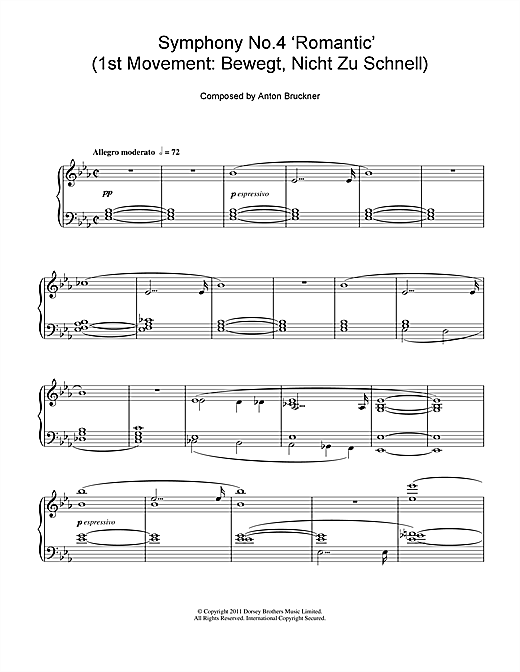
What happens when a chamber orchestra tackles an orchestral behemoth? Ticciati has gone on record as saying “We need to scrape back the veneers” and “reveal the work in new colours”. This they did, although I do concede that the orchestra was beefed up to maximum strength. What they brought to Bruckner’s 4th Symphony was an astonishing clarity along with a seemingly relaxed approach that allowed the music to speak for itself, rather than  suffering the relentless drive of some other conductors. Ticciati’s body language and general demeanour suggested he could have been conducting Haydn or Mozart. So relaxed!

An eerie, breathtaking entry by the double basses in the Bewegt nicht zu schell followed by the winsome horn solo morphed into our first treat of full-on Bruckner brass. Ticciati, restrained, holding back, but not quite teasing, built the perfect climax. I have rarely heard such delicacy or clarity in orchestral Bruckner. Clever stuff!

The Andante, quasi allegretto gave us another very gentle pianissimo opening leading to the violas taking up the theme supported by pizzicato violins and cellos. We were being reminded of the SCO’s impeccable chamber orchestra credentials. There soon followed some of the best brass passages ever written and towards the end we were at last in “wild Bruckner” territory with the whole orchestra playing in apparent wilful abandon, but in fact right on the button, until we returned to a reflective pizzicato coda.

In the Sherzo; Bewegt haunting brass led us off with some very clean playing ending in a resounding conclusion.

Finally the Finale of the fourth movement: again, Bewegt, doch nicht zu schnell. After another plaintive horn call there was no shortage of brass and then the full orchestra gave us everything we wanted and took us home. I am delighted to report that the Usher Hall audience did not burst into applause immediately but waited until Ticciati had lowered his hand after some ten seconds, and gave him four curtain calls.

So the experiment worked. This was a genuinely fresh approach to the Bruckner symphony. I got clarity, freshness and an unstrained, natural and not too over intense approach that let the music speak for itself. Now, perhaps, for the same approach to the more difficult 6th or 8th.

nae bad_blue

Star (blue)Star (blue)Star (blue)Star (blue)

Reviewer: Charles Stokes (Seen 3 November)

Go the Scottish Chamber Orchestra

Visit Edinburgh49‘s Usher Hall archive.

RSNO: Sondergard, Jansen: Usher Hall 21 Oct 16

Image result for RSNO

“What struck me …. was the precision, accuracy and vitality of the playing, with rock steady tempi combined with real verve”

Editorial Rating: 5 Stars: Outstanding

Following on the RSNO’s opening gig a fortnight ago featuring the fabulous Nicola Benedetti and the Tchaikovsky Violin Concerto, Friday’s concert fielded another outstanding violinist in the persona of Janine Jansen playing the Sibelius. What is so special about live music is that you don’t know what you are going to get, in terms of interpretation and playing skill, until you hear it. You know it is (usually) going to be good, but how, and in what way? The RSNO, guest conductor Thomas Sondergard and Jansen, are all very fine artists approaching the top of their game, but who perhaps one would not yet categorise as world class. However, I defy anyone to name an artist or orchestra who could have performed better than they did on the night. I have never heard a rendition of the Sibelius Violin Concerto played with more clarity, dazzling technique and sheer artistic conviction, with orchestra and soloist joined at the hip through the sensitive yet controlled baton of Sondegard.

Intriguingly, the orchestra started the evening off with two short pieces by Mahler, Blumine, and What the Wild Flowers Tell Me, arranged by Benjamin Britten from the Third Symphony.

Blumine is a serious, complete piece. A quiet string introduction led to a short horn passage before the bleak solo trumpet established the theme, followed by lush strings that proved we were definitely in Mahler land. Plaintive oboe and mournful horn passages followed before the strings brought the work to an ethereal close.

What the Wild Flowers Tell Me made for a pleasant intermezzo. We were now musically well set up for the main event with our confidence in the orchestra and conductor fully endorsed.

Jean Sibelius was a violinist himself and knew the capabilities of his instrument, which he exploited to the full in his concerto. A violinist in the RSNO to whom I was chatting in the interval, described the first movement as “hard”, the second as “OK” and the third as “really very hard”. All I did was gasp at Janine Jansen’s ability to get concert hall audibility from pianissimo passages, and volume from high register playing and harmonics with little more than an inch or two of metal string to draw it from. The first movement conveyed an eerie dramatic tone that permeates much of Sibelius’s music, and suggested frozen wastes and Nordic mythology. The pianissimo opening with the interplay between the soloist and strings was brilliant and perfectly balanced, and as the movement progressed the theme was passed seamlessly from violin to woodwind and brass and then to a magnificent cadenza. To my satisfaction, the breath taken audience (I suspect a little more cognoscenti than on the opening night) refrained from applause.

In the second movement a rich woodwind opening gradually built up to a grand, panoramic finale. Come the third, the danse macabre, the soaring soloist and supportive orchestra brought the work to a deeply satisfying, enriching conclusion.

Our evening ended with Beethoven’s Seventh Symphony. What struck me about the performance of the work, which often comes across as a bit stodgy and clumsy, was the precision, accuracy and vitality of the playing, with rock steady tempi combined with real verve. A joyous, carefree end to an exceptional evening’s music.

outstanding

StarStarStarStarStar

Reviewer: Charles Stokes (Seen 21 October)

Visit Edinburgh49‘s Usher Hall archive.