‘1984’ (Venue 139, until AUG 28th)

“This is a show that has, despite the odds, pulled a rabbit out of a hat and snatched victory from the jaws of defeat.”

Editorial Rating: 4 Stars (Outstanding)

In Fringe lore, Proletariat Productions’ production of ‘1984’ will be remembered as the little engine that could. Beset by off-stage problems, not the least of which was the sudden short-notice loss of their original O’Brien, this is a show that has, despite the odds, pulled a rabbit out of a hat and snatched victory from the jaws of defeat.

George Orwell’s masterpiece will always draw a crowd but it isn’t often that we get to see his work presented with such chilling clarity. This is a multimedia heavy, perhaps a little too multimedia heavy, rendering of ordinary people trapped in the brutality and squalor of a society gone wrong.

As Winston Smith, Orion Powell delivers the goods in a powerful performance which brings all the classic elements of the rebellious everyman together with fresh insights and pathos. In a story centred on artificiality and the breakdown of empathy, Powell reaches towards the light Smith detects in others. With both Julia and O’Brien there is a deeper humanity on show often missing in less well-observed adaptations.

Although not on stage, she is only ever seen in the video clips, Estelle Mey establishes herself as one to watch. She is neither too sexual, nor too unsensual. If Disney did Orwell, Mey would be the princess. The setting for her relationship with Smith is staged so as to highlight the escapism, the fantasy, and the impossibility of their love. It’s one of several devices which make this production so compelling.

In the other supporting roles Michael Keegan and Camber Sands buttress the drama with carefully considered yet dynamic character sketches which do much to shoulder the weight of this heavy script. This is entertainment after all. Having joined the production just two days before opening night, Daniel Llewelyn-Williams as O’Brien cannot be praised highly enough for his superb performance, the keystone on which all else rests. I’ve never understood people who enjoy potholing. I will never understand how Llewelyn-Williams can be having so much fun under so much pressure, but he is and it’s because he suspects what we all know – he is a great character actor of the auld skool in whose hands a script becomes a kite soaring skyward.

This is not a production without faults, but there are no unforced errors. This is a Herculean effort that has rolled the boulder up the hill where it stands in majesty. This is a troupe of players with something special on offer. Their chemistry is fresh, compelling, and hugely satisfying. If vampires fed off theatre companies this is the slender neck that would attract the most fangs. The pleasure of auld EdFringe is seeing something break out of the seed and start to grow. Where this group goes next I want to follow.

Come for a classic done proper. Stay for a fine ensemble. Get your blue boiler suits on comrades and go see this!


ALL our recent coverage? Click here!

1984 (Festival: 31 March – 2 April ’16)

Tobias Batley and Martha Leebolt as Winston and Julia in 1984. Photo Emma Kauldhar.

Tobias Batley and Martha Leebolt as Winston and Julia in 1984. Photo Emma Kauldhar.

“A spine-tingling masterpiece”

Editorial Rating: 5 Stars: Outstanding

To this day, Northern Ballet’s The Great Gatsby is the most beautiful thing I have ever seen on a stage, so I was excited and intrigued to see what the company would do with another classic novel, albeit a completely different genre and tone. What they’ve created is another spine-tingling masterpiece.

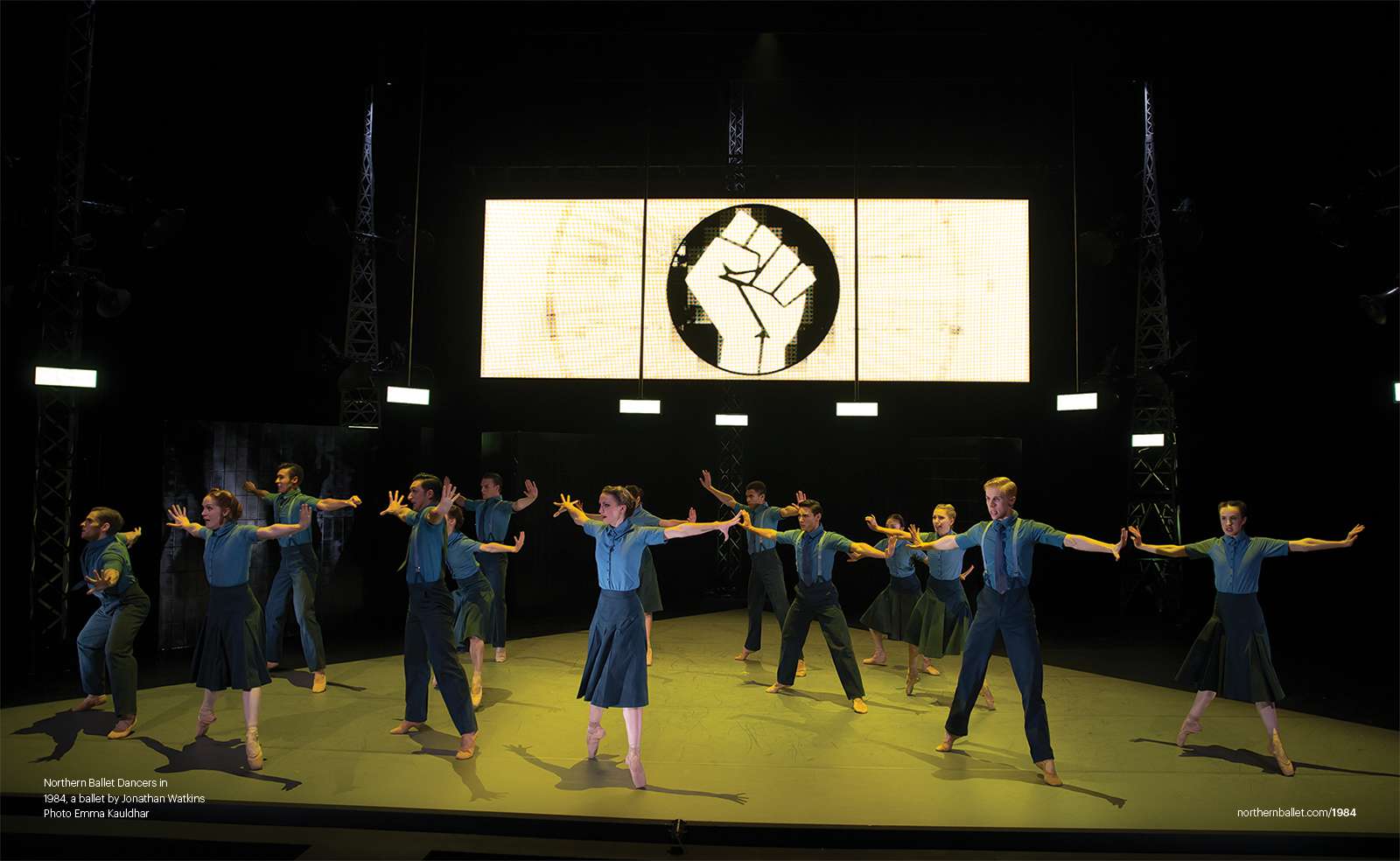
Jonathan Watkins’ choreography is created with all the intricacy and intelligence necessary to portray the complex ideas and changing moods within Orwell’s book. The workers’ unison sections are very crisp and powerful, with many recurring motifs of straight lines and triangles, both in individual movements and formation, which cleverly reflect the “all seeing eye”. Canon variations are used throughout for interest, which work very well to create production line style sequences, again very relevant to the era. In contrast, the Proles’ movements are easily identified through curves, contact improvisation and individuality of style. The lovers’ duet captures all the breath-taking beauty one might expect from a traditional ballet, while the fight scene towards the end is both graceful and gutting, as we see Winston fall and give in to the higher power.

Alex Baronowski’s score is full of accented beats and staccato rhythms which perfectly translate to the repeated motifs of the workers under the control of Big Brother, while the more romantic elements are brought out with strings and flowing, rousing melodies. Much like experimental music of the time, the orchestra uses an assortment of non-traditional instruments to create clashing tinny sounds and altogether this results in an authentic, haunting and sympathetic accompaniment to the action on stage.

Northern Ballet dancers in 1984. Photo Emma Kauldhar.

Northern Ballet dancers in 1984. Photo Emma Kauldhar.

While the relationship between music and movement are clearly intertwined, the design of this production seems equally balanced with the other elements. Chris Davey’s lighting is stark and structural, creating yet more triangles and straight lines for the dancers to follow and stay within, and Simon Daw’s set of moving walls and simple blank spaces adds to the feeling of isolation and hopelessness. Use of colour is also very powerful, from the traditional blue of the workers uniforms, to the bright yellow of hate to the oranges and browns of the Proles, this is clearly a production that pays high regard to many details, making it a joy to watch.

As can be expected in such an interpretation, not every nuance of the book is covered on stage, and sacrifices have to be made to adapt the work for this new form. It’s a shame that some sections aren’t made more of – the final quarter in particular seems a little rushed – but overall the piece strikes a fine balance between narrative progression and beauty of form. For those unfamiliar with the story this production may be somewhat difficult to follow, but even then, the artistry on display is of such high quality that it almost doesn’t matter.

outstanding

StarStarStarStarStar

Reviewer: Steve Griffin (Seen 1 April)

Go to Northern Ballet’s  1984

Visit the Festival Theatre archive.