‘Dark Road’ (Lyceum: 25 Sept – 19 Oct ’13)

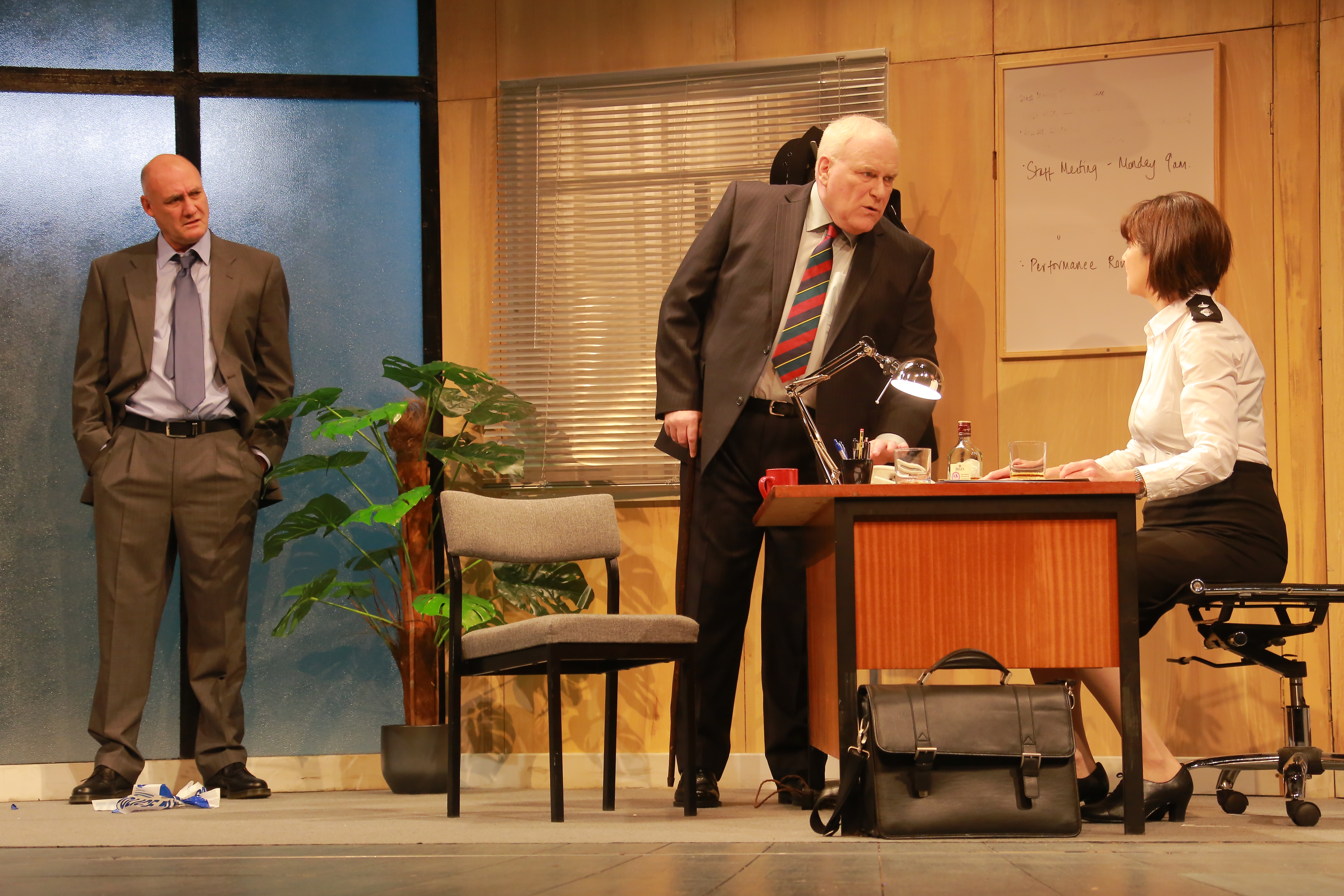
Robert Gwilym as Frank Bowman , Ron Donachie as Fergus McLintock and Maureen Beattie as Isobel McArthur

Image by Douglas McBride

“The production is a mixed bag in most regards.”

Editorial Rating: Unrated

Ian Rankin is no stranger to Edinburgh’s criminal underworld –fictionally, of course. Inspector Rebus, Rankin’s most famous literary creation, is known to millions as the slightly off-beat but loveable curmudgeon, for whom this city’s cobbled streets are home. Perhaps it is no surprise, then, that his theatrical debut (in collaboration with the Lyceum’s own Mark Thomson) is firmly rooted in this world.

It is twenty five years since the conviction of Alfred Chalmers for the murder and mutilation of four young Edinburgh women (there are definite comparisons to be made with the BBC’s hit series The Fall). This, combined with her thirtieth anniversary of being on the force, provokes Superintendent Isobel McArthur (Maureen Beattie) to reflect on what proved a land mark case in her career; or, more specifically, on a nagging doubt she has harboured since that day. Dredging up the past, however, reveals a well of raw emotions in both her closest work colleagues and her only daughter, Alexandra.

The production is a mixed bag in most regards. On the one hand, much of the writing is disappointingly predictable – not simply in terms of the plot, but also the inclusion of well-worn topics such as sexism in the police, the role of a policeman’s ‘hunch’ in conviction, and the bureaucratic barrier of paperwork that stands between policemen and ‘real police work’; a commentary that fails to really add any new angles on these issues. On the other, some of the writing is delicious – finding its strongest moments in scenes of quippy character interaction.

Similarly, a handful of characters were intensely believable – Philip Whitchurch’s portrayal of Alfred Chalmers was magnetic, managing to baffle the audience and leave us in a confused state, somewhere between terror and sympathy. But, at the other end of the spectrum, Sara Vickers (Alexandra) was lumped with a caricature of a teenage girl, whose mood swings between being angsty and angry, and as horny as a bitch in heat, leave her little room for development.

An area of no doubt, however, was staging – which was certainly the production’s strongest suit. The three room revolve worked incredibly well, particularly with the addition of corridors which provided both a realistic edge and an extra dimension to the performance. Furthermore, the soundtrack, ranging from a lamenting violin to Psycho inspired string segments, did much to add dramatic tension in scenes and maintain atmosphere between them; combining well with projections that slowly built a visual backstory for the audience.

Dark Road has the beginnings of a good production, but there is work to be done. It would benefit from some trimming – particularly in the first half, where certain scenes and ideas dragged on too long – and a more careful concealment of the plot to avoid the predictability that currently plagues it. As it stands, Dark Road is middle of the road.

Reviewer: Madeleine Ash (Seen 28 September)

Visit Dark Road homepage here.

‘The Baroness: Karen Blixen’s Final Affair’ (Traverse; 27-28 Sept ’13)

Dogstar Theatre The Baroness Roberta Taylor (Karen Blixen (Isak Dinesen) Photo credit Leila Angus

Image by Leila Angus

 “Among Denmark’s literary superstars few are more fascinating than Karen Blixen, pen name Isak Dinesen (1883-1962). The Baroness is the story of her final affair: a platonic entanglement with a much younger poet.”

Editorial Rating: Unrated

For a country where summer temperatures struggle to exceed 20°C, in terms of cultural exports, Denmark and all things Danish are surprisingly hot right now. Successes such as The Killing and Borgen have rocketed outside awareness and interest. Among Denmark’s literary superstars few are more fascinating than Karen Blixen, pen name Isak Dinesen (1883-1962). The Baroness is the story of her final affair: a platonic entanglement with a much younger poet.

We enter to find two harp-shaped window frames with fewer right angles than the Goetheanum. In one hangs a tribal mask intended to conjure images of Blitzen’s years as a coffee planter in Africa (I think it resembles Norman Tebbit). An eclectic harmony of furniture perfectly captures the sense that we are looking into the dwelling place of a mind born for the Belle Époque. Her young companion is evidently much less at home. He belongs instead to that new generation which Kennedy’s Danish-American speechwriter would describe a year before Blixen’s death as “tempered by war, disciplined by a hard and bitter peace.”

The friendship of Blixen and Thorkild Bjørnvig is a matter of historical record. At times the script creeps into the realm of docudrama. When Blixen encourages her protégée to abandon his wife, child and work in order to compel the flow of his artistic creativity, she laments that Denmark is “flat as a duck pond”. Similarly, the muted script gives little sense of a tempest brewing in, or subsequently howling through, the hearts of the protagonists.

Roberta Taylor as Blixen and Ewan Donald as Bjørnvig provide well-rounded individual character sketches. There are flashes of real insight, such as Donald’s steadily improving posture, but there is little shared fascination. Blixen is portrayed at the centre of a social and cultural web in which she occultishly snares young bloods with which to feed her imagination.

Several of the techniques deployed to fill a stylized frame with stylish content are over hesitant. The dramatic function of the mutual friend (played charmingly by Romana Abercromby), for example, is uncertain – diverting more than developing the over-lengthy central narrative. By the interval I think I’ve got the point. Other than the brightly conceived set transition from Blixen’s home to Bjørnvig’s northern hideaway, not much more is said or done.

Pace was a problem throughout. Far from crisp efficiency, the frequent scene changes are slow (although composer Aiden O’Rourke’s bold, introspective score make this less of a negative). Projection was a problem too, I did not feel played to in the steeply tiered back row of Traverse One.

Dogstar Theatre squeezed hard and a good amount of zesty juice was delivered into the glass. If their future endeavours maintain the very high standards set by The Baroness for smart, funny staging of deep, moody drama then we can expect great things from them in the coming years.

Reviewer: Dan Lentell (Seen 28 September)

Visit The Baroness homepage here.

‘Only Wolves and Lions’ (Summerhall; 12, 14-15 Sept ’13)

“From this melting pot, hopefully, will be drawn a social bond that will spark conversation when we finally sit back down to eat.”

Editorial Rating: Nae Bad

Only Lions and Wolves is a collaboration between British artist Leo Kay and his Basque collaborator Unai Lopez de Armentia. Their aim is to bring together a group of total strangers to select, cook and consume a menu of dishes made from an array of raw ingredients brought by us.

The dining table is set for an extended family banquet. Gas camping hobs have been set up  along the hall’s sides. At one end is a table of carbs (rice, flour etc) and condiments such as tinned tomatoes, olive oil et al. At the other end are the cooking pots, utensils and cutlery which we will use to prepare our dishes. A washing line runs behind this table hung with ladles and potato mashers and above it hangs a chandelier of colanders. We sit and, under Kay’s direction, introduce ourselves. The ice is melted with a free form dance warm up as well as bonobo impressions – bonobos and chimps are social creatures too runs the logic.

We team up and are asked to suggest possible dishes within our culinary range and the options available. Then we cook against a clock set for 45 minutes. From this melting pot, hopefully, will be drawn a social bond that will spark conversation when we finally sit back down to eat.

The frame may be hippy-dippy collectivist, but the content of Lions and Wolves feels a lot like the team building exercises, networking events and other assorted workshops strewn throughout corporate life. I am reminded why I’d never want to live in a commune. When Kay and de Armentia start talking Trotsky I regret there isn’t an ice pick on the washing line. It’s a shame that the meal is not billed as vegetarian – for an event aimed at deconstructing social barriers the line between herbivores and carnivores is jarring.

Discussing politics at the dinner table and in mixed company does not come easily. The work is much stronger, pacier too, when outlining broader philosophical lessons from thinkers such as Epicurus and how these might be applied topically to alleviate the symptoms of downturn and recession.

Only Lions and Wolves is a conceptual work in progress. Edinburgh has a well established dining club scene into which this format (if not the current means of execution) could easily fit. An ambitious yet inventive concept, it could hold better selected material, but what tailoring there is, is neat, stylish and bold. When they loosen up, the performers are a lovely bromantic couple in whose company it is a pleasure to spend an evening.

nae bad_blue

Reviewer: Dan Lentell (Seen 12 September)

Visit Only Wolves and Lions homepage here.

Three to See: Summerhall: September ’13

This September Edinburgh49‘s Three to See events at Summerhall are:

Only Wolves and Lions (18:30 – 12 & 14, 14:30 – 15 September, Summerhall)

“Only Wolves And Lions takes a fresh look at human behaviour in the pursuit of happiness. After food clothes and shelter, what do we need? Exploring ideas surrounding community, isolation and the meaning of the word crisis, Leo Kay and Unai Lopez de Armentia invite you to cook, eat and speak together”

Images Were Introduced (11:00-18:00 – Daily until 27 September, Summerhall)

“Michael Nyman’s first ever exhibition in Scotland will consist of a major installation in Summerhall’s Upper Church Gallery (off Hope Street Terrace) showing simultaneously the video film-maker, photographer and composer’s ten (10!) remakes of the famous vintage film “Man with a Movie Camera” by the Russian film-maker Dziga Vertov and his wife Yelizaveta Svilova (who edited the film).”

Neu! Reekie! 39 (19:00, 27 September, Summerhall)

“Brought to you my Michael Pedersen and Kevin Williamson Neu! Reekie! is a delicious feast of spoken word, music, animation and film fusion.”

Four to Paw: The Stand: September ’13

This September Edinburgh49‘s Four to Paw shows at The Stand are:

Red Raw (19:30, 2nd, 9th, 16th 23rd & 30th September, The Stand)

“Our long-running weekly beginner’s showcase is regarded as the best open mic night in the UK. Catch up to ten new acts – some treading the boards for the very first time. This is where everyone starts and it’s your chance to see the stars of tomorrow today. Watch out for older hands dropping in to try out new material too.”

With Matt Rudge and host Scott Gibson.

Whose Lunch is it Anyway (13:30, 8th, 15th, 22nd & 29th September, The Stand)

“Our long-running improvised comedy show will have you in stitches. Marvel as resident duo Stu & Garry weave comedy magic from your suggestions. It’s the perfect way to nurse a hangover and a sure-fire way to kick-start your weekend after the big night out. There’s a special menu too so you’ll be in danger of laughing with your mouth full.”

The Sunday Night Laugh-In (19:30, 22nd September, The Stand)

“Round off the weekend with our comedy cocktail which has the emphasis on the chilled and the laid back. At least five acts on each bill ensure variety and its great value at just a fiver. With Chris Conroy, Gareth Mutch and host Ben Verth.”

Best of Scottish Comedy (20:30, 25th September, The Stand)

“Talk about doing what it says on the tin! Here you go a carload of simply the best comics on the contemporary Scottish circuit. At least four acts on every bill with seasoned headliners joining forces with newer kids on the comedy block each month.”