
“Sadly, a number of (right-wing) US gun clubs have taken the slogan ‘Molon labe’ (come and get ’em – allegedly Leonidas to Xerxes) as their motto.”
WHAT: “In 480 B.C., the mighty Persian king Xerxes led a massive force to the narrow mountain pass called Thermopylae, anticipating no significant resistance in his bid to conquer Greece. But the Greeks, led by Leonidas and a small army of Spartan warriors, took the battle to the Persians and nearly halted their advance.
Paul Cartledge’s riveting, authoritative account of King Leonidas and the legendary 300 illuminates this valiant endeavour that changed the way future generations would think about combat, courage, and death.”
WHO: Professor Paul Cartledge, A.G. Leventis Senior Research Fellow, Clare College, Cambridge & Emeritus A.G. Leventis Professor of Greek Culture
MORE? Here!
Why Thermopylae?
I hate the word, usually, but it conveys the point I wish to make: ‘Thermopylae’ – just that one name – is one of the ‘iconic’ battles in world history: i.e., if you consult one of those ‘Greatest World Battles’ compilations, it invariably is featured. This is partly because it really was in its own immediate circumstances – August 480 BCE, a narrow pass in north-central Greece, at the start of a potentially world-shattering amphibious invasion of mainland Greece by the forces of the mighty Persian Empire under Great King/Emperor Xerxes – an important (but far from decisive) military confrontation), but *mainly* because of what has been made of the battle/made out of the battle subsequently – at first by the Spartans (then leading the rather shaky and feeble Greek Resistance to Persia) and then by any number of historians and/or moralists preoccupied with ‘last stand’ heroics or nostalgia therefor, and, more recently, by filmmakers (“The Three Hundred Spartans” (1962); “300”, (2006).
Sadly, a number of (right-wing) US gun clubs have taken the slogan ‘Molon labe’ (come and get ’em – allegedly Leonidas to Xerxes) as their motto.
Was there any way in which the forces led by King Leonidas might have won (militarily speaking) the battle?
Absolutely no way whatsoever. The points of sending *any* sort of Resistance force to Greece south of the kingdom of Macedonia (already a vassal province of Persia) and the region of Thessaly (where the four main cities had ‘medized’, i.e., decided they’d be better off submitting to Persia than resisting) were i. to delay the Persian advance on its main immediate target (the city of Athens) ii. to liaise with the Greek Resistance fleet based at the northern tip of the island of Euboea and iii. ‘show the flag’, i.e. demonstrate to both allies in the Resistance and to those Greeks who were wavering over whether to resist or not that it was both possible and worthwhile to resist.
The Resistance intially sent a force north of Thermopylae as far as the vale of Tempe but quickly discovered that that line of defence could easily be turned, hence the decision to focus on the Thermopylae pass (c. 1 km W-E, already fortified for earlier, local reasons). It was unfortunate for the Resistance that Thermopylae coincided with major Greek religious festivals – one of them all-Greek (the Olympics), the others local – since that reduced the numbers of available troops; although not even a 10-fold increase (from the actual 6-7,000 troops under Leonidas) would have enabled the Resistance to resist successfully! Xerxes had anything from 80-200,000 land troops (a motley crew admittedly – Herodotus our main source includes a sort of Catalogue of Xerxes’ muti-ethnic forces; we can’t be certain of ANY numbers for Persian forces on land or sea) at his disposal, so it was only a matter of time before he forced his way through. It took him 3 days.
King Xerxes I of Persia notoriously misunderstood the Spartans grooming ritual – not understanding that the warriors combed their long hair out before the battle as their way of preparing to fight to the death. What was the biggest misconception about the Persians held by the Greeks?
See above on uncertainty over the numbers on Xerxes’ side. Greeks were generally not good on big numbers at the best of times – they used the same word for ‘10,000’ to mean ‘millions’ or ‘countless’! – but Herodotus will not have been alone in thinking Xerxes had over 5 million (sic) men under him on land – so many that they drank whole rivers dry etc. They were of course therefore pretty worried about facing his troops in open pitched battle, though the victory of the Athenians (and Plataeans) at Marathon ten years earlier (490) will have been a considerable encouragement. Historians today reduce Herodotus’s figure even as low as 80,000 (George Cawkwell) but most of us would say 100,000 plus.
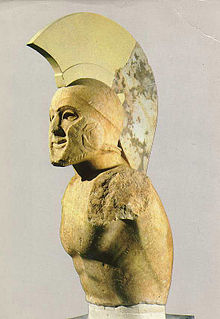
You shut your eyes and you picture the face of Leonidas. What springs to mind, the statue unearthed in 1926 on the Spartan Acropolis, pictured above, or the face of Gerard Butler?
Good question! For me, the former every time, but then I’m a historian and archaeologist who’s lived in (modern) Sparta for over a year and spent many many hours in the Sparta Museum, where ‘Leonidas’ normally resides!
Actually, ‘Leonidas’ (unearthed at the foot of the Acropolis, amid theatre debris, though originally he’d been on what passes for an acropolis in Sparta) cannot be an image of the real king Leonidas (reigned c. 490-480), for several reasons: i. on style he belongs in the 480s, before the battle, and Spartans didn’t then commission ‘portrait’ statues of living kings ii. he wasn’t originally a free-standing, isolated sculpture but part of a sculptural group affixed probably to the pediment of some sort of religious structure, probably a temple, and he probably represented some sort of (mythical) figure or ‘hero’.
The nicest story I know of Butler’s Leonidas comes after a recent final of the NY tennis Open won by Novak Djokavic, a friend of GB, when GB joined him in a unison cry (from the movie) of ‘This is Sparta’. Sadly, it’s on
youtube:
You illustrate how the Spartan form of education influenced the British public school from Thomas Arnold to Kurt Hahn. Is there another aspect of Spartan civilization you’d like to see given a dust off and resurrected into modern civic life?
There’s really no way in which an ancient society – possibly *especially* a very odd ancient Greek society such as Sparta’s – can teach us directly anything. I suppose one possible but by no means novel lesson would be the value, the overriding value in the time of COVID-19, of community. The Spartans, of course, took to an extreme the general ancient Greek notion that the community was far more important than any individual member (they didn’t even have a word for ‘individual’), so that they even treated individuals as dispensable in a way that we today find morally indefensible. But it’s hard to believe that without the Spartans’ taking the lead there would have been much of a defence put up against the Persians in 480, and especially not at Thermopylae. And it took a special sort of communitarian courage to take the lead in the way the Spartans did.
The modern city of Sparta has been described as the most conservative city in Greece. It’s never had a left-wing mayor and it was one of the few cities that voted in 1974 to retain the monarchy. Laconia was the region with the highest proportion of “yes” votes in the 2015 bailout referendum. Is that a coincidence?
Yes, when I was first working in Sparta in 1970, which wasn’t all that long after the end of the Civil War (1946-9) in which most – but not all (see American archaeologist-historian Kevin Andrews’s brilliant memoir, ‘The Flight of Ikaros’) – Spartans and Laconians had fought on the royalist side, my much more liberal Greek friends referred to Lakonia (the region) as ‘Vlachonia’ meaning something like ‘stupid Lakonia’ (the Vlach- bit refers to the Vlachs, or Wallachians, a non-Greekspeaking transhumant pastoralist people from NW Greece – see JK Campbell Honour Family and Patronage on the related Sarakatsani people, 1964). But there were also Spartan anti-Nazis (a friend of mine’s brother was killed resisting their occupation), and there were Spartan/Laconian Communist partisans 1946-9. And in the 2000s at last Sparta had its first woman bank manager (I think partly German-educated. The ancient Spartans were paradoxically rather more liberated on the ‘woman question’.) The current and recently elected Mayor of Sparta, Petros Doukas, is not especially rightwing but most Spartans and Laconians probably are, and sadly that includes members of the Extreme Far Right ‘Golden Dawn’ party, now thankfully in eclipse.
Why are Laconians so prone to be rightwing? Until the recent transformation of communications (when I first went 50 years ago, it took 6 hours to reach Sparta by road from Athens – now it’s 2 hours) Sparta was very cut off from ‘metropolitan’ Greece. And within Laconia itself there were some sharp divisions – e.g. the Taygetos and Parnon mountain areas vs the plains, and the whole Mani district, the central-southern prong of the Peloponnese with its separate identity and history and self-identification – none of which tended in a liberal direction. ‘King’ Constantine self-exiled and then after the overthrow of the Colonels (1967-74) was refused re-entry to Greece, which only increased the monarchist-royalist fervour of the ‘Restore Constantine and the monarchy’ lobby that had its base in … Laconia (at Gytheion in the Mani).
What’s the one thing that we don’t know about the battle that you wish we did?
Why the Phocian detachment which Leonidas had purposely placed in the Anopaea flanking back pass failed to realise they were being bypassed by a crack force of elite Persian ‘Immortals’, and so failed to alert Leonidas that he was about to be pincered? And/or why Leonidas posted this clearly incompetent detachment of locals and did not put a Spartan in command of them?
If you could possess one object associated with your narrative what would it be?
A shield – either of a Spartan or of a Perioecus. Other items of offensive or defensive equipment were worn for individual reasons, but the shield (hoplon) – as an apophthegm (witty saying) preserved by Plutarch tells us – was worn for the line as whole.
Does the battle of Thermopylae still matter?
It couldn’t matter more. Not, obviously, because it was a defeat but i. because of the sort of (heroic) defeat it was and could later be made out to be for propaganda purposes and ii. because of the context – in the Graeco-Persian Wars, which was a battle of civilisations as well as a geopolitical conflict. What if … the Persians had won either the Battle of Salamis (480) or Plataea (479)??
What are you currently working on?
Having just finished the last-minute corrections to my forthcoming (May 28) ‘Thebes’ book, I am putting the final touches to a book I am co-editing with a former PhD student, Dr Carol Atack: it is the first, ‘Antiquity’ (c.1000 BCE to 550 CE), volume in a 6-volume Cultural History of Democracy (part of a Bloomsbury series). My main (pre)occupation, as it has been since the end of 2014, is co-directing and co-editing with Prof Paul Christesen (Dartmouth College, New Hampshire, USA) ‘The Oxford History of the Archaic Greek World’. ‘Oxford’ = O.U.P. (New York), ‘Archaic = c. 800 BCE-c.500/450 BCE. ‘Greek’ = Hellas, the Greek world of the Med and Black Seas. ‘History’ = archaeo-history, i.e. the c. 35 ‘essays’ are mainly written by archaeologists, using mainly archaeological data. Submission date, for the in toto c. 1.25 million words, is the end of 2020, publication 2021/2, at first in hard copy (6 volumes?), then online.
LIKE WHAT YOU JUST READ? FOLLOW US ON TWITTER! FIND US ON FACEBOOK! OR SIGN UP TO OUR MAILING LIST!



 Get Your Coats On
You must be logged in to post a comment.