EdFringe Talk: Twonkey’s Zip Wire to Zanzibar

“The fringe has got a bit smaller sense Covid which I think is a good thing. It got too big, I remember 2019 that was the biggest Fringe ever had more than 5,000 shows. This year has 3,352 shows so It’s lot smaller now which is better I think.

WHO: Paul Vickers aka Mr.Twonkey,Twonks or Twonketta

WHAT: “Supercalifragilisticexpialidocious. Performed in drag as the vaudevillian widow Twonketta, a lady who is somewhat late for church. This year it’s a thriller about rival rollercoasters and fairgrounds set by a smoky lagoon in a valley once owned by ex-milkman-turned-singer Shakin’ Stevens. An award-winning trailblazer of a show featuring Fringe royalty such as: the Steve Martin puppet made from sanitary towels, the pocket princess and the flugelhorn-tooting Tutti Cnutti. ‘Clowning at its very best’ ***** (Scotsman). ‘His idiotic joy is infectious: he is a masterclass in play’ ***** (NeurodiverseReview.co.uk).”

WHERE: Other Room at Laughing Horse @ Dragonfly (Venue 414) 

WHEN: 20:15 (60 min)

MORE: Click Here!


Is this your first time to Edinburgh?

It’s never the same twice but it would really frightening if it was, Groundhog Day. I’ve done 13 solo shows and I’ve written 2 plays and put them on at the fringe too, so 15 fringe shows in total.

The most famous one had me playing David Lynch which was a bit like Les Dawson playing David it was a real experience that one. My normal show is the Twonkey show if you can call it normal.
I use puppets, I sing songs and I tell jokes. This year i’m dressing up as lady i’m playing Mr.Twonkey’s widow, I like to push myself.

The fringe has got a bit smaller sense Covid which I think is a good thing. It got too big, I remember 2019 that was the biggest Fringe ever had more than 5,000 shows. This year has 3,352 shows so It’s lot smaller now which is better I think The first Fringe was just Peter Cook in a pub that was maybe too small, lol.

What are the big things you’ve learned since 2024 and have you absorbed any of the lessons yet?

In 2023 I was doing Twonkey at the Voodoo Rooms ballroom, It was a fun year it was great to playing such an amazing room but it was my Greatest Hits show so I pulled out all the stops.
I was on all the lampposts and felt like a real star but I learnt those lampposts cost money BABY!
So I’m at the super cute and friendly Dragonfly, the staff are wonderful and Alex who runs the venue is a lovely man, so I feel at home. I’ve played many venues but I think Dragonfly is the closest to a real home I have had.

Tell us about your show.

t’s a bit like a one man Carry On franchise now. This year is my Carry On Up the Khyber or maybe Carry On Regardless, I don’t know for sure.

It has a plot line that’s goes back years to when show was performed by a small baby dragon which sadly got smashed into tiny lumps on a pool table during the semi finals of the Laughing Horse new comic of the year awards. It’s actually a bit like Doctor Who as I travel through space and time and have many adventures this year we are off to Zanzibar on a zip wire, last year it was Peru on a ship and one year I ran a restaurant during World War 2 and even a jet ski up the Mississippi.

I’m autistic so I’m going full genderfluid this year and why not?

What should your audience see at the festivals after they’ve seen your show?

Sam Nicoresti : Baby Doomer,

Sam is ace and free wheeling and very funny.
She deals with sensitive issues in a way that never feels overwhelming or heavy-handed.
Go.

Athens of The North : Mark Hannah

A one man Alan Bennett style taking heads theatre show and his acting is mesmerising.
It’s also wonderfully well written and I was blown away by it.


LIKE WHAT YOU JUST READ? FOLLOW US ON TWITTER! OR SIGN UP TO OUR MAILING LIST!

INTERESTED IN BEING INTERVIEWED TOO? CLICK HERE!

EdFringe Talk: Ian Smith: Foot Spa Half Empty

“I’m only 36 but I feel like an old veteran of the Fringe now.”

WHO: Ian Smith

WHAT: “Edinburgh Comedy Award nominee Ian Smith (co-host of the Northern News podcast) returns with a new show about stress, love and buying a magic spell off Amazon. As seen on Live at the Apollo, Have I Got News For You and The Stand Up Sketch Show – and heard on The News Quiz, The Unbelievable Truth, Just A Minute and his own Radio 4 series, Ian Smith Is Stressed. ‘Effortlessly brilliant’ **** (Scotsman). ‘There are few Fringe shows as purely funny as this’ **** (Guardian). ‘An outstanding and stressed-out hour of stand-up’ **** (Fest).”

WHERE: Monkey Barrel 1 at Monkey Barrel Comedy (Venue 515) 

WHEN: 12:30 (60 min)

MORE: Click Here!


Is this your first time to Edinburgh?

No, this will be my 8th solo show! I’m only 36 but I feel like an old veteran of the Fringe now. I know all the best placesto go to the toilet when you’re rushing around. I realise that makes me sound even more like an old man. But seriously, please feel free to approach me and ask for a full run down of Edinburgh’s toilets.

I really love Edinburgh – as a comedian its a month where you get to perform to the best comedy fans, but its also just one of the most beautiful cities in the UK. It can be a stressful month performing multiple times a day, but there’s beaches nearby, great food, lots of green spaces and some excellent toilets. It’s the perfect place for an intense month-long arts festival.

What are the big things you’ve learned since 2024 and have you absorbed any of the lessons yet?

My last show in 2023 was all about how stressed I was and some of the bizarre attempts to relax I tried (largely tank based – a floatation tank and driving over a car in a tank with my hairdresser in Slovakia (a tale as old as time))…

I don’t seem to have learnt how to relax yet because in the build up to this years show I visited the most haunted house in the UK (again with Dom, my hairdresser – who got briefly possessed) and I entered a competitive jigsaw tournament with my girlfriend (no practice, no major interest in jigsaws). Maybe this will be the show where I finally learn the key to de-stressing! You’ll have to come and see to find out.

Tell us about your show.

The show is written and performed by me – it’s a solo stand-up show about thinking my life was heading in a relaxing direction but it actually becoming far more stressful. Lots of things happened in the build up to the Fringe and it’s changed what the shows about. It’s shouty, stressed out, but also just very silly.

It’s produced by Strip Light and the Fringe will bt the show’s premiere. After the Fringe I’ll be taking it to Soho Theatre in November and then a UK tour in Feb/March.

What should your audience see at the festivals after they’ve seen your show?

I love Pierre Novellie – he always creates very funny and brilliant structured shows and I’ve seen bits of this year’s already. Also, I’m excited to see John Kearns do his work in progress. He’s one of my favourite comics is always a Fringe highlight.


LIKE WHAT YOU JUST READ? FOLLOW US ON TWITTER! OR SIGN UP TO OUR MAILING LIST!

INTERESTED IN BEING INTERVIEWED TOO? CLICK HERE!

← Back

Thank you for your response. ✨

EdFringe Talk: Crownless

“I’m at the point in my career that I’m exclusively celebrating the different, the new, the up-and-coming in theatre… and Fringe feels like the heart of that.”

WHO: Ashley Amodeo

WHAT: “When the ghost of her father returns seeking revenge, Hamlet has to choose: play along, or break the cycle? When she makes her choice, the ghost makes his and haunts her coat. Crownless fuses Shakespeare’s text with contemporary female poetry in a bold exploration of grief and power. It’s a ghost story, a coming-of-age tale and a stylish love letter to saying ‘no’. With sharp dialogue, unexpected laughs and a coat full of unresolved trauma, this show walks the line between comedy and heartbreak. If you’ve ever argued with a parent’s voice in your head, this one’s for you.”

WHERE: studio at C ARTS | C venues | C aquila (Venue 21) 

WHEN: 12:30 (50 min)

MORE: Click Here!


Is this your first time to Edinburgh?

It is! I’ve always been so fascinated by Fringe for a long time, and I’m so excited to be bringing this show there. Being an actor in New York, it’s one of those things you think “well maybe some day…” for so long. So this really is a dream come true for me. I also think I’m at the point in my career that I’m exclusively celebrating the different, the new, the up-and-coming in theatre… and Fringe feels like the heart of that. I’m honored to be a part of it.

What are the big things you’ve learned since 2024 and have you absorbed any of the lessons yet?

2023 was the year I learned to stop saying no to myself.

There were a lot of things that year that I thought I couldn’t do, but decided to do anyway. I learned that I don’t need some sort of “you’re ready” certificate to do something… I should just be doing it.

But as for fully absorbing that?

I think that will be a lifelong journey. Being a creative is a constant battle between chasing what you want to do and also doubting if you can do it. But I’m trying everyday to just tell myself “you can do this!” Because if you can’t tell yourself that, will you ever believe it from anyone else?

Tell us about your show.

I’m the writer and performer of the play! I moved here from Brooklyn to get my masters, and part of my course was to write a solo show. But when I had the idea for the play back in 2023, I basically turned myself down right away and said “I can’t write that.”

3 months later, I went back to the idea and just wrote it. (I say that like it was easy… it was a long and scary process.) When I performed it, I was shocked at how well received it was by my peers, my teachers, and the school as a whole. It’s now featured in the advertisement for the school’s postgraduate acting program. I then approached the MA course director, asking if she would like to direct it for Fringe… and she replied “Well, I was just about to tell you that I’m retiring… so let’s do it!”

The show is a one-woman Hamlet, told from the perspective of the Ghost of Hamlet’s Father. It’s modernized, so instead of being royalty, the family are well known writers. When Hamlet Sr. is killed by his brother, he goes to the garden and wait for his daughter, Hamlet, but she never shows up. So he decides he has to find a way to talk to her without her freaking her out too much… and ends up haunting her coat. What follows is a deep dive into their family dynamic, lots of scheming from both of the Hamlets, and a bunch of modern female poetry!

Interwoven within the text from Shakespeare’s Hamlet are excerpts of poetry from contemporary poets Leland Bardwell, Emily Dickinson, Tess Gallagher, Louise Glück, Amanda Gorman, Jane Hirshfield, Denise Levertov, Sylvia Plath, & Maya C. Popa.

The show is being produced by C-Arts for one week this Fringe, from August 18-24 at C-Aquila Studio @ 12:30 PM.

Afterwards, it will be appearing at Voila! Festival in London this November with Etcetera Theatre!

What should your audience see at the festivals after they’ve seen your show?

So many things!

A fellow actor in my agency, Sam MacGregor will be in Hold the Line with the Pleasance for the whole of Fringe. (Shout out to our agent, Nathalie Bazan!)

Also check out After Shakespeare with Slade Wolfe Enterprises Limited, Timonopoly with Brite Theater, and Shakespeare for Breakfast with C Theatre!


LIKE WHAT YOU JUST READ? FOLLOW US ON TWITTER! OR SIGN UP TO OUR MAILING LIST!

INTERESTED IN BEING INTERVIEWED TOO? CLICK HERE!

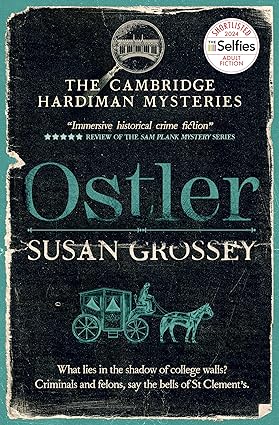
“Hardiman would laugh at how uneasy I am around the animals that he loves!” – Author Susan Grossey talks about ‘Ostler: The Cambridge Hardiman Mysteries Book 1’

“If you were transported from modern Cambridge to Regency Cambridge, the first thing you would notice is how busy the river is. Nowadays it is rather pretty and has gentle punts on it, but Gregory would have seen it literally packed with boats delivering supplies to the growing town.”

WHAT: “It’s the late Regency period in Cambridge, and fine wines and precious artworks are disappearing from St Clement’s College. But just who is responsible, and how far will they go to keep their secret?

After the horrors of the Napoleonic Wars, ex-soldier Gregory Hardiman is enjoying the quiet life of an ostler at a Cambridge coaching inn. But when the inn’s cook is found drowned in the river in the spring of 1825 and his distraught widow pleads for help, Gregory finds himself caught up in the unexpectedly murky world of college life in the town. He navigates uneasily between the public world of the coaching inn and the hidden life behind the high walls of the college. And when a new law requires the university to create a cadre of constables, will Gregory take on the challenge?”

WHO: “For twenty-five years Susan Grossman ran her own anti-money laundering consultancy. In 2013 she published ‘Fatal Forgery’ – a mystery focused on the case of a historical real-life Regency banker. Her narrator, a well-meaning, slightly crusty, deeply honourable magistrates’ constable called Sam Plank, would return for a further six novels.

In 2023 Susan released the first of her Gregory Hardiman series set in Regency Cambridge where she herself had been a student.”

MORE? Here!


Why Ostler?

While I was writing my London series – narrated by magistrates’ constable Sam Plank – I started to wonder whether my hometown of Cambridge had had a similar, experimental period of policing. When I discovered that in 1825 – right in the middle of my favourite decade – parliament had passed a piece of legislation called the Universities Act, permitting the universities (at the time, only Cambridge and Oxford) to appoint their own constables, my fate was sealed.

However, being a university constable was only a part-time job: six o’clock to ten o’clock, about five nights a week. No man could have survived on those wages, so I had to give my constable a day job. I wanted him to be able to move freely about the town and to know people at the university – and then I read about ostlers. They look after horses at the inns, and are usually the first to hear all the gossip – and that seemed an ideal choice.

When did you first “meet” Gregory Hardiman? Did he arrive in your mind’s eye all at once, or did a portrait of him establish one layer at a time? Is he based on or inspired by a particular individual?

The first thing I chose was his name. I knew I wanted a fish out of water – a country lad living in a town – and Hardiman was a common Norfolk surname at the time. I then wanted to hint delicately at another of his outsider characteristics: his religion. And Gregory is a popular Catholic name…

I was worried that Gregory would end up a carbon copy of Sam Plank (whom I loved), so I wrote down a list of how he could be different. Sam is married, so Gregory is not. Sam spent his whole life in London, so Gregory has travelled: I put him in the army, and he spent time in Spain, Gibraltar and Australia. And then I realised I had a big problem: I know nothing of military history. I was moaning about this one day during the lunch-break at court (I am a magistrate) and in one of those serendipitous moments of life, my fellow magistrate said that he was an expert in Napoleonic history and would be happy to devise a service history for Gregory! He has done that, and I stick to it like glue.

Finally, Sam is rather vain, so I wanted Gregory to be the opposite. In fact, I wanted him to be ashamed of his appearance, so I decided he should be disabled in some way. I initially thought of making him an amputee – very common in the period, with old soldiers – but of course that would mean he couldn’t be a constable, as they had to be physically fit. I eventually lighted on a large facial scar, which does not affect his health but makes people react to him.

Hardiman is an instinctive and experienced horse handler. Is that something you know about, or something you’ve had to learn? How would Hardiman judge and asses your horsemanship?

I lived in Newmarket – the home of horseracing – for five years when I was a child, so I know a little of the expensive end of horse ownership. And I know that horses are skittish and intelligent. But I have no natural skill as a horsewoman and now avoid riding at all costs after being rolled on by a fat Thelwell pony when I was nine! Thankfully, I am friends with another self-published author who is a horse-owner and knows everything I could possibly ask her about the care and management of horses – and I run every horse-based scene past her for approval. Hardiman would laugh at how uneasy I am around the animals that he loves!

The Hardiman mysteries are set in Regency Cambridge. What sights, sounds, and scenes should be included in the discerning Time Traveller’s itinerary? Where would you recommend staying overnight?

The second question is easy: you should of course stay at the Hoop Inn, run by the ambitious William Bird, and where ostler Gregory Hardiman will take excellent care of your horse. If you were transported from modern Cambridge to Regency Cambridge, the first thing you would notice is how busy the river is. Nowadays it is rather pretty and has gentle punts on it, but Gregory would have seen it literally packed with boats delivering supplies to the growing town. The boat folk were hard-working and coarse, and their shouts as they steered through the water-based throng would have been heard all over town.

You would also notice the stink of the town: the King’s Ditch (now thankfully covered up and superseded by modern sewers) ran right through the middle of town. The town would have been much darker at night – electric street lighting came only to a couple of streets in the 1820s – and bickering over whose responsibility it was to keep the streets clean and safe was almost a full-time occupation for the Mayor of the town and the Vice-Chancellor of the University. And a visit to the daily market was a must: much larger than it is now, and with a huge range of goods brought in on those boats, Cambridge’s market was famous for miles around. Particularly popular was the local butter, which was sold by the yard.

Who are the authors and sources you most rely on while recreating Regency Cambridge? Have you made any deliberate departures?

It has been hard to find many contemporary descriptions of Cambridge – the two main diarists were Henry Gunning (who wrote up to 1820) and Josiah Chater (writing in the 1840s). And very few people at all have written novels set in the 1820s – which is partly why I love it so! But that’s not to say I have been without original sources. I rely heavily on archives of the two newspapers at the time: the conservative Cambridge Chronicle and Journal (which offered no editorial comment at all) and the left-wing Independent Press (which offered perhaps too much). And – as always – local historians and librarians are an astonishing and generous source of information, no matter how obscure the question.

And no, I am very careful not to make any deliberate departures. One of the joys for me of writing historical – rather than contemporary – fiction is the puzzle of having to fit my made-up story within the known confines of history. I cannot alter something that happened or existed just because it does not fit my story; rather, I must alter the story so that it works. As I say, it’s sometimes a puzzle, but one that I love solving.

Has diving deep into Regency Cambridge shifted, altered, or enhanced your perspective on today’s Town and Gown? Is there something they got right that we are getting wrong?

Interestingly, the year I am researching and writing about now – 1827 – was the year of the first acknowledged Town and Gown Riot, on 5 November. But I am not yet sure how that will affect my story, with Gregory being a university constable while having many friends in the town. What is clear is that the two halves of Cambridge life have always found it difficult to understand each other. I have to say that my sympathy in the 1820s is with the town, because the University was so parsimonious and condescending when it came to paying its (agreed, fair) share of lighting, sewage and cleaning bills. Indeed, when I look at college accounts from the period, it seems that the colleges spent most of their money on coal and alcohol, to keep warm and drunk in the frigid Cambridge climate!

How does writing Gregory Hardiman’s Cambridge compare and contrast to writing Sam Plank’s London?

In some ways, it is easier to write about a smaller, more distinct community – London was (is!) such a vast and sprawling and cosmopolitan place that you have to pick only a small element to concentrate on. I feel I have more of a general grasp of life in Cambridge, as it is a more manageable size. That said, I can feel myself getting completist about it and wanting to know EVERYTHING about Cambridge in the 1820s, which is of course impossible.

When I was writing the London series I was fierce with myself about visiting every location that Sam went to, and – where possible – following the routes he took. We called this Walking the Plank! I used to book days in my diary, go down on the train, and just walk and walk and walk. All of this is much simpler now that I am setting books in Cambridge; if I want to check a location, I can just whizz out on my bike and get my answer within minutes.

You’ve had a rather interesting pre-literary career. Where on the journey did you turn around and say, “I really ought to put this in a book?”

For twenty-five years I ran an anti-money laundering consultancy, advising banks, accountancy and law firms, trust companies, casinos, estate agencies and the like on how to spot and avoid criminal money. But I read English at university, and I always suspected that one day I would want to try and write a novel. When that urge became irresistible (and I thought, if not now, then when?) I realised that I had become obsessed with criminal money, and that it would make a great angle for a crime novel. I published my first eight novels while I was still working full-time, and it was such fun to escape into the past but armed with my understanding of criminal attitudes to money. Of course, in the 1820s they hanged fraudsters…

You self-publish your work. How are you finding that process, and what’s the biggest thing you’ve learnt that you wish you’d known on Day 1?

I should say that I did not choose to self-publish my novels. Once I had finished the first Sam Plank book Fatal Forgery (although at the time I did not realise it was the first book – I thought it was the only book!) I submitted it to nine agents and publishing houses. They all replied in the same vein: it’s a good story, well-written, but we can’t sell it because no-one is interested in financial crime. I disagreed – remember my obsession? – and as I had already self-published dozens of non-fiction books in my working life, I decided to self-publish the novel. And that was it: I never tried again with the agents or publishing houses. I enjoy the process of self-publishing, which has changed and improved immeasurably over the years. And I like feeling that each novel is all my own work: I write it, produce it and sell it.

As for what I wish I had known on Day 1, well, it’s that nothing is forever. You can always change things: pressing the big red Publish button is not the end of the world. You can upload a new file, you can change the cover, you can publish via a different system. All of that would have made it less scary and more fun – much more like it is now!

What are you currently working on?

I am currently writing Gregory 3, which I promise you will have a better title by the time it appears in early December. It is set in 1827, and touches – among other things – on silver mines in Bolivia, balloon rides in Cambridge, and quack remedies in London.

LIKE WHAT YOU JUST READ? FOLLOW US ON TWITTER! OR SIGN UP TO OUR MAILING LIST!