Ring Road (Traverse: 12 – 16 April ’16)

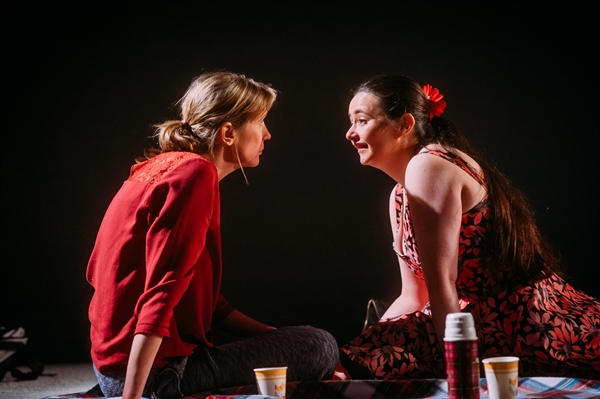
Martin Donaghy as Mark and Angela Darcy as Lisa. Photo. Traverse theatre.

Martin Donaghy as Mark and Angela Darcy as Lisa.
Photo. Traverse theatre.

“Both actors perform brilliantly in a small space (and on a narrow bed)”

Editorial Rating: 4 Stars Outstanding

Fifth and last in this Spring season of A Play, A Pie and a Pint.

It was the prickly cactus that did it, that brought to mind Love’s Labour’s Lost and fun puns on pricks, butts and horns. Mark notices it by the Reception desk of the hotel that’s just off the ring road. He reckons he’s there for sex (oh, not the archery then) and he’s right. Lisa does want him but it’s more his sperm than his good self that she’s targeting. She desires a baby while Mark just fancies the pants off his teacher sister-in-law. Ouch!

Anita Vettesse has written a painfully entertaining comedy and director Johnny McKnight does indeed make the pants fly off the bed. Ring Road is frisky, certainly, but it is also sensitive to what Lisa is feeling. She is 40 years old, has ‘grown to love’ her husband, but is still without a child. The pressure is on big time.

A late afternoon’s delight via Dayuse.com might be all very well but Lisa (Angela Darcy) sees Mark (Martin Donaghy) more as a ‘facilitator’, which he’s not best pleased about. He is even less keen on the idea when brother Paul (a wry, downcast voice-over from Robbie Jack), Lisa’s husband, joins them by being put ‘on speaker’. The two brothers are plumbers, sharing the same van, rather than the same women but it’s still odds-on that the dismissive reference to Screwfix is deliberate.

Mark’s spattered overalls and rigger boots look strange in the tidy, unexciting hotel room and he knows that the whole situation is just not right. Twin beds are bad enough – and that ‘art’ on the wall!- but the twitchy tension is the real passion killer. Lisa, in particular and unsurprisingly, is a bundle of nerves. At worst Mark is confused, but she is probably more conflicted at the end than at the beginning, which is touching and sadly credible.

Both actors perform brilliantly in a small space (and on a narrow bed). Donaghy does “For fuck’s sake” as baffled, happy, hurt and kind all at once, while Darcy is no less expressive, just more couth and desperate. The fact that Ring Road is also very funny is down to the quality of Vettesse’s writing.


outstanding

StarStarStarStar

Reviewer: Alan Brown (Seen 12 April)

Go to Ring Road at the Traverse.

Visit Edinburgh49′s Traverse archive.

The Silent Treatment (Traverse: 7 – 9 April ’16)

Photo: Lung Ha Theatre

Photo: Lung Ha Theatre

“A lot of barmy mischief making”

Editorial Rating: 3 Stars

Lung Ha Theatre Company is a leading theatre company for people with learning disabiities, in Scotland and internationally.

Shout it out: Lung Ha bucks trend! By the latest UK stats worker output per hour is down; well, not when you put 21 actors on stage and keep them acting all the while. All the more testing, when there’s little to no dialogue in Douglas Maxwell’s script of stage directions.

The Silent Treatment subjects its cast to keeping shtum – and alert. For the most part it is full on music and sound (by M J McCarthy) that cues the action. After Lung Ha’s Thingummy Bob with Cliff and The Shadows I had my old money on ‘Silence is Golden’ for some signature backing; but, no, that was 1967 and this play needs mobiles, scratchcards, emoticons and a chainsaw. Still, The Tremeloes’ lyrics have something relevant to say: here’s the second verse,

Talkin’ is cheap …
How could she tell? He deceived her so well.
Pity she’ll be the last one to know.

Billie (Nicola Tuxworth) thinks she has the secret to end all secrets. In fact, it’s her boyfriend (Stephan Tait) who’s got it and she won’t find it out until the end, when she will be speechless. In the meantime Billie goes with her little secret and sets out to try and wreck the sponsored silence that is being held to raise money for her mum, who’s in and out of hospital. Why would she do such a thing? That’s her secret and she’s not telling.

And, of course, no-one else is saying anything. The writing on the blackboard spells it out: SPONSORED SILENCE. No Phones (ignored), No Sleeping (impossible), No Eating (not when there’s a packet of Penguin biscuits around), No Knitting (didn’t see any), wheel noises and body noises don’t count (fair enough). It is the irrepressible Kenneth Ainslie as Toby who has real trouble with the rules but even he doesn’t speak.

Billie finds a helper in Stacey (Emma Clark) and the two of them, in and out of disguises and of the windows, do a lot of barmy mischief making under the stern nose of dominie Kitty (Kay Ann Jacobs); but it’s the four strong building crew (with foreman Mark Howie unmistakeably in charge) in high-vis vests and bowlers who do the heavy lifting, paying no attention whatsoever to Kitty’s gong.

The audience did not want to break the silence either. Hearty laughter seemed somehow disrespectful to Maria Oller’s close direction and the disciplined work of the performers on stage. With one great, if unholy, exception, the ingenious visual gags were met with appreciative chuckles rather than guffaws , and so when the end came – when it blossomed is actually more accurate – the applause was for hard study and successful work rather than for easy laughs.

Star (blue)Star (blue)Star (blue)

Reviewer: Alan Brown (Seen 7 April)

Go to The Silent Treatment and to Lung Ha Theatre Company

Visit Edinburgh49‘s Traverse archive.

Neither God Nor Angel (Traverse 5 – 9 April ’16)

Jimmy Chisholm as James VI and Gavin Wright as William. Photo: Leslie Black

Jimmy Chisholm as James VI and Gavin Wright as William.
Photo: Leslie Black

“To an eloquent vocabulary!”

Editorial Rating: 4 Stars

4th in this Spring’s season of a Play, a Pie and a Pint.

Union (2014), Tim Barrow’s second play, was full of the joys of the Referendum campaign – vigorous, disputatious, even romantic. Neither God Nor Angel, his third, is not ‘Union the prequel’ (by a century), but more of a light amuse-bouche to that earlier rich and hearty fare. This is a waggish two-hander, chummier, a pawky chamber piece.

It is an entertaining fact that James VI, King of Scotland, must have spent some part of the night of April 4th 1603 in Holyrood wondering what it was going to be like to be James I of England (& Ireland) to boot. He was away to London the following morning. Did he blow hot and cold about the whole enterprise? The Incarnation probably sprang to the mind of this godly, seriously literate and absolute monarch who, in 1598 and blessedly free of irony, wrote of ‘the Reciprock and Mutuall Dutie betwixt a free King and his naturall Subiectes’. Let there then steal upon the scene, for the purposes of comic wrangling over glasses of good Rhenish wine, one such subject.

Levity, clearly, is heaven-sent. Enter gawky William (Gavin Wright) to cheek and cheer his King, who has been in peevish sorts. James (Jimmy Chisholm) welcomes – and would embrace in all innocence – the impertinent company of a serving man. Better William, any day, than those ‘devious bastards, the bankers, with their velvet draped bollocks’; and so the toast, raised by His Majesty, ‘To an eloquent vocabulary!’

William speaks Leith and James, crowned at thirteen months, speaks privilege with moments of dainty Morningside. “Would you ken where yon bottle is hid?” might well be an habitual question in Hermitage Gardens but the interesting parts, in amidst the humour, is the forgotten or unfamiliar history: Royal pal Esmé Stewart is pined for; recall of Gowrie and the Ruthven raid shakes the King; his wife, Anne of Denmark, is cherished; and William is sacked for spilling wine on John Ramsay’s silk doublet, which could have happened. I liked all this, almost as much as the use of quill on paper.

It’s a good title, Neither God Nor Angel, provided you can accept that the king’s a man for a’ that, which he ain’t really. Director Ryan Dewar and his two actors do very well with this pithy play of make-believe.

Star (blue)Star (blue)Star (blue)Star (blue)

Reviewer: Alan Brown  (Seen 5 April )

Go to Neither God Nor Angel at the Traverse

Visit Edinburgh49‘s Traverse archive.

International Waters (Traverse: 30 March – 3 April ’16)

International Waters 1

Photos: Tommy Ga-Ken Wan

“Almost edifying”

Editorial Rating:3 Stars Outstanding

You have to wonder. Fifty minutes into the heaving swell of International Waters when we’re all dramatically well and truly cast off, the fire alarm lights flash red and the theatre is evacuated. It has to be a Fire Exit production. And the prime minister announces that there will be no fire sale of the UK’s steel industry but it could still all go down the pan; which is pretty much where David Leddy’s new play takes us. It’s gut-churning with intent, from programme-as-origami downwards. This is theatre in the raw; its passage probably indigestible without great work by Becky Minto (Design), Nich Smith (Lighting) and Danny Krass (Sound).

For the U-bend see a cabin suite for the super-rich in the bowels of a super-tanker, complete with champagne buffet and karaoke machine. Cheaper accommodation is in assorted containers where you might be stacked next to a tiger or two. It is all rather make-do, rather urgent, for this is the last ship out of London where the banks have really, really, done their mucky worst. It’s safe to assume that the ATMs are empty and that the poor are on the streets and burning porsches. Still, if you have shedloads of ready money you can look good in white linen, enjoy the Moët, do a line of coke, and singalong to doomsday. Unfortunately it turns out that Sarah, Ben, Sophia, and Arian are in the Caliban suite for a less than delightful reason and that their ‘escape’ will end wretchedly. There’s no mage on the bridge to save them or to get them away from each other’s throats … or crotches.

International Waters 2

Down below, gripped by burning cabin fever and flushing itself out, is the fabled 1%: powerful and greedy, vulnerable and unhappy. Sarah (Claire Dargo), Ben (Robin Laing), Sophia (Selina Boyack), and Arian (Lesley Hart) go at it with astonishing abandon, pulling each other’s chains – just to stay with the scatological – and soiling themselves and their values in the process. It’s abject, messy, and ridiculous and yet the acutely angled and allusive content is almost edifying.

Leddy unships a bulk load of issues: rogue algorithms, flagrant wealth, economic migrants, drowned refugees; the paranoid survivalist versus the self-obsessed, #Blessed; Twitter storms, Old Testament retribution and the gospel strains of New Testament promise. This is one crowded ark of a stage, freighted with ideas, that spills more than it holds, deliberately upset by intemperate behaviour, bad language, and scary discordant sound. If the play is dead in the water at its conclusion, it’s not rudderless or overblown, but simply exhausted.

FYI. The show continued after the fire alarm, which says a lot about the quality of the performance and the unlikely integrity of the piece. It is preposterous and explicitly farcical, yet Leddy goes in behind the theatrical facade. He says (see programme note) that he’s also after the romantic sublime. Well, here’s Adele on a comparable course from Rolling in the Deep: “Go ‘head and sell me out and I’ll lay your shit bare.” Nice!


outstanding

StarStarStar

Reviewer: Alan Brown (Seen 30 March)

Go to International Waters at the Traverse and at Fire Exit .

Visit Edinburgh49‘s  Traverse archive.

I Am Thomas (Lyceum: 23 March – 9 April ’16)

'Our God above is a God of Love' with Dominic Marsh, Hannah McPake (back), Amanda Hadingue, Charlie Folorunsho (back), Myra McFadyen, John Cobb, Iain Johnstone.

‘Our God above is a God of Love’ with Dominic Marsh, Hannah McPake (back), Amanda Hadingue, Charlie Folorunsho (back), Myra McFadyen, John Cobb, Iain Johnstone (back).

“Fiercely well executed”

Editorial Rating: 4 Stars

I suppose that it is justifiable that Edinburgh’s Gallow Lee was half a mile down Leith Walk and not on East(er) Road. You don’t want too much of the promise of the resurrection to hang about the gibbet. And what do atheists care anyway? Let the foul mouthed blasphemer swing. Or maybe not. It depends on the law, on the Kirk, on freedom of expression, on private conscience, on your reception of I Am Thomas.

Here’s an examination in popular, not judicial, terms of ‘Extreme Justice’ in its unholy alliance with the Scottish Presbytery of 1696. Did Thomas Aikenhead, a gobby twenty year old student at Edinburgh Uni., deserve to be put to death for railing and cursing against his God? Well, no, not in the opinion of this fiercely well executed (Ha!) piece of musical theatre.

There was just the one Thomas A. but there are several red T shirts with his name on it; one in French with ‘Je suis Thomas’ delivering its contemporary message of defiance in the face of intolerance, inhumanity and murder. Thomas might be Everyman but there is an Archie Gemmill shirt too and Match of the Day, for there’s the entertaining conceit – if you like football – of Thomas as a player who is beginning to make a name for himself. Archie Macpherson analyses his game while Thomas sets about committing offences. A short story by author James Robertson is credited as providing inspiration for this ‘brutal comedy with songs’; just possibly his ‘Portugal 5, Scotland 0’.

The songs are intense, all the more so when set against wicked ensemble work and vivid backcloths. Consequential lyrics, expertly crafted, are by Oxford Professor of Poetry Simon Armitage and musical direction is by composer Iain Johnstone, who is also on stage and does his ‘turn’ as Thomas and as penitent John Fraser, who picks up a yellow. There are eight performers and there is a lot of music making, if it’s only a moaning wind from a piano accordion. Listen up for Thomas’ ‘Rhapsody of Nonsense’ sung by Hannah McPake that really puts the boot into the Divinity – and gets him red-carded. As for Charlie Folorunsho’s ‘Our God above is a God of Love’, that is a LOL belter to grimace at.

Charlie Folorunsho and Dominic Marsh. Photos. Manuel Harlan

Charlie Folorunsho and Dominic Marsh.
Photos. Manuel Harlan

The referee plays a blinding, prosecuting role that shouldn’t be his to play, of course; but then Thomas is monumentally unlucky with officialdom. It is bad enough that the chief witness against him is his friend Mungo Craig but to have the Lord Advocate James Stewart (Dominic Marsh) in charge is one hell of a sad joke. Stewart, himself indicted and condemned for treason and author of ‘The People’s Right to Defend Themselves’, characterises himself as the ‘rat catcher’ and is a problem for writers Told by an Idiot. The company excels in creating theatre that is larger than life but wily Jamie has an outsize history all of his own and it is his story, rather than poor young Thomas’s, that often starts to claim the audience’s attention. Still, the result of chronicling the two lives is an inventive, fluid and colourful montage that – you could say – is nearly always on the ball. Only in the second ‘half’, when Aikenhead moves onto exalted ground, with Messiah status and personal glitterball, does it get stuck in an heroic, almost self-regarding mode. There’s a call to freedom in there in an African strain that director Paul Hunter is obviously keen to liberate but I found it more distracting than helpful.

And there you have it: in I Am Thomas the lauded Scottish Enlightenment (not Harry Lauder) stays in the dressing room. What’s on stage is uglier, funnier and shockingly legitimate.


Star (blue)Star (blue)Star (blue)Star (blue)

Reviewer: Alan Brown (Seen 24 March)

Go to the Lyceum theatre, to the National Theatre of Scotland and to Told By An Idiot

Visit Edinburgh49‘s The Lyceum  archive.

Angels in America (Bedlam: 8 – 12 March ’16)

Brooks Hudgins as Prior and Emily Deans as Harper Photos: EUTC

Brooks Hudgins as Prior and Emily Deans as Harper
Photos: EUTC

‘A Gay Fantasia on National Themes’

Editorial Rating: 4 Stars: Outstanding

If you think a log cabin Republican is the kind of guy who would fire off a Patriot missile at a low flying angel, that would be way, way off target. And what would be his (her?) Democrat equivalent? I dunno but it might involve tepees and he / she might major in lines like ‘Respect the delicate ecology of your emotions’. You get both sorts on the Bedlam stage this week. Yay!

This is Tony Kushner’s cultural blockbuster of a play from the early 90s: that’s actually two plays, Millenium Approaches and Perestroika, with a runtime – then – of around seven hours. See this EUTC production, ably directed by Liam Rees, and you’re done in just over three hours but you will probably want to know what has had to be cut. (There is the made-for-cable HBO miniseries that might help and you won’t have to suffer the Baltic temperatures of Bedlam, although the scenes in Antarctica might feel familiar.) In the original script there are 67 scenes for two characters and that’s more or less how it all proceeds, two-handers with stand-out monologues for the principals. It’s sharp, witty, political, and yet manages to shade from the domestic to the mythic. Its subtitle, ‘A Gay Fantasia on National Themes’ sets the scene.

To begin with it is 1985, Cats is going strong on Broadway and Ronald Reagan is President. In New York City Prior Walter – latest of the Walters who got off the Mayflower – is getting sick from AIDS and his partner of four years, Louis Ironson, is not coping. Lou works in the same building as Joe Pitt, a legal clerk, who is offered a big move to Washington DC by his powerful associate and friend, Roy Cohn. Joe does not know if he can take the job because his wife, Harper, is popping Valium like there’s no tomorrow. You are never entirely sure how many tomorrows Prior has left, not least when he’s visited by two ancestors in black capes who regard his pestilential condition as entirely befitting a sodomite.  Angel wings hang above the stage and at the close a tremendous thrumming heralds the arrival of the ‘Messenger’. In all likelihood the bearer of glad tidings has arrived but there have been angelic voices before and Prior, bless him, has no idea what they’re talking about.

The excellent cast does not leave the stage which works well to impress a sense of full-on, marginally dislocated action. Prior’s sick bed stays up centre throughout. Brooks Hudgins plays the stricken WASP with timing that stings and with biting bittersweet delivery. Abandoned by Louis, he muses on his desperate isolation: it’s a sad joke that his dermatologist is on a [long] vacation in Hawaii and his mother … well, his mother just stays away. Rob Younger as Louis has all the lines and tousled angst of a Woody Allen character. It’s a kind, thoughtful part, full of faltering starts, punctuated by ‘Okay ..’ and ‘Right ..’ as he tries to explain himself. At home, stranded in her Brooklyn apartment, Emily Deans is outstanding as Harper Pitt, managing her depressive state with what amounts to mischievous glee in pyjamas and spotted dressing gown. Andrew Hally as husband Joe has to behave decently against demanding odds and more insuperable than even his Mormon upbringing or his sexuality is the foul mouthed, monster ego of Roy Cohn. The fact that Al Pacino took this part gives you a measure of what Peter Morrison has to do and he does well, lurching from one ghastly judgement to the next upon what’s rotten in the land of the free. It is not at all difficult to realise that Cohn (1927-1986) was a real-life horror show.

Peter Morrison as Roy Cohn

Peter Morrison as Roy Cohn

Supporting roles by Meera Munoz Pandya (notably as Belize, onetime drag queen, Prior’s ex-boyfriend and best friend) and by Erica Belton are clearly defined and remarkably effective within the significantly reduced script. The inevitable problem in this half and half version of Angels in America is that the impact of the ‘blockbuster’ cannot be the same as it was when young Americans were all ‘Reagan’s children’. It even predates Friends for heaven’s sake! The angelic chorus gets muffled, as it certainly did up in the rafters of Bedlam. Exhortations to ‘Look up, look up’ did not just baffle Prior Walter. Nevertheless, when ‘Modern Studies’ in many a Scottish high school can still stop at JFK’s assassination and when HIV infection and AIDS simply register as component parts of the Health and Well Being curriculum, this EUTC production is important work.


outstanding

StarStarStarStar

Reviewer: Alan Brown (Seen 8 March)

Go to Angels in America at Bedlam Theatre

Visit Edinburgh49’s Bedlam archive.

King Lear (Pleasance: 1 – 5 March ’16)

MacLeod Stephen as Poor Tom (Edgar) & Will Fairhead as Lear. Photos: Louise Spence.

MacLeod Stephen as Poor Tom (Edgar) & Will Fairhead as Lear.
Photos: Louise Spence.

“Expressionist-noir”

Editorial Rating: 4 Stars

In this ‘Year of Lear’ the Edinburgh University Shakespeare Company is not afraid. It should be though, for the ‘True Chronicle Historie of the life and death of King Lear and his three daughters’ is a terrifying play. The voracious, great, Samuel Johnson could not stomach its last scenes and for near on 200 years it had to put up with the rewrite to end all rewrites. This is the tragedy that puts the brave into bravo.

And, first off, there were standing cheers at the curtain call. Will Fairhead’s performance as the foolhardy, maddening, mad, Lear deserved them. MacLeod Stephen acted out of his skin and nearly out of Poor Tom’s loincloth. Goneril (Caroline Elms) and Regan (Agnes Kenig) did that nasty, alluring thing with crystal diction on high heels and Cordelia (Marina Windsor) would break any father’s heart. Oliver Huband put the bad boy into whoreson, if that’s possible, and Tom Stuchfield made the worthy Earl of Kent positively exciting. Dual death by dagger thrust – Cornwall’s (Jordan Roberts-Laverty) and of the servant who dares protest at the blinding of Gloucester – is admirably dealt and nothing, nothing, disguises the naked brutality of the action that follows the ‘hideous rashness’ of Lear’s decision to dismember his kingdom. Cue the ‘What is Britain?’ line, topical then as now.

Still, forget history, or politics come to that, which is a professional undertaking. Henry Conklin directs a student production that bleaches affection and colour in favour of cold and dreadful suffering. The air drums relentlessly. Grey / blue, white and black predominate in a setting that may as well be called expressionist-noir. Only the all-licensed Fool is allowed to stand out but where, oh where, is the motley coat? A cheeky alpine hat is not enough support, even for the accomplished and confident Pedro Leandro. The wit and the timing worked well enough in the moment, prompting chuckles, but the effect was more often glib than penetrating. There was too much bleak distance between the king and his fool to reach across. Rid them of sympathy and these huge lines get the shakes:

Fool:    Thou shouldst not have been old till thou hadst been wise.
Lear:    O! Let me not be mad, not mad, sweet heaven;
Keep me in temper; I would not be mad!

Actually, of all things, it was near indistinguishable costume not age or aging that looked inescapable. No one stoops and Edgar, as poor bare Tom, is unmissable. Lear, mad, should appear ‘fantastically dressed with wild flowers’. You are more likely to notice his pronounced twitching and swinging arm than his headband. Presumably, in a man of eighty plus, this is a sign of Parkinson’s but then it makes sense to join the destruction of Lear’s reason to a modern interpretation that trembles upon Alzheimer’s.

Caroline Elms as Goneril & Oliver Huband as Edmund.

Caroline Elms as Goneril & Oliver Huband as Edmund.

Set aside the difficulties of keeping the verse safe – and some of it is gunned down – Lear can still be a bewildering nightmare of a play, if not downright disorientating, which might put an audience alongside the blind Gloucester (Ben Schofield) who thinks that he has just thrown himself off the white cliffs of Dover when he’s just taken a tumble in a field. Incriminating letters fall out of pockets and the foul Edmund proves irresistible to both Goneril and Regan, which provoked some inopportune laughter. For some reason, at the herald’s command, ‘Sound’ [trumpet] you hear a bell. Swords are fencing foils and you are treated to some impressive attacks and parries.

At heart, of course, this is a production where that throwaway “Love you” at the end of a 21st century phone call meets Lear’s last howling entry with Cordelia dead in his arms. Conklin and cast have done their very best to get you back to 1606 when it really hurts.


Star (blue)Star (blue)Star (blue)Star (blue)

Reviewer: Alan Brown (Seen 3 March)

Go to Edinburgh University Shakespeare Company

Visit Edinburgh49’s Pleasance archive.

The James Plays (Festival Theatre: 3 – 13 Feb.’16)

Steven Miller (James I) Photo Tommy Ga-Ken Wan

Steven Miller (James I) Photo Tommy Ga-Ken Wan

“‘On you go then, son. On you go. You can do it’.”

Editorial Rating: 4 Stars: Nae Bad

‘Poisoned dresses are something out of children’s stories … if you want to kill her. Put a knife in her’, which would explain, right enough, why there is a whopping great sword on the boards. Still, The James Plays do imply – with a nod and a wink and a catchy dance step – that the Scots are one wicked antidote to the English. They also, with stirring ease, bring on guid strong women. Admire (or not) the toxic fortitude and murderous determinations of James I, II, and III but applaud Queens Joan, Mary and Margaret and give thanks for Annabella, Meg and Phemy.

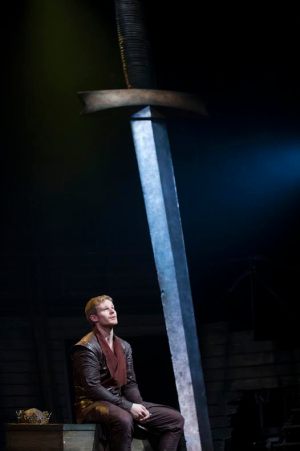
There is no shortage of bloodletting in Rona Munro’s gutsy trilogy of how to keep head and crown together – in fact the ginormous sword runs with the red stuff – but actually the property of the piece is the kist in the bedroom. That’s ‘proper furniture’ [that chest], with a hundred uses’. You can hide a boy king in it for a start – and ‘drop it out of the window and brain any bastard climbing up the castle’. Munro’s writing is like that: hands-on, unhesitating and constructive.

Best, if you can, to see the plays in order – that’s from 1420 to 1488; and although they’re too inventive and complete to be Horrible Histories they do, in their savage and entertaining scenes, come pretty close: in James I, for instance, when Walter Stewart nails horseshoes to the hands and feet of one of his tenants, old Ada, for scolding him; or in James II when the young king peeks out of his kist to see his mother about to have sex with her ‘protector’ John Stewart. Too many Stewarts? Well, there’s always a Douglas on the make and by the time of the bi-sexual James III, there’s his lover, architect Cochrane, and fine wine and madrigals before all else, especially trying to rule Scotland.

Laurie Sansom’s convinced direction and Jon Bausor’s set design, with drawbridge, allow a febrile exchange between private and public space. The royal four-poster is closely guarded and/or spied upon, take your pick, and the king swings his sword on its canopy. When Parliament assembles it is alongside an audience on stage. The throne is up there too, occasionally occupied, but the space also doubles as a tower room where Isabella Stewart is held captive and spins out her prophetic misery.

Blythe Duff (Isabella Stewart) in James I_& II Photo Tommy Ga-Ken Wan

Blythe Duff (Isabella Stewart) in James I & II Photo Tommy Ga-Ken Wan

That’s Blythe Duff as Isabella and as Annabella in James III and it is, again, a terrific performance. She reprises the roles from the original 2014 production with the same astringent glee and love. She’s there at the very end, dressing the new king with clothes and jewels and with an absolute definition of understatement: ‘On you go then, son. On you go. You can do it’.

And, yes, these dramatised chronicles do at times go on … and on. The squabbling lords might get to you, as they certainly did to James III, or it might just be that the set-piece addresses to the Three (male) Estates are too PC, too YES-NO referendum freighted for your taste, or that you find staged medieval football awkward, but then there’s the wheel of fortune to turn and it’s a mighty one to get going and even harder to brake. These are, after all, history plays and since when were they short and sweet?
Matthew Pidgeon (King James III) in James III_ Photo Tommy Ga-Ken Wan

Matthew Pidgeon (King James III) in James III
Photo Tommy Ga-Ken Wan

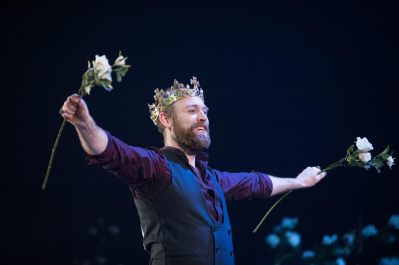
Go into the National Museum of Scotland, as I did in-between plays. You’ll find wolves on level 1, ‘Beginnings’, and they certainly belong in the nightmare sequences of James II, but search further and there ain’t too much in the Kingdom of the Scots: one small panel for each of ‘our’ Jamies and arrowheads from the walls of Threave Castle. More fun certainly, more knowledge possibly, is to be had watching Peter Forbes as gross, droll, Balvenie stacking up the Douglas lands; or see Dani Heron as Phemy, 15, assault a guard who’s presuming to search the queen’s rooms. Ballsy! And then there are the sovereign roles: Steven Miller as James I, the poet king, keyed up, commanding in the thick of it but who would have given everything to pen ‘Love, love me do’ in his time; rangy Andrew Rothney as James II, damaged and vulnerable, but who has that majesty thing ; and Matthew Pidgeon as James III, truth seeker, rascal man, outrageous king in black patent winklepickers , only matched by his virtuous Danish queen, Margaret, played by Swedish actress Malin Crepin, naturally.

I saw The James Plays in 2014, when I had been reviewing Fringe shows, and was disconcerted by the numbers on stage and by the sheer size of the venture. In review terms it was a stand-off. Now, second time around, I’d call it all audacious and vivid. Showstoppers with attitude.
nae bad_blue

Star (blue)Star (blue)Star (blue)Star (blue)

Reviewer: Alan Brown (Seen 6 February)

Go to The James Plays at the Festival Theatre and to the National Theatre of Scotland

Visit Edinburgh49’s Festival Theatre archive.

The Weir (Lyceum: 15 Jan – 6 Feb. ’16)

l to r. Lucianne McEvoy, Darragh Kelly, Brian Gleeson, Frank McCuster, Gary Lydon. Photo. Drew Farrell

l to r. Lucianne McEvoy, Darragh Kelly, Brian Gleeson, Frank McCuster, Gary Lydon.
Photos. Drew Farrell

“You will not want to let these characters go home”

Editorial Rating:  4 Stars: Outstanding

For an Irish play set in an out of the way bar, The Weir is pretty sobering. That it is also witty, articulate, and beset by place, loss and sprites is less of a surprise. Writer Conor McPherson has serious form by now when it comes to the dregs of self at the bottom of a glass,  or more cheerfully, to the poetry in the head of a creamy pint of Guinness.

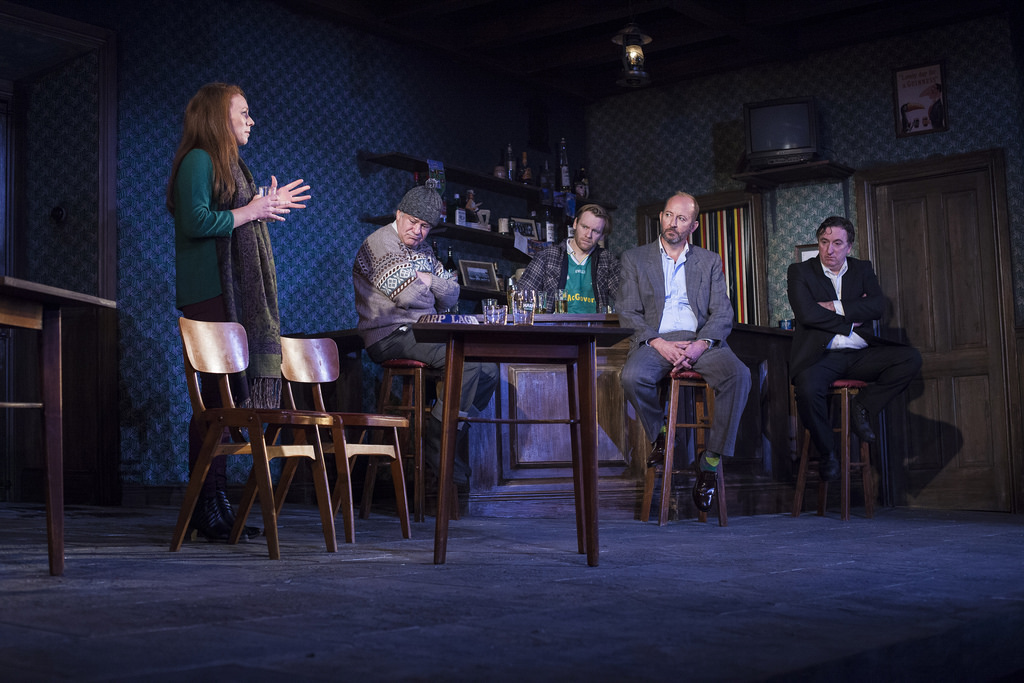
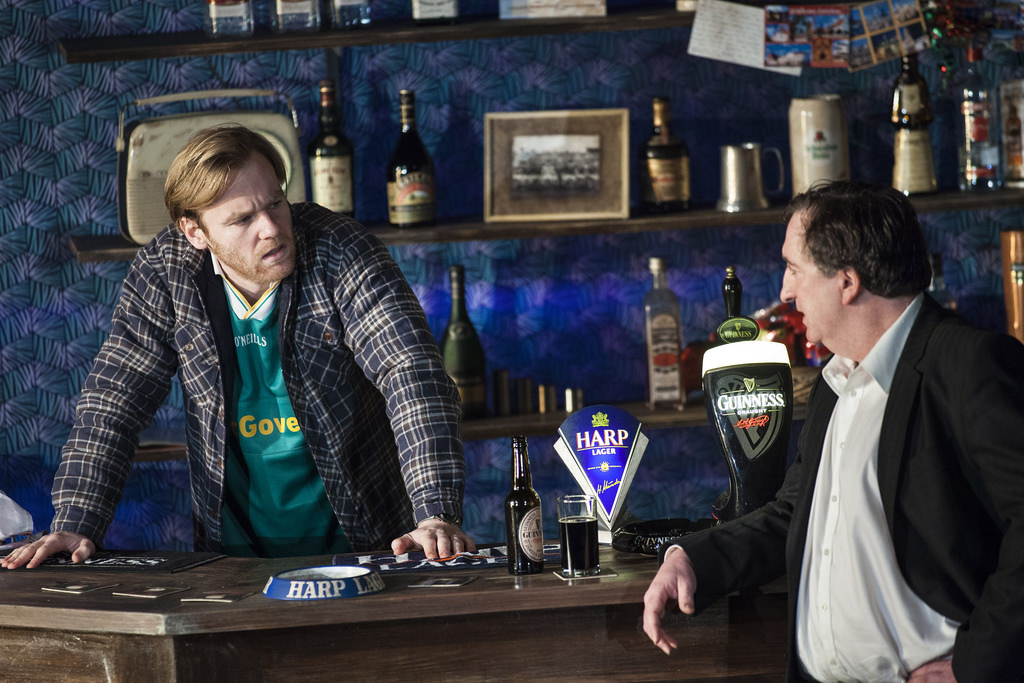
Except that the Guinness in Brendan’s bar is ‘off’ because the fecking tap is broken. Jack has to help himself to a bottle (it’s that kind of village pub); Finbar’s ok because he’s become a tad more sophisticated and drinks Harp Lager; Jim, gentle soul, is happy with small chasers; Brendan is pleased to keep them company; and Valerie, well, she’s down from Dublin and might stay a while. She has a white wine – awkward – poured in a straight glass. There is no smoking ban yet and Designer Francis O’Connor has the craic curling across a wide, low beamed, space with the telegraph poles leaning drunkenly outside. There is a television above the bar but it’s a careful, appealing touch when Jack reaches up to switch off the rugby – it might have been gaelic football. The reception was bad anyway.

Nothing interferes with the story telling and there is no interval. First, Jack with his faerie road and spooky knocks at the door; then Finbar, with a terrifying old woman on the stairs; then Jim’s unwitting shocker in the graveyard that summons Valerie’s nightmare; and finally, cleverly, at the fireside, it’s back to Jack as he mournfully recalls his lost chance at love and marriage. Each tale is far too enthralling, too involving and heartfelt, to be contained as a monologue. The silence after Valerie’s story is literally stunning. Director Amanda Gaughan lets it down evocatively, rendering the men helpless in their sympathy.

McPherson’s achievement is to write bar stool conversation that is as moreish as good peanuts, wholesome against the odds. And the Irish cast are very, very good at helping themselves: Gary Lydon as Jack, sturdy, crumpled; Darragh Kelly as Jim, fond, credulous; Brian Gleeson (yes, son of ….) as Brendan, open, obliging; Lucianne McEvoy as Valerie, injured, self-possessed. And Frank McCusker as Finbar, whose equable, decent, tones stay short of the self-satisfied.

Brian Gleeson, Brendan, and Gary Lydon as Jack. Harp Lager and Draught Guinness as themselves.

Brian Gleeson, Brendan, and Gary Lydon as Jack.
Harp Lager and Draught Guinness as themselves.

‘The Weir’ was written in 1997, enjoyed immediate success and has attracted lyrical approval thereafter. Personally, I’ll play safe and just recognise how companionable a piece it is. You will not want to let these characters go home in the rain*. Single men, who know each other well, have gathered hospitably, stood each other a drink (or two), and have talked idly. However, there is the one woman amongst them and it’s Valerie who’s channeling the hard stuff.

(*Too tempting, sorry, not to cross -reference to Seamus Heaney’s Casualty from a darker period whose subject is the ‘Dawn-sniffing revenant’ plodding home from the pub in midnight rain.)


outstanding

StarStarStarStar

Reviewer: Alan Brown (Seen 19 January)

Go to The Weir

Visit the The Lyceum  archive.

Tracks of the Winter Bear (Traverse: 9- 24 December ’15)

Traverse Theatre

Traverse Theatre

“Cool and works a treat”

Editorial Rating: 4 Stars: Nae Bad

Now here’s a frosty cracker of a show in two acts: Act 1 written by Stephen Greenhorn and directed by Zinnie Harris; Act 2, written by Rona Munro and directed by Orla O’Loughlin. Each Act tells a different story with different characters but pull them apart and – with a muffled bang – you get a Christmas message and a novelty polar bear torch. There’s a ginormous bear as well, but that would explode the cracker idea way beyond belief.

As last year, with The Devil Masters, we’re close to home but it’s the sanctimonious New Town no more; no, it’s Craigmillar, Abbeyhill, and on the beach at Portobello. Act 1 opens up high, probably on the Crags, looking ‘down there’ on Edinburgh. Act 2, for the most part, is up a hillside but closes on a tenement stair. It is most definitely winter in both acts. You can almost hear the soft snow crunch beneath the boots – and it stays white n’ even – and there are bare trees suspended from the sky. Kai Fischer (Designer) and Simon Wilkinson (Lighting) make it blue and cold and pretty empty. But there’s keen writing, much humour, a lot of tenderness and a finely attuned soundscape from David Paul Jones. And the audience is close-in on both sides of a narrow traverse stage, behind scrim gauze, which is cool and works a treat.

Deborah Arnott and Karen Bartke Photos: Mihaela Bodlovic

Deborah Arnott and Karen Bartke
Photos: Mihaela Bodlovic

Act 1, Greenhorn’s work, is the love story of Shula (Deborah Arnott) and Avril (Karen Bartke). Shula went away after exams and came back to find Avril married to Craig, which both women find hard to take. ‘How to cope?’ falls somewhere between nostalgia and vodka, which makes it a slightly unsteady mix of the sad and the satisfying. The story is told in retrospective snatches of memory and loss. Arnott does forsaken and hurt very well; whilst Bartke has the gentler, healing role. Watch out too for the graveside wit of Mairi (Kathryn Howden) as she tends the memory of her Donald.

Act 2, Munro’s piece, is funnier, more outrageous. Jackie (Kathryn Howden again) has had enough of being Mrs Claus in a tacky Winter Wonderland but along comes her one big ‘wee adventure’ involving a killer polar bear with a bloodcurdling roar and a fantastic nose for shortbread. As Jackie mentioned Snowball cocktails, I thought Advocaat, and then of Dutch author Hans de Beer’s lovely Little Polar Bear stories; and indeed Munro’s bear (a magnificently swaddled Caroline Deyga) is a kind creature, once she has digested and expressed the men in her life, but I still wouldn’t bring susceptible children to this show.

Kathryn Howden and Caroline Deyga

Kathryn Howden and Caroline Deyga

‘Look at you!’ calls out a delighted Jackie as she passes under the Bridges. She is, naturally, on the back of a polar bear and having a whale of a time. No doubt the water is freezing but I still found the Tracks of the Winter Bear to be peculiarly heart-warming, which is always good at this time of year.


nae bad_blue

Star (blue)Star (blue)Star (blue)Star (blue)

Reviewer: Alan Brown (Seen 9 December)

Go to Tracks of the Winter Bear

Visit the Traverse archive