The Art of Reduction and the Distillation of Humanity (Jenners: Aug. 19, 21 – 23, 25 – 26, 28 – 29 : 1hr 30m)

Picture of Delta flag & anorak. John Mark Di Ciacca.

Picture of Delta flag & anorak. John Mark Di Ciacca.

” .. Choice flavours, like custard creams and Fisherman’s Friend, and choice knowledge ..”

Editorial Rating:  4 Stars: Nae Bad

For a start that’s a crafted title. If you know your whisky making, you might think ‘Angel’s Share’, but precious little escapes the ken of the Whisky Anorak. Take naval flags, for example. If you’re out in a dinghy in the Firth, would you recognise the signal flag ‘Delta’? Me neither. Well, set a course for the old Board Room at Jenner’s and drink your fill of select knowledge, chased down by some very distinctive whiskies. You’ll leave it a happier and wiser person.

OK, it’s a fun history lesson of the 20th Century with three drams –  a mellow Spoken Word event rather than ‘Theatre’, but so what? It’s clear, easy-going, and I learnt good stuff. Next time you nose a whisky, hold the glass to one nostril and then to the other one. Sensational! What’s the connection between the Monarch of the Glen – the painting of 1851 – and the 1967 album cover of the Beatles’ ‘Sgt. Pepper’s Lonely Hearts Club Band’? What did the ‘Right Spirit Boys’ use for a cricket bat in 1930? And, your last snifter, what was the CIA’s Project MKUltra all about?

John Mark Di Ciacca is the Whisky Anorak. He has years of experience in the drinks trade behind him and tells us all the answers over the course of ninety minutes. He talks, he uses a PowerPoint slideshow throughout, and he has significant objects: books, bottles, art works, album covers – all over the front of the oak panelled Board Room. It’s a smallish space, with room for ten to twelve, comfortably seated at two nicely dressed long tables with three spotless Glencairn glasses (with tasting caps) at each cover. A teaspoon is to hand to add water – not too much! – and you do need it with the 56.3% Dalmore …

I’m sure there is ‘structure’ to an excellent whisky. John Mark did not use the word but he does use the drink(s) to assemble his talk. Three bottles, three time periods: 1850s to the early 1900s; the 1920s – just consider the effect of Prohibition in the USA upon the whisky business – through to the 1950s; and then from the Cold War to the Internet and beyond. His theme is the liminal, tracing the development of a counter culture whose markers are just visible at the edge of school history books. To take one example: dazzle camouflage from the 1914 -18 war links to Aldous Huxley’s mescaline-induced ‘The Doors of Perception’ (1954) that in turn opens up to ‘The Doors’ (1968) on the tripping West Coast scene in a summer of love.

In-between times, and the lesson dragged just a tad during the 1960s, we enjoyed our whisky tasting and John Mark offered some choice flavours, like custard creams and Fisherman’s Friend, and choice knowledge of old bottle effect and of casks and ‘finishing’.

Where have we got to? Well, the whisky trade has boomed and bust and boomed again, from the Blend to the Single Malt to ‘maybe a product that has lost its way’ where a Dalmore 19 year old ‘Constellation’ bottle can be yours for around £11,000. And as far as the moral story of humanity is concerned, John Mark is a Trekkie, confessing that “The Federation is the way forward.”

That Delta question? Here’s the answer: ‘Keep clear of me; I am manoeuvering with difficulty.” Neat.

nae bad_blue

Star (blue)Star (blue)Star (blue)Star (blue)

Reviewer: Alan Brown (Seen 13 August)

Visit the Other archive.

The Bookbinder (Assembly Roxy : 6- 31 Aug : 1340 : 50m)

Photo. Trick of the Light Co. NZ.

Photo. Trick of the Light Co. NZ.

“A great pleasure.”

Editorial Rating: 5 Stars

We all know that Middle-earth is in New Zealand but does the Shire have a bookbinder? I hope so, for it seems a time-honored craft worthy of any self-respecting hobbit. Anyhow, this treat of a show comes from Trick of the Light company of Wellington, NZ.

From now on you can forget Tolkien, in fact the old Bookbinder would have you forget the writer and just have you concentrate on getting together the right pages  in the right order. If, perish the thought, you start reading them, then you’re in trouble and might get seriously lost in story world; which, of course, is exactly what happens to our young apprentice, who falls down on the job, skimps the last few pages, sticks (‘tips’) them in, and trusts to Fate. She, however, does not give him an easy ride.

Ralph McCubbin Howell is the bearded Bookbinder and tells us the story. There’s just the old man’s voice at work, informed by the occasional kiwi aside, and the solemn turning of the pages of an impressive pop-up book, which the mystery author of the Edinburgh Book Sculptures would love. For me though it is the central conceit, that the world is a book whose fabric needs looking after, that is especially satisfying. Bind the book well, my child, and all will be well!

There’s an anglepoise lamp on the worktable, ink in the water, and an eagle’s nest on a lampshade; all manipulated to ingenious effect. Trick(s) of the light they may be but you – and your children – will find great pleasure in this illuminating tale.

Star (blue)Star (blue)Star (blue)Star (blue)Star (blue)

Reviewer: Alan Brown  (Seen 8 August)

Go to the  ‘Trick of the Light’ company.

Visit the Assembly Roxy archive.

Flight (Assembly Roxy: 6 – 31 Aug’15, 1230, 50m)

Photos. The Curbside Company.

Photos. The Curbside Company.

“Sure-footed and affectionate “

Editorial Rating: 3 Stars:  Nae Bad

‘The Unauthorised Story of The Little Prince’ says the flyer, which might – to a grown-up – suggest something naughty and sneaky under the radar. Fortunately, not. Relocated but not crudely transplanted this is still St Exupéry’s wonderful story where, in case you’ve forgotten, ‘All grown-ups were once children … but only few of them remember it.’ Flight hopes to take you to where the children are – wide-eyed and looking to learn.

Much of The Little Prince was actually written on Long Island, NY, and Flight has come in from Long Beach, California; so feel the sand between your toes and see wide horizons in the little space that is Roxy Downstairs ( … 2 seats in rows to the left of the aisle, 6 to the right). The vision thing is big in southern California but it’s for real on stage, down to earth: nothing adult, shiny and corporate. Flight would have us forget BMWs, lattes, suits and golf carts, and see instead singing birds rise against the coastal dunes and have the splash of the Pacific against your face. That’s the alternative point, Exupéry’s core text: ‘It is only with the heart that one can see rightly; what is essential is invisible to the eye’. It all happens along the coastline of Baja California in Mexico so magic stingray, wise turtle and badger – surprisingly! – are at home, joined by exotic zebra and wicked bottle (baobab) trees.

So what would, what can Flight ‘s writer Ezra LeBank show and tell? Well, as a master teacher of movement, there is a lot of accomplished physical theatre. Three expert performers: LeBank himself as Pilot and earnest Narrator; Cynthia Price as the brave Little Prince(cess); and Taylor Casas as the most supple of cacti – effortlessly fold and lift and turn through a busy story. The only props that I can remember are the blinking LED torches of the plane’s navigation lights. What I have no trouble recalling is the Little Prince rising and falling in the air bubble of a blue whale and the constant slightly puzzling play upon cactus rose and thorn.

Imagine, the Little Princess in her element (but not on stage!)

Imagine, the Little Princess in her element .

What I missed was colour, even costume, which is probably my senior hangover from Exupéry’s own illustrations that are so integral to his famous book. A black backcloth with a slash of white could have been relieved occasionally. LeBank’s voice has the whole story to tell and although he manages this with marked clarity it does not, in Scottish terms, set the heather on fire. No doubt the company decided that once you provide one visual your audience starts looking for the screen rather than realising what matters. Desensitised schmuck that I am, I began to want to interrogate a seven year old, nurtured by character animation, to ask what he thought.

Portable, of necessity, rather than deep-rooted, ‘Flight’ is still a sure-footed and affectionate reshaping of an important and civilising story.

nae bad_blue

Star (blue)Star (blue)Star (blue)

Reviewer: Alan Brown  (Seen 8 August)

Go to Flight and Curbside.

Visit the Assembly Roxy archive.

‘The Children’ and ‘Mancub’ (Lyceum: 17 July ’15)

Mancub & The Children

“Evolutionary studies”

Editorial Rating: 3 Stars

A Lyceum Youth Theatre double bill.

It must be heroic happenstance that Mancub opened on the Lyceum stage on the same day, July 17, that Ant-Man came to a (film) theatre near you. The little guy wins out and gets out, but it’s tough going. As for The Children, performed by the senior class after the interval, it is kind of the same story but a whole lot nastier. The despairing cry is, “We’re not animals”. The shame is that no-one told the adults.

Mancub

Mancub is Douglas Maxwell’s 2005 adaptation of John Levert’s book Flight of the Cassowary. Paul is in S4. On the good days school is an adolescent aviary; on the bad days, it’s a jungle with teachers in their lairs. A diagram of the human eye is up there on the board in Biology class but Paul only sees foxy Karen (Emma Gribbon) and gulps with nerves. That’s the goldfish in him. He gets a red card in a cup game for roaring at the referee. That’s the grizzly bear in him. He makes friends with the neighbour’s dog (cute and canny Max Hampson) and they chat together. His younger brother, Wee Luke, hates Kipling’s Jungle Book but loves the Disney version. Their Mum and Dad don’t have the imagination to enjoy either.

Xana Mawick, Director, does well to put a cast of 26 on stage all the time and to keep the many episodes distinct. There’s a camera for bonus close-ups and five narrators do a good, clear voiced, job of introducing and accompanying the action. Alexander Levi is Paul, shy but plucky, and able to survive becoming the road kill of insensitive grown-ups; although Tom Borley as football coach, Susskind, is a likeable chump. Best friend Jerry, ably played by Carson Ritchie, is the smart dude with the knockout comeback lines.

The representation and/or mention of those other species, teachers, parents, gran, and – awkwardly, Neds – is a little sketchy, even foolish, but that’s evolutionary studies for you.

The Children tech

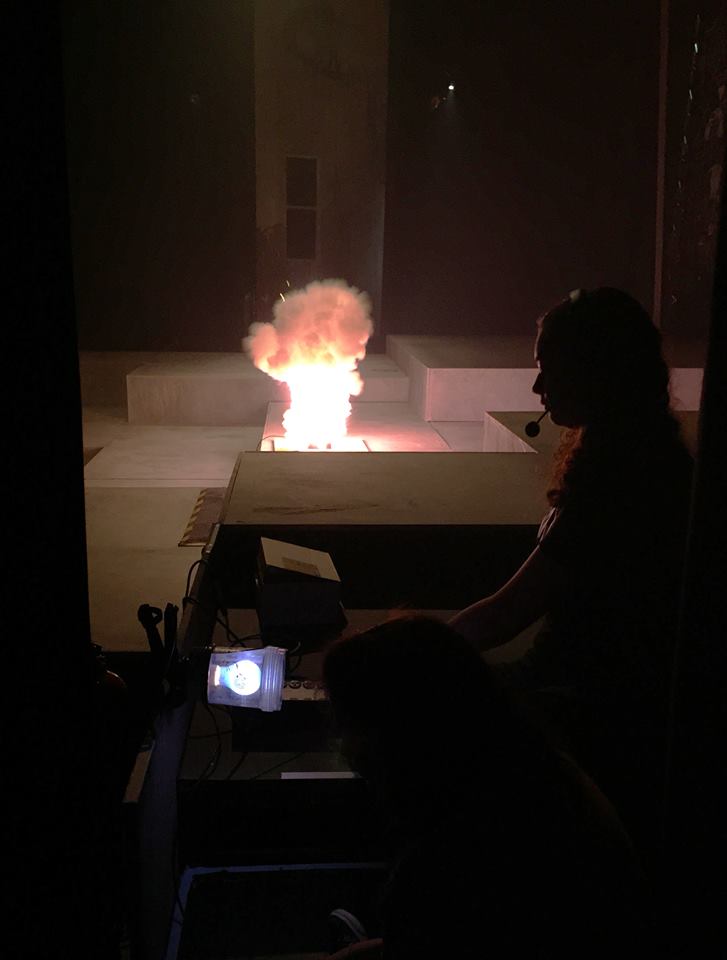
There is nothing ill-defined about Edward Bond’s The Children (2000). It is determinedly and definitely in your face – and there’s a brick to hand. When a mother’s instruction, fuelled by fags and booze, is to burn down a house it is no surprise that blood splatters to an acoustic treatment of The Offspring’s The Kids Aren’t Alright.

P

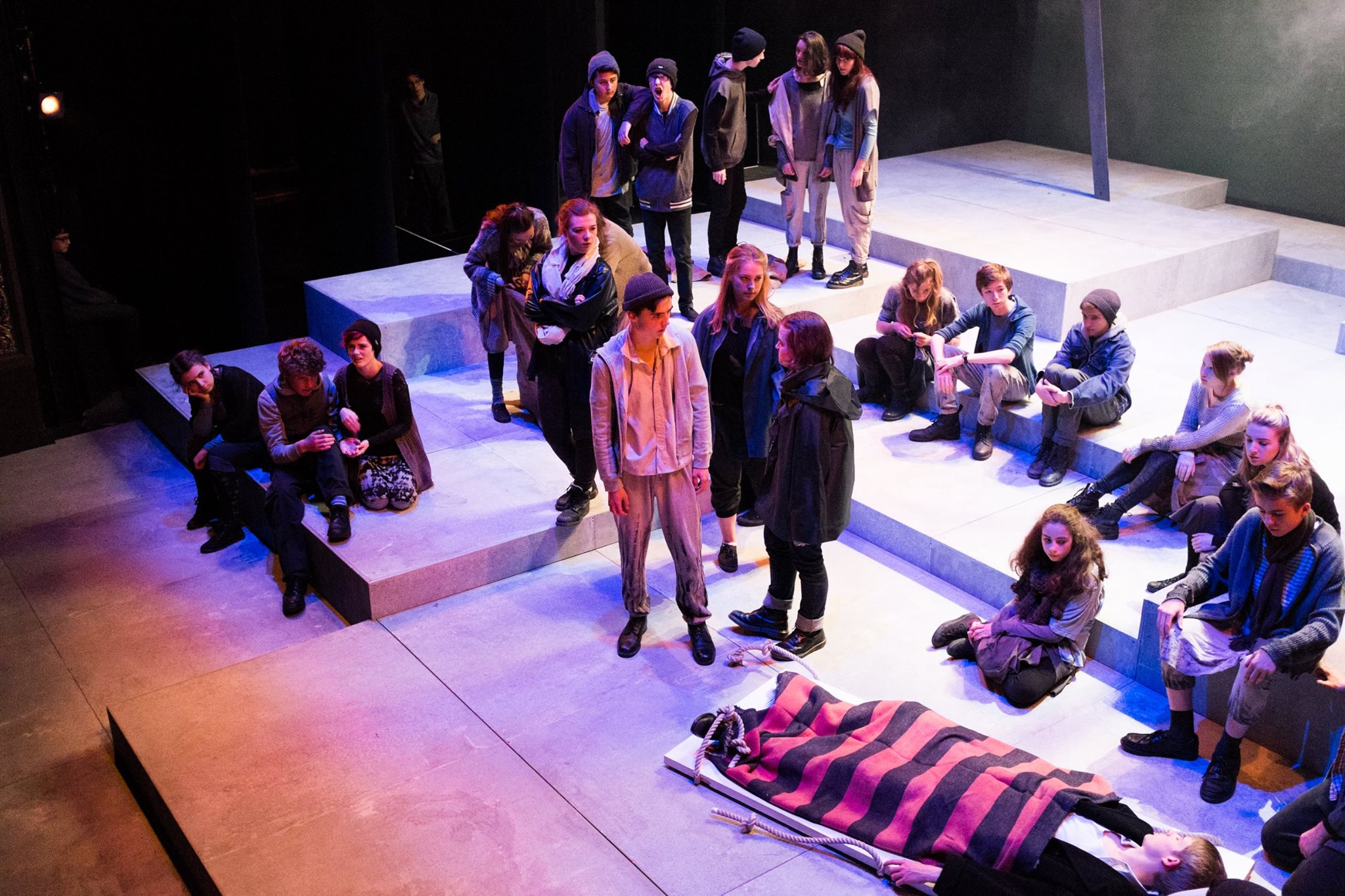
Daughter Jo, in a firm and touching performance by Caitlin Mitchard, does what she is told and is abandoned to a bleak, murderous, environment that offers no features, no direction, no way out (although Fraserburgh is on the map!). Her several – too many? – friends don’t make it. When, at the close, we’re in a harbour with a lighthouse the quiet relief is unlooked for and rather welcome.

There are two adult roles – principally Mum (Jenny Barron) and then the male Stranger shows up. Christie O’Carroll as director must have thought about playing the Stranger himself. Certainly Bond wanted that effect: the dreadful weight and mistaken, if not extinct, certainty of the adult up against the weaker, unscripted promise of the young – and at times it told.

All credit to LYT for holiday performances of a special kind.

Star (blue)Star (blue)Star (blue)

Reviewer: Alan Brown (Seen 17 July)

Go to LYT here.

Visit the  The Lyceum  archive.

‘The Driver’s Seat’ (Lyceum: 13 -27 June ’15)

Driver's Seat

“Prime Muriel Spark”

Editorial Rating: 4 Stars Nae Bad

Never mind the 4th wall, how about knocking down the back wall? Break out upstage centre from the Lyceum and you’ll be into Saltire Court on Castle Terrace. You know you’re in one of Edinburgh’s superior premises when the tenants include global accountants Deloittes and KPMG. A neat, if accidental, location then for a play whose principal character has had enough of audit, who hammers her stapler into her desk, has hysterics and takes a holiday but with absolutely no intention of coming back to the office.

Bye-bye patronizing suits, hello lemon yellow, orange, purple and blue V stripes. It’s 1970 (kind of), when you could buy novelty knives at the airside shops before boarding at Gate 14. Stressed out Lise is all decked out for the fervid south – could be Naples, might be Palermo – and with one type of man very definitely in mind.

This is prime Muriel Spark territory. She had been living in Italy since 1967 and the shocker that is The Driver’s Seat was published three years later. Here we have it adapted – call it exposed – and directed by Laurie Sansom in a one act, ninety minute, cross-over between garish psychodrama and police procedural. It is articulated, televisual theatre; think anglepoise lamp on accountant’s desk and mess with the springs.

Gabriel Quigley (on screen) and Morven Christie. Photos: Tommy Ga-Ken Wan

Gabriel Quigley (on screen) and Morven Christie.
Photos: Tommy Ga-Ken Wan

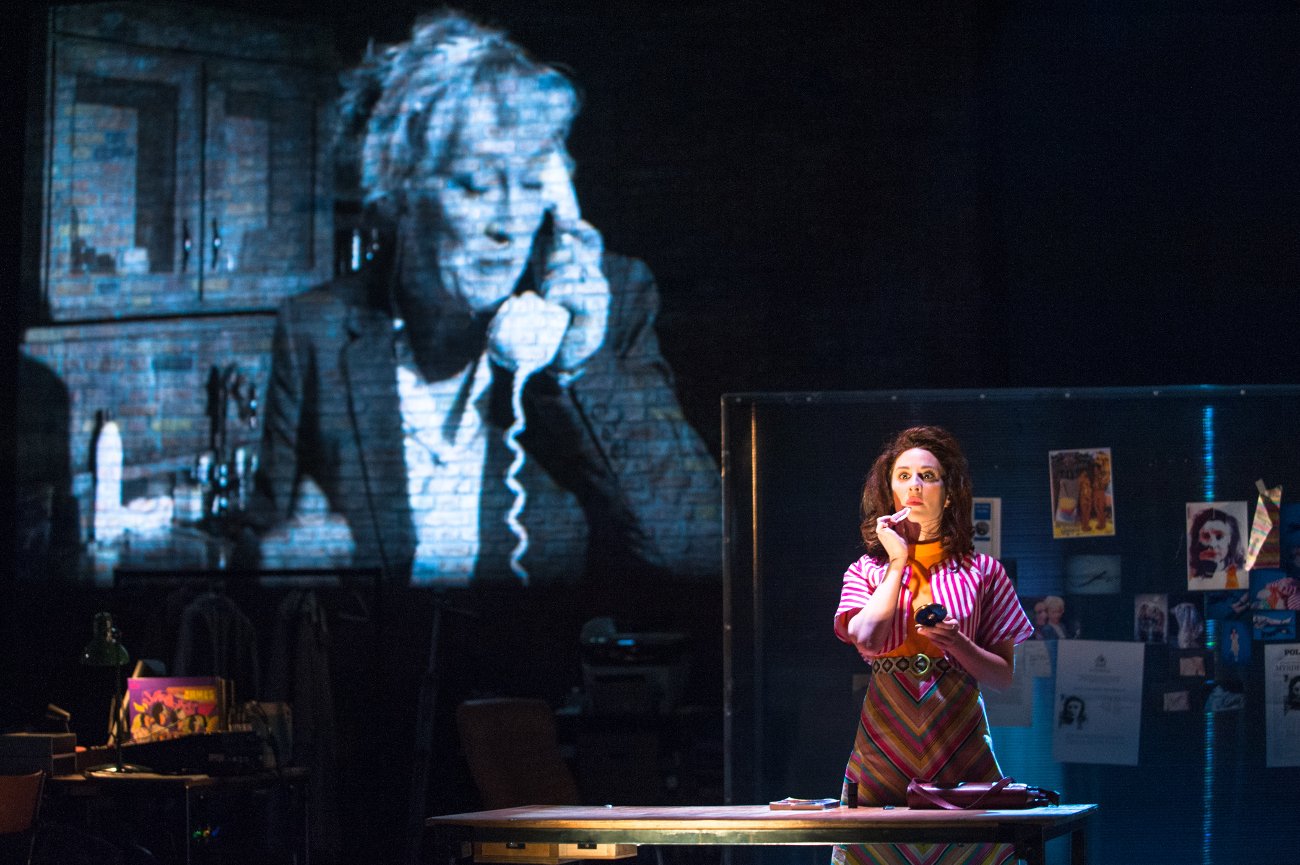
Centre stage is the incident ‘room’. As the investigation into ‘What-Happened-to-Lise?’ is conducted, so information, photographs, etc. go up onto a transparent wipe board. You see ‘VICTIM’ in marker pen. That’s retrospective action for you, sorted, marginally distracting, smart; very unlike the downstage action, where ‘What-Is-Happening-to-Lise’ is compulsive, jumpy, and unstable.

Lise herself (in an impressively tight performance by Morven Christie) is vulnerable because she is alone and out there, fixated, conflicted. At home in her bedsit, trying to sleep, she suffers – hands over ears – the moans of her neighbours having sex. Thirty-four years old in the book, she masquerades as the lady abroad: at one point a ‘widow and an intellectual from Iowa, New Jersey’ (sic) – supposedly fluent in four languages but plainly lost when it comes to real Italian. And it is real, via potent supporting roles from Ivan Castiglione and Andrea Vopetti.

There are no hands to the big clock in the incident room, which does point to alienation theory, but up come the sound cues and they appear, chronicling Lise’s known movements from hotel lobby to department store . There’s live mapping of her taxi on the large upstage screens while handheld TV cams relay fraught close-ups. You would think that little is hidden on such a tech-savvy set but as to why Lise acts the way she does there’s not much to go on, which is probably the existential point. Are we watching an object/abject study in self-destruction or an introverted and skittering operetta, complete with CS gas? Composer and sound designer Philip Pinsky uses mild jazz in ironic counterpoint to the spiky and alarming story. Did he, I wonder, smile at the desperate lyrics of the Sniff ‘n’ The Tears’ hit single Driver’s Seat (1979), where  “She had another way of looking at life”?  Accept stunned recall of Elizabeth Taylor & Ian Bannen in film-of-the-book Identikit of 1974 and you can see that Spark’s work is heading straight for Thelma and Louise some twenty years down the road, except that Lise has no buddy to go over the edge with.

Take that original, startling writing of 1970 – you’ll want to read it – and lay bare its mucky gender issues. The result, from creatives and excellent cast, is hard sprung. You won’t enjoy its forlorn subject, unrelieved by some crazy Italian driving in outsize shades, but it is acute work.

A National Theatre of Scotland production.

nae bad_blue

Star (blue)Star (blue)Star (blue)Star (blue)

Reviewer: Alan Brown (Seen 18 June)

Go to The Driver’s Seat and the National Theatre of Scotland here.

Visit the The Lyceum archive.

‘Yer Granny’ (King’s: 2 – 6 June ’15)

Gregor Fisher as Granny. Photography: Manuel Harlan

Gregor Fisher as Granny.
Photography: Manuel Harlan

“A performance of grotesque delights”

Editorial Rating: 5 Stars: Outstanding

This is a rollicking and roiling mix. The Russo family grew up with Fritto Misto and Potato Croquettes but it has all gone belly up since then. Their chip shop closed two months ago and perky Cammy is scraping a living out of his old burger van. There is no De’Longhi Deep Fryer on the worktop, just a hazardous barrel drum of cooking oil downstage right. Halfway to tragic maybe, but I took my seat to the whooping sound of Slade’s Mama Weer All Crazee Now, which (looking back) is one lurid invitation to excess. “Don’t stop now a c-‘mon” is what happens next and it’s flammable fun.

Writer Douglas Maxwell has lifted Roberto Cossa’s La Nona from Buenos Aires in 1977 and puts it down in Glasgow in the exact same year. Cue the glam soundtrack of the late 70s with Mrs Thatcher warming up and set that against the dismal fortunes of famiglia Russo; not that dizzy Marissa (20) knows any Italian beyond “Ciao” but at least she’s bringing home some cash. Best not ask what her boyfriend is selling to the kids in the high rise flats. Her uncle Charlie is definitely not making it as a composer, although his aunty Angela has high hopes for him. She hears his bedsprings squeaking rhythmically at night, you understand. Marie, Cammy’s wife and Marissa’s mother, is keeping the home together but is screaming inside, not least when the Bay City Rollers are playing Money Honey. And that leaves Nana, 100 years old, a metre wide, and yer granny at the maw of Hell. Against Nana, no jar of mayonnaise is safe, no food bank secure.

Gregor Fisher, as Nana, puts in a performance of grotesque delights. He growls Glaswegian gobbets, waddles athletically, and reaches for the digestives behind the clock with unflinching courage. The audience actually feels for the old glutton as she balances on the step stool. The family chippy was ‘The Minerva’ but that didn’t last. Nana is the awful immortal here. Invoke her, if you dare, by calling out “Anymare?” Ironic that the Romans got around to seeing Nemesis, aka Nana, as the maiden goddess of proportion.

Barbara Rafferty as Aunt Angela

Barbara Rafferty as Aunt Angela

Maureen Beattie as Marie

Maureen Beattie as Marie

Considerable credit therefore to Maxwell’s adaptation and to Graham McLaren’s direction for ensuring that Nana does not swallow the whole play. Cammy (Jonathan Watson) gives us two hilarious spiels of HM the Queen in his shop – reopened for business. He’s a proud Unionist is our Cammy but still manages to tell the sovereign to bugger off. She, for good measure, calls him a fanny. By contrast, Maureen Beattie is serene and strong as Marie and would save them all if only her good sense got the respect it deserved. Unfortunately that’s unlikely to begin with and downright impossible when sensitive brother-in-law Charlie (Paul Riley) has a mad and smutty idea. Enter very slowly rival fish bar owner Donnie Francisco (Brian Pettifer) halfway through the second act who, together with Barbara Rafferty’s amphetamine addled Angela, creates category one scatological bedlam. Suddenly poor, obliging Marissa (a great turn by Louise McCarthy) has a lot on her plate too. Never, ever, will chips and cheese pass my mouth and the wonderful Singing Kettle’s You Cannae Shove Yer Granny Aff a Bus has all gone to pot.

Brian Pettifer (l) as Donnie Francisco  with Jonathan Watson (r) as Cammy.

Brian Pettifer (l) as Donnie Francisco with Jonathan Watson (r) as Cammy.

My favourite (after Susi Quatro)? Donnie’s ‘It’s no that I dinae go fur older women … Mrs Robertsons (sic)? I love a Mrs Robertson so I dae. But surely to Christ there’s an upper limit on Robertsons?’

I enjoy eating at Nonna’s Kitchen on Morningside Road but that’s nothing to what Yer Granny serves up of West Kilbride. This National Theatre of Scotland production is a feast of Scottish comedy: clever and exquisitely tasteless.

outstanding

StarStarStarStarStar

Reviewer: Alan Brown (Seen 2 June)

Go to ‘Yer Granny’ here.

Visit the King’s Theatre archive.

‘Normal / Madness’ (Assembly Roxy: 12 – 13 May ’15)

Photos: Kidder theatre

Photos: Kidder theatre

“A show that is performed with great sympathy that you will take heart from”

Editorial Rating:  4 Stars: Nae Bad

You say ‘Normal’, slash, ‘Madness’; I say ‘Normal’, oblique, ‘Madness’. WTF; you’re right, ‘slash’ is sharper, more definite. But it cuts both ways. Yes, there’s separation but they’re related, surely?

And that’s the point. Look at the flyer for Kidder theatre’s Normal / Madness. Mother and daughter, backs to the camera, are walking down a railway track holding hands; each balances on one rail, each supports the other. They walk beneath a star filled sky – in golden light – and it’s a lovely, endearing picture; but were it for real we’d have an irresponsible, lunatic, piece of parenting.

Here’s the crass response: “Pull yourself together woman!” Oh, is that all you have to do? What if you can’t because you’re ill? What if your whole life can become precarious in an instant? That’d be mental, then.

Kirsty McKenzie, 30, tells it how it is and how it was. Her mother, Mary, has schizoaffective disorder and has had it for a long time. She suffers psychotic symptoms, similar to schizophrenia, and the mood symptoms of the manic depressive. We see Mary overwhelmed and scared. We see Kirsty caring, trying to help and to understand.

Writer/Actor Fiona Geddes is alone on stage. She’s Kirsty with a broad smile, a ready sense of humour and a wonderful positive manner. She’s also Mary, low, terribly anxious and scrabbling in the sand for the six pounds in coppers that she buried and now cannot find. The tide is coming in along the Moray Firth and the children’s treasure hunt has had it. As a metaphor for how mental illness wipes you out, time and again, that’s hard to beat.

Fiona Geddes as Kirsty

Fiona Geddes as Kirsty

We get to learn a fair bit about schizoaffective disorder. Medical information is relayed in tones halfway patronising and/or foreign. I couldn’t help wishing for some projected slides with bullet points to do a professional job. More time with Mary, Kirsty, and bipolar boyfriend Patrick, would have been better, especially as mother and Patrick don’t get on. The familiar, homely, strains of ‘Coronation Street’ are almost therapeutic and are certainly ironic.

You’ll like Kirsty because of her honesty and because she is a loving person. Yes, the issue is her Mum’s condition but the story is Kirsty’s. Consider the choices she (& Patrick) have to make regarding children of their own. Genetic counselling gives you fair enough odds but ….

Geddes and director Jessica Beck brought Normal / Madness to the Fringe last year. Now, during Mental Health Awareness Week, it is back in Edinburgh and on tour. It’s on next at The Tron in Glasgow . The charity ‘Rethink Mental Illness’ supports this production, which – forgive me – is a no-brainer. It is a show that is performed with great sympathy that you will take heart from. ‘Help and Hope’ is the message.

nae bad_blue

Star (blue)Star (blue)Star (blue)Star (blue)

Reviewer: Alan Brown (Seen 12 May)

Go to ‘Normal / Madness’ at Kidder here

Visit the Assembly Roxy archive.

‘The Venetian Twins’ (Lyceum: 24 April – 16 May ’15)

Angela Darcy as Columbina and Grant O'Rourke as Tonino. Photos by Alan McCredie

Angela Darcy as Columbina and Grant O’Rourke as Tonino.
Photos by Alan McCredie

“Helpless merriment awaits”

Editorial Rating: 4 Stars

The fun that there is to be had with twins, eh? And with the long-legged long lost sister who, naturally, is being wooed by one of the brothers, but which one? There’s a consultation on offer with Dr Freud but, nah, he stays in Vienna and it’s much more jolly here in a sun dappled piazza in rosy Verona.

Wednesday was a shocking day in Lothian and so all the more reason to enjoy one of Signor Goldoni’s cloudless comedies. It’s funny what a master drammaturgo can do with disinheritance, murder, suicide and a lovesick ginger loon in lime green.

That’s Carlo Goldoni of a Servant of Two Masters (1743) and many, many more of that ilk. Its near relation has to be I Due Gemelli Veneziani (1750), respectfully translated, because our Edinburgh is the city of La Favorita, ‘the authentic Italian experience’. And just like those jaunty yellow 500s that we see around and about so adaptor/director Tony Cownie delivers big time – in FIAT speak – ‘an emotional mixture of vintage flavours, where everything is colourful, joyful and [almost] authentic’, plus a high speed rally of Scots accents and banter. It’s also now around 1905, Italian railways are steaming in but a bag of gold and a box of jewels will still buy you a bride in an astonishing frock.

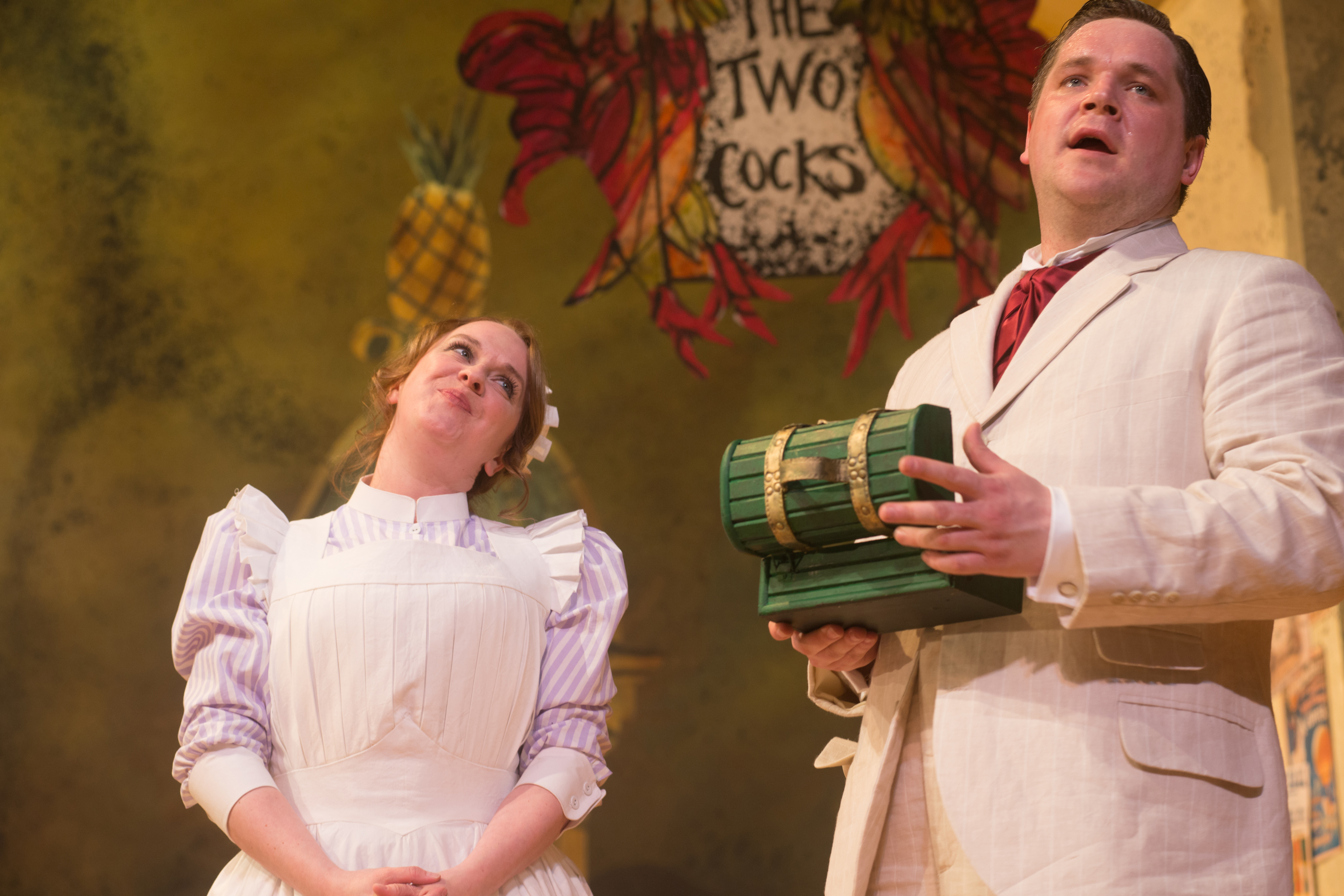
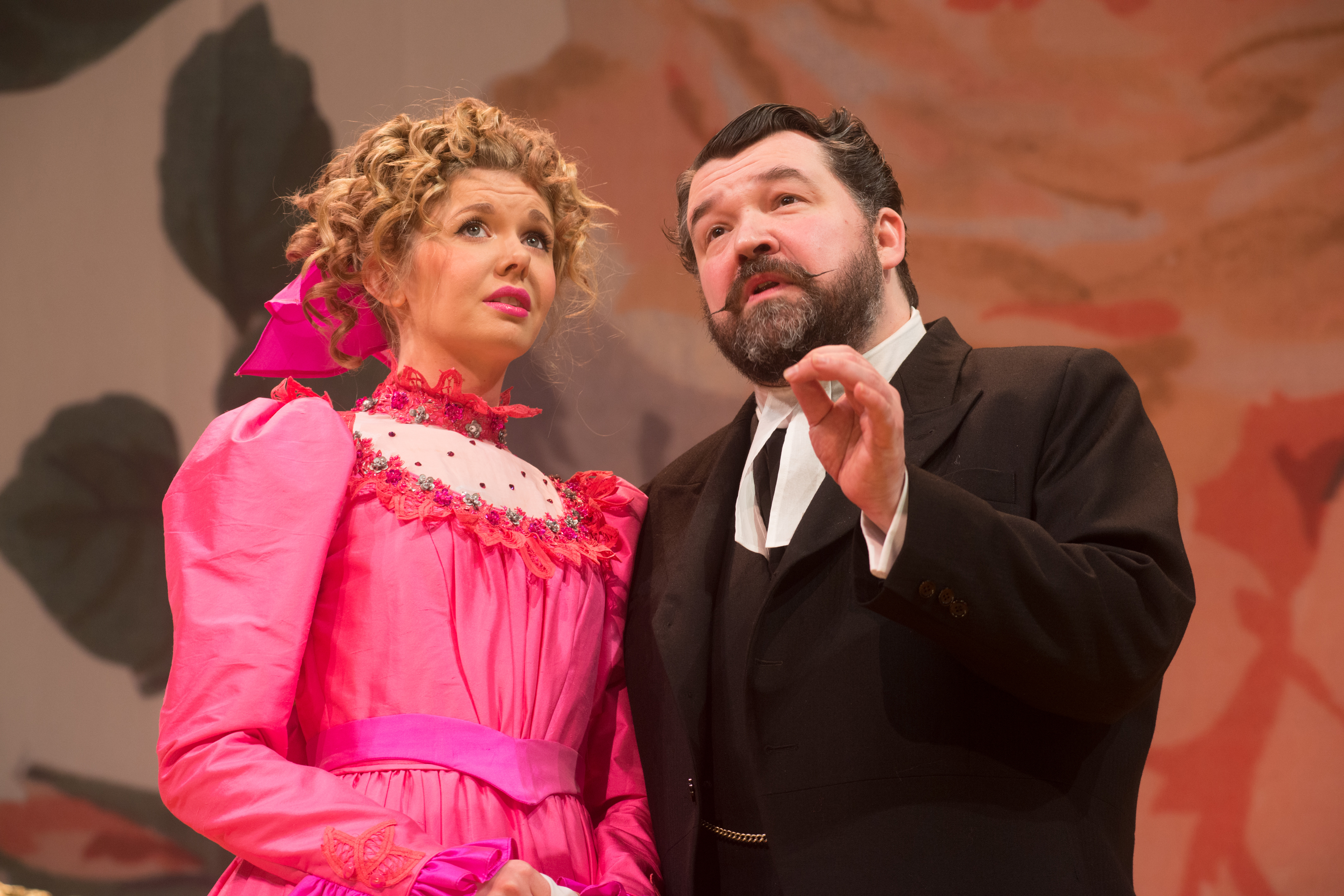
‘This place is mental, eh?, declares Twin 1, provincial Zanetto, who is a mild and endearing sort. He’s come to town from the sheep folds and pig pens of Bergamo to marry Rosaura, whom he’s never met, but who has been kept under house arrest for her (rich) Intended. Poor Rosaura! Home tuition didn’t help much and she suffers from acute malapropism, make-up dependency, and the lust of Pancrazio, the priest, who is a top graduate of the Tartuffe school of rank hypocrisy. Twin 2, is dauntless and debonair Tonino, whose tireless belief in the beauty that is Venice and in his no less beauteous self, probably led to his conflicted fiancée, Beatrice (PhD), running away to Verona where she meets …. Zanetto. Signore e signori, it’s the face-off show! Meanwhile, opposite Rosaura’s just has to be the inn of the Two Cocks where more helpless merriment awaits behind the bar.

Dani Heron as Rosaura and Steve McNicoll as Pancrazio

Dani Heron as Rosaura and Steve McNicoll as Pancrazio

Twins 1 and 2 are – or is – Grant O’Rourke. It is a treat of a ‘double’ performance where panache meets dead-pan humour and survives. Dani Heron serves up Rosaura as a pink sweetie and the whole piece, actually, is offered con brio: from the bright accordion music to the swashing sword play and pink cravat of posh boy Lelio (James Anthony Pearson). Kern Falconer’s turn as barmaid Mammy Flozzie is a shameless hoot whilst Steve McNicoll as the villainous Pancrazio exists seconds away from pantomime hisses.

The audience knows just about what to expect at every madcap moment because the characters delight in telling them – especially Angela Darcy’s fly Columbina; but there are a couple of slaps in the face, as a reminder that Goldoni’s laughs can and perhaps should at times own a keener edge. You won’t miss them, though, but you might feel for good ole’ Zanetto as I did.

Star (blue)Star (blue)Star (blue)Star (blue)

Reviewer: Alan Brown (Seen 5 May)

Go to ‘The Venetian Twins’ here

Visit the The Lyceum archive.

‘Birdsong’ (King’s: 21 – 25 April ’15)

Edmund Wiseman as Stephen Wraysford and Emily Bowker as Isabelle Azaire. Photos: Jack Ladenburg

Edmund Wiseman as Stephen Wraysford and Emily Bowker as Isabelle Azaire.
Photos: Jack Ladenburg

“More resonant than sword waving in front of machine guns”

Editorial Rating:  4 Stars Nae Bad

If you can bear a literary introduction read Sassoon’s The Redeemer and Owen’s Strange Meeting before the show. If not, just take this from Issac Rosenberg’s Returning, we hear the Larks:

‘Death could drop from the dark
As easily as song –
But song only dropped’

Which is what you do get in this moving if fitful adaptation of Sebastian Faulks’ Birdsong. There is lovely singing and there are skylarks – but there is also a rat on a bayonet, blood dripping down 60 feet, and furious bombardment.

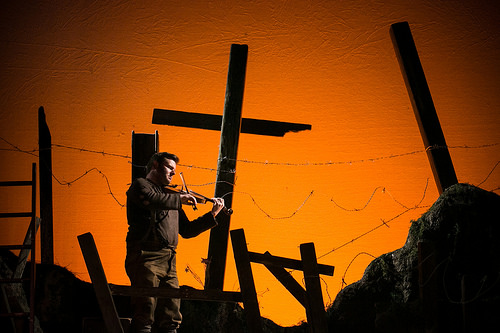
This is poignant and dramatic storytelling by the Original Theatre Company. Yes, Faulks’ book is blasted open in Rachel Wagstaff’s new version for the stage and at times the effect is not pretty, parts do fall away and some of the shoring up looks shaky but I reckon that’s inevitable. The back set is a high rampart of shattered wood and piled debris. Two large timbers make a cross that rises above the parapet in a stark reminder that Christ had one hell of a job to do on the Western Front. Men pray in this play, which is not at all what I remember from the book, and it is horribly easy to understand why. That green hill is not so far away and might well be undermined by tons of explosive that will send you to kingdom come.

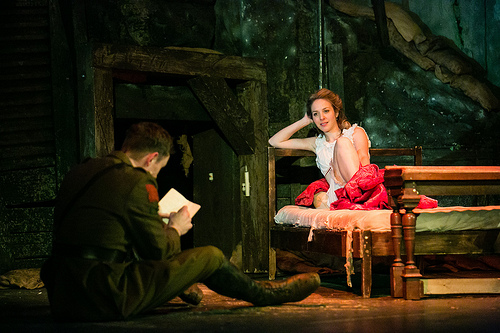
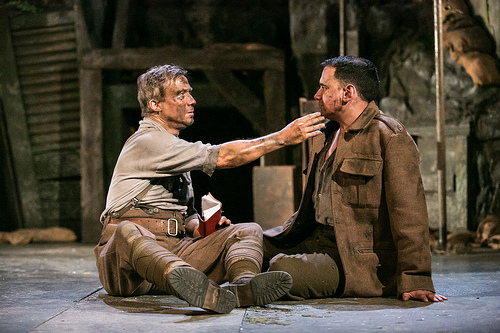
What I do recall from Faulks’ pages are sex and war story content of frightful detail and claustrophobic novelty. Well, the sex is still around but the novelty has gone because even if you do not know the book there’s the two-part tv. series with Eddie Redmayne and the Australian film Beneath Hill 60. Tunnelling onto and about the stage aint the same but the sappers do a brave job of crawling by (electric) candlelight. They ‘Play Fritz’ and imagine the lives of the enemy, who may only be a few feet away, below, above, or ahead. There’s suspense to be had before an attack tunnel breaks through or a detonation shakes the walls and then there’s rushing confusion. Nevertheless, the best action stays with the characters.

Peter Duncan as Jack Firebrace and Liam McCormick as Arthur Shaw

Peter Duncan as Jack Firebrace and Liam McCormick as Arthur Shaw

With a name like Jack Firebrace we’re close to plain allegory. Peter Duncan plays him admirably as sturdy, loving, dauntless . The short scenes when this former London Tube tunneller and his best mate, Arthur Shaw (Liam McCormick), share letters and thoughts of home are possibly the most affecting in the play. What is more intense but – it seems – far less mature is the love affair between Stephen Wraysford, 20, (Edmund Wiseman) and Isabelle Azaire, 27 (Emily Bowker). The individual performances are easily good enough to make this believable in the moment but it is a stretch to see it played out over eight years, from 1910 to 1918. The flashbacks flare and are gone and you can almost see the narrative being shovelled in before the light vanishes. A final, near wordless, scene when the cast of Stephen’s lacerated memories people the stage is a welcome coup d’oeil upon the whole ghastly shebang.

Arguably a resurrection is being played out: of Stephen’s passionate love and of his war – that’s understood; but it is also an appeal to stand by what is now out of living memory. Hence the really telling effect in this production of folk song, hymn and psalm, beautifully sung by James Findlay ; a cut above and much more resonant than sword waving in front of machine guns, more so even than a Tommy / Hun hug of reconciliation. For what Wagstaff has crafted from Faulk’s book and what director Alastair Whatley turns out on stage is a theatrical ‘Stand to’ – to guard against what Stephen kept close in his coded notebook and is now given voice:

James Findlay as Cartwright, Singer and Musician

James Findlay as Cartwright, Singer and Musician

‘No child or future generation will ever know what this was like. They will never understand … We will seal what we have seen in the silence of our hearts and no words will reach us’.

You might simply want to accept Stephen’s commanding officer’s invitation to join him for tea on the Royal Mile when ‘this’ is all over. Or you can talk about ‘Birdsong’, which would be better.

nae bad_blue

Star (blue)Star (blue)Star (blue)Star (blue)

Reviewer: Alan Brown  (Seen 22 April)

Go to the King’s and Festival theatres here.

Visit the King’s Theatre archive.

‘The Strange Case of Jekyll and Hyde’ (Traverse: 19 – 21 March ’15)

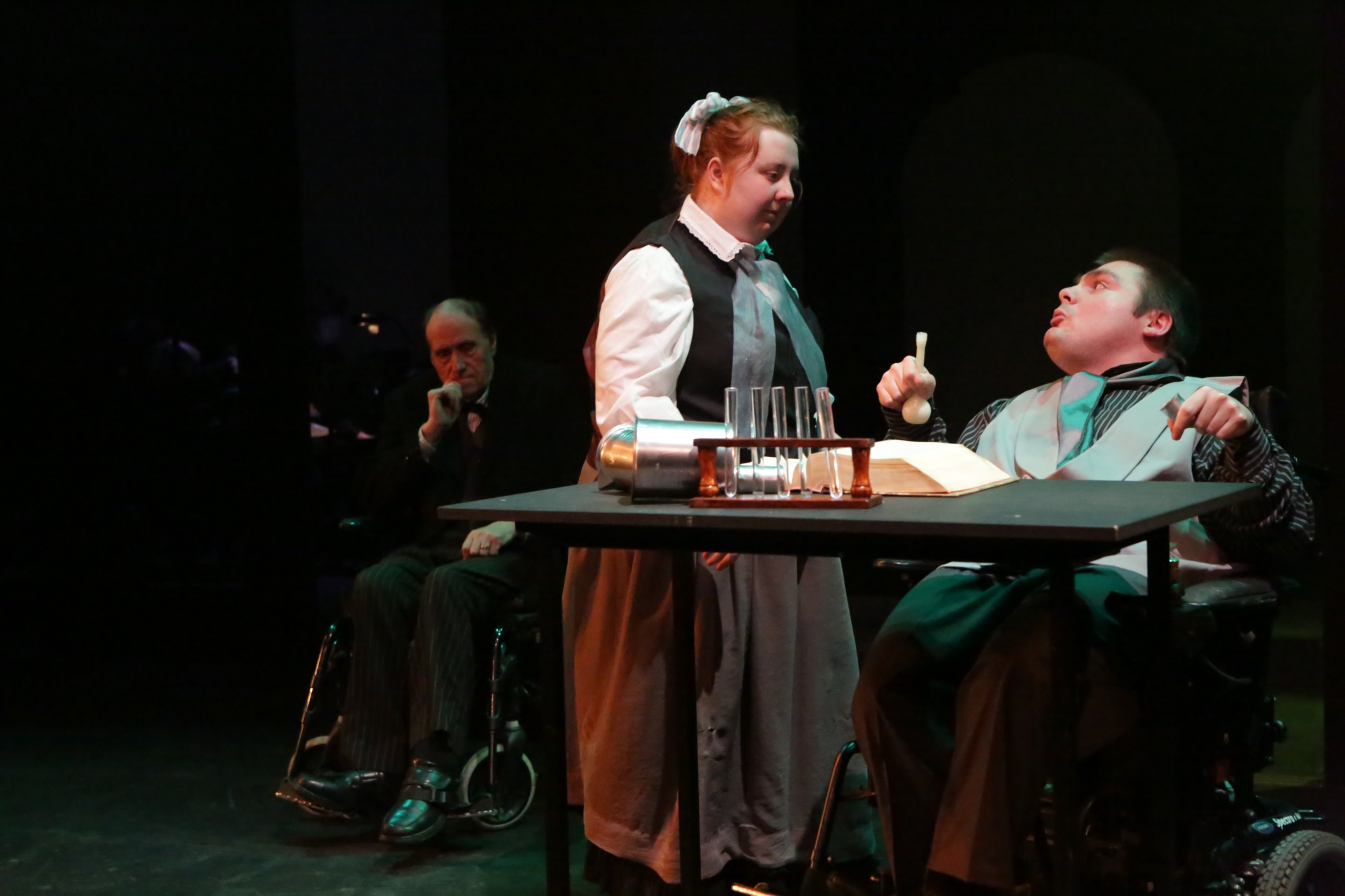
(l - r) John Edgar as Poole, Emma McCaffrey as Miriam Jekyll and Stephen Tait as Dr Jekyll Photos: Douglas Jones

(l – r) John Edgar as Poole, Emma McCaffrey as Miriam Jekyll and Stephen Tait as Dr Jekyll
Photos: Douglas Jones

“A fleet and surprising adaptation of a famous story”

Editorial Rating: 4 Stars

It is strange indeed when Miriam Jekyll puts Hyde onto her shoulders and carries her off stage. You might think that light work is being made of RLS’s ‘classic’ shocker of morbid psychology. You’d be wrong though. Stevenson’s story is here, it’s just been gifted with some nimble ideas and relocated to Edinburgh. Hair restoration and topiary outrages in the New Town are up there together with the double consciousness.

Writer Morna Pearson gives Dr Jekyll a family: Jane, his wife, who finds anaesthesia from marriage in drink; William, his son, a friendly soul who is never going to get to Uni’; and Miriam, his daughter, who should be in the Chemistry labs but who has become Hugo’s darling Intended. It is Miriam who helps herself to her father’s green potion and who finds Hyde (a dead ringer for The Woman in Black) at the bottom of the glass. And it is together, through the toun, that the two young women enact ‘the thorough and primitive duality of man’. It is not the case, in this version, that when Hyde appears Jekyll disappears. No, theirs is a prime alliance.

The pathological strain is replaced by social horrors: Jekyll has money problems and his creditor, Dr Black, sexually assaults Miriam. Hyde fights back. Police enquiries get nowhere as the good folk cannot see that the evil doers are just like them – sometimes. To frame the action Director Caitlin Skinner has the twenty cast members divide into pairs and to eyeball each other accusingly and then “Shush!” us into a conspiracy of silence.

The thematic assists from composer Greg Sinclair and the musicians of Drake Music work extremely well. The opening soundscape of bells and chimes and hooves quickly gives way to single notes and jagged chords. Miriam suffers the effects of the concoction as pins and needles stick in our ears. Solo voices intone in uncanny ways and wind about the silhouetted archways, stairs and closes of the city.

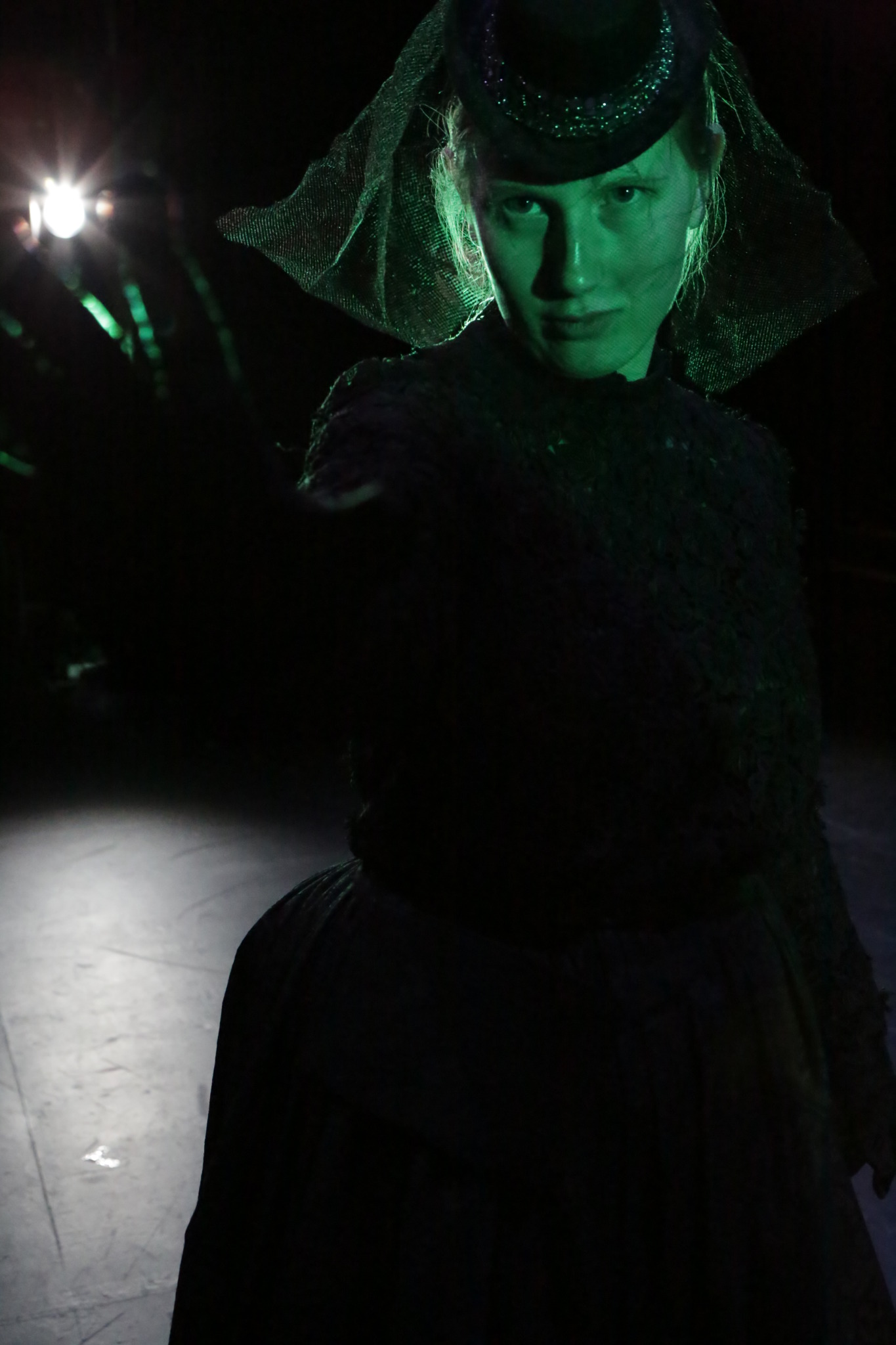
Nicola Tuxworth as Hyde

Nicola Tuxworth as Hyde

The open stage and precise blocking allows the performers to distinguish themselves. Stephen Tait as Dr Jekyll is the focused professional with secrets to concentrate on. He loves his daughter but is the late Victorian father with some lunatic ideas about the brain. Emma McCaffrey’s Miriam responds with due affection but has her own abiding demon to wrestle with, both in the parlour and on the roof. Hyde (Nicola Tuxworth) does not speak but is a veiled and forbidding presence whose outstretched hand you would not want to hold. For me, though, it is the lugubrious Poole (John Edgar), butler to Jekyll’s household, whose words you hang onto. After all, it is Poole who reveals that he has heard Miriam talking to her ‘friend’.

So, a fleet and surprising adaptation of a famous story that really belongs to Edinburgh and which Lung Ha Theatre make their own.

Star (blue)Star (blue)Star (blue)Star (blue)

Reviewer: Alan Brown (Seen 21 March)

Go to Lung Ha Theatre Company and Drake Music Scotland here.

Visit the Traverse archive.