‘The Children’ and ‘Mancub’ (Lyceum: 17 July ’15)

Mancub & The Children

“Evolutionary studies”

Editorial Rating: 3 Stars

A Lyceum Youth Theatre double bill.

It must be heroic happenstance that Mancub opened on the Lyceum stage on the same day, July 17, that Ant-Man came to a (film) theatre near you. The little guy wins out and gets out, but it’s tough going. As for The Children, performed by the senior class after the interval, it is kind of the same story but a whole lot nastier. The despairing cry is, “We’re not animals”. The shame is that no-one told the adults.

Mancub

Mancub is Douglas Maxwell’s 2005 adaptation of John Levert’s book Flight of the Cassowary. Paul is in S4. On the good days school is an adolescent aviary; on the bad days, it’s a jungle with teachers in their lairs. A diagram of the human eye is up there on the board in Biology class but Paul only sees foxy Karen (Emma Gribbon) and gulps with nerves. That’s the goldfish in him. He gets a red card in a cup game for roaring at the referee. That’s the grizzly bear in him. He makes friends with the neighbour’s dog (cute and canny Max Hampson) and they chat together. His younger brother, Wee Luke, hates Kipling’s Jungle Book but loves the Disney version. Their Mum and Dad don’t have the imagination to enjoy either.

Xana Mawick, Director, does well to put a cast of 26 on stage all the time and to keep the many episodes distinct. There’s a camera for bonus close-ups and five narrators do a good, clear voiced, job of introducing and accompanying the action. Alexander Levi is Paul, shy but plucky, and able to survive becoming the road kill of insensitive grown-ups; although Tom Borley as football coach, Susskind, is a likeable chump. Best friend Jerry, ably played by Carson Ritchie, is the smart dude with the knockout comeback lines.

The representation and/or mention of those other species, teachers, parents, gran, and – awkwardly, Neds – is a little sketchy, even foolish, but that’s evolutionary studies for you.
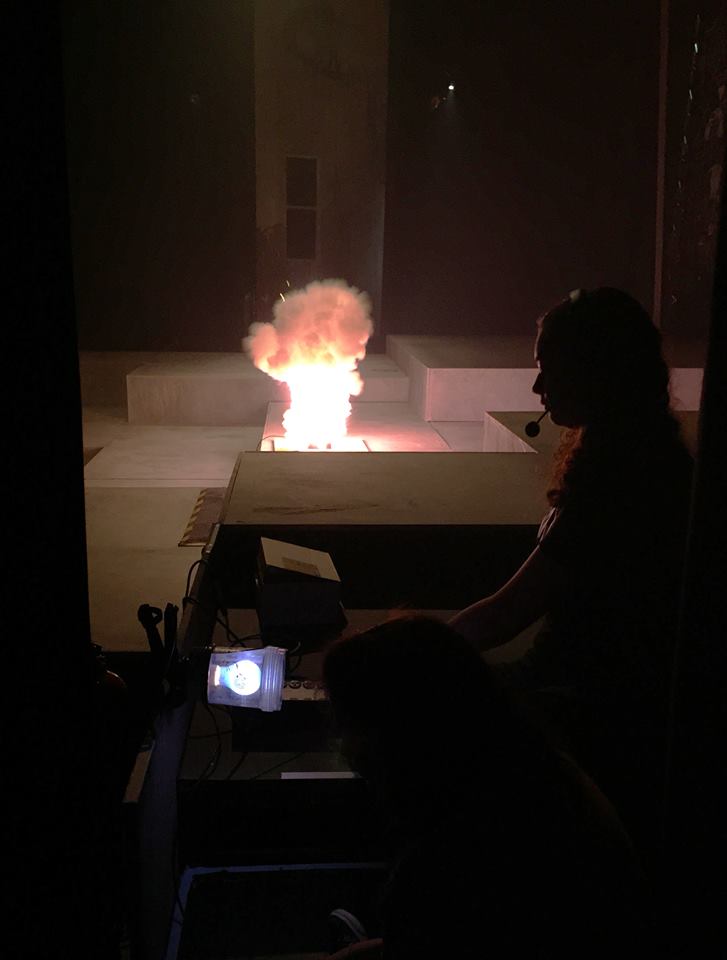
The Children tech

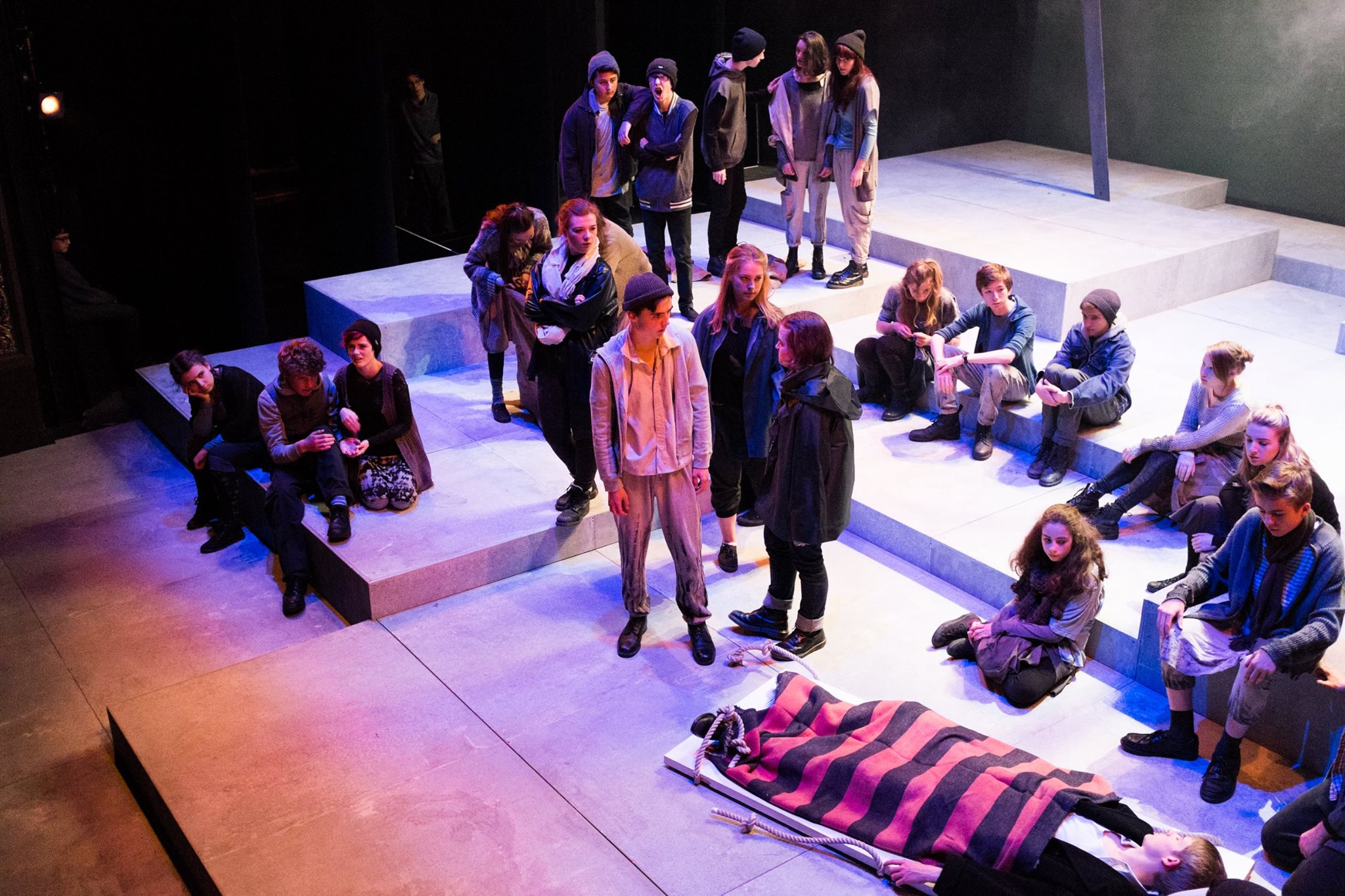
There is nothing ill-defined about Edward Bond’s The Children (2000). It is determinedly and definitely in your face – and there’s a brick to hand. When a mother’s instruction, fuelled by fags and booze, is to burn down a house it is no surprise that blood splatters to an acoustic treatment of The Offspring’s The Kids Aren’t Alright.
P

Daughter Jo, in a firm and touching performance by Caitlin Mitchard, does what she is told and is abandoned to a bleak, murderous, environment that offers no features, no direction, no way out (although Fraserburgh is on the map!). Her several – too many? – friends don’t make it. When, at the close, we’re in a harbour with a lighthouse the quiet relief is unlooked for and rather welcome.

There are two adult roles – principally Mum (Jenny Barron) and then the male Stranger shows up. Christie O’Carroll as director must have thought about playing the Stranger himself. Certainly Bond wanted that effect: the dreadful weight and mistaken, if not extinct, certainty of the adult up against the weaker, unscripted promise of the young – and at times it told.

All credit to LYT for holiday performances of a special kind.

Star (blue)Star (blue)Star (blue)

Reviewer: Alan Brown (Seen 17 July)

Go to LYT here.

Visit the  The Lyceum  archive.

‘Hatters!’ (Assembly Roxy: 31 March – 3 April’15)

“Awash with lots of individually interesting ensemble moments and devices.”

Editorial Rating: 3 Stars: Nae Bad

Hatters is an intriguing piece of ensemble theatre. It follows the story of Robert, a hapless member of the Bright Young Things in 1930s London, and his attempts to navigate a minefield of sinister characters and mistaken identities in order to marry his fiancé.

Loosely inspired the Evelyn Waugh novel Vile Bodies, the company devised the production around the novel’s key dramatic moments and characters. Keeping very much in theme with the “modernist” style adopted by Waugh in his book, a more experimental approach is used by the company in its presentation of society in the run up to World War 2.

It’s a very physical production, which at times hinders the narrative of the piece as the actors often parade around from scene to scene embodying furniture, cars and general London street scenes. This makes it quite difficult for the audience to know what’s going on. In fact, the show opens with all nine actors stood in a circle facing inwards, and one by one they appear to suffer some sort of epileptic fit before ending in a pile on the floor. By the end of the performance we still had no idea what relevance this had to everything else, and moments like this unfortunately detracted from what was actually a very interesting exploration of modernist theatrical storytelling.

In saying that, in many of the physical sections the action was accompanied by human soundscaping, which worked particularly well in creating atmosphere, and was executed with just the right level of depth and detail. In some cases though, a subtler approach could have been more effective and less jarring to the main action, which was on the whole, very well executed.

As a devised work, facilitated by the passionate Sibylla Archdale Kalid, Hatters is awash with lots of individually interesting ensemble moments and devices. One good example of this was the tea party scene, where actors swapped character with each other many times, but managed to maintain continuity and clarity of action and dialogue. Indeed, the cast’s overall approach to and execution of characterisation, aided by different hats to help identify them, was a real strength of the show.

However, the fragmented style and seeming need to cram in everything that had been devised for fear of wasting it did end up being a bit overkill. With so many different devices and styles used, the piece lacked some consistency. It would have been more effective to see more themes running throughout the performance, rather than something new adopted for every new scene.

The production was certainly not without its laughing moments. Comic timing was very good throughout, as was delivery of some of the witty one-liners worked into the script. My particular favourite was uttered by Robert’s fiancé, just after he’d had to sell her to pay off his debts: “These feelings don’t just go away when you’re sold!” Something about the pure innocence in the delivery had the whole audience in stitches.

Overall, this was a courageous and admirable effort, with a lot of potential to be expanded and developed over time. It’s just not quite there yet.

nae bad_blue

Star (blue)Star (blue)Star (blue)

Reviewer: Steve Griffin  (Seen 3 April)

Visit the Assembly Roxy Bedlam Church Hill Theatre Festival Theatre King’s Theatre Other Pleasance, Potterrow & Teviot Summerhall The Lyceum The Stand Traverse archive.

THIS REVIEW HAS NOT BEEN SUBEDITED

‘Stepping Out’ (Bedlam: 25 – 26 March ’15)

Olivia Evershed as Andy

Olivia Evershed as Andy

“Tap isn’t easy to master, so respect must go to the whole cast for giving it a very good shot, as well delivering a solid comedic acting display.”

Editorial Rating: 3 Stars: Nae Bad

Stepping Out is a comedy about a group of mismatched characters in the 80s who are all in the same recreational tap dance class. And yes, they do actually dance. If that doesn’t sound funny already, Lorna Treen’s performance as ancient, grouchy pianist Mrs Fraser in the opening scene, delivering witty one-liners in brilliant dead pan style, sets the show off to a very good start.

As the play progresses, we get to learn more about each character and their relationships with each other, some of which aren’t as rosy as they might initially seem. Although a bit of a slow burner in terms of narrative in the first half, when the class is offered the chance to put on a real show to a paying audience the tension is raised a notch and it picks up some of the pace it had been lacking.

The script posed some difficulties with staging, largely due to its ensemble nature (most of the cast were on stage a majority of the time) and the structure of the dialogue into small snippets rather than full scenes. This had the effect of it all feeling a bit fragmented and having a stilted sense of flow, but director Zoe Most and the cast did well to keep action on stage alive from every angle despite this.

Interspersed with the comedy were some very touching moments, particularly between Andy and Geoffrey. However these got a little bit lost among the more active, ensemble scenes, and could have been more impactful with a bit more contrast in pace and dynamics.

The dancing itself was very enjoyable and was well choreographed to show progression in the class’s ability from the beginning to the end of the play. Tap isn’t easy to master, so respect must go to the whole cast for giving it a very good shot, as well delivering a solid comedic acting display.

The stand out performer (for me) was Isabella Rogers as the outspoken, middle class Vera. Her facial expressions, comic timing and perfect delivery of the line “I used to be fat, you know” had the whole audience giggling with glee. She drew attention whenever she was on stage and delivered a captivating and comical performance. Olivia Evershed, playing the browbeaten Andy, showed great depth in a complex character and was also compelling to watch.

For the opening night of a student production, one can forgive it being a little rough around the edges. The heart and soul of the piece were definitely intact and it delivered laughs a plenty. Overall, a very enjoyable evening, well worth stepping out to.

nae bad_blue

Star (blue)Star (blue)Star (blue)

Reviewer: Steve Griffin  (Seen 25 March)

Visit the Assembly Roxy Bedlam Church Hill Theatre Festival Theatre King’s Theatre Other Pleasance, Potterrow & Teviot Summerhall The Lyceum The Stand Traverse archive.

THIS REVIEW HAS NOT BEEN SUBEDITED

‘The Merchant of Venice’ (Assembly Roxy: 10 – 14 March’15)

Isobel Moulder as Portia and Will Fairhead as Bassanio.

Isobel Moulder as Portia and Will Fairhead as Bassanio.

“From the Rialto to Little Venice, W9,  is neat”

Editorial Rating:  3 Stars

Were Antonio at work today, this stacked play would be even trickier than it already is. He’d be talking about moving cargo rather than sailing ships. His wealth would be in metal boxes to Singapore or Mumbai rather than argosies from Venice. Nevertheless, reassuringly, his sound advice to Bassanio would be the same: “Go, presently inquire where money is”. That would send the enterprising lover to Shylock, who would have friends and funds in Frankfurt and away we go.
However, in this production when Shylock asks “What news from Germany?” (that’s Genoa back then), the context shifts mightily. For now we’re back to September 1939 and the news ain’t good. In fact if you’re Jewish it has been desperate. Director Rae Glasman finds a choice text in Prime Minister Chamberlain’s declaration of war:

   “Now may God bless you all. May He defend the right. It is the evil things that we shall be fighting against – brute force, bad faith, injustice, oppression and persecution – and against them I am certain that the right will prevail.”

That’s not Shakespeare but it works. For a start, which God: Christian or Jewish? Who is the more righteous: backscratching Bassanio, Jew-baiting Gratiano, or is it Antonio, who spits at Shylock in the street? Is it merciful or just to condemn Shylock to near ruin and to force him to convert? Portia, if always an unlikely victim, will find happiness in marriage. There is a happy and flimsy ending, which is why – I suppose – Glasman has that radio broadcast at the end of the play, to make her audience ask what exactly has prevailed here? Actually, I would have welcomed that mooring at the start. There’s the trouble with The Merchant of Venice; it goes all over the place: scenically, tonally, action-wise. Underwhelming and overwhelming.

From the Rialto to the City of London and to Little Venice, W9, is still neat. Portia’s Belmont is relocated to a country house, somewhere in the Chilterns, I guess. That is not a displacement too far but it looked hard to accommodate on the Roxy’s stage. I found the opening and drawing of the full length curtains in-between scenes more distracting than helpful and it’s a No-thank you to the squealing Downton maids at open-the-box time. The Glen Miller sound was melodious though and the cocktail cabinet and fetching evening wear did their elegant, idle, thing well enough.

As do Bassanio’s set of chaps. Portia (Isobel Moulder) sees them – and quite possibly all men – as “bragging Jacks” to be practised upon, which this marble-mouthed lot certainly deserve. She is also properly merciless in the court, where otherwise the languor of the club rooms seemed to have carried over. To supply Bassanio (Will Fairhead) with an Eton education and braces was presumably to allow him to stand nonchalantly, hands in pockets, between the caskets and to give him the manners, surely the compassion, to pick up Shylock’s yarmulke from the floor and to give it back.

Joe Shaw as Shylock with Kirsty Findlay as Jessica. Photos: Aliza Razel

Joe Shaw as Shylock with Kathryn Salmond as Tubal.
Photos: Aliza Razel

I could believe in Shylock (Joe Shaw) as a broken father. “My daughter is my flesh”, he says, and then Jessica abandons him – or is stolen from him. His hair should have been greyer but it is no surprise when – to take like for like – he would cut into a spent Antonio (Pedro Leandro) above his heart. There is real pain in that vengeful effort.

Kirsty Findlay as Jessica and Chaz Watson as Lucy Gobbo.

Kirsty Findlay as Jessica and Chaz Watson as Lucy Gobbo.

There are laughs in the features and antics of preposterous suitors, Arragon and Morocco, and in the crazy work of Lucy Gobbo (Chaz Watson) who sounds like the ‘wauling bagpipe’ of Shylock’s protest and who looks way too bad for Emil and the Detectives.

Rory McIvor as Lorenzo spoke the (blank) verse best and did Moonlight Serenade introduce his scene with Jessica near the close? I can’t recall. I do remember approving Bassanio’s choice of the lead casket, for ‘Thy plainness moves me more than eloquence’, which is where I stand on this production. It looks pretty and sounds attractive but its necessary centre of gravity is away, awry.


Star (blue)Star (blue)Star (blue)

Reviewer: Alan Brown  (Seen 10 March)

Visit the Assembly Roxy archive.

‘Bitter Sweet’ (Discover 21 Theatre: 27 Feb -1 March ’15)

Bitter Sweet 2

“Distorted Love”

Editorial Rating: 3 Stars: Nae Bad

Shocking.

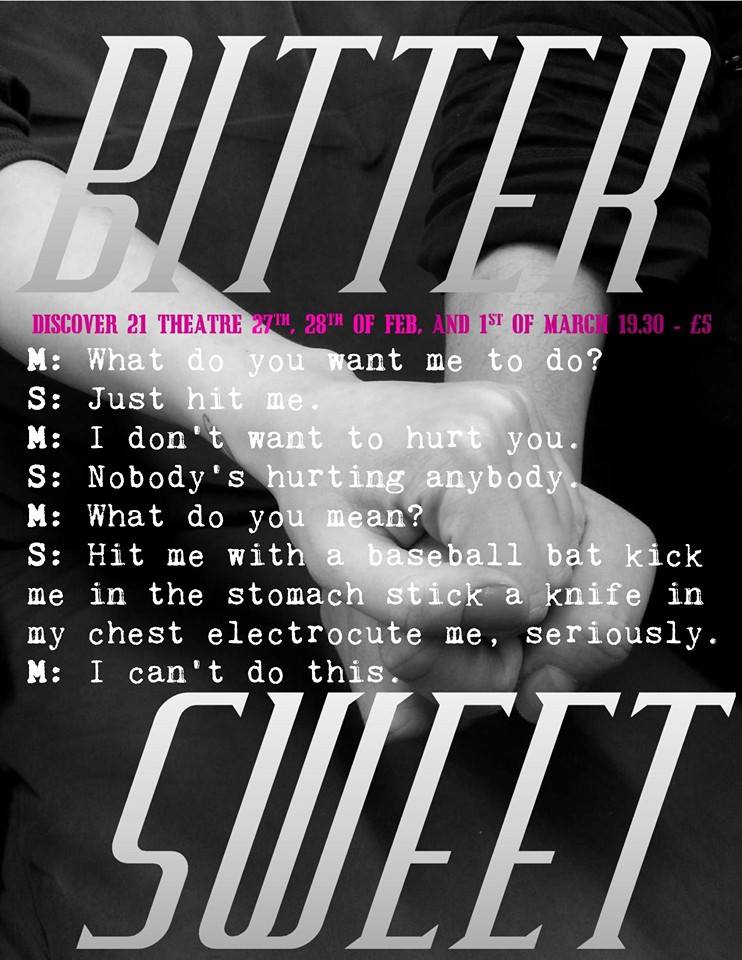
That’s the first word that springs to mind when looking back on the journey followed in Bitter Sweet. Writer and Director Kolbrun Bjort Sigfusdottir created a show that saw reality and fantasy twisted and contorted into a near horror story.

The venue, Discover 21 Theatre, was a perfectly intimate venue that provided closeness to the action that was necessary for this performance to deliver its full impact.

The set was simple, yet detailed. The hints of Steig Larsson’s influence on the script were mirrored in the set – his books featured on the shelves of the bookcase and were reflected in S’s character traits. A small fold-out sofa that sat stage-right was used in a variety of ways that kept the action from becoming too similar and repetitive.

Technically, this play was slick. The music was well-fitted to the rising tensions and served to heighten emotions – both loving and dark. The tone of the scene changed with the lighting cues which was a clever technique to keep the course of the play as disjointed as the relationship.

Both Kate Foley-Scott and Ben Blow tackled this difficult script with a tenacity that is commendable.

Depression and its effects on love feature heavily in this show. Foley-Scott was completely convincing in her portrayal of a manic depressive. Her pleads to be hurt were difficult to watch but impossible to look away from. Her character, known only as S, was desperate to feel anything, while inflicting nothing but pain on her partner. Despite her small stature, Foley-Scott offered a huge performance that was warmly received by the audience.

Ben Blow approached this play masterfully. His constant switching between the softly spoken, sensitive boyfriend and the angry, resentful, jilted lover was fascinating to watch. Blow owned the stage in both roles and that made for confident performance, even the most controversial scenes between the couple were grimly tenable.

The sensitive subject matter of sexual violence left the audience reeling; perhaps it really was too vivid and coarse. A less abrasive way to introduce the idea could have been to perform the scene in a black-out so only the voices could be heard. In all honesty, one scene was too graphic and uncomfortable to the point where it was unwatchable.

It would be wrong to say that this show was enjoyable – what with its dark content – but it certainly grips you. It was a shame that the audience were so few in number, but their appreciation for the performance was genuine and well-deserved.


nae bad_blue

Star (blue)Star (blue)Star (blue)

Reviewer: Amy King  (Seen 27 February)

Visit Discover 21 theatre here .

THIS REVIEW HAS NOT BEEN SUBEDITED

‘Journey’s End’ (Bedlam: 3 – 7 February ’15)

“That was a damn plucky sparrow. Did you hear it chirping away, all through the final artillery bombardment?”

Editorial Rating: 3 Stars: Nae Bad

Recent findings, reported in The Journal of Rhetorical Geology, suggest that the best seams of theatrical pathos (the awakening of emotion) are to be found in the scarred and sacred landscape of the Great War. There pathos in its purest form can be located, under layer upon layer of cultural sediment laid down by successive generations struggling to comprehend the bloodshed.

Extracting pathos is relatively simple. Pop down to Armstrongs, buy a few green jackets, then sit around on stage acting out various combinations of maudlin, keen, world-weary and surprisingly chipper. Refining said pathos, into something worthy of the sacrifice of the young men who actually lived and suffered through the realities of trench warfare is, however a much taller order.

We enter to find one of the best sets ever seen at Bedlam. The officers’ dugout is constructed of little more than canvas and suggestion. Somehow it’s both claustrophobic and snugly, a shelter against Gerry’s wizzbangs, a petri dish for festering resentments. Here a mixed cast will achieve mixed results unraveling the social nuance and dark humour of R. C. Sherriff’s classic script.

Based on the writer’s own experience as a Captain on the Western Front, Journey’s End has been revised time and again. It first opened in 1928, starring Laurence Olivier as Stanhope, the company commander stretched passed the limits of mental and physical endurance. It’s the story of men living among the wreckage of their youth, uncertain of their future, certain that nothing can be as it was before.

EUTC’s Ben Schofield steps confidently into the breech focusing his fire on Stanhope’s relationship with the recently posted 2nd Lieutenant Raleigh, a greenhorn from his pre-war past. Tom Trower captures Raleigh’s hero worship of Stanhope without neglecting his own dramatic narrative. A fine bromance disintegrates before our eyes. It’s the one theme signed, sealed, and delivered enough to satisfy even the most finickity marker of an English Lit paper.

Ross Baillie as Osbourne, Stanhope’s second in command, brings Jovian gravity to the picture. His coupling of calm self-possession to undertones of physical menace are reminiscent of those Scottish Green Party political broadcasts featuring The Hound from Game of Thrones. Alex Andrassy provides equally strong character work, catching the comic value of Private Mason, the Baldrickian mess cook, with a bittersweet distillation of timing and physicality.

Jari Fowkes, as Lt. Trotter, bowls the social googly. Trotter isn’t one of the chaps, he’s come up through the ranks. Despite baiting the hook with almost every non-RP middle-class accent variation from the Thames estuary to West Yorkshire, none of the other actors bite and a trick is missed. Ciara Chapman, as the unaccountably poshest Sergeant-Major in British military history, underscores a glaring oversight – yes, the play is set in France, but it’s about a changing Britain.

There are moments when this production is utterly captivating, the acting sharp, the discipline, focus and effort obvious. Equally there are times – such as when a sparrow continues to sing through the final bombardment (rather than poignantly waiting for peace to break out like how John Lloyd had it) – that you find yourself wishing for something informed by more than Blackadder Goes Forth. You start to wish that this had been a production referencing more broadly the artistic expression, across every medium, which the Western Front continues to inspire.

Then the ending reveal happens, the set transforms, and it’s magnificent.

nae bad_blue

Star (blue)Star (blue)Star (blue)

Reviewer: Dan Lentell (Seen 5 February)

Visit the Assembly Roxy Bedlam Church Hill Theatre Festival Theatre King’s Theatre Other Pleasance, Potterrow & Teviot Summerhall The Lyceum The Stand Traverse archive.

THIS REVIEW HAS NOT BEEN SUBEDITED

‘The Real Inspector Hound’ (Bedlam: 28-29 January ’15)

Real Inspector Hound

“…utterly absurd and completely entertaining”

Editorial Rating: 3 Stars: Nae Bad

A buzz of excitement rippled through the café during the wait for the doors to open. Inside the auditorium the audience is greeted with the strains of period music and a spotlight trained on a man in an armchair with a notebook to hand, who would later be introduced to us as Moon, played by Ben Horner.

As can be expected of any of Tom Stoppard’s work, The Read Inspector Hound is a wordy script with many a tricky speech to deliver, which at times proved a challenge  – but not one the actors were defeated by – and a journey for its audience that can be difficult to follow. Director Cameron Scott was brave to tackle this play but his addition of updated jokes including Real McCoys – the crisps – and a myriad of highly comical moments from his cast proved that he was more than capable of handling such a project.

This murder mystery play-within-a-play delved with ease into the absurdity of the human condition and the blurring of lines between what is real and what we desire to be real , drawing the audience in and gripping them from the very beginning with the fast pace and rapidly building hysteria.

The production team’s terrific set design included patio doors, a very large Persian rug and two tables, one holding the drinks, the other waiting for the drinkers. The elevated pair of armchairs, occupied by Moon and his most respectable reviewing counterpart Birdboot, brought to life by Finlay MacAfee, worked well to maintain the separation of reality and imagination – at first.

As a duo, MacAfee and Horner were most convincing; Moon’s nervous disposition and Birdboot’s self-righteous air coloured the play throughout and their back-and-forth monologues were highly entertaining.

Leyla Doany gave a great performance – her busybody Mrs Drudge’s facial expressions, dusty white hair and reactions to the goings on around her kept the stage alive with comic ridicule.

The suave Simon Gascoyne – a smooth delivery from Leopold Glover – and his scorned lovers had the audience in hysterics; both Lady Cynthia Muldoon and Felicity Cunningham proved they could hold their own against the stud. Liss Hansen and Heather Daniel’s respective characters certainly appeared to take some satisfaction in the slaps they delivered so soundly.

Capturing madness and mayhem in his enigmatic performance, Joseph Macaulay’s manic portrayal of Inspector Hound was impressive in its crazed delivery. The long-winded speeches and wrongful assumptions were delivered with a high energy and conviction of character. His deer-stalker, binoculars and wellington boots were comic props used to their fullest potential, much like their owner.

To add to the further absurdity, the casting of Megan Burt as Albert, who was masquerading as the crippled brother Magnus, brought comic timing and a most-amusing manoeuvring of Magnus’s wheelchair. Her adorned beard was a favourite in the costume department. The big reveal at the close of the play – that Albert is also the real ………….. – stays true to the whodunit nature of this bizarre adventure.

A special mention must also be given to Liam Rees who arguably had the most difficult part to play of all – the corpse. How he was able to lie still and play dead surrounded by the onslaught of commotion, without so much as a twitch and a chuckle, is beyond me.

Technically, this production was slick. Jack Simpson’s work on lighting and sound effects did enhance the action with the constant ringing of the telephone (with the cut cable!) and dramatic spotlights at every opportune moment.

As the story unravelled and reviewers Moon and Birdboot are sucked into the madness of the play, the action and pace built and built to a dizzying climax, ending in death and further confusion. Stoppard always keeps you guessing.

The production team – Cameron Scott, producer Tabitha James, stage manager Jonathan Barnett and tech manager Jack Simpson, evidently put a lot of energy into creating this show and their hard work most certainly paid off. All in all, as a reviewer reviewing a play of reviewers reviewing a play, I must admit this show was utterly absurd and completely entertaining.

nae bad_blue

Star (blue)Star (blue)Star (blue)

Reviewer: Amy King  (Seen 28 January)

Visit the Bedlam archive.

THIS REVIEW HAS NOT BEEN SUBEDITED

♫ Kat Healy (Voodoo Rooms: 17 December ’14)

“I only seem to write songs about boys and the weather”

Editorial Rating: 3 Stars: Nae Bad

Kat Healy is an Edinburgh singer­-songwriter, based in Leith, with an acoustic, folk-influenced style. She kicked off her set with Weatherman (“I only seem to write songs about boys and the weather”), accompanying herself on guitar in a finger­picking style. There are quotations on Kat’s website comparing her to Joni Mitchell… yes… well… maybe. Certainly Kat’s voice is beautiful, expressive with a huge amount of control, able to sustain the final note in each phrase with excellent tone and apparent ease – all the more remarkable given that she is currently suffering with a heavy cold.

The patter between numbers is entertaining, chatty. Graham joins the stage on guitar for Frozen Smile, his playing style is understated, staccato notes with lots of muting, an excellent accompanist. The keys emphasise the scrunchy dissonance of the 9th and 11th chords. Kat did not play guitar for this and that allowed for fuller vocals and expression. Unfortunately the next song was spoiled by an annoying PA hum from the electric guitar that Graham had swapped to. Paul Gilbody, who had done his own very entertaining guitar and vocal slot in support earlier, joined on double bass and, for me, this didn’t add too much to the performance; mainly pizzicato root notes with octave leaps, notes that were already being played on keys.

Paul’s bass part for the next song, No Heros, did add a lot to the music, with a well­ crafted line with a nice hook which leaped effectively to a high register, overlapping with the guitar part. This was a great song, where Kat performed with a real emotional depth – though the bass notes on the keys in the chorus were a little ham­fisted.

Heart strings were tugged with a song about Kat’s late mother. However, this beautiful song was marred as the buzzing electric guitar returned and, with no other instruments playing to mask it, the fault was quite stark. Kim Edgar and Emily Kelly, who had both done support earlier, joined in for the final piece, I’ll Fly Away, from the American songbook. This was a fun, upbeat, three­ part close­harmony version. There were a few balance issues with Kim being quite a bit quieter than the other two, but they clearly enjoyed singing this song.  And that, along with a great little guitar solo from Graham, was a fitting end to the night.

As a gig it was good value at £9, especially with the three support acts. I found Kat’s professionalism of performing whilst feeling under the weather to be great, BUT starting the gig over half an hour late was not! I came to hear Kat’s amazing voice and I got that, but I do feel that she is at her best when she is not playing guitar herself. As a set then one or two more up­beat numbers would not have gone amiss, but that emotion, always on the edge of melancholy does have its place and maybe, quite possibly, the world needs a female equivalent of Ben Howard or Benjamin Francis ­Leftwich.

nae bad_blue

Star (blue)Star (blue)Star (blue)

Reviewer: David Jones (Seen 17 December)

Visit Kat Healy here

Visit our Assembly Roxy Bedlam Church Hill Theatre Festival Theatre King’s Theatre Other Pleasance, Potterrow & Teviot Summerhall The Lyceum The Stand Traverse archive.

THIS REVIEW HAS NOT BEEN SUBEDITED

‘The Devil Masters’ (Traverse: 10 – 24 December’14)

Photo: Mihaela Bodlovic

Photo: Mihaela Bodlovic

“Chains, mordant humour and lashings of sharp comment”

Editorial Rating: 3 Stars Nae Bad

Admire the set. Designed by Anthony Lamble and lit by Colin Grenfell. Very tasteful, very Royal Circus; to begin with, at least, and then it looks unhinged.

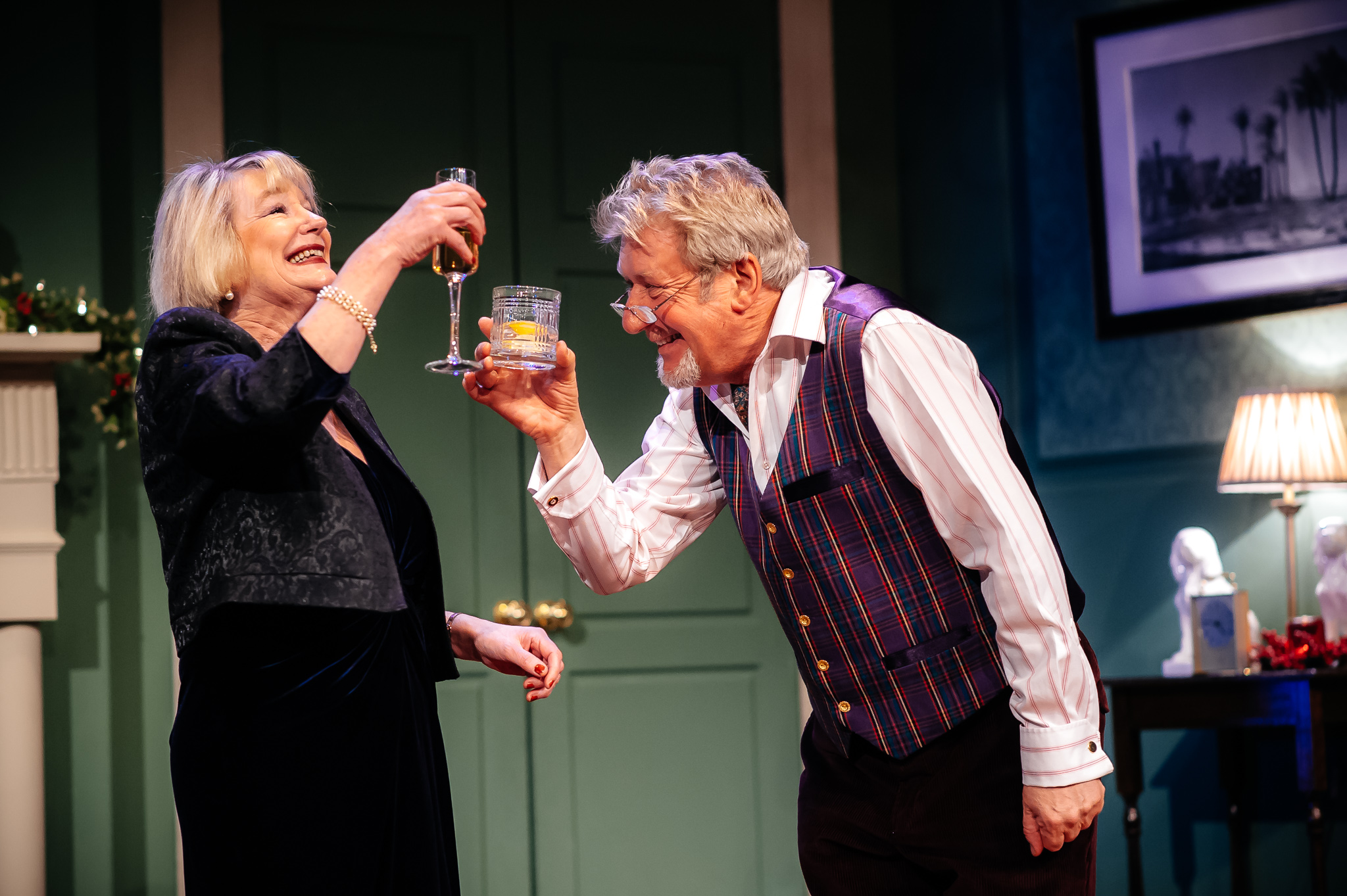
It is Christmas Eve and Cameron and Lara Leishman are ‘At Home’ for drinkies, the remains of a chinese carry-out and lots of presents, just the two of them and their Skye terrier, Maximilian, and that’s how they like it. That these two advocates are self-satisfied is to put it mildly, but then their swish garden flat is in the New Town and no doubt they have worked so very hard to afford it. You might have called round earlier, expressing mild surprise that Cameron isn’t a QC yet and thought it all a touch chichi, maybe, but it is still absolutely fabulous … “and do have a lovely time this evening, just the two of you”.

Except that they don’t, not at all.

‘Season’s Greetings’ are a joke when it comes to what happens to the Leishman’s. For a start, Max’ gets dognapped and second there’s that pun in their name. Iain Finlay Macleod gives us pedigree ‘Christmas Carol’, the writer’s mega cut. No redemption is offered but this story has chains, mordant humour and lashings of sharp comment .

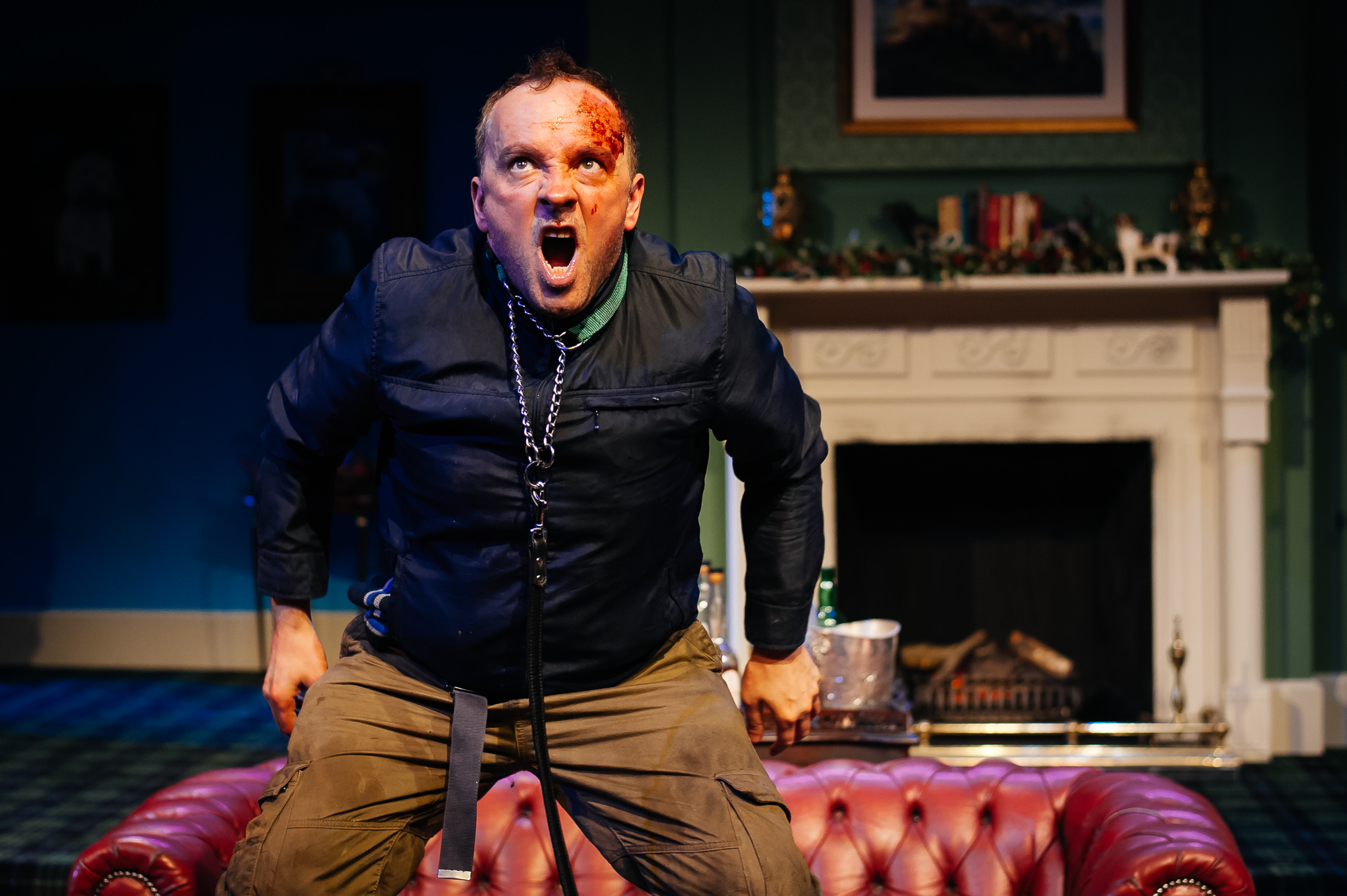
The first gift is unwrapped and admired and Cameron and Lara receive an unexpected and unwelcome visitor. John watches ‘The Wire’, so he says he’s from ‘the projects’. For Lara he’s a schemie, feral, the low life of the Sheriff’s Courts. He needs house training. Cameron, well bred, is a little more accommodating. He realises that for John to have had to leave Fettes junior school after only a couple of years was not one of life’s lucky breaks (!). John (Keith Fleming) has nerve, wit and honesty but gets it in the neck. He’s walking wounded in a nasty class war that Lara (Barbara Rafferty) prosecutes with all her vicious might. Cameron (Johnny Bett) would intercede but plays junior counsel to his partner’s vengeful brief. Director Orla O’Loughlin brings on action that is outrageous, radge and lurid.

Photo: Mihaela Bodlovic

Photo: Mihaela Bodlovic

It is close to home. Some will wince in recognition at lookalike ANTA interiors. There’s Albinoni on the invisible Sonos wireless system. Cameron knocks plebian Glasgow. Edinburgh lawyers acquire frightfully mannered English accents. There’s the EH3 postcode, Georgian cornicing, John’s pals from Pilton with their howling dogs, fireworks at New Year, and a legal profession prejudicially bent on fee income. But there’s more to it. David Hume’s statue is arraigned, or more accurately his toe is. What would the great philosopher make of the Leishman’s behaviour? For sure, they only actually do anything – as opposed to decorating their tree with photographs of past pooches – when they’re frightened or threatened. At best this is difficult to live with; at worst, it’s deranged.

I’ll stay with Christmas rather than moral philosophy. Go to ‘The Devil Masters’ with this text in mind: ‘He came unto his own, and his own received him not. (John 1:11) ’. Dispute ownership.


nae bad_blue

Star (blue)Star (blue)Star (blue)

Reviewer: Alan Brown  (Seen 10 December)

Visit ‘The Devil Masters’ at the Traverse here.

Visit our Assembly Roxy Bedlam Church Hill Theatre Festival Theatre King’s Theatre Other Pleasance, Potterrow & Teviot Summerhall The Lyceum The Stand Traverse archive.

THIS REVIEW HAS NOT BEEN SUBEDITED

‘Home for Christmas’ (The Studio: 3 December 2014)

  carol-ann-duffy

little machine

“some shakin’ metaphysics to die for”

Editorial Rating:  3 Stars

As Homecoming Scotland 2014 approaches its close we enter The Home Straits, a programme of poetry and music on the theme of … home. This show, first of three, finished with the sweet tones and bitter air of Byron’s We’ll Go No More A-Roving that deserved louder applause (& participation) than our few and faint hearts allowed.

Home for Christmas is Poet Laureate Carol Ann Duffy’s idea. She is up front for the first half, reading her poems, alongside musician and Edinburgh friend John Sampson, but after the interval she sits out and Little Machine, is on stage. The band sing their settings of six of Duffy’s Christmas poems and then eight further poems, from the 16th Century ballad Western Wind to Liz Lochhead’s fervid My Way. Mood and style vary from piece to piece, from loose and cool J.J Cale to a Rocksteady lilt for Advent and there’s some shakin’ metaphysics to die for in Thomas Carew’s Mediocritie. The music making is very good – I like distinct guitar work – and the high regard for the poetry is evident in the diction.

However, it is sombre and plaintive to start with. “It’ll be over soon; home by Christmas” was the fond, forsaken hope. John Sampson’s trumpet opens with the Last Post, and then there’s Duffy’s own poem Last Post, where ‘If poetry could truly tell it backwards, then it would …. And all those thousands dead … Are queuing up for home … Freshly alive.’ Christmas Truce follows, when ‘beneath the yawn of history’ a miraculous peace broke out. The subsequent pairing of Wilfred Owen’s The Send-off with her response, An Unseen, is dreadfully poignant.

Just as sharp is the keen, deadpan, humour of three monologues from the celebrated The World’s Wife: Mrs Midas, Mrs Tiresias, and (Duffy’s favourite) Faust; and then four later poems of percipient, careful intent: Mrs Schofield’s GCSE, The Counties, The Human Bee, and Liverpool. They are all in the public domain – and not just on The Guardian’s pages – so go find them, realise their quality and why Duffy wrote them.

Little Machine had been on Radio Scotland’s ‘Culture Studio’ with Janice Forsyth that same afternoon. The trio anticipated an evening of banter and wit. Well, not really. I enjoyed their music, admired John Sampson’s playing the two halves of the recorder at the same time (do not try this at home, he cautioned) and heard really good poems, tellingly read by the poet herself, but it proved a subdued occasion, with little ‘give’ from our side of the stage. That’s what happens when the Last Post sounds. It all goes still and not in a stille nacht, glad tidings, kind of way.

Star (blue)Star (blue)Star (blue)

Reviewer: Alan Brown (Seen 3 December)

Visit ‘Little Machine’ here

Visit our Assembly Roxy Bedlam Church Hill Theatre Festival Theatre King’s Theatre Other Pleasance, Potterrow & Teviot Summerhall The Lyceum The Stand Traverse archive.

THIS REVIEW HAS NOT BEEN SUBEDITED