“People admire superheroes, the larger-than-life figures who fight for justice. They also enjoy hearing about eccentrics, and Holmes certainly is an eccentric.”
Like insects trapped in amber, preserved in situ for all time, the cast of characters who populate the environs of 221B Baker Street offer a glimpse into a vanished milieu. Sir Arthur Conan Doyle wrote what he saw. The canonical Sherlock Holmes stories are filled to bursting with charmers and charlatans, machiavellians and muddleheads inspired by, or taken directly from, the Victorian and Edwardian eras. In March 2016 MX Publishing will be setting 800 Sherlockian period portraits in a single gallery, a biographical dictionary to accompany fans as they journey in company with Holmes and Watson.
Canadian author Christopher Redmond is a Sherlock Holmes expert of exceptional standing. His Welcome to America, Mr. Sherlock Holmes (1987) chronicled Conan Doyle’s 1894 tour of America, while his In Bed With Sherlock Holmes (1984) examines the sexual elements in stories of the great detective. Arguably Christopher’s most important contribution thus far is his A Sherlock Holmes Handbook (1993) which went into a second edition in 2009.
The editor, past and present, of leading scholarly journals focused on all things Holmes, Christopher is also a founder and guiding genius behind Sherlockian.Net – the web portal about Conan Doyle’s most famous creation.
Lives Beyond Baker Street: A Biographical Dictionary of Sherlock Holmes’s Contemporaries (published by MX Publishing, March 2016).To find out more click here.
Why the lives of Sherlock Holmes’s contemporaries?
Most people who are interested in the original Sherlock Holmes are interested in the world in which he moved, and the people around him. Most of the characters in the Holmes stories may be fictitious, but they are convincing portrayals of how people lived and behaved in that era. Standing just behind them (and, surprisingly often, making brief appearances in the stories) are the real people of the 1880s and 1890s. I wanted to introduce them to readers, in more depth than the footnotes in an annotated edition can do.
Each biography is a paragraph long. How on Earth do you go about scaling down the great and the good to fit that frame?
Of course it means leaving out lots of details and many accomplishments, but it’s always possible to summarize who an individual was and what he or she did. I was constantly asking myself: what would an encyclopaedia say about Willam J. Burns? How would I tell my grandchild the story of Nelly Bly? What’s the elevator pitch for Sir Thomas Lipton?
Lives Beyond Baker Street is going to contain the lives of names who remain household even today, but who’s the who in there who’s been most unfairly overlooked?
That would be Bertha (Ringer) Benz, the wife of automotive engineer Karl Benz, who drove his prototype car 120 miles cross-country in 1886 to demonstrate that it worked, and invented brake linings during her trip. Without her efforts at marketing and technical improvement, the “100-horse-power Benz car” mentioned in one of the Sherlock Holmes stories would never have existed.
What kind of sources have you been using?
My introduction to the book lists a number of Sherlockian sources that have helped me identify people I should include. General information about them came from reference books and, primarily, online reference sources. I have to acknowledge constant use of Wikipedia, which contains a mountain of information about both well-known and obscure historical figures; the hard part is knowing which details to pull out and how to combine them into a narrative that’s interesting and doesn’t waste words.
Why only 800 biographical sketches? Or why so many?
I set that as the target early in the project, when I thought that each biography could be limited to 100 words. Eight hundred paragraphs each 100 words long would make 80,000 words, which I thought was a reasonable size for a substantial book. Unfortunately I rarely was able to stick to the 100-word target. I did manage to write exactly 800 biographies, if my count is correct, although one reviewer has already said that he thinks there are 806.
Why does Sherlock Holmes continue to fascinate, especially North Americans?
People admire superheroes, the larger-than-life figures who fight for justice. They also enjoy hearing about eccentrics, and Holmes certainly is an eccentric. Discriminating readers admire his dedication to sheer logic, pure reason, at the expense of emotion and human frailty. And, to justify my book a little further, the Victorian age in which his life is set has a great appeal because we see it as stable and reasonable, a time when inventors and reformers were making life a little better every year.
How did your own love and fascination for Holmes begin? Does it extend to Conan Doyle’s other work?
I read Sherlock Holmes as a young teenager — most people did in those days — and never really grew out of my enthusiasm. I have read most of Arthur Conan Doyle’s other books but don’t often return to them.
Conan Doyle wrote the original Sherlock Holmes stories, inspiring others to take up his characters and carry on writing where he left off. Sir Arthur was the first Holmes writer, but is he still the definitive and best?
Yes indeed. Of course he is the definitive author because he is the one who created the character and his immediate setting, his Watson and Mrs. Hudson, his Baker Street sitting-room and magnifying glass and all the rest. Any subsequent Sherlock Holmes is based on the original, either trying to match it or deliberately varying from it. And ACD is the best author of Sherlock Holmes because of his brilliantly clear, simple, straightforward and yet imaginative style, which has not been equalled and is infuriatingly hard to imitate.
If you were having a dinner party, and could only invite two of the figures profiled, who would you invite?
I can eliminate many of the 800 immediately: no murderers at dinner, please, no politicians, and I think no soldiers if their talk would all be of blood and battles. I would love to dine with Caroline Otero, but perhaps that meal should be tête-à-tête rather than with a party! So perhaps I’ll choose Anthony Hope Hawkins, who wrote some of the Victorian era’s other popular adventure fiction including The Prisoner of Zenda, and music-hall star Bessie Bellwood, who was known for her uninhibited repartee. That should keep the conversation lively.
What should be playing on the stereo when we’re reading Lives Beyond Baker Street: A Biographical Dictionary of Sherlock Holmes’s Contemporaries?
I don’t have a close relationship with music, and I don’t play anything when I’m reading or writing, but perhaps it would be pleasant to hear something by one of the composers or performers mentioned in the book. I wonder if there are any recordings of Sir Charles Hallé’s orchestra, which Sherlock Holmes himself supposedly heard in concert.
LIKE WHAT YOU JUST READ? FOLLOW US ON TWITTER! FIND US ON FACEBOOK! OR SIGN UP TO OUR MAILING LIST!
“Dr. Bell kept the name of his confederate anonymous, but I have deduced that he was Arthur Conan Doyle. Who better to work with on the Ripper case than the world-famous mystery author?”
Could Sir Arthur Conan Doyle have deduced the identity of Jack the Ripper? That’s the premise of novelist Diane Gilbert Madsen’s third book featuring ace investigator Daphne December McGil.
Author Diane was born in Chicago and has an M.A in English literature (specializing in the 17th century) from Roosevelt University. Cited in both the World Who’s Who of Women and the Who’s Who in Finance and Industry, Diane worked a range of government jobs from Deputy Village Clerk, to Director of Economic Development for the State of Illinois. She oversaw the Illinois Film Office during the filming of Blues Brothers.
Diane became a writer after moving to Florida with her husband, Tom. Her acclaimed DD McGil Literati Series of murder mystery novels also includes Hunting for Hemingway & A Cadger’s Curse.
The Conan Doyle Notes: The Secret of Jack the Ripper (published by MX Publishing, August 2014).To find out more click here.
Why Conan Doyle and Jack the Ripper?
First of all, thanks so much Dan for interviewing me about The Conan Doyle Notes. I must tell you that I love your questions. I’ve always been a fan of Doyle, and I’ve always been interested in the Ripper murders. These two passions fortuitously came together resulting in my third book.
It all began because I was fortunate to know Ely Liebow when I lived in Chicago, and we talked about his book, Dr. Joe Bell, model for Sherlock Holmes, which mentions that Joe Bell was given access to the Ripper files and that he solved the case with “another friend who liked solving deep problems.” Bell himself wrote in an article in Tit-Bits in October of 1911 that “there were two of us in the hunt, and when two men set out to find a golf ball in the rough, they expect to come across it where the straight line marked in their mind’s eye to it, from their original positions, crossed.
In the same way, when two men set out to investigate a crime mystery, it is where their researches intersect that we have a result.” Dr. Bell kept the name of his confederate anonymous, but I have deduced that he was Arthur Conan Doyle. Who better to work with on the Ripper case than the world-famous mystery author? Doyle and Bell were friends and colleagues, and it stimulated my imagination. Dr. Bell and his anonymous friend, according to Ely Liebow, deduced the murderer and each wrote a name on a piece of paper, put the paper in an envelope and then exchanged enveloped.
Both men had the same name, and Dr. Bell sent a report to Scotland Yard. A week later, the Ripper murders ceased, but no report has ever been found. This incident forms the basis of the plot in The Conan Doyle Notes, and I have endeavored to include only factual information about the Ripper case. Although I name the suspect whom I believe was deduced by Doyle and Dr. Bell, I include the clues I used to arrive at my conclusion. I had lots of challenges writing this book, but I loved doing it and hope my readers enjoy it as much as I do.
The Conan Doyle Notes: The Secret of Jack the Ripper is inspired by Sir Arthur’s historical trip to Chicago. When and why did that happen?
Conan Doyle arrived in Chicago on October 12, 1894 when he was 35 yrs old, in the prime of his life and famous world-wide for his Sherlock Holmes stories. He was booked in 15 northeast cities for a series of 67 “set” lectures including Readings & Reminiscences and Facts and Fiction. He wanted to see the states – his favorite childhood books were American wild west adventure stories, especially those of Bret Harte.
The US population at this time was double that of Great Britain and a big market for selling his stories. He stayed at the Grand Pacific Hotel, a 6 story luxury hotel where Oscar Wilde had stayed in 1882 on his 1st tour. He was shown the Water Tower, the elevated and Marshall Field’s, and he took a lot of snapshots whenever he could with his Kodak camera. It is highly likely that he met the Chicago lumber baron, David Gage Joyce, on this trip. Joyce is another character I used in The Conan Doyle Notes because David Gage Joyce did in fact own the manuscript of Doyle’s The White Company, which is now at the Newberry Library.
Doyle arrived a year after he’d written The Final Problem, killing off Sherlock Holmes. In Britain, Doyle had been shocked when over 20,000 people cancelled their Strand Magazine subscriptions in protest. The magazine nearly went under, and the staff referred to Holmes’s death as “the dreadful event.” Although the Chicago press greeted him warmly, they too all wanted to know WHY he’d killed off Sherlock Holmes. Doyle was dismayed. He didn’t want to talk about his detective, and he revealed his true feelings when he said: “I have been much blamed for doing Holmes to death, but I hold that it was not murder, but justifiable homicide in self-defense, since, if I had not killed him, he would certainly have killed me.”
Interestingly, Doyle was asked about the Ripper murders on his tour of America in 1894. He must have given some thought to the Ripper case, as he outlined to an American journalist just how Sherlock Holmes would have set about tracing the culprit:
“I am not in the least degree either a sharp or an observant man myself. I try to get inside the skin of a sharp man and see how things strike him. I remember going to Scotland Yard Museum and looking at the letter which was received from the Ripper. Of course it may have been a hoax, but there were reasons to think it genuine, and in any case, it was well to find out who wrote it.
“It was written in red ink in a clerky hand. I tried to think of how Holmes might have deduced the writer of that letter. The most obvious point was that it had been written by someone who had been in America. It began ‘Dear Boss’ and contained the phrase ‘fix it up’ and several others which are not usual with Britishers. Then we have the quality of the paper, and a round, easy, clerky hand. He was, therefore, a man accustomed to the use of a pen.
“Having determined that much, we cannot avoid the inference that there must be somewhere letters that this man has written over his own name, or documents or accounts that could readily be traced to him. Oddly enough, the police did not, as far as I know, think of that, and so they failed to accomplish anything. Holmes’ plan would have been to reproduce the letters in facsimile and on each plate indicate briefly the peculiarities of the handwriting. Then publish these facsimiles in the leading newspapers of Great Britain and America and in connection with them offer a reward to anyone who could show them a letter or any other specimen of the same handwriting. Such a course would have enlisted millions of people as detectives on the case.”
What do we know for certain about Conan Doyle’s own reaction to the Ripper murders?
Here’s information I’ve collected on Doyle and the Ripper murders:
Doyle visited Scotland Yard’s Black Museum on December 2, 1892, four years after the Ripper murders. He was shown one of the Ripper letters. He said that the murderer might have dressed as a woman.
On April 19, 1905, nearly 7 years after the murders, a number of police gave Doyle a guided tour of all the Ripper murder sites in Whitechapel. Doyle said the police knew who the Ripper was.
Nigel Morland, who died in 1986, possessed an enormous library of books on criminology and his wide circle of friends shared his considerable knowledge of the subject, especially the mystery of Jack the Ripper. Morland said Edgar Wallace had told him he knew the Royal identity of Jack the Ripper and Sir Arthur Conan Doyle told him the same thing.
Doyle and Dr. Joseph Bell, one of the world’s first forensic pathologists, were friends and colleagues. Few people know that Bell was part of the police net that was thrown around the Ripper, in spite of the fact that Dr. Bell lived hundreds of miles from the Ripper murders in London. Dr. Bell was set up in Edinburgh while the Ripper murders took place in London. However, the London force was under so much pressure, they were ready to try just about anything. Dr. Bell was given all the facts of the case by the Metropolitan Force. Based on this, he wrote a report which named the suspect he believed was the Ripper. However, Dr. Bell’s report disappeared and has never been found.
Doyle’s son, Adrian Doyle, told Tom Cullen in 1962 what he remembered of his father’s views on the Ripper case: “More than 30 years having passed, it is difficult to recall his views in detail on the Ripper Case. However, I do remember that he considered it likely that the man had a rough knowledge of surgery and probably clothed himself as a woman to approach his victims without arousing suspicion on their part.” (From: Conan Doyle, Detective, By Peter Costello)
The setting for the novel is the Kenwood / Hyde Park districts on the Southside of Chicago, home to the Obama family. Dust of your Director of Economic Development hat for a second, tell us about the area and its advantages as a literary setting.
I love Chicago. It’s where I grew up, and I try to use it as a “character” in the DD McGil Literati Mystery Series. I recently wrote an article entitled “Chicago Rules,” in which I explain my fascination.
Chicago – my city of birth Chicago – my city of choice. My curse and my muse That’s why I refuse To write about anywhere else.
There is a distinct feel about the place and its people. We Chicagoans tend to be down to earth and hard working and perhaps a little sentimental. We love our heroes and hate our villains. We support our city, our teams, our schools and our friends; and above all we display an enduring hope for the future. These characteristics come from our connective, collective experiences living in the city.
First of all, we must contend with our name which, taken from the Ojibwa Indians, means ‘skunk.’ Then too, we used to be known as the Second City before LA went on steroids. We knew we were number two, not number one, and we were never allowed to forget it. That mind set fostered a certain perverse twist to our egos and our ids. Then there’s our weather. Let’s face it, when it’s nice, it’s really nice, but when it’s not, it’s horrible. And it’s horrible usually 6 months out of the year. That’s why we don’t act like carefree Californians. No – we need our coats, our scarves and our gloves. We don’t go naked into that good sunlight in January, and it marks us for life.
On top of that, as fans of the Chicago Cubs, we are doomed to never win a pennant. In setting my books, I’ve used many well known Chicago landmarks such as Soldier Field, Wrigley Field, and Graue Mill, the oldest working mill in the area and where I served as a Board Member. I’ve also used all four of Chicago’s seasons to give readers a feel of the hardiness it takes to be a Chicagoan. And, as with every writer, my characters are connected to my own life and experiences in the city.
My main character, DD McGil, lives in Wrigleyville, as I did, and she’s a Cubs fan, as am I. Her university connections come from my own associations with the University of Chicago which I attended as an undergraduate. Like Chicago, DD is stubborn, sassy, determined, and loyal to her friends. Another character in the series, Tom Joyce, is a real Chicagoan who owns and operates the famous Joyce and Company Rare Books on Racine Street. He’s been great fun to include and has also been invaluable as a resource on texts and book prices and rare manuscripts and ephemera.
When did you and DD McGil first “meet”?
When I sat down to write a mystery story, I knew I wanted it to be a “Literati” mystery, and I knew I wanted to write first person. So I decided to use a female investigator. Many people have asked if I am DD McGil, but as Hemingway pointed out, a writer’s characters are a combination of many people and many observations. There is a core of DD that’s very like me, but I’ve tried to make her fit the mold of an academic turned insurance investigator who’s had some difficult times in life. And she, like the other characters in my Literati Mystery Series, always surprises me with dialogue and actions that I haven’t planned out. That’s the fun of writing.
What are the qualities that make McGill an engaging personality?
DD is a fun character to write. She’s always surprising me. She lives in Chicago and is very quick on her feet. She’s loyal and has a soft spot for her friends and her neighbors, but she has a lot of quirks, too. She’s lippy and sassy and superstitious, but not nearly as much as her Scottish Auntie Elizabeth. She loves puzzles, like any good detective, and as an insurance investigator, she’s always throwing around statistics.
She’s fond of her cat, Cavalier, and she definitely likes men – a lot. She also has a sense of humor and is able to laugh at herself when she gets into a scrape, which she regularly does. Here’s what Kirkus Reviews said: “Crime follows DD McGil almost as closely as eligible bachelors do. DD’s dry wit and internal monologue go far… Another fast read with quirky characters and due reverence for the Second City.”
Do you ever look back and wish you’d given her a sidekick?
In my first DD McGil Literati Mystery, A Cadger’s Curse, my agent loved the bookseller character, Tom Joyce, and she urged me to write more about him in the stories. He turned out to become DD’s sidekick. Tom is a real person, a Chicago icon who runs Joyce and Co. Rare Books and Appraisals. Whenever we’re at a book signing, he signs as many books as I do. As a writer, especially since I write in the first person, using the device of a sidekick allows me to add a great deal to the story through the eyes and actions of someone other than DD herself.
If you were on a gameshow and your grand prize could either be a secret trove of Conan Doyle papers or a lost manuscript of Robert Burns (the premise of A Cadger’s Curse) which would you pick (assuming you didn’t go for the holiday of a lifetime)?
Could any true Sherlockian turn down the grandest gameshow prize of all time – a secret trove of Conan Doyle papers? Some have (literally) died for this – I reference the strange death of Lancelyn Green, who was obsessed with Doyle and Sherlock Holmes. By the way, Lancelyn Green was the model for the character of Philip Green in The Conan Doyle Notes. Philip Green is a character in The Disappearance of Lady Frances Carfax. He is one of a number of character names from the Canon I’ve used in
Together you and McGil have investigated Hemingway (Hunting for Hemingway), Burns (A Cadger’s Curse), and Conan Doyle. Who’s next?
I am working on the next three in the DD McGil Literati Mystery series: The 4th book in the DD McGil series is The Cardboard Palace, featuring a true incident in the life of Bram Stoker. DD investigates the oldest women’s club in Chicago and finds that – The candle burns, And lights the way. For trouble past, Someone must pay.
The 5th is Dark As Shadows, featuring a true incident in the life of Robert Louis Stevenson. DD’s Auntie Elizabeth – known as the Scottish Dragon – asks DD to drop everything and “hie to Scotland for it’s dark as shadows here.”
The 6th is Restless Bones which features an incident in The Gold Bug by Edgar Allen Poe. DD’s idyllic vacation is interrupted when her lover Scotty is determined to go hunting after Captain Kidd’s buried treasure.
Right now I’m editing my first non-fiction book for MX Publishing entitled, Cracking The Code of the Canon: How Sherlock Holmes Made His Decisions. It takes a look at how Holmes views crimes, criminals and victims and what he considers justice in the Canon. It will be out shortly.
I’ve also written a play entitled, Sherlock Holmes and the Queen of Hearts. My agent has submitted it to several theaters in hopes of getting it produced soon.
What should be playing on the stereo when we’re reading The Conan Doyle Notes: The Secret of Jack the Ripper?
Read the book under a soft light so there are shadows and dark corners about you while you listen to the soundtrack from Link Wray’s 1959 instrumental Jack the Ripper which as I understand begins with an evil laugh and a woman’s scream.
LIKE WHAT YOU JUST READ? FOLLOW US ON TWITTER! FIND US ON FACEBOOK! OR SIGN UP TO OUR MAILING LIST!
“We have a wonderful group of people including the editor, authors and fans creating awareness.”
He’s one of the most iconic literary characters of all time. When, in the 1890s, his creator tried to kill him off the public outcry was such that Sir Arthur Conan Doyle was forced to resurrect him. Plausible in his own time and realistic in ours, Sherlock Holmes has been portrayed by some of the greatest actors of the stage and screen. The resonant canon of Conan Doyle’s original stories, featuring the world’s only consulting detective, remains a call to arms for other writers seeking to test their ingenious mettle in one of the best loved literary genres.
Steve Emecz’s passion is publishing. As Managing Director of MX, one of the UK’s leading independent publishers, Steve oversees hundreds of authors and titles. MX is now the world’s largest Sherlock Holmes publisher, including the international bestseller Benedict Cumberbatch In Transition which is also being launched in Japanese, Chinese and several other languages.
Steve’s latest project, being funded through Kickstarter, is Volume IV of the largest collection of new Sherlock Holmes stories ever attempted. Bringing together over sixty of the world’s leading Sherlock Holmes authors, this anthology includes only traditional stories set in the original Sherlock Holmes period.
Royalties are going towards the restoration of Conan Doyle’s home Undershaw, saved from destruction by the Undershaw Preservation Trust and now owned by Stepping Stones (a school for children with learning difficulties). Royalties will support specific projects such as the restoration of Sir Arthur’s study which will be open for visitors outside term time.
The MX Book of New Sherlock Holmes Stories Volume IV (published by MX Publishing, 22nd May 2016 – Conan Doyle’s Birthday). To find out more click here.
Why Sherlock Holmes?
Conan Doyle was the father of all modern crime fiction and Sherlock Holmes holds the Guinness World’s Record for the most portrayed character ever on screen.
Conan Doyle is the definitive Sherlock Holmes writer, but is he still the best?
Conan Doyle was the first, but I am a big fan of several modern crime fiction writers as well.
Why is the collection only featuring stories from the traditional Holmes period?
Holmes fans prefer traditional stories. There are thousands of pastiches out there and we wanted to bring together a very traditional collection.
What’s the biggest licence (with Conan Doyle’s original formula) taken by any of the new writers?
In our collection, very little. Across the world there are vampires, time travel. In fact, one of our writers, Tracy Revels has a brilliant series (Shadowfall etc) where Holmes is a warlock.
What’s the standard, the feature, or other aspect that all the writers involved with the project have had to achieve in order to gain inclusion?
They had to get past the editor, David Marcum’s keen eye on traditional Holmes and Watson. David is our most experienced writer with dozens of stories and novels under his belt.
John or James?
Watson. In the Victorian period nobody used first names so it was Watson and Holmes.
Undershaw was briefly a hotel after Conan Doyle stopped living there, but has been vacant for most of the time since. Similarly (prior to its being listed by Historic Scotland) Liberton Bank House in Edinburgh – where the young Conan Doyle lived in the 1860s – faced demolition to make way for a fast food restaurant. Why have we been so neglectful of the bricks and mortar footprints of this most celebrated writer?
Sadly it happens a lot in the UK. The US seems to be more respectful of the heritage of writers. It often comes down to, as it did in this case, loyal groups of fans [in this case the Undershaw Preservation Trust] to do what the authorities don’t.
How do Kickstarter, advance sales, and subscriptions feature in today’s publishing landscape?
Kickstarter is vital for us. For some projects it is the difference between being able to do the project or not. For others, it is a brilliant awareness tool.
The Kickstarter campaign set out to raise £500, the total is already at over £1400 (and rising). What’s the secret of a successful crowdfunding project?
This one is all about teamwork. We have a wonderful group of people including the editor, authors and fans creating awareness. It’s important to set good rewards and be very active on social media – but ultimately it comes down to the quality of what’s on offer. The collection is the best project we’ve ever delivered and we hope to keep it going as long as possible.
What should be playing on the stereo when we’re reading The MX Book of New Sherlock Holmes Stories Volume IV?
For me, nothing. I like to read out in the fresh air. If you like music while you read then I’d recommend something classical, pre 1900. Music for the era.
LIKE WHAT YOU JUST READ? FOLLOW US ON TWITTER! FIND US ON FACEBOOK! OR SIGN UP TO OUR MAILING LIST!
“Over time he has learned to exploit his environment and shape it more than it shapes him. Unfettered by modesty or empathy, he crashes about in the pursuit of ego gratification. This is what many of us who were born in the two decades after World War II seem to have done on a smaller scale.”
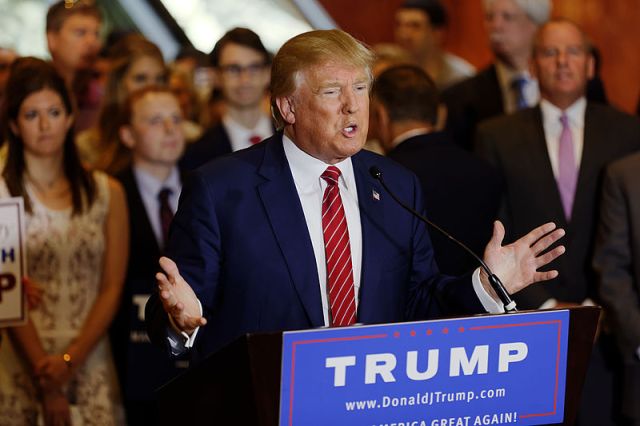
“Simpsons did it! Simpsons did it! SIMPSONS DID IT!” It’s taken over a decade but reality itself is now confronted with a problem once only a headache for the writers of other cartoon shows. When a Native American Casino Manager predicts Lisa Simpson will one day become President of the United States, the man she replaces is none other than Donald Trump. Trump’s self-funded real life run for the White House is proving no less entertaining, and there is a growing possibility that he might become the first registered New Yorker to win the Presidency since 1968.*
In his campaign book, Crippled America, Trump sums up the state of things by quoting Mark Twain, “Suppose you were an idiot. And suppose you were a member of Congress. But I repeat myself.” Nowhere (that I know of) does Trump repeat what the comic sage had to say on the subject of golf.
One day the campaign trail of 2016 will be done and dusted. When only historians are left to weigh its import against Adams v. Jefferson or Lincoln v. Vampires there will still be many in Scotland ready, and willing, to point to scars (physical as well as emotional) and say, “I telt ye so. That man didnae ken one end of a spurtle frae t’other.”
Pulitzer Prize winning writer Michael D’Antonio has published more than a dozen books on subjects ranging from the space race (A Ball, a Dog, and a Monkey) to the Vatican’s role in sheltering predator priests (Mortal Sins). His matter of fact style brings clarity to some of the messiest, most emotive issues of recent history. Born and raised in New Hampshire, Michael now lives on Long Island with his wife, the psychotherapist, professor, and author, Toni Raiten-D’Antonio.
Never Enough: Donald Trump and the Pursuit of Success (published by St. Martin’s Press, October 2015) To find out more click here. To find out more click here.
Why Donald Trump?
In retrospect the answer seems obvious. Back then, in 2013, I had just finished Mortal Sins and the subject came up at lunch with my publisher Thomas Dunne. I hadn’t ever taken-up a book on an editor’s suggestion and at first I thought there wasn’t much to say about Trump. But during subsequent conversations we settled on the idea of a biography that was more contextual than most. I generally disagree with the “great man” theory of history and see things working out more as a matter of forces beyond an individual’s control.
Is Mr. Trump more a product or more a shaper of the times in which we live?
Trump is both a shaper and a product of the culture of narcissism identified by Christopher Lasch. However over time he has learned to exploit his environment and shape it more than it shapes him. Unfettered by modesty or empathy, he crashes about in the pursuit of ego gratification. This is what many of us who were born in the two decades after World War II seem to have done on a smaller scale.
In this time self promotion (and indulgence) have become the norm and perhaps the worst fate of all is to be always in the audience and never on stage. The support Trump receives now in the political realm is an expression of this desire. people are living through him, enjoying the vicarious thrill of being center stage.
You chronicle the ways in which groups and individuals were “suckered” by promises made but not fully delivered by the Trump machine. Was former First Minister Jack McConnell one of them?
Plainly, yes. McConnell acted in the spirit of Sinclair Lewis’ character George Babbitt, who practiced boosterism as a religion. Both Babbitt and McConnell acted sincerely, believing that by chasing new business and, in McConnell’s case development, they were working for the common good.
Of course “good” is a complex and difficult thing to determine and like many politicians. McConnell made the mistake of believing he understood what he was getting as he courted Trump’s investment. Trump is a wily creature who never makes a commitment without an “out” in it.
Has Mr. Trump ever watched Local Hero? Did it make, or would it have made, any difference to his relationship with the holdout residents of Balmedie such as Michael Forbes?
I don’t think Trump ever watched the film. If he did, he’s not the sort to be influenced, on a moral level, by anything that challenges his belief system.
What does he believe? He believes in Donald Trump and, beyond that, not much at all. As far as I can tell he wasn’t aware of the life his ancestors lived, nor is he aware of the fact that as he tried to push Michael Forbes off of his land he was victimizing him in the way that his mother’s people were victimized historically.
In Local Hero the omnipotent Felix Happer (Burt Lancaster) is tormented by his overzealous therapist, Moritz (Norman Chancer). Moritz’s self-appointed role is to heap scorn and abuse on his overmighty client. Is that your role in the story of Donald Trump?
I wouldn’t say ‘heaping scorn.” I think my role is always to find and reveal the fullness of a story – in this case a man’s life story – in a way that is more complete and, I hope, compelling.
Trump is the least reliable narrator imaginable, so it falls to someone like me to make the attempt at telling the tale of his life. Yes he is overmighty, but in such cases scorn isn’t as illumination. With a little more light, for example, Scotland might have avoided some of its Trump troubles.
Each year The New York Landmarks Conservancy recognizes New Yorkers who have made outstanding contributions to the City and honors them as Living Landmarks. You wrote that not getting that award genuinely hurts Mr. Trump’s feelings. Will the revocation of his GlobalScot status and honorary degree have a similar impact?
I must say that I think he would be unmoved. His attachment to Scotland is commercial, and not so heartfelt, I think. New York is his true home and he would find much more validation in honors bestowed there. I also think that, like it or not, the degree and the Global Scot honor were conferred by those who wanted Trump’s favor in some way. As such, it’s less distinct an honor than the Living landmark designation.
If any one decision lost John McCain the presidency it was arguably his choice of running mate. Have you any predictions about who Mr. Trump will ask to join his ticket and why? How does someone who projects a sense that he is irreplaceable and cannot be improved or balanced, begin to tackle that question?
After seizing the hard Right ground, Trump is already moderating his campaign approach, drifting toward the middle. I expect him to become more and more like a regular candidate as time passes. If I had to guess about his VP choice I would say that he’ll look for someone who could reassure those who find him repugnant. Some of the men competing with him today seem to be angling for a spot on the ticket. Of them I think Chris Chistie might be the smartest choice. Trump knows him well and has insulted him the least.
Candidate Trump declared that all illegal immigrants would be required to leave the US, but that they could return legally. His rival Ted Cruz went one further and said he would never allow former undocumented migrants back. Mr. Trump is campaigning for the Republican nomination which in living memory has been sought by homophobes, misogynists, segregationists and holocaust deniers. How is it that he is singled out for travel restrictions, stripped of honorary degrees, etc? What does that say about how Mr. Trump is (and chooses to be) covered by the media?
The American media is completely flummoxed by Trump. In part this is because it has, itself, become part of the entertainment economy. Journalistic values have been smothered by commercial interest and most reporters are not accustomed to playing the role of watchdog or guardian. As the greater entertainer in every encounter, Trump dominates his relations with the press.
It’s important to keep in mind, however, that we’ve been measuring his success with a small fraction of the electorate. His support has never ranged higher than about 15 percent of the voting public. These backers are very firm in their choice, but opposition to Trump is just as firm, and the numbers on that side are much greater.
Will Donald Trump be an effective President?
By history’s measure, no. By his own lights? of course.
What should be playing on the stereo when we’re reading Never Enough: Donald Trump and the Pursuit of Success?
The list would have to include, perhaps in this order, Coming to America, by Neil Diamond, to honor his immigrant roots. No Son of Mine by Genesis, to highlight Trump’s exile to military school. Sinatra’s New York New York. (Unavoidably.) More, More, More by Andrea True and his favorite tune, Peggy Lee’s, Is That All There Is?
*Richard Nixon moved to New York following his defeat in the 1962 California gubernatorial election. During his first term as president, Nixon re-established his residency in California which was his home state in the 1972 (as it had been in the 1960) election.
LIKE WHAT YOU JUST READ? FOLLOW US ON TWITTER! FIND US ON FACEBOOK! OR SIGN UP TO OUR MAILING LIST!
In June 1840, when Victoria was pregnant but had no living children, the succession would have passed to Ernest, her widely-loathed eldest uncle. I can’t help but wonder, then, whether, hearing of the news of the failed attempt, Ernest thanked God – or cursed.
At about 4 p.m. on 10 June 1840, a young man took up a position on a footpath at Constitution Hill, near Buckingham Palace. He had with him a pair of poor quality pistols. Two hours later a young couple drew alongside seated in an open carriage. It was the moment Edward Oxford had been waiting for. He discharged his firearms but missed both the young (and pregnant) Queen Victoria as well as her Consort Prince Albert.
What could have proved a national calamity instead became a public relations coup, helping Victoria and Albert reshape the monarchy and its role.
Oxford became the first of a surprisingly long line of assailants who took pot shots at Britain’s second-longest reigning monarch. Each was an eclectic mix of poverty, grandiosity, and mental disorder. For the first time, author Paul Thomas Murphy has drawn together the threads of each case – criminal, medical, and political – into a single narrative. The result is an ever-shifting landscape portrait of Victoria and the age to which she gave her name.
Paul Thomas Murphy is the author of Shooting Victoria, a 2012 New York Times notable book. He holds advanced degrees in Victorian Studies from Oxford and McGill Universities and the University of Colorado, where he taught both English and writing on interdisciplinary topics. He currently resides in Boulder, Colorado.
I strongly believe that one of the most effective ways to gain insight into a culture is to focus upon its episodes of extreme cultural collision. And few episodes of cultural collision in Victoria’s reign were more extreme, in terms of social, political, legal, and gender conflict, than these eight attempts by the Queen’s seven assailants. More than this, these attempts occurred throughout Victoria’s reign—the first occurring when she was twenty-one, newly married and newly pregnant, and the last when she was sixty-one and a great-grandmother.
By focusing on all of the attempts, therefore, I am able present a portrait of the era from an entirely new perspective – a sweeping depiction portrayal both of the endlessly fascinating Victoria, Queen and Empress, and of some of the darker aspects of her age in the stories of the seven malcontents who bedeviled her.
Seven boys and men attempted attacks on Queen Victoria between 1840 and 1882. What, if anything, did they have in common?
Every single one of them was an outsider, removed from society for a variety of reasons: two identified themselves as Irish, one suffered a painful and discernible physical disability, and several clearly suffered from mental impairment. More than this, with one possible exception each of them had an aching desire to be somebody: a desire to force themselves upon the collective consciousness of Britain and of the world through one dramatic act that at least temporarily placed them on a level with Victoria, the ultimate insider of the time.
The one possible exception—the one who apparently had no desire to be somebody — was the fourth assailant, the Irishman William Hamilton, who in 1849 made his attempt in order to trade his free but impoverished life for the social security of a long stint in prison. He got exactly what he wanted.
The first assailant was Edward Oxford, who had a uniform, military rules of conduct and a manifesto for a revolutionary organisation called Young England – of which he was the only member. Did you ever find yourself wondering if there was more to Oxford’s assault, the autocratic hand of Victoria’s reactionary uncle Ernest Augustus I of Hanover for instance?
That is certainly what Edward Oxford wanted the world to think, and he succeeded—for a few days, at least. And even when it became abundantly clear to the police and to the government that Young England was entirely a figment of Oxford’s fertile imagination, some people—Irish nationalist and politician Daniel O’Connell, for instance—continued to believe that dark and reactionary forces were at work behind Oxford’s attempt. Clearly, Oxford was not a pawn in a right-wing conspiracy, vast or otherwise. But it is equally clear that in inventing his backstory he was influenced by extreme political currents of the time. And although Victoria’s uncle Ernest was certainly innocent of any direct involvement in Oxford’s crime, he certainly would have profited by it: had Oxford succeeded: in June 1840, when Victoria was pregnant but had no living children, the succession would have passed to Ernest, her widely-loathed eldest uncle. I can’t help but wonder, then, whether, hearing of the news of the failed attempt, Ernest thanked God – or cursed Oxford.
The key statesmen of Victoria’s reign appear through the course of the narrative, from Wellington via Peel to Gladstone and Disraeli. What light do the attempts throw on them and their policies?
All of these men were, in the fullest sense of the term, ministers to Queen Victoria, and after every attempt, each one was caught up not simply in protecting the Queen, but in protecting, in redefining, and in promoting the institution of monarchy. In the wake of Oxford’s attempt Lord Melbourne, Victoria’s first Prime Minister, successfully fought for an act to make Prince Albert regent in the case of Victoria’s death. After the two attempts of Victoria’s second assailant John Francis, her second Prime Minister Robert Peel devoted himself to strengthening her security and the security of the monarchy, and when a month later John William Bean made his attempt, Peel is said to have wept openly in Victoria’s presence.
Of all of Victoria’s Prime Ministers, however, the one who did the most not simply to protect Victoria, but to rehabilitate and promote the institution of the monarchy, was —surprisingly enough— William Gladstone. It’s worth remembering that Victoria’s fifth assailant, Arthur O’Connor, had originally planned to attack the Queen during a Thanksgiving service at Westminster Abbey to celebrate the recovery of the Prince of Wales from Typhoid Fever. Gladstone had planned that Thanksgiving service meticulously as a way to force the Queen back into public life after her ten years’ seclusion and abandonment of her responsibilities after the death of Prince Albert. And though Victoria fought him, Gladstone succeeded magnificently. Of Victoria’s Prime Ministers, Benjamin Disraeli is usually the one seen as the unabashed proponent of the modern monarchy. But I would argue that Gladstone more than Disraeli deserves credit for shaping a monarchy that has endured to this day.
You write about the assassination of US President James Garfield, but not that of Lincoln. How come?
Timing, for one thing. Lincoln’s assassination, as it happens, occurred fifteen years after the fifth assault upon Victoria, and six years before the sixth. Garfield’s, on the other hand, occurred just a year before the seventh assault. So did the assassination of Tsar Alexander II. Those two assassinations demonstrate the specific threats facing Victoria in 1882: an assault by a madman, or an attack by political terrorists. Garfield’s attempt is therefore more directly a part of the story.
Saying that, Victoria’s response to Lincoln’s death does provide true insight into Victoria’s state of mind in 1865. Last April 15th — the 150th anniversary of Lincoln’s assassination — I republished in my blog Victoria’s heartfelt letter to Mary Todd Lincoln. “I cannot remain silent when so terrible a calamity has fallen upon you & your Country,” she wrote Lincoln’s widow. But Victoria showed her greatest sympathy not for the great loss to the United States, but in Mary Todd Lincoln’s sudden and devastating loss of her husband, so similar to Victoria’s own loss of Albert four years before: “No one can better appreciate than I can, who am myself utterly broken-hearted by the loss of my own beloved Husband, who was the Light of my Life, — my Stay — my all, — what your sufferings must be.”
What’s the most interesting place you’ve been in your search for Victoria’s assailants? Is there anything left to see outside the Public Records Office?
There is much to see outside the PRO. There’s the neighbourhood in Southwark where Edward Oxford lived before his attempt, and nearby Bethlehem Hospital (now the Imperial War Museum) where he was sent afterwards; there’s the Round Tower at Windsor, where Victoria’s letters and journals are archived. There’s the Museum of London, which contains, deep in its archives, a chain mail parasol created for Victoria’s protection. And then there’s Constitution Hill itself, the site of three of the attempts. But of all the places I’ve been to in researching Shooting Victoria, the oddest and the most evocative has got to be the apartment of assailant #5, Robert Pate. Pate, Victoria’s only wealthy assailant, lived in luxury on Piccadilly, four floors above what was then, and is now, Fortnum and Mason’s world-renowned shop.
Since Pate’s day, Fortnum and Mason has expanded upwards, and today—oddly appropriately—what was in 1850 Pate’s apartment is now the men’s furnishings department of that store. I visited the store as I was completing my research. By ignoring the ties, the belts, the hairbrushes and shaving kits, and by focusing on the views out the window onto the neighborhood of St James — views that Pate surely would have recognized — I never felt more as if I was seeing the world through one of Victoria’s assailants’ eyes.
Did you interview or encounter any of the descendants of any of the assailants?
I have had the pleasure of speaking with a descendant of Edward Oxford’s family—specifically a descendant of his grandparents and one of his many uncles. Interestingly, that particular uncle emigrated to India after Oxford’s attempt, and generations of Oxfords have lived in India since then. I also engaged in a fascinating correspondence with the descendant of a participant in the 1842 attempt of assailant #2, John Francis — a descendant of PC William Trounce, the officer who seized Francis after he shot at Victoria on Constitution Hill. Trounce’s act—admittedly embellished by the family with time — has become a central episode in the Trounce family mythology.
Who was the most fortunate of Victoria’s assailants and who was the least?
The most fortunate has to have been Robert Pate, poster child for the great benefits of Victorian penal sentence of transportation. Pate, in spite of his father’s great wealth and his own privileged lifestyle, was a miserable man when he smacked Victoria with his cane in 1850: solitary and desolate, suffering from debilitating mental illness. He was tried and sentenced to seven years’ hard labour in Van Diemen’s Land, and that sentence, remarkably enough, seems to have prompted something like a miracle cure: before his sentence expired he married, and for years he lived the life of a proper Hobart gentleman. When his father died Pate inherited his estate and returned to England, living by all accounts a full, stable, and happy life.
The least fortunate? That’s more difficult to say. Is it #3, John William Bean? After his short but humiliating imprisonment Bean lived a long life of alienation, depression and disability, before finally killing himself with an overdose of opium in 1882. Or is it #6, Arthur O’Connor, or #7, Roderick Maclean? Both struggled with mental illness for most of their lives, and after their attempts both suffered decades of depressing confinement, O’Connor in a series of asylums in New South Wales, Australia, and Maclean in dreary Broadmoor. Both died in confinement in the 1920s.
Shooting Victoria was your first book. What’s next?
I’ve just completed another narrative of extreme cultural collision, but this time dealing with a more limited social sphere, and focusing upon a lesser-known heroine than Queen Victoria. Pretty Jane and the Viper of Kidbrooke Lane—the title taken from a penny dreadful written soon afterwards—concerns the murder in 1871 London of Jane Clouson, a seventeen-year-old maid-of-all-work. The narrative follows the police investigation of the crime and, with the arrest for murder of Jane’s young master, the remarkable legal odyssey that ensued. While Victoria’s fame will never die, and while Jane Clouson has (until now) been forgotten, I believe that the story of this young servant can reveal as much about the Victorian age as did that of the woman who gave it its name. Pretty Jane and the Viper of Kidbrooke Lane is slated for release next April.
What should be playing on the stereo when we’re reading Shooting Victoria?
I suppose the obvious answer to this would be—something by Elgar: anything by Elgar. But I would recommend something else. At the beginning of Shooting Victoria, I provided two epigraphs. The first was written by Victoria after the final attempt in 1882: “It is worth being shot at to see how much one is loved.” The second is more recent, from 1976: “Don’t know what I want, but I know how to get it.” Nothing I’ve read more succinctly and accurately captures the mindset of the seven who bedeviled the Queen: their angst, their undefined and undefinable longing to lash out for something—for anything—different than the world they discontentedly inhabited. What did they have in common? That’s what they had in common. The author of that quote is John Lydon; it’s a line, of course, from the Sex Pistols’ Anarchy in the UK. And to get into the spirit of Shooting Victoria, you could do far worse than accompany your reading with a good cranking out of Never Mind the Bollocks – perhaps balanced with the occasional Elgar track?
LIKE WHAT YOU JUST READ? FOLLOW US ON TWITTER! FIND US ON FACEBOOK! OR SIGN UP TO OUR MAILING LIST!
At water coolers in offices across this country, the first question was often “did you hear what Carson said about…”
What does it profit a man to gain the whole world and forfeit his soul? For thirty years (1962–1992) Johnny Carson hosted The Tonight Show, presiding over the pinnacle of American popular culture. He was a star among stars, loved by millions, respected by his peers, the big-break bestowing godfather to many of the biggest names in Hollywood. Yet he died alone.
Johnny Carson is a warts and all portrait of the man dubbed the King of Late Night. Focusing on Carson’s years at the height of his fame, wealth and power, it’s a memoir written by his lawyer and close confidant, Henry Bushkin. For eighteen years, prior to an unceremonious and acrimonious parting, Bushkin was Johnny Carson’s personal legal adviser, fixer, confidant, and close friend, frequently referred to on the on the Tonight Show as “Bombastic Bushkin”.
Could anyone else have written this book? Would anybody else have dared to?
Not that I can imagine. After all Doc Severinson is still performing due to Carson and The Tonight Show. Doc was “appalled” at my book. Why? Because Johnny was shown to be a human being as opposed to simply being presented in a puff piece a la Ed McMahon’s book.
[Severinson was The Tonight Show‘s bandleader from 1967-92]
Jerry Seinfeld said he was never so nervous before a performance as when he was first about to go on with Johnny Carson. What made Carson so important?
The answer is simple. Carson made careers. If Johnny invited a young comedian to sit by the desk after a routine-it was nirvana for the unknown.
Carson was a star among stars, eminent in high society on both the East and West coasts, but how did his rural Iowa roots feed into his later public successes and private failures?
People of Johnny’s generation who grew up in Iowa and Nebraska had a difficult time sharing or expressing real emotional content. I call it the John Wayne tough guy approach to feelings and thoughts.
In a Presidential election cycle that features both Trump and Sanders as serious contenders, do you ever find yourself missing the cultural cohesion brought about (or exemplified) by figures such as Carson, Cronkite and Sinatra?
Yes. Johnny was the litmus test for the country. People tuned in to his monologue to hear him poke fun at the important issues of the day. At water coolers in offices across this country, the first question was often “did you hear what Carson said about…”
Carson’s died owning about half a billion dollars. He was very much not in the 99%. Yet he opposed the Vietnam War and capital punishment, as well as favoring racial equality at a time when many Americans did not. Where would his inclinations be taking him in 2016? Would he look with any favour on Jim Webb’s possible run as an independent candidate in 2016?
As you are probably aware, Carson never shared political leanings on his show. He poked fun at all comers. He was quite conservative fiscally and liberal on the important social issues. He always carried a .38 revolver and would be aligned with the NRA.
A dozen years before NBC ran The West Wing Carson Productions produced Mr. President, a sitcom starring George C. Scott as the President and Conrad Bain as his key advisor. Did you ever find yourself watching Martin Sheen, John Spencer et al and wondering what if?
I loved West Wing. Our Mr. President was far too costly to produce with Mr. Scott. There were no regrets as I lobbied Barry Diller to cancel that show. The ratings were strong enough for renewal but the cost did not justify another season.
Every year you traveled with Carson to watch Wimbledon. If you could visit the tournament together again which match would you and he rather watch, Isner–Mahut (2010) or Murray-Djokovic (2013)?
Murray/Djokovic for sure. Johnny would have rooted for Murray out of respect for the home town favorite.
The book is the memoir of a bromance shared between you and Carson. Given his lack of other friends and family it may well be the final word on him done in depth by a contemporary. It’s a portrait of light and dark. How did you determine to walk the line between tell-all sensationalism and paying tribute to a one-time friend and mentor?
It took 3 years before I found the right voice. If I had written the book in the late 80’s the tone and content would have been different. But as they say, tragedy plus 30 years equals comedy. Once I found the right tone, the writing became easier.
What did Carson have that later talk show hosts lack? Have you been on any of their shows to plug the book?
I was not invited to any of those shows. I believe all his successors felt the book exposed some warts that they did not want to discuss or acknowledge. Johnny began his career in radio and before that he taught himself to be a skilled magician. To be good at Magic, one has to develop the gift of gab in order to divert the audience. He continued honing his skill while in the Navy which added to the patter necessary to keep the audience entertained. Years of radio work helped develop the skill even further. His followers in late night mainly did stand up without the skills that Johnny developed.
For the guys behind the scenes is it true that there’s no business like show business, or is making money the same all over?
It’s not the same all over. Johnny to my upset passed on a $100 million dollar deal with Coca Cola because he did not fancy sitting in a board room with a bunch of civilians. Today that stock would be with in excess of $2.3 billion. People on Wall Street would be horrified to learn that he passed because of this.
What should be playing on the stereo when we’re reading Johnny Carson?
Anything from the American Songbook. Johnny was a superb drummer who often times sat in with a band or quartet and took over the drums. Gershwin, Cole Porter or Johnny Mercer were all favorites particularly Mercer.
LIKE WHAT YOU JUST READ? FOLLOW US ON TWITTER! FIND US ON FACEBOOK! OR SIGN UP TO OUR MAILING LIST!
Scotland is getting over Bannockburn in the emotional sense, probably because we have had to put our money where our mouth is and govern ourselves to a considerable extent.
From disastrous beginnings after he took the throne of Scotland, having murdered a powerful rival, Robert I became a military leader of consummate genius. Throwing away the rulebook of medieval warfare, which favoured the mounted knight, he remodeled the Scottish army as a disciplined, audacious band of brothers capable of surprising castles, raiding and extracting blackmail as far south as Yorkshire and even defeating a mighty English army in pitched battle. Ruthless, charismatic, indomitable and lucky, the ‘Bruce’ is a towering example of an underdog capable of turning disadvantage into advantage and winning the day through talent and sheer determination.
Fiona Watson is a writer, historian and broadcaster living on the edge of the Scottish mountains rather too near the site of the battle of Bannockburn. Her most recent book was Macbeth. A True Story and she presents Scottish stories for Radio 4’s Making History. She was heavily involved in preparations for Bannockburn’s 700th anniversary and has written a graphic novel for the National Trust for Scotland about the battle. She is also writing a more traditional novel which has nothing whatsoever to do with Bannockburn set in the 1720s in the Highlands and the American colonies.
Pocket GIANTS: Robert The Bruce (published by The History Press, August 2014) To find out more click here. To find out more click here.
What makes Robert The Bruce different from any other land-hungry, sword-swinging, peasant-oppressing medieval ruler?
Well, you could say that he was your typical power-hungry, sword-swinging nobleman eager to make the most of a rather flimsy claim to the Scottish throne. The difference would be that he proved, somewhat unexpectedly given his rather mediocre record up until 1306, exceptionally good at being a king fighting for the freedom of his kingdom.
How did you go about setting the life in the times?
Well, I have been studying the Anglo-Scottish wars in general for far more years than I would like to admit, especially the period when Edward I was alive. It made sense to then go that bit further and look at the hero king, whom I knew pretty well while he was still Earl of Carrick. But, as with any great figure (especially one with such a dodgy start to his royal career), you have to be very careful not to just accept the hype that was written about him by his own propagandists and in the 700 years since. As with current politics, there is a lot more disagreement in reality than those trying to stage-manage things would like us to believe.
What is the best little known fact about Bruce?
ooooh, tricky, since we don’t have so very much personal stuff to go on. But I like the fact that, four years before he died, he gave his great friend, James Douglas, a charter with exceptional rights over his lands, accompanied by the gift, presented personally by the king, of an emerald. Sadly, the Douglases have managed to lose it (along with most of their lands). The Good Sir James had his own room in Bruce’s newly-built mansion at Cardross near Dumbarton and was with him pretty constantly before he died.
Which actor would you cast to play Bruce?
Yes, well, it’s about time there was a film about him, isn’t it? A bit late for Sir Sean. I would have had Peter O’Toole, who was just wonderful as Henry II in The Lion in Winter. And it’s a pity that Michael Fassbinder has got to Macbeth first. It has to be someone capable of complexity. I suppose Daniel Craig might be looking for a new job soon…
Who were the women in Bruce’s life, what impact did they have?
We don’t really know anything much about his mother, but his sisters were feisty characters. One of them, Mary, bad-mouthed Edward I and so was treated very harshly when she was captured, ending up suspended in a cage from the walls of Roxburgh castle. Then there was his wife, Elizabeth de Burgh, daughter of the earl of Ulster, who supposedly told Bruce off taking the throne, telling him they were no more than ‘the king and queen of summer’. And the Countess of Buchan, who left her husband to take part in Bruce’s inauguration as a member of the Fife family, who usually played a key role in that ceremony. She ended up in a cage as well.
And finally Marjorie Bruce, the king’s daughter by his first marriage, though her main contribution was in having a son (who probably killed her in childbirth, sadly). That son was Robert Stewart, who became king in 1371 and whose line lasted right up until 1714. Unfortunately, it’s really hard to say very much about any of them, because the documents aren’t there.
When is the best time of year to visit Bannockburn battlefield? What are the unmissable features?
When it’s quiet is a good start. I slipped away during a bash to mark the anniversary in 2014 to go up to the statue and was pretty much on my own, trying to imagine what it would have been like exactly 700 years previously.
Unfortunately, it isn’t actually the battlefield but probably the site of Bruce’s camp between the two days of the battle. Everything else is under housing now. But if you stand at the rotunda, you can see the castle, which the English army were intent on relieving, the direction in which the English were coming and the direction that the Scots would have taken to engage them on the next, proper day of the battle. It is worth standing there too and reading the wonderful poem that Kathleen Jamie wrote to commemorate last year’s anniversary.
Does Bannockburn have greater emotional than historical significance?
It certainly used to have a tremendous emotional pull but I didn’t think that was quite so obvious last year, perhaps because of the referendum. I actually think that Scotland is getting over Bannockburn in the emotional sense, probably because we have had to put our money where our mouth is and govern ourselves to a considerable extent. We are a lot more grown up now.
Not that Bannockburn isn’t important, but I think it may be its historical significance that grows in importance now.
Was Bannockburn’s 700th anniversary a focus for celebration or commemoration?
Actually, being a smart alec, I did tell a journalist off on the radio for saying we were celebrating the anniversary. Thousands and thousands of men died on that day and I think, after 700 years, it really should go without saying that we ought to be commemorating the occasion and not being jubilant about such carnage.
Was there a spider?
No. Isn’t that devastating? The spider story was actually first told about James Douglas, but was later transferred to Bruce since, let’s face it, there is no better way to sum up his trials and tribulations and how he overcame them in the first couple of years of his reign.
What should be playing on the stereo when we’re reading pocket GIANTS: Robert the Bruce?
How about ‘The Boys are back in Town’ by Thin Lizzy. I think that would get anyone in the mood. Followed by ‘We are the champions’ by Queen to mark Bannockburn, with a side order of ‘Another one bites the dust’ in memory of Edward II.
LIKE WHAT YOU JUST READ? FOLLOW US ON TWITTER! FIND US ON FACEBOOK! OR SIGN UP TO OUR MAILING LIST!
I just sat back in my chair and had the realization: “My God, what if he had been on the other side?”
In November 1910 a four-year-old boy looked up into the sky above his home in a run-down section of Columbus, Ohio. To his amazement, and quite contrary to the laws of gravity, he saw there a flying machine, a Model B Wright Flyer. The boy set off in hot-footed pursuit, through lawns, streets and fields, chasing the airplane until eventually he lost sight of it. “It came from nowhere,” General Curtis LeMay wrote decades later, “…and I wanted to catch it.”
During WW2, LeMay oversaw incendiary bombing raids on 67 Japanese cities. In a three-hour period the firebombing of Tokyo killed an estimated 100,000 civilians, destroyed 250,000 buildings, and incinerated 16 square miles of the city. LeMay was unapologetic for the devastation. ”We’re at war with Japan. We were attacked by Japan. Do you want to kill Japanese, or would you rather have Americans killed?”
In a candid and challenging biography journalist and author Warren Kozak untangles many of the inconsistencies knotted together in the peculiar genius of Curtis LeMay (1906-90). Kozak unflinchingly sets his subject in context. LeMay’s times included the interwar depression years; the founding of American airpower; the European and Pacific theatres of WW2; the Berlin airlift; the reorganization of America’s Strategic Air Command and the brinksmanship of nuclear war; LeMay’s service as Chief of Staff of the US Air Force (1961-5); and (perhaps most controversially) his idiosyncratic run alongside former Alabama Governor George Wallace on an Independent ticket in the 1968 Presidential Election.
Curtis LeMay: Strategist and Tactician (published by Regnery History; Reissue edition September 9, 2014) To find out more click here.
Why Curtis LeMay?
Probably the best question because he isn’t an obvious war hero or glamorous in the slightest. But I discovered that he wasn’t the man that I – and my entire generation – had been led to believe. In the 1960s, Curtis LeMay became the caricature of the inhuman, brutal militarist. He was the George C. Scott character in Dr. Strangelove. Leftist journalist I.F. Stone called him “the caveman in the jet bomber.” He was completely dismissed by an entire generation and the country that he helped save.
I had the same attitude … based on nothing. And it was a throw-away line in a college lecture years before that always stayed with me. “You may not agree with his politics, but if you have a son serving in combat, you want him serving under someone like LeMay.” I thought that if you could entrust your child’s life to this man, there had to be more to him than the one-dimensional view I was given.
In pop culture LeMay became something of a ludicrous figure. He was the caveman in a jet bomber, a source of inspiration for Dr. Strangelove. What are the more important features to be observed once the satirical fog lifts?
When I started to research him and when I spoke to men who served under him, I found that depiction wasn’t true at all. He was brilliant, incredibly brave and cared deeply about the men who served under him. He also cared about the country he swore to protect and took his job very seriously.
The problem was that LeMay didn’t give a damn what anyone thought of him. In an era when political figures and celebrities spend vast sums of money on image makers – who coach them on what to say, how to say it and even what to wear – LeMay went in the opposite direction. He only cared about doing his job and in a strange way, he almost cultivated the sour image.
LeMay arrived in England with 35 B-17 bombers in 1942. His pilots were so inexperienced that he was afraid they wouldn’t even make it across the Atlantic. And he knew they were going to go up against the best air force in the world at that time – the Luftwaffe. So LeMay came up with one ingenious strategy after another – all of which were quickly adopted by the entire air force because they worked. The man worked 24 hours a day developing a whole new type of warfare.
Perhaps the most important skill came on his first mission. When he ordered his crews to fly straight into the target – right through the flak – they balked. They thought they would be slaughtered. But then he demonstrated the most important form of military leadership – he told the crews he believed they could take it and to prove it, he would fly the lead bomber. The lead bomber in the formation was the first bomber the enemy would target. LeMay insisted on flying the lead on every dangerous mission. He was the only general in World War II who fought in front of his troops. He thought his life was less important than accomplishing the mission.
Because of his command style, the men were willing to follow him. They came to believe in him. And although he terrified them, they revered him.
What was the LeMay Doctrine and does it have any relevance today?
The LeMay Doctrine was important then, throughout history and today. Basically, a nation should think long and hard before it makes the fateful decision to go to war. But if all diplomatic measures have failed and there is no choice, then that nation should use every weapon in its arsenal to end the war as quickly as possible. Prolonged wars help no one – not your country, not the enemy, no one. More people die and more damage is created.
But here is the kicker to the doctrine: if a country isn’t willing to do that, then it shouldn’t go to war in the first place. Think of all the wars that wouldn’t have been fought or would have been fought differently if that doctrine had been applied.
Could the LeMay Doctrine have been successfully applied to a regime such as North Korea’s in the early 1950s?
LeMay suggested it. So did MacArthur for that matter. Would the world be better off without the last six decades of the Kim crime syndicate, especially now with nuclear proliferation? Would the North Koreans be better off? Just look at the standard of living in South Korea and compare it to the millions of Koreans who have died of starvation in the North. And add their collusion with Syria and other rogue states selling nuclear technology.
Curtis LeMay won battles. He won battles as Grant and Sherman won battles, by beating the enemy overwhelmingly no matter the cost to the other side. Why did he fail in the battle of ideas against those advocating the incremental meeting of aggression with proportionate force?
You are referring to the strategy employed by Robert McNamara and Lyndon Johnson in the Vietnam War. That strategy worked in the Cuban Missile Crisis in 1962 – which was not a war but a tense negotiation – and McNamara thought it would work in Vietnam. It didn’t and the war went on for ten years and killed many more thousands of people.
If the LeMay doctrine had been put into place in Vietnam, it would have ended in either the country being free … or no war at all.
But remember, LeMay was just one member of the Joint Chiefs and the United States President is the Commander-In-Chief. Their job is to provide the President with military options. In the end the President decides. They take orders from him and they follow those orders, whether they like them or not. It was LBJ’s call and in my opinion, it was a bad one.
Hindsight is famously 20:20, but do events in Vietnam, Afghanistan, Iraq, Libya, Syria and Iran suggest to you that the time has come for a reassessment of the LeMay Doctrine as applied to war and peace?
Just look at the disaster that was Vietnam and the disaster in the Middle East today. The U.S. should have fought to win or not fought at all. However, winning in the Middle East today would have required an American troop commitment for perhaps decades. That would have taken a great deal of political will to get the American public on board and I’m not sure that was something any president could have accomplished. Don’t forget, the entire country was behind the effort in World War II but we still have troops in Germany 70 years after V-E Day. Japan too.
Wallace’s plan in ‘68 was to deadlock the Presidential election in the hope of securing victory when the tie was broken by the House of Representatives. You pull no punches in Curtis LeMay: Strategist and Tactician demonstrating why LeMay was a dire choice of running-mate for Wallace, one that made little sense for either man. Could LeMay have been unleashing a kamikaze strategy, one that would divert electoral college votes from Hubert Humphrey, denying LBJ’s Vice President victory over Richard Nixon, while also undermining Wallace (with whom he seemed to have little sympathy) as a credible candidate? If not, why on Earth did he run and run the way he did?
Very good question. Why on earth, indeed. No one I spoke to could answer that – not even his family. In the end, I could only speculate. But he was a disaster on the campaign stump. LeMay had zero political skills – actually less than zero. He didn’t even like Wallace and disagreed with Wallace’s views on race. In the end, I believe he thought he could push more votes to Nixon. The truth is that Wallace, who was a real threat in the beginning of the 1968 election, reached his high point two minutes before he announced LeMay as his running mate. Perhaps Wallace would have collapsed on his own, but there is no doubt that LeMay was a disaster on the campaign – saying everything a candidate should not say.
What sort of people did you meet, and what sort of places did you go, in your search for Curtis LeMay?
I met the most extraordinary people I’ve ever had the privilege to meet. Men in their 90s – many gone now – who served under LeMay in World War II. These men were extraordinary heroes – and I believe that word is over used today. But they went in those planes for 25, 35 some even flew 50 missions. Statistically they shouldn’t have survived. Over 60,000 U.S. airmen were shot down. But they kept going back. When I asked Judge Ralph Nutter, a Harvard trained lawyer and judge how he could do that, he looked at me and said: “It was just that kind of war.”
The reason I have lived a wonderful life in freedom is because of these men. It was just an honor to be next to them. I wanted to set the record straight about LeMay and I wanted people to know that he wasn’t what they were told he was … but meeting these men was such an added benefit. I will be grateful for this forever.
A few years ago I was invited to address the Air Force Academy. I flew into Denver and met Janie LeMay Lodge, his daughter, at the airport. We drove down to the Academy together and stopped along the way to have lunch. When we sat down, she put a box on the table. I asked “What’s this?” She said, “Just read the card.”
She wrote how grateful the family was to have the record set straight. She said she wanted me to have something of her father’s, but almost everything went to the Air Force Museum or the Smithsonian. Writing a biography of someone who is no longer living can be strange – I spent 4 years trying to get into this man’s head and understand him and I knew I would never meet him nor did I have anything that actually belonged to him. So I opened the box and there was his Zippo lighter … very well used. In the U.S. military, Zippo lighters are a very personal object. They are a very big deal. I was very moved.
What is the most common misconception you encountered from friends and family who heard about the project and what did you do to put them right?
I was walking down the street and ran into someone I knew right when the book came out. When she saw me, all said was: “I hated him.” Not “how are you?” or even “hello.” Just “I hated him.” I understood whom she was referring to. I must have been feeling some of LeMay’s belligerence and instead of just smiling, I asked her a counter question: “Did you like winning World War II?” … “Did that work for you?” She was silent.
Most people under a certain age never heard of LeMay. He’s been forgotten. That’s another reason I wrote the book.
I have to tell you one thing that I learned. Up until I wrote the book, I always thought of World War II as some gigantic mass that fell upon the earth and swayed this way and that way from 1939 to 1945. If you were lucky, you survived. If you weren’t, you died or someone close to you died.
I never thought one individual could make a difference in something that big. But one night … late … I just sat back in my chair and had the realization: “My God, what if he had been on the other side?” Just a simple question, but I realized just how much this one man had accomplished through sheer force of will. Of course one man didn’t make the difference between winning and losing, but there were a few who had a huge impact on the outcome and LeMay was certainly one of them.
What should be playing on the stereo when we’re reading LeMay?
Sorry, can’t help you with this one. I read in quiet.
LIKE WHAT YOU JUST READ? FOLLOW US ON TWITTER! FIND US ON FACEBOOK! OR SIGN UP TO OUR MAILING LIST!
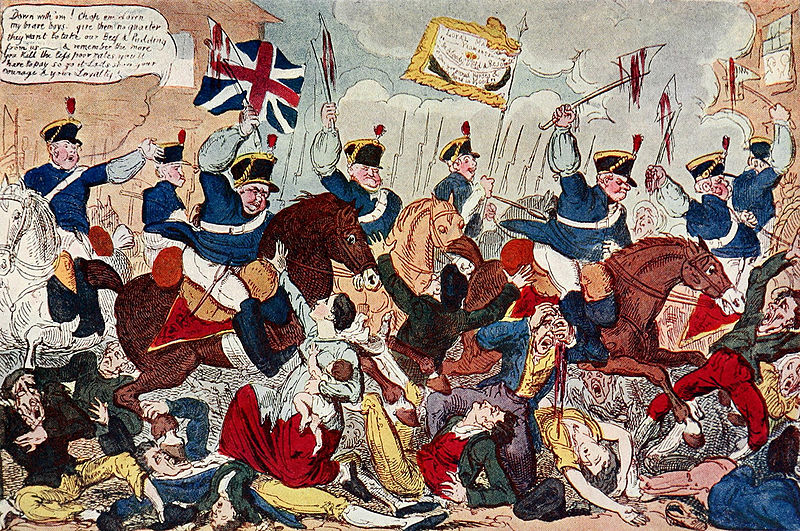
“We came closer to revolution post 1815 than at any time since the civil war of 1542.”
In 1938 the Scots Greys buried one of their own on Edinburgh’s Castle Esplanade. The hero they honoured, Ensign Charles Ewart, had distinguished himself at the Battle of Waterloo by capturing a regimental eagle from Napoleon’s 45e Régiment de Ligne.
Despite his fame and renown in the heady aftermath of victory, Ewart’s original grave in Greater Manchester was abandoned, all but forgotten, for the better part of a century. The neglect Ewart experience in death, was reflected in that of many of his comrades when they returned home to a regency Britain at war with itself.
Colin Brown was a lobby journalist for 30 years, first for The Guardian and then for The Independent, with a couple of years as the political editor of The Sunday Telegraph. Taking Wellington’s description of his own men – The Scum of the Earth – as his title, Brown tells the story of what happened to ordinary soldiers like Ewart after the initial flush of victory wore off.
The Scum of the Earth: What Happened to the Real British Heroes of Waterloo? (published by The History Press, May 2015) To find out more click here.
Was Britain on 19 June 1815 a land fit for heroes?
It was a country in turmoil – hundreds of thousands out of work from farms and factories, wages cut, the price of bread was increased by Act of Parliament, cottagers relying on subsistence farming were forced to leave the land by the Enclosure Acts, national debt increased to 230 per cent of GDP, and there was an economic slump. The Government reacted to the decisive defeat of Napoleon with austerity – the army was cut over five years from 233,000 in 1815 to 92,000, adding to the jobless seeking work. Eventually, the huge changes brought about the industrial revolution brought an economic boom to Britain, but that took another twenty years.
It’s the 200th anniversary of Waterloo. You’ve warned of the dangers of “an anniversary of misty-eyed backslapping”. Is that what has happened / is happening?
My book was criticised as “a left-wing whinge” on Amazon, which underlines the extent to which people want to read about the glory and the blood of the battle, not the uncomfortable truth.
Brits like to think of themselves as great at pomp and pageantry. Are they as good at commemoration vs. celebration?
The organisers of the national service of commemoration at St Paul’s warned guests it was “not triumphalist”. I think they got the balance right.
Which better defines the character and career of the Iron Duke, Waterloo or Peterloo?
Waterloo; he was undoubtedly a great commander at the peak of his ability at Waterloo. Wellington’s political stand was certainly a contributory factor to Peterloo – his fear of revolution; and his failure to respond to reasonable demands for political reform led to his own political defeat by forces which were unstoppable. But there were others to blame for the massacre, including a lack of a proper civil authority that knew how to handle peaceful demonstrations.
Why didn’t Britain experience the political upheavals that beset continental Europe in the decades after 1815?
We came closer to revolution post 1815 than at any time since the civil war of 1542. But repression worked. The Six Acts, including the ban on the press, the ban on meetings, and the suspension of Habeas Corpus, with the gallows or deportation to Australia for minor offences was enough to keep the lid on the seething discontent for nearly twenty years. In the end, the Government had to concede reform with the vote, however limited.
But I also believe the repression worked because it was coupled with a lack of revolutionary zeal among the British public. As I say in the chapter on the Cato Street conspiracy, any would-be revolutionary should study the Cato Street files in the National Archives: they include many anonymous tip-offs from the general public warning the authorities that revolutionaries are plotting an attack on the Cabinet.
Of all the individual stories you’ve uncovered researching The Scum of the Earth, which most shaped your thinking and conclusions?
Francis Stiles and the battle with his commanding officer, Alexander Kennedy Clark, over who captured the Eagle of the 105th Regiment (now in the National Army Museum, Chelsea). The Eagle itself is a moving symbol of war: men shed blood and died for possession of that gilded bird, on top of a black wooden pole. It symbolises the gore and the ‘glory’ of war – it represented regimental pride; it was a reason why the ordinary men stayed and fought, and did not run away. It also represented the grandiose ambitions of the Emperor Napoleon, who wanted his soldiers to be like the Roman legions that ruled the world. The struggle by Alexander Kennedy Clark to gain the credit for capturing it represented a very real battle of class – the ordinary trooper against the landed gentry.
What happened to Stiles was an object lesson in how the army brushed an awkward problem under the regimental carpet: Stiles was paid for his silence, then dumped: he was promoted to sergeant; then in 1816 – the same year that he wrote to an officer asking him to confirm that he, Stiles, not Alexander Kennedy Clark, had captured the Eagle – he was made an Ensign, almost doubling his pay from 2s 11d a day to 5s 3d a day but it was in the West India Regiment which was unpopular because it could mean serving in the West Indies with the risk of malaria and other diseases. On 28th December 1817, he was put on half pay 2s 71/2d a day and effectively discharged from the army. This seems to me to be a plan to silence Stiles. By 1817, nobody was interested in who captured the Eagle. Stiles died in poverty; Alexander Kennedy Clark became Queen Victoria’s ADC.
This story still rankles with some of the NCOs of the Household Cavalry. After reading my book, some members of the Blues and Royals – his regiment – arranged to have a plaque put up to Stiles at St John’s church, Clerkenwell, where he was buried. I am glad I found the painting The Captive Eagle to use for the front cover of my book. But why was the painting in Great Yarmouth Town Hall, and not the National Army Museum? Could it be that the Army still won’t give Stiles the credit?
What sort of places have you visited for the sake of your research, or was it all dusty libraries and the Public Records Office?
I make a point of travelling to key sites to get a sense of place. My aim is to write history like Bill Bryson writes travel books. I therefore went twice to the battlefield at Waterloo, particularly Hougoumont; Salford central rail station to see the car park where Ewart was buried; the back of the Radisson hotel, Manchester, to walk the place where John Lees was battered in the Peterloo Massacre; to Oldham to pace out the route Lees would have taken when he started the march to Manchester; Oldham parish church, where he was buried; Edinburgh to see the Ewart memorial and the Castle where the Ewart Eagle and painting are kept; Walmer Castle, Kent, to see the dining room, where Wellington regaled his guests with stories of the battle and its political aftermath (noted by Earl Stanhope for Notes of Conversations with the Duke of Wellington).
The dusty places were also fascinating – the Hartley Library containing the archive of Wellington’s papers at Southampton University allowed me to hold the letter he wrote in 1813 attacking the ‘scum of the earth’; Apsley House, London, the Duke’s home; and Chethams library in Manchester, for its unrivaled collection about Peterloo.
I also visited the National Army Museum, the Guards Museum and the Woolwich artillery museum. I was surprised to discover that regimental museums are not publicly funded, and heavily rely on amateur volunteers, which accounts for their patchy performance. For example, the Coldstream Guards had none of the archive material I uncovered on James Graham, the “hero” of Hougoumont. I think the big new discoveries in history could come with ordinary people researching the lives of their ancestors.
Do you think of Regency England as an enlightened or a primitive society? Are there social policy lessons we can learn from the period? For example, could there be a place for the “King’s Hard Bargain” as a response to modern social problems?
Wellington favoured conscription. It is hard to see how it would work in peacetime. There are superficial attractions to national service, including discipline and self-awareness, but there are disadvantages – I have seen both in countries where it is still in use, Greece and Cyprus. Wellington is right in one respect – it has to apply to everyone, low or high; it could not be seen as a national service for the ‘working classes’. Middle class kids would have to serve too, and would complain if their careers were put on hold.
A national service for the unemployed, or those facing prison would bring as many problems as it seeks to solve. I think the most important policy lesson from Waterloo is to know our past. Were the defeats of Napoleon, the Kaiser and Hitler allied victories or the triumph of an island warrior race that has been called upon three times to rescue Europe from tyranny? (See my earlier book, Glory and Bollocks). With the EU in-out referendum approaching, it could become more important.
200 years on, do we treat our veterans any better?
The public do – the armed forces chiefs don’t seem to have changed in their attitude to the expendability of since Waterloo. They are imbued with the “can do” attitude, which can be lethal for their men and women. Two examples: before the Iraq war I asked Geoff Hoon, Defence Secretary, whether a) the troops had radios that worked (there was doubt) and b) the equipment they needed. He said he had been assured by the chiefs they had on both counts.
Five red caps died in an ambush because they did not have radios that worked. Men were sent on patrol in ‘snatch squad’ Land Rovers designed for Northern Ireland. As a result, men needlessly died from IEDs or were maimed and are now limbless ex-servicemen having to cope with life on charity and a pension. The chiefs are too inclined to say they “can do”, without saying, ‘actually, what you are asking the men to do is ridiculous. We could save lives by adopting a different strategy.’
For example, what was the point in defending Helmand Province in a hostile environment in the Taliban stronghold in Afghanistan? I sat through debates in the Commons when it was argued that going into Helmand was futile and likely to lead to more casualties. Bush and Blair disagreed, and the army chiefs said: ‘can do’. Now we have surrendered that land to the Taliban… for what?
What should be playing on the stereo when we’re reading The Scum of the Earth?
Never Mind the Bollocks, Sex Pistols (Anarchy in the UK).
LIKE WHAT YOU JUST READ? FOLLOW US ON TWITTER! FIND US ON FACEBOOK! OR SIGN UP TO OUR MAILING LIST!
“Beware the London establishment trying to bring you to heel with honours, flattery and peerages; that’s what they tried with Campbell.”
In May 1808 the son of a Glaswegian cabinet-maker was commissioned an ensign in the 9th Foot (without purchase). That August he saw his first action at the Battle of Vimeiro. The military career of Colin Campbell, later 1st Baron Clyde, would include The Peninsular War, The War of 1812, The First Opium War, The Second Anglo-Sikh War, and The Crimean War. His “Thin Red Line” won immortality at the Battle of Balaclava.
Campbell, in contradiction of many assumptions about class and the British Army in the 19th Century, ended his career as a Field Marshall. When he received an honorary degree from Oxford University, it was in the company of Isambard Kingdom Brunel and Dr. David Livingstone. He is buried in Westminster Abbey. A statue of Campbell (by John Foley) stands in Glasgow’s George Square. A complex, mercurial man, loved by his troops and admired by Queen Victoria, he’s been called Britain’s first ‘working-class’ field marshal.
Adrian Greenwood, Campbell’s most recent biographer, read Philosophy, Politics and Economics at Christ Church, Oxford before taking an MBA at Imperial College. After university he started buying British Rail lost property at auction and selling it at car boot sales around London. From there he moved on to antiques, and eventually specialised in antiquarian books. Having supplied items to a broad range of clients – including the British Library and the Getty Museum – Adrian retired to concentrate on his writing.
Victoria’s Scottish Lion: The Life of Colin Campbell, Lord Clyde (published by the History Press, July 28th). To find out more visit: www.adriangreenwoodbooks.co.uk
Why Campbell?
I first came across him 25 years ago when I was doing History ‘A’ Level – I couldn’t understand why he wasn’t more famous. Over the years I kept seeing his name in books on the Victorian army, by historians like Trevor Royle and Saul David, and he seemed by far the most brilliant general of his age, yet no one had looked at his career thoroughly for a century or more. Then, as I found out more about him, the idea of writing the story of this working class maverick, riling the Victorian establishment, became irresistible. As one reader said to me, ‘You wonder why you haven’t heard of this man before.’
What accounts for Campbell’s rise through the ranks?
Well, back in the Peninsular War it wasn’t quite as hard to get promotion as Sharpe would have you believe. Campbell got his first commission for free because there was such a demand for new officers. He was promoted lieutenant because the officers above him got shot or died of disease, then he was made captain for leading a ‘forlorn hope’ at San Sebastian – that’s when a young officer leads a detachment to storm a town’s defenses. In that assault he was hit twice by musket balls but won his captaincy.
In peacetime it was much harder to rise up the ranks but Campbell managed to borrow the money to become major and then lieutenant-colonel. After that, even in the 19th century, promotion was by seniority and merit – you couldn’t buy a rank higher than lieutenant-colonel, you had to wait until the old buffers further up died off. After a long pause stuck as a colonel, he raced through the general ranks during the Crimean War (1854-56) and the Indian Mutiny (1857-1858).
Was there a particular battle, or other event, which shaped Campbell more than any other?
Difficult to pin down one, but his very first battle, Vimeiro in 1808, had a big effect. Campbell described how a captain led him by the hand up to the front while the French shot and shell thundered overhead. He was only fifteen. After that he was fearless – Queen Victoria used to tick him off for rushing into action, sword in hand, in his sixties, when he was supposed to be supervising the battle.
His other formative experience, what made him a ‘soldiers general’ (one who always looked after the men) was seeing the losses on the terrible retreat to Corunna through the Galician mountains in 1809.
What did Disraeli mean when he said that Campbell had, “only one fault – a courage too reckless for his country”?
Purple prose on Dizzy’s part, to play up to the mob, I think. He definitely wasn’t referring to rashness in strategic terms – if anything Campbell was criticized for being too cautious. Either he was referring to Campbell’s personal courage, his tendency to rush in where the fighting was thickest, or his habit of speaking his mind and rubbing people up the wrong way.
Campbell served in a time when Scotland was largely imperialist and unionist. What lessons, if any, can modern Scots draw from such ancient history?
What a disproportionately large contribution Scots made to the British army, in terms of officers and men, and to world history. Second, beware the London establishment trying to bring you to heel with honours, flattery and peerages; that’s what they tried with Campbell. Third, the Devils in Skirts still scare the bejesus out of the natives.
What has been the reaction so far from other scholars of the period?
Very positive, although at the time of writing it’s not out yet, nor are the reviews. There has been a distinct air of expectancy from a lot of academics in this field.
What’s the single best fact you’ve learned from your research into Campbell’s life and times?
From a historical perspective, whole chunks of his career – like his time in the Caribbean – were previously unreported and unstudied, but if you want a single anecdote, it was Campbell’s reaction when the 1,200 civilians he was evacuating from Lucknow, in the face of 50,000 rebels, tried to take their furniture with them. A vicar’s wife strapped a harmonium to a camel to get it out of town. When one man tried to take a ‘large, circular drawing room table’, Campbell lost his temper and ordered it left by the roadside.
Why did Campbell change his name (he was born Colin Macliver)?
That’s still opaque. It wasn’t, as usually claimed, because when his uncle, Colonel Campbell, presented him at Horse Guards, the Commander-in-Chief (the Duke of York) assumed he had the same name and no-one dared correct him. Actually, Colin started using the name Campbell before that, when his uncle took over his education and sent him to school in Gosport in his early teens. One newspaper suggested Colin was really his uncle’s son, but that seems far-fetched – he would not only have been illegitimate but the result of an incestuous affair between a brother and sister.
His mother and uncle’s family, though poor, was descended from the Dukes of Argyll, so for them the Campbell name was extremely important. Maybe his uncle, in virtually adopting him, insisted he use the name. It’s still a puzzle.
As a book dealer you sold some ultra-rare J.K. Rowling 1st and special editions. Will these really hold their value as well as a signed 1st edition by P.G. Wodehouse or a 1st French edition of Verne’s Around the World in 80 Days?
Excellent question. I remember when someone told me a Harry Potter had sold for £1,000 at auction (this was in the late 1990s), I couldn’t believe a modern children’s book could make that much, yet this June Sotheby’s sold one for £25,000. The first hardback edition of the first Harry Potter is genuinely scarce – there are probably no more than 50 really good copies.
Rowling’s place in children’s literature is well and truly cemented so they should hold their price, but they haven’t gone up as much in the last seven or eight years as other modern first editions. That’s partly because the films have come to a close and that’s a big factor.
If my customers asked whether a specific book would be a good investment I used to tell them to try the stock market instead, but if you want a ‘blue chip’ book to buy, go for Bond. They have been performing well for forty years, and they get a fillip every time a new film appears.
What should be playing on the stereo when we’re reading Victoria’s Scottish Lion?
For the action bits ‘The Campbells are Coming!’ or the ‘Thin Red Line March’. Half the book’s about India and I played quite a lot of Ravi Shankar while writing it.
LIKE WHAT YOU JUST READ? FOLLOW US ON TWITTER! FIND US ON FACEBOOK! OR SIGN UP TO OUR MAILING LIST!
You must be logged in to post a comment.